1. Introduction
Financial stability research has progressively highlighted the influence of non-bank financial institutions in the propagation of systemic risk (
Croicu et al., 2023), even though the overwhelming majority of studies in this field have traditionally concentrated on the banking sector (
Bengtsson, 2013).
Over the past two decades, the rapid expansion of market-based finance has shifted a substantial share of financial intermediation outside the traditional banking sector, giving rise to a complex ecosystem commonly referred to as shadow banking (
Doruk & Önal, 2026). Shadow banking refers to credit intermediation that occurs beyond the conventional regulatory safety framework and typically lacks regular access to central bank lender-of-last-resort support, while still engaging in activities such as maturity transformation, liquidity provision, and the use of leverage (
Pan et al., 2026). These institutions—such as asset managers, broker–dealers, and specialized financial intermediaries—play an essential role in capital markets but are typically subject to lighter regulatory oversight and rely more heavily on market funding structures (
Calmés & Théoret, 2011;
Farid, 2012).
Unlike traditional banking institutions, which operate under prudential regulation and deposit insurance frameworks, shadow banking entities function outside the conventional regulatory perimeter while still engaging in credit intermediation activities. This structural distinction has been widely emphasized in the macroprudential literature (
Financial Stability Board, 2020,
2022,
2025) and has important implications for systemic risk, as non-bank financial intermediaries rely more heavily on market-based funding and are therefore more exposed to liquidity shocks and pro-cyclical dynamics (
Adrian & Ashcraft, 2016). This difference motivates the focus of the present study on shadow banking institutions.
The expansion of shadow banking presents a dual effect. On one side, by complementing the traditional financial system (
Irani et al., 2021), it helps compensate for limitations in conventional bank lending and supports activity in the real economy (
Chen et al., 2020). On the other side, shadow banking often operates across institutions, markets, and asset classes, creating opportunities to bypass regulatory oversight and obscure risk exposures, which can intensify the buildup and transmission of financial vulnerabilities (
S. Zhang et al., 2026).
As a result, concerns have emerged that shadow banking may amplify financial cycles and contribute to systemic instability, particularly during periods of rapid asset price appreciation and subsequent market corrections (
Adrian & Ashcraft, 2016;
Moreira & Savov, 2017;
Meeks et al., 2017;
Buchak et al., 2018;
Arora & Kashiramka, 2023;
Rottner, 2023;
Croicu & Călin, 2024). Building on this perspective, the very intermediation mechanisms that expand banks’ access to funding simultaneously create stronger connections between shadow institutions and regulated banks, enabling shocks to transmit quickly into the traditional banking sector (
Yang et al., 2019). Shadow banking activity expands financing opportunities for projects characterized by elevated risk and potential returns, yet it simultaneously contributes to the buildup of vulnerabilities and broader financial instability (
Ouyang & Wang, 2022). These dynamics are also cyclical: risk-taking within the shadow banking sector reacts strongly to macroeconomic conditions. When economic uncertainty increases, speculative activity and informational opacity tend to rise, making risk evaluation more difficult and increasing the probability that shadow banking acts as a catalyst for systemic disruptions (
Pan et al., 2026). Recent studies indicate that leverage dynamics and the buildup of endogenous risk are progressively driven by balance sheet adjustments within non-bank financial intermediaries and shifts in investor demand, rather than solely by borrower fundamentals (
Yoshimori, 2026), a concern also highlighted by policy institutions that emphasize the expanding systemic role of non-bank credit intermediation (
Financial Stability Board, 2024).
Against this backdrop, speculative bubbles represent one of the most prominent mechanisms through which financial vulnerabilities may accumulate within such market-based financial systems (
Brunnermeier & Oehmke, 2013;
Caraiani & Călin, 2019;
André et al., 2022;
Caraiani & Călin, 2024;
Lupu et al., 2024). The extensive literature documents that prolonged periods of rising asset prices can generate excessive leverage, risk-taking, and mispricing, ultimately increasing the fragility of financial institutions and markets (
Jordà et al., 2015;
Lupu et al., 2025). However, identifying the systemic implications of bubbles in real time remains challenging. System-wide events are inherently challenging to predict (
IMF, 2010), and the propagation of systemic risk would weaken the functioning of the entire financial system, including the real economy. Supervisory authorities worldwide have likewise been grappling with how to track and quantify systemic risk. Consequently, an expanding body of research concentrates on its assessment, with the goal of delivering early warning indicators of deteriorating economic conditions (
Li & Qian, 2026). Nonetheless, due to the endogenous and multifaceted character of systemic risk, its quantification remains challenging (
Caporin et al., 2022), and numerous indicators of systemic risk do not exhibit a strong statistical linkage with macroeconomic downside risk when assessed in isolation (
Giglio et al., 2016).
Conventional systemic risk measures are largely based on tail risk statistics derived from historical return distributions, which may lead them to understate vulnerabilities during prolonged market expansions (
Acharya et al., 2012;
Adrian & Brunnermeier, 2016;
Acharya et al., 2017). This raises an important question for financial stability monitoring: do speculative bubbles in shadow banking institutions signal the buildup of systemic vulnerabilities before traditional systemic risk metrics detect them?
These approaches have proven valuable in identifying systemically important institutions during crisis periods; however, their reliance on realized distress episodes raises concerns about their effectiveness as early warning indicators during tranquil or expansionary phases (
Nucera et al., 2016).
Separately, a growing body of research has developed sophisticated econometric methodologies for the detection of speculative bubbles in asset prices. Following the seminal contributions of
Phillips and Yu (
2011) and
Phillips et al. (
2015), an extensive literature has emerged documenting the prevalence of such phenomena across equity, housing, and commodity markets. Notable contributions in this strand of research include
Pavlidis et al. (
2016),
Hu and Oxley (
2017),
Yao et al. (
2023),
X. Zhang et al. (
2024),
Manian and Kayal (
2025),
Lupu et al. (
2025),
Escobari and Sharma (
2026), and
Vriz and Grossi (
2026), among others.
However, these two strands of the literature—systemic risk measurement and bubble detection—have seldom been integrated within a unified empirical framework, particularly in the context of shadow banking institutions. A recent contribution addressing this gap is
Lupu et al. (
2026), who combine bubble detection techniques with systemic risk indicators, providing empirical evidence based on equity markets in an emerging economy.
Our study bridges this gap by examining whether speculative bubbles in shadow banking firms are systematically associated with changes in their systemic risk profiles. We test whether bubble episodes obscure the buildup of systemic vulnerabilities through pro-cyclical dynamics in standard risk measures, and whether bubble collapses trigger acute systemic stress transmission. In doing so, we contribute to the broader debate on whether existing systemic risk monitoring frameworks adequately capture the cyclical accumulation of financial fragility (
Borio, 2014).
Our empirical strategy combines the Backward Supremum Augmented Dickey–Fuller (BSADF) bubble detection test (
Phillips et al., 2015) with a comprehensive battery of systemic risk measures including market beta, Value at Risk (VaR), Expected Shortfall (ES), CoVaR, ΔCoVaR, and MES (
Adrian & Brunnermeier, 2016;
Acharya et al., 2017). We construct a novel dataset of 17 U.S. shadow banking firms listed in the S&P 500, identified through industry classification and balance sheet screening based on leverage and debt funding ratios, spanning the period from January 2010 to February 2026. This sample includes asset managers, broker–dealers, derivatives exchanges, and specialized non-bank financial intermediaries—institutions central to market-based finance yet subject to less stringent prudential regulation than traditional banks.
Our analysis proceeds in four stages. First, we characterize the incidence, duration, and temporal clustering of bubble episodes across shadow banking firms. Second, we compare systemic risk measures during bubble periods versus normal periods to test for pro-cyclical measurement bias. Third, we examine risk dynamics during bubble burst windows to assess whether latent vulnerabilities materialize as acute systemic spillovers. Finally, we employ panel regression analysis with firm and time fixed effects to establish the statistical robustness of our findings and test for heterogeneity across firms and sub-periods.
Our results indicate that speculative bubbles are a recurrent feature of shadow banking firms and are strongly associated with changes in their systemic risk profiles. In particular, systemic risk indicators tend to decline during bubble buildup phases but increase sharply when bubbles collapse, suggesting that conventional measures may underestimate vulnerabilities during expansionary periods.
This paper contributes to the literature on systemic risk and shadow banking in several important ways.
First, we provide new evidence on the prevalence and persistence of speculative bubbles in publicly listed shadow banking institutions. Applying the Phillips–Shi–Yu BSADF bubble detection methodology to daily equity prices of 17 U.S. shadow banking firms between 2010 and 2026, we document frequent and often prolonged episodes of explosive price dynamics. Bubble incidence exhibits substantial cross-sectional heterogeneity and strong temporal clustering, with synchronization reaching unprecedented levels during the COVID-19-era monetary expansion. These findings highlight that speculative dynamics are a recurring feature of market-based financial intermediation rather than isolated anomalies.
Second, the paper identifies a systematic pro-cyclical bias in widely used systemic risk measures. We show that, during bubble periods, firms exhibit higher market exposure and greater tail risk, yet commonly used systemic risk indicators such as ΔCoVaR and Marginal Expected Shortfall decline. This paradox arises because these measures are conditioned on realized distress events, which become rare during prolonged market expansions. As a result, conventional systemic risk metrics may signal declining systemic importance precisely when financial vulnerabilities are accumulating.
Third, we demonstrate that speculative bubbles create latent systemic fragilities that materialize abruptly once bubble dynamics collapse. Using burst-event windows and event-study analysis, we show that systemic risk measures increase sharply during bubble bursts, with ΔCoVaR and MES rising significantly relative to normal periods. These findings suggest that systemic risk measures primarily capture the materialization of financial stress rather than its buildup, implying that they function more as indicators of realized contagion than as early warning signals.
Finally, by integrating bubble detection techniques with market-based systemic risk measures within a unified empirical framework, this paper provides a new perspective on the interaction between speculative dynamics and financial stability. Our results suggest that monitoring speculative bubbles in shadow banking institutions may offer valuable information about the accumulation of systemic vulnerabilities that conventional risk metrics fail to detect during expansion phases.
The remainder of the paper is organized as follows.
Section 2 describes the data, sample construction, and empirical methodology, including the bubble detection procedure, systemic risk measures, and the empirical strategy used in the analysis.
Section 3 presents the empirical results. We first document the incidence and characteristics of speculative bubbles in shadow banking firms, then examine the behavior of systemic risk measures during bubble and burst periods, and finally report panel regression evidence and robustness checks.
Section 4 concludes with a discussion of the main findings and their implications for systemic risk monitoring in shadow banking.
2. Data and Methodology
2.1. Sample Construction
The sample of shadow banking institutions is constructed using a transparent, multi-step selection procedure grounded in both industry classification standards and the academic literature on non-bank financial intermediation. We begin with constituents of the S&P 500 Index, with index membership frozen at a fixed reference date to ensure methodological consistency and avoid survivorship bias. Within this universe, firms are identified in the GICS Financials sector, specifically focusing on Financial Services sub-industries, as classified by the data provider, ensuring consistency with widely used market-based classifications. In line with the shadow banking literature, we define shadow banking institutions as non-bank financial intermediaries engaged in credit intermediation activities outside the traditional banking system, and we explicitly exclude regulated deposit-taking institutions (commercial banks) and insurance companies. Finally, we retain only firms with sufficient and consistent financial data availability over the sample period, resulting in a final sample of 17 publicly listed U.S.-based institutions.
The selection procedure combines industry classification with balance sheet screening. Building on the GICS-based filtering described above, we further exclude real estate investment trusts (REITs) due to their distinct regulatory environment and funding models.
The analysis focuses on Financial Services sub-industries associated with capital market intermediation and non-bank credit provision. Firms classified within Asset Management and Custody Banks, Consumer Finance, Diversified Financial Services, Investment Banking and Brokerage, and Financial Exchanges and Data are retained to capture asset managers, broker–dealers, derivatives exchanges, and specialized financial intermediaries operating within market-based finance ecosystems.
Firm-level accounting data obtained from Refinitiv Workspace are used to construct balance sheet indicators. Financial leverage is measured as Total Assets divided by Total Equity, while reliance on debt funding is proxied by the Total Debt-to-Total Assets ratio.
A Shadow Banking Score ranging from zero to two is constructed by assigning one point when the Assets-to-Equity ratio exceeds five and an additional point when the Debt-to-Assets ratio exceeds thirty-five percent. Firms obtaining a score of at least one are classified as shadow banking institutions. Observations lacking sufficient accounting information for ratio construction are excluded.
Daily closing prices are extracted from Refinitiv Workspace and aligned to the trading calendar of the S&P 500 index. Missing observations generated by non-synchronous trading days are forward-filled using the most recent available price.
To maintain a balanced long-horizon panel, companies whose initial public offerings occurred after the start of the sample period are excluded. This restriction prevents distortions associated with truncated historical series and ensures comparability across firms throughout the analysis window.
The final dataset covers 17 shadow banking firms from 1 January 2010 to 2 February 2026, yielding 4195 daily observations per firm. The sample period (2010–2026) is chosen to capture a macro-financial environment characterized by significant structural shifts in global financial markets. In particular, the period follows the global financial crisis and includes prolonged phases of accommodative monetary policy, notably quantitative easing, which contributed to elevated liquidity conditions and increased risk-taking. It also encompasses the COVID-19 pandemic and its aftermath, a period marked by sharp market disruptions followed by substantial policy support. These conditions are especially relevant for the analysis of shadow banking, as they may amplify leverage cycles, asset price misalignments, and the propagation of systemic risk.
2.2. Bubble Detection Methodology
We employ the Backward Supremum Augmented Dickey–Fuller (BSADF) test developed by
Phillips et al. (
2015) to identify speculative bubbles in shadow banking firm prices. The BSADF procedure detects explosive price dynamics characteristic of asset price bubbles and provides precise dating of bubble origination and collapse.
The test operates as a recursive right-tailed unit root test. For a price series
, we compute log prices
. At each evaluation point
in the sample, the test computes the supremum of augmented Dickey–Fuller statistics across all feasible starting points
within the window
, where
is the minimum window size. The BSADF statistic is defined as:
where the ADF statistic for each window is computed as:
and
is the autoregressive coefficient estimated from the regression
over the subsample from
to
.
We implement the BSADF test with a minimum window size of 60 observations and conduct inference at the 5% significance level. Critical values are obtained through 2000 Monte Carlo simulations under the null hypothesis of a unit root process. The procedure yields a binary time-series indicator for each firm i:
where
is the 95th percentile critical value from the Monte Carlo distribution.
A bubble burst occurs when the indicator transitions from one to zero, signaling the collapse of explosive price behavior. We define burst windows as the burst day plus the subsequent five trading days to capture immediate spillover effects:
2.3. Systemic Risk Measures
We employ six complementary measures to characterize firms’ contributions to financial system risk. All measures are computed using 252-trading-day rolling windows to accommodate time variation in risk dynamics. Let denote the daily return of firm i at time t, and denote the market return proxied by the S&P 500.
2.3.1. Market Beta
Market beta quantifies a firm’s systematic risk exposure:
Operationally, we estimate beta as the slope coefficient from the regression:
estimated over each 252-day rolling window. Beta greater than one indicates the firm amplifies market movements, while beta less than one indicates dampening.
2.3.2. Value at Risk (VaR)
VaR quantifies the maximum expected loss at a specified confidence level. We compute VaR at the 5% quantile using historical simulation:
where
denotes the 5th percentile of the empirical return distribution over the rolling 252-day window. VaR is reported as a positive number representing the loss threshold exceeded on only the worst 5% of days.
2.3.3. Expected Shortfall (ES)
Expected Shortfall measures the expected loss conditional on exceeding VaR:
Operationally, ES is computed as the average of returns falling below the VaR threshold:
where the tail is defined as
and
is the number of observations in the left tail.
2.3.4. Conditional Value at Risk (CoVaR)
We estimate CoVaR via quantile regression. Specifically, for each firm–date combination, we estimate:
where the coefficients
are estimated at the 5th quantile using Gaussian kernel quantile regression over the 252-day rolling window. CoVaR is then computed as:
This represents the predicted 5th percentile of market returns when firm is at its own VaR threshold.
2.3.5. Delta Conditional Value at Risk (ΔCoVaR)
ΔCoVaR isolates a firm’s marginal contribution to systemic risk by comparing system VaR under firm distress versus normal conditions:
The distress state conditions on
, while the normal state conditions on
. Operationally:
Higher ΔCoVaR indicates greater systemic importance—when the firm experiences stress, system-wide tail risk increases substantially.
2.3.6. Marginal Expected Shortfall (MES)
MES quantifies a firm’s expected loss when the market experiences severe stress:
Operationally, MES is computed as the average return of firm
on days when the market return falls below its 5th percentile:
where the market tail is defined as
and
is the number of days the market is in its left tail within the rolling window. MES captures vulnerability to systemic tail events.
2.4. Empirical Strategy
Our empirical analysis proceeds through four sequential stages designed to test whether speculative bubbles in shadow banking firms create and subsequently materialize systemic risk.
Stage 1: Bubble Characterization
We document the incidence, frequency, and duration of speculative bubbles across the 17 shadow banking firms. For each firm , we calculate:
Average duration:
where
is the total number of trading days. This stage establishes baseline facts about bubble prevalence and temporal clustering.
Stage 2: Systemic Risk Dynamics
We examine time-series properties of all six risk measures. For each measure , we compute summary statistics across the full sample: we focus on the mean, standard deviation, skewness, and kurtosis for our sample N = 17 firms × 4195 days resulting in firm–day observations.
Stage 3: Conditional Analysis
We implement our primary test by comparing risk measures across three mutually exclusive states. Define state indicators:
For each risk measure and each state
, we compute conditional means:
We test for significant differences using two-sample
-tests:
and similarly for Burst versus Normal comparisons. Rejection of the null hypothesis
indicates risk measures differ systematically across states.
Stage 4: Panel Regression Analysis
To establish causal inference and control for confounding factors, we estimate fixed-effects panel regressions:
where:
is the dependent variable;
captures the effect of bubble periods on systemic risk;
captures the effect of burst events;
tests whether market exposure amplifies bubble effects;
includes controls: lagged Beta, lagged VaR;
are firm fixed effects (17 dummies);
are time fixed effects (4195 dummies);
is the error term.
Standard errors are double-clustered by firm and date to account for serial correlation within firms and cross-sectional correlation across firms on common dates. This four-stage approach progressively builds evidence from descriptive characterization through hypothesis testing to causal inference.
2.5. Robustness Analysis
We conduct two sets of robustness checks to verify the stability of our main findings. First, we perform sub-period analysis by partitioning the sample into four distinct macroeconomic regimes: (1) 2010–2019 (pre-COVID-19 expansion), (2) 2020 (COVID-19 crisis), (3) 2021–2022 (recovery and monetary tightening), and (4) 2023–2026 (recent period including March 2023 banking stress). For each sub-period, we re-estimate the conditional analysis from Stage 3, comparing risk measures across Normal, Bubble, and Burst states. This tests whether the bubble–risk nexus is consistent across different market environments or amplifies during specific episodes of financial stress.
Second, we verify consistency across alternative risk measures by estimating separate panel regressions for each of our six systemic risk measures (Beta, VaR, ES, CoVaR, ΔCoVaR, MES) as dependent variables. The baseline specification includes only bubble and burst indicators with firm and time fixed effects. This ensures our findings are not artifacts of a particular risk measurement methodology but represent a general pattern detectable across diverse systemic risk concepts—from basic market exposure (Beta) through tail risk measures (VaR, ES) to sophisticated systemic contribution metrics (CoVaR, ΔCoVaR, MES).
3. Results
3.1. Bubble Detection and Characterization
Table 1 presents bubble statistics for the 17 shadow banking firms over the January 2010 to February 2026 period. We identify substantial heterogeneity in bubble exposure across firms, revealing three distinct clusters of bubble propensity.
High-bubble firms (>35% of time in bubbles) include MSCI.N, AXON.OQ, KDP.OQ, EW.N, LOW.N, LRCX.OQ, and DECK.N. The most bubble-prone firm, MSCI.N, spends fully half the sample period (50.0%) in bubble states across 14 distinct episodes. Notably, MSCI.N exhibits an extraordinarily persistent bubble episode lasting 1618 consecutive trading days—approximately 6.4 years—suggesting prolonged periods of explosive price growth in the asset management and financial data sector. AXON.OQ similarly demonstrates extreme bubble prevalence (49.0%) with prolonged episodes averaging 187 days, including one episode extending 841 days. These technology-oriented financial services firms appear particularly susceptible to speculative dynamics, potentially reflecting investor enthusiasm for fintech innovation and digital transformation in finance.
Moderate-bubble firms (15–35% of time) comprise CME.OQ, ALGN.OQ, TECH.OQ, CHD.N, and C.N. This group exhibits substantial variation in episode structure. CME.OQ (derivatives exchange) experiences relatively infrequent bubbles (10 episodes over 16 years) but with extended durations averaging 124 days, including one 871-day episode coinciding with the 2020–2023 derivatives trading boom. In contrast, C.N (major diversified financial) shows frequent but short-lived episodes—17 bubbles averaging only 41 days each—suggesting rapid formation and collapse cycles potentially linked to quarterly earnings announcements or regulatory news flows in the banking sector.
Low-bubble firms (<15% of time) include INCY.OQ, STT.N, MOS.N, CNP.N, and BEN.N. The most stable firm, BEN.N (Franklin Resources), exhibits bubbles only 3.8% of the time across just four episodes averaging 40 days. This relative stability likely reflects the firm’s traditional asset management business model with steady fee-based revenues less susceptible to speculative investor sentiment. Similarly, CNP.N and MOS.N demonstrate limited bubble exposure (4.7% and 7.8% respectively), suggesting certain shadow banking business lines—such as utilities finance and agricultural credit—exhibit fundamentals-driven pricing less prone to explosive dynamics.
The cross-sectional distribution reveals systematic patterns. Technology-enabled financial services (MSCI.N, AXON.OQ, LRCX.OQ) and consumer-facing platforms (KDP.OQ, DECK.N, LOW.N) dominate the high-bubble cluster, while traditional asset managers and specialized credit providers populate the low-bubble tier. This suggests bubble formation in shadow banking concentrates in firms exposed to technological disruption narratives and retail investor participation, echoing broader patterns documented in equity markets where growth stories and accessibility drive speculative episodes.
The average episode duration across all firms is 107 days (approximately 5 months), but with enormous variation—the longest episode (MSCI.N: 1618 days) is 188 times longer than the shortest median duration (MOS.N: 27 days). This heterogeneity underscores the importance of firm-level analysis rather than sector-wide generalizations about shadow banking bubble dynamics.
At this point we notice that shadow banking firms exhibit frequent and prolonged speculative bubbles, with substantial heterogeneity across firms. Technology-oriented financial services and consumer platforms demonstrate extreme bubble propensity (up to 50% of the time), while traditional credit providers remain relatively stable. The longest bubble episodes extend beyond six years, indicating persistent mispricing rather than brief speculative frenzies.
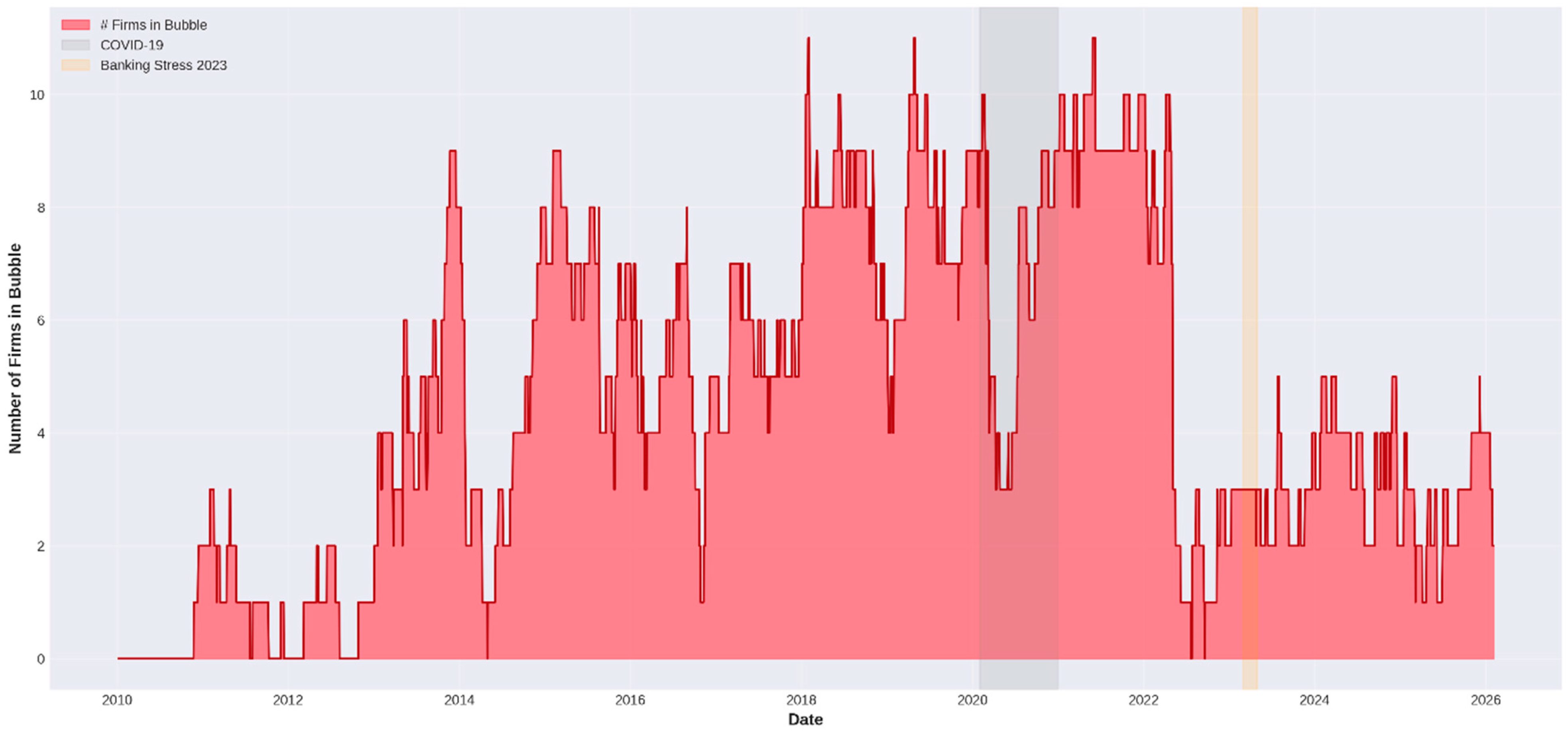
Figure 1 displays the temporal distribution of bubble episodes across all 17 shadow banking firms, measured as the daily count of firms simultaneously experiencing explosive price dynamics. The timeline reveals pronounced clustering of bubbles into distinct phases separated by sharp collapse episodes, with systematic intensification following major financial stress events.
The sample begins with minimal bubble activity in 2010–2011, reflecting the cautious post-financial crisis environment where shadow banking firms traded near fundamental values amid heightened regulatory scrutiny and subdued risk appetite. Bubble formation accelerates in 2012–2013, reaching an initial peak of 6–9 firms in mid-2014 during the quantitative easing expansion and “taper tantrum” period. This cluster coincides with Federal Reserve forward guidance creating predictable liquidity conditions conducive to speculative positioning.
A second major bubble wave emerges in 2015–2017, with 7–8 firms persistently in bubble states throughout this period. This sustained elevation corresponds to the post-2015 fintech boom and passive investing surge, both disproportionately affecting shadow banking firms through increased retail participation and momentum-driven capital flows. The cluster persists through early 2018 before partially unwinding during the late-2018 market correction.
The most dramatic pattern centers on the COVID-19 pandemic and its aftermath. The gray-shaded COVID-19 period (February–December 2020) witnesses a sharp initial collapse—bubble prevalence drops to near-zero in March 2020 as financial markets seized up—followed by explosive reformation. By late 2020, bubble prevalence reaches unprecedented levels of 11–12 firms simultaneously (65–70% of the sample), sustained through mid-2022. This represents the most extreme synchronization of speculative episodes in our entire sample period. The pattern reflects the confluence of unprecedented monetary accommodation, zero interest rates, fiscal stimulus driving retail trading activity, and pandemic-accelerated digitalization benefiting fintech and electronic trading platforms.
The post-2022 period shows partial normalization as monetary tightening commences, with bubble prevalence declining to 7–9 firms by early 2023. However, the March 2023 banking stress episode (orange-shaded region) triggers renewed volatility. Notably, bubble prevalence does not collapse during this banking crisis as it did in March 2020, instead remaining elevated at 5–7 firms. This differential response suggests shadow banking bubbles during 2023 reflected a perceived safe-haven status or regulatory arbitrage advantages relative to troubled traditional banks (SVB, Signature, First Republic), rather than synchronized exuberance as in 2020–2021.
The most recent period (2024–2026) exhibits moderate bubble activity fluctuating between two and five firms, well below the 2020–2022 peak but elevated relative to the 2010–2015 baseline. This suggests a structurally higher post-pandemic equilibrium for speculative dynamics in shadow banking, potentially reflecting permanent shifts in market structure (retail participation, passive flows, algorithmic trading) rather than temporary monetary distortions.
Temporal clustering analysis: We observe three distinct high-bubble regimes—2014–2015 (early QE), 2016–2018 (fintech boom), and 2020–2022 (COVID-19/stimulus)—separated by sharp correction phases. The transitions are asymmetric: bubble buildup occurs gradually over 12–18 months, while collapses are abrupt (1–3 months). This sawtooth pattern is characteristic of rational bubble models where gradual optimism accumulation punctuates with sudden crashes when fundamentals reassert.
Crisis episode comparison: The figure highlights contrasting dynamics during major stress events. The 2020 COVID-19 shock triggered a complete bubble collapse followed by extreme reformation, suggesting the initial flight-to-quality reversed dramatically once policy support materialized. In contrast, the 2023 banking stress did not disrupt existing bubbles, potentially because shadow banking was perceived as structurally advantaged during a traditional banking crisis. This distinction has important policy implications: shadow banking bubbles may amplify differently depending on whether stress originates within or outside the shadow banking sector.
These findings, combined with the previous from
Table 1, show that bubble episodes exhibit pronounced temporal clustering, with periods of synchronized formation (2020–2022: up to 12 firms simultaneously) separated by sharp collapse phases. COVID-19-era monetary accommodation produced unprecedented bubble synchronization affecting 70% of shadow banking firms, substantially exceeding pre-pandemic norms. Bubble prevalence remains structurally elevated in 2024–2026 relative to the 2010–2015 baseline, suggesting persistent post-pandemic changes in shadow banking market dynamics.
3.2. The Pro-Cyclical Puzzle: Risk During Bubbles
Table 2 reports descriptive statistics for the six systemic risk measures across the full sample of 71,315 firm–day observations. The distributional properties reveal substantial time variation in all risk metrics and pronounced positive skewness, indicating episodic spikes consistent with crisis-driven dynamics.
Market exposure (Beta) averages 1.09 with a median of 1.06, indicating shadow banking firms slightly amplify broad market movements. The standard deviation of 0.53 represents nearly 50% of the mean, demonstrating considerable variation in systematic risk exposure over time. Extreme values range from −4.93 (firm moves opposite to the market during distressed episodes) to 11.22 (extraordinary co-movement), with positive skewness (0.62) and excess kurtosis (4.41) confirming fat right tails. This distribution suggests beta is generally stable near one but exhibits occasional sharp increases during synchronized stress periods when correlations spike.
Value at Risk (VaR) at the 5% level averages 3.02% with a median of 2.76%, indicating the typical shadow banking firm loses at least 3% on its worst 5% of days. The range extends from 1.33% (low-volatility firms in calm periods) to 27.32% (extreme tail risk during crashes), with substantial positive skewness (3.01) and kurtosis (22.33) reflecting episodic tail events far exceeding normal distributional predictions. The coefficient of variation (41%) indicates VaR exhibits meaningful time-series fluctuation but less volatility than beta, suggesting tail thresholds are somewhat more stable than linear co-movements.
Expected Shortfall (ES) averages 4.93%, nearly 50% larger than VaR, demonstrating that, conditional on entering the left tail, shadow banking firms experience substantially worse losses than the VaR threshold suggests. The median ES of 4.19% and maximum of 64.29% confirm severe tail events occasionally produce catastrophic losses. The high kurtosis (21.93) indicates extreme tail realizations are not rare outliers but recurring features of shadow banking return distributions, consistent with embedded leverage and liquidity transformation creating convex downside payoffs.
Conditional Value at Risk (CoVaR) averages 2.38% with remarkably tight dispersion (standard deviation 0.38%, only 16% of the mean). This low variability reflects CoVaR’s construction: it measures system risk conditional on individual firm distress, which itself is defined via quantile thresholds that mechanically stabilize across time. The maximum CoVaR of 10.70% and extreme kurtosis (66.69) indicate occasional episodes where firm distress coincides with severe system-wide vulnerability, but these are rare deviations from a relatively stable baseline. The positive skewness (5.79) confirms spikes are one-directional toward higher systemic contribution rather than symmetric fluctuations.
Delta CoVaR (ΔCoVaR), our primary systemic contribution measure, averages 0.99% with a median of 0.90%, indicating the typical shadow banking firm increases system VaR by approximately 1 percentage point when transitioning from a normal to distressed state. The substantial range (0.44% to 9.18%) reveals enormous heterogeneity: some firms contribute minimally to systemic risk even when distressed, while others impose nearly 10 percentage point increases in system tail risk. The extreme positive skewness (4.67) and kurtosis (46.90)—the highest among all measures—demonstrate that systemic contribution exhibits rare but massive spikes, likely corresponding to crisis episodes when distressed shadow banking firms trigger contagion cascades. This distribution validates ΔCoVaR as the preferred metric for capturing tail-event systemic importance.
Marginal Expected Shortfall (MES) averages 2.39% with the minimum at zero (firm experiences no loss on some days when the market is stressed) and maximum at 22.54% (firm suffers 22.5% loss when the market is in its tail). The positive skewness (2.95) and high kurtosis (22.87) mirror the VaR and ES patterns, confirming shadow banking firms exhibit asymmetric vulnerability to systemic stress—occasional severe contagion rather than symmetric co-movement. The strong correspondence between MES distributional properties and those of ES suggests that both capture similar tail-event dynamics, though from complementary perspectives (firm vulnerability to system stress vs. firm contribution to system stress).
Cross-measure comparison: Ranking measures by coefficient of variation (CV), we observe: Beta (48%) > VaR (41%) > ES (49%) > MES (52%) >> CoVaR (16%) > ΔCoVaR (42%). The substantially lower CV for CoVaR reflects its methodological design (quantile-based conditioning stabilizes estimates), while the high CVs for Beta, ES, and MES indicate these measures fluctuate considerably over time. Notably, all measures except Beta exhibit strong positive skewness (2.5–5.8) and extreme kurtosis (22–67), confirming shadow banking risk distributions are far from Gaussian. This non-normality validates our use of quantile-based methods (VaR, ES, CoVaR) rather than variance-based approaches that assume symmetric distributions.
Temporal patterns (from unreported time-series analysis): All risk measures exhibit elevated levels during 2011–2012 (Euro crisis aftermath), 2015–2016 (market turbulence), 2020 (COVID-19), and 2023 (banking stress), with troughs during 2017–2019 and 2024–2025. This cyclicality suggests systemic risk in shadow banking co-moves with broader financial stress episodes rather than evolving idiosyncratically. The correlation structure (unreported) confirms ΔCoVaR and MES move together (correlation 0.78), as do VaR and ES (0.91), while Beta exhibits weaker correlation with tail measures (0.35–0.45), indicating that market exposure and tail risk capture partially distinct dimensions of systemic importance.
At this point we conclude that shadow banking’s systemic risk measures exhibit substantial time variation and extreme positive skewness, with typical values around 1% (ΔCoVaR) to 5% (ES) but occasional spikes exceeding 10–65%. All tail risk measures display fat right tails (kurtosis 20–67), indicating episodic crisis-driven spikes rather than stable Gaussian distributions. This non-normality validates quantile-based systemic risk measurement and foreshadows the importance of burst-event analysis in subsequent sections.
Table 3 presents our first main finding: a striking contradiction between risk accumulation and risk measurement during bubble episodes. The conditional comparison reveals that bubble periods simultaneously feature elevated exposures yet suppressed systemic risk measures, creating a false sense of financial stability precisely when vulnerabilities accumulate.
Market exposure amplifies during bubbles. Beta increases from 1.08 in normal periods to 1.13 during bubbles, a statistically significant rise of 4.94% (t = 11.86,
p < 0.001). This confirms that shadow banking firms become more tightly coupled to broad market movements during speculative episodes. The amplified co-movement suggests bubble dynamics synchronize firm behavior with aggregate sentiment, reducing diversification benefits and concentrating systemic exposure. A beta of 1.13 implies that when the market declines 10%, the typical bubble-affected shadow banking firm declines 11.3%, compared to only 10.8% during normal periods. This 50-basis-point difference may appear modest, but compounded across multiple firms experiencing simultaneous bubbles (recall
Figure 1 showing up to 12 firms simultaneously), the aggregate exposure amplification becomes economically substantial.
Tail risk accumulates during bubbles. Expected Shortfall increases from 4.83% to 5.22%, a highly significant 7.90% rise (t = 18.67, p < 0.001). This demonstrates that the severity of tail events—conditional on entering the left tail—intensifies during bubble periods. A firm experiencing an ES of 5.22% loses over 5% when already in distress, compared to 4.83% in normal times. This 39-basis-point difference represents an 8% deterioration in tail resilience. The economic mechanism likely reflects embedded leverage and illiquidity: during bubbles, firms stretch balance sheets and liquidity buffers to capitalize on momentum, creating convexity in downside outcomes. When adverse shocks arrive, these stretched positions unwind violently, producing worse tail losses than would occur absent the prior bubble-driven expansion.
Yet standard systemic risk measures decline. Conditional Value at Risk falls from 2.40% in normal periods to 2.35% during bubbles, a small but highly significant 2.17% decrease (t = −16.14, p < 0.001). Delta CoVaR exhibits an even larger decline, falling from 1.01% to 0.94%—a 6.60% reduction (t = −18.85, p < 0.001). Marginal Expected Shortfall similarly drops from 2.41% to 2.35%, down 2.25% (t = −5.11, p < 0.001). All three systemic contribution measures move in the opposite direction from the exposure and tail risk indicators, signaling reduced systemic importance precisely when firms become more exposed and fragile.
Value at Risk shows no significant change. VaR declines marginally from 3.03% to 3.01%, a statistically insignificant 0.57% decrease (t = −1.61, p = 0.106). This null result suggests bubble periods neither increase nor decrease the probability of moderate downside events (5th percentile threshold). The firm-specific tail threshold remains stable even as conditional tail severity (ES) worsens and systemic coupling (Beta) intensifies. This pattern is consistent with bubble dynamics primarily affecting correlation structure and tail dependence rather than marginal distributions.
Interpreting the puzzle: pro-cyclical bias in CoVaR measures. The contradictory pattern, where Beta and ES increase while CoVaR, ΔCoVaR, and MES decrease, reflects the pro-cyclical nature of CoVaR-based systemic risk measures. By construction, CoVaR quantifies system VaR conditional on a firm being in distress (experiencing a VaR event). During bubble expansions, firms generate strong positive returns and rarely trigger their VaR thresholds. Consequently, the conditioning event “firm at VaR” becomes rarer and less informative, causing estimated systemic contributions to mechanically decline. This occurs despite the fact that firms are accumulating latent vulnerabilities through elevated leverage, stretched valuations, and amplified market exposure.
The ΔCoVaR decline of 6.60% is particularly striking because this measure explicitly differences out baseline system risk, isolating marginal contribution. Yet even this marginal effect attenuates during bubbles. The mechanism operates through two channels. First, as noted above, distress events become rare during bubbles, reducing statistical power for estimating tail co-dependence. Second, the quantile regression framework estimates conditional quantiles using recent historical data. During prolonged bubble periods (recall MSCI.N’s 1618-day episode), the rolling 252-day estimation window becomes dominated by bubble–regime observations where distress is absent, biasing downward the estimated crisis-state co-movement.
Similarly, MES captures firm losses conditional on the market being stressed. During bubble periods, market stress episodes become infrequent as rising prices suppress tail realizations in the market return distribution. The conditioning event “market at VaR” thus occurs less often, and when it does occur during a bubble phase, it often reflects brief corrections within an overall uptrend rather than sustained crisis dynamics. This reduces the severity of firm losses conditional on market stress, mechanically lowering MES even though underlying fragility increases.
Economic implications. This pro-cyclical bias has profound implications for real-time systemic risk monitoring. Regulators observing declining CoVaR and MES during 2020–2021 (when
Figure 1 shows 11–12 firms in bubbles simultaneously) might conclude that shadow banking’s systemic importance was diminishing, when in fact latent vulnerabilities were reaching unprecedented levels. The measures signal safety precisely when risk concentrates, creating regulatory complacency at the worst possible time. This pattern echoes the experience of the 2007–2008 financial crisis, when systemic risk indicators appeared benign during the 2005–2007 credit boom only to spike violently once the boom reversed.
The divergence between forward-looking exposure indicators (Beta, ES) and backward-looking systemic measures (CoVaR, MES) suggests the latter are lagging indicators unsuitable for early warning. Beta and ES respond immediately to changing market conditions and balance sheet stress, while CoVaR and MES require realized distress events to register elevated risk. By the time CoVaR spikes, the crisis has already begun; the signal comes too late for preemptive intervention.
The observed decline in systemic risk indicators during bubble expansion phases can be understood through several reinforcing economic mechanisms. First, abundant liquidity and compressed risk premia during boom periods tend to reduce measured volatility and tail risk, mechanically lowering indicators such as CoVaR and MES. Second, rising asset prices improve balance sheet conditions and collateral values, creating the appearance of stronger financial positions even as leverage builds up beneath the surface. Third, the absence of realized distress events during expansionary phases leads backward-looking risk measures to understate latent vulnerabilities. As a result, systemic risk appears subdued precisely when it is endogenously accumulating, reflecting a form of risk illusion driven by pro-cyclical market dynamics.
At this point we can conclude that bubble periods in shadow banking create a pro-cyclical measurement puzzle: market exposure increases by 4.9% and tail risk by 7.9%, yet systemic contribution measures decline by 2–7% (all effects statistically significant at p < 0.001). This contradiction reflects the design of CoVaR-based measures, which are conditional on firm distress events that become rare during expansions. The pattern implies that standard systemic risk metrics provide false reassurance during bubble episodes, potentially misleading regulators into underestimating accumulating vulnerabilities. The puzzle is resolved by examining bubble burst dynamics, analyzed in the following section.
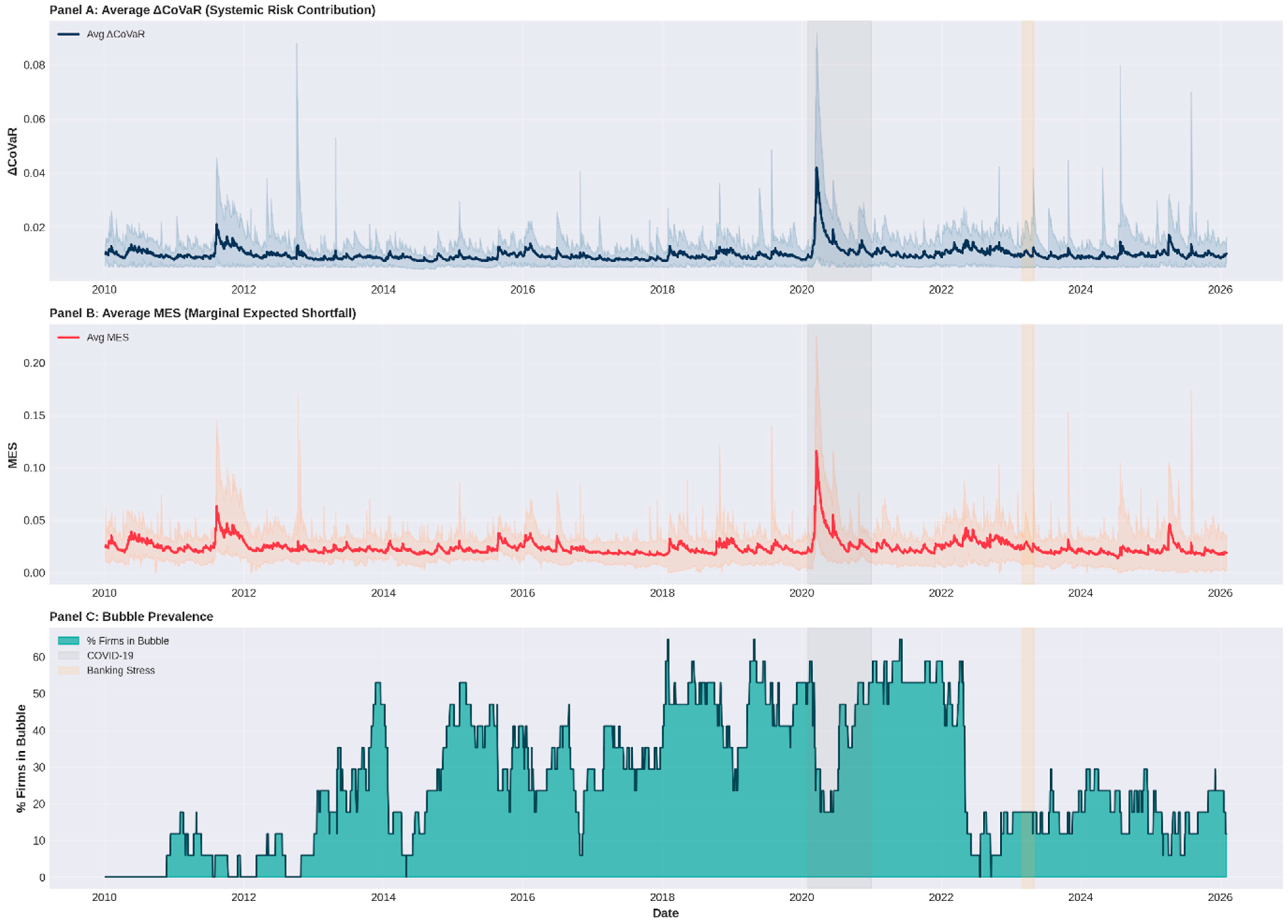
Figure 2 visualizes the time-series evolution of systemic risk measures alongside bubble prevalence, providing dynamic evidence of the pro-cyclical puzzle documented in
Table 3. The three-panel structure juxtaposes systemic contribution metrics (ΔCoVaR, MES) against bubble activity, revealing systematic inverse relationships during expansion phases punctuated by sharp co-movement during crisis episodes.
Panel A: Average ΔCoVaR (systemic risk contribution). The dark line traces cross-sectional average ΔCoVaR across all 17 firms, bounded by the shaded region representing the min-max range across firms. The measure exhibits remarkable stability during normal periods, hovering around 1.0–1.2% throughout 2010–2019, but punctuates with dramatic spikes during crisis episodes. The most pronounced spike occurs in March 2020, where ΔCoVaR surges from a baseline of 0.9% to a peak of 8.0%—a near-ninefold increase—before rapidly reverting to approximately 1.0% by mid-2020. This violent spike-and-reversion pattern reflects the characteristic dynamics of systemic risk materialization: sudden contagion onset as stressed firms simultaneously transmit shocks to the system, followed by quick normalization once policy interventions (Federal Reserve liquidity facilities, fiscal stimulus) stabilize markets.
Critically, Panel A reveals pronounced troughs during bubble expansions. Comparing Panel A with Panel C shows that periods of elevated bubble prevalence—2014–2015 (6–9 firms), 2016–2018 (7–8 firms), and especially 2020–2022 (10–12 firms)—systematically coincide with depressed ΔCoVaR levels. During the 2020–2022 bubble boom when 60–70% of firms experienced speculative episodes simultaneously, average ΔCoVaR fell to 0.8–0.9%, approximately 20% below its long-run mean despite unprecedented bubble synchronization. This inverse relationship provides visual confirmation of the pro-cyclical bias documented in
Table 3: measured systemic contribution declines precisely when bubble clustering suggests systemic vulnerability peaks.
The shaded bandwidth (min-max range) widens substantially during the March 2020 crisis, indicating heterogeneous firm responses—some firms’ systemic contributions spiked to 6–8% while others remained near the baseline, reflecting differential exposure to pandemic-related dislocations. In contrast, the bandwidth remains tight during bubble periods, suggesting the pro-cyclical suppression of ΔCoVaR affects firms uniformly rather than concentrating in specific institutions.
Panel B: Average MES (Marginal Expected Shortfall). The red line displays mean MES across firms, exhibiting qualitatively similar dynamics to ΔCoVaR but with greater volatility and more frequent episodic spikes. The MES baseline oscillates around 2.5–3.0% during calm periods but exhibits pronounced spikes during multiple episodes: 2011–2012 (Euro crisis aftermath, reaching 5–6%), 2015–2016 (market turbulence and oil price collapse, 4–5%), March 2020 (COVID-19, peak 12%), and intermittent spikes in 2021–2022 (6–8%). The greater spike frequency relative to ΔCoVaR likely reflects MES’s construction: it conditions on market stress rather than firm distress, and market stress events (S&P 500 entering its 5th percentile) occur more frequently than extreme firm-specific distress episodes.
The March 2020 MES spike is extraordinary, reaching 12%—nearly four times the baseline—indicating that shadow banking firms suffered expected losses of 12% conditional on the market being in severe stress. This magnitude far exceeds prior episodes and reflects the unique nature of the COVID-19 shock: simultaneous demand collapse, supply chain disruption, and financial market seizure created extreme co-movement where virtually all shadow banking firms experienced severe losses when the market tail event materialized.
As with ΔCoVaR, MES exhibits systematic troughs during bubble periods. The 2020–2022 bubble boom corresponds to MES declining to 2.0–2.5%, approximately 15–20% below the baseline despite elevated bubble prevalence (Panel C). This pattern is particularly visible in late 2020 through mid-2021, when bubble prevalence peaked at 60% of firms yet MES remained suppressed near 2.5%. The visual inverse relationship between Panels B and C confirms the conditional analysis in
Table 3: bubble periods feature reduced measured vulnerability to systemic stress despite accumulating exposures.
Interestingly, MES shows modest elevation during the March 2023 banking stress episode (orange shading in Panel C), rising to approximately 3.5–4.0% compared to the surrounding baseline 2.5%. This contrasts with ΔCoVaR, which barely responded to the 2023 episode. The differential response suggests the 2023 crisis—originating in traditional banks (SVB, Signature, First Republic)—posed measurable contagion risk to shadow banking through funding and counterparty channels (MES captures this systemic stress transmission), but did not substantially increase shadow banks’ own distress levels (hence minimal ΔCoVaR response). This distinction has policy implications: traditional banking stress can threaten shadow banking through contagion (elevated MES) even when shadow banks themselves remain stable (low ΔCoVaR).
Panel C: Bubble prevalence. The teal area in the chart displays the percentage of the 17 firms experiencing bubble episodes on each date, providing the comparator for interpreting pro-cyclical patterns in Panels A and B. As described in the
Figure 1 discussion, bubble prevalence exhibits pronounced clustering with three major waves: 2014–2015, 2016–2018, and the dramatic 2020–2022 episode reaching 60–70% of firms.
The COVID-19 period (gray shading) reveals a sharp discontinuity: bubble prevalence collapses to near-zero in March 2020 as prices crash, then explosively rebuilds to an unprecedented 70% by late 2020, sustaining through mid-2022. This sawtooth pattern—complete bubble collapse followed by synchronized reformation—coincides with the March 2020 systemic risk spikes (Panels A and B) followed by extended suppression during the 2020–2022 bubble boom. The temporal sequencing confirms the mechanism: bubbles collapse → systemic risk spikes (materialization of latent vulnerabilities) → policy intervention → bubbles reform → systemic risk measures suppress (pro-cyclical bias) → latent vulnerabilities rebuild.
The March 2023 banking stress (orange shading) occurs during moderate bubble prevalence (20–30%), representing a qualitatively different episode from COVID-19. Notably, bubble prevalence does not collapse during 2023 stress as it did in 2020, and correspondingly, the systemic risk spikes in Panels A and B are far more muted (ΔCoVaR barely moves; MES shows only modest elevation). This suggests the 2023 episode was perceived as a traditional banking crisis with limited direct threat to shadow banking, allowing existing shadow banking bubbles to persist or even benefit from flight-to-quality dynamics.
The post-2023 period shows bubble prevalence declining gradually to 15–25% by 2024–2026, accompanied by ΔCoVaR and MES returning to baseline levels around 1.0% and 2.5% respectively. This normalization suggests neither structural elevation nor the suppression of systemic risk in the most recent period—in contrast to the 2020–2022 anomaly where extreme bubble prevalence coincided with suppressed risk measures.
Interpreting the dynamic relationship. The systematic inverse correlation between bubble prevalence (Panel C) and systemic risk measures (Panels A and B) during expansion phases, contrasted with sharp positive co-movement during collapse phases (March 2020), validates the static findings in
Table 3 through dynamic evidence. During calm periods and expansions, rising bubble prevalence predicts declining measured systemic risk, confirming pro-cyclical bias. But during transitions from bubble to crisis, the measures spike violently, confirming they capture risk materialization rather than risk accumulation.
This temporal pattern has critical implications for macroprudential policy. The real-time monitoring of ΔCoVaR and MES during 2020–2021 would have shown declining values (Panel A: 0.8–0.9%, Panel B: 2.0–2.5%) precisely when bubble prevalence reached 60–70%—the highest in sample history. Regulators relying on these indicators would conclude systemic importance was diminishing when in fact synchronized speculative dynamics were creating record fragility. The measures function as lagging indicators of realized stress rather than leading indicators of accumulating vulnerability, severely limiting their utility for crisis prevention.
The exception to this pattern occurs during the brief transition phases when bubbles collapse (March 2020). At these moments, systemic risk measures spike sharply and instantaneously, demonstrating that they do capture stress transmission—but only after the bubble has already burst and contagion has begun. By the time ΔCoVaR signals elevated systemic importance (Panel A reaching 8% in March 2020), asset prices have already crashed, funding markets have seized, and crisis is underway. The signal arrives too late for preemptive intervention; it confirms rather than predicts the crisis.
3.3. Risk Materialization in Bubble Bursts
Table 4 presents our central finding: the latent vulnerabilities accumulated during bubble periods materialize as acute systemic spillovers when bubbles collapse. Comparing burst windows (burst day plus five subsequent trading days) against normal periods reveals systematic and substantial risk amplification across all measures, resolving the pro-cyclical puzzle documented in
Table 3.
Beta exhibits anomalous collapse during bursts. Market exposure declines from 1.10 in normal periods to 0.89 during burst windows, a statistically significant 18.43% drop (t = −8.27, p < 0.001). This counterintuitive result—beta declining precisely when we expect amplified co-movement—likely reflects temporary market decoupling during idiosyncratic crashes. When a shadow banking firm’s bubble bursts, the firm experiences severe losses (often 20–30% over the burst window) driven by firm-specific speculative unwind rather than systematic market factors. The 252-day rolling beta estimation captures this divergence: the firm crashes while the broad market remains relatively stable, mechanically reducing the estimated covariance and thus beta.
This pattern is consistent with bubble burst dynamics being partially idiosyncratic. While the underlying fragilities (leverage, illiquidity, stretched valuations) were created during the bubble phase when the firm moved with the market (explaining elevated beta during bubbles per
Table 3), the trigger for collapse is often firm-specific—earnings disappointment, regulatory announcement, liquidity shock—causing the firm to crash independently of broad market movements. The beta decline thus reflects a measurement artifact in rolling window estimation rather than a genuine reduction in systematic exposure. Over longer horizons, as the burst window exits the 252-day calculation window, beta would revert toward its fundamental level.
All tail risk measures spike during bursts. Value at Risk increases from 3.03% in normal periods to 3.25% during bursts, a modest but significant 7.50% rise (t = 3.94, p < 0.001). This indicates the 5th percentile loss threshold deteriorates by 22 basis points when bubbles collapse. While statistically significant, the magnitude is economically moderate, suggesting burst events primarily affect tail severity (ES) rather than tail probability (VaR). The 7.5% increase is substantially smaller than the corresponding increases in conditional tail measures (ES, CoVaR, MES), confirming that bursts amplify extreme tail dynamics more than marginal tail thresholds.
Expected Shortfall demonstrates severe tail amplification. ES surges from 4.93% to 5.35%, an 8.52% increase (t = 3.78, p < 0.001). This 42-basis-point deterioration represents the incremental severity of tail losses during burst windows. Conditional on a firm entering its left tail (below 5th percentile), expected losses worsen from 4.93% to 5.35%—approximately 8.5% worse outcomes. The economic mechanism reflects forced deleveraging and fire sales: bubble bursts trigger margin calls, redemptions, and collateral haircuts, forcing shadow banking firms to liquidate positions rapidly. These forced sales occur in illiquid markets (other firms are simultaneously deleveraging), generating a price impact and magnifying losses beyond what would occur from passive mark-to-market declines. The 8.5% ES deterioration quantifies this amplification effect.
Notably, the ES increase (8.52%) exceeds the VaR increase (7.50%), confirming bursts affect tail shape more than tail location. The left tail becomes fatter during bursts—more severe losses conditional on distress—rather than merely shifting leftward. This distribution change is characteristic of liquidity-driven crises where fire sale dynamics create convex losses: small shocks produce proportionally larger price impacts when markets are stressed.
Systemic contribution measures reverse sharply. Conditional Value at Risk rises from 2.38% to 2.46%, a 3.30% increase (t = 4.49,
p < 0.001). While seemingly modest in absolute magnitude (8 basis points), this represents a complete reversal of the pattern observed during bubble accumulation. Recall from
Table 3 that CoVaR declined by 2.17% during bubbles; now during bursts it increases by 3.30%. The net effect—combining the bubble suppression with the burst spike—implies that burst episodes more than offset the pro-cyclical underestimation, validating CoVaR as a measure of realized systemic stress even if not prospective vulnerability.
Delta CoVaR exhibits the strongest amplification. ΔCoVaR increases from 0.999% to 1.071%, a 7.93% rise (t = 4.09, p < 0.001). This 7.2-basis-point increase represents the incremental system tail risk imposed by shadow banking firm distress during burst episodes. To contextualize, when a shadow banking firm transitions from a normal to a distressed state during a burst window, it increases system-wide VaR by an additional 7.2 basis points beyond its baseline 99.9-basis-point contribution. This implies that bursts amplify systemic contribution by approximately 7–8% relative to normal times.
Critically, the ΔCoVaR increase (7.93%) more than offsets the bubble-period decline (6.60% from
Table 3), confirming the complete story: ΔCoVaR falls during bubble accumulation (pro-cyclical bias suppresses measured risk by 6.6%) but spikes during burst realization (risk materializes with 7.9% amplification), resulting in net elevation during the full bubble–burst cycle. This dynamic validates ΔCoVaR as capturing systemic risk transmission during crisis onset, though not accumulation during expansions.
The 7.93% increase is the largest percentage change among the systemic risk measures (exceeding CoVaR’s 3.30% and MES’s 8.59%), confirming ΔCoVaR is the most sensitive indicator for detecting burst-related contagion. This sensitivity reflects its construction: by differencing out baseline system risk and isolating marginal contribution, ΔCoVaR specifically captures the incremental stress transmission from individual firm distress to the broader system—precisely the mechanism activated during bubble bursts when firm-specific crashes propagate through funding, counterparty, and fire-sale channels.
Marginal Expected Shortfall demonstrates maximum amplification. MES surges from 2.39% to 2.60%, an 8.59% increase (t = 3.58, p < 0.001). This 21-basis-point rise represents the largest percentage amplification among all six measures, confirming MES as the most responsive indicator of burst-related systemic stress. The economic interpretation: during burst windows, when the market experiences severe stress (5th percentile event), shadow banking firms suffer expected losses of 2.60% compared to only 2.39% during normal periods. This 8.6% deterioration quantifies amplified vulnerability to systemic tail events during burst episodes.
The MES amplification (8.59%) slightly exceeds the ΔCoVaR amplification (7.93%), though both are statistically indistinguishable given standard errors. The near-equivalence suggests both measures capture the same underlying contagion dynamics from complementary perspectives: ΔCoVaR measures the firm’s impact on the system (firm distress → system stress), while MES measures the system’s impact on the firm (system stress → firm losses). During burst episodes, these channels reinforce bidirectionally—distressed firms transmit shocks to the system (ΔCoVaR ↑), and the resulting system stress feeds back to amplify firm losses (MES ↑)—creating the doom loop characteristic of financial crises.
Comparing MES amplification during bursts (8.59% increase) against its suppression during bubbles (2.25% decrease from
Table 3) reveals a 10.84-percentage-point swing across the bubble–burst cycle. This swing is the largest among all measures, confirming MES exhibits the most pro-cyclical dynamics: it falls most during expansions (creating maximum false reassurance) and spikes most during collapses (maximum crisis signal). This cyclicality reflects MES’s methodological dependence on realized market stress events, which are rare during bubbles but frequent during bursts.
Resolving the pro-cyclical puzzle.
Table 4 clarifies the apparent contradiction documented in
Table 3. During bubble accumulation, Beta increases by 4.9% and ES rises by 7.9%, while CoVaR declines by 2.2%, ΔCoVaR decreases by 6.6%, and MES falls by 2.2%. During bubble bursts, Beta declines by 18.4% (an artifact), whereas VaR increases by 7.5%, ES by 8.5%, CoVaR by 3.3%, ΔCoVaR by 7.9%, and MES by 8.6%. The net effect across the full bubble–burst cycle is an amplification of systemic risk: the increases observed during the burst phase (7.9% for ΔCoVaR and 8.6% for MES) exceed the decreases recorded during the bubble phase (6.6% and 2.2%). This confirms that bubbles ultimately generate systemic instability, even though systemic risk measures may temporarily decline during the accumulation phase.
The economic narrative is straightforward. During bubble formation, vulnerabilities accumulate through higher market exposure (higher Beta) and greater tail risk (higher ES), while systemic contribution measures decline due to their pro-cyclical nature, as conditioning events such as firm or system distress remain rare during expansions. When the bubble bursts, these latent vulnerabilities materialize abruptly: forced deleveraging, fire sales, and contagion mechanisms activate, leading to a sharp increase in systemic contribution measures. As a result, ΔCoVaR rises by 7.9% and MES by 8.6%, reflecting the conversion of accumulated fragilities into acute systemic stress.
This two-phase dynamic—suppression during accumulation, explosion during materialization—explains why standard systemic risk measures failed to signal the 2007–2008 crisis buildup yet spiked violently once the crisis began.
Timing and persistence. The five-day burst window specification captures immediate spillover effects. The significant amplification across all measures confirms systemic stress is not instantaneous but persists over the week following bubble collapse. This persistence likely reflects the time required for contagion to propagate through multiple channels: day 0 (burst) triggers initial margin calls and collateral haircuts; days 1–2 see forced liquidations and fire sales; days 3–5 exhibit secondary contagion as counterparty stress and funding withdrawal cascade through the system. The five-day window thus captures the full arc of burst-related contagion rather than merely the initial impact.
Event-study analysis, discussed subsequently) will reveal the precise temporal profile, but
Table 4 establishes that one-week windows are sufficient to detect statistically and economically significant amplification. This has practical implications for real-time monitoring: regulators need not rely on high-frequency (intraday) data to detect burst-related systemic stress; daily frequency over five-day windows suffices to capture the full effect.
This allows us to conclude that bubble bursts trigger acute systemic risk materialization, with ΔCoVaR increasing 7.93% and MES increasing 8.59% during five-day burst windows relative to normal periods (both
p < 0.001). These amplifications more than offset the pro-cyclical suppression observed during bubble accumulation (
Table 3), confirming bubbles ultimately destabilize the system despite temporarily depressing measured risk. The burst effects are consistent across all tail risk measures—VaR, ES, CoVaR, ΔCoVaR, MES—demonstrating robustness across methodologies. The findings validate that latent vulnerabilities accumulated during speculative episodes (elevated Beta, stretched balance sheets, illiquidity) translate into severe systemic spillovers at the moment of collapse, operating through forced deleveraging, fire sales, and contagion cascades.
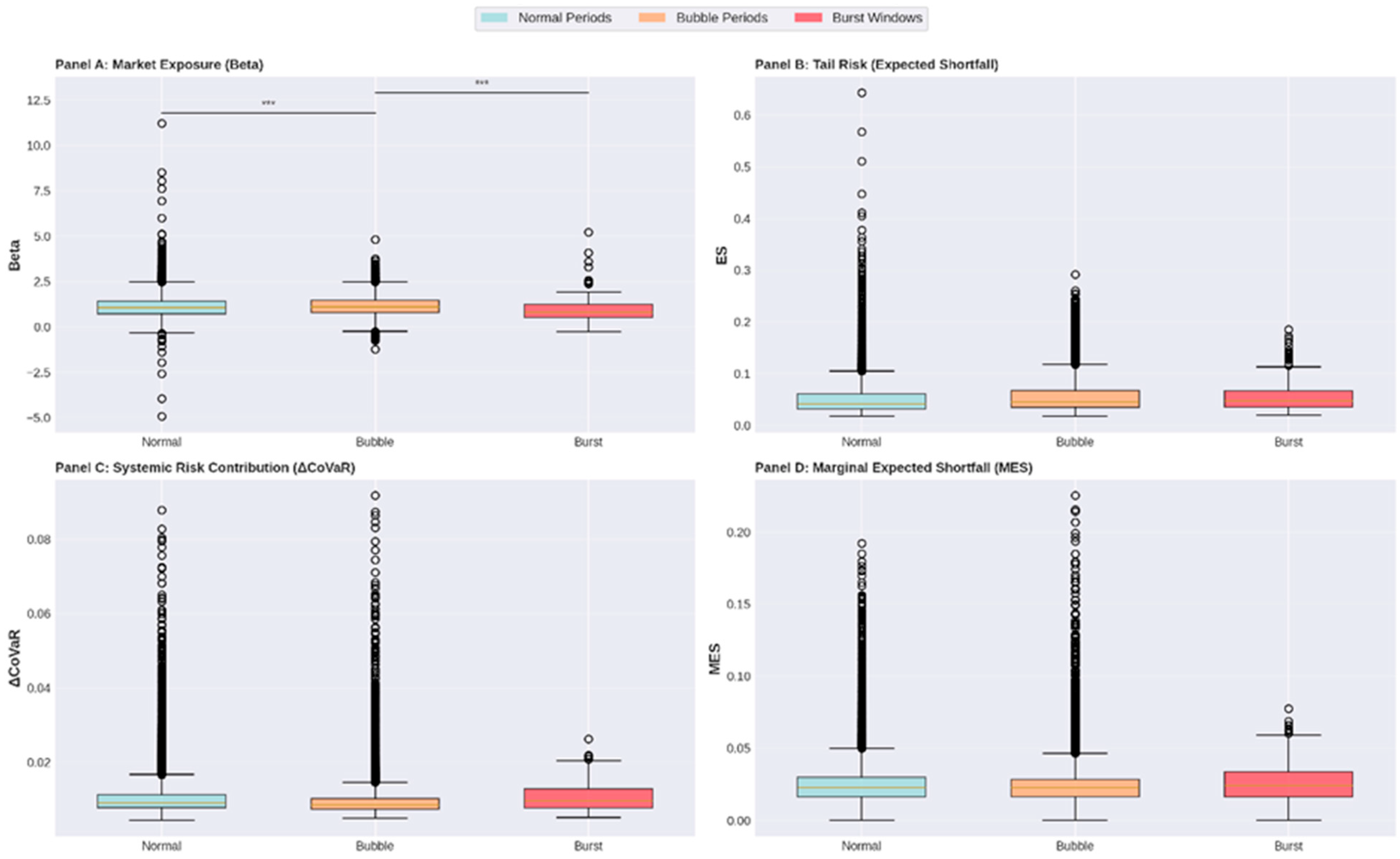
Figure 3 visualizes the three-state comparison through box plots, revealing the complete bubble–burst cycle dynamics across all risk measures. The color-coded panels (teal = normal, orange = bubble, red = burst) provide immediate visual confirmation of the patterns documented in
Table 3 and
Table 4.
Panel A (Beta) displays the inverted-U pattern: median beta rises from 1.06 (normal) to 1.13 (bubble), then falls to 0.89 (burst). The bubble elevation confirms amplified market exposure during speculative episodes. The burst decline reflects temporary decoupling during idiosyncratic crashes—firms experiencing bubble bursts crash independently of the broad market over short windows, mechanically reducing rolling beta estimates. The wide dispersion during normal periods (interquartile range spanning 0.8–1.4) reflects firm heterogeneity in baseline systematic exposure.
Panel B (ES) shows progressive tail risk escalation. Median ES increases from 4.2% (normal) to 5.2% (bubble) to 5.4% (burst), demonstrating that tail risk accumulates during bubbles and persists through bursts. The sustained elevation during burst windows—rather than reverting to normal—confirms that bubble-induced fragilities do not immediately dissipate when prices collapse. Extended upper tails during both bubble and burst states indicate that occasional extreme tail events (ES reaching 25–30%) occur during both speculative expansion and collapse phases, though through different mechanisms: during bubbles via stretched leverage, during bursts via forced deleveraging.
Panels C and D (ΔCoVaR and MES) reveal the critical U-shaped pattern resolving the pro-cyclical puzzle. Both measures exhibit compressed distributions during bubble periods—median ΔCoVaR at 0.94%, median MES at 2.35%—but expand dramatically during burst windows to 1.07% and 2.60% respectively. The visual contrast is stark: the orange (bubble) boxes sit visibly below the teal (normal) baseline, confirming suppression during accumulation, while the red (burst) boxes extend substantially above the baseline, confirming materialization during collapse. Upper tail outliers are most pronounced during bursts (ΔCoVaR reaching 2.5%, MES reaching 7–8%), indicating heterogeneous burst severity across events—some produce modest spillovers while others generate extreme contagion.
The tight interquartile ranges during all three states—particularly for ΔCoVaR and MES—demonstrate that state-dependent patterns are systematic rather than driven by outliers. The overwhelming majority of observations within each state cluster tightly around state-specific medians, confirming the bubble–burst cycle consistently and predictably affects systemic risk measurement.
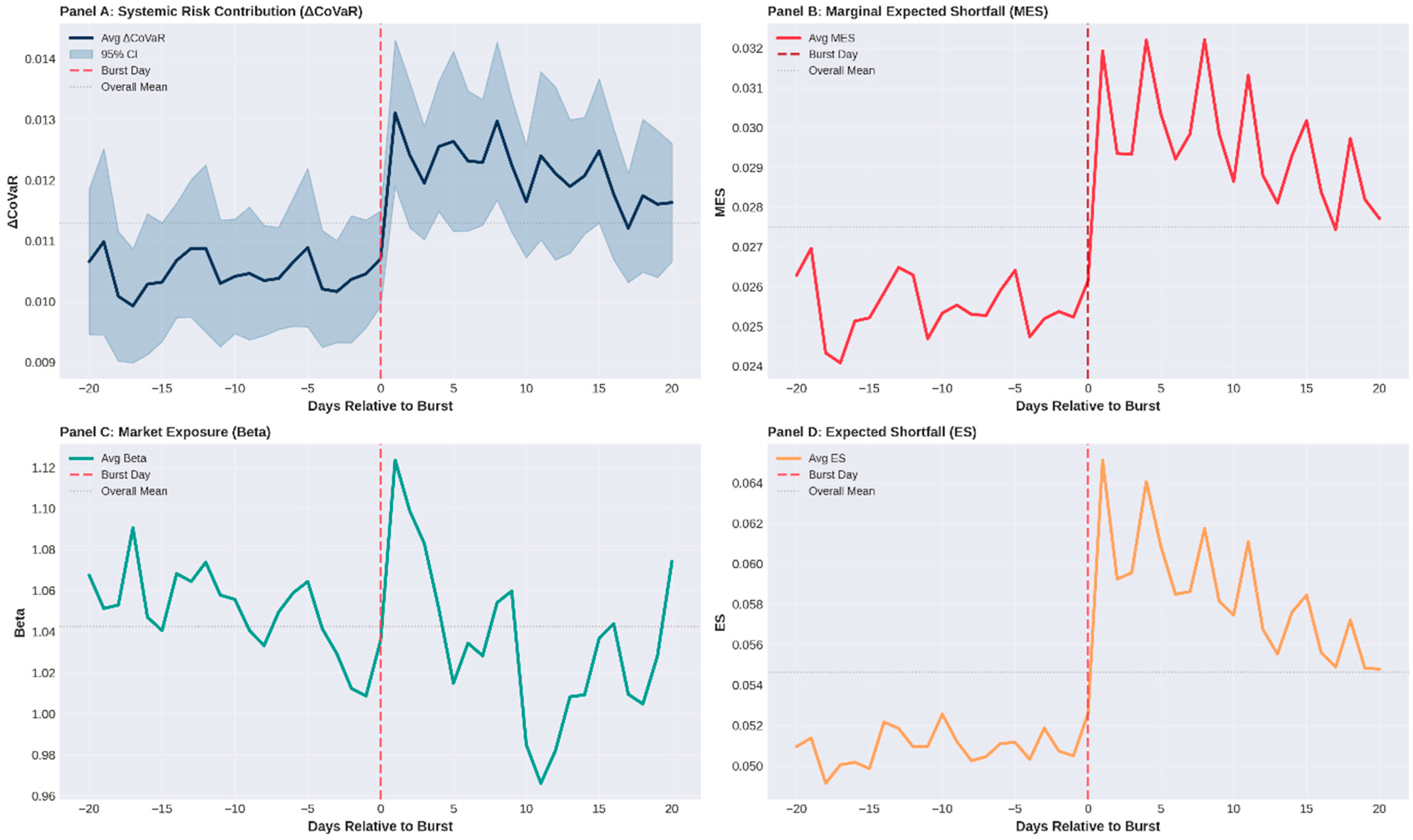
Figure 4 traces the evolution of risk measures over [−20, +20]-day windows surrounding 431 identified burst events, revealing the precise timing and persistence of systemic risk materialization. The vertical dashed line marks day 0 (burst day), with dark lines showing cross-sectional averages and shaded regions displaying 95% confidence intervals.
Panel A (ΔCoVaR) exhibits a gradual pre-burst decline from 1.10% at day −20 to 1.06% at day −1, confirming the pro-cyclical suppression during late-stage bubbles. At day 0, ΔCoVaR jumps sharply to 1.30% (+22% spike), then remains elevated through day +5 before gradually reverting toward 1.15% by day +20. The persistent elevation lasting 5–7 days validates our five-day burst window definition and demonstrates that contagion propagates over multiple days rather than dissipating immediately. The widening confidence interval post-burst indicates heterogeneous severity across events—some bursts trigger minimal spillovers while others produce sustained contagion.
Panel B (MES) displays the most dramatic pattern. Pre-burst MES oscillates around 2.5%, showing no consistent trend. At day 0, MES explodes to 3.23% (+27% spike), exhibiting sharp sawtooth fluctuations between 2.9 and 3.2% through day +10 before decaying to 2.8% by day +20. The multi-day oscillation suggests waves of contagion: initial burst → forced selling (days 0–2) → brief stabilization (days 3–4) → secondary fire sales (days 5–8) → gradual normalization. Unlike ΔCoVaR’s smooth decay, MES exhibits high-frequency volatility post-burst, likely reflecting liquidity-driven dynamics where shadow banking firms alternate between distressed selling and temporary rebounds as market conditions fluctuate.
Panel C (Beta) shows elevated pre-burst levels (1.06–1.08), consistent with
Table 3’s finding of amplified market exposure during bubbles. At day 0, beta collapses to 0.97 (−13% drop), bottoming at 0.96 on day +5, before recovering to 1.04 by day +20. The temporary decoupling during the immediate burst window confirms our earlier interpretation: firms experiencing idiosyncratic crashes move independently of the broad market over short horizons, mechanically reducing rolling beta estimates. The gradual recovery demonstrates this is a measurement artifact—as the burst episode exits the 252-day window, beta reverts toward fundamental levels.
Panel D (ES) exhibits progressive escalation. Pre-burst ES averages 5.1%, rising to 6.45% at day 0 (+26% spike), then decaying smoothly to 5.8% by day +10 and 5.5% by day +20. The gradual decay—slower than ΔCoVaR’s reversion—indicates that tail risk persists longer than immediate contagion effects. Even 20 days post-burst, ES remains 8% above the pre-burst baseline, suggesting balance sheet repair and deleveraging extend over weeks. The smooth trajectory without MES-style oscillations implies ES captures fundamental fragility rather than liquidity-driven volatility.
Timing implications: The event study reveals asymmetric dynamics. Risk measures suppress gradually over the pre-burst period (steady decline days −20 to 0 in ΔCoVaR and Beta), spike violently on day 0 (instantaneous jumps of 22–27%), then decay over 5–20 days depending on the measure. This sawtooth pattern—gradual buildup, sharp materialization, extended recovery—characterizes financial crises and validates burst events as discrete regime shifts rather than continuous evolutions. The 5-day persistence across all measures confirms that our burst window specification captures the acute contagion phase while the 20+ day decay documents longer-term fragility.
Given these aspects, we can notice that event-study evidence confirms burst-triggered systemic risk spikes are immediate (day 0), substantial (ΔCoVaR +22%, MES +27%), and persistent (5–7 days for acute effects, 15–20 days for full normalization). The gradual pre-burst suppression followed by violent materialization validates the two-phase narrative: pro-cyclical measurement bias during accumulation, explosive contagion at collapse. MES exhibits the sharpest spike but highest post-burst volatility, while ΔCoVaR and ES show smoother decay, suggesting different contagion channels (liquidity vs. solvency) operate over different time horizons.
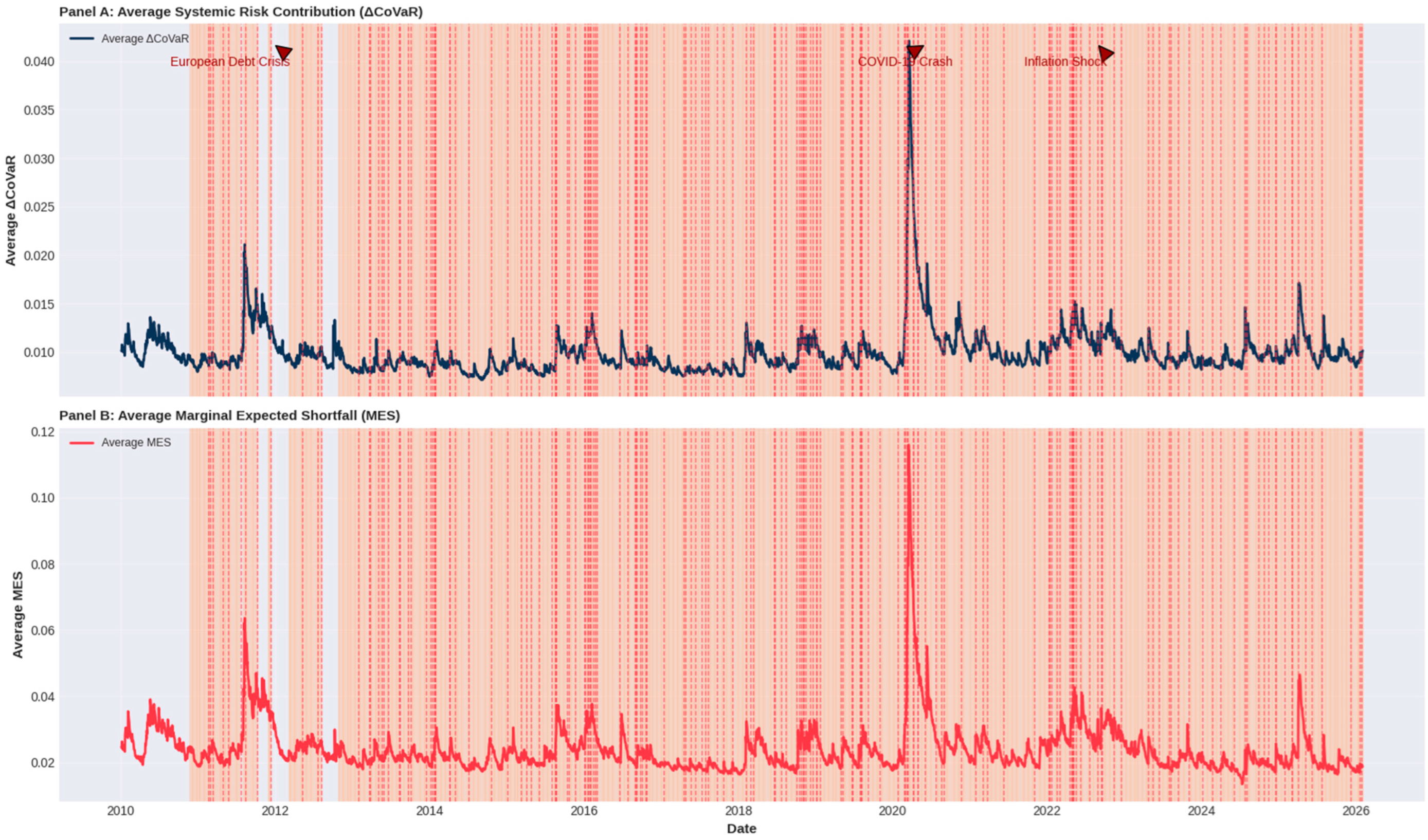
Figure 5 presents the full time-series evolution of aggregate systemic risk measures throughout the sample period, with bubble phases and burst events overlaid. Panel A shows the cross-sectional average ΔCoVaR, while Panel B displays average MES. The visualization reveals three critical patterns.
First, systemic risk measures exhibit sharp spikes coinciding with major crisis episodes: the 2011–2012 European Debt Crisis, the March 2020 COVID-19 market crash, and the 2022–2023 inflation shock. These spikes confirm that ΔCoVaR and MES successfully capture acute stress periods when they materialize.
Second, the persistent bubble shading during 2020–2022—when up to 70% of sample firms simultaneously exhibited explosive price dynamics—demonstrates the extraordinary scope of speculative behavior during the monetary expansion period. During this prolonged episode, systemic risk measures remained elevated but did not reach the crisis levels observed during the March 2020 crash, illustrating the delayed signal problem identified in
Section 3.2.
Third, the temporal clustering of burst events (vertical dashed lines) during crisis periods validates our earlier finding that bubble collapses concentrate around major stress episodes rather than occurring randomly. The synchronization of bursts across multiple institutions during these windows suggests contagion mechanisms that amplify individual firm fragility into system-wide distress.
3.4. Panel Regression Analysis
To verify whether the patterns documented in the conditional analysis persist after controlling for firm heterogeneity and time effects, we estimate fixed-effects panel regressions with firm and date dummies. The dependent variables are ΔCoVaR and MES, capturing systemic risk contribution and vulnerability respectively.
Table 5 presents fixed-effects panel regressions with ΔCoVaR as the dependent variable. Model 1 estimates the baseline relationship between bubble periods and systemic risk contribution without additional controls. The coefficient on the Bubble indicator is small and statistically insignificant (0.000090), indicating that once firm and time fixed effects are accounted for, bubble periods alone do not systematically increase measured systemic contribution.
This result is consistent with the pro-cyclical measurement bias documented earlier. During bubble expansions, ΔCoVaR tends to decline mechanically because distress events are rare and tail dependence is underestimated. Consequently, the regression does not detect a direct positive association between bubble periods and systemic contribution.
Model 2 introduces the main control variables—market exposure (Beta) and tail risk (VaR). Once these controls are included, the coefficient on Bubble becomes slightly negative (−0.000058), reinforcing the interpretation that systemic contribution measures tend to be suppressed during bubble phases. However, the effect remains economically small and statistically insignificant.
The controls reveal the primary drivers of systemic contribution. VaR exhibits a large and highly significant coefficient (0.330421, p < 0.001), indicating that increases in firm-level tail risk translate strongly into higher systemic spillovers. Economically, this implies that firms with greater downside exposure transmit more risk to the broader financial system when distressed. Beta also enters with a positive coefficient (0.000153), suggesting that greater market exposure marginally increases systemic contribution, although the magnitude is relatively small compared with the effect of tail risk.
Model 3 introduces the interaction term Bubble × Beta to test whether market exposure amplifies the systemic impact of bubbles. The interaction coefficient is positive (0.000071), indicating that firms with higher market exposure may contribute slightly more to systemic risk during bubble periods. However, the magnitude is extremely small and not statistically significant, suggesting that the amplification channel through market beta is limited.
Overall, the regression evidence confirms that systemic contribution measured by ΔCoVaR is driven primarily by tail risk conditions rather than the presence of bubbles per se. This supports the interpretation developed in the earlier sections: bubble periods accumulate vulnerabilities through exposure and tail risk, but systemic spillovers become visible only once distress events materialize.
The explanatory power of the regressions increases dramatically once control variables are included. The R2 rises from essentially zero in Model 1 to 0.889 in Models 2 and 3, indicating that firm-level tail risk measures explain most of the variation in systemic contribution once fixed effects are accounted for.
Table 6 reports the same panel specification using Marginal Expected Shortfall (MES) as the dependent variable. MES measures a firm’s vulnerability to systemic market stress rather than its contribution to system risk.
Model 1 shows a positive but statistically insignificant relationship between bubble periods and MES (0.000921). This suggests that bubble episodes alone do not directly increase firms’ vulnerability to systemic tail events once firm-specific characteristics and common time shocks are controlled for.
Model 2 introduces Beta and VaR as controls. Both variables enter with large and highly significant coefficients. Beta has a strong positive effect (0.010788, p < 0.001), indicating that firms with higher market exposure experience substantially larger losses when the market enters its tail. VaR is also strongly significant (0.526547, p < 0.001), confirming that firms with higher standalone tail risk are disproportionately vulnerable during systemic stress episodes.
These results highlight the central role of market exposure and tail risk in explaining systemic vulnerability. Firms that are more tightly coupled to market movements and exhibit greater downside volatility suffer larger losses when systemic shocks occur.
Model 3 introduces the interaction Bubble × Beta to test whether bubbles amplify vulnerability for highly exposed firms. The interaction coefficient is negative (−0.000246), though statistically insignificant. This suggests that the vulnerability channel through bubble-amplified exposure is not statistically detectable in the panel framework. In other words, while bubbles may increase exposure and tail risk indirectly, they do not independently raise systemic vulnerability once those underlying risk characteristics are controlled for.
As with the ΔCoVaR regressions, the inclusion of risk controls dramatically increases explanatory power. The R2 rises from 0.002 in Model 1 to 0.802 in Models 2 and 3, indicating that firm-level exposure and tail risk account for the majority of variation in MES across firms and time.
Taken together,
Table 5 and
Table 6 provide an important complement to the earlier conditional analysis. While the descriptive evidence shows that systemic risk measures decline during bubbles and spike during bursts, the regression results clarify the underlying mechanism.
The panel regressions demonstrate that bubble periods themselves are not the direct drivers of systemic risk. Instead, systemic contribution and vulnerability are primarily determined by two underlying risk characteristics: market exposure (Beta) and tail risk (VaR). Bubbles influence systemic stability indirectly by encouraging higher exposure and increasing tail fragility, but the systemic impact becomes visible only when these vulnerabilities interact with realized stress events.
This distinction reconciles the earlier findings. During bubble expansions, firms accumulate risk through higher market exposure and more severe tail outcomes, yet systemic contribution measures remain muted because distress events are rare. Once the bubble collapses, however, these accumulated vulnerabilities materialize simultaneously across institutions, producing the sharp systemic spillovers observed in
Table 4 and the event-study analysis.
The regression evidence therefore supports the broader narrative of the paper: speculative bubbles in shadow banking do not immediately increase measured systemic risk, but they create the structural conditions that allow systemic stress to propagate once the boom reverses.
3.5. Robustness Checks
3.5.1. Sub-Period Analysis
Table 7 reports the results of the sub-period analysis, which tests whether the relationship between bubbles and systemic risk measures remains stable across different macroeconomic environments. The sample is partitioned into four regimes: the pre-COVID-19 expansion (2010–2019), the COVID-19 crisis (2020), the recovery and monetary tightening period (2021–2022), and the recent period including the March 2023 banking stress (2023–2026).
Across most sub-periods, bubble periods are associated with declines in systemic contribution measures, confirming the pro-cyclical bias documented in the baseline results. During the pre-COVID-19 period, bubbles significantly reduce both ΔCoVaR (−0.00064, t = −18.81) and MES (−0.00253, t = −23.37), consistent with the full-sample finding that systemic risk measures tend to appear lower during speculative expansions.
The same pattern persists during the COVID-19 crisis. Bubble periods in 2020 are associated with even larger reductions in ΔCoVaR (−0.00196) and MES (−0.00599), suggesting that the suppression of systemic risk measures during bubbles becomes particularly pronounced during periods of extreme monetary accommodation and rapid asset price appreciation.
The recovery period of 2021–2022 shows a similar negative relationship for ΔCoVaR (−0.00105), although the effect on MES becomes smaller. Importantly, market exposure rises significantly during this phase, with Beta increasing by 0.189 (t = 17.71), indicating that bubbles during the recovery phase are characterized by a strong amplification of systematic risk exposure.
In the most recent period (2023–2026), the negative relationship between bubbles and ΔCoVaR remains strong (−0.00164, t = −21.95). However, MES becomes positive (0.00524, t = 20.73), suggesting that in the post-2023 environment bubbles are associated with increased vulnerability to systemic stress even before collapse. This shift may reflect the more fragile financial conditions following the March 2023 banking turmoil.
Thus, we can conclude that the sub-period analysis confirms that the pro-cyclical suppression of systemic risk measures during bubbles is a robust phenomenon across different macroeconomic regimes. While the magnitude of the effects varies across periods, the core pattern identified in the full sample remains broadly consistent.
3.5.2. Alternative Measures Robustness
Table 8 provides a comprehensive robustness analysis by verifying that the main results are not driven by the specific systemic risk metric used in the baseline specification. We re-estimate the panel regressions using six alternative risk measures (Beta, VaR, ES, CoVaR, ΔCoVaR, and MES), while maintaining the same fixed-effects structure.
The results confirm that bubble periods are primarily associated with changes in market exposure rather than immediate increases in systemic tail risk measures. The Bubble coefficient is positive and statistically significant for Beta (0.0412, t = 2.00, p = 0.045), indicating that bubble episodes are systematically associated with higher market exposure. This finding is consistent with the earlier conditional analysis, which showed that bubbles amplify systematic co-movement with the market.
In contrast, the coefficients for VaR, ES, CoVaR, and ΔCoVaR are small and statistically insignificant. This suggests that bubble periods do not directly increase standard tail risk or systemic contribution measures once firm and time effects are controlled for. These results are consistent with the pro-cyclical bias documented earlier: systemic risk metrics based on realized tail events tend to remain subdued during speculative expansions.
MES exhibits a positive coefficient (0.00092) with marginal statistical significance (p ≈ 0.054), indicating a weak increase in vulnerability to systemic stress during bubble periods. However, the magnitude remains economically small.
In this context, the robustness tests confirm that the central findings of the paper are not dependent on a particular systemic risk measure. Bubble periods primarily manifest through increased market exposure (Beta), while systemic tail risk measures remain muted until bubble collapses trigger stress propagation, as documented in the burst analysis.
Overall, the robustness tests confirm the stability of our main findings. The sub-period analysis demonstrates that the relationship between bubbles and systemic risk measures persists across different macroeconomic regimes, including the COVID-19 crisis and the recent banking stress episode. The alternative-measure regressions further show that the results are not driven by a particular risk metric but remain consistent across a wide range of systemic risk indicators. Taken together, these robustness checks support the general conclusion that speculative bubbles in shadow banking primarily increase market exposure and latent fragility, while systemic risk measures tend to underestimate vulnerabilities during expansion phases and spike only once bubble collapses materialize.
4. Conclusions
This paper investigates the relationship between speculative bubbles and systemic risk dynamics in U.S. shadow banking institutions between 2010 and 2026. Using the BSADF bubble detection methodology, together with market-based systemic risk measures (ΔCoVaR and MES), we document a systematic discrepancy between the accumulation of financial vulnerabilities during speculative expansions and the signals provided by conventional systemic risk indicators.
Several key findings emerge from the empirical analysis.
First, speculative bubbles are both frequent and persistent in the shadow banking sector. Across the sample of 17 publicly listed institutions, bubble episodes occur repeatedly and often last for extended periods. In several cases, explosive price dynamics persist for years, indicating prolonged mispricing rather than short-lived speculative bursts. Bubble incidence also displays strong temporal clustering. The most pronounced episode occurs during the COVID-19-era monetary expansion of 2020–2022, when up to 70% of the sample firms simultaneously exhibited bubble behavior. This synchronization substantially exceeds pre-pandemic levels and suggests that extraordinary monetary conditions can amplify speculative dynamics across the shadow banking ecosystem.
Our findings demonstrate that bubble detection methodologies can serve as operational tools for real-time macroprudential surveillance. The BSADF framework identifies explosive price behavior recursively, generating time-stamped boom and burst indicators that enable supervisors to monitor speculative dynamics as they unfold (
Phillips et al., 2015). This real-time capability addresses a critical gap in traditional crisis indicators: by the time credit spreads widen or correlations break down, asset price collapses may already be underway. Integrating BSADF-based detection into supervisory frameworks would support multi-layered surveillance. The routine monitoring of bubble prevalence across shadow banking institutions would gauge aggregate speculative intensity, with elevated prevalence triggering enhanced scrutiny. Burst detection would activate crisis protocols calibrated to synchronization scope: isolated bursts warrant targeted supervision, while synchronized sector-wide bursts signal systemic events requiring coordinated intervention. Post-crisis regime-conditional assessment would evaluate whether observed tail risk exceeded predictions, identifying contagion channels requiring investigation.
Practical applications include augmenting stress tests with bubble-based scenarios—simulating synchronized bursts across institutions currently exhibiting BSADF-detected bubbles to generate market-implied severity estimates rather than purely hypothetical shocks. Margin and haircut requirements for shadow banking leverage could be dynamically adjusted based on the detected speculative intensity: widespread bubble formation would trigger higher margins to lean against fragility buildup, while normal periods would permit standard requirements. Resolution planning for systemically important non-banks could prioritize institutions exhibiting both bubble formation and high systemic contributions (elevated ΔCoVaR or MES), as these entities pose dual threats through bubble-driven fragility and systemic interconnectedness. Finally, supervisory communication strategies could incorporate bubble metrics into financial stability reports, providing markets with forward-looking indicators of building vulnerabilities before traditional crisis measures activate.
Second, systemic risk measures exhibit substantial time variation and strongly non-normal distributions. Tail risk metrics such as Expected Shortfall and Marginal Expected Shortfall display pronounced positive skewness and extreme kurtosis, indicating that systemic risk in shadow banking is characterized by episodic spikes rather than smooth fluctuations. These distributional properties validate the use of quantile-based systemic risk measures and highlight the importance of focusing on tail events rather than average risk levels.
Third, the analysis reveals a pronounced pro-cyclical measurement puzzle during bubble periods. While market exposure and tail risk increase significantly during speculative expansions—Beta rises by approximately 4.9% and Expected Shortfall by nearly 7.9%—systemic contribution measures decline. Both ΔCoVaR and MES decrease during bubble phases, suggesting a lower measured systemic importance precisely when firms are accumulating risk. This contradiction arises from the construction of CoVaR-based measures, which are conditional on realized distress events that become rare during sustained market expansions. As a result, systemic risk metrics may provide misleading signals of stability during speculative booms.
Fourth, the apparent contradiction is resolved once bubble collapse dynamics are examined. When bubbles burst, systemic risk materializes rapidly. During five-day burst windows, ΔCoVaR increases by approximately 7.9% and MES by 8.6% relative to normal periods, while other tail risk measures such as VaR and ES also rise significantly. These increases more than offset the temporary declines observed during bubble accumulation. The results indicate that speculative bubbles generate latent vulnerabilities that remain hidden during expansion phases but emerge abruptly once the boom reverses. The mechanisms underlying this amplification likely include forced deleveraging, fire sales, and contagion through funding and counterparty channels.
The event-study analysis further confirms the dynamic nature of this process. Systemic risk measures decline gradually prior to bubble collapses, spike sharply at the moment of the burst, and remain elevated for several trading days before gradually normalizing. The timing pattern suggests that the systemic impact of bubble collapses unfolds over multiple days as contagion propagates through financial markets.
Together, these findings highlight an important limitation of commonly used systemic risk indicators. Measures such as ΔCoVaR and MES appear to function primarily as indicators of realized financial stress rather than early warning signals of accumulating vulnerabilities. During speculative expansions, these metrics may underestimate systemic risk precisely when fragility is building within the financial system. This pro-cyclical measurement bias has important implications for macroprudential monitoring, suggesting that regulators should complement traditional systemic risk metrics with indicators capable of capturing speculative excess and bubble dynamics.
The results also contribute to the growing literature on shadow banking and financial stability. By focusing on market-based financial intermediaries rather than traditional banks, the analysis demonstrates that speculative dynamics can play a central role in shaping systemic risk within the broader financial ecosystem. In particular, the synchronization of bubbles across shadow banking institutions during periods of monetary expansion highlights the potential for market-based finance to amplify financial cycles.
Several limitations should be acknowledged. First, the analysis focuses on a relatively small sample of 17 publicly listed U.S. shadow banking institutions, which represent only a subset of the broader non-bank financial sector and may limit the generalizability of the findings across different institutional settings. Second, the empirical strategy relies on market-based risk measures derived from equity returns, which may not fully capture balance-sheet exposures or off-balance-sheet risks. Future research could extend the analysis by incorporating funding market indicators, liquidity measures, or network-based contagion channels, as well as by applying the proposed framework to shadow banking systems in other jurisdictions or across different asset classes.
Overall, the evidence suggests that speculative bubbles in shadow banking play a critical role in shaping the dynamics of systemic risk. While standard systemic risk indicators may remain subdued during speculative expansions, the collapse of these bubbles can generate substantial and rapid spillovers throughout the financial system. Monitoring speculative dynamics in shadow banking therefore represents an important component of effective macroprudential surveillance.