
Article

The Correlation Between Income Inequality and per Capita GDP in Georgia’s Counties
Hull College of Business, Allgood Hall, Summerville Campus, Augusta University, 1120 15th Street, Augusta, GA 30912, USA
*
Author to whom correspondence should be addressed.
J. Risk Financial Manag. 2026, 19(3), 234; https://doi.org/10.3390/jrfm19030234
Submission received: 27 January 2026 / Revised: 12 March 2026 / Accepted: 17 March 2026 / Published: 23 March 2026
(This article belongs to the Special Issue Recent Developments in Finance and Economic Growth)

Abstract

We use Reiterative Truncated Projected Least Squares (RTPLS) to estimate the correlation between real GDP per capita and income inequality for the 159 counties in Georgia, USA, from 2011 to 2021. RTPLS produces a separate slope estimate for every observation (data point), where differences in these slope estimates are due to omitted variables. Our measure of inequality is the ratio of household income at the 80th percentile divided by income at the 20th percentile. We find that the negative marginal correlation between income inequality and real per capita income has strengthened over time, and there are large differences between the effects for different counties. For example, in 2021, our estimate for d(real per capita GDP)/d(income inequality) ranged from −3.70 to −28.48. We find that this estimate becomes more negative when there are increases in the percentage of the county population with some college education, the percentage of the county population that is Black, the percentage of the county population that is Hispanic, as well as when unemployment increases. However, d(real percapita GDP)/d(income inequality) becomes less negative as the percentage of the county that is rural increases and as the percentage of the population that is less than 18 years old increases.

1. Introduction

Throughout the history of economic thought, the primary ways that inequality is viewed as affecting economic growth are through how inequality affects production-expanding investment. Some scholars focus on how savings fund investment in production-expanding capital, while other scholars argue that consumption provides a reason to invest in expanding production. These two reasons are the foundations for two opposite and opposing recommendations on income distribution. If a lack of savings constrains investment, then redistributing income from the poor to the rich will increase savings, investment, and growth. However, this view does not work in the extreme—if all income were taken from consumers and given to savers, then there would be no reason to invest in expanding production because the increased production would not sell. In a world with insufficient consumption, taking from the rich to give to the poor would increase consumption, investment, and growth. In a world where savings are needed to fund investment and consumption is needed to provide a reason to invest, there must be an optimal mix of savings and consumption that would maximize growth (Leightner, 2015; Leightner & Sinha, 2025).
Adam Smith’s Wealth of Nations (Smith, 1776/1937, edition) contains a few passages that emphasize the importance of savings (see page 321) and many passages that emphasize the importance of the “extent of the market”, which affects consumption. Mummery and Hobson (1889/1956, edition) believed that consumption drives demand, which drives investment and growth. In the simplest Keynesian analysis, redistributing income from the rich to the poor would increase consumption and the marginal propensity to consume. The increase in the marginal propensity to consume would increase the multiplier effect on growth of the increase in consumption of that pro-equality redistribution.
In contrast to Adam Smith, Mummery and Hobson (1889/1956, edition), Ricardo (1817/1951, edition) believed that profits drive investment, which drives growth. Growth, however, is limited because growth drives up rents, which decreases profits. Marx (1867/1976, edition) believed that capitalism would keep growing as long as the capitalist system could increase the surplus value that it extracts from labor. Again, this growth is limited by the maximum number of hours labor can work and by the limits of mechanization. Rostow (1960/1971, edition) and Lewis (1954) emphasized the role of savings in financing investment. In a simple Domar (1946) growth model, the equilibrium growth rate is the marginal propensity to save divided by the capital/output ratio. If income is redistributed to the classes that save a larger proportion of their income than other groups, then the average marginal propensity to save will increase, which, ceteris paribus, will cause the Domar growth rate to rise.
Leightner (2015) and Leightner and Sinha (2025) argue that the world is currently suffering from a global glut of savings. These authors recommend redistributing income from the rich to the poor in order to spur consumption, which will give a reason to invest the glut of savings in production-expanding ways. Other 21st-century scholars have discussed how inequality affects growth in ways other than through consumption and savings. Some scholars argue that inequality fosters competition and innovation by incentivizing entrepreneurship and investment, suggesting a positive relationship between income inequality and economic growth (Forbes, 2000). Others assert that income inequality fosters social discontent and unrest, increases policy uncertainty, and threatens property rights, all of which can discourage investment and ultimately reduce economic growth and stability (Alesina & Perotti, 1999). Rising income inequality in developed countries has become a significant concern, with many studies linking widening income inequality gaps to macroeconomic consequences (Mdingi & Ho, 2021). Some scholars link equality and democracy and rising inequality with a decline in democracy (Milanovic, 2005).
Research suggests that high levels of income inequality bring about high social and economic costs, especially for the poor and middle class. Dabla-Norris et al. (2015) state that income inequality can deprive lower-income households of the opportunity to stay healthy and accumulate capital, which can lead to decreased mobility, productivity, and aggregate demand. Their findings estimate that almost half of the world’s wealth is concentrated among the top 1 percent of the population, exacerbating disparities in economic opportunity. Evidence from the International Monetary Fund (IMF) indicates that income inequality negatively affects both the rate and sustainability of economic growth (Dabla-Norris et al., 2015).
Recent subnational studies in the U.S. reinforce that the inequality–growth relationship is complex and have produced mixed results based on methodology, measure of inequality, and timeline. For example, Partridge (1997) found a positive relationship between state-level inequality and growth, but in a later paper (Partridge, 2005) found that this was true in the long run but less clear in the short run. Frank (2009) also found a long-run positive relationship at the state level. Panizza (2002) generally finds a negative relationship between inequality and growth at the county level, but the results are not robust to time periods or inequality measures. Fallah and Partridge (2007) likewise find unstable results across counties but find a positive relationship between inequality and growth in metro areas and a negative relationship in non-metro areas. Bhatta (2001) finds a positive relationship in metro areas, but Fee (2025) finds that this positive relationship appears only in the densest central metropolitan counties—roughly 5 percent of all U.S. counties—while inequality elsewhere shows no or a negative association with per capita income growth. When controlling for county fixed effects, the positive relationship disappears, indicating that high inequality is generally linked to slower growth across local economies (Fee, 2025).
Most empirical studies of the effects of income inequality on growth estimate partial derivatives—the effects of inequality on growth holding all other included independent variables constant. However, many of the “other” included independent variables are probably correlated with inequality. Some examples include the percent of the population that is Black or Hispanic, the percent of the population with some college education, the percent of the county that is rural, and the unemployment rate, which are probably highly correlated with inequality. In contrast to finding partial derivatives, we want to find total derivatives—how inequality affects growth—holding nothing else constant.
To find total derivatives using traditional regression methods would require the construction of a simultaneous equation model that explains how each endogenous variable is determined. That model would have to be perfectly specified—using the correct functional forms (linear, logarithmic, discontinuous, etc.) and correctly modeling all interactions between the variables. For example, this model would have to correctly specify every factor that could affect savings, investment, and consumption, including all the determinants of interest rates, exchange rates, and relative prices. Moreover, recent research indicates that all factors that affect competition, innovation, social discontent, policy uncertainty, and property right security would also need to be correctly modeled. Once each equation in the model was estimated (perhaps with two-stage least squares), the estimated equations could be combined to find the desired total derivative: dGDP/d(inequality).
Instead of going through the above-described laborious process, where every step could be criticized, we use a statistical technique that produces total derivative estimates without needing to correctly model all the interconnections between the variables. The method we use is called “Reiterative, Truncated, Projected, Least Squares” (RTPLS). RTPLS produces for each observation its own total derivative estimate, where differences in these estimates are due to omitted variables. RTPLS does not require the construction of a structural model, and thus it is not “model-dependent.” However, RTPLS estimates cannot reveal the mechanisms through which the independent variable affects the dependent variable.
This paper applies RTPLS to annual county-level data on income inequality and per capita gross domestic product (GDP) for the state of Georgia, USA, from 2011 through 2021. This is the first study to apply RTPLS to county-level data on income inequality. The closest research to this one is Leightner (2015) which used RTPLS and quarterly data to estimate the change in production expanding investment due to a one unit change in the consumption/savings ratio for Estonia (1993–2012), Finland (1980–2012), Germany (1991–2012), Italy (1980–2012), Spain (1995–2012), UK (1980–2012), and the USA (1980–2012). He found evidence that consumption drives investment in Italy, Spain, the UK, and the USA. He found evidence that savings constrain investment in Estonia, Finland, and Germany.
This paper that you are reading now is also the first paper to regress RTPLS estimates on other variables in an effort to (at least partially) explain what is correlated to their variations. Furthermore, this paper looks at the correlation between this year’s inequality and this year’s per capita GDP; in contrast to the existing literature, which is dominated by studies that examine how a previous time period’s inequality affects current GDP. Finally, this is the first paper to show that the exact relationship between the dependent variable (Y) and the included independent variable (X) does not have to be correctly modeled to use RTPLS as long as that relationship can be expressed as a polynomial.
The rest of the paper is organized as follows. Section 2 explains the statistical technique used—RTPLS. Section 3 presents the RTPLS results. Section 4 compares the RTPLS results to the results from using several traditional regression methods. Section 5 provides the discussion.

2. The Statistical Technique

This paper’s d(real GDP per capita)/d(inequality) estimates were generated using Reiterative Truncated Projected Least Squares (RTPLS), a statistical technique that produces estimates that reflect the influence of omitted variables. Kuznets (1955) hypothesized an inverted U-shape relationship between inequality and growth. U- or inverted U-shaped relationships are estimated using equations like (1) below. “Y” is the dependent variable, “X” is the independent variable, “u” is random error, “α0” is the y-intercept to be estimated, and the βs are coefficients to be estimated.
Yt = α0 + β1Xt + β2X2t + u
Equation (1) has an omitted variables problem if β1 and/or β2 are related to omitted variables, as shown in Equations (2) and (3), where “q” represents the combined influence of all omitted variables upon β1 and β2.
β1 = α1 + α2q1t
β2 = α3 + α4q2t
Substituting Equations (2) and (3) into Equation (1) produces Equation (4), from which Equations (5) and (6) are derived.
Yt = α0 + α1Xt + α2Xtq1t + α3X2t + α4X2t q2t + ut.
(dYt/dXt)True = α1 + α2q1t + 2α3Xt + 2α4Xt q2t  Derivative of (4)
Yt/Xt − α0/Xtut/Xt= α1 + α2q1t + α3Xt + α4Xt q2t  (4) divided by Xt
Notice that the only difference between the right-hand sides of Equations (5) and (6) is that α3 and α4 are scaled up by 2 in Equation (5) but not in Equation (6). However, since RTPLS does not estimate α3 and α4 separately from the other items on the right-hand side of Equation (6), this scaling up does not matter.
To better understand why this scaling up does not matter, consider the steps that are taken to calculate RTPLS estimates: (1) an upper left hand frontier is drawn through the top most data observations, (2) the data not on the frontier is projected to the frontier, (3) if the upper right hand side of the frontier is horizontal it is truncated off, (4) an OLS regression is run between Y and X using the projected and truncated data and the resulting estimate of dY/dX is associated with the observations that determined the current frontier. Steps (1) through (4) produce an estimate of dY/dX for when omitted variables increase Y the most. This slope estimate is an estimate of the true slope, containing the scalar 2 in Equation (5). The observations that determined the frontier are then deleted, and the process is reiterated, peeling the data down layer by layer (step 6). When 10 or fewer observations are left, the process then starts over (starting with the original entire data set) and peels the data up from the bottom (step 7). Again, the slope estimates in the peeling-up process are of the true slope, which contains the scalar 2. In step (8), Y/X is subtracted from the slope estimates from the peeling down and peeling up processes, and this difference is regressed on 1/X to find an estimate for −α0. A separate slope estimate is calculated for every observation by plugging each observation’s values for Y and X along with α0 into Equation (8).
In other words, Equation (7) could be derived from Equations (5) and (6), ignoring the scalar 2.
(dYt/dXt)True = Yt/Xt − α0/Xtut/Xt  From (5) and (6)
(dYt/dXt)^ = Yt/Xt − α0^/Xt
The slope estimate for each observation would be unique (different from all other observations) because different observations are associated with different values of the omitted variables (q), which affect Y and X via q’s effect on one or both of the βs in Equations (2) and (3).
Equation (9) shows the error due to using Equation (8) to calculate β1.
(dYt/dXt)True − (dYt/dXt)^ = (α0^ − α0)/Xtut/Xt  From (7) and (8)
The ut/Xt term in Equation (9) will usually be relatively small because Xt is usually much bigger than random error (ut), making ut/Xt even smaller (if Xt > zero). Random error is usually attributed to measurement error, round-off error, or omitted variables. RTPLS estimates reflect the influence of omitted variables, and Xt should be much bigger than measurement and round-off error if the data is worthy of use in an estimation. Thus, the accuracy of RTPLS estimates derived using Equation (8) depends primarily on the accuracy of the α0 estimate.
Leightner et al. (2021) check three ways of getting estimates of α0 to plug into Equation (8): using the RTPLS process described above, using Generalized Least Squares (GLS) to estimate Equation (1 without the X2 term), and using Ordinary Least Squares (OLS) to estimate Equation (1 without the X2 term). Using RTPLS and GLS was far superior to using OLS. Using RTPLS and GLS produced similar levels of error except for the case of no random error. When there is no random error, GLS produces double the error of RTPLS.
The most complete explanation of RTPLS is in Appendix 1 of Leightner (2015). Leightner et al. (2021) and Leightner and Sinha (2025) provide open-access explanations of the RTPLS process and how the central limit theorem can be used to generate confidence intervals for RTPLS estimates. In simulations reported in Leightner et al. (2021), RTPLS outperformed OLS while ignoring the omitted-variables problem, except for when random error affected Equation (1 without the X2 tern) as much or more than the omitted variable did. Using OLS while ignoring omitted variables produced approximately 35 times the error of RTPLS when the importance of the omitted variable was 100 times as big as random error. Using OLS while ignoring omitted variables produced approximately 3.8 times the error of RTPLS when the importance of the omitted variable was 10 times as big as random error.
RTPLS imposes no restrictions on q: q can represent forces that affect the slope in a linear or log-linear fashion, in a continuous or discontinuous fashion, in a simple or complex manner, with any positive or negative exponent, or in any other way. RTPLS uses a quartile type of analysis by dividing the data into layers and finding separate slope estimates for each layer. However, where quartile analysis uses an arbitrary four layers, RTPLS uses the maximum number of layers that the data can handle.
Unlike panel fixed effects models, RTPLS does not assume that the coefficients for a given type of unit (be it country, state, or county) are constant. Instead, RTPLS estimates a separate slope for every observation (data point). Section 3 below clearly shows that an assumption of each county having a constant slope does not fit our data—we find that 46 out of 159 counties had statistically significant (at a 95% confidence level) changes in their slope estimates between 2011–2015 and 2017–2021.
Leightner (2015) shows that RTPLS can handle cases where omitted variables change the true slope from positive to negative or from negative to positive. However, a researcher needs to decide whether a positive or negative slope is more prevalent (fits more than 50% of the observations) for the case he or she is studying. It is preferable to do this initial determination using theory, but if theory is inconclusive, then a preliminary regression (a simple OLS regression between Y and X is sufficient) should be run. The sign of the slope shown in this preliminary regression should then be used as the base sign for the RTPLS estimation. If the most prevalent slope is negative, then all values for the independent variable must be multiplied by negative one to change the negative slope into a positive slope, and a constant must be added to all the independent variables, where the constant is sufficiently large to change all negative values into positive values. Adding a constant to all independent variable values does not change the slope. Once RTPLS finds positive slope estimates, these estimates must be remultiplied by (−1) to give them their correct negative sign. This process is needed because the RTPLS process uses frontier analysis (which requires positive values for Y and X and a positive relationship between Y and X), as the steps outlined above showed. Whereas finding total derivative estimates using traditional regression methods requires the construction and justification of a structural model that correctly models all possible interactions between the dependent and independent variables; RTPLS only requires (1) that the prevalent sign of the slope be determined and (2) that the true relationship between Y and X can be described as a polynomial.
RTPLS estimates are of total derivatives, not partial derivatives. The partial derivative estimates produced by traditional regression analysis show how the dependent variable (Y) is affected by each independent variable (X), holding all other included independent variables constant. The total derivative estimates produced by RTPLS show all the ways that the independent variable affects the dependent variable, holding nothing constant. RTPLS and traditional estimates are not substitutes for each other; they are complements in that these methods produce different sets of useful information.
Peer reviewed journals that have published RTPLS estimates include Journal of Productivity Analysis (2005), The Japanese Economy: Translations and Studies (2005), Pacific Economic Review (2007), European Journal of Operational Research (2007 and 2008), International Journal of Contemporary Mathematical Sciences (2008), International Journal of Economic Issues (2008), Applied Economic Letters (2009 and 2011), China and the World Economy (2010), Frontiers of Economics in China (2010 and 2021), International Economics & Finance Journal (2012), Advances in Decision Sciences (2012), China Economic Policy Review (2013), Economies (2013), Economy (2014), Contemporary Social Science (2016), International Journal of Financial Research (2018), Global Economy Journal (2019), Economics Bulletin (2019), Journal of Central Banking: Theory and Practice (2020), Journal of Financial Economic Policy (2021), Journal of Risk and Financial Management (2021, 2022, 2023, 2024, 2024, and 2025), Biomedical Journal of Scientific & Technical Research (2021), Journal of Economic Analysis (2024), and Journal of Economic Integration (2024).

3. The Data and RTPLS Results1

Most studies of the effects of inequality on growth lag the explanatory variable—inequality—by one or two time periods. For example, Marrero et al. (2021) lagged inequality by one time period, but since their data is for every ten years, that lagged inequality a decade. We want to find the effects of this year’s inequality on this year’s growth. Thus, we do not lag inequality.
Our study focuses on Georgia’s 159 counties to evaluate whether higher inequality corresponds with slower economic performance at the local level. Our dependent variable for growth was real GDP divided by the population (per capita GDP). Real GDP was measured in thousands of chained 2017 dollars as reported by the Bureau of Economic Analysis. Our data on income distribution came from County Health Rankings & Roadmaps (CHR&R), which is a program of the University of Wisconsin Population Health Institute and supported by the Robert Wood Johnson Foundation. Our measure of income inequality is the ratio of household income at the 80th percentile to that at the 20th percentile, with a higher ratio indicating greater inequality. This data is in 5-year rolling estimates from 2009 to 2024. The median year of each estimate was used to ascribe the data to a single year. For example, the 2015 report (estimate for 2009 to 2013) was attributed to the median year, 2011. This method was continued for each year that followed.
This was the only inequality data that County Health Rankings & Roadmaps publishes on the county level. Admittedly, using an inequality measurement derived from a 5-year rolling estimate may result in the estimated relationships being smoothed over time. The fact that we find estimates that exhibit statistically significant changes over time is even more impressive when one realizes that smoothing reduces the likelihood of finding statistically significant changes. CHR&R also provided us with data on the percentage of the population with some college education, the percentage of the county classified as rural, the unemployment rate, age (percent of the population below 18 and the percent over 65), and demographic factors (percentages of Black and Hispanic populations).
Table 1 presents the maximum, minimum, mean, and standard deviation for all the data used in this study. All of the columns from “College” through “Hispanic” are in shares of the total (e.g., counties that are 100% rural are listed as being 1.000 under the rural column).
In Section 2, we discussed using a preliminary regression to determine if a positive or negative relationship predominates between the dependent and independent variables. The preliminary regression (OLS) using per capita real GDP as the dependent variable and income inequality as the independent variable produced a negative, but statistically insignificant sign on income inequality. With a weak preliminary regression, we turn to theory—we believe that there is strong evidence that there currently is a global glut of savings, implying that a decrease in inequality would cause consumption to rise, which would increase production expanding investment, and GDP (see Leightner, 2015; Leightner & Sinha, 2025). Thus, as described in Section 2, we multiplied the inequality data by (−1) and added a constant to change the resulting negative values to positive values as needed for RTPLS. Adding a constant to all values does not change the slope.
The RTPLS estimate for (−α0) was 21.6690, which, when plugged into Equation (8), produced Equation (10).
(dYt/dXt)^ = Yt/Xt + 21.6690/Xt
Plugging Y and X into Equation (10) and multiplying the result by (−1) produced the d(Real GDP Per Capita)/d(Income Inequality) estimates presented in Appendix A. The first number in this appendix, −12.98 for Appling County in 2011, means that if Appling’s inequality measure had been 5.0 instead of 5.1 in 2011, then real GDP per person would have been associated with 1298 more chained 2017 dollars (or would have been US$ 82,156 instead of 80,858). Note that the RTPLS estimates are for “marginal” effects; thus, it is best to think of 0.1 changes in inequality, which moves the decimal place for the RTPLS estimates to the left by one place.
As explained in Leightner et al. (2021) and Leightner and Sinha (2025), the central limit theorem can be used to create a confidence interval for RTPLS estimates. The four columns to the far right of Appendix A show two different 95% confidence intervals for each county’s RTPLS estimates—one interval for 2011 through 2015 and another for 2017 through 2021. If the 2011–2015 confidence interval does not overlap with the 2017–2021 confidence interval, then there has been a statistically significant (at a 95% confidence level) change in d(Real GDP Per Capita)/d(Income Inequality) for that county. Thirty-four counties had statistically significant declines in d(Real GDP Per Capita)/d(Income Inequality), and only 12 counties had statistically significant increases in d(Real GDP Per Capita)/d(Income Inequality), where a “decline” (increase) means this estimate became more (less) negative.
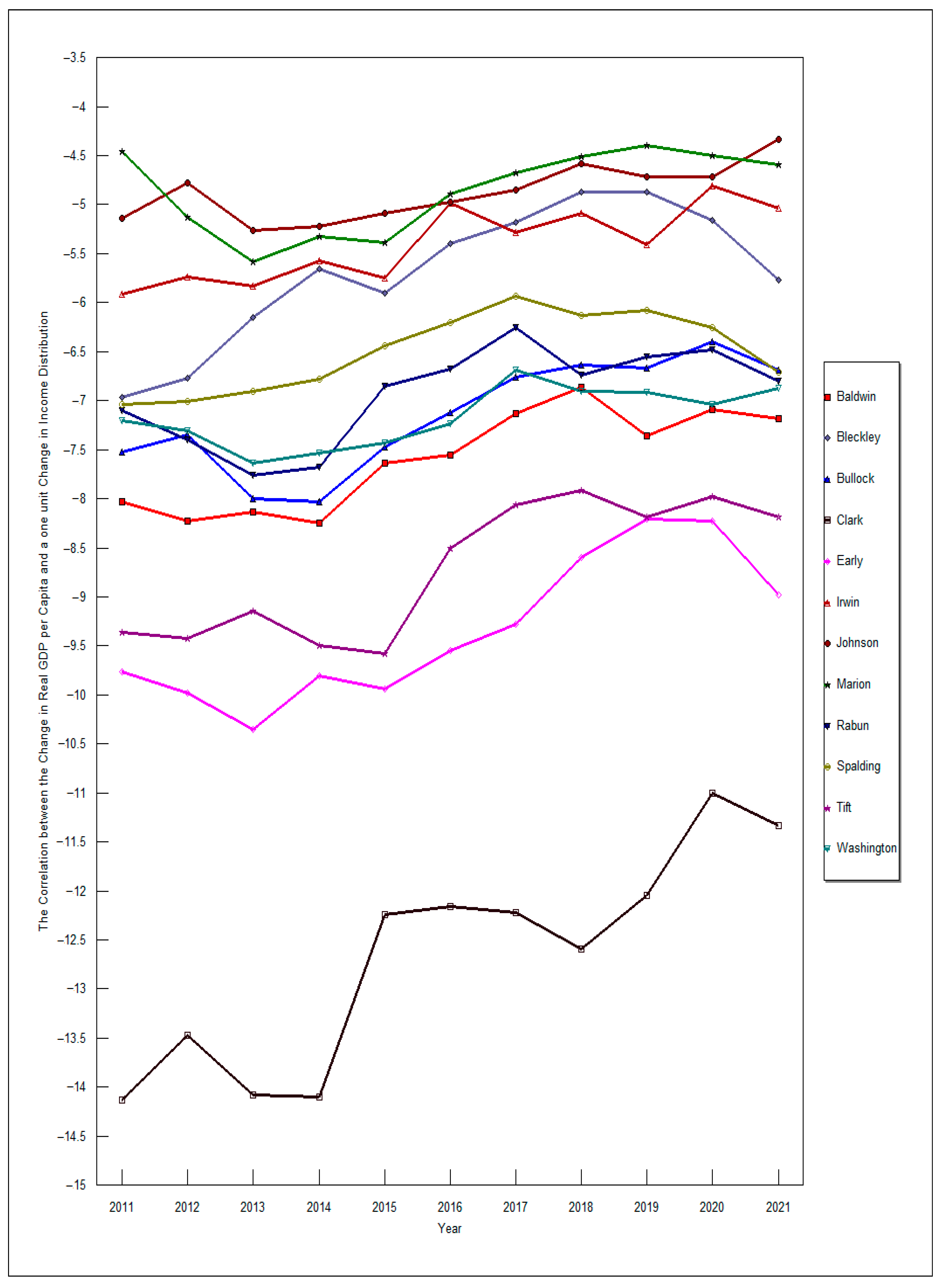
Figure 1 shows the RTPLS estimates over time for the 12 counties that had a statistically significant increase in d(Real GDP Per Capita)/d(Income Inequality). These counties are scattered through the state of Georgia, stretching from Early County in the Southwest corner to Rabun in the Northeast corner of the state. They include Clarke County, in which the city of Athens and the University of Georgia are located. However, they include no counties in the metropolitan areas of Atlanta or Augusta, the two largest cities in Georgia.
Only 12 counties of Georgia’s 159 counties experienced a statistically significant rise in d(Real GDP Per Capita)/d(Income Inequality) between 2011 and 2021. Thus, these are the exceptions. Even for these 12 exceptions, Figure 1 shows that 10 of them had falling d(Real GDP Per Capita)/d(Income Inequality) between 2020 and 2021. This 2021 fall in d(Real GDP Per Capita)/d(Income Inequality) in these (and in many other counties) could be due to the pandemic increasing the negative impact of inequality on per capita GDP.
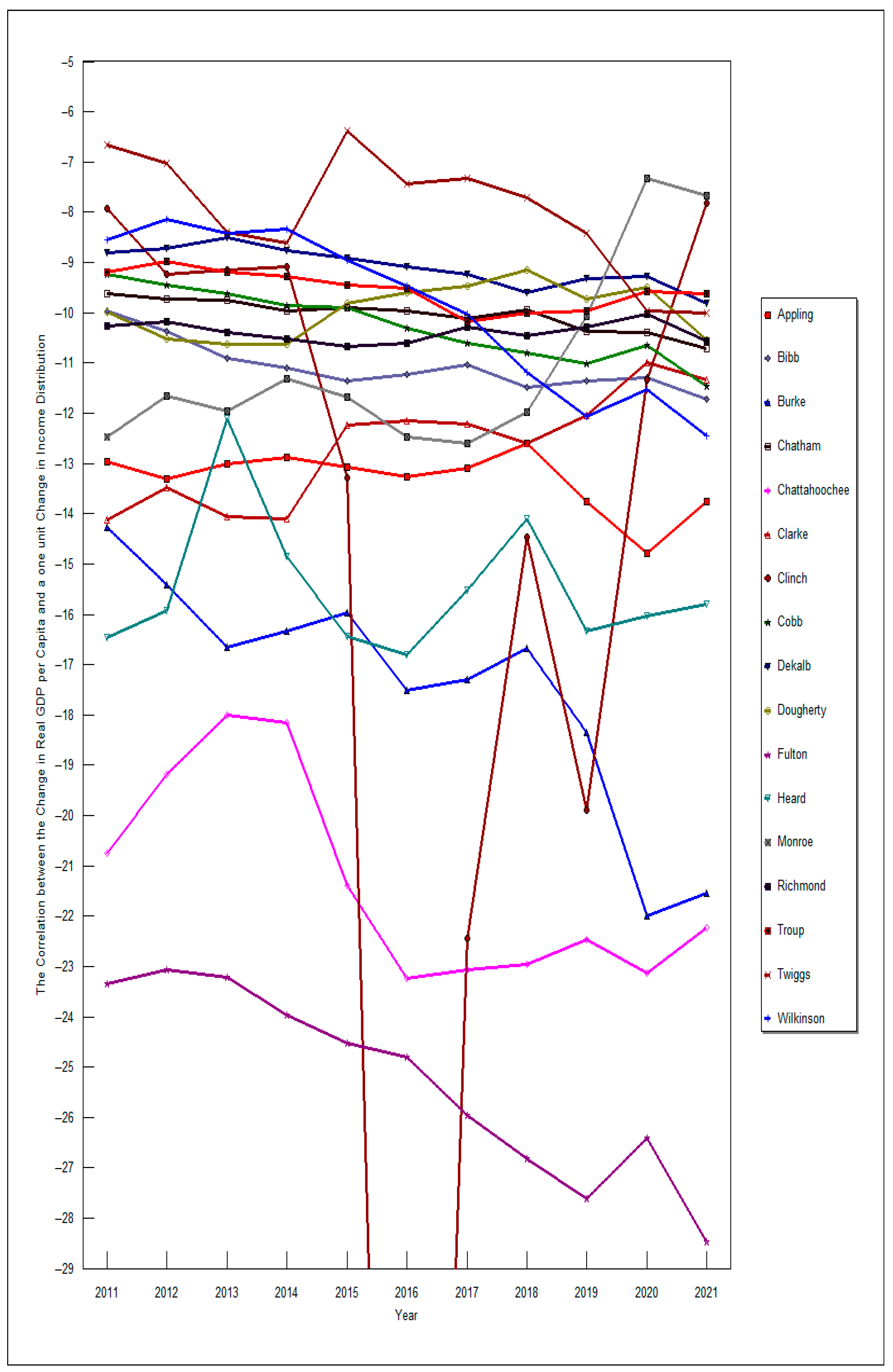
Figure 2 shows the d(Real GDP Per Capita)/d(Income Inequality) values over time for the 17 counties that had the lowest estimates. The estimate for Clinch County in 2016 is below the bottom of Figure 2. According to our data source, inequality in Clinch County was 7.0 in 2014, rose to 8.8 in 2015, and rose again to 12.0 (the maximum inequality measurement in our data) before falling to 10.5 in 2017. Clinch County’s d(Real GDP Per Capita)/d(Income Inequality) 2016 estimate of −56.94 (the lowest estimate in our analysis) implies that if Clinch’s inequality measurement had been 11.9 (instead of 12) in 2016 then Clinch County’s real per capita GDP would have been associated with US$ 5694 more (US$ 40,962 instead of US$ 35,268 for a 16 percent increase). These calculations are based upon the reported data; however, we wonder if there is an error in the reported data. To test the robustness of our results, we redid the analysis after deleting all of the Clinch County observations. In the analysis without Clinch, the estimated α0 was 24.3746, which, when inserted into Equation (8), produces Equation (11).
(dYt/dXt)^ = Yt/Xt + 24.3746/Xt
Plugging Y and X into Equation (11) and multiplying the result by (−1) would produce estimates that are slightly lower (more negative) than the estimates reported in Appendix A, which were based on Equation (10) for which the estimated α0 was 21.6690.
The lowest line in Figure 2 that does not extend beyond the bottom of this graph is for Fulton County, the county for downtown Atlanta. Downtown Atlanta is known for its large homeless population. Our inequality measurement for Fulton County was 6.3 in 2011 and fell to 5.9 in 2021. In spite of this drop in inequality, Fulton County’s d(Real GDP Per Capita)/d(Income Inequality) fell from −23.34 in 2011 to −28.48 in 2021—the lowest estimates for any county other than for Clinch County in 2016.
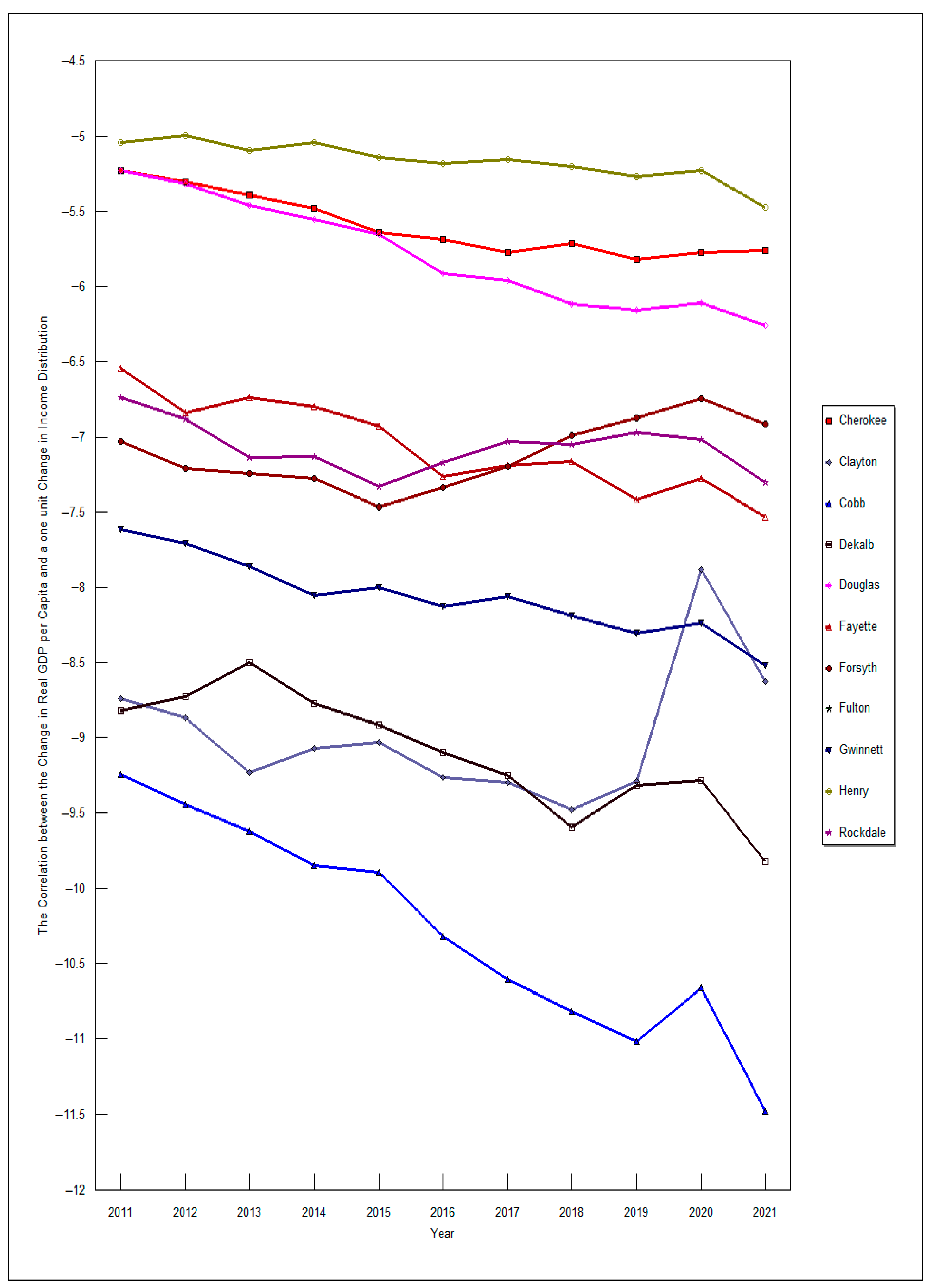
Figure 3 depicts the RTPLS estimates over time for d(Real GDP Per Capita)/d(Income Inequality) for the counties that make up the Atlanta metropolitan area (other than Fulton’s, which was in Figure 2). Figure 3 shows that the counties that make up a major metropolitan area can have statistically significant different estimates for d(Real GDP Per Capita)/d(Income Inequality). As Appendix A shows, the 2017 to 2021 confidence interval for Henry County was −5.40 to −5.13, for Cobb County was −11.31 to −10.52, and for Fulton County was −28.17 to −25.95. Furthermore, seven of the Atlanta counties had statistically significant (at a 95% confidence level) falls in d(Real GDP Per Capita)/d(Income Inequality) between 2011 to 2015 and 2017 to 2021: Cherokee, Cobb, Dekalb, Douglas, Fayette, Fulton, and Gwinnett.
Given the statistically significant differences in d(Real GDP Per Capita)/d(Income Inequality) between different counties and over time shown in Appendix A, an important question is as follows: “What is driving these differences?” In a first effort to address this question, we regressed our estimates of d(Real GDP Per Capita)/d(Income Inequality) versus the percent of the population who have completed some college education, who are unemployed, who are below the age of 18, who are above the age of 65, who are Black, and who are Hispanic, as well as the percent of the county that is rural. The results of this regression are given in Table 2.
This regression only explained 14.6 percent of the variation in the RTPLS estimates of d(Real GDP Per Capita)/d(Income Inequality). However, all of the independent variables are statistically significant at a greater than 99% confidence level except for the percentage of the population who are over 65 years of age (the student T test limits for a 90%, 95%, and 99% confidence level for 1000 observations are, respectively, 1.646, 1.962, and 2.581).

4. Results Using Traditional Regression Methods

We compare our results from RTPLS to a traditional fixed effects panel estimation with county and year fixed effects. The results are provided in Table 3. In the baseline specification (Column 1), using the independent variables described previously, income inequality is insignificantly associated with real GDP per capita. Counties with a higher percentage of the population with some college education are associated with higher levels of real GDP per capita. Rural counties and those with higher unemployment rates are associated with lower real GDP per capita. When income inequality is interacted with the other independent variable, none of the interactions are significantly different from zero (Column 2). When each of the independent variables is lagged by one year, none of the signs from the baseline model change (Column 3). Column 4 provides the results of the Arellano-Bond dynamic panel estimator. The coefficient on the inequality term is negative and significant. In this estimation, some of the demographic variables become significant.
We also provide quartile regression results over the distribution of real GDP per capita using the same fixed effects model as in Table 3. The results of the quartile regressions are shown in Table 4 and display some heterogeneity with respect to the relationship between income inequality and real GDP per capita. The coefficients on income inequality are negative for three of the four quartiles, although only the coefficient for the second quartile is significant (and negative).
In terms of the estimated signs on the coefficients, these traditional regression results support our RTPLS assumption of a negative relationship between real per capita GDP and inequality (except for quartile 3 of the quartile regression). Granted, most of these traditional regression coefficients are statistically insignificant. One possible explanation for the statistically insignificant signs on inequality for the traditional regression results is that omitted variables affect the relationship between real per capita GDP and inequality, driving up standard errors, producing statistically insignificant results. RTPLS produces estimates that reflect the influence of omitted variables found statistically significant relationships between real per capita GDP and inequality.
Notice that the absolute value of the RTPLS estimates is numerically larger than the absolute value of the traditional regression results. This is to be expected because traditional regressions produce partial derivatives that hold all other included independent variables constant; RTPLS produces total derivatives, holding nothing else constant. Thus, when the fixed effects regressions reported in Table 3 found some of the other included independent variables statistically significant, any correlation between those variables and inequality would be reflected in the RTPLS estimates.
The statistically significant strong correlations between the independent variables shown in Table 2 versus the statistically insignificant interaction terms shown in Column 2 of Table 3 imply that using interaction terms for a partial derivative analysis cannot replicate or replace an analysis of what variables are correlated with total derivatives. It is important to remember that RTPLS and traditional regressions are not substitutes for each other—they are complements in that they produce different types of information.
Notice that the coefficients reported in Table 4 are noticeably different for the four quartiles. This implies that different layers (in this case, quartiles) of the data are associated with different relationships between real per capita GDP and inequality (and other independent variables). However, quartile analysis divides the data into an arbitray four layers. Recall that part of the RTPLS process involves peeling the data down layer by layer and then peeling it up layer by layer. In contrast to quartile analysis, which uses just four layers, RTPLS utilizes as many layers as the data can handle. Thus, RTPLS estimates are less “arbitrary” and can better reflect differences in relationships between different layers of the data.

5. Discussion

Limitations of this paper include the following. We only used data for the state of Georgia from 2011 to 2021, and similar results might not be found for other states or countries or for different time periods. Georgia, being a southern state, makes it different from a northern or western state. Replication of our study using data from other states or countries would be advisable. Second, we only used one income inequality measurement, and that measurement was derived from a 5-year rolling average. Other inequality measurements that are not derived from a 5-year rolling average may produce different results. In our defense, we used the only inequality measurement that County Health Rankings & Roadmaps publishes at the county level for the state of Georgia. We believe that the inequality measurement that we used may have smoothed our results, which makes the statistically significant differences that we found even more notable.
Third, the dependent variable for the regression reported in Table 2 is an RTPLS estimate, and not directly observable. This produces some statistical problems that are beyond our expertise to solve. Thus, the results shown in Table 2 should be viewed with some skepticism. Furthermore, this regression only explained 14.6 percent of the variation in the RTPLS estimates of d(Real GDP Per Capita)/d(Income Inequality), which implies that this regression itself may suffer from omitted variables. It is important to remember that the results in Table 2 are not our primary findings; our primary findings are presented in Appendix A and depicted in the figures.
Fourth, and most importantly, a major limitation of RTPLS is that it cannot reveal the mechanisms through which the independent variable is related to the dependent variable. Thus, RTPLS is not a substitute for the creation and estimation of structural models—RTPLS is a complement. RTPLS can reveal heteroscedastic trends that the creators of structural models may wish to consider when building their models.
This paper contributed to the literature in several important ways. Previous RTPLS publications derive Equation (8), which underlies the RTPLS process, assuming a linear relationship between the dependent variable (Y) and the known independent variable (X). This paper shows that the exact same Equation (8) can be derived when a “U” shaped or an “inverted U” shape between Y and X is assumed (these shapes require that both X and X2 be used in the equation). It is easy to extend the derivations of Section 2 to show that the RTPLS process is the same as long as the relationship between Y and X can be expressed as a polynomial. Furthermore, the exact form of the polynomial describing the relationship between Y and X does not need to be determined—putting just X, or X and X2, or X, X2, … Xn on the right-hand side of Equation (1) does not change Equation (8).
Second, this is the first paper to find total derivative estimates (denoted “dY/dX”) of the relationship between inequality and growth using Reiterative Truncated Projected Least Squares (RTPLS). The inequality and growth literature consists primarily of theoretical papers and empirical estimates of partial derivatives (denoted “∂Y/∂X”). Partial derivative estimates find slope estimates holding all other included independent variables constant. When estimating the partial derivative relationship between inequality and growth, many researchers include the percent of the population with some college education, who are unemployed, who are under the age of 18, who are over the age of 65, who are Black, and who are Hispanic. Instead of using a technique that holds these variables (and the percentage of the county that is rural) constant, we held none of these variables constant and found total derivatives for the relationship between inequality and growth.
However, after finding total derivatives for d(Real GDP Per Capita)/d(Income Inequality), we then regressed those total derivative estimates on the independent variables usually held constant when estimating partial derivatives for the effects of inequality on growth. We found that six of the seven independent variables listed in Table 2 have a statistically significant effect (at a 99% confidence level) on d(Real GDP Per Capita)/d(Income Inequality). In contrast to most partial derivative estimates in the literature, our results show that the negative effect of inequality on real GDP becomes more negative as the percent of the population with some college education, who are unemployed, who are Black, and who are Hispanic increases.
Third, our paper finds estimates for how this time period’s inequality affects this time period’s real GDP; the literature is dominated by studies that show how inequality in past time periods affects present real GDP.2 Fourth, our paper is the first to find that d(Real GDP Per Capita)/d(Income Inequality) varies significantly (at a 95% level) between different Georgia counties and (for approximately 30 percent of the counties) over time.
When interpreting our results, it is important to remember that both traditional regression analysis and RTPLS find (1) estimates of marginal effects and (2) correlations—neither shows what would happen if there were large changes in the independent variables, and neither proves causality. Concerning marginal effects, we recognize that the Khmer Rouge, driving Cambodia’s entire urban population into rural areas (making all cities into ghost towns in 1975), led to massive starvation and economic devastation. Likewise, China’s colleges and universities being shut down during the Cultural Revolution dramatically reduced China’s GDP and potential GDP for decades. Moreover, we know what happened when everyone shipwrecked on an island was under 18 years old in Golding’s (1954) book, Lord of the Flies.
Most importantly, we see the regression results shown in Table 2 as showing correlations, not direct causations. The fact that the estimated relationship between inequality and per capita real GDP becomes more negative as the percent of the population that is Black or Hispanic increases does not imply that reducing these populations would make inequality less harmful. Instead, we suspect that discrimination, unequal access to opportunity, and distrust between racial groups augment the negative effects of inequality on per capita real GDP. Thus, if discrimination were reduced and Black and Hispanic workers faced the same opportunities and compensation as similarly productive white workers, then we believe that the negative effects of any remaining inequality would be less.
Likewise, we suspect that Table 2 result that shows that inequality in more rural counties have a smaller negative effect on real per capita GDP than in more urban areas is due to frictions that can be more pronounced in large urban areas, such as high housing costs (Fee, 2025), neighborhood segregation (Nilforoshan et al., 2023), crime (Glaeser & Sacerdote, 1999), and lower interpersonal trust (Fallah & Partridge, 2007); all of which may augment the negative effects of inequality on local economic performance. Thus, we suspect that if large cities could be made safer, less segregated, and more integrated economically, then the negative correlation between inequality and real per capita GDP would be less.
We should also not interpret Table 2’s result on “some college” as implying that education should be reduced to weaken the negative relationship between inequality and per capita real GDP. Instead, we suspect that the “some college” variable may be proxying for other county characteristics that are correlated with education, such as urbanization, industrial structure, occupational polarization, the dispersion of wages and returns to skill, or many employers requiring college degrees, even when having a college degree would not increase an employee’s productivity. Thus, the more negative correlation in higher-education counties may reflect that inequality is more economically damaging in settings where differences in earnings potential and the sorting of workers across jobs are larger, not that education itself is harmful.
We suspect that the negative correlation between inequality and per capita GDP is less as the percent of the population under the age of 18 increases because consumption drives investment and people with children consume more of their income than those without children, ceteris paribus. This reasoning fits with the pro-equality theoretical literature cited in our introduction.
This discussion merely speculates on possible reasons for the results given in Table 2. Future research is needed to test these speculations by incorporating additional measures (e.g., crime, housing costs, segregation, social capital, or industrial composition). Finally, this paper used data from only one state of the USA; future research examining other states and other countries would be helpful.
However, our most important conclusion is not dependent on Table 2. Our most important conclusion is that for all Georgia counties, there is a strong negative correlation between income inequality and per capita GDP, and for many counties, that negative correlation is getting stronger over time. Our findings are consistent with the view that areas with lower inequality tend to have higher per capita GDP, but causal policy conclusions require the construction of correctly specified and estimated structural models. These structural models would have to include every force that could affect per capita GDP and income distribution, including interest rates, exchange rates, relative prices, discrimination, fiscal policy, monetary policy, trade policy, tariff rates, population growth, etc.

Author Contributions

Conceptualization and methodology, J.E.L.; formal analysis, J.E.L. and S.M.; data curation, K.A.; writing—original draft preparation, J.E.L. and K.A.; writing—review and editing, J.E.L., K.A. and S.M.; visualization, J.E.L.; supervision, J.E.L. All authors have read and agreed to the published version of the manuscript.

Funding

This research received no external funding.

Institutional Review Board Statement

Not applicable.

Informed Consent Statement

Not applicable.

Data Availability Statement

The data used in this paper are freely available from the Bureau of Economic Analysis and from County Health Rankings & Roadmaps (CHR&R).

Conflicts of Interest

The authors declare no conflicts of interest.

Appendix A. RTPLS Estimates of d(Real per Capita GDP)/d(Income Inequality for Georgia Counties)

County2011201220132014201520162017201820192020202195%Confidence 2011–201595%Confidence 2017–2021
Appling, GA−12.98−13.31−13.00−12.89−13.08−13.28−13.09−12.61−13.76−14.79−13.75−13.23−12.87−14.52−12.69
Atkinson, GA−6.02−5.94−5.98−6.00−5.54−5.55−5.77−5.66−5.95−5.57−5.26−6.12−5.67−5.93−5.36
Bacon, GA−7.64−6.73−6.56−6.68−6.74−6.72−7.37−7.25−6.95−6.75−6.86−7.35−6.39−7.33−6.75
Baker, GA−7.83−7.95−7.35−6.61−6.39−6.49−6.47−8.02−6.62−6.55−12.02−8.01−6.44−10.57−5.30
Baldwin, GA−8.03−8.23−8.13−8.25−7.64−7.56−7.13−6.86−7.36−7.09−7.19−8.33−7.78−7.33−6.93
Banks, GA−4.40−4.65−4.80−5.19−5.07−4.96−5.30−5.66−5.72−5.15−5.51−5.18−4.47−5.73−5.20
Barrow, GA−4.81−4.89−5.04−5.05−5.13−5.14−5.21−5.34−5.31−5.24−5.39−5.13−4.84−5.38−5.21
Bartow, GA−7.64−7.06−7.17−7.61−7.59−7.74−7.84−7.88−7.86−7.60−7.72−7.72−7.11−7.91−7.65
Ben Hill, GA−7.10−7.86−8.15−8.08−6.79−6.33−6.42−6.70−7.07−7.13−7.50−8.28−6.92−7.42−6.51
Berrien, GA−6.16−5.91−5.87−5.67−5.24−5.53−5.30−5.30−6.00−6.09−6.14−6.15−5.38−6.24−5.29
Bibb, GA−9.98−10.38−10.91−11.11−11.36−11.24−11.03−11.49−11.36−11.29−11.72−11.37−10.13−11.66−11.09
Bleckley, GA−6.96−6.77−6.15−5.66−5.91−5.39−5.19−4.87−4.87−5.16−5.77−6.91−5.67−5.58−4.77
Brantley, GA−3.99−3.99−3.97−4.05−4.08−4.64−4.37−4.91−4.35−4.76−5.26−4.07−3.97−5.16−4.31
Brooks, GA−5.51−4.87−5.06−5.12−5.14−5.78−6.38−5.88−7.20−6.83−6.73−5.40−4.88−7.16−6.05
Bryan, GA−4.94−4.95−4.88−5.01−5.56−5.65−5.58−5.19−4.98−4.71−5.06−5.38−4.76−5.46−4.75
Bulloch, GA−7.53−7.35−8.00−8.04−7.48−7.12−6.76−6.64−6.67−6.40−6.69−8.03−7.33−6.78−6.48
Burke, GA−14.28−15.41−16.66−16.33−15.97−17.52−17.30−16.68−18.36−22.00−21.54−16.77−14.69−21.90−16.45
Butts, GA−4.92−5.22−5.61−5.69−5.72−5.49−5.56−5.49−5.34−5.09−5.80−5.82−5.04−5.75−5.16
Calhoun, GA−6.70−6.44−5.64−5.22−5.35−5.14−5.18−5.09−5.48−5.84−5.88−6.61−5.14−5.89−5.09
Camden, GA−6.90−6.45−6.43−6.41−6.33−6.55−6.81−6.67−6.68−6.63−6.37−6.75−6.25−6.81−6.46
Candler, GA−5.76−6.35−5.89−5.88−6.42−5.89−6.42−5.94−6.27−6.14−6.19−6.39−5.73−6.39−6.00
Carroll, GA−6.89−6.90−6.88−6.79−6.68−6.93−6.84−7.16−7.30−8.29−8.07−6.93−6.72−8.22−6.84
Catoosa, GA−4.87−4.90−4.94−4.88−4.96−4.87−4.87−4.91−4.95−4.77−5.07−4.95−4.87−5.04−4.79
Charlton, GA−4.59−4.92−4.32−4.42−4.93−5.39−4.55−4.59−5.06−4.77−4.80−4.95−4.32−4.98−4.53
Chatham, GA−9.62−9.74−9.75−9.98−9.90−9.96−10.11−9.95−10.38−10.39−10.71−9.95−9.64−10.63−9.99
Chattahoochee−20.76−19.20−18.01−18.17−21.40−23.24−23.07−22.97−22.47−23.13−22.23−21.20−17.82−23.22−22.33
Chattooga, GA−4.90−5.01−5.28−5.39−5.56−5.45−5.35−5.40−5.09−4.71−4.84−5.53−4.93−5.42−4.74
Cherokee, GA−5.23−5.31−5.39−5.48−5.64−5.68−5.78−5.72−5.82−5.77−5.76−5.58−5.23−5.81−5.73
Clarke, GA−14.13−13.48−14.07−14.10−12.25−12.16−12.22−12.59−12.05−11.00−11.33−14.50−12.71−12.57−11.11
Clay, GA−5.39−5.13−6.07−5.52−6.46−6.41−5.53−6.48−6.31−6.62−5.26−6.31−5.12−6.71−5.36
Clayton, GA−8.74−8.87−9.23−9.07−9.03−9.27−9.30−9.48−9.29−7.88−8.63−9.20−8.78−9.65−8.18
Clinch, GA−7.92−9.25−9.14−9.09−13.29−56.94−22.45−14.46−19.91−11.34−7.84−12.02−7.46−21.87−8.53
Cobb, GA−9.25−9.44−9.62−9.85−9.90−10.32−10.60−10.81−11.02−10.66−11.48−9.92−9.31−11.31−10.52
Coffee, GA−6.08−6.11−6.82−6.89−7.34−6.82−6.80−7.40−7.93−7.47−7.57−7.25−6.05−7.89−6.98
Colquitt, GA−6.30−6.15−6.03−5.89−6.23−6.34−6.82−7.46−7.75−7.60−7.58−6.30−5.94−7.84−7.04
Columbia, GA−5.02−5.08−5.10−5.10−5.03−5.13−5.10−5.25−5.33−5.38−5.40−5.11−5.02−5.42−5.16
Cook, GA−5.25−5.09−5.07−5.19−5.20−5.46−5.62−5.79−6.75−6.30−5.84−5.25−5.07−6.57−5.55
Coweta, GA−5.38−5.39−5.56−5.72−5.83−5.91−5.98−6.03−6.40−6.31−6.31−5.80−5.35−6.41−6.00
Crawford, GA−4.21−3.69−3.86−3.98−4.35−4.57−5.02−4.38−4.22−4.12−4.17−4.31−3.72−4.79−3.97
Crisp, GA−7.14−7.32−8.21−8.36−8.14−7.88−8.75−9.37−9.57−9.06−9.87−8.45−7.21−9.81−8.84
Dade, GA−4.85−4.97−4.84−4.84−5.45−5.29−5.02−5.21−5.12−5.07−5.43−5.28−4.70−5.35−4.99
Dawson, GA−6.22−6.25−6.26−6.37−6.39−5.91−6.31−6.23−6.20−5.78−6.00−6.39−6.21−6.34−5.86
Decatur, GA−7.08−7.34−7.44−7.02−7.68−7.23−6.19−6.26−6.62−7.08−7.55−7.61−7.01−7.38−6.10
DeKalb, GA−8.82−8.73−8.50−8.77−8.91−9.09−9.25−9.60−9.32−9.29−9.82−8.92−8.58−9.73−9.18
Dodge, GA−6.12−6.28−5.73−5.67−5.86−6.06−5.50−5.51−5.79−5.92−5.73−6.22−5.64−5.89−5.49
Dooly, GA−6.16−5.68−5.55−5.40−6.13−6.79−7.36−6.99−8.15−7.26−7.07−6.17−5.40−7.88−6.85
Dougherty, GA−9.99−10.52−10.64−10.64−9.81−9.60−9.47−9.16−9.74−9.50−10.55−10.75−9.89−10.27−9.10
Douglas, GA−5.23−5.32−5.46−5.55−5.65−5.91−5.96−6.12−6.15−6.11−6.26−5.63−5.25−6.24−6.00
Early, GA−9.77−9.98−10.36−9.80−9.94−9.55−9.28−8.60−8.21−8.22−8.98−10.23−9.71−9.18−8.13
Echols, GA−4.10−3.93−4.32−4.31−4.38−4.16−4.27−4.47−4.96−4.08−3.94−4.42−4.00−4.78−3.90
Effingham, GA−6.16−6.20−5.82−5.62−5.71−5.96−5.89−5.70−5.72−5.84−5.67−6.19−5.61−5.87−5.66
Elbert, GA−6.10−6.25−6.74−6.83−7.38−6.74−6.79−7.28−6.91−6.70−7.12−7.23−6.10−7.22−6.70
Emanuel, GA−6.16−6.09−6.23−6.21−6.51−6.38−6.83−6.54−6.55−6.23−6.20−6.42−6.06−6.76−6.18
Evans, GA−7.03−7.12−7.02−7.14−7.45−8.36−8.38−7.82−7.51−7.08−6.93−7.34−6.96−8.19−6.89
Fannin, GA−5.68−5.80−5.66−5.78−5.79−5.88−5.87−6.03−6.26−5.77−6.09−5.82−5.67−6.22−5.79
Fayette, GA−6.55−6.84−6.74−6.80−6.93−7.27−7.19−7.16−7.42−7.28−7.53−6.93−6.61−7.49−7.15
Floyd, GA−7.82−7.90−7.89−8.14−7.89−8.18−7.77−7.81−7.90−7.79−7.99−8.06−7.79−7.95−7.75
Forsyth, GA−7.03−7.21−7.24−7.28−7.47−7.34−7.20−6.99−6.87−6.75−6.92−7.42−7.07−7.13−6.76
Franklin, GA−6.25−6.64−6.87−7.27−7.85−7.76−7.95−8.33−7.71−7.20−8.53−7.66−6.30−8.53−7.36
Fulton, GA−23.34−23.06−23.21−23.97−24.53−24.81−25.97−26.82−27.62−26.41−28.48−24.30−22.94−28.17−25.95
Gilmer, GA−5.20−5.49−5.87−6.06−6.00−5.68−5.88−5.79−5.62−5.46−6.03−6.14−5.31−6.00−5.51
Glascock, GA−3.92−3.61−3.66−3.59−3.95−4.08−4.25−4.35−4.11−4.35−3.78−3.94−3.55−4.43−3.90
Glynn, GA−8.85−8.65−8.75−8.70−9.05−8.70−8.92−8.70−8.46−8.19−8.81−8.98−8.62−8.94−8.29
Gordon, GA−6.61−6.54−6.51−6.58−6.54−6.64−7.13−7.02−7.72−7.02−7.46−6.60−6.51−7.61−6.93
Grady, GA−6.34−5.82−5.48−5.29−5.45−5.56−5.96−5.85−6.18−6.14−5.70−6.14−5.21−6.19−5.74
Greene, GA−7.56−8.19−8.47−8.79−8.84−8.62−8.72−9.62−9.25−8.65−8.70−8.95−7.79−9.47−8.51
Gwinnett, GA−7.61−7.70−7.86−8.05−8.00−8.13−8.07−8.19−8.31−8.24−8.52−8.06−7.64−8.45−8.08
Habersham, GA−6.20−6.04−6.10−6.22−6.56−6.47−6.50−6.51−6.24−6.25−6.26−6.45−6.00−6.50−6.20
Hall, GA−7.65−7.57−7.74−7.99−8.06−8.08−8.54−8.66−8.83−8.87−9.22−8.04−7.56−9.11−8.54
Hancock, GA−5.22−5.04−5.22−5.16−5.42−5.41−4.88−4.93−5.11−5.58−5.41−5.37−5.06−5.52−4.84
Haralson, GA−6.36−6.13−5.99−6.10−6.45−6.35−6.45−6.53−6.42−6.08−6.81−6.42−5.99−6.75−6.17
Harris, GA−4.31−4.11−4.34−4.36−4.43−4.23−4.38−4.15−4.00−3.92−4.01−4.45−4.18−4.29−3.89
Hart, GA−6.51−6.62−6.50−6.72−6.39−6.43−6.46−7.16−6.95−6.33−6.29−6.69−6.41−7.07−6.20
Heard, GA−16.47−15.93−12.11−14.86−16.45−16.81−15.51−14.11−16.33−16.04−15.80−17.19−13.13−16.52−14.60
Henry, GA−5.04−5.00−5.10−5.04−5.14−5.18−5.16−5.20−5.27−5.23−5.47−5.13−5.00−5.40−5.13
Houston, GA−7.50−7.67−7.57−7.45−7.60−7.48−7.58−7.75−7.63−7.36−7.47−7.65−7.47−7.72−7.39
Irwin, GA−5.92−5.74−5.84−5.57−5.75−4.99−5.29−5.09−5.41−4.82−5.04−5.91−5.62−5.38−4.87
Jackson, GA−6.20−6.79−6.87−7.01−7.27−7.32−7.53−7.44−7.60−7.64−7.78−7.27−6.39−7.74−7.46
Jasper, GA−4.42−4.75−4.63−4.69−4.79−4.64−4.62−4.44−4.51−4.31−4.65−4.82−4.50−4.66−4.35
Jeff Davis, GA−5.72−5.75−5.85−5.88−6.16−5.81−5.71−5.78−6.25−6.03−7.24−6.07−5.67−6.89−5.51
Jefferson, GA−6.68−6.85−7.28−7.08−7.15−7.50−7.50−7.67−7.14−7.85−7.01−7.27−6.74−7.83−7.04
Jenkins, GA−5.13−4.97−5.20−5.12−4.96−5.13−4.55−4.74−4.74−5.10−5.61−5.19−4.96−5.41−4.48
Johnson, GA−5.14−4.78−5.26−5.22−5.09−4.98−4.85−4.58−4.71−4.72−4.33−5.31−4.88−4.86−4.42
Jones, GA−4.09−4.20−4.36−4.38−4.35−4.38−4.42−4.21−4.42−4.32−4.26−4.42−4.13−4.43−4.22
Lamar, GA−5.04−5.57−6.05−6.03−6.31−6.11−5.91−5.26−5.55−5.31−5.09−6.36−5.24−5.78−5.07
Lanier, GA−4.74−4.87−5.23−5.32−6.36−6.23−6.11−5.50−5.17−5.12−4.70−6.01−4.60−5.91−4.73
Laurens, GA−8.95−7.84−8.17−8.01−7.56−7.75−7.98−8.33−8.41−9.03−9.37−8.69−7.52−9.25−7.99
Lee, GA−4.52−4.61−4.63−4.57−4.34−4.49−4.45−4.32−4.40−4.47−4.66−4.66−4.41−4.60−4.32
Liberty, GA−9.64−9.20−8.93−8.44−8.45−8.36−8.27−8.50−8.44−8.39−8.54−9.50−8.36−8.55−8.31
Lincoln, GA−5.25−5.03−4.83−4.79−5.20−5.38−5.60−5.61−4.92−4.82−4.63−5.25−4.79−5.62−4.61
Long, GA−3.46−3.53−3.44−3.45−3.64−3.62−3.63−4.12−4.37−3.65−3.70−3.60−3.41−4.26−3.52
Lowndes, GA−7.91−8.07−8.25−8.29−8.90−9.79−9.43−9.00−9.58−8.48−8.47−8.70−7.87−9.56−8.42
Lumpkin, GA−5.47−5.76−5.72−5.73−5.53−5.44−5.44−5.92−6.19−5.89−6.30−5.79−5.50−6.32−5.58
McDuffie, GA−7.03−6.30−6.43−6.51−6.35−6.75−6.42−7.22−8.38−7.99−7.82−6.85−6.20−8.41−6.72
McIntosh, GA−4.44−4.55−4.69−4.77−5.03−4.98−5.11−4.80−5.18−5.23−4.92−4.95−4.44−5.25−4.85
Macon, GA−6.09−5.99−5.99−6.22−6.53−6.40−6.44−6.66−6.25−5.81−6.44−6.41−5.91−6.67−5.96
Madison, GA−4.51−4.76−4.91−5.14−5.25−5.11−4.95−4.70−4.46−4.44−4.77−5.24−4.59−4.91−4.42
Marion, GA−4.45−5.13−5.59−5.33−5.38−4.90−4.67−4.51−4.40−4.50−4.59−5.66−4.69−4.65−4.42
Meriwether, GA−5.41−5.76−5.86−5.89−5.95−6.22−6.51−6.65−6.69−6.31−6.16−6.01−5.54−6.72−6.22
Miller, GA−7.16−6.85−6.51−6.08−6.12−6.67−6.74−8.17−8.25−8.84−8.80−7.06−6.03−9.10−7.22
Mitchell, GA−7.24−7.84−7.79−7.87−7.05−6.35−6.16−6.23−7.12−8.23−7.81−7.98−7.13−8.14−6.09
Monroe, GA−12.48−11.65−11.97−11.32−11.68−12.47−12.61−11.99−10.07−7.32−7.68−12.30−11.34−12.62−7.25
Montgomery, GA−4.93−4.95−4.83−4.81−5.03−5.33−5.15−4.74−5.28−5.09−4.42−5.01−4.81−5.33−4.55
Morgan, GA−6.18−6.37−6.32−6.56−7.03−7.13−7.11−6.96−7.58−7.73−8.04−6.86−6.12−7.98−6.99
Murray, GA−6.02−6.00−5.64−5.59−5.68−6.01−5.86−5.58−5.70−5.74−6.16−6.02−5.55−6.06−5.56
Muscogee, GA−9.20−8.95−8.81−8.90−9.42−9.32−9.59−9.58−9.18−8.92−9.16−9.33−8.78−9.61−8.96
Newton, GA−5.02−5.29−5.39−5.38−5.63−5.62−5.61−5.62−5.50−5.44−5.48−5.59−5.10−5.62−5.44
Oconee, GA−5.63−5.91−5.87−6.14−6.39−6.28−6.23−6.38−6.54−6.32−6.67−6.31−5.67−6.62−6.23
Oglethorpe, GA−4.18−4.54−4.56−4.89−4.87−5.03−5.09−5.45−5.13−4.74−5.05−4.93−4.29−5.37−4.81
Paulding, GA−3.82−4.03−4.04−4.04−4.13−4.14−4.17−4.12−4.14−4.08−4.14−4.14−3.88−4.16−4.10
Peach, GA−6.83−6.36−6.65−7.03−6.98−6.93−7.54−7.77−7.69−7.67−7.25−7.07−6.47−7.81−7.36
Pickens, GA−5.86−5.52−5.81−6.04−5.94−6.05−5.93−5.95−6.00−5.79−6.15−6.05−5.61−6.11−5.82
Pierce, GA−4.71−4.90−5.29−5.24−5.48−5.16−5.11−4.93−4.90−4.93−5.32−5.47−4.78−5.23−4.84
Pike, GA−3.93−4.25−4.25−4.25−4.51−4.57−4.30−4.19−4.31−4.24−4.57−4.46−4.01−4.48−4.16
Polk, GA−5.53−5.51−5.67−5.80−5.71−5.96−5.83−5.92−6.02−6.11−6.36−5.78−5.51−6.27−5.82
Pulaski, GA−5.41−5.32−6.01−5.88−6.25−6.41−6.45−7.50−6.93−6.30−6.82−6.21−5.34−7.32−6.28
Putnam, GA−7.51−6.14−6.35−6.37−5.40−5.16−5.27−5.33−5.47−5.39−5.80−7.20−5.51−5.68−5.22
Quitman, GA−4.23−4.53−4.71−4.61−4.86−5.23−5.11−4.20−4.61−4.67−4.84−4.85−4.33−5.06−4.31
Rabun, GA−7.11−7.40−7.76−7.68−6.85−6.68−6.25−6.73−6.56−6.48−6.81−7.78−6.93−6.81−6.32
Randolph, GA−5.71−6.65−6.28−6.24−5.81−5.67−5.04−5.36−5.84−5.62−6.56−6.57−5.72−6.32−5.04
Richmond, GA−10.26−10.17−10.39−10.52−10.68−10.60−10.29−10.46−10.29−10.03−10.56−10.63−10.18−10.55−10.11
Rockdale, GA−6.74−6.88−7.14−7.13−7.33−7.17−7.03−7.05−6.97−7.02−7.30−7.30−6.79−7.22−6.93
Schley, GA−7.13−6.59−6.40−6.14−5.56−5.92−5.90−6.18−5.53−7.83−5.78−7.01−5.72−7.26−5.22
Screven, GA−6.37−6.58−6.17−5.96−5.76−6.08−5.87−5.82−5.39−5.39−5.62−6.53−5.81−5.87−5.37
Seminole, GA−7.41−7.40−7.10−6.66−6.97−6.71−6.91−7.40−7.19−8.25−9.15−7.46−6.76−8.79−6.77
Spalding, GA−7.04−7.01−6.91−6.78−6.44−6.20−5.94−6.13−6.07−6.25−6.71−7.11−6.56−6.55−5.89
Stephens, GA−6.32−6.39−6.50−6.86−7.66−6.72−6.79−6.79−6.49−6.58−6.76−7.36−6.13−6.84−6.53
Stewart, GA−5.14−5.04−5.92−5.69−6.06−6.32−5.82−5.48−5.71−5.95−7.03−6.08−5.06−6.66−5.33
Sumter, GA−7.75−7.64−8.10−7.83−7.34−7.18−7.29−7.37−7.89−7.24−6.53−8.04−7.43−7.80−6.73
Talbot, GA−5.27−5.02−5.68−5.74−4.92−5.22−5.22−5.29−5.41−5.95−5.45−5.74−4.91−5.78−5.15
Taliaferro, GA−4.21−3.96−4.23−4.60−4.71−4.60−4.31−4.36−4.16−3.68−4.54−4.69−4.00−4.57−3.85
Tattnall, GA−5.59−5.67−5.59−5.84−5.68−6.17−6.00−6.00−5.71−5.29−5.65−5.79−5.56−6.06−5.40
Taylor, GA−6.04−5.81−5.57−5.36−5.16−6.19−5.86−8.48−8.89−8.84−9.78−5.98−5.20−10.02−6.72
Telfair, GA−5.59−5.06−5.01−5.27−5.32−5.57−5.67−6.38−6.20−5.59−6.02−5.51−4.99−6.35−5.59
Terrell, GA−6.93−6.97−7.18−6.81−6.89−6.44−6.65−6.01−6.18−6.37−6.96−7.11−6.80−6.85−6.02
Thomas, GA−9.64−9.25−8.70−8.62−8.30−8.55−8.44−8.35−8.13−8.43−9.08−9.50−8.31−8.88−8.09
Tift, GA−9.36−9.42−9.14−9.50−9.58−8.51−8.06−7.92−8.19−7.98−8.19−9.58−9.22−8.20−7.94
Toombs, GA−8.82−8.07−7.83−7.70−7.47−7.68−8.14−7.68−7.85−7.81−7.80−8.55−7.40−8.05−7.67
Towns, GA−6.04−5.96−5.78−5.75−5.85−6.16−5.79−5.64−6.21−6.15−6.20−6.01−5.74−6.29−5.71
Treutlen, GA−5.26−4.76−4.73−4.65−4.58−4.68−5.11−7.14−6.65−5.97−5.22−5.10−4.50−7.00−5.04
Troup, GA−9.19−8.98−9.20−9.28−9.45−9.53−10.18−10.02−9.98−9.58−9.63−9.41−9.03−10.17−9.59
Turner, GA−6.77−6.03−5.63−5.40−6.13−8.71−8.70−5.76−5.26−5.26−5.65−6.58−5.41−7.74−4.51
Twiggs, GA−6.67−7.02−8.39−8.62−6.39−7.43−7.33−7.72−8.42−9.97−10.01−8.55−6.28−10.08−7.31
Union, GA−6.27−6.21−6.18−6.28−6.74−6.89−6.67−6.71−6.79−6.50−6.61−6.59−6.08−6.78−6.54
Upson, GA−5.38−5.58−5.64−5.66−6.05−6.10−5.73−5.90−6.39−6.36−6.31−5.94−5.39−6.47−5.80
Walker, GA−4.90−5.02−5.14−5.03−5.13−5.04−5.07−4.88−4.84−4.81−5.05−5.15−4.94−5.07−4.80
Walton, GA−5.43−5.38−5.14−5.20−5.29−5.56−5.67−5.45−5.62−5.52−5.55−5.43−5.15−5.66−5.47
Ware, GA−7.73−7.34−7.48−7.56−7.84−7.73−7.96−7.77−7.99−7.48−7.70−7.81−7.37−8.01−7.55
Warren, GA−6.52−6.81−7.31−7.27−7.30−6.31−6.27−6.75−7.06−6.90−7.10−7.44−6.65−7.19−6.45
Washington, GA−7.20−7.30−7.64−7.53−7.43−7.24−6.69−6.91−6.91−7.04−6.87−7.62−7.23−7.02−6.74
Wayne, GA−6.19−6.71−7.27−8.44−6.38−6.36−5.77−6.66−8.67−8.53−9.52−8.00−6.00−9.55−6.10
Webster, GA−6.48−6.05−5.75−5.15−6.09−6.01−7.26−6.30−6.68−7.12−6.98−6.45−5.35−7.29−6.44
Wheeler, GA−5.16−4.83−4.43−4.35−4.49−4.25−4.68−4.53−4.55−4.85−5.53−5.03−4.28−5.29−4.37
White, GA−5.15−5.49−5.47−5.71−5.96−5.57−5.63−5.43−5.73−5.45−5.90−5.89−5.22−5.84−5.41
Whitfield, GA−8.06−8.14−8.21−8.42−8.67−8.54−8.34−8.48−8.39−8.31−8.77−8.58−8.03−8.67−8.25
Wilcox, GA−5.23−4.98−4.82−4.56−5.00−4.84−5.19−5.00−5.14−4.98−5.09−5.19−4.64−5.18−4.98
Wilkes, GA−6.44−6.23−6.48−6.84−6.80−6.95−7.11−7.26−6.92−6.02−6.36−6.84−6.27−7.32−6.15
Wilkinson, GA−8.55−8.14−8.42−8.33−8.96−9.48−10.03−11.20−12.07−11.53−12.46−8.82−8.14−12.49−10.42
Worth, GA−4.66−4.91−4.70−4.49−4.50−4.26−4.35−4.38−4.41−4.47−4.49−4.84−4.46−4.48−4.35

Notes

1
It is possible to conduct the RTPLS process by interfacing a frontier analysis program, a regression program, and a spreadsheet program, which is the way that RTPLS was conducted for the years 2000–2004. Fortunately, Tomoo Inoue wrote a program in GAUSS that conducts the RTPLS process in minutes. This program is not user-friendly, requires a GAUSS license, and is not commercially available at this time. However, very similar estimates can be obtained by estimating α0 using Generalized Least Squares and Equation (8), as explained in Section 2.
2
This contribution is somewhat complicated due to our inequality measurement variable being a 5-year rolling average assigned to the median year.

References

  1. Alesina, A., & Perotti, R. (1999). Income distribution, political instability, and investment. European Economic Review, 40(6), 1203–1228. [Google Scholar] [CrossRef]
  2. Bhatta, S. D. (2001). Are inequality and poverty harmful for economic growth? Evidence from the metropolitan areas of the United States. Journal of Urban Affairs, 23(3–4), 335–359. [Google Scholar] [CrossRef]
  3. Dabla-Norris, E., Kochhar, K., Suphaphiphat, N., Ricka, F., & Tsounta, E. (2015). Causes and consequences of income inequality: A global perspective. International Monetary Fund. [Google Scholar]
  4. Domar, E. (1946). Capital expansion, rate of growth, and employment. Econometrica, 14(2), 137–147. [Google Scholar] [CrossRef]
  5. Fallah, B. N., & Partridge, M. (2007). The elusive inequality–economic growth relationship: Are there differences between cities and the countryside? The Annals of Regional Science, 41(2), 375–400. [Google Scholar] [CrossRef]
  6. Fee, K. D. (2025). Income inequality and economic growth in United States counties: 1990s, 2000s, and 2010s. Federal Reserve Bank of Cleveland Working Paper No. 25-05. Federal Reserve Bank of Cleveland. [Google Scholar]
  7. Forbes, K. J. (2000). A reassessment of the relationship between inequality and growth. American Economic Review, 90(4), 869–887. [Google Scholar] [CrossRef]
  8. Frank, M. W. (2009). Inequality and growth in the United States: Evidence from a new state-level panel of income inequality measures. Economic Inquiry, 47(1), 55–68. [Google Scholar] [CrossRef]
  9. Glaeser, E. L., & Sacerdote, B. (1999). Why is there more crime in cities? Journal of Political Economy, 107(S6), S225–S258. [Google Scholar] [CrossRef]
  10. Golding, W. (1954). Lord of the flies. Perigee. [Google Scholar]
  11. Kuznets, S. (1955). Economic growth and income inequality. American Economic Review, 45(1), 1–29. [Google Scholar]
  12. Leightner, J. E. (2015). The limits of fiscal, monetary, and trade policies: International comparisons and solutions. World Scientific. [Google Scholar]
  13. Leightner, J. E., Inoue, T., & Lafaye de Micheaux, P. (2021). Variable slope forecasting methods and COVID-19 risk. Journal of Risk and Financial Management, 14, 467. [Google Scholar] [CrossRef]
  14. Leightner, J. E., & Sinha, A. (2025). The Feldstein–Horioka puzzle, a global glut of savings, and omitted variable bias: 1970–2023. Journal of Risk and Financial Management, 18(12), 676. [Google Scholar] [CrossRef]
  15. Lewis, W. A. (1954). Economic development with unlimited supplies of labour. The Manchester School, 22(2), 139–191. [Google Scholar] [CrossRef]
  16. Marrero, G., Rodriguez, J. G., & van der Weide, R. (2021). Does race and gender inequality impact income growth? Policy Research Working Paper 9865. World Bank Group. [Google Scholar]
  17. Marx, K. (1976). Das kapital: A critique of political economy (B. Fowkes, Trans.). Penguin Books. (Original work published 1867). [Google Scholar]
  18. Mdingi, K., & Ho, S.-Y. (2021). Literature review on income inequality and economic growth. MethodsX. [Google Scholar]
  19. Milanovic, B. (2005). World’s apart: Measuring international and global inequality. Princeton University Press. [Google Scholar]
  20. Mummery, A. F., & Hobson, J. A. (1956). The physiology of industry: Being an exposure of certain fallacies in existing theories of economics. Kelley & Millman. (Original work published 1889). [Google Scholar]
  21. Nilforoshan, H., Looi, W., Pierson, E., Villanueva, B., Fishman, N., Chen, Y., Sholar, J., Redbird, B., Grusky, D., & Leskovec, J. (2023). Human mobility networks reveal increased segregation in large cities. Nature, 624(7992), 586–592. [Google Scholar] [CrossRef] [PubMed]
  22. Panizza, U. (2002). Income inequality and economic growth: Evidence from American data. Journal of Economic Growth, 7(1), 25–41. [Google Scholar] [CrossRef]
  23. Partridge, M. D. (1997). Is inequality harmful for growth? Comment. American Economic Review, 87(5), 1019–1032. [Google Scholar]
  24. Partridge, M. D. (2005). Does income distribution affect U.S. state economic growth? Journal of Regional Science, 45(2), 363–394. [Google Scholar] [CrossRef]
  25. Ricardo, D. (1951). The principles of political economy and taxation. Cambridge University Press. (Original work published 1817). [Google Scholar]
  26. Rostow, W. W. (1971). The stages of economic growth: A non-communist manifesto (2nd ed.). Cambridge University Press. (Original work published 1960). [Google Scholar]
  27. Smith, A. (1937). The wealth of nations. The Modern Library. (Original work published 1776). [Google Scholar]
Figure 1. d(GDP Per Capita)/d(Inequality) estimates for all counties that had a statistically significant increase (at 95% confidence level) in the estimates between 2011–2015 and 2017–2021.
Jrfm 19 00234 g001
Figure 2. d(GDP Per Capita)/d(Inequality) estimates between 2011 and 2021 for the counties with the most negative values for this estimate.
Jrfm 19 00234 g002
Figure 3. d(GDP Per Capita)/d(Inequality) estimates for counties in the Atlanta Metropolitan Area (except for Fulton, which is in Figure 2) between 2011 and 2021.
Jrfm 19 00234 g003
Table 1. Data characteristics.
InequalityReal GDP per Capita CollegeRuralUnemployedAge < 18Age > 65BlackHispanic
max12190.040.821.0000.2240.3150.3450.7560.359
min2.69.730.180.0000.0300.1210.0260.0050.006
mean 4.9533.360.480.6190.0820.2370.1530.2790.062
st.dev.0.87621.420.120.2930.0290.0310.0430.1710.055
Table 2. Pooled OLS regression results with dependent variable = d(Real GDP Per Capita)/d(Income Inequality) estimates.
Constant −5.284
Std Err Y 2.866
R Squared 0.146
DF 1741
collegeruralunemployedage < 18age > 65BlackHispanic
Coefficients−5.9671.591−9.3918.5861.832−3.152−7.461
Std Err Coef.0.8410.3432.8182.8882.3400.4571.475
t-stat−7.0944.643−3.3322.9720.783−6.898−5.058
Table 3. Fixed effects regression results with dependent variable = real GDP per capita.
(1)(2)(3)(4)
VARIABLESBaselineInteractionsLagged 1 YearArellano-Bond
inequality−0.194−3.982−0.267−0.319 *
(0.334)(0.284)(0.309)(0.061)
college5.758 *10.3523.9997.154 ***
(0.052)(0.349)(0.244)(0.000)
rural−4.136 ***−7.138−3.336 ***−1.249
(0.001)(0.166)(0.007)(0.292)
unemployed−31.088 ***5.818−28.708 ***−14.708 ***
(0.000)(0.904)(0.001)(0.004)
age < 18−24.082−86.530 **−10.0873.950
(0.150)(0.025)(0.583)(0.703)
age > 65−6.913−69.2486.73724.246 ***
(0.601)(0.116)(0.641)(0.003)
Black11.4189.26512.1568.356 *
(0.111)(0.272)(0.302)(0.079)
Hispanic13.72140.490 **15.43732.692 ***
(0.335)(0.049)(0.263)(0.000)
inequality × college −1.058
(0.648)
inequality × rural 0.586
(0.568)
inequality × unemployed −7.310
(0.452)
inequality × age < 18 11.379
(0.113)
inequality × age > 65 11.870
(0.159)
inequality × Black 0.429
(0.806)
inequality × Hispanic −4.949
(0.223)
lagged realGDPpc 0.443 ***
(0.000)
constant39.281 ***60.124 ***34.368 ***9.618 **
(0.000)(0.002)(0.000)(0.000)
observations1749174915901431
R-squared0.1330.1470.118
number of county_obs159159159159
Robust p-values in parentheses. *** p < 0.01, ** p < 0.05, and * p < 0.1.
Table 4. Quartile regression fixed effects model with dependent variable = real GDP per capita.
(1)(2)(3)(4)
VARIABLESQuartile 1Quartile 2Quartile 3Quartile 4
inequality−0.174−0.364 *0.164−1.260
(0.176)(0.075)(0.369)(0.229)
college2.0601.2593.842 *12.163
(0.133)(0.626)(0.095)(0.427)
rural−1.595 *−1.716−0.238−12.582 *
(0.051)(0.107)(0.809)(0.051)
unemployed−0.335−10.965 *−13.324 *−85.645 ***
(0.933)(0.092)(0.092)(0.004)
age < 18−4.963−3.5684.816−117.900
(0.546)(0.770)(0.778)(0.158)
age > 653.164−0.5250.325−45.060
(0.526)(0.956)(0.982)(0.616)
Black4.12913.483 *8.500 **−16.581
(0.169)(0.058)(0.045)(0.697)
Hispanic17.024 ***24.968 *27.929−104.320
(0.000)(0.053)(0.170)(0.254)
Constant17.317 ***24.411 ***25.791 ***117.729 ***
(0.000)(0.000)(0.000)(0.005)
observations437438437437
R-squared0.1070.1690.1700.185
number of county_obs54756949
Robust p-values in parentheses. *** p < 0.01, ** p < 0.05, and * p < 0.1.
Disclaimer/Publisher’s Note: The statements, opinions and data contained in all publications are solely those of the individual author(s) and contributor(s) and not of MDPI and/or the editor(s). MDPI and/or the editor(s) disclaim responsibility for any injury to people or property resulting from any ideas, methods, instructions or products referred to in the content.