Systematic Review

The Digitalization of Corporate Sustainability Reporting: A Systematic Literature Review and Synthesis for Future Research


Department of Accounting and Analysis, Institute of Economics and Management, Lviv Polytechnic National University, 79013 Lviv, Ukraine
*
Author to whom correspondence should be addressed.
J. Risk Financial Manag. 2026, 19(3), 167; https://doi.org/10.3390/jrfm19030167
Submission received: 9 January 2026 / Revised: 19 February 2026 / Accepted: 23 February 2026 / Published: 27 February 2026

Abstract

The purpose of the article is to conduct a systematic literature review on the role of digitalization in corporate sustainability reporting processes. Scientific publications from the Scopus database were used to conduct a systematic literature review. As a result of reviewing the abstracts to determine suitability for the research topic, 193 publications were selected. Data for analysis were processed using the computer programs R Studio and VOSviewer. The obtained results of the analysis made it possible to state the exponential growth of research on digitalization in the processes of forming corporate sustainability reporting. The segmentation of the studied conceptual landscape made it possible to identify five clusters. The obtained thematic areas indicate increased interaction between information technologies (artificial intelligence, machine learning, cloud computing, blockchain, and iXBRL) and sustainability reporting. The results of the analysis indicate that recently, there has been an evolutionary transition from broad (more theoretical) topics to highly specialized research, in which scientists are increasingly paying attention to the practical implementation and future trajectories of digital transformations. The following research areas on the digital transformation of corporate sustainability reporting have been identified: (1) digital technologies (mainly artificial intelligence and machine learning) as a means of collecting information for sustainability reporting; (2) digital technologies (mainly blockchain) as a tool for ensuring transparency and security of information in the context of sustainability reporting; (3) digital technologies (mainly iXBRL) as a standard (electronic format) for the digital presentation of data in sustainability reporting. The originality of this article lies in the fact that it presents the current state of scholarly work in the field of the digitalization of sustainability reporting, providing a promising agenda for scholars, practitioners, and policymakers and outlining a roadmap for future research.

1. Introduction

Sustainable development is a modern concept that aims to meet the needs of the present without compromising the ability of future generations to meet their own needs. One way to measure how effectively a company is approaching sustainable development and to reflect the business’s efforts in this direction is through non-financial reporting (Hyk et al., 2025). Over the past 30 years, the global community has been moving from the formation of only financial reporting to non-financial reporting, which includes corporate social responsibility reports, environmental reports, sustainability reports, and integrated reports. A new trend has emerged in the development of corporate non-financial reporting—the correlation of the company’s strategy with the Sustainable Development Goals approved by the UN for the period up to 2030. This global trend allows us to move from simple declarations to the formation of a set of specific indicators that reflect a company’s contribution to achieving these goals.
Sustainability reporting reflects information about the social, environmental, ethical, and other non-financial activities of the company and is an important aspect of corporate social responsibility (Shygun & Bezverkhyi, 2026). The process of forming sustainability reporting is associated with the disclosure of information about the company’s impact on the economy, society, and the environment, as well as about the strategy, based on relevant standards and guidelines.
The importance of this type of reporting emphasizes its important role in promoting transparency and openness and contributing to improving public access to information (Pozniakovska et al., 2025). The formation of sustainability reports shows the contribution of companies to the formation of sustainable development and environmental protection (Vaio et al., 2024). The publication of sustainability reports can bring a number of benefits to companies, including helping them improve relations with stakeholders, enhance their reputation, and strengthen trust. The information reflected in sustainability reporting is primarily aimed at external users, and the process of its preparation can be considered as an important tool for solving strategic tasks of companies: improving the risk management system, developing corporate governance practices (including environmental and social activities), and organizing constructive dialog and interaction with stakeholders (Alrowwad et al., 2022). The implementation of corporate reporting in the field of sustainable development not only contributes to increasing the transparency of activities but also affects the financial performance of companies (Lehenchuk et al., 2023; O. Vysochan et al., 2023).
Non-financial reporting is, by its nature, a social innovation that has been implemented for a long time in heterogeneous business environments, and its gradual institutionalization became possible due to the use of differentiated instruments to stimulate corporate participants at each stage of its promotion. The strengthening of the regulatory role of state structures and the emergence of a legislative framework for corporate non-financial reporting officially marked the completion of the stage of its legitimization and institutionalization (Mysaka & Derun, 2022). The desire to ensure the transparency of a company’s activities and disclose their impact on the economic, social, and environmental spheres led to the emergence and development of sustainability reporting. Accounting scholars have identified various theories to explain the concept of accounting and reporting in the context of sustainable development and have pointed to the possibilities of their integration. In their research, scientists mainly distinguish legitimacy theory, stakeholder theory, signaling theory, institutional theory, and decision utility theory (Schaltegger & Burritt, 2010; Bashatweh, 2018). These theories help to understand the direction of modern accounting and reporting on sustainable development, as proven by large-scale scientific research. They contribute to understanding what motivates companies to form sustainable development reporting as evidence of “moral maturity”. In general, from a methodological point of view, legitimacy theory, stakeholder theory, signaling theory, institutional theory, and decision utility theory should explain the concept of accounting for sustainable development in a broader context in connection with social sciences, ethics, philosophy, sociology, and modern information technologies. That is, we can conclude that the listed theories, in a complementary manner, allow for a multifaceted analysis of factors that influence the improvement of the accounting and reporting system in the context of sustainable development.
In the modern world, digitalization and sustainable development are becoming increasingly important factors for the successful operation of companies. The rapid development of technologies, increased competition, and public awareness of sustainable development problems force companies to look for new ways to improve their activities. Over the past few years, developments in information technology have influenced how companies interact with their stakeholders (Coluccia et al., 2016).
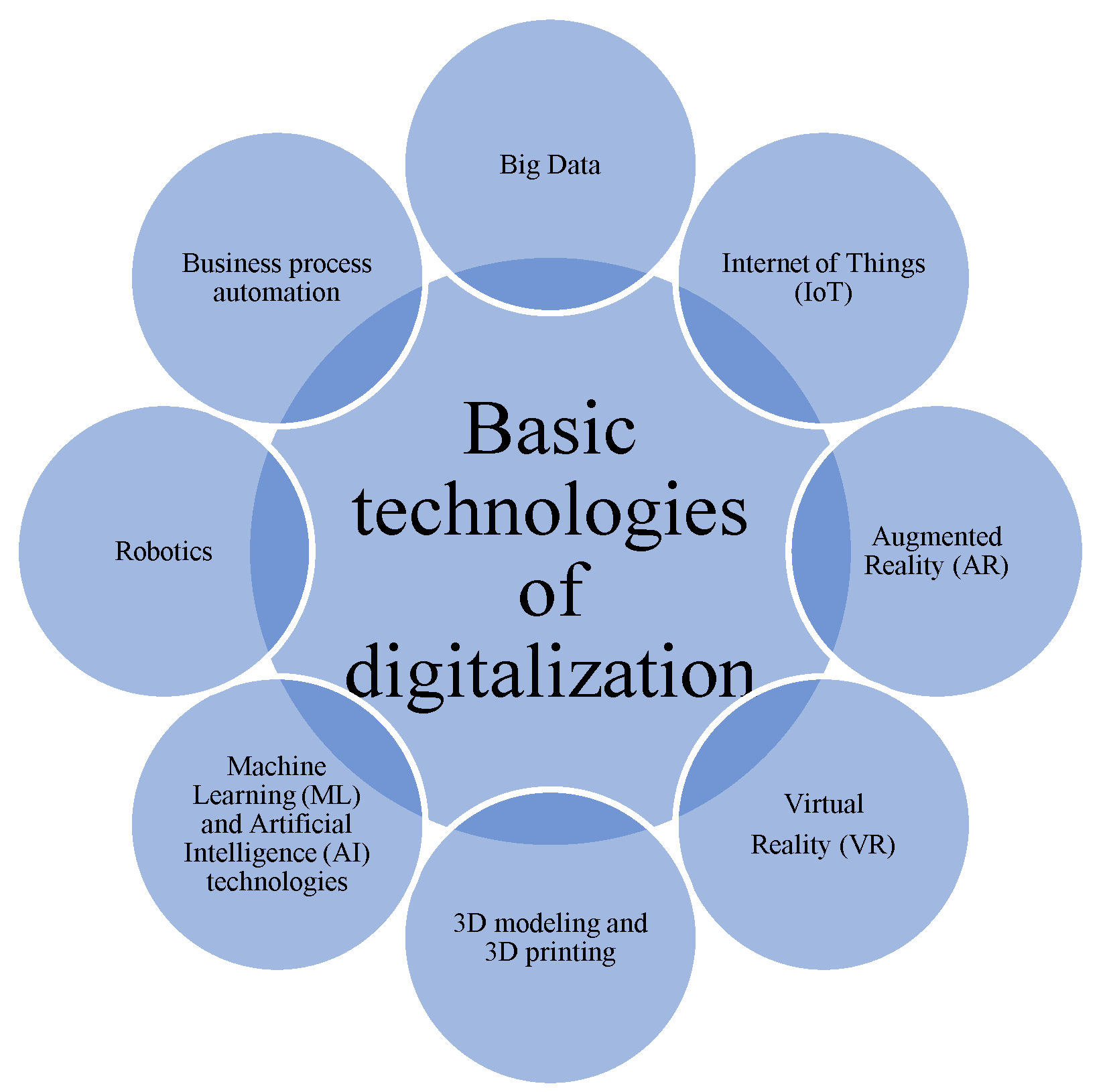
Today, there is an active introduction of modern digital technologies into all areas of enterprise activity (Voronenko et al., 2024). Digital technologies are becoming the foundation for building a new management model in which economic, social, and environmental factors are connected by a single digital circuit and management effectiveness is measured by the degree of achievement of sustainable development goals. Digitalization is the integration of digital innovations into a business model in order to optimize operations (Shapovalova et al., 2023). The integration of digital technologies into business processes is no longer just one of the paths to success but an integral part of the modern world. The main technologies of digitalization are presented in Figure 1.
The importance of digitalization in corporate sustainability reporting is crucial, as it allows for the integration of this process with modern concepts, including Industry 4.0, blockchain, the Internet of Things, artificial intelligence, and cloud computing (Corazza et al., 2023; de Villiers et al., 2024; Moodaley & Telukdarie, 2023). Digitalization is seen by many scholars as a tool that facilitates full corporate sustainability reporting by improving data accuracy, streamlining processes, and increasing the accessibility and transparency of information disclosure (Hoiten et al., 2026; Dănescu & Stejerean, 2025; Chyzhevska et al., 2021; O. S. Vysochan et al., 2023; Gil & Montoya, 2021). The connection between the digital transformation of a business entity and sustainability reporting is supported by legitimacy theory, which considers the relationship built between the firm and society (Appiah-Kubi et al., 2025; Derun et al., 2023). To improve the accuracy of climate risk reporting, corporations should implement software that can accelerate data standardization and comparability of assessments (Miglionico, 2022). As Bednárová and Serpeninova (2023) point out, digitalization has great potential to promote sustainable development and points to the emergence of a new concept called “Corporate Digital Responsibility”, while Olsen (2023) proposed an approach to implement digital sustainability reporting in the modern era of Industry 5.0.
Despite the positive aspects of implementing modern information technologies in sustainability reporting processes, certain challenges arise. First, a high level of automation and digitalization of financial data is required so that machine learning algorithms can effectively analyze them. This may require significant investments and costs in the development and implementation of new accounting systems, as well as staff training (Irianto et al., 2025). Second, issues of confidentiality and data security arise. Since financial data is extremely vulnerable, it is necessary to ensure reliable protection against unauthorized access and information leaks. This requires the development and implementation of appropriate security systems and access control to information. Finally, we must not forget about the human factor. The implementation of modern technologies may lead to a reduction in the number of personnel and changes in the requirements for employee competencies. Personnel will have to have a sufficient level of technical knowledge and skills to successfully work with new technologies. The implementation of modern technologies also depends on the strategic alignment and management of company resources (Molho et al., 2025). In general, the implementation of modern information technologies presents enormous opportunities for improving the efficiency and accuracy of accounting and reporting processes. However, this prospect is also associated with challenges that need to be taken into account. Thus, it is important to carefully consider the strategy for implementing modern information technologies in order to minimize possible risks. With the right approach, training of personnel and the development of appropriate security systems, it is possible to achieve maximum benefits from the implementation of modern information technologies in the context of sustainability reporting and create a competitive advantage for business (Atanasov, 2023).
It is worth emphasizing that the desire to get the most out of digital technologies, digital solutions, and business models and to obtain a high return on capital investments often comes into conflict with the environmental criterion. Leitoniene and Kundeliene (2021) studied the extent of environmental disclosure in companies’ sustainability reporting and how they use digitalization. Understanding the dual role of digitalization is critical for developing effective, sustainable development strategies.
Thus, the relevance of studying the digitalization process in the context of sustainable development is due to the growing global concern about climate change, the need to preserve the environment for future generations, and the backdrop of the depletion of natural resources. The need to analyze the impact of digitalization on environmental, social, and managerial performance indicators is due to both the internal needs of companies to increase performance and external factors—strengthening regulatory requirements, increased competition, and the growing role of sustainable development in assessing investment attractiveness. Taking into account the above, the relevance of the study is determined by the fact that the preparation of sustainability reporting in modern conditions is impossible without the systematic implementation of digital technologies that ensure transparency, efficiency, and adaptability of business processes. Despite a significant number of publications, the problem of the impact of digitalization on sustainability reporting remains poorly studied both from a theoretical and a practical point of view. Therefore, the purpose of the article is to study the role of digitalization in the processes of forming corporate reporting on the sustainable development of an enterprise based on a systematic review of the literature. Bibliometric analysis is a modern and innovative tool for identifying research development trends and evaluating scientific output in various fields (Ellegaard & Wallin, 2015). Bibliometric analysis methods have recently been increasingly used in the study of problematic issues, including in the field of accounting (Maksymiv et al., 2024).
To achieve the goal, it is necessary to solve the following tasks (research questions):
RQ 1. What is the total volume of publications on the topic of digitalization in the processes of forming corporate reporting on the sustainable development of companies?
RQ 2. What publications, journals, and countries have the greatest scientific influence on the topic of digitalization in the processes of forming corporate reporting on the sustainable development of companies?
RQ 3. What are the topics of scientific publications and possible directions of future research on the topic of digitalization in the processes of forming corporate reporting on the sustainable development of companies?

2. Materials and Methods

The research methodology is a bibliometric analysis of publication metadata, which includes terminology mapping, clustering, and retrospective analysis.
Scientific publications obtained from the scientific metric and abstract database Scopus were used for bibliometric analysis. This multidisciplinary resource is positioned by the Elsevier publishing corporation as the world’s largest universal abstract database with the ability to track scientific citation of publications (Donthu et al., 2021). The choice of this information base was made for a number of reasons: the availability of a variety of original metrics; the assignment of each publication to separate SciVal topics; a large repertoire of scientific publications; and wide coverage of subject areas. The Scopus bibliometric database allows researchers to analyze the scientific literature by a number of quantitative indicators, such as the number of publications, citations, and co-authors and complex production indicators (H index, impact factor, etc.) (Aria & Cuccurullo, 2017). At the same time, the analysis can be conducted in different sections: by scientific fields, by organizations, in a chronological section, geographical section, by types of publications, etc. In order to obtain a list of publications on the topic of research, a query is formed in the bibliographic database, which can be executed by source metadata such as authors, title, year of publication, and the title of journal or collection. Searching for articles by keywords in bibliometric databases allows you to identify publication trends and trends in the development of individual fields of knowledge (Hyk et al., 2023). An important feature of modern bibliometric databases is a significant number of filters and fields that can be used to conduct searches, which allows you to create and analyze samples of the most diverse configurations.
The search query, which was conducted on 19 December 2025, involved entering the research keywords “digitalization” and “sustainability reporting” in the search bar (with the possibility of using other words that were similar in meaning: “ESG reporting”, “CSR reporting”, “corporate reporting”, and “non-financial reporting”). To achieve greater accuracy and completeness of coverage, the operators (“OR” and “AND”) and special symbol (“*”) were used in the research. As a result, the search query in the system was as follows: (TITLE-ABS-KEY (digital*) AND TITLE (sustain* AND report*) OR TITLE (esg AND report*) OR TITLE (csr AND report*) OR TITLE (corporat* AND report*) OR TITLE (non-financial AND report*)).
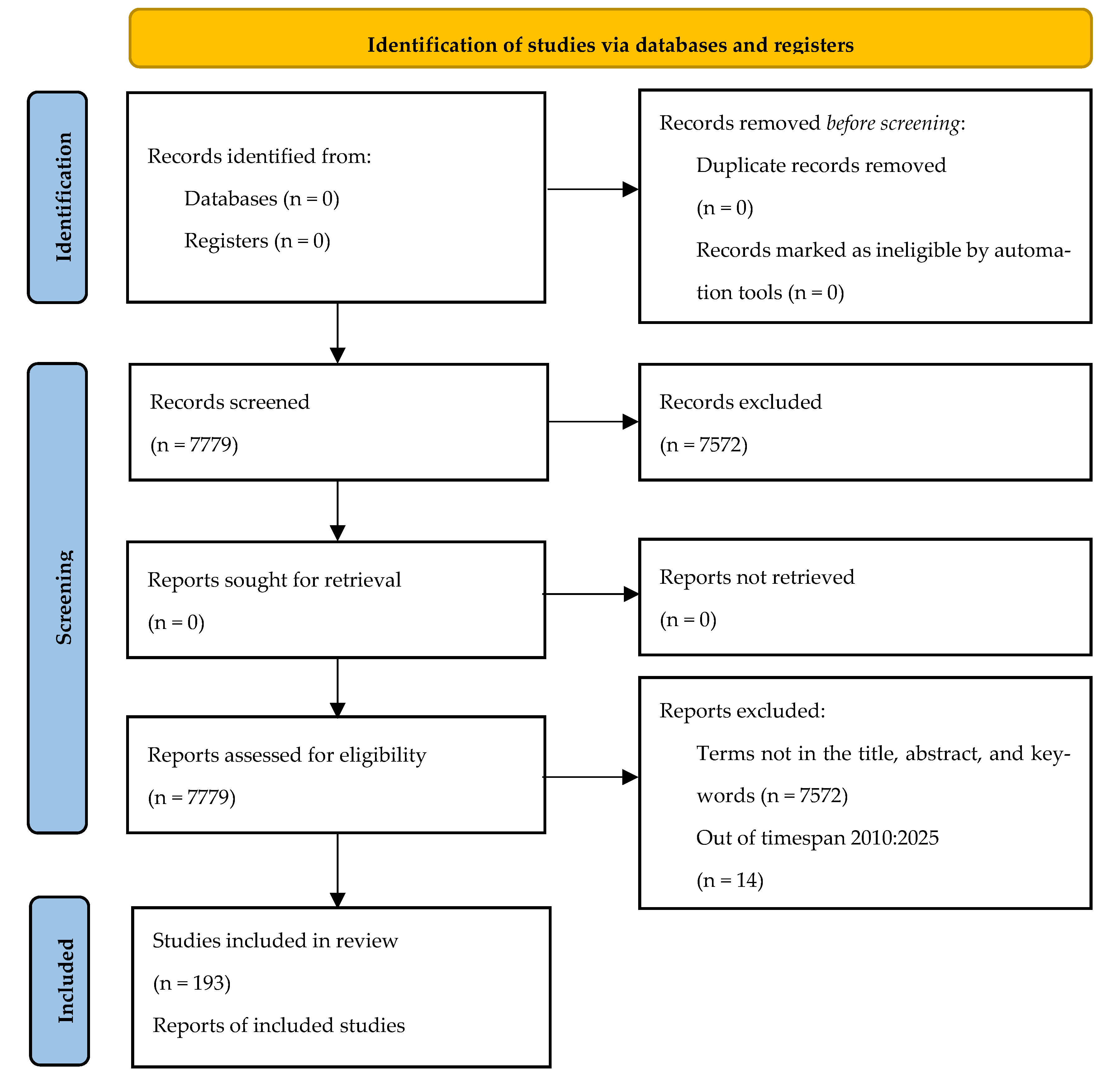
In order to establish additional search criteria, the PRISMA 2020 protocol was used. The selection criteria were selected using search filters in the Scopus database and included sample restrictions based on the following criteria: initial search—all publications (result: 7779 records); restrictions on the use of specified terms—in the title of the publication, introduction and keywords (result: 209 records); year of publication—2010–2025 (result: 193 records). The full sequence of filtering using the PRISMA 2020 flowchart is shown in Figure 2.
The resulting filtered data file was saved in the appropriate format (.csv). This file contained the full metadata, including information on the names and surnames of the authors, affiliation, abstract text, keywords, and citations. Data visualization was performed using the functionality of the R Studio software version 4.1.2 (Bibliometrix package) and VOSviewer (ver. no. 4116390). The choice of these software products was due to their efficiency in processing large data sets and the ability to create visually informative maps, providing researchers with a practical tool for navigating and interpreting a complex thematic landscape. The clear and consistent methodology for data collection and processing ensured transparency, reproducibility, and academic accuracy, which is consistent with the best practices of bibliometric research.
The examination was not registered and no protocol was prepared.

3. Results

3.1. General Descriptive Review and Analysis of Effectiveness

At the initial stage of conducting a systematic literature review, it is important to establish the general state of the availability of publications, publication activity of scientists, their time distribution, and the number of authors and co-authors. General descriptive information on the topic of the digitalization of corporate sustainability reporting is presented in Table 1.
Based on the information provided, we can draw the following conclusions:
(1)
The total number of publications received is 193 documents, including: articles—118, conference papers—32, book chapters—26, reviews—9, books—5, notes—2, data papers—1.
(2)
The average number of citations (8.518) is an indicator calculated by dividing the total number of citations by the total number of articles. This indicator helps to assess the quality of research and the impact of a scientist and reveals a typical level of citations, comparing it with other indicators, such as the Hirsch index (h-index).
(3)
A total of 673 scientists participated in the preparation of the publications, and 1653 sources of the literature were processed.
(4)
Scientists used 599 keywords (DE) and 756 keywords plus (ID) in their publications.
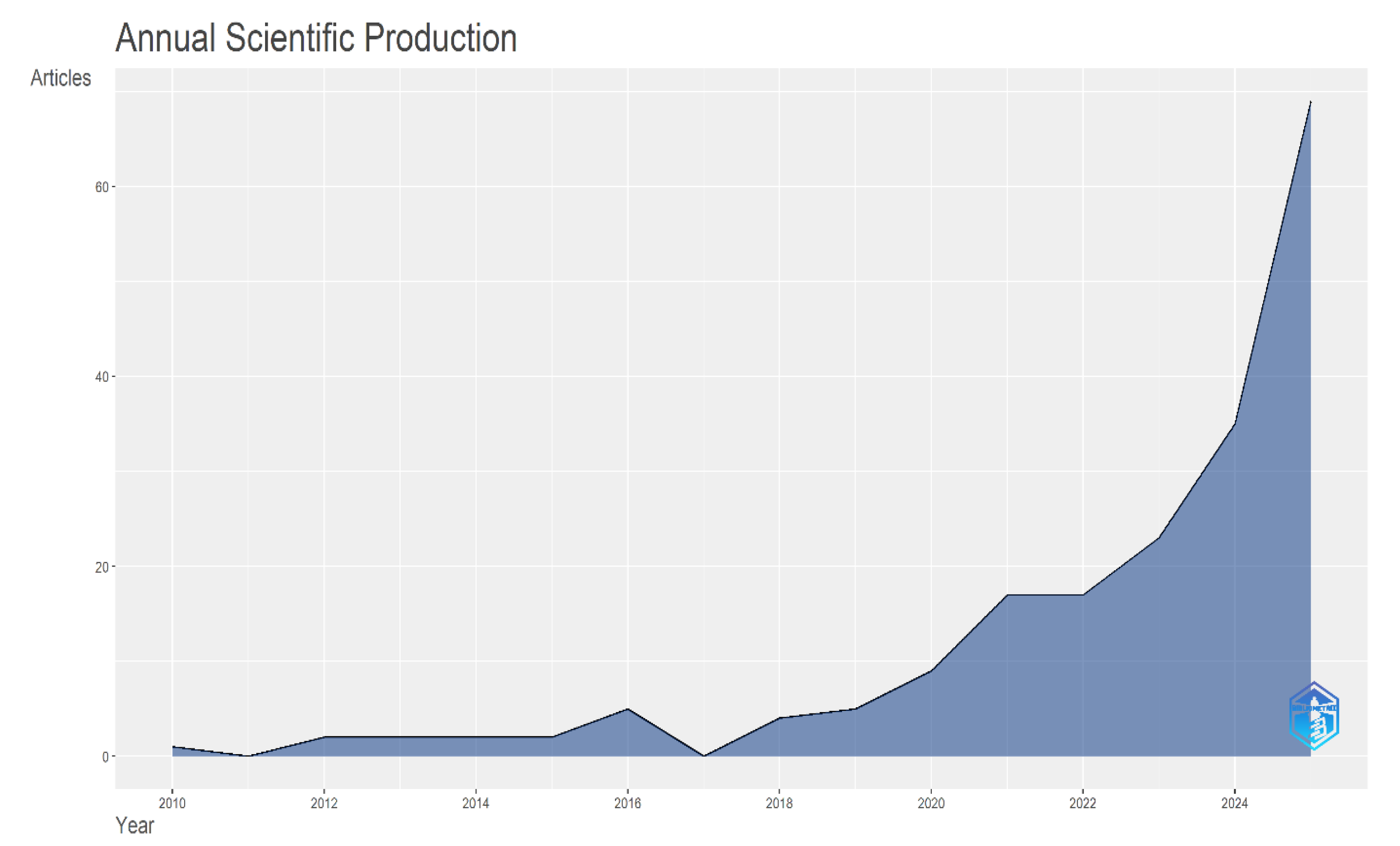
A detailed distribution of scientific publications by year on the topic of the digitalization of corporate sustainability reporting is shown in Figure 3.
From the data in Figure 3, it is established that the total number of publications on the digitalization of corporate sustainability reporting has only grown over the past few years. This trend is especially noticeable starting in 2021, when the number of publications approached the mark of 20 units per year. It reached its highest peak in 2025 (n = 69), which emphasizes the extreme relevance of this topic and indicates that this trend will only grow in the future.

3.2. Analysis of the Most Cited Publications, Journals, and Countries

An important indicator that determines the degree of influence and relevance of the study in the scientific community is the number of citations of the publication by other researchers. Table 2 presents the top 10 most cited authors on the topic of the digitalization of corporate sustainability reporting, which demonstrates their academic influence.
The most cited (n = 131) article according to the analysis is Lombardi and Secundo (2021), in which the authors consider the impact of digital technologies on the process of forming corporate reporting of enterprises. Also investigated in the list of the most cited articles is the importance of digitalization in the preparation of corporate reporting on sustainable development of enterprises in the banking sector of the economy: in particular, Amidjaya and Widagdo (2020) investigated the role of digital banking as a determining factor in the context of preparing sustainability reporting in Indonesian registered banks; Dashottar and Srivastava (2021) proposed the use of blockchain technology to reduce information asymmetry and uncertainty in the Indian banking sector, make credit decisions, generate timely alarm signals and strengthen the regulatory framework, and increase the efficiency of certain corporate banking products.
The third place on the list (n = 74) belongs to the article by Seele (2016), in which the author presented his own concept of “digitally unified reporting”, which involves an approach to preparing sustainability reports based on XBRL. Almost the same number of citations (n = 73) as the previous article on the list has been achieved by the publication of the team of authors Narula et al. (2021), which examines the importance of Industry 4.0 technologies for accelerating the implementation of the Global Reporting Initiative (GRI) based on empirical research. The researchers conclude that the existence of a relationship between Industry 4.0 digital technologies and GRI standards indicates that digitalization can act as a catalyst for improving sustainability factors and supporting the implementation of the GRI framework in organizations.
A slightly lower number of citations is held by the publication by Niehoff (2022), in which the author explores the relationship between corporate digitalization and sustainability management based on a qualitative analysis of data from the 2019 DAX30 companies’ sustainability reports. The author notes some caveats, which relate to the fact that digitalization is predominantly business-oriented (weak sustainability), which could potentially accelerate unsustainable growth patterns and thus harm the goals of sustainable development. The remaining publications on the list have less than 40 citations and include a study of the impact of corporate digitalization on green innovation based on data from the annual reports of 2908 companies—Fang and Li (2024); a study establishing the impact of technological innovation on the quality and practice of sustainability reporting based on a fuzzy expert system (FES)—Pizzi et al. (2024); a study of the importance of digitalization for ensuring universal codification of information disclosure—Rowbottom et al. (2021); a study defining the characteristics of firms that transmit financial and non-financial information on the Internet—Alali and Romero (2012).
The results of the analysis of the 10 most cited articles indicate that the vast majority of them were published relatively recently, i.e. after 2020. At the same time, their average citation coefficient by year is quite high at 13 references per article.
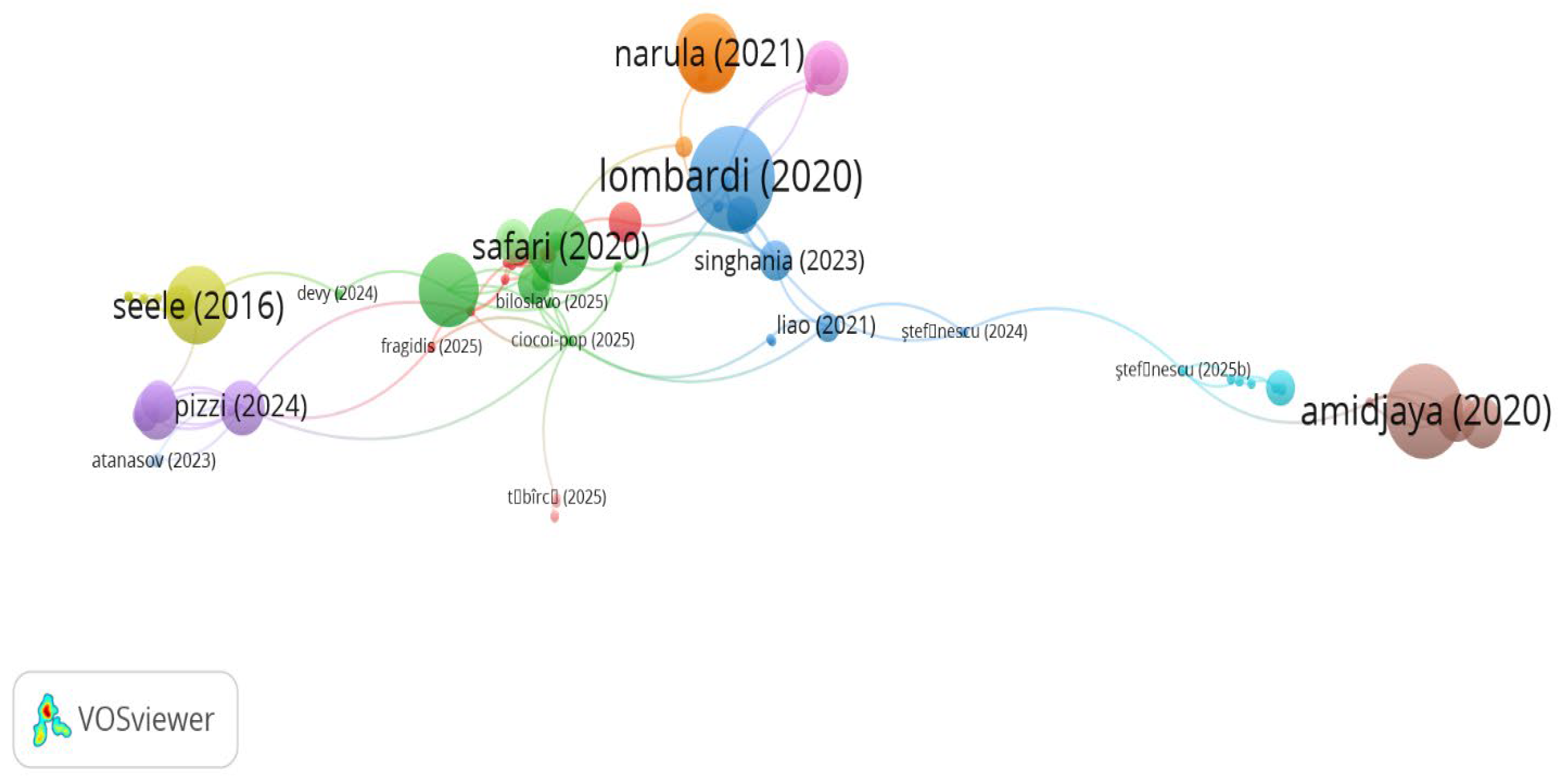
The analysis of citations between publications based on the use of bibliographic coupling was developed by Kessler (1963). In bibliographic coupling, the common reference of two publications is used as the unit of connection between the two publications. Thus, the strength of their bibliographic coupling is identical to the number of common references between them. Figure 4 shows the bibliographic coupling network on the topic of the digitalization of corporate reporting on sustainable development.
According to the results of the analysis of co-citation, it can be stated that digitalization and sustainability reporting have recently become increasingly interconnected through common theoretical references and methodological approaches.
The effectiveness and quality of scientific work are largely determined by the completeness of the use of various sources of information on the topic of research. Periodicals are a mirror that reflects the development of scientific thought in the world. Table 3 presents the top 10 most influential journals on the topic of the digitalization of corporate sustainability reporting.
According to the data presented in Table 3, Meditari Accountancy Research (n = 162) is the most cited journal. Following it in the top five most influential journals are authoritative journals such as the Journal of Cleaner Production (n = 147), Business Strategy and the Environment (n = 140), Journal of Applied Accounting Research (n = 105), and Sustainability (Switzerland) (n = 84). The remaining journals (Accounting Forum (n = 69); Electronics (Switzerland) (n = 69); Journal of Banking Regulation (n = 46); Accounting, Organizations and Society (n = 35); and Plos One (n = 35)) are less influential, as they have fewer citations. However, in terms of the number of publications, a slightly different situation is observed: the first place is occupied by Sustainability (Switzerland) (n = 12), the second by Business Strategy and the Environment (n = 5), and the third is shared by Electronics (Switzerland) and Meditari Accountancy Research, which have the same number of 4.
If we talk not about quantitative indicators but about qualitative ones, then the highest places are occupied by Sustainability (Switzerland) (h_index = 4 and g_index = 7), Meditari Accountancy Research, Business Strategy and the Environment, and Electronics (Switzerland) equally (h_index = 4 and g_index = 4), which indicates their rather large influence in terms of productivity in the analyzed field of research. It is also worth noting that the main segment of the most actively cited publications is concentrated in highly rated journals of the first and second quartiles.
The next stage of bibliometric analysis is the study of scientific productivity by geographical criteria. Table 4 lists the top 10 countries whose representatives, based on citations, made the greatest contribution to the research topic.
From the data in Table 4, it is clear that the leading positions in terms of the largest number of citations are occupied by representatives of Italy (n = 245) and the United Kingdom (n = 205). Representatives from Australia and Indonesia (n = 118), who share the third position, and Germany (n = 118), which is in fifth place, have a significantly smaller number of citations. The remaining countries on the list have fewer than 100 citations.
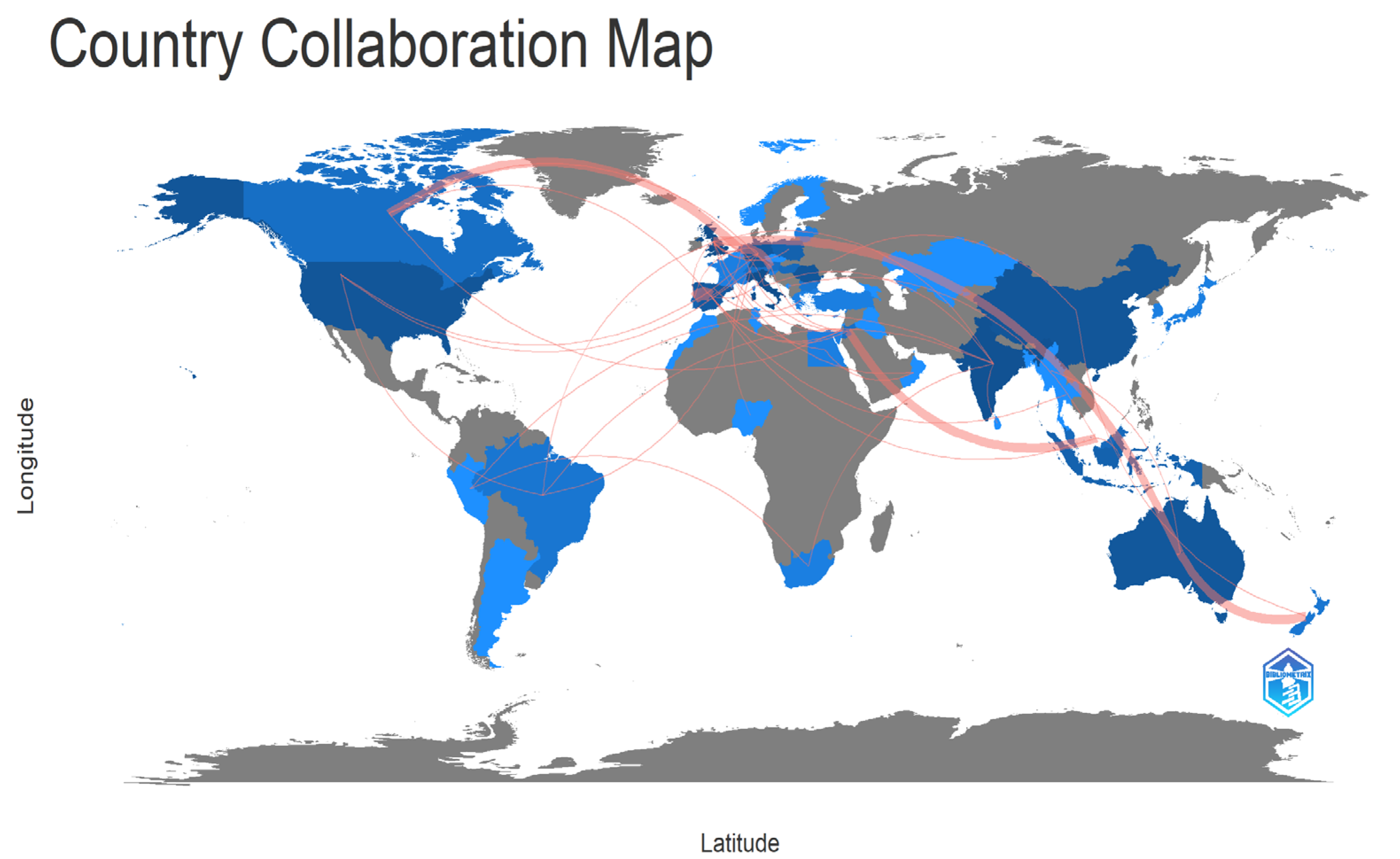
Over the past decade, the number of works carried out with the participation of large international scientific collaborations has been actively increasing worldwide, and, accordingly, there has been a significant increase in the number of publications with mega-co-authorship. Figure 5 presents a map of collaboration between countries on the topic of the digitalization of sustainability reporting.

3.3. Thematic Mapping

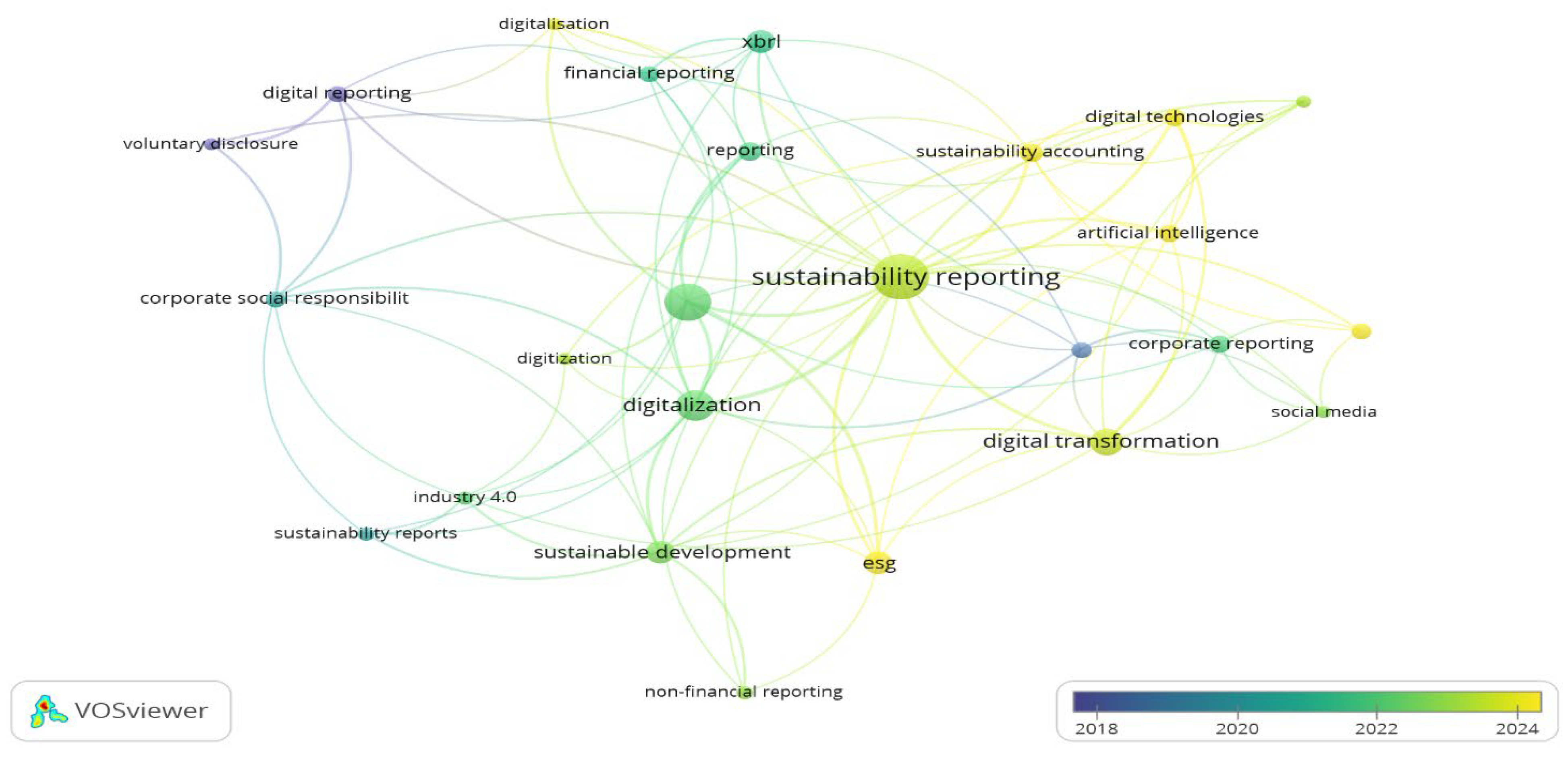
Thematic analysis is one of the most important sections of a systematic literature review and is based on keyword scoring, thematic mapping, and conceptual clustering by research areas. The analysis of authors’ keywords allows us to establish relationships between the main topics of digitalization and the formation of corporate sustainability reporting. As a result of the analysis of the common use of keywords by research topic, a network visualization map is presented (Figure 6)
From Figure 6, five separate thematic clusters can be distinguished.
Cluster 1 (green) is focused on digitalization processes to achieve sustainable development. In this cluster, there is a close interweaving of the terms sustainability, digitalization, sustainable development, non-financial reporting, Industry 4.0, sustainability report, and ESG, which emphasizes the rather close relationship between them. This cluster is associated with the study of digitalization processes and sustainable development, establishing the crucial role of digitalization in the successful implementation of organizational changes and the formation of sustainability reporting; using Industry 4.0 tools to optimize the economic, social and environmental components of the sustainable development of enterprises; and considering digitalization and non-financial reporting as key factors in achieving the Sustainable Development Goals (SDGs) and their cumulative impact on the 2030 Agenda (Krasteva-Hristova et al., 2025; Erokhin, 2025; Lulaj & Brajković, 2025; Lodhia et al., 2025; Ştefănescu, 2025; Shehadeh et al., 2024). Thus, Krasteva-Hristova et al. (2025) examined ESG reporting practices, integrated reporting, and circular economy with a focus on sectoral analysis. The authors note that gaps remain in the interconnections between sustainability reporting practices, the integration of digital innovations, and the consideration of social dimensions of circularity. Ştefănescu (2025), examining the interdependence between digitalization, non-financial reporting, and the achievement of the Sustainable Development Goals (SDGs), concludes that digital transformation plays a major role in promoting economic, social, and environmental sustainability, especially in developing countries, through improved environmental performance, ecosystem health, and economic growth. The use of digital technologies was initially seen as a way to improve the efficiency of existing business models and processes by reducing costs, increasing product quality, reducing production times, and optimizing supply chains. The changes taking place in the economy affect both the external and internal environment of the company, which, going through the path of digital transformation, is transformed from a classic enterprise into a complex network structure. In general, a developed digital business environment provides great potential for creating new value propositions and increasing productivity and efficiency. It also contributes to intelligent decision-making by economic agents, facilitating access to accounting information and increasing awareness. This approach confirms the accuracy of the thesis of Lodhia et al. (2025) that the awareness of the role of digital technologies in improving accounting, reporting and ensuring sustainable development will open up greater opportunities and benefits for stakeholders and society.
Cluster 2 (pistachio) is the largest in size and is generated around the term “sustainability reporting”, which is mentioned most often by the authors. This cluster is related to the impact of artificial intelligence and machine learning on accounting and reporting on sustainable development. The main keywords were: sustainability reporting, sustainability accounting, artificial intelligence, digital technologies, and cloud computing. Based on this, research focuses on the established potential of artificial intelligence to improve sustainability reporting, especially in terms of its impact on data accuracy, transparency, risk reduction, and efficiency (de Villiers et al., 2024; Novicka, 2025; Magli & Amaduzzi, 2025; Thaher Amayreh et al., 2025; Strazzullo et al., 2025; Appiah-Kubi et al., 2025; Petcu et al., 2024; Kaur et al., 2024; Caldarelli, 2025). This indicates the significant importance of modern information technologies and artificial intelligence for sustainability reporting. In particular, de Villiers et al. (2024) conducted a critical analysis of text generation and processing using artificial intelligence and their impact on sustainability reporting. Magli and Amaduzzi (2025) conducted an analysis of current trends in the use of artificial intelligence for corporate reporting. Artificial intelligence allows for large-scale collection and formalization of ESG data, reduction in transaction costs of reporting, and the making of management decisions based on scenario analysis of company practices. Thus, in summary, it is worth noting that the introduction of digital technologies into business processes forms a new management paradigm (concepts and management models), in which artificial intelligence acts as a connecting link between corporate governance, sustainability strategies and investment practices. With the help of artificial intelligence, an infrastructure of data, trust and transparency is formed, that is, all the key conditions for the transition to an economy of responsible growth.
Artificial intelligence technologies are becoming an integral part of the transformation process of sustainability reporting. The use of artificial intelligence creates new business models aimed at ensuring long-term value and balanced interaction with the natural environment and allows companies to effectively achieve their strategic goals. The use of artificial intelligence allows corporations to deepen their understanding of their own operations, quickly adapt to external changes and manage risk factors caused by environmental, social and corporate governance (ESG factors). Many challenges remain in implementing the principles of sustainable development and ESG management, such as the legal framework, resources, data analysis capabilities and, in particular, methods for effective and transparent collection and processing of information. The use of artificial intelligence data and modern digital technologies is seen as a key solution for increasing management efficiency, expanding analytical and monitoring capabilities, supporting decision-making processes, improving control of accounting operations, avoiding errors, and ensuring compliance with requirements and trust in the reliability of financial data (Sampaio & Silva, 2025).
Cluster 3 (yellow): This is related to digital transformation and corporate sustainability reporting with the keywords digital transformation, ESG reporting, corporate reporting, and disclosure. The literature on this topic has mainly focused on exploring the transformation processes involved in implementing digital sustainability reporting (DSR) in the context of the Corporate Sustainability Reporting Directive (CSRD) (Alroud, 2025; Wang et al., 2025; Swart & Zincume, 2025; Molho et al., 2025; Novicka & Volkova, 2025). Research in these areas reflects the multifaceted nature of sustainability reporting, encompassing regulatory issues, structural transformations, business process re-engineering, and customer experience. Against the backdrop of actively discussed climate change, regulatory consolidation of non-financial reporting standards is taking shape. In the European Union, the Corporate Sustainability Reporting Directive (CSRD) has entered the implementation phase: the first wave of reports for the 2024 financial year was published in 2025, and the coverage is gradually expanding to tens of thousands of companies. In particular, Novicka and Volkova (2025) in their article provide some recommendations for the implementation of digital sustainability reporting (DSR) to comply with CSRD reporting requirements. Strengthening requirements increases the cost of non-compliance and makes digital tools (including artificial intelligence) a prerequisite for the quality and compatibility of disclosures.
Cluster 4 (light green) focuses on the issues of reporting based on eXtensible Business Reporting Language (XBRL). The main keywords were: reporting, financial reporting, XBRL, and digitalization. The publications are mainly related to the advantages and opportunities of using XBRL to optimize reporting, as well as certain difficulties in its widespread implementation and recognition (Zvekan, 2025; Kobbi-Fakhfakh & Athie, 2023; Troshani & Rowbottom, 2021; Atanasov, 2023). Such proximity between the terms indicates the important need for structured data processing and ensuring transparency when using XBRL reporting. In particular, Troshani and Rowbottom (2021), conducting a study of the processes of the digitalization of corporate reporting based on XBRL, focus on the consequences of evidence for key stakeholders in the reporting information supply chain, including users and those who prepare digital corporate reports, regulators and standards developers. XBRL simplifies the exchange and analysis of data for different groups of stakeholders and provides an expansion of information about the activities of an economic entity, which, on the one hand, allows you to automatically bring the reports of economic entities into the required format (frees up resources from expensive manual processes of collecting and verifying information and makes it possible to concentrate efforts on data analysis, relying on software for the XBRL format); on the other hand, it expands the composition of reporting information (XBRL can be adjusted according to specific business requirements, which allows you to mark up and submit almost any financial and non-financial information).
Cluster 5 (blue) is related to the disclosure of information on corporate social responsibility through digital reporting on sustainable development. The central keywords were: corporate social responsibility, digital reporting, and voluntary disclosure. Publications on this topic have focused on the introduction of digital reporting to improve the quality and level of voluntary disclosure of corporate social responsibility information (Zarzycka, 2025; Martín-Zamora & Borralho, 2025; Almeida et al., 2022). For example, Almeida et al. (2022) conducted an analysis of digital CSR based on water companies. In addition, the study examined factors influencing the digital status of online disclosure. The results indicate factors that need to be improved in the best practices of digital CSR reporting by companies. In general, companies may face a number of challenges, such as the high costs of implementing digital technologies, the need to adapt to new social norms and standards, and the problems of integrating these two components into the company’s development strategy. Digital transformation allows companies to more effectively implement CSR through new technologies, improving environmental and social indicators. This includes the ethical use of data, transparency, employee and stakeholder engagement, and the solving of digital ethical dilemmas, forming “corporate digital responsibility” (CDR) (Sun et al., 2024). Zarzycka (2025) studied the opportunities and challenges of reporting on corporate digital responsibility from the perspective of stakeholder influence. The study concluded that not all stakeholder groups influence corporate digital responsibility reporting.
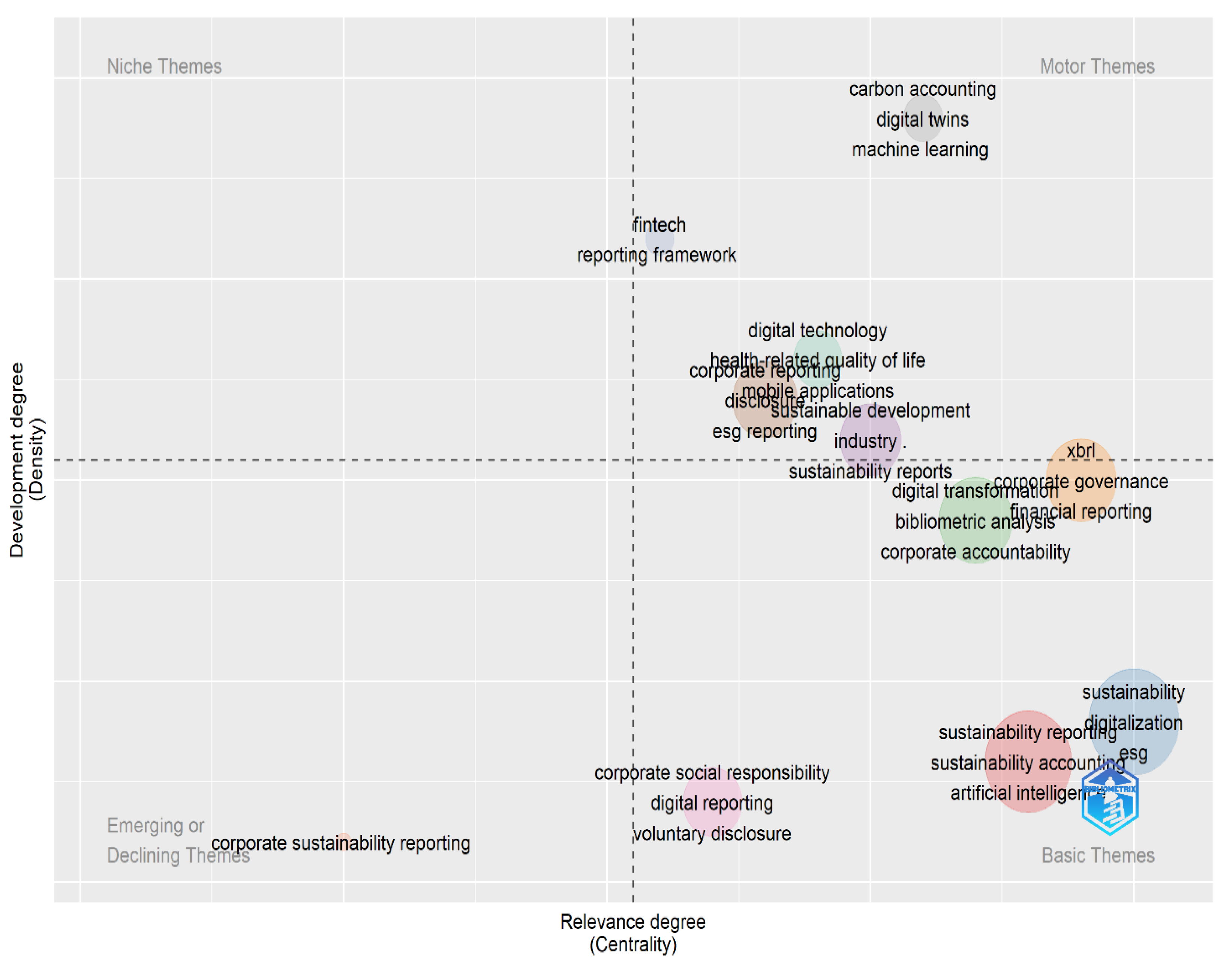
The next important stage of bibliometric analysis is thematic mapping, which is built in a two-dimensional coordinate system and places keywords depending on their centrality (degree of relevance) and density (degree of development) (Figure 7).
Figure 7 presents the thematic map of the study, which is divided into four quadrants: Motor Themes, Basic Themes, Niche Themes, and Emerging or Declining Themes. The upper right quadrant, “Motor Themes”, contains highly researched and extremely central themes, including reporting frameworks, fintech, carbon accounting, digital twins, machine learning, digital technology, corporate reporting, and ESG reporting. These themes are characterized by a high degree of maturity and strong interconnections, which indicates their pivotal importance in stimulating scientific discussions. The lower right quadrant, “Basic Themes”, contains dominant themes that are fundamental to the research field, in particular sustainability reporting, sustainability accounting, artificial intelligence, corporate social responsibility, digital reporting, voluntary disclosure, XBRL, and corporate governance. These themes have high centrality but relatively moderate development and are somewhat less relevant and have potential for more detailed, in-depth study. The upper left quadrant, “Niche Themes,” contains specialized but less central themes. No such themes were found in our study, so this quadrant is empty. The lower left quadrant, “Emerging or Declining Themes,” contains themes with low centrality and density. In our study, this quadrant was represented by only one theme, corporate sustainability reporting.
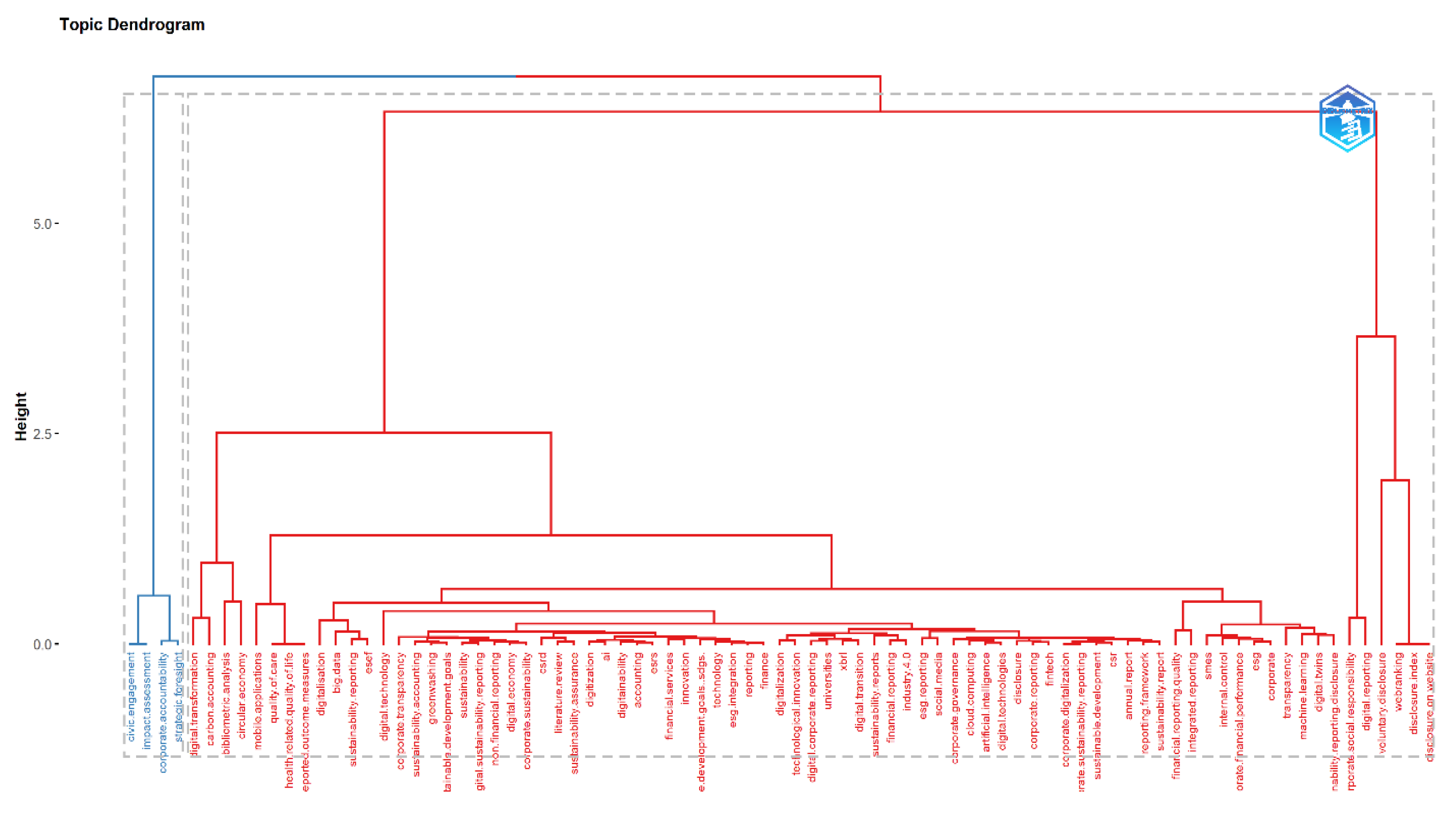
To further explore the hierarchical relationships between authors’ keywords and their clustering into consistent thematic groups, a dendrogram of the conceptual structure was constructed (Figure 8).
From Figure 8, it can be seen that the constructed dendrogram demonstrates the proximity and interconnection between concepts and allows for a more thorough understanding of how research topics on digitalization are structured in the formation of corporate sustainability reporting. In bibliometric analysis, dendrograms are used to structure knowledge, identify research fronts, and uncover hidden connections in the scientific literature. From the data presented, three branches are clearly visible: the first, highlighted in blue, is represented by several terms with an emphasis on corporate accountability; the second, highlighted in red with a left-hand branch, is represented by a large number of terms related to digital transformation, various types of technologies, and sustainability reporting; the third, highlighted in red with a right-hand branch, is represented by the terms corporate social responsibility, voluntary disclosure, and digital reporting.

4. Discussion

The theoretical analysis of the integration of digital technologies into the sustainable development strategy and the publication of sustainability reporting by companies showed the presence of a stable trend, offering significant opportunities for increasing the transparency of financial information and making strategic decisions. These conclusions are consistent with the results of Valentinetti and Rea (2025), who noted the growing interest in the digitalization of corporate accounting and sustainability reporting. According to the results of the bibliometric analysis of publications on the digitalization of sustainability reporting, it can be stated that there is a dynamic of increasing interest in this issue among scientists. Over the past few years, there has been a steady increase in the number of scientific publications on the specified topic. An analysis of the array of publications on the topic of the study showed that a large number of them are represented not only by research articles but also by conference materials, book chapters, reviews, books, etc. The results obtained provide grounds for revising the approach developed in recent years, which requires considering only certain types of scientific publications for scientometric analytics, sometimes limiting their scope exclusively to articles and reviews.
Studies of the influence of the geographical proximity of scientists on the likelihood of their cooperation have long been conducted by foreign authors. It is known that geographical proximity, as well as language and culture as indicators of social proximity, are among the important factors determining the nature and effectiveness of interregional cooperation. The results of the analysis revealed a certain geographical imbalance in scientific output, which indicates that the dominant influence is exerted by countries with high and above-middle income levels, which are mainly represented by the countries of the European Union, Australia, the USA, and China. Similar results were obtained in the study by Lombardi and Secundo (2021). At the same time, most countries in South America, Asia, and Africa remain unrepresented, which demonstrates their limited participation in international research networks. A characteristic feature of modern science is the constant growth of the number of scientists from different countries in joint research. Thanks to extensive international cooperation in research and significant funding, scientific collaborations produce knowledge at a new, more scientific and technological level, and publications made with the participation of such collaborations are significantly ahead in quality of work compared to that made by small scientific groups or individually. Therefore, in this context, in order to improve the situation of solving the problems of the digitalization of sustainability reporting, it is necessary to strengthen the coordination of scientific and research interaction, which will increase the effectiveness of collective efforts and eliminate the “narrowness” of individual scientists. Improving indicators reflecting the effectiveness of joint scientific activity will, among other things, reduce the segmentation of new knowledge and expand the fragmentation of scientific research.
As a result of the data analysis, it was not surprising to find that the selected works that are most actively cited were published in high-ranking international publications of the first (Q1) and second (Q2) quartiles. Analysis of the landscape of the most actively cited publications allows us to identify the most successful vectors of development of scientific directions.
The large number of various keywords and the allocation of their numerous clusters indicate a noticeable thematic diversity in the field of the digitalization of sustainability reporting. According to the compiled retrospective analysis, established research directions are mostly related to the Fourth Industrial Revolution, artificial intelligence, and the open standard XBRL. Based on the study of the frequency of use of keywords, five important thematic clusters were identified: (1) focused on digitalization processes for achieving sustainable development; (2) was the largest in size, generated around the term “sustainability reporting”, and related to the impact of artificial intelligence and machine learning on accounting and reporting on sustainable development; (3) related to digital transformation and corporate sustainability reporting with the keywords digital transformation, ESG reporting, corporate reporting, and disclosure; (4) focused on issues of reporting based on eXtensible Business Reporting Language (XBRL); (5) related to disclosure of information on corporate social responsibility through digital sustainability reporting. These thematic areas summarize the research focus of each cluster, reflecting modern multidimensional trends and indicating increased interdisciplinary interaction between the business environment and information technologies.
Overall, the analysis shows that as the volume of publications increases, research topics are diversifying over time towards more specialized and focused research. Earlier publications focused on broad topics, such as theoretical foundations and perspectives of information technology in shaping sustainability reporting in the digital economy (Alekseeva et al., 2018; Efimova & Rozhnova, 2019). As technologies have developed and some of their aspects have been integrated into companies’ activities, research has shifted towards a more practical focus, becoming more focused and including assessments and forecasts of future events not just as potential theories but also as probable directions (Zakaria et al., 2021; Shan & Troshani, 2021; So et al., 2021; Almeida et al., 2022; Said et al., 2023; Mehedintu & Soava, 2023). This shift reflects the maturity of the industry, as researchers increasingly focus on the practical implementation and future trajectories of digital transformation.
Based on the analysis, this study synthesizes the main vectors that may serve as opportunities for future research at the intersection of digital technologies and corporate sustainability reporting. Summarizing the above information, we consider it appropriate to highlight the following new research directions on the digital transformation of corporate sustainability reporting:
(1)
Digital technologies (mainly artificial intelligence and machine learning) as a means of collecting information for sustainability reporting;
(2)
Digital technologies (mainly blockchain) as a tool for ensuring transparency and security of information in the context of sustainability reporting;
(3)
Digital technologies (mainly iXBRL) as a standard (electronic format) for the digital presentation of data in sustainability reporting.
Therefore, the results of the study suggest that future research will focus on: (1) AI and machine learning in sustainability reporting: researchers should explore how AI is rapidly becoming a powerful tool for optimizing ESG data collection, improving its accuracy, and generating actionable insights; how AI is changing the ESG reporting landscape; why it matters; and how companies can leverage its potential to achieve significant sustainability and accountability outcomes. Other important questions include how machine learning can help companies with sustainability reporting and how machine learning tools can identify hidden ESG risks, predict development scenarios, and make informed management decisions in real time. AI has the potential to transform ESG reporting, making it more accurate, efficient, and insightful (Magli & Amaduzzi, 2025). By implementing AI, companies can meet stakeholder expectations for transparency and accountability, ultimately strengthening their commitment to sustainability. (2) Blockchain technology: the issue of ensuring a high level of transparency and reliability of reporting should be considered, as well as how the use of distributed storage and smart contracts created using blockchain technology can significantly increase the transparency of the accounting system. Using blockchain technologies that ensure data immutability, enterprises can increase trust among investors, consumers, and other stakeholders (Troshani & Rowbottom, 2021). (3) The development and implementation of a single electronic iXBRL format for sustainability reporting: the exploration of how the use of the iXBRL format as a business communication language for non-financial reporting can solve the problem of improving the quality of information for interested users. It is also possible to raise the issue of the demand for iXBRL reporting in the business environment. In order for a reporting format to be in demand, it must contain advantages that can optimize the exchange of business information in a business environment or be set at the legislative level.

5. Conclusions

In this article, a bibliometric analysis was conducted using R Studio and VOSviewer tools to study the relationship between digitalization and sustainability reporting, which made it possible to establish the connection of the scientific economic space between the authors of the articles and determine the number and citation of publications in a geographical context, as well as the similarity of scientific research topics. A comprehensive approach based on a systematic literature review provided a multidimensional understanding of the complex relationships between digitalization and sustainability reporting, which meets an urgent need as we approach the deadline for the implementation of the 2030 Agenda. The methodological basis of the study was a combination of scientific and theoretical generalization and analysis aimed at assessing the impact of digital technologies on companies’ sustainability reporting.
Based on the results of the study, the following conclusions can be drawn, which will be useful for groups of stakeholders, such as theoretical researchers, practitioners, and policymakers, and suggest directions for future research:
-
From a theoretical point of view, the main conclusion of the study is that sustainability reporting fundamentally depends on digital transformation processes. This state of affairs requires a fundamental rethinking of the role and key importance of digitalization as an important driver of sustainable development. The use of Big Data analysis systems, artificial intelligence, and blockchain technology allows companies to increase the efficiency of implementing environmental, social, and governance (ESG) initiatives, as well as strengthen competitive positions. Most studies also confirm the thesis that digitalization is considered a continuous process built into a long-term sustainable development strategy. It is important to continue monitoring this issue and analyzing the trends in the implementation of digitalization and its consequences in the preparation of sustainability reporting to ensure gradual, comprehensive, and effective adaptation of companies to challenges, including for the implementation of a sustainable development strategy. Thus, the results of the analysis can serve as a theoretical basis (foundation) for future scientific research, in particular assessing the impact of each modern innovative technology (artificial intelligence, blockchain, Big Data, and the Internet of Things) on corporate sustainability reporting.
Also, academics could focus their attention on the use of economic and mathematical models and conduct empirical studies of the relationship between digital transformation and sustainability reporting. It is worth noting that in the scientific literature, separate studies on this issue have already been carried out. For example, Vărzaru (2022) investigated the processes of digitization of sustainability reporting at the level of 21 countries of the European Union. The results demonstrate a close connection between these two phenomena, ensuring symbiotic, integrative development in the future. Jäger and Federau (2025) used a regression model to assess the impact of the level of digitalization of a company on environmental and sustainability indicators, and the results of their study showed a statistically significant relationship. Dinu et al. (2025) analyzed the impact of digital technology integration on ESG indicators of Central and Eastern European countries based on empirical studies and panel data modeling methods.
Another important area for future research could be to further analyze the impact of digital transformation on sustainability reporting for companies in different sectors of the economy (especially in carbon-intensive sectors), in particular in terms of ESG performance management. For example, this was done based on data from automotive companies (Tóth et al., 2021).
-
From a practical point of view, the results allow accountants and managers to better understand the importance of digital technologies in processes related to economic, social, and environmental factors and disclosures in sustainability reporting, in particular in terms of digital literacy and awareness. Digital literacy is the set of knowledge and skills necessary for the safe, effective, and conscious use of digital technologies in the context of sustainability reporting. Antonini (2024), examining the current state of the digitalization of accounting in the context of sustainable development, argues that accountants today are reluctant toward the digital transformation of accounting, and this may lead to a decrease in the legitimacy of accountants due to the lack of digital literacy. Increasing digital literacy among accountants and managers can enhance the readiness of human (labor) resources to achieve the Sustainable Development Goals. To strengthen digital literacy, it is necessary to pay attention to the development of digital skills and the formation of a favorable digital environment. Thus, an indispensable condition for the formation of sustainability reporting is to increase the level of digital literacy among accountants and managers.
-
From the point of view of policymaking, the results can be useful in issues related to legislative regulation. The efforts of politicians should be directed to the formation of a legal framework for the use of information technologies, compliance with cybersecurity of accounting information, and sustainability reporting. Politicians are obliged to create a favorable environment that supports digital transformation for sustainable development. This can manifest itself in the processes of investing in digital infrastructure, creating accessibility to digital tools for companies. They must create regulatory boundaries that will simultaneously facilitate digital transformation and ensure compliance with sustainability disclosure requirements.
It is worth noting that the collaboration between the scientific community, business, society, and government in discussing the digital transformation and its impact on sustainability reporting will facilitate transparency processes and ultimately ensure more effective achievement of the Sustainable Development Goals. Therefore, comprehensive policies are needed that better take into account the economic, social, and environmental aspects of the digital transformation: strengthening digital literacy, retraining the workforce, developing a “green” economy, promoting the values of smart consumption and energy saving, ensuring cybersecurity, and addressing ethical issues related to digital technologies. Only with this approach can digitalization become a powerful engine of sustainable development and contribute to creating a more just, prosperous, and environmentally sustainable future.
The scientific novelty of the study lies in the comprehensive analysis that allowed us to identify the most widely used concepts and tools, such as blockchain, the Internet of Things, artificial intelligence, cloud computing, and iXBRL, and establish their role in the formation of corporate sustainability reporting. Thus, the work not only systematizes existing research but also opens up new prospects for further empirical and theoretical research in the field of the digitalization of corporate sustainability reporting. As a result, the study improves the understanding of the structure and evolution of the digitalization of sustainability reporting, offering valuable knowledge for scientists, practitioners, and politicians who seek to advance the issues of sustainable accounting and reporting.
Despite the comprehensive nature of this study, certain limitations were identified that may lay the foundation for future research. In particular, the analysis focused exclusively on articles published in the Scopus database. Therefore, one possible recommendation for future research could be to conduct an analysis from other databases (such as Web of Science and Google Scholar), which would allow for more publications on the topic under study. Also, the analysis was limited to the time period from 2010 to 2025, which may introduce bias and potentially exclude other studies that fall outside this period.

Author Contributions

Conceptualization, V.H. and O.V. (Oleh Vysochan); methodology, V.H., O.V. (Oleh Vysochan) and O.V. (Olha Vysochan); software, V.H.; validation, O.V. (Oleh Vysochan) and O.V. (Olha Vysochan); formal analysis, O.V. (Oleh Vysochan) and O.V. (Olha Vysochan); investigation, V.H., O.V. (Oleh Vysochan) and O.V. (Olha Vysochan); resources, V.H., O.V. (Oleh Vysochan) and O.V. (Olha Vysochan); data curation, O.V. (Oleh Vysochan) and O.V. (Olha Vysochan); writing—original draft preparation, V.H. and O.V. (Oleh Vysochan); writing—review and editing, V.H. and O.V. (Oleh Vysochan); visualization, V.H. and O.V. (Oleh Vysochan); supervision, V.H.; project administration, V.H. and O.V. (Oleh Vysochan); funding acquisition, V.H. All authors have read and agreed to the published version of the manuscript.

Funding

This research received no external funding.

Institutional Review Board Statement

Not applicable.

Informed Consent Statement

Not applicable.

Data Availability Statement

The data supporting the findings of this study are available from the corresponding author upon reasonable request.

Conflicts of Interest

The authors declare no conflicts of interest.

References

  1. Alali, F., & Romero, S. (2012). The use of the Internet for corporate reporting in the Mercosur (Southern common market): The Argentina case. Advances in Accounting, 28(1), 157–167. [Google Scholar] [CrossRef]
  2. Alekseeva, I. V., Fedosova, O. N., Pryadkina, E. A., & Troshkova, S. V. (2018). Application of IT in the formation of sustainable reporting of business entities. European Research Studies Journal, XXI(2), 207–217. [Google Scholar]
  3. Almeida, R., Pérez-López, J. Á., & Abreu, R. (2022). Digital corporate social responsibility reporting in the water industry. Water Resources Management, 36, 3929–3947. [Google Scholar] [CrossRef]
  4. Alroud, S. F. (2025). Digital transformation as a moderator: A study of the impacts of sustainability reporting disclosure on financial reporting quality in the Jordanian banking sector. Economics, 13(2), 389–413. [Google Scholar] [CrossRef]
  5. Alrowwad, A. M., Alhasanat, K. A., Sokil, O., Halko, S., & Kucherkova, S. (2022). Sustainable transformation of accounting in agriculture. Agricultural and Resource Economics: International Scientific E-Journal, 8(2), 5–29. [Google Scholar] [CrossRef]
  6. Amidjaya, P. G., & Widagdo, A. K. (2020). Sustainability reporting in Indonesian listed banks: Do corporate governance, ownership structure and digital banking matter? Journal of Applied Accounting Research, 21(2), 231–247. [Google Scholar] [CrossRef]
  7. Antonini, C. (2024). Accounting digitalization in the quest for environmental sustainability. Current Opinion in Environmental Sustainability, 66, 101399. [Google Scholar] [CrossRef]
  8. Appiah-Kubi, E., Dura, C. C., Niță, D., Drigă, I., Preda, A., & Baltador, L. A. (2025). The effect of digitalization on sustainability reporting: The role of sustainability competence, green knowledge integration, and stakeholder pressure. Business Strategy and the Environment, 34(1), 1133–1153. [Google Scholar] [CrossRef]
  9. Aria, M., & Cuccurullo, C. (2017). Bibliometrix: An R-tool for comprehensive science mapping analysis. Journal of Informetrics, 11(4), 959–975. [Google Scholar] [CrossRef]
  10. Atanasov, A. (2023). Digitalization of sustainability reporting—Current trends and future problems. In S. G. Yaseen (Ed.), Cutting-edge business technologies in the big data era (SICB 2023. Studies in Big Data (Vol. 135). Springer. [Google Scholar] [CrossRef]
  11. Bashatweh, A. D. M. (2018). Accounting theory and its impact on adoption of sustainability reporting dimensions—A field study. International Journal of Accounting and Financial Reporting, 8(4), 82–99. [Google Scholar] [CrossRef][Green Version]
  12. Bednárová, M., & Serpeninova, Y. (2023). Corporate digital responsibility: Bibliometric landscape—Chronological literature review. The International Journal of Digital Accounting Research, 23, 1–18. [Google Scholar] [CrossRef] [PubMed]
  13. Caldarelli, G. (2025). Integration of blockchain in accounting and ESG reporting: A systematic review from an oracle-based perspective. Journal of Risk and Financial Management, 18(9), 491. [Google Scholar] [CrossRef]
  14. Chyzhevska, L., Voloschuk, L., Shatskova, L., & Sokolenko, L. (2021). Digitalization as a vector of information systems development and accounting system modernization. Studia Universitatis Vasile Goldiș Arad, Seria Științe Economice, 31(4), 18–39. [Google Scholar] [CrossRef]
  15. Coluccia, D., Fontana, S., & Solimene, S. (2016). Disclosure of corporate social responsibility: A comparison between traditional and digital reporting. An empirical analysis on Italian listed companies. International Journal of Managerial and Financial Accounting, 8(3–4), 230–246. [Google Scholar] [CrossRef]
  16. Corazza, L., Zhang, J., Arachchilage, D. K., & Scagnelli, S. D. (2023). Blockchain and sustainability disclosure: A scenario-based application for supply chains. Sustainability, 15(1), 571. [Google Scholar] [CrossRef]
  17. Dashottar, S., & Srivastava, V. (2021). Corporate banking—Risk management, regulatory and reporting framework in India: A blockchain application-based approach. Journal of Banking Regulation, 22, 39–51. [Google Scholar] [CrossRef]
  18. Dănescu, T., & Stejerean, R. M. (2025). Romanian corporate discourse within the context of digital transformation: A multi-methodological longitudinal analysis. Studia Universitatis Vasile Holdiș Arad. Seria Științe Economice, 35(4), 51–77. [Google Scholar] [CrossRef]
  19. Derun, I., Mysaka, H., & Skliaruk, I. (2023). Contextual research of strategic theories for non-financial reporting: A system-structural approach to formulating reporting principles. Scientific Papers of the University of Pardubice, Series D: Faculty of Economics and Administration, 31(1), 1644. [Google Scholar] [CrossRef]
  20. de Villiers, C., Dimes, R., & Molinari, M. (2024). How will AI text generation and processing impact sustainability reporting? Critical analysis, a conceptual framework and avenues for future research. Sustainability Accounting, Management and Policy Journal, 15(1), 96–118. [Google Scholar] [CrossRef]
  21. Dinu, E. M., Jurcuț, C. N., Gligor, D. A. G., Cișmașu, I., & Buglea, A. (2025). Integrating digital technologies to enhance ESG performance: A focus on central and eastern European countries. Amfiteatru Economic, 27(70), 903–921. [Google Scholar] [CrossRef]
  22. Donthu, N., Kumar, S., Mukherjee, D., Pandey, N., & Lim, W. M. (2021). How to conduct a bibliometric analysis: An overview and guidelines. Journal of Business Research, 133(C), 285–296. [Google Scholar] [CrossRef]
  23. Efimova, O., & Rozhnova, O. (2019). The corporate reporting development in the digital economy. In T. Antipova, & A. Rocha (Eds.), Digital science. DSIC18 2018. Advances in intelligent systems and computing (Vol. 850). Springer. [Google Scholar] [CrossRef]
  24. Ellegaard, O., & Wallin, J. A. (2015). The bibliometric analysis of scholarly production: How great is the impact? Scientometrics, 105(3), 1809–1831. [Google Scholar] [CrossRef]
  25. Erokhin, D. (2025). ESG reporting in the digital era: Unveiling public sentiment and engagement on YouTube. Sustainability, 17(15), 7039. [Google Scholar] [CrossRef]
  26. Fang, L., & Li, Z. (2024). Corporate digitalization and green innovation: Evidence from textual analysis of firm annual reports and corporate green patent data in China. Business Strategy and the Environment, 33(5), 3936–3964. [Google Scholar] [CrossRef]
  27. Gil, M. A., & Montoya, M. A. (2021). Digital transformation and corporate sustainability accounting. In S. H. Park, M. A. Gonzalez-Perez, & D. E. Floriani (Eds.), The Palgrave handbook of corporate sustainability in the digital era. Palgrave Macmillan. [Google Scholar] [CrossRef]
  28. Hoiten, T., Restrepo, M. F. D., & Pehlken, A. (2026). Potential of digital tools for sustainability reporting. In P. Rosa, & S. Terzi (Eds.), Circular approaches for the ecodesign, repair and remanufacturing of car and mass electronics (Springer Briefs in Applied Sciences and Technology). Springer. [Google Scholar] [CrossRef]
  29. Hyk, V., Vysochan, O., & Vysochan, O. (2023). Sustainability reporting trends: A systematic literature network analysis. Comparative Economic Research. Central and Eastern Europe, 26(2), 7–31. [Google Scholar] [CrossRef]
  30. Hyk, V., Vysochan, O., & Vysochan, O. (2025). Sustainability reporting of agricultural enterprises in Ukraine: Development trends and domestic practice of implementation. International Journal of Sustainable Agricultural Management and Informatics, ahead-of-print. [Google Scholar] [CrossRef]
  31. Irianto, O., Adiatma, T., & Rachman, A. M. (2025). Digital platforms for sustainability reporting: A review of bridging business ethics and economic transformation. Account and Financial Management Journal, 10(2), 3491–3500. [Google Scholar] [CrossRef]
  32. Jäger, J., & Federau, M. (2025). Digitalization, sustainable development, and the role of company size: Evidence from Germany, Austria, and Switzerland. Sustainable Development, 33(6), 9352–9371. [Google Scholar] [CrossRef]
  33. Kaur, S., Arora, A., & Goyal, A. (2024). A bibliometric review on the evolution of technology in sustainability reporting. In Sustainability reporting and blockchain technology (pp. 54–70). Routledge. [Google Scholar]
  34. Kessler, M. M. (1963). An experimental study of bibliographic coupling between technical papers. IEEE Transactions on Information Theory, 9(1), 49–51. [Google Scholar] [CrossRef]
  35. Kobbi-Fakhfakh, S., & Athie, S. (2023). Digitalization of financial reporting through XBRL and corporate tax avoidance: Evidence from Indonesia. Asia Pacific Journal of Information Systems, 33(4), 1016–1035. [Google Scholar] [CrossRef]
  36. Krasteva-Hristova, R., Papradanova, D., & Vechev, V. (2025). Mapping the landscape of sustainability reporting: A bibliometric analysis across ESG, circular economy, and integrated reporting with sectoral perspectives. Journal of Risk and Financial Management, 18(8), 416. [Google Scholar] [CrossRef]
  37. Lehenchuk, S., Zhyhlei, I., Ivashko, O., & Gliszczyński, G. (2023). The impact of sustainability reporting on financial performance: Evidence from Turkish FBT and TCL sectors. Sustainability, 15, 14707. [Google Scholar] [CrossRef]
  38. Leitoniene, S., & Kundeliene, K. (2021, August 24–27). Sustainability reporting: The environmental impacts of digitalization [Conference session]. IEEE International Conference on Technology and Entrepreneurship (ICTE) (pp. 1–6), Kaunas, Lithuania. [Google Scholar] [CrossRef]
  39. Lodhia, S., Farooq, M. B., Sharma, U., & Zaman, R. (2025). Digital technologies and sustainability accounting, reporting and assurance: Framework and research opportunities. Meditari Accountancy Research, 33(2), 417–441. [Google Scholar] [CrossRef]
  40. Lombardi, R., & Secundo, G. (2021). The digital transformation of corporate reporting—A systematic literature review and avenues for future research. Meditari Accountancy Research, 29(5), 1179–1208. [Google Scholar] [CrossRef]
  41. Lulaj, E., & Brajković, M. (2025). The moderating role of finance, accounting, and digital disruption in ESG, financial reporting, and auditing: A triple-helix perspective. Journal of Risk and Financial Management, 18(5), 245. [Google Scholar] [CrossRef]
  42. Magli, F., & Amaduzzi, A. (2025). Innovations in corporate reporting: The effects of digital innovation, sustainability, and AI. In Innovations in corporate reporting the effects of digital innovation sustainability and AI (pp. 1–295). Palgrave Macmillan. [Google Scholar] [CrossRef]
  43. Maksymiv, Y., Skromyda, N., & Urbancic, J. (2024). Accounting and reporting in supporting the transition to a circular economy: A bibliometric analysis. Journal of Vasyl Stefanyk Precarpathian National University, 11(4), 101–110. [Google Scholar] [CrossRef]
  44. Martín-Zamora, M., & Borralho, J. M. (2025). Digitalization of financial reporting: Its role in improving corporate efficiency and transparency. In F. Albuquerque, & P. Gomes dos Santos (Eds.), Contemporary innovations in reporting and analysis (pp. 123–164). IGI Global Scientific Publishing. [Google Scholar] [CrossRef]
  45. Mehedintu, A., & Soava, G. (2023). Approach to the impact of digital technologies on sustainability reporting through structural equation modeling and artificial neural networks. Electronics, 12, 2048. [Google Scholar] [CrossRef]
  46. Miglionico, A. (2022). The use of technology in corporate management and reporting of climate-related risks. European Business Organization Law Review, 23, 125–141. [Google Scholar] [CrossRef]
  47. Molho, C., Monteiro, S., & Montez, P. (2025). The digitalization of corporate sustainability reporting: Opportunities and challenges. In R. Zimmermann, J. C. Rodrigues, A. Simoes, & G. Dalmarco (Eds.), Human-centred technology management for a sustainable future. IAMOT 2024. Springer proceedings in business and economics. Springer. [Google Scholar] [CrossRef]
  48. Moodaley, W., & Telukdarie, A. (2023). Greenwashing, sustainability reporting, and artificial intelligence: A systematic literature review. Sustainability, 15(2), 1481. [Google Scholar] [CrossRef]
  49. Mysaka, H., & Derun, I. (2022). Conceptual determinants of the corporate reporting development in the information-based economies and societies. Financial and Credit Activity Problems of Theory and Practice, 4(45), 68–82. [Google Scholar] [CrossRef]
  50. Narula, S., Puppala, H., Kumar, A., Frederico, G. F., Dwivedy, M., Prakash, S., & Talwar, V. (2021). Applicability of industry 4.0 technologies in the adoption of global reporting initiative standards for achieving sustainability. Journal of Cleaner Production, 305, 127141. [Google Scholar] [CrossRef]
  51. Niehoff, S. (2022). Aligning digitalisation and sustainable development? Evidence from the analysis of world views in sustainability reports. Business Strategy and the Environment, 31(5), 2546–2567. [Google Scholar] [CrossRef]
  52. Novicka, J. (2025). Unpacking the role of big data analytics capability in sustainable business performance: Insights from digital sustainability reporting readiness in Latvia. Sustainability, 17(8), 3666. [Google Scholar] [CrossRef]
  53. Novicka, J., & Volkova, T. (2025). Regulation of sustainability reporting requirements—Digitalisation path. Sustainability, 17(1), 138. [Google Scholar] [CrossRef]
  54. Olsen, C. (2023). Toward a digital sustainability reporting framework in organizations in the industry 5.0 Era: An accounting perspective. In A. M. A. Musleh Al-Sartawi, A. Razzaque, & M. M. Kamal (Eds.), From the internet of things to the internet of ideas: The role of artificial intelligence. EAMMIS 2022. Lecture notes in networks and systems (Vol. 557). Springer. [Google Scholar] [CrossRef]
  55. Page, M. J., McKenzie, J. E., Bossuyt, P. M., Boutron, I., Hoffmann, T. C., Mulrow, C. D., Shamseer, L., Tetzlaff, J. M., Akl, E. A., Brennan, S. E., Chou, R., Glanville, J., Grimshaw, J. M., Hróbjartsson, A., Lalu, M. M., Li, T., Loder, E. W., Mayo-Wilson, E., McDonald, S., & Moher, D. (2021). The PRISMA 2020 statement: An updated guideline for reporting systematic reviews. International Journal of Surgery, 88, 105906. [Google Scholar] [CrossRef] [PubMed]
  56. Petcu, M. A., Sobolevschi-David, M.-I., & Curea, S. C. (2024). Integrating digital technologies in sustainability accounting and reporting: Perceptions of professional cloud computing users. Electronics, 13(14), 2684. [Google Scholar] [CrossRef]
  57. Pizzi, S., Mastroleo, G., Venturelli, A., & Caputo, F. (2024). The digitalization of sustainability reporting processes: A conceptual framework. Business Strategy and the Environment, 33(2), 1040–1050. [Google Scholar] [CrossRef]
  58. Pozniakovska, N., Nikytenko, D., & Tyvonchuk, O. (2025). Transformation of non-financial reporting on the path to sustainable development of society. Baltic Journal of Economic Studies, 11(2), 47–56. [Google Scholar] [CrossRef]
  59. PRISMA flow diagram. (2020). Available online: https://www.prisma-statement.org/prisma-2020-flow-diagram (accessed on 20 December 2025).
  60. Rowbottom, N., Locke, J., & Troshani, I. (2021). When the tail wags the dog? Digitalisation and corporate reporting. Accounting, Organizations and Society, 92, 101226. [Google Scholar] [CrossRef]
  61. Said, F., Jalil, A. A., & Zainal, D. (2023). Big data analytics capabilities, sustainability reporting on social media, and competitive advantage: An exploratory study. Asian Journal of Business and Accounting, 16(1), 129–160. [Google Scholar] [CrossRef]
  62. Sampaio, C., & Silva, R. (2025). Digital transformation in accounting: An assessment of automation and AI integration. International Journal of Financial Studies, 13(4), 206. [Google Scholar] [CrossRef]
  63. Schaltegger, S., & Burritt, R. L. (2010). Sustainability accounting for companies: Catchphrase or decision support for business leaders? Journal of World Business, 45(4), 375–384. [Google Scholar] [CrossRef]
  64. Seele, P. (2016). Digitally unified reporting: How XBRL-based real-time transparency helps in combining integrated sustainability reporting and performance control. Journal of Cleaner Production, 136, 65–77. [Google Scholar] [CrossRef]
  65. Shan, Y. G., & Troshani, I. (2021). Digital corporate reporting and value relevance: Evidence from the US and Japan. International Journal of Managerial Finance, 17(2), 256–281. [Google Scholar] [CrossRef]
  66. Shapovalova, A., Kuzmenko, O., Polishchuk, O., Larikova, T., & Myronchuk, Z. (2023). Modernization of the national accounting and auditing system using digital transformation tools. Financial and Credit Activity Problems of Theory and Practice, 4(51), 33–52. [Google Scholar] [CrossRef]
  67. Shehadeh, M., Hussainey, K., Alhadab, M., & Kilani, Q. (2024). Corporate narrative reporting on industry 4.0 technologies: Do the COVID-19 pandemic and governance structure matter? Review of Accounting and Finance, 23(5), 687–714. [Google Scholar] [CrossRef]
  68. Shygun, M., & Bezverkhyi, K. (2026). Sustainability reporting as a tool for corporate social responsibility. European Journal of Sustainable Development Research, 10(1), em0337. [Google Scholar] [CrossRef]
  69. So, I. G., Haron, H., Gui, A., Princes, E., & Sari, S. A. (2021). Sustainability reporting disclosure in Islamic corporates: Do human governance, corporate governance, and IT usage matter? Sustainability, 13, 13023. [Google Scholar] [CrossRef]
  70. Strazzullo, S., Acampora, L., Cricelli, L., Ianniello, S., Nenni, M., & Singh, N. (2025). Leveraging artificial intelligence for ESG reporting: A case study in the European fashion industry. Business Strategy and the Environment, 1–17. [Google Scholar] [CrossRef]
  71. Sun, Z., Wang, W., Wang, W., & Sun, X. (2024). How does digital transformation affect corporate social responsibility performance? From the dual perspective of internal drive and external governance. Corporate Social Responsibility and Environmental Management, 31(2), 1156–1176. [Google Scholar] [CrossRef]
  72. Swart, C. F., & Zincume, P. N. (2025, June 16–19). ESG reporting and digitalization in financial services: A scoping review of emerging trends and gaps [Conference session]. 2025 IEEE International Conference on Engineering, Technology, and Innovation (ICE/ITMC) (pp. 1–10), Valencia, Spain. [Google Scholar] [CrossRef]
  73. Ştefănescu, C. A. (2025). Unveiling the moderating role of non-financial reporting in the nexus of digitalization and sustainable development goals. Spanish Journal of Finance and Accounting/Revista Española de Financiación y Contabilidad, 54(3), 347–374. [Google Scholar] [CrossRef]
  74. Thaher Amayreh, K., Radwan Alnsour, I., Hamad Mahmoud Hasoneh, M., Yousef Alghadi, M., & Zakaria AlQudah, M. (2025). FinTech innovation, ESG reporting quality, and information systems risk: Panel data evidence from financial institutions in emerging markets. EDPACS, 1–11. [Google Scholar] [CrossRef]
  75. Tóth, Á., Szigeti, C., & Suta, A. (2021). Carbon accounting measurement with digital non-financial corporate reporting and a comparison to European automotive companies statements. Energies, 14(18), 5607. [Google Scholar] [CrossRef]
  76. Troshani, I., & Rowbottom, N. (2021). Digital corporate reporting: Research developments and implications. Australian Accounting Review, 31(3), 213–232. [Google Scholar] [CrossRef]
  77. Vaio, A. D., Zaffar, A., Chhabra, M., & Balsalobre-Lorente, D. (2024). Carbon accounting and integrated reporting for net-zero business models towards sustainable development: A systematic literature review. Business Strategy and the Environment, 33(7), 7216–7240. [Google Scholar] [CrossRef]
  78. Valentinetti, D., & Rea, M. A. (2025). Factors influencing the digitalization of sustainability accounting, reporting and disclosure: A systematic literature review. Meditari Accountancy Research, 33(2), 633–680. [Google Scholar] [CrossRef]
  79. Vărzaru, A. A. (2022). An empirical framework for assessment of the effects of digital technologies on sustainability accounting and reporting in the European union. Electronics, 11(22), 3812. [Google Scholar] [CrossRef]
  80. Voronenko, I., Bohush, A., Voronenko, O., Klymenko, N., Kostenko, I., Kudrina, O., & Bozhkova, V. (2024). Digital transformation research trends in Ukraine and the world: Meta & bibliometric analysis. Knowledge and Performance Management, 8(1), 74–90. [Google Scholar] [CrossRef]
  81. Vysochan, O., Hyk, V., & Vysochan, O. (2023). The impact of corporate governance, financial performance, intellectual capital and enterprise size on integrated reporting: Evidence from Ukraine. Journal of Environmental Accounting and Management, 11(4), 429–439. [Google Scholar] [CrossRef]
  82. Vysochan, O. S., Hyk, V., Mykytyuk, N., & Vysochan, O. O. (2023). Taxonomy of financial reporting in the context of digitalization of the economy: Domestic and international analysis scientific research. Studia Universitatis “Vasile Goldis” Arad—Economics Series, 33(2), 49–70. [Google Scholar] [CrossRef]
  83. Wang, Y., Wang, D. D., & Liu, R. (2025). Impact of digital technology adoption on the similarity of sustainability reports. Sustainability, 17(8), 3728. [Google Scholar] [CrossRef]
  84. Zakaria, M., Aoun, C., & Liginlal, D. (2021). Objective sustainability assessment in the digital economy: An information entropy measure of transparency in corporate sustainability reporting. Sustainability, 13(3), 1054. [Google Scholar] [CrossRef]
  85. Zarzycka, E. (2025). Driving sustainable development: Stakeholder impact on corporate digital responsibility reporting. Corporate Social Responsibility and Environmental Management, 32(6), 7713–7726. [Google Scholar] [CrossRef]
  86. Zvekan, G. (2025). Socio-technical dynamics of XBRL extensions in Europe: An analysis of digital corporate reporting practices. Journal of Financial Reporting and Accounting, ahead-of-print. [Google Scholar] [CrossRef]
Figure 1. Basic technologies of digitalization. Source: compiled by the authors.
Jrfm 19 00167 g001
Figure 2. Procedure for selecting publications based on PRISMA 2020. Source: Adapted from PRISMA flow diagram (2020) and Page et al. (2021).
Jrfm 19 00167 g002
Figure 3. Dynamics of scientific publications by year on the topic of digitalization of corporate sustainability reporting. Source: generated by the authors using R-studio.
Jrfm 19 00167 g003
Figure 4. Bibliographic coupling network of articles. Source: generated by the authors using VOSviewer.
Jrfm 19 00167 g004
Figure 5. Map of collaboration between countries on the topic of the study. Source: generated by the authors using R-studio.
Jrfm 19 00167 g005
Figure 6. Map of the most commonly used terms regarding the role of digitalization in corporate sustainability reporting. Source: generated by the authors using VOSviewer.
Jrfm 19 00167 g006
Figure 7. Thematic map on the topic of digitalization in the formation of corporate sustainability reporting. Source: generated by the authors using R-studio.
Jrfm 19 00167 g007
Figure 8. Dendrogram of key terms on the topic of digitalization in the formation of corporate sustainability reporting. Source: generated by the authors using R-studio.
Jrfm 19 00167 g008
Table 1. General information based on the research results.
DescriptionResultsDescriptionResults
MAIN INFORMATION ABOUT DATADOCUMENT CONTENTS
Timespan2010:2025Keywords plus (ID)756
Sources (journals, books, etc.)119Author’s keywords (DE)599
Documents193AUTHORS
Average years since publication2.36Authors673
Average citations per document8.518Author appearances1149
Average citations per year per doc2.285Authors of single-authored documents0
References1653Authors of multi-authored documents673
DOCUMENT TYPESAUTHOR COLLABORATION
Article118Single-authored documents0
Book5Documents per author0.287
Book chapter26Authors per document3.49
Conference paper32Co-authors per documents5.95
Data paper 1Collaboration index3.49
Note2
Review9
Source: generated by the authors using R-studio.
Table 2. Top 10 most globally cited documents.
Author(s)Document NameYearTotal CitationsTC per Year
Lombardi R. and Secundo G.The digital transformation of corporate reporting—a systematic literature review and avenues for future research202113121.8
Amidjaya P.G. and Widagdo A.K.Sustainability reporting in Indonesian listed banks: Do corporate governance, ownership structure and digital banking matter?202010517.5
Seele P.Digitally unified reporting: how XBRL-based real-time transparency helps in combining integrated sustainability reporting and performance control2016747.4
Narula S., Puppala H., Kumar A., Frederico G. F., Dwivedy M., Prakash S., and Talwar V.Applicability of Industry 4.0 technologies in the adoption of global reporting initiative standards for achieving sustainability20217314.6
Niehoff S.Aligning digitalisation and sustainable development? Evidence from the analysis of worldviews in sustainability reports20226015.0
Dashottar S. and Srivastava V.Corporate banking—risk management, regulatory and reporting framework in India: a blockchain application-based approach2021469.2
Fang L. and Li Z.Corporate digitalization and green innovation: Evidence from textual analysis of firm annual reports and corporate green patent data in China20243618.0
Pizzi S., Mastroleo G., Venturelli A., and Caputo F.The digitalization of sustainability reporting processes: A conceptual framework20243517.5
Rowbottom N., Locke J., and Troshani I.When the tail wags the dog? Digitalisation and corporate reporting2021357.0
Alali F. and Romero S.The use of the Internet for corporate reporting in the Mercosur (Southern common market): The Argentina case2012322.3
Table 3. Top 10 most influential journals.
Journal TitleTotal Citationsh_Indexg_Indexm_IndexNumber of ArticlesPublication Start Year
Meditari Accountancy Research162440.6742020
Journal of Cleaner Production147220.2022016
Business Strategy and the Environment140441.0052022
Journal of Applied Accounting Research105110.1712020
Sustainability (Switzerland)84470.40122016
Accounting Forum69110.1712020
Electronics (Switzerland)69441.0042022
Journal of Banking Regulation46110.2012021
Accounting, Organizations and Society35110.2012021
Plos One35110.3312023
Table 4. Top 10 countries by citation rate.
CountryTotal CitationsAverage Article Citations
Italy24520.42
United Kingdom20534.17
Australia11816.86
Indonesia11819.67
Germany11013.75
Romania837.55
China748.22
India7314.60
USA589.67
New Zealand3636.00
Disclaimer/Publisher’s Note: The statements, opinions and data contained in all publications are solely those of the individual author(s) and contributor(s) and not of MDPI and/or the editor(s). MDPI and/or the editor(s) disclaim responsibility for any injury to people or property resulting from any ideas, methods, instructions or products referred to in the content.