
Article

The Effects of Financial Stability, Economic Growth, and Industrial Production on Environmental Performance: Evidence from Türkiye


by
Huri Gül Aybudak
Department of Economics, Zonguldak Bulent Ecevit University, Zonguldak 67100, Türkiye
J. Risk Financ. Manag. 2026, 19(3), 166; https://doi.org/10.3390/jrfm19030166
Submission received: 14 January 2026 / Revised: 13 February 2026 / Accepted: 20 February 2026 / Published: 27 February 2026
(This article belongs to the Special Issue Energy and Sustainability Finance: Pathways to a Low-Carbon Economy)

Abstract

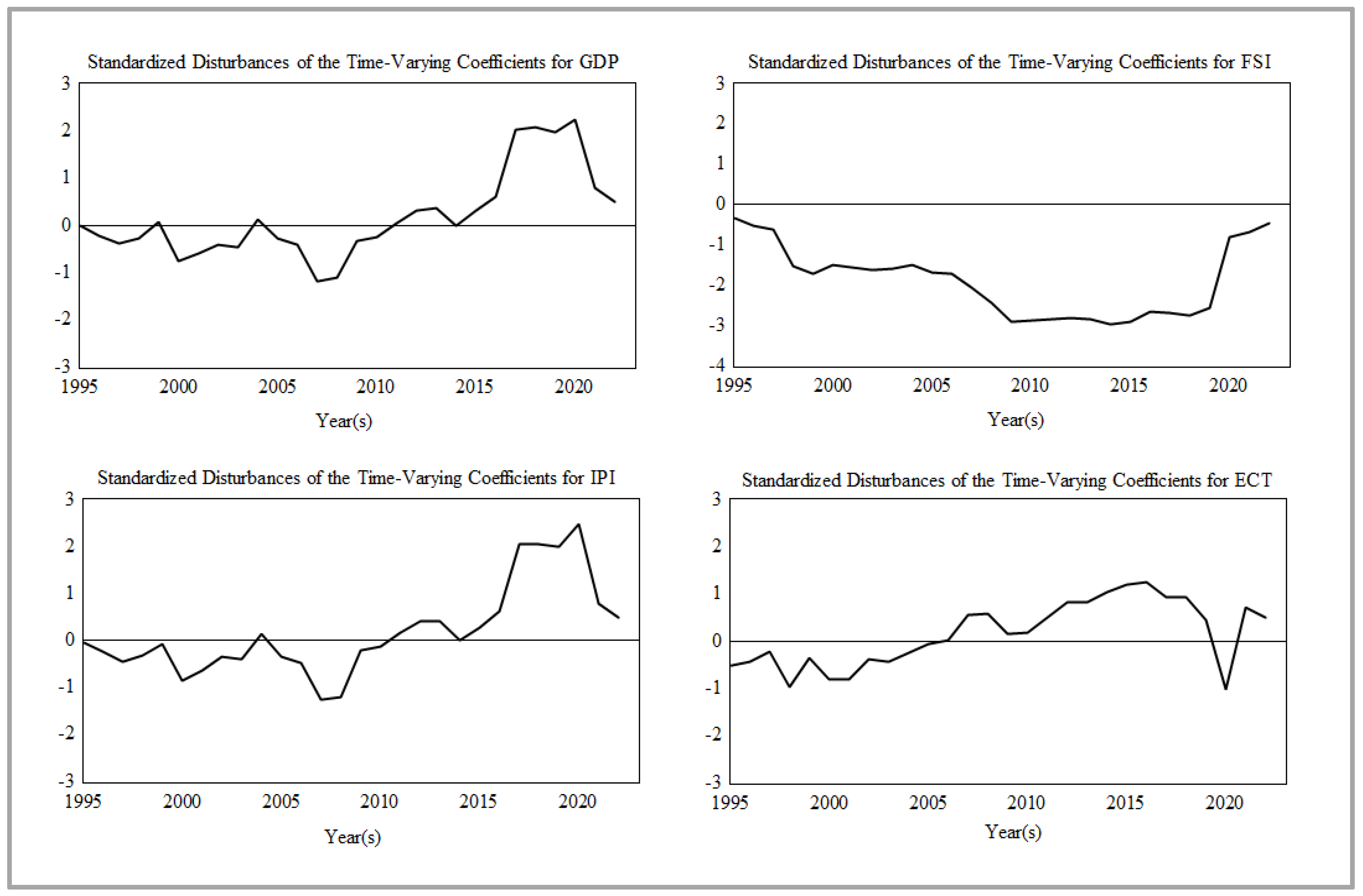
Environmental performance constitutes a core dimension of the environmental, social, and governance (ESG) framework; however, empirical evidence for developing economies such as Türkiye remains limited, particularly regarding regime-dependent effects. Accordingly, this study examines the effects of financial stability, economic growth, and industrial production on environmental performance for Türkiye within a Markov-switching error correction and time-varying parameter state–space framework using annual data for 1990–2023. The findings show that financial stability is insignificant in the low error-variance regime but is negatively associated with environmental performance in the high error-variance regime. Economic growth is negatively associated with environmental performance in the low error-variance regime and becomes insignificant in the high error-variance regime. In contrast, industrial production has a positive and statistically significant effect on environmental performance in both regimes. The error correction mechanism indicates that short-run disequilibria are gradually corrected, supporting the existence of long-run convergence. Furthermore, the time-varying parameter state–space estimates indicate that these effects change over time. Overall, the findings indicate that the effects of financial stability, economic growth, and industrial production on environmental performance differ depending on regime periods and changing economic conditions.
Keywords: environmental performance; financial stability; Markov-switching ECM; time-varying parameter (TVP) state–space estimates; Türkiye environmental performance; financial stability; Markov-switching ECM; time-varying parameter (TVP) state–space estimates; Türkiye