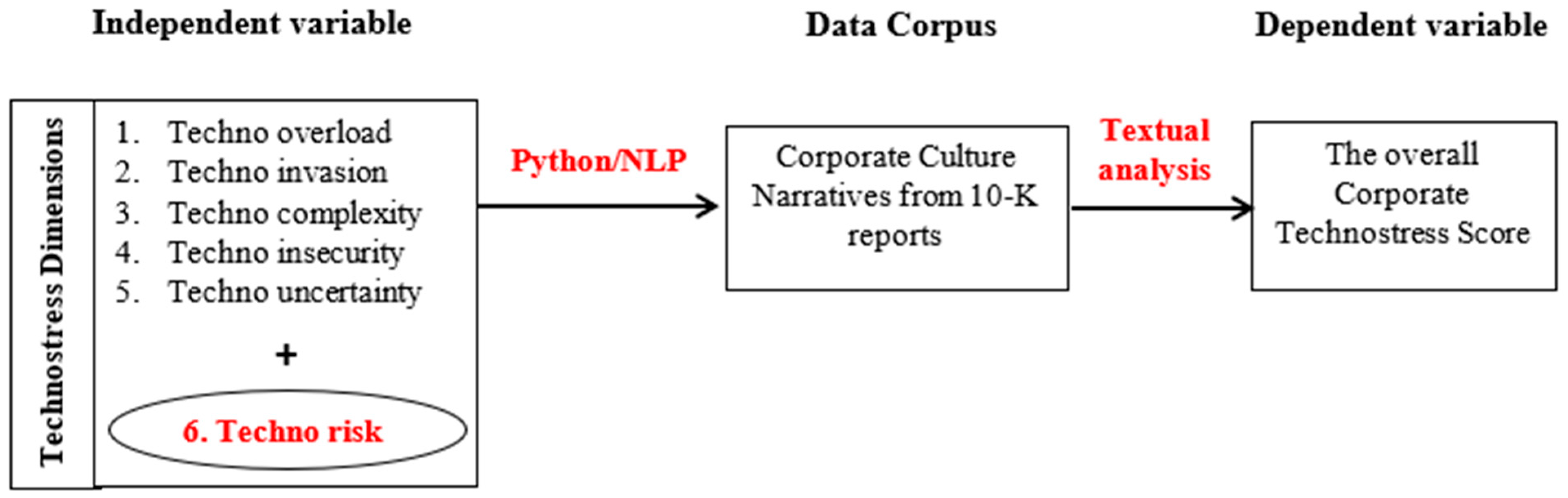
Measuring Technostress in Corporate Culture: Insights from the 10-K Annual Reports

Abstract
1. Introduction
2. Literature Review
3. Research Design
3.1. Technostress Measurement
3.2. Sample and Data Collection
4. Validation of the Proposed Measure
Validating Textual Analysis Through Operational Impact
5. Robustness Test
6. Conclusions
Author Contributions
Funding
Data Availability Statement
Conflicts of Interest
Appendix A
| Variable | Obs. | Mean | Std. Dev. | Min | Max | Jarque–Bera | Probability |
|---|---|---|---|---|---|---|---|
| ROA | 2534 | 23.22938 | 1.318457 | 3.175039 | 27.19735 | 46,161.69 | 0 |
| Tech_Stress | 2534 | 220.2253 | 110.4422 | 10 | 968 | 2376.09 | 0 |
| Firm_Size | 2534 | 10.39781 | 0.599114 | 8.228264 | 12.60237 | 89.808 | 0 |
| IT_Capability | 2534 | 0.418706 | 0.493444 | 0 | 1 | 423.5788 | 0 |
| LEV | 2534 | 0.832715 | 19.62108 | −550.685 | 432.2 | 29,139,053 | 0 |
| CAP | 2534 | 24.165 | 1.18134 | 4.323735 | 28.89587 | 118,901.1 | 0 |
| Report_Complex | 2534 | 10.80343 | 0.858798 | 1.791759 | 13.27872 | 422,298.8 | 0 |
| Ass_Turover | 2534 | 0.986977 | 0.120156 | 0 | 2 | 453,183.3 | 0 |
| Big 4 | 2534 | 0.636771 | 0.601111 | 0 | 8.126312 | 37,842.47 | 0 |
| Variables | 1 | 2 | 3 | 4 | 5 | 6 | 7 | 8 | 9 |
|---|---|---|---|---|---|---|---|---|---|
| ROA | 1 | ||||||||
| ----- | |||||||||
| Tech_Stress | −0.02974 | 1 | |||||||
| −1.49721 | ----- | ||||||||
| Firm_Size | 0.734703 | 0.075961 | 1 | ||||||
| 54.49597 | 3.833351 | ----- | |||||||
| IT_Capability | 0.014091 | −0.02799 | −0.08941 | 1 | |||||
| 0.709103 | −1.40909 | −4.5172 | ----- | ||||||
| LEV | 0.027402 | −0.01942 | −0.00517 | 0.044929 | 1 | ||||
| 1.37934 | −0.97757 | −0.25998 | 2.263078 | ----- | |||||
| CAP | 0.695888 | 0.097923 | 0.619525 | 0.001848 | 0.021952 | 1 | |||
| 48.75907 | 4.951177 | 39.71309 | 0.092996 | 1.104854 | ----- | ||||
| Report_Complex | −0.00966 | 0.121182 | 0.022349 | −0.02494 | −0.02355 | −0.03216 | 1 | ||
| −0.48619 | 6.143048 | 1.124835 | −1.25557 | −1.18507 | −1.61924 | ----- | |||
| Ass_Turover | 0.121798 | −0.07324 | −0.04091 | −0.00561 | −0.02629 | 0.040619 | −0.0132 | 1 | |
| 6.174724 | −3.69512 | −2.06032 | −0.28203 | −1.32345 | 2.045592 | −0.66441 | ----- | ||
| Big 4 | 0.188944 | −0.03703 | 0.137717 | 0.078686 | 0.001498 | 0.137169 | −0.01545 | 0.005521 | 1 |
| 9.681854 | −1.86436 | 6.996436 | 3.971719 | 0.075357 | 6.968082 | −0.77767 | 0.277798 | --- |
References
- Abdallah, M. A. M., & Eltamboly, N. A. (2022). Narrative forward-looking information disclosure, do ownership concentration, boardroom gender diversity and cultural values matter? A cross country study. Managerial Auditing Journal, 37(6), 742–765. [Google Scholar] [CrossRef]
- Ahmad, N., Shah, F. N., Ijaz, F., & Ghouri, M. N. (2023). Corporate income tax, asset turnover and Tobin’s Q as firm performance in Pakistan: Moderating role of liquidity ratio. Cogent Business and Management, 10(1), 2167287. [Google Scholar] [CrossRef]
- Alsaawi, A. (2016). A critical review of qualitative interviews. European Journal of Business and Social Sciences, 3(4), 149–156. [Google Scholar] [CrossRef]
- Al-Shattarat, W., Benameur, K. B., Mostafa, M. M., Hassanein, A., & Hamed, R. S. (2025). A decade of cybersecurity research in business, management, and accounting: Bibliometric analyses and future research directions. Cogent Business & Management, 12(1), 2544230. [Google Scholar] [CrossRef]
- Alshenqeeti, H. (2014). Interviewing as a data collection method: A critical review. English Linguistics Research, 3(1), 39–45. [Google Scholar] [CrossRef]
- Arnetz, B. B., & Wiholm, C. (1997). Technological stress: Psychophysiological symptoms in modern offices. Journal of Psychosomatic Research, 43(1), 35–42. [Google Scholar] [CrossRef] [PubMed]
- Ayyagari, R., Grover, V., & Purvis, R. (2011). Technostress: Technological antecedents and implications. MIS Quarterly: Management Information Systems, 35(4), 831–858. [Google Scholar] [CrossRef]
- Bahamondes-Rosado, M. E., Cerdá-suárez, L. M., Félix, G., Ortiz, D., & Espinosa-cristia, J. F. (2023). Technostress at work during the COVID-19 lockdown phase (2020–2021): A systematic review of the literature. Frontiers in Psychology, 14, 1173425. [Google Scholar] [CrossRef]
- Beattie, V., McInnes, B., & Fearnley, S. (2004). A methodology for analysing and evaluating narratives in annual reports: A comprehensive descriptive profile and metrics for disclosure quality attributes. Accounting Forum, 28(3), 205–236. [Google Scholar] [CrossRef]
- Berger, M., Schäfer, R., Schmidt, M., Regal, C., & Gimpel, H. (2024). How to prevent technostress at the digital workplace: A delphi study. Journal of Business Economics, 94(7–8), 1051–1113. [Google Scholar] [CrossRef]
- Bondanini, G., Giorgi, G., Ariza-Montes, A., Vega-Muñoz, A., & Andreucci-Annunziata, P. (2020). Technostress dark side of technology in the workplace: A scientometric analysis. International Journal of Environmental Research and Public Health, 17(21), 8013. [Google Scholar] [CrossRef]
- Borle, P., Reichel, K., Niebuhr, F., & Voelter-Mahlknecht, S. (2021). How are techno-stressors associated with mental health and work outcomes? A systematic review of occupational exposure to information and communication technologies within the technostress model. International Journal of Environmental Research and Public Health, 18(16), 8673. [Google Scholar] [CrossRef]
- Boyer-Davis, S. (2019). Technostress: An antecedent to job turnover intention in the accounting profession. Journal of Business and Accounting, 12(1), 49–63. Available online: https://www.researchgate.net/publication/343658519 (accessed on 25 June 2025).
- Brod, C. (1984). Technostress: The human cost of the computer revolution. In Basic books (1st ed.). Addison-Wesley Publishing Compamy. Available online: https://archive.org/details/technostresshuma0000brod/mode/2up (accessed on 25 June 2025).
- Califf, C. B., Sarker, S., & Sarker, S. (2020). The bright and dark sides of technostress: A mixed-methods study involving healthcare it1. MIS Quarterly: Management Information Systems, 44(2), 809–856. [Google Scholar] [CrossRef]
- Camacho, S., & Barrios, A. (2022). Teleworking and technostress: Early consequences of a COVID-19 lockdown. Cognition, Technology and Work, 24(3), 441–457. [Google Scholar] [CrossRef] [PubMed]
- Castro Rodriguez, C. F., & Choudrie, J. (2021). The impact of different organizational environments on technostress: Exploring and understanding the bright and dark sides before and during COVID-19. In UK academy for information systems conference proceedings (p. 23). AIS. [Google Scholar]
- Chin, W. W., Gopal, A., & Salisbury, W. D. (1997). Advancing the theory of adaptive structuration: The development of a scale to measure faithfulness of appropriation. Information Systems Research, 8(4), 342–367. [Google Scholar] [CrossRef]
- Consiglio, C., Massa, N., Sommovigo, V., & Fusco, L. (2023). Techno-Stress creators, burnout and psychological health among remote workers during the pandemic: The moderating role of e-work self-efficacy. International Journal of Environmental Research and Public Health, 20(22), 7051. [Google Scholar] [CrossRef]
- Cooper, H., Ewing, M., & Mishra, S. (2022). Text-mining 10-K (annual) reports: A guide for B2B marketing research. Industrial Marketing Management, 107, 204–211. [Google Scholar] [CrossRef]
- Cremer, F., Sheehan, B., Fortmann, M., Kia, A. N., Mullins, M., Murphy, F., & Materne, S. (2022). Cyber risk and cybersecurity: A systematic review of data availability. Geneva Papers on Risk and Insurance: Issues and Practice, 47(3), 698–736. [Google Scholar] [CrossRef]
- D’Arcy, J., Herath, T., & Shoss, M. (2014). Understanding employee responses to stressful information security requirements: A coping perspective. Journal of Management Information Systems, 31(2), 285–318. [Google Scholar] [CrossRef]
- Day, A., Paquet, S., Scott, N., & Hambley, L. (2012). Perceived information and communication technology (ICT) demands on employee outcomes: The moderating effect of organizational ICT support. Journal of Occupational Health Psychology, 17(4), 473–491. [Google Scholar] [CrossRef]
- Deloitte. (2024). Global cyber threat intelligence (CTI) annual cyber threat trends (pp. 1–19). Deloitte Development LLC. [Google Scholar]
- Duevel, C. (2019). SAGE research methods. The Charleston Advisor, 19(4), 38–41. [Google Scholar] [CrossRef]
- Dutta, D., & Mishra, S. K. (2024). “Technology is killing me!”: The moderating effect of organization home-work interface on the linkage between technostress and stress at work. Information Technology and People, 37(6), 2203–2222. [Google Scholar] [CrossRef]
- Eltamboly, N. A. (2025). Beyond busy board members: A comparative analysis of the impact of remote board meetings on the profitability of banks in the Middle East and North Africa. Future Business Journal, 11, 1–13. [Google Scholar] [CrossRef]
- Forina, M., Armanino, C., Lanteri, S., & Leardi, R. (2005). Methods of varimax rotation in factor analysis with applications in clinical and food chemistry. Journal of Chemometrics, 3(S1), 115–125. [Google Scholar] [CrossRef]
- Gaudioso, F., Turel, O., & Galimberti, C. (2017). The mediating roles of strain facets and coping strategies in translating techno-stressors into adverse job outcomes. Computers in Human Behavior, 69, 189–196. [Google Scholar] [CrossRef]
- Gerekan, B., Şendurur, U., & Yıldırım, M. (2024). Mediating role of professional commitment in the relationship between technostress and organizational stress, individual work performance, and independent audit quality. Employee Responsibilities and Rights Journal, 36(3), 367–381. [Google Scholar] [CrossRef] [PubMed]
- Glassman, H. S., Rhodes, P., & Buus, N. (2020). A critical review of qualitative interview studies with alcoholics anonymous members. Substance Use and Misuse, 55(3), 387–398. [Google Scholar] [CrossRef]
- Guo, J., Zhou, S., Chen, J., & Chen, Q. (2021). How information technology capability and knowledge integration capability interact to affect business model design: A polynomial regression with response surface analysis. Technological Forecasting and Social Change, 170, 120935. [Google Scholar] [CrossRef]
- Harris, K. J., Harris, R. B., Valle, M., Carlson, J., & Carlson, D. S. (2022). Technostress and the entitled employee: Impacts on work and family. Information Technology & People, 35(3), 1073–1095. [Google Scholar]
- Hoffman, B. W., Sellers, R. D., & Skomra, J. (2018). The impact of client information technology capability on audit pricing. International Journal of Accounting Information Systems, 29, 59–75. [Google Scholar] [CrossRef]
- Hofisi, C., Hofisi, M., & Mago, S. (2014). Critiquing interviewing as a data collection method. Mediterranean Journal of Social Sciences, 5(16), 60–64. [Google Scholar] [CrossRef]
- Hong, Q. N., Rees, R., Sutcliffe, K., & Thomas, J. (2020). Variations of mixed methods reviews approaches: A case study. Research Synthesis Methods, 11(6), 795–811. [Google Scholar] [CrossRef]
- Hurtt, R. K. (2010). Development of a scale to measure professional skepticism. Auditing, 29(1), 149–171. [Google Scholar] [CrossRef]
- Hussainey, K., Schleicher, T., & Walker, M. (2003). Undertaking large-scale disclosure studies when AIMR-FAF ratings are not available: The case of prices leading earnings. Accounting and Business Research, 33(4), 275–294. [Google Scholar] [CrossRef]
- Hwang, I., & Cha, O. (2018). Examining technostress creators and role stress as potential threats to employees’ information security compliance. Computers in Human Behavior, 81, 282–293. [Google Scholar] [CrossRef]
- Ingusci, E., Signore, F., Giancaspro, M. L., Manuti, A., Molino, M., Russo, V., Zito, M., & Cortese, C. G. (2021). Workload, techno overload, and behavioral stress during COVID-19 emergency: The role of job crafting in remote workers. Frontiers in Psychology, 12, 655148. [Google Scholar] [CrossRef] [PubMed]
- Ioannou, A. (2023). Mindfulness and technostress in the workplace: A qualitative approach. Frontiers in Psychology, 14, 1252187. [Google Scholar] [CrossRef]
- Jena, R. K. (2015). Technostress in ICT enabled collaborative learning environment: An empirical study among Indian academician. Computers in Human Behavior, 51, 1116–1123. [Google Scholar] [CrossRef]
- Jones, T. L., Baxter, M., & Khanduja, V. (2013). A quick guide to survey research. Annals of the Royal College of Surgeons of England, 95(1), 5–7. [Google Scholar] [CrossRef]
- Khedhaouria, A., & Cucchi, A. (2019). Technostress creators, personality traits, and job burnout: A fuzzy-set configurational analysis. Journal of Business Research, 101, 349–361. [Google Scholar] [CrossRef]
- Klarin, A. (2024). How to conduct a bibliometric content analysis: Guidelines and contributions of content co-occurrence or co-word literature reviews. International Journal of Consumer Studies, 48(2), e13031. [Google Scholar] [CrossRef]
- Krippendorff, K. (2019). SAGE research methods content analysis: An introduction to its methodology introduction. Sage. [Google Scholar]
- La Torre, G., De Leonardis, V., & Chiappetta, M. (2020). Technostress: How does it affect the productivity and life of an individual? Results of an observational study. Public Health, 189, 60–65. [Google Scholar] [CrossRef]
- Li, Y., & Liu, Q. (2021). A comprehensive review study of cyber-attacks and cyber security; Emerging trends and recent developments. Energy Reports, 7, 8176–8186. [Google Scholar] [CrossRef]
- Li, Z., & Liu, H. (2021). Mixed methods: Interviews, surveys, and cross-cultural comparison. Journal of Mixed Methods Research, 15(1), 138–140. [Google Scholar] [CrossRef]
- Liew, A., O’leary, D. E., Perdana, A., & Wang, T. (2022). Digital transformation in accounting and auditing: 2021 international conference of the journal of information systems panel discussion. Journal of Information Systems, 36(3), 177–190. [Google Scholar] [CrossRef]
- Molino, M., Ingusci, E., Signore, F., Manuti, A., Giancaspro, M. L., Russo, V., Zito, M., & Cortese, C. G. (2020). Wellbeing costs of technology use during COVID-19 remote working: An investigation using the italian translation of the technostress creators scale. Sustainability, 12, 5911. [Google Scholar] [CrossRef]
- Nastjuk, I., Trang, S., Grummeck-Braamt, J. V., Adam, M. T. P., & Tarafdar, M. (2024). Integrating and synthesising technostress research: A meta-analysis on technostress creators, outcomes, and IS usage contexts. European Journal of Information Systems, 33(3), 361–382. [Google Scholar] [CrossRef]
- Nayak, M. S. D. P., & Narayan, K. A. (2019). Strengths and weaknesses of online surveys. IOSR Journal of Humanities and Social Sciences (IOSR-JHSS), 24(5), 31–38. [Google Scholar] [CrossRef]
- Nazari, J. A., Hrazdil, K., & Mahmoudian, F. (2017). Assessing social and environmental performance through narrative complexity in CSR reports. Journal of Contemporary Accounting and Economics, 13(2), 166–178. [Google Scholar] [CrossRef]
- Obaid, M. S. (2024). Navigating digital transformation in accounting system: Challenges and opportunities. International Journal of Data and Network Science, 8(2), 935–946. [Google Scholar] [CrossRef]
- Petersen, M. (2009). Estimating standard errors in finance panel data sets: Comparing approaches. Review of Financial Studies, 22(1), 435–480. [Google Scholar] [CrossRef]
- Ponto, J. (2020). Understanding and Evaluating Survey Research. Journal of the Advanced Practitioner in Oncology, 6(2), 168–171. Available online: https://www.ncbi.nlm.nih.gov/pmc/articles/PMC4601897/pdf/jadp-06-168.pdf (accessed on 25 June 2025).
- Ragu-Nathan, T. S., Tarafdar, M., Ragu-Nathan, B. S., & Tu, Q. (2008). The consequences of technostress for end users in organizations: Conceptual development and validation. Information Systems Research, 19(4), 417–433. [Google Scholar] [CrossRef]
- Saganuwan, W., Ismail, K. W., & Ahmad, U. N. U. (2013). Technostress: Mediating accounting information system performance. Information Management and Business Review, 5(6), 270–277. [Google Scholar] [CrossRef]
- Salazar-Concha, C., Ficapal-Cusí, P., Boada-Grau, J., & Camacho, L. J. (2021). Analyzing the evolution of technostress: A science mapping approach. Heliyon, 7(4), e06726. [Google Scholar] [CrossRef]
- Sanjeeva Kumar, P. (2024). TECHNOSTRESS: A comprehensive literature review on dimensions, impacts, and management strategies. Computers in Human Behavior Reports, 16, 100475. [Google Scholar] [CrossRef]
- Schmidt, M., Frank, L., & Gimpel, H. (2021). How adolescents cope with technostress: A mixed-methods approach. International Journal of Electronic Commerce, 25(2), 154–180. [Google Scholar] [CrossRef]
- Sellberg, C., & Susi, T. (2014). Technostress in the office: A distributed cognition perspective on human-technology interaction. Cognition, Technology and Work, 16(2), 187–201. [Google Scholar] [CrossRef]
- Serafini, F., & Reid, S. F. (2023). Multimodal content analysis: Expanding analytical approaches to content analysis. Visual Communication, 22(4), 623–649. [Google Scholar] [CrossRef]
- Shu, Q., Tu, Q., & Wang, K. (2011). The impact of computer self-efficacy and technology dependence on computer-related technostress: A social cognitive theory perspective. International Journal of Human-Computer Interaction, 27(10), 923–939. [Google Scholar] [CrossRef]
- Silva, A. F. d., Goncalves, M. J., & Oliveira, A. (2024). Digital transformation in accounting: The perception of portguese accountants. In 112 international scientific conference on economic and social development (pp. 238–250). Varazdin Development and Entrepreneurship Agency. [Google Scholar]
- Snider, K. L. G., Shandler, R., Zandani, S., & Canetti, D. (2021). Cyberattacks, cyber threats, and attitudes toward cybersecurity policies. Journal of Cybersecurity, 7, tyab019. [Google Scholar] [CrossRef]
- Srivastava, S. C., Chandra, S., & Shirish, A. (2015). Technostress creators and job outcomes: Theorising the moderating influence of personality traits. Information Systems Journal, 25(4), 355–401. [Google Scholar] [CrossRef]
- Stern, M. J., Bilgen, I., & Dillman, D. A. (2014). The state of survey methodology: Challenges, dilemmas, and new frontiers in the era of the tailored design. Field Methods, 26(3), 284–301. [Google Scholar] [CrossRef]
- Tan, E., Wong-Lim, C., & Lim, E. (2023). Employment quality and 10-K report readability. Journal of Accounting and Public Policy, 42(2), 107020. [Google Scholar] [CrossRef]
- Tarafdar, M., Maier, C., Laumer, S., & Weitzel, T. (2020). Explaining the link between technostress and technology addiction for social networking sites: A study of distraction as a coping behavior. Information Systems Journal, 30(1), 96–124. [Google Scholar] [CrossRef]
- Tarafdar, M., Pullins, E. B., & Ragu-Nathan, T. S. (2015). Technostress: Negative effect on performance and possible mitigations. Information Systems Journal, 25(2), 103–132. [Google Scholar] [CrossRef]
- Tarafdar, M., Tu, Q., Ragu-Nathan, B. S., & Ragu-Nathan, T. S. (2007). The impact of technostress on role stress and productivity. Journal of Management Information Systems, 24(1), 301–328. [Google Scholar] [CrossRef]
- Turel, O., & Gaudioso, F. (2018). Techno-stressors, distress and strain: The roles of leadership and competitive climates. Cognition, Technology and Work, 20(2), 309–324. [Google Scholar] [CrossRef]
- U.S. Securities and Exchange Commission [SEC]. (2023). Cybersecurity risk management, strategy, governance, and incident disclosure (Release Nos. 33-11216; 34-97989, File No. S7-09-22). U.S. Securities and Exchange Commission.
- Weber, R. (2011). Basic content analysis. Sage Publications. [Google Scholar] [CrossRef]
- Wu, J., Wang, N., Liu, L., & Mei, W. (2020). Technology-induced job anxiety during non-work time: Examining conditional effect of techno-invasion on job anxiety. International Journal of Networking and Virtual Organisations, 22(2), 162. [Google Scholar] [CrossRef]
- Zhang, Z., Ye, B., Qiu, Z., Zhang, H., & Yu, C. (2022). Does technostress increase R&D employees’ knowledge hiding in the digital era? Frontiers in Psychology, 13, 873846. [Google Scholar] [CrossRef] [PubMed]

| Technostress Dimension | Key Clues | Technostress Dimension | Key Clues |
|---|---|---|---|
| Techno-overload | Overload | Techno-insecurity | Job security |
| Workload | AI | ||
| Work pressure | Machine learning | ||
| Information overload | Talent | ||
| Big data | Workforce reduction | ||
| Large volume | Automation | ||
| Productivity demands | Robot | ||
| Volatile | New recruits | ||
| Competitive | Techno-uncertainty | Uncertainty | |
| Speed | Development | ||
| Scalability | Rapid | ||
| New trends | New laws | ||
| New technology | Regulatory changes | ||
| Technology-driven tasks | System upgrade | ||
| Multitasking | Change | ||
| Techno-invasion | Remote | Training | |
| 24/7 | Unauthorized | ||
| Global supply chain | Techno-risk | Cyber security | |
| Digital transformation | IT Control | ||
| Work-life balance | |||
| Connectivity | Hack | ||
| Intrusion | Data security | ||
| Virtual | Breach | ||
| After work hours | Vulnerability | ||
| Techno-complexity | Complexity | System failure | |
| Digitization | Leakage | ||
| IT | Technology risks | ||
| ICT | Confidentiality | ||
| Cryptocurrency | Privacy risks | ||
| Blockchain | Security risks | ||
| ERP | IT fatigue | ||
| Cloud | Technostress | ||
| Technical skills | Attacks | ||
| System updates | |||
| User difficulty | Total key clues | 68 |
| Component | ||||||
|---|---|---|---|---|---|---|
| 1 | 2 | 3 | 4 | 5 | 6 | |
| Connectivity | 0.891 | |||||
| Regulatory changes | 0.861 | |||||
| Global supply chain | 0.857 | |||||
| Data security | 0.845 | |||||
| Competitive | 0.812 | |||||
| Training | 0.806 | |||||
| Uncertainty | 0.799 | |||||
| Remote | 0.791 | |||||
| Complexity | 0.786 | |||||
| Unauthorized | 0.733 | |||||
| Leakage | 0.73 | |||||
| System failure | 0.725 | |||||
| Big data | 0.705 | |||||
| Attacks | 0.681 | |||||
| Workforce reduction | 0.607 | |||||
| Digitization | 0.607 | |||||
| System updates | ||||||
| technostress | ||||||
| New technology | ||||||
| Rapid | ||||||
| Automation | 0.916 | |||||
| Scalability | 0.89 | |||||
| Cloud | 0.885 | |||||
| Machine learning | 0.807 | |||||
| 24-Jul | 0.799 | |||||
| Breach | 0.774 | |||||
| Confidentiality | 0.739 | |||||
| Virtual | 0.723 | |||||
| Volatile | 0.694 | |||||
| Technical skills | 0.634 | 0.635 | ||||
| Changes | 0.615 | |||||
| Speed | ||||||
| Vulnerability | ||||||
| IT | ||||||
| Overload | ||||||
| Work-life balance | ||||||
| User difficulty | ||||||
| Productivity demand | ||||||
| Job security | ||||||
| Information overload | ||||||
| Technology-driven tasks | ||||||
| Cryptocurrency | 0.798 | |||||
| Cyber security | 0.733 | |||||
| Development | 0.71 | |||||
| New trends | 0.612 | 0.697 | ||||
| IT fatigue | ||||||
| Intrusion | ||||||
| Work pressure | ||||||
| Multitasking | ||||||
| Hack | ||||||
| After work hours | ||||||
| Technology-driven tasks | ||||||
| Technology risk | 0.858 | |||||
| ERP | 0.763 | |||||
| Workload | 0.664 | |||||
| Talent | 0.641 | 0.652 | ||||
| New technology | 0.613 | 0.624 | ||||
| AI | 0.606 | |||||
| Security risks | 0.89 | |||||
| Large volume | 0.844 | |||||
| IT Control | 0.832 | |||||
| New laws | ||||||
| Robot | ||||||
| ICT | ||||||
| System upgrade | ||||||
| Privacy risks | 0.928 | |||||
| Digital transformation | 0.774 | |||||
| Blockchain | ||||||
| Extraction Method: Principal Component Analysis. | ||||||
| Rotation Method: Varimax with Kaiser Normalization. | ||||||
| Rotation converged in 6 iterations. | ||||||
| Technostress Dimension | Key Clues | Technostress Dimension | Key Clues |
|---|---|---|---|
| Techno-overload | Workload | Techno-insecurity | AI |
| Big data | Workforce reduction | ||
| Large volume | Automation | ||
| Volatile | Machine learning | ||
| Talent | |||
| Regulatory changes | |||
| Changes | |||
| Training | |||
| Competitive | Techno-uncertainty | Uncertainty | |
| Scalability | Rapid | ||
| New technology | Regulatory changes | ||
| Techno-invasion | Remote | Training | |
| 24/7 | Development | ||
| Global supply chain | Techno-risk | Unauthorized | |
| Digital transformation | Cyber security | ||
| Connectivity | Attacks | ||
| Virtual | Data security | ||
| Techno-complexity | Complexity | Breach | |
| Digitization | System failure | ||
| IT control | Leakage | ||
| Cryptocurrency | Confidentiality | ||
| ERP | Security risks | ||
| Cloud | Technology risks | ||
| Technical skills |
| Technostress Dimension | Proposed Key Clues | Analytical Notes |
|---|---|---|
| Techno-overload | Workload | The increase was primarily due to higher labor-related costs driven by overtime and contractor usage to support the increased workload. |
| Volatile | The Company believes, in general, gross margins will be subject to volatility and downward pressure… in competitive markets. The electric utility industry is subject to various factors that may result in volatile fuel costs. | |
| Competitive | The markets for the Company’s products and services are highly competitive… aggressive pricing. The electric utility industry is highly competitive and subject to evolving regulatory requirements. | |
| Scalability | Our manufacturing operations must maintain the capacity and scalability to meet fluctuating global demand for our products. | |
| Techno-invasion | Remote | Some of our employees continue to work in remote or hybrid arrangements |
| Global supply chain | We are subject to risks associated with the global supply chain, including delays and increased costs. Abbott’s global supply chain is subject to risks including disruptions from natural disasters, geopolitical events, and supplier issues. | |
| Work-life balance | We provide various options to assist with career growth and development…We also provide volunteer opportunities and volunteer grants, as well as $10,000 of charitable giving matching annually, through the ONEOK Foundation. | |
| Techno-complexity | Complexity | The complexity of global regulatory requirements presents ongoing compliance challenges. The complexity of our energy delivery systems requires significant ongoing maintenance and investment. |
| IT control | We rely on information technology (IT) systems to operate our business and maintain customer data. …the Company’s business and reputation are impacted by information technology system failures and network disruptions. | |
| ERP | Oracle Fusion Cloud Enterprise Resource Planning (ERP), which is designed to be a complete and integrated ERP solution to help organizations improve decision-making and workforce productivity and to optimize back-office operations by utilizing a single data and security model with a common user interface. | |
| Cloud | The Company’s cloud services store and keep customers’ content up-to-date and available across multiple Apple devices and Windows personal computers. We believe that our Oracle Cloud Services offerings are opportunities for us to continue to expand our cloud and license business. | |
| Techno-insecurity | Automation | Automation in manufacturing processes improves efficiency but may require significant capital investment. |
| AI | Abbott is exploring the use of artificial intelligence (AI) in diagnostic technologies. | |
| Machine learning | Machine learning algorithms are being incorporated into some of Abbott’s diagnostic platforms. | |
| Talent | Failure to attract and retain a qualified workforce could have an adverse effect on our business. | |
| Workforce reduction | Our recruitment strategy is focused on hiring a workforce to meet our business objectives, including critical skilled trade roles. A shortage of skilled labor may make it difficult for us to maintain labor productivity and competitive costs. | |
| Regulatory changes | Changes in regulatory requirements could impact the timing and cost of bringing products to market. | |
| Changes in tax laws and regulations may adversely affect our financial condition… | ||
| Training | Abbott provides ongoing training to employees to ensure compliance with quality and regulatory standards. | |
| Development | Research and development expenses were $2.8 billion in 2023, reflecting continued investment in innovation. | |
| Techno-risk | Unauthorized | The Company and its business partners and customers could be subject to unauthorized access… |
| Cyber security | We have implemented cybersecurity measures to protect our IT systems from unauthorized access. The Company and its business partners and customers could be subject to unauthorized access, cybersecurity threats, data breaches and other security incidents… | |
| Attack | Cybersecurity attacks could result in operational disruptions or unauthorized disclosure of sensitive information. Attacks are expected to continue accelerating in both frequency and sophistication. …hackers and other malicious actors… | |
| Breach | …cybersecurity threats, data breaches and other security incidents… A data breach could have a material adverse effect on our reputation and financial condition. | |
| System failure | …the Company’s business and reputation are impacted by information technology system failures and network disruptions. | |
| Leakage | If any of our systems are damaged, fails to function properly or otherwise becomes unavailable, we may incur substantial costs to repair or replace them and may experience loss or corruption of critical data and interruptions or delays in our ability to perform critical functions, which could affect adversely our business and results of operations. | |
| Confidentiality | The misappropriation, corruption or loss of personally identifiable information and other confidential data from us or one of our vendors could lead to significant breach of notification expenses… | |
| Security risks | Abbott faces security risks related to both its physical facilities and IT systems. Security risks include both physical and cybersecurity threats to our assets and systems. |
| Terms and Bigrams | Frequency | The Percentage of Total Technostress Clues Count | No. of Reports |
|---|---|---|---|
| Workload | 230 | 0.013% | 223 |
| Big data | 283 | 0.25% | 206 |
| Large volume | 140 | 0.02% | 201 |
| Volatile | 4540 | 0.79% | 1718 |
| Competitive | 39,107 | 7.26% | 2540 |
| Speed | 3362 | 0.66% | 1255 |
| Scalability | 445 | 0.19% | 316 |
| New technology | 1007 | 0.066% | 801 |
| Remote | 3321 | 0.613% | 1438 |
| 24/7 | 271 | 0.038% | 343 |
| Global supply chain | 1269 | 0.269% | 631 |
| Digital transformation | 536 | 0.089% | 326 |
| Connectivity | 2657 | 0.432% | 737 |
| Intrusion | 772 | 0.132% | 579 |
| Virtual | 2547 | 0.312% | 842 |
| Complexity | 5622 | 0.967% | 67 |
| Digitization | 191 | 0.032% | 208 |
| IT control | 2495 | 23.17% | 77 |
| Cryptocurrency | 197 | 0.0164% | 107 |
| Blockchain | 189 | 0.0277% | 164 |
| ERP | 1651 | 0.183% | 330 |
| Cloud | 21,561 | 3.369% | 1541 |
| Technical skills | 154 | 0.0205% | 183 |
| Automation | 3935 | 0.822% | 967 |
| AI | 8752 | 1.341% | 673 |
| Machine learning | 1266 | 0.208% | 568 |
| Talent | 9464 | 1.768% | 1795 |
| Workforce reduction | 403 | 0.068% | 315 |
| Uncertainty | 15,691 | 2.905% | 2443 |
| New laws | 1833 | 0.335% | 1130 |
| Regulatory changes | 1904 | 0.384% | 1071 |
| Training | 12,186 | 2.119% | 2133 |
| Unauthorized | 10,817 | 1.876% | 2429 |
| Cyber security | 1381 | 0.273% | 600 |
| Attacks | 12,275 | 2.306% | 2345 |
| Data security | 3684 | 0.60% | 1362 |
| Breach | 11,461 | 1.635% | 3425 |
| System failure | 245 | 0.043% | 273 |
| Leakage | 253 | 0.049% | 1686 |
| Technology risks | 289 | 0.058% | 254 |
| Confidentiality | 3215 | 0.540% | 1434 |
| Security risks | 1089 | 0.023% | 837 |
| Variables | Model (1) Revenue Growth | Model (2) ROE | Model (3) Lagged 2 |
|---|---|---|---|
| Tech_Stress | −0.001481 *** (−9.40645) | −0.00218 ** (−2.33123) | −0.00631 ** (−2.2344) |
| Firm_Size | 1.147389 *** (34.5865) | −0.0733 (−0.08449) | −0.71245 *** (−4.6392) |
| IT_Capability | 0.119569 ** (3.829824) | −0.18198 (−0.89015) | −0.06344 (−0.84153) |
| LEV | 0.001384 (0.416473) | 0.285272 ** (2.575353) | 5282.602 *** (7.774141) |
| CAP | 0.416473 *** (25.08076) | 0.046975 (0.666771) | 1.190006 *** (2.780128) |
| Report_Complex | 0.00232 (0.128464) | −0.03388 (−0.66581) | −0.02407 *** (−3.47823) |
| Ass_Turover | 0.273204 *** (10.68288) | 0.068838 (0.363501) | 0.073523 *** (3.676603) |
| Big 4 | 0.714439 *** (5.434125) | 0.187274 (0.836811) | 0.251825 *** (3.948869) |
| C | 0.61219 (1.574044) | 1.770008 ** (2.966364) | 17.7374 *** (11.91317) |
| Year Fixed Effects | Yes | Yes | Yes |
| Firm Fixed Effects | Yes | Yes | Yes |
| Adj. R-squared | 0.671759 | 0.461977 | 0.448345 |
| F-statistic | 635.4293 | 5.828718 | 4.044966 |
| Prob(F-statistic) | 00000 | 0.0000 | 0.0000 |
| Durbin–Watson | 2.263651 | 1.513625 | 1.57598 |
| VIF. | 3.046542022 | 1.858657 | 1.170746 |
| Obs. | 2532 | 2532 | 2532 |
| Variable | Model (1) | Model (2) | Model (3) | Model (4) | Model (5) | Model (6) |
|---|---|---|---|---|---|---|
| Techno-overload | −0.01099 (−1.33633) | |||||
| Techno-invasion | −0.06671 ** (−2.18679) | |||||
| Techno-complexity | −0.00646 (−0.91534) | |||||
| Techno-insecurity | −0.01073 *** (−3.51852) | |||||
| Techno-uncertainty | −0.031467 ** (−2.403959) | |||||
| Techno-risk | 0.00014 *** (−4.2684) | |||||
| Firm_Size | −0.02004 (−0.09287) | −0.17506 (−0.97601) | −0.28871 (−1.22905) | −0.29299 (−1.23156) | 0.336683 (0.145037) | 0.000538 (1.053121) |
| IT_Capability | 0.312841 ** (2.565339) | 0.286006 ** (2.551512) | 0.285656 ** (2.551361) | 0.285659 ** (2.551427) | −1.068729 (−0.680302) | −5.42 × 10⁻⁷ (−0.07787) |
| LEV | 0.150148 (0.868963) | 0.166711 ** (2.377836) | 0.058223 (0.847637) | 0.058697 (0.85781) | 0.229796 (1.346195) | 0.003236 ** (2.020165) |
| CAP | −0.07326 (−0.66315) | −0.02756 (−0.54249) | −0.04081 (−0.88697) | −0.04391 (−0.96725) | −0.984641 (−1.093158) | 1.40 × 10⁻⁷ (0.885502) |
| Report_Complex | −0.09183 (−0.25562) | 0.03648 (0.180057) | 0.049026 (0.246336) | 0.051402 (0.259828) | −0.000139 *** (−3.1948) | 0.002927 (1.397936) |
| Ass_Turover | 0.256859 (1.324924) | −0.38243 (−0.9766) | −0.01209 (−0.07741) | −0.0201 (−0.12282) | −2.633196 ** (−2.026122) | −0.00782 ** (−2.19672) |
| C | −2.67929 (−0.86566) | −3.24619 ** (−2.7013) | −0.78589 (−0.75004) | −0.77921 (−0.74389) | 35.51408 (1.63093) | −0.05706 (−1.41213) |
| Year Fixed Effects | Yes | Yes | Yes | Yes | Yes | Yes |
| Firm Fixed Effects | Yes | Yes | Yes | Yes | Yes | Yes |
| Adj.R2 | 0.503717 | 0.460097 | 0.459785 | 0.499794 | 0.291431 | 0.814958 |
| F-statistic | 6.692012 | 6.256657 | 5.743039 | 5.285412 | 3.055343 | 25.60266 |
| Prob(F-statistic) | 0.000 | 0.000 | 0.000 | 0.000 | 0.009045 | 0.000 |
| Durbin–Watson stat | 1.543719 | 1.523781 | 1.523395 | 1.523348 | 1.936821 | 1.141354 |
| VIF. | 2.014979 | 1.852185 | 1.851115 | 1.999176 | 1.411295 | 5.404179 |
| Obs. | 2453 | 2453 | 2453 | 2453 | 2453 | 2453 |
| Variables | Panel A: Tech_Stress Forward | Panel B: Productivity Lag 1 | ||
|---|---|---|---|---|
| (1) | (2) | (1) | (2) | |
| Tech_Stresst+1 | 3.529473 (0.653175) | 0.000707 (0.789018) | ||
| Rev growtht−1 | 0.030848 (0.63616) | |||
| ROEt−1 | 0.023517 (1.154867) | |||
| Firm_Size | −4.670012 (−1.97137) | −2.15399 ** (−2.31159) | −0.14592 ** (−3.49248) | −4.750012 * (−1.91859) |
| IT_Capability | −0.64409 (−1.12278) | 0.345928 (0.554371) | −2.98123 * (−1.8049) | −0.62207 (−0.90666) |
| LEV | 0.217223 (0.597096) | 0.000778 (0.275381) | 0.430796 (0.582473) | 0.226458 (0.637409) |
| CAP | 0.000233 (0.201016) | 0.157467 (1.099826) | −0.00051 (−0.2196) | 0.000222 (0.327962) |
| Report_Complex | 0.191818 (1.064525) | 0.120472 (1.331389) | 0.308073 (0.707427) | 0.202068 (0.807663) |
| Ass_Turover | −0.02038 (−0.40393) | −0.0476 (−0.20424) | 0.145258 (0.878958) | 0.024437 (0.352478) |
| Big 4 | −1.41949 (−5.8412) | 3.302582 * (1.670937) | −0.11725 (−0.41508) | −1.41731 ** (−2.77275) |
| C | 0.10738 (0.461543) | 17.51315 * (1.800241) | 2.986881 *** (9.417875) | 0.065275 (0.187537) |
| Cross-section fixed (dummy variables) | Yes | Yes | Yes | Yes |
| Period fixed (dummy variables) | Yes | Yes | Yes | Yes |
| Cross-section weights (PCSE) standard errors and covariance (d.f. corrected) | ||||
| Adj. R-squared | 0.259222 | 0.383047 | 0.333971 | 0.289562 |
| F-statistic | 1.555969 | 2.219458 | 2.229635 | 1.461256 |
| Prob(F-statistic) | 0.000001 | 0.00000 | 0.000000 | 0.000026 |
| DW | 1.484854 | 2.325093 | 2.105547 | 1.613674 |
| VIF. | 1.349932 | 1.620869 | 1.501436 | 1.407582 |
| Obs. | 1477 | 1453 | 1477 | 1453 |
Disclaimer/Publisher’s Note: The statements, opinions and data contained in all publications are solely those of the individual author(s) and contributor(s) and not of MDPI and/or the editor(s). MDPI and/or the editor(s) disclaim responsibility for any injury to people or property resulting from any ideas, methods, instructions or products referred to in the content. |
© 2026 by the authors. Licensee MDPI, Basel, Switzerland. This article is an open access article distributed under the terms and conditions of the Creative Commons Attribution (CC BY) license.
Share and Cite
Eltamboly, N.; Farag, M.; Gomaa, M.; Abdallah, M. Measuring Technostress in Corporate Culture: Insights from the 10-K Annual Reports. J. Risk Financial Manag. 2026, 19, 150. https://doi.org/10.3390/jrfm19020150
Eltamboly N, Farag M, Gomaa M, Abdallah M. Measuring Technostress in Corporate Culture: Insights from the 10-K Annual Reports. Journal of Risk and Financial Management. 2026; 19(2):150. https://doi.org/10.3390/jrfm19020150
Chicago/Turabian StyleEltamboly, Nayera, Magdy Farag, Mohamed Gomaa, and Maysa Abdallah. 2026. "Measuring Technostress in Corporate Culture: Insights from the 10-K Annual Reports" Journal of Risk and Financial Management 19, no. 2: 150. https://doi.org/10.3390/jrfm19020150
APA StyleEltamboly, N., Farag, M., Gomaa, M., & Abdallah, M. (2026). Measuring Technostress in Corporate Culture: Insights from the 10-K Annual Reports. Journal of Risk and Financial Management, 19(2), 150. https://doi.org/10.3390/jrfm19020150