Article

Digital Disruptive Innovation and Firm Performance Nexus: Role of Dynamic Managerial Competence, Innovative Work Practices and COVID-19


UNE Business School, University of New England, Armidale, NSW 2351, Australia
*
Author to whom correspondence should be addressed.
J. Risk Financ. Manag. 2026, 19(2), 149; https://doi.org/10.3390/jrfm19020149
Submission received: 25 November 2025 / Revised: 5 February 2026 / Accepted: 6 February 2026 / Published: 14 February 2026
(This article belongs to the Section Business and Entrepreneurship)

Abstract

This study investigates, with a particular focus on understanding how digital change shapes firm performance in an emerging economy context, first, the impact of digital disruptive innovation, conceptualized as an external condition characterized by technological, market, and competitive turbulence on firm performance within tech-intensive service sector companies, and second, the mediating influence of management skills, proxied by dynamic core managerial competence, and the moderating influence of modern management practices, proxied by innovative work practices, on this relationship. It also examines the moderating effect of innovative work practices on the relationship between digital disruptive innovation and dynamic core management competence, and the impact of COVID-19 on the link between dynamic core management competence and firm performance. This study applies structural equation modelling (SEM) (AMOS 26.0 software) to explore several hypotheses testing for target relationships. The sample was collected via a Qualtrics online survey from 730 senior executives working in digital telecom and banking firms in Pakistan. The study findings show that digital disruptive innovation has a negative effect on service sector performance, and this negative impact is also mediated by dynamic core management competence, as heightened digital disruption tends to weaken managerial competence, which subsequently affects firm performance. While innovative work practices exhibit a positive association with performance, they also positively moderate the negative effect of digital disruptive innovation on performance and mitigate the negative impact of dynamic core management competence on performance. The analysis also reveals that the COVID-19 pandemic positively moderates the effect of dynamic core management competence on performance, indicating that managerial adaptability becomes particularly important when firms operate under crisis conditions. Overall, this study highlights the significance of these phenomena on firm performance in an emerging economy context and provides practical insights for managers and policymakers operating in digitally disrupted service sectors.

1. Introduction

Rapid technological advancement in the digital age poses unprecedented challenges to companies. In this competitive environment, companies must not only innovate technologically but also maintain a strong, skilled workforce with effective practices for sustained performance. Digital disruptive innovation (DDI) refers to radical technological changes (i.e., technological turbulence) that simultaneously create new processes, disrupt markets (i.e., market turbulence), and displace leaders (i.e., competitive turbulence) (Niaz et al., 2021; Schuelke-Leech, 2021; Tait & Wield, 2021). In this study, digital disruptive innovation is treated as an external environmental condition reflecting technological, market, and competitive turbulence faced by incumbent firms, rather than firms’ own innovation outputs. While DDI is essential (Tukina et al., 2020), it can also create risks and unintended consequences (Bains, 2022). It often poses challenges and can challenge the stability of incumbent companies (Dorothy et al., 2020; Raffaelli et al., 2019; Weile et al., 2018). Such disruption occurs when an innovation creates disturbances, displaces or renders existing technologies less effective, and offers improved performance (Brownsword, 2022). Complementing this, Chen (2021) asserts that disruptive technologies, influenced by relentless innovations, drive companies and economies.
A skilled workforce and effective workplace practices are essential for companies to maintain a competitive edge against threats driven by DDI. The literature documents that managers require industry-specific skills and competencies that directly influence firm performance (Al-Subaie et al., 2021). However, existing managerial competencies can quickly become ineffective, resulting in a competence gap that impedes innovation (Bondarenko et al., 2021; Busulwa et al., 2022). Moreover, continuously improving competencies for innovation and performance is becoming highly challenging (Cui et al., 2022). While competence deficiencies hinder firm performance (FP) and organizational efficiency, dynamic core management competence (DCC) enhances collaborative competence and organizational resilience (Chen, 2022; Elia et al., 2020; Lan et al., 2020; Ma et al., 2022). Dynamic competence requires managers to develop new competencies for achieving a competitive advantage (Pechlaner et al., 2019). This suggests that companies can develop core management competencies (e.g., marketing, technological, social) to enhance their competitive advantage and market responsiveness (Lan et al., 2020). These core competencies facilitate the efficient use of company resources, leading to better performance (Nurfauzi & Firmansyah, 2018).
Relatedly, developing DCC requires modern workplace practices in a disruptive environment, combining individual and team efforts for improved ways of working (Totterdill & Exton, 2014). Specifically, these practices include creative ideas and innovative practices that enable managers to implement changes necessitated by disruptions. In the literature, innovative work practices (IWPs) generate innovative products and services, thereby enhancing firm performance (Ko & Ma, 2019). Hence, IWPs achieve this by improving employee skills, motivation, and overall firm performance (Wattoo et al., 2020). This suggests that IWPs provide a productive and challenging work environment for employees by increasing favourable interactions between them and the organization (Wattoo et al., 2020). Nevertheless, while IWPs develop a competent workforce (Moussa & El Arbi, 2020), maintaining DCC requires structured, creative work, continuous learning, and robust HR support.
Critically, no industry is immune to DDI, especially tech-intensive service sectors in developed and emerging economies, due to their reliance on innovation and intense competition. Lubkova et al. (2019) argue that this effect is particularly evident in the telecom and banking sectors that have been evolving rapidly through the use of the latest technologies. Increasing DDI poses severe threats to incumbent firms, requiring tailored market responses (Dorothy et al., 2020). To mitigate the profound impact disruptive technology has on business operations and firm performance, the roles played by both DCC and IWPs are paramount in effectively managing the structural relationship between DDI and sustained firm performance. Thus, both telecom and banking sectors, which have gone through massive digital disruption, are required to execute new types of strategies to ensure the competence of managers in effectively avoiding future disruptions. Understanding the dynamics of individual-level DCC and firm-level IWPs for identifying the skills that are essential in a disruptive environment to bring clarity and allow firms to invest in the right direction and develop strategies (Li et al., 2020). Thus, a detailed empirical investigation of DCC is required to draw a meaningful conclusion. Despite this need, there is currently little understanding of the influence of managers’ competence acquisition on incumbent firms’ strategic reactions to DDI. Moreover, Diener (2020) noted that the employee competence gap is expected to increase due to changes in the current market direction and competitive dynamics within the service sector, caused by DDI. This relationship remains insufficiently explored in the literature, stressing the need for further empirical research.
Our motivation derives from C. Wang et al. (2021), highlighting that the research on DDI and its impact on firm performance remains scarce and ambiguous. In an intense market competition environment, increasing dependency on technology by service sector companies, such as banking and telecommunications, causes disruption that can jeopardize performance. This study complements the ongoing academic debate by addressing a significant void in the literature in the context of an emerging economy. Moreover, the interplay between managerial competence deficiency and innovative practices has not been explored in depth and thus requires further empirical attention. We address the pertinent gap in the literature by examining the unique interrelationships among DDI, DCC, IWPs, and FP within the telecom and banking service sectors. More precisely, we examine the impact of DDI on tech-intensive service sector performance, mediated through DCC, and also the moderating effect of IWPs on the nexus between DDI and firm performance, as well as on the relationship between DDI and DCC. In addition, we explore the moderating role of COVID-19 on DCC and firm performance relationships. We contribute to extant literature in several ways:
First, unlike prior DDI research, this study examines the impact of DDI on firm performance within Pakistan’s service sectors, a developing economy with limited research in this area. It specifically analyses three dimensions of DDI (technological, market, and competitive turbulences) as direct determinants of performance, rather than as moderators used in the extant literature (C. Wang et al., 2022). Second, our study introduces a new idea of exploring the mediating role of dynamic core competence (DCC) in the DDI and firm performance (FP) relationship, recognizing the role of DCC in enhancing firm performance under conditions of digital disruption. We contend that DCC is a critical driver and has utmost importance in influencing FP. By investigating the under-explored mediation effect, this study clarifies the nature of DCC to address practical gaps in the literature.
Third, our study examines both the direct and moderating effects of innovative work practices (IWPs) on FP. While some research exists on the link between IWPs and FP, the moderating influence of IWPs between the DDI and FP relationship, as well as the DDI and DCC relationship, represents a significant gap in the literature that this study addresses. Finally, this study investigates the moderating impact of the COVID-19 pandemic on the DCC–FP nexus by treating the pandemic as an external shock that enhances the value of dynamic managerial capabilities. Given the profound economic impact of the pandemic and uncertainty across Pakistani service sector firms’ responses (Xu et al., 2022), this study fills a critical empirical void. Taken together, we uncover a comprehensive investigation for the (i) direct relationship of DI, DCC, and IWPs to FP, (ii) mediating relationship of DCC between DI and FP, (iii) moderating relationship of IWPs between DI and DCC, and between DI and FP, and (iv) moderating impact of COVID-19 between DCC and FP. Until now, there have been no frameworks for these three types of moderating relationships in the extant literature. Overall, this study provides a comprehensive investigation of DDI, DCC, and FP, including the moderating roles of IWPs and COVID-19, offering valuable insights for policymakers in emerging economies.
The rest of the paper is organized as follows: Section 2 presents the review of the literature and develops the study’s theoretical underpinning and hypotheses for empirical investigation. Section 3 reports on the data and methodology used. Section 4 presents the empirical results. Section 5 provides the discussion of findings, followed by Section 6, which concludes this study, with theoretical and practical contributions, policy implications, limitations, and directions for future research.

2. Theory, Literature and Hypotheses

In the areas of organizational dynamics in an environment of digital disruptive innovation and its link to financial performance, multiple theories have been explored, with the disruptive innovation theory (DIT) being the most commonly applied. In line with this study’s perspective, these theories are applied to explain digital disruptive innovation as an external environmental condition that alters market, technological, and competitive dynamics faced by firms, rather than as firms’ own innovation activities. This theory is widely used across various organizational aspects. Prior studies have shown that goods and services using innovative technology are more cost-effective, leading to a competitive market environment and ensuring a firm’s targeted performance (Almulla & Aljughaiman, 2021). DIT is directly tied to both internal and external changes in organizations, which are indispensable in ensuring organizational performance in the service industry business in response to disruption from innovations (Zubizarreta et al., 2021). Complementing this, dynamic capability theory (DCT) explains how firms develop, deploy, and reconfigure managerial and organizational competencies to cope with disruptive conditions and sustain performance. Within this theoretical lens, DCC represents a firm’s managerial capability to sense, integrate, and respond to environmental disruption. This theory posits that an organization must have the capability to incorporate, build, and reconfigure its internal and external capabilities to function in disruptive environments (Rotjanakorn et al., 2020). DCT enables firms to manage change in dynamic environments by leveraging core competencies and adapting to market conditions (Shan et al., 2019). DCT describes dynamic capabilities that enable organizations to meet the needs of a growing business environment when digital disruptive innovation affects firm performance (Saunila et al., 2019; Mehta & Ali, 2021; Lee et al., 2021). Contingency theory also helps to understand organizational dynamics during disruptive change, which is often unpredictable and inevitable due to market volatility and technological progress (Aubry & Lavoie-Tremblay, 2018; Ramiel, 2021). Therefore, managing disruptive change requires a deliberate and context-specific approach, as such disruptions can have meaningful implications for firm performance (Dikova & Veselova, 2021). Drawing on contingency theory, firm strategies and performance outcomes are contingent on how organizations align their managerial competencies and work practices with changing environmental conditions (Nekhili et al., 2018). Accordingly, the effects of digital disruptive innovation on firm performance are expected to vary depending on firms’ dynamic managerial competence and innovative work practices. It suggests that during technological disturbances, adopting new organizational structures can be an effective response to external shifts and is also a valuable way to improve firm performance (Adawiyah, 2021). Firms may deal with digital disruptive innovation turbulence by using creative and new strategies to gain market share. Taken together, these theoretical perspectives suggest that digital disruptive innovation shapes firm performance through its influence on managerial competence, while the effectiveness of this relationship depends on organizational work practices and broader environmental conditions.

2.1. Digital Disruptive Innovation (DDI) and Firm Performance (FP)

DDI is regarded as an external technological and market condition that disturbs market activity and affects the growth of incumbent firms (Coccia, 2018; Lima et al., 2019). As DDI accelerates and creates new disturbances, many organizations, including multinationals, struggle to adapt (Anindita, 2021). Thus, DDI disrupts incumbents’ business models, forcing them to deploy competent resources to maintain their competitive edge in the face of market change. In the digital era, DDI generates significant shifts in markets. Therefore, to remain competitive, companies must adapt to changing consumer needs, market rivalry, technological improvements, and the operational environment (Koay & Muthuveloo, 2021). Furthermore, firms’ perception of disruption significantly influences their businesses, and rapid increases in innovative technologies may disrupt business activities and, in some cases, lead to performance losses (Arifin, 2022). Companies may flourish by improving their competencies in all business areas to gain a competitive edge and improve performance (Kornelius et al., 2021).
The existing literature suggests that in today’s unstable technological environment, practical innovations are crucial for organizational survival and sustainability (Abbas et al., 2020). Research on the relationship between firm performance and innovation yields mixed results, ranging from positive to negative and mixed results (Rajapathirana & Hui, 2018). In highly turbulent service-sector contexts, the disruptive effects of DDI may outweigh its potential benefits in the short to medium term. DDI has a significant impact on financial performance, which is not always negative and can even advance an industry (Arifin, 2022; Ritch & McColl, 2021). While Bughin and Zeebroeck (2017) show DDI’s significant effect on the company performance, Hunter (2003) highlights its negative impact on market value. In addition, Wicaksono et al. (2020) report the negative influence of external technological disruption on the performance of weakly and moderately reactive banking sector companies. Ramdani et al. (2018) argue that escalating DDI and the need for technology replacement have negatively affected the telecom sector’s performance. Despite some research (Roy & Viswanathan, 2018), the effects of DDI on service sector firm performance remain poorly understood (Liu et al., 2020; Radukić & Kostić, 2019). Drawing on prior empirical evidence suggesting adverse performance effects of digital disruption (Feder, 2018; Wicaksono et al., 2020), we propose the following hypothesis:
H1: 
Digital disruptive innovation (DDI) has a negative impact on firm performance (FP).

2.2. Dynamic Core Management Competence (DCC), Digital Disruptive Innovation (DDI) and Firm Performance (FP)

Extant literature endorses that competence and industry-specific skills strongly influence DDI and directly affect firm performance (Al-Subaie et al., 2021). In the service sector, employee dynamic competence is a significant driver of performance and organizational success by developing new competencies to maintain competitive advantage (Pillai et al., 2019; Raffaelli et al., 2019; Pechlaner et al., 2019). Successful companies invest in the development of business strategies that would help them perform effectively in the face of stiff competition to improve firm performance (Chowdhury & Quaddus, 2021; Do et al., 2022). Moreover, companies must continually adapt to changing internal and external situations to ensure long-term survival. This suggests that businesses may develop core management competences for a competitive advantage and quick, cost-effective market response (Lan et al., 2020). Thus, a firm’s capabilities and resources lead to a competitive advantage, depending on its dynamic business potential.
Having the DCC to respond quickly and recognize a DDI appears to be key to assisting organizations in determining the best method of competing (Rakic, 2020). DCC is required to maintain firm performance in changing environments (Rotjanakorn et al., 2020). Moreover, DDI, organizational skills and people all have a major impact on organizational success (Koay & Muthuveloo, 2021). So, the acquisition of dynamic capabilities can assist incumbents in surviving in the market (Rakic, 2020). In this sense, DCC functions as a mechanism through which firms interpret, absorb, and respond to digital disruption, thereby shaping subsequent performance outcomes. Consequently, a positive effect of DCC on performance is expected. Furthermore, the development of advanced professional and managerial competences becomes a priority for executing an innovation-based corporate digitalization strategy (Vovchenko et al., 2018). However, when a business disruption occurs, firms often experience operational strain, and employees may be unprepared or lack the relevant expertise to respond effectively (J. Wang & Habibulla, 2021). As a consequence, a negative relationship is expected between DDI and DCC. However, their survival depends on their ability to predict and handle potentially disruptive risks successfully (Blume et al., 2020). So, firms must be prepared with strong and patient dynamic skills, as well as ongoing innovation to benefit from these prospects (Trivellato et al., 2021). Through such managerial abilities and dynamic skills (i.e., DCC), firms can, to some extent, minimize the negative effect of DDI on financial performance (FP). In other words, DCC mediates the negative effect of DDI on FP by attenuating the effect and improving firm performance. However, the negative mediation effect reflects transitional inefficiencies and short-term erosion of dynamic core management competence, rather than a permanent loss of managerial capabilities. Under conditions of heightened digital disruptive innovation, existing managerial competencies may become temporarily misaligned with rapidly changing technological and market demands, resulting in reduced effectiveness until firms adapt and rebuild competence.
In a study of digital disruption in the fashion industry, Langley and Rieple (2021) show that higher-performing incumbents tend to acquire new skills and upgrade existing ones to remain competitive. Huang et al. (2019) discovered that DCC strongly supports the efficacy of the innovation-based research project in China. Service sectors face increasing pressure to provide innovative services, demanding greater competencies due to dynamic changes. Such core competencies and technology skills of employees form the basis for ensuring high firm performance. However, most incumbent businesses lack the skills to address critical and novel challenges effectively. Therefore, further empirical research on DCCs is needed, which has been an important part of strategic management (Zhou et al., 2019). Nevertheless, neither has a serious effort been made to measure the disruptive threat of DDI on firms’ DCCs, nor has there been any detailed and robust empirical research investigating DCC’s role as a mediator between DDI and FP. We aim to investigate the role of DCC in ensuring firm performance amid the peculiar business environment of the telecom and banking sectors when DDI emerges. Based on the above discussion, we propose the following hypothesis:
H2: 
Dynamic core management competence (DCC) mediates the negative relationship between digital disruptive innovation (DDI) and firm performance (FP).

2.3. Innovative Work Practices (IWPs) and Firm Performance (FP)

Innovative work practices refer to individual and team-based activities that involve generating creative and useful ideas and responding to problems arising from technological disruption, often leading to new and improved ways of working (Loo & Sutton, 2020; McMurray et al., 2023). IWPs occur in complex, dynamic, and stressful environments where plans can go awry (Super, 2020). As a result, IWPs can improve employee skills, knowledge, motivation, and performance (Wattoo et al., 2020). Innovative practices positively influence employee performance, firm productivity, and work-related perceptions (Garg, 2019; Jain, 2020). Nowadays, innovative practices are becoming a mainstream demand for service sectors (Lu et al., 2020). Research shows that coherent IWPs are associated with improved firm performance (Diaz-Fernandez et al., 2015). Prior studies also assert that organizations resort to IWPs to accomplish positive outcomes (Pam, 2011). Jungblut and Storrie (2011) observe that IWPs are positively related to firm performance. Macky and Boxall (2007) reveal that IWPs can produce win-win results for both employees and companies. We assert that IWPs align primarily with HRM-oriented behavioural innovation practices, encompassing training, teamwork, knowledge sharing, innovative attitudes, and task design. Such IWPs are distinct from mere technological innovation outputs, as organizational and human-centred practices shape employee behaviour and capability development in disruptive environments. Based on the above discussion, innovative work practices are expected to play a direct positive role in shaping firm performance, leading to the following hypothesis:
H3: 
Innovative work practices (IWPs) have a positive impact on firm performance (FP).

2.4. Digital Disruptive Innovation (DDI), Innovative Work Practices (IWPs) and Firm Performance (FP)

DDI refers to an external technology-driven market condition that disrupts existing processes and brings transformational changes to industries and markets (Niaz et al., 2021). DDI may create opportunities for firms with strong adaptive capabilities, while posing significant challenges for those that struggle to respond effectively to technological change (Aeknarajindawat et al., 2020; Rizki & Saputra, 2021). In response to this volatile business environment, companies need IWPs and innovative capabilities to thrive in volatile business environments (Tammam et al., 2019). In fact, technological disruption increases pressure on management to develop IWPs for competitive advantage. Nasifoglu Elidemir et al. (2020) and Federici et al. (2021) find that effective IWPs are essential for employee motivation and performance in service firms. Furthermore, Punia and Garg (2012) assert that IWPs positively affect employee competence and organizational performance. So, IWPs can counter the negative profit effects of disruptive changes by increasing productivity (Addison & Teixeira, 2020). In this way, IWPs are expected to reduce the intensity of the negative performance effects associated with digital disruption, rather than fully offsetting them. In fact, the influence of IWPs implies a vertical alignment between the employee’s behaviours and the firm’s outcome objectives. While IWPs correlate with positive employee attitudes, new technologies can negatively impact their work (Agogo & Hess, 2018). Nevertheless, the above discussion suggests that higher levels of investment in IWPs may help firms better manage the performance challenges associated with digital disruption. This is because IWPs, in conjunction with innovative thinking and working capabilities, are able to influence such disruptions and attenuate the negative effects of DDI on FP. Accordingly, our fourth hypothesis is proposed as follows:
H4: 
Innovative work practices (IWP) moderate the negative relationship between digital disruptive innovation (DDI) and firm performance (FP).

2.5. Digital Disruptive Innovation (DDI), Innovative Work Practices (IWP) and Dynamic Core Management Competence (DCC)

In contemporary business environments, digital disruption represents a pervasive external condition that can challenge firms’ existing competencies, particularly where internal capabilities are limited. To cope with that, DCC is required to maintain firm performance in changing environments (Rotjanakorn et al., 2020). Rapid DCC response to DDI is key for competitive strategy (Rakic, 2020). Moreover, IWPs empower employee problem-solving and enable innovation strategies. In disruptive environments, such practices help employees translate external digital pressures into learning and capability development, thereby strengthening firms’ dynamic core management competence. In fact, IWPs promote modernization by developing employee competencies (Roch, 2018). It can advance their lifelong learning and enable them to have more active, productive and fulfilling working lives. IWPs foster employee commitment to company growth. IWPs predict employee competence and firm financial performance (van Esch et al., 2018). Hence, embracing digital disruptive innovation requires more dynamic and innovative approaches to IWPs (Khatri et al., 2010). Because IWPs, in conjunction with innovative thinking, employee competencies, and working capabilities, can influence such disruptions and attenuate the negative effects of DDI on DCC. Despite the importance of DDI, organizational skills, and people (Koay & Muthuveloo, 2021), few firms have sufficient innovative practices (Naranjo-Valencia et al., 2018), hindering their ability to respond to disruptions and achieve strategic success. Based on the above discussion, we propose the following hypothesis:
H5: 
Innovative work practices (IWP) moderate the negative relationship between digital disruptive innovation (DDI) and dynamic core management competence (DCC).

2.6. COVID-19 Pandemic, Dynamic Core Management Competence (DCC) and Firm Performance (FP)

The COVID-19 pandemic severely disrupted healthcare systems, economies, businesses, and financial markets worldwide. The COVID-19 pandemic caused significant economic, social, and political disruption globally (Shehzadi et al., 2020). It reduced financial resources and increased pressure on industries and GDP (Khurshid & Khan, 2021). Shen et al. (2020) found that the pandemic decreased firm performance across industries and regions. The pandemic placed significant strain on economies and workforce stability, largely due to widespread business disruptions and closures (Cukier et al., 2021). Even dynamic and innovative firms were affected (Apedo-Amah et al., 2020). This new reality created challenges for organizations to sustain vitality, ensure survival, and adapt performance and workforce management (Carnevale & Hatak, 2020). However, growing investment and income will mitigate the pandemic’s detrimental impact. Moreover, firms need adequate collective competencies to manage situations like the COVID-19 pandemic (Yustian, 2021). Under such crisis conditions, the effectiveness of dynamic core management competence (DCC) in supporting firm performance is likely to vary depending on the severity and persistence of pandemic-related disruptions. A higher DCC can reduce the negative impact of COVID-19 on FP, and vice versa. But many companies lack resilience and recovery plans, hoping for a return to normalcy. In this new context, examining the pandemic’s effects on corporate performance and employee competence management is worthwhile (Hu & Zhang, 2021; Guerrero et al., 2021). Based on the above discussion, we propose the following hypothesis:
H6: 
COVID-19 moderates the positive relationship between dynamic core management competence (DCC) and firm performance (FP).

2.7. Theoretical Frameworks

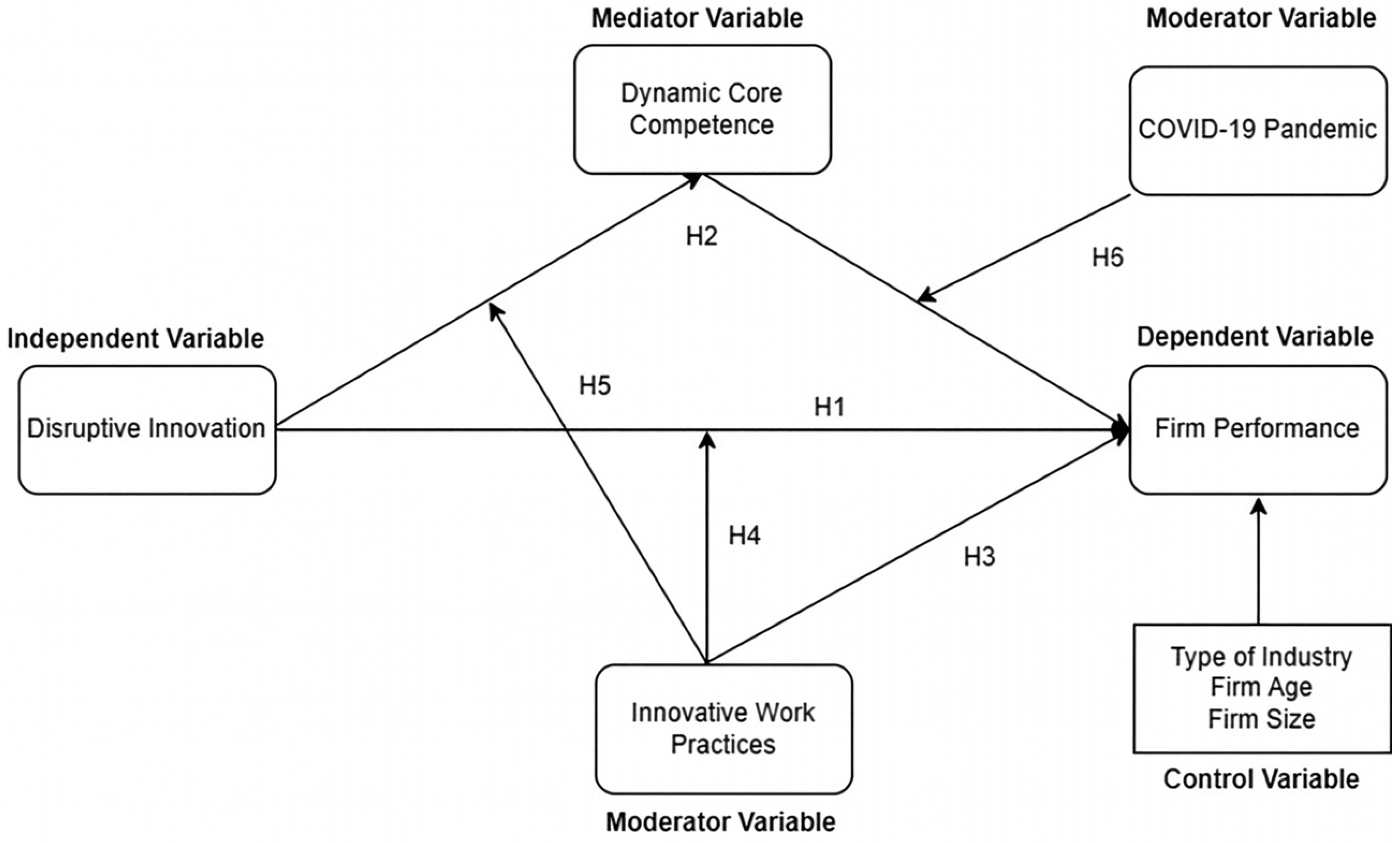
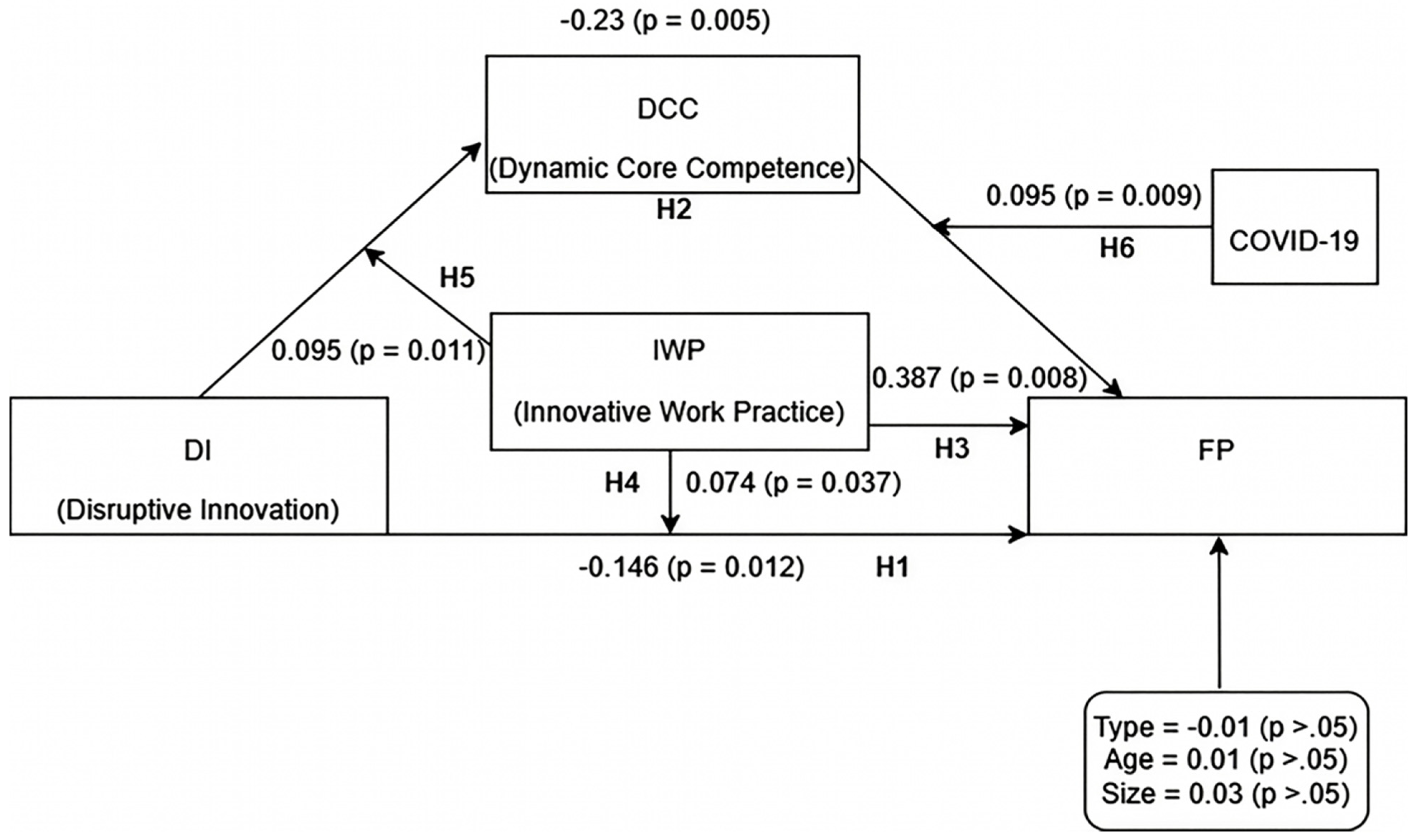
The relationships hypothesized in H1–H6 are represented in Figure 1 below. The primary theme of this research relates to the relationships between digital disruptive innovation, dynamic core management competence, and firm performance. As illustrated in Figure 1, the framework depicts the directional relationships among digital disruptive innovation (DDI), dynamic core management competence (DCC), innovative work practices (IWP), and firm performance (FP). Specifically, the framework examines the direct relationship between DDI and FP, with dynamic core management competence (DCC) acting as a mediating mechanism, and innovative work practices (IWP) and the COVID-19 pandemic serving as moderating variables. In short, the framework below presents the direct relationship of DI, DCC, and IWPs to FP, and for the mediating relationship of DCC between DI and FP, finally, and for the first moderator relationship of IWPs between DI and DCC, the second moderator relationship between DI and FP, and the third moderator impact of COVID-19 between DCC and FP.

3. Research Method and Data

3.1. Sample Selection and Data Collection

With the assistance of Qualtrics, we collected data through an online survey. The research participants were the senior executives from Pakistan’s two key service sector industries—telecom and banking. In the service industry, the telecom and banking sectors are rapidly evolving global business fields from one generation to the next and are more diverse than Pakistan’s other key industries on the grounds of the prevailing rate of innovations. Hence, primary data were gathered from senior executives in the digital telecom sector (PTCL, Jazz, Ufone, Telenor, and Zong) and banking (HBL, NBP, MCB, UBL, and ABL) from Pakistan, using a cross-sectional design through an anonymous structured questionnaire. All the companies have their own registered company pages on LinkedIn, which are used by almost 80% of staff regularly for business purposes (Raheem & Khan, 2019). A link to an online survey was created in Qualtrics, which was later shared with the senior executives via LinkedIn Messenger. Before data collection, permission was obtained from the relevant companies to conduct the study in their organizations, and respondents were assured that their responses would remain completely anonymous and strictly confidential. A priori power analysis, with a moderate effect size, i.e., 0.15 (Cohen, 1988), p < 0.05, and observed power of 80%, revealed that a sample size of 68 respondents would be adequate for each organization (Faul et al., 2009). The final sample comprised 730 respondents from 10 organizations, and it exceeded the minimum sample size indicated by the a priori power analysis.
A pilot study was conducted before the main survey to assess the clarity and suitability of the questionnaire. Following Cooper and Schindler (2008), a sample of 100 participants was selected from the telecom and banking sectors (i.e., 50 from each sector) to measure whether respondents were able to complete the questionnaire on diverse activities across their respective firms. Accordingly, the questionnaire was pilot tested with the subset of respondents drawn from both sectors to evaluate reliability and relevance, as well as to obtain feedback on item clarity and identify any necessary modifications. Cronbach’s alpha was used to assess the items’ relevance, reliability, and consistency. The results indicated strong internal consistency with no further revisions required. All the lower-order and higher-order scales had Cronbach alpha values > 0.7, indicating a high standard of reliability as the literature has suggested (Hair et al., 2019). Thus, the measurement instruments demonstrated satisfactory internal consistency, and the questionnaire was deemed reliable and suitable to proceed to the full-scale data collection phase.

3.2. Measurement of Main Variables and Scales Used

All measurement scales were adapted from established literature and slightly refined to align with the study’s context and objectives. The questionnaire had 98 items included in two sections: the first contained 8 items of demographic information about the participants, and the second 90 items that measured five constructs. These constructs, together with the relevant items used in our survey, are spelled out in the Appendix A.
All study variables were measured using established multi-item scales on a five-point Likert scale ranging from 1 (strongly disagree) to 5 (strongly agree) (Likert, 1932). Following Y. Wang et al. (2006), digital disruptive innovation (DDI) was operationalized across three dimensions: technological turbulence, market turbulence, and competitive intensity. These dimensions were measured using a total of 15 items. Dynamic core management competence (DCC) was measured across five dimensions, and they were marketing, technological, integrative, social, and service competence, and used 25 items adapted from prior studies (Z. Wang & Xu, 2017; Yun & Lee, 2017). To understand the participants’ views about IWPs, we used five dimensions (i.e., innovative teamwork, innovative training, innovative attitude, innovative task, and innovative knowledge sharing) with 25 items of IWPs developed by Puente-Palacios et al. (2016), and Yun and Lee (2017). Next, the 5 items that we adapted to measure COVID-19 were originally developed by Conway et al. (2020). Finally, the variable firm performance (FP) is classified as a firm’s capacity to meet its financial, customer and internal processes and learning and growth perspectives (Abuzaid, 2018). To measure the past three years’ FP of telecom and banking companies, a 20-item scale was adapted from the literature, and responses were collected from executives regarding their company’s performance based on Kaplan and Norton’s (1992).

3.3. Control Variables

This study also controls for firm-specific variables, which may influence firm performance. The control variables in this study were chosen based on the pertinent literature to ensure the strength of the results (e.g., Bodlaj & Čater, 2019). Accordingly, firm size, firm age, and industry type were included as control variables in the empirical model.

4. Empirical Results

4.1. Data Analysis

The data were analyzed using SPSS v26 for descriptive and inferential statistics, and AMOS v26 was employed to test the hypothesized causal relationships using structural equation modelling (SEM). Details on the demographics of this study are given in Table 1.
The self-administered online questionnaire was distributed to 800 targeted senior executives in the telecom and banking sectors. A total of 761 responses were completed and received (95.125%), of which 730 were usable, resulting in an effective response rate of 91.25%. The remaining 31 responses (3.875%) were excluded due to excessive neutral responses or limited variability in response patterns and straight-lining, which indicates a potential response bias. Our response rate exceeded 90%, and according to Kog (2019), the minimum response rate for a survey study should be 50%. Carley-Baxter et al. (2009) asserted that the non-response error is negligible, especially when the percentage of the non-response is very little (i.e., 20% or less). Therefore, it was not necessary to conduct the test of non-response bias. Nonetheless, following data cleaning and screening, non-response bias was assessed by comparing 25% of early and 25% of late respondents. No significant differences were observed, suggesting that non-response bias was not a concern (Ali et al., 2022). Mahalanobis distance was employed to identify multivariate outliers using a significance threshold of p < 0.001, as recommended in prior studies (Hair et al., 2019). To declare any value an outlier, the p-value should be < 0.001 (Ghorbani, 2019); as such, no outliers were detected. To assess the potential presence of common method bias, Harman’s (1960) single-factor test was conducted. Common Factor Analysis (CFA) examined the possibility of common method bias using Harman’s single-factor test. Less than 50% of the variance was accounted for by the first factor or first-order (i.e., 28.64%), which suggests that the data is not afflicted by common method bias (Hair et al., 2019). Furthermore, our data was also found to be normal, as most of the skewness and kurtosis values were within ±1, a few within ±2 (Hair et al., 2019; George & Mallery, 2021). Similarly, multicollinearity was not a concern, as variance inflation factor (VIF) values were below 3 and tolerance values exceeded 0.2 for all variables (Hair et al., 2019). The non-existence of multicollinearity is also another way to rule out common method bias. The linearity assumption was fulfilled with the help of positive and negative significant bivariate correlations (Table 2). In addition to this, the measures of central tendency and correlations are given in Table 2. Table 1 presents the demographic profile of the respondents and shows a balanced representation of the telecom and banking sectors and a predominance of senior managerial roles. In Table 2, the descriptive statistics indicate acceptable distributional properties, with skewness and kurtosis values within recommended thresholds, and no evidence of multicollinearity based on VIF and tolerance values.

4.2. Measurement Model Validation

We conducted a confirmatory factor analysis (CFA) to test the reliability and validity of the pre-developed study measures. Hair et al. (2019) recommend checking the fitness of the CFA model by examining three fitness categories, namely, incremental fit, absolute fit, and parsimonious fit, with a minimum of one index from each category. Following Byrne (2016), the model was re-specified to allow theoretically justifiable correlated error terms with modification index (MI) values > 4, in order to improve model fit. Subsequently, to identify the best-fitting model, we investigated various CFA models (Hair et al., 2019). As shown in Table 3, the five-factor model showed the best fit among the alternate CFA model options, χ2 = 7789, df = 3813, χ2/df = 2.043, CFI = 0.910, TLI = 0.905, RMR = 0.044, RMSEA = 0.038. The full five-factor model shows superior fit compared to alternative and more constrained models, supporting the distinctiveness of the study constructs. All reported fit indices meet or exceed commonly accepted thresholds, indicating an adequate overall fit of the measurement model.
Our additional measures on the reliability and validity of the measurement model also showed compliance with the established criteria. Table 4 provides details on indicators’ reliability or FL (>0.5), Cronbach alpha or CA (>0.7), composite reliability or CR (>0.7), convergent or AVE (>0.5), and discriminant validity or HTMT (<0.85). Acceptable values are given in parentheses (Hair et al., 2019). It is noted that no indicator reduction was applied. As shown in Table 4, all constructs determine satisfactory internal consistency and convergent validity, with factor loadings, CA, and CR values exceeding recommended thresholds. In addition, the HTMT ratios are below the critical value, confirming adequate discriminant validity among the study constructs. It is, however, noted that although the AVE of COVID-19 is marginally below the 0.50 threshold, we justify its acceptance based on its strong composite reliability. Also, the variation between 0.50 and 0.492 is not statistically significantly different.

4.3. Structural Model Analysis

We tested the direct, indirect and total effects of the predictors (i.e., DDI, IWP, DCC) on firm performance (FP) to evaluate hypotheses using the bootstrapping method and 95% confidence intervals, including both the lower bound (LB) and the upper bound (UB), and the significance level set to p < 0.05 for accepting or rejecting respective hypotheses. The relationships were modelled and tested using AMOS v26. The results in Table 5 show a significantly negative relationship between DDI and FP (B = −0.146, p = 0.012, 95% CI [−0.216, −0.091]. Therefore, H1 is supported. IWP has a positive and significant influence on FP (B = 0.387, p = 0.008, 95% CI [0.306, 0.478]); thus, H3 is also supported. Next, we find that DDI has a significantly negative impact on FP via Dynamic Core Management Competence (DCC) (B = −0.023, p = 0.005, 95% CI [−0.045, −0.010]), hence, the mediation effect of DCC is documented. However, since DDI has a significant direct impact on FP (B = −0.079, p = 0.006, 95% CI [−0.121, −0.051]), this is a case of ‘partial’ mediation as per Baron and Kenny (1986). Therefore, these results confirm that H2 is partly supported. Our results also indicate that only 22.55% of the negative effect of DDI on FP is mediated by DCC. We performed Sobel’s (1982) test to further support the noted mediation, which suggests a strong indirect influence of DDI on FP via DCC (z = 5.23, p < 0.001). Hence, H2 is supported with partial mediation. Again, aligned with the literature, we used Industry Type, Firm Age, and Firm Size as controls, though none of the control factors significantly affected FP. Thus, these controls do not have a confounding influence on FP.
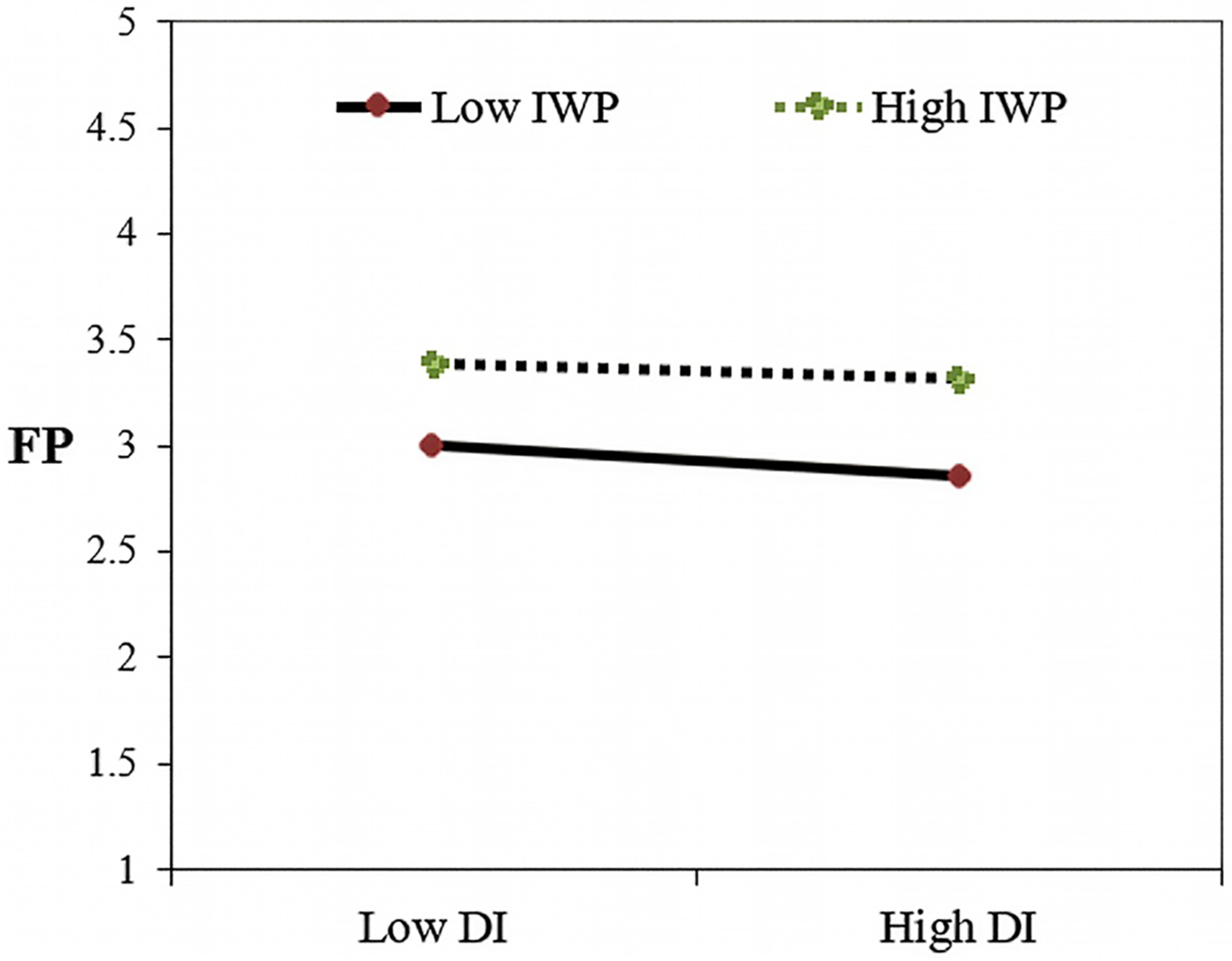
Next, we test the interaction/moderation effect of IWP and COVID-19 on the relationship between DDI and FP. The results in Table 6 show a significant influence of IWP on the relationship between DDI and FP (B = 0.074, p = 0.037, 95% CI [0.005, 0.125], suggesting a positive moderation effect of IWP. Therefore, H4 is supported. To assess H4 further, the observed interaction impact is plotted (Cohen et al., 2003). Figure 2 demonstrates that the negative effects of DDI on FP are reduced with the increase in the IWP scores. As revealed in Table 6, the slanted slope has weaker effects or relationships at the low levels of the moderator/–1SD of IWP (gradient = −0.146, t = 6.497, p < 0.001) but stronger effects or relationships at higher levels of the moderator/+1SD of IWP (gradient = −0.072, t = 2.426, p = 0.016), which confirms that IWP significantly reduces the negative impact of DDI on FP; hence H4 is further supported.
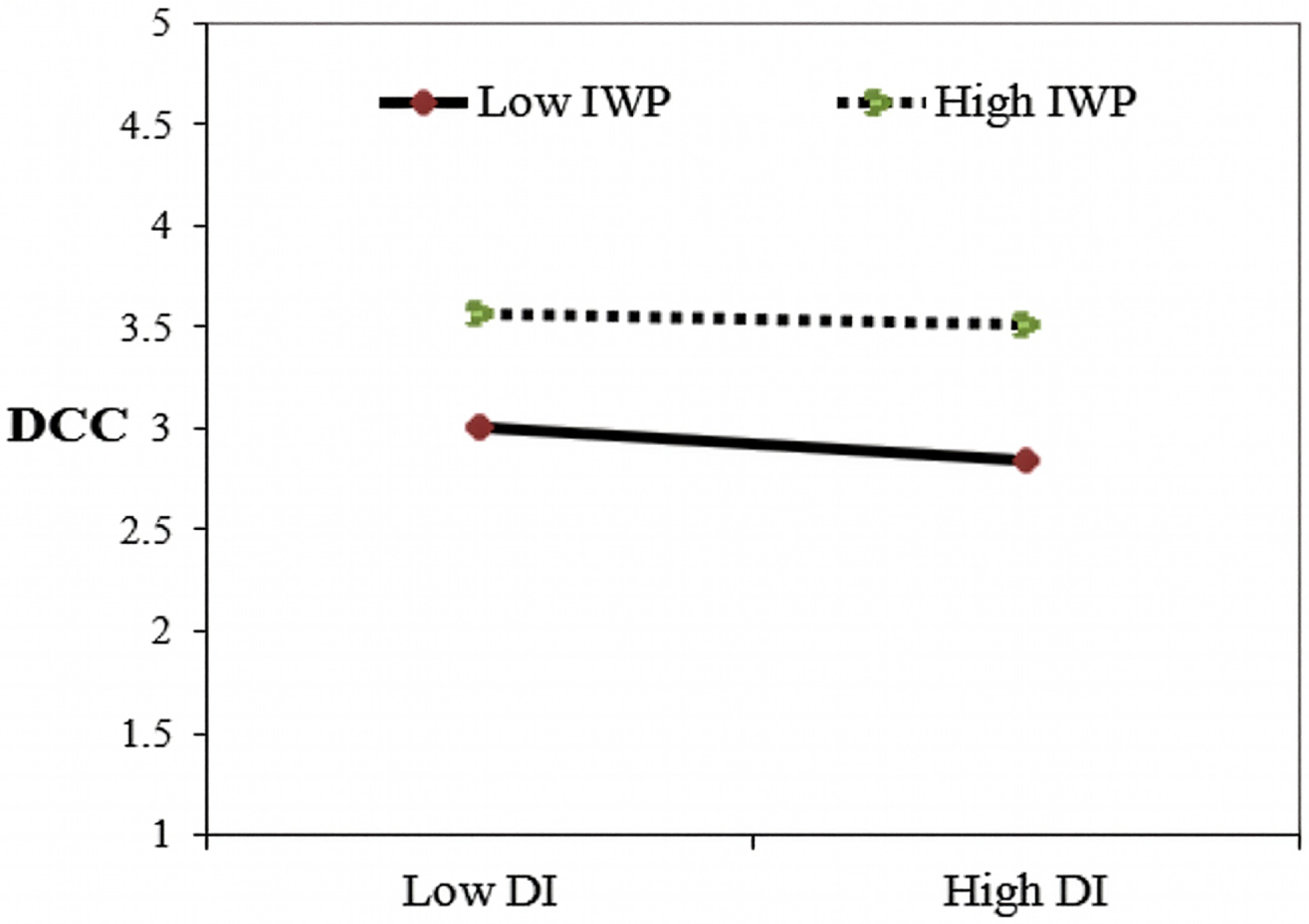
Similarly, Table 6 also demonstrates the interaction/moderation effect of IWP on the relationship between DDI and DCC, which is significant (B = 0.095, p = 0.011, 95% CI [0.022, 0.173]. This suggests that a positive moderation occurred, where IWP significantly reduced the negative impact of DDI on DCC. Thus, H5 is also supported. Following Cohen et al. (2003), we plotted the interaction impact of IWP on the DDI–DCC relationship to confirm H5 further. Figure 3 substantiates that the negative impact of DDI on DCC is reduced with the increase in the scores of IWP. As depicted in Table 6, the slanted slope has weaker effects or relationships at the low levels of the moderator/–1SD of IWP (gradient = −0.162, t = 5.180, p < 0.001) but the slanted slope has stronger effects or relationships at higher levels of the moderator/+1SD of IWP (gradient = −0.067, t = 1.976, p = 0.049). This clearly establishes that IWP significantly reduces the negative impact of DDI on DCC. Thus, H5 is further supported.
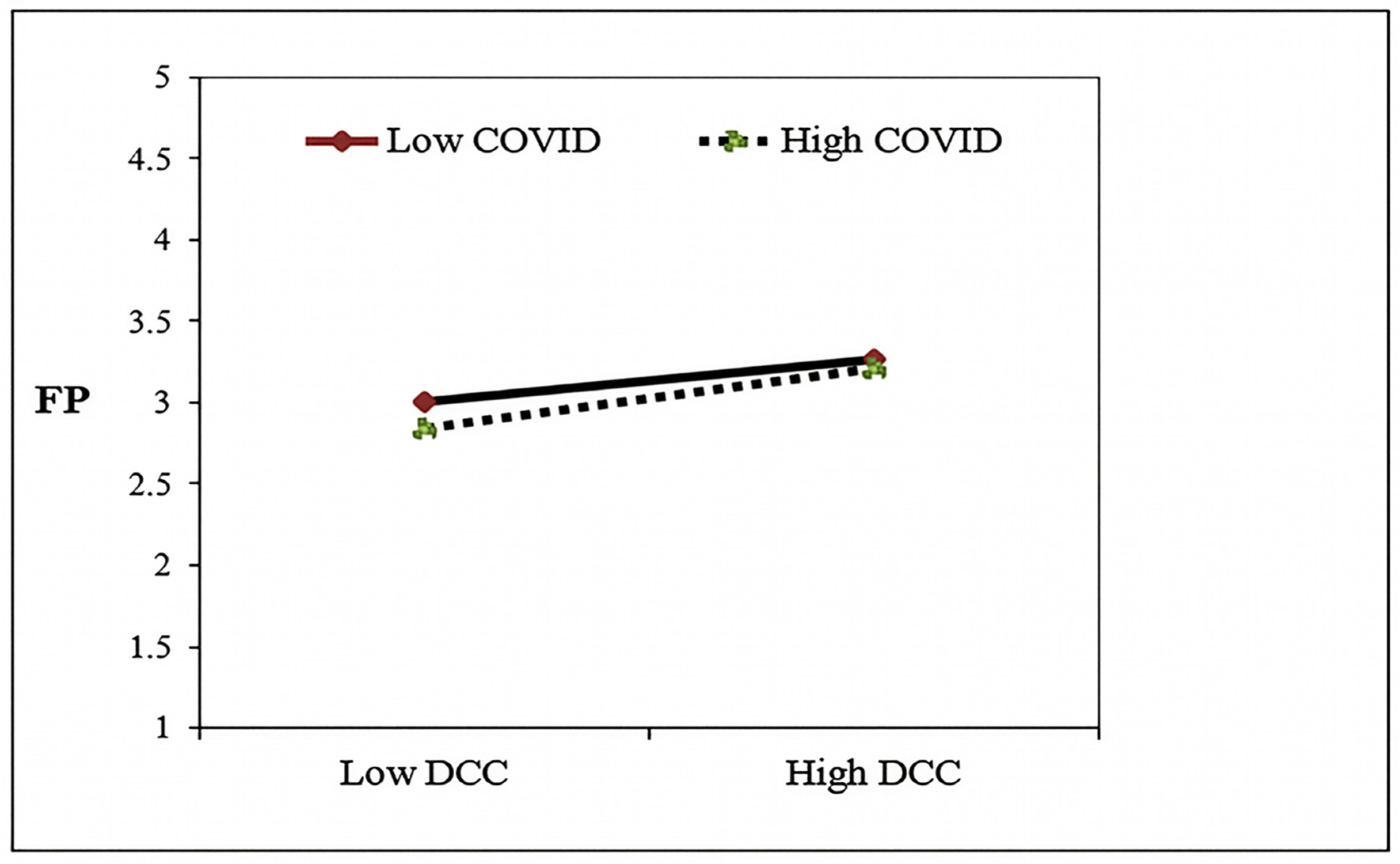
Further, we check the interaction/moderation effect of COVID-19 on the positive relationship between DCC and FP. The results in Table 6 show that COVID-19 amplifies the positive effect of DCC on FP (B = 0.095, p = 0.009, 95% CI [0.020, 0.169]. Hence, the moderation of COVID-19 occurred in a positive direction, which supports H6, implying that higher DCC was able to maintain a positive relationship with FP, despite the presence of COVID-19 pandemic as an external shock. To further validate H6, following Cohen et al. (2003), we plotted the interaction impact of the COVID-19 on the relationship between DCC and FP. Figure 4 reveals that the positive effect of DCC on FP increased with the increase in the scores of COVID-19. As shown in Table 6, the slanted slope has weaker effects or relationships at the low levels of the moderator/–1SD of COVID-19 (gradient = 0.265, t = 11.887, p < 0.001) compared to the stronger effects or relationships at the higher levels of the moderator/+1SD of COVID-19 (gradient = 0.360, t = 16.659, p < 0.001), which indicates that COVID-19 significantly strengthened the positive impact of DCC on FP.

5. Discussion of Results

Table 5 provides the results of the SEM for the testing of H1 to H3, while Table 6 presents the results of relevance to H4 to H6. Figure 5 represents the quantified relationships that we found between the variables when considering the sample. As recommended by Hair et al. (2019), we examine the model indices of the SEM model and find fit with the data very well, χ2 = 22.804, df = 5, χ2/df = 4.561, CFI = 0.992, TLI = 0.925, RMR = 0.014, RMSEA = 0.070; the χ2/df ratio exceeds 3, but is acceptable because the criterion is <5, as set by Marsh and Hocevar (1985).
From the results of data analysis, our hypotheses from H1 to H6 are supported by the data. Concerning H1, the finding confirms a direct negative effect of DDI on firm performance, consistent with Arifin (2022), demonstrating that DDI could negatively affect business performance. A critical reflection for incumbents substantiates that DDI is effective and has the potential to continually cause disruption in the market (Tiilikainen et al., 2024; Yasser, 2021), as predicted by disruptive innovation theory. As such, incumbent firms need to accommodate customers’ needs while also providing opportunities for innovation. As for Pakistan’s telecom and banking sectors, high regulatory constraints, legacy systems, and uneven digital infrastructure make rapid digital disruption particularly costly for incumbents, thereby amplifying the negative performance effects of DDI.
Next, for H2, we find a partial mediation (inverse) effect of DCC contributing to minimizing the negative impact of DDI on FP. Given that DCC has a direct positive effect on performance and DDI has a direct negative effect on both DCC and performance, we document the ‘partial’ mediation effect of DCC in minimizing the negative effect of DDI on FP. Rather than fully offsetting the intensity of the negative nexus between performance and digital disruption, DCC is partially reducing the negative effect of DDI on FP. In other words, this implies that the indirect effect of DDI on performance through DCC is negative. However, the intensity of the negative performance effects associated with DDI depends on the strength of DCC compared to DDI in affecting FP, meaning that while DCC itself improves performance, it is eroded under conditions of high DDI, and vice versa. Although we report a negative indirect effect of DDI on FP via DCC, unlike prior studies, supporting a direct positive association between DCC and FP, extant literature has not focused on the mediator variable (Rotjanakorn et al., 2020). Nevertheless, our evidence shows that incumbent firms cannot control DDI or take precautions to prevent DDI due to a lack in core management competence, i.e., DCC (Roblek et al., 2021).
Again, regarding H3, our results show a direct positive relationship between IWPs and FP, consistent with the finding of Baltrunaite et al. (2021), suggesting that competent senior executives can boost a firm’s productivity if they use IWPs. This is because of implementing a new set of practices in a workplace that combines individual and team-based activities, enabling managers to participate in institutional change, as necessitated by technological disruptions and renewals, either structurally or culturally, and hence improve work quality and FP. Also, IWPs provide employees with training and teamwork opportunities to generate positive work outcomes. Such a direct performance-enhancing effect of IWPs has become essential for employees to use more innovation at work and produce favourable organizational efficiency.
Next, for H4, the positive moderation effect of IWPs on the relationship between DDI and FP that supports H4 indicates critical needs for innovative work practices and the dynamic capability of employees. Such a moderation impact is in line with Alatailat et al. (2019), denoting IWPs to be an effective moderator of the link between timely thinking and success in business. In a similar vein, another finding of moderation of IWP exhibits that IWP positively moderates the negative relationship between DDI and DCC, thus supporting H5. This signifies the likelihood that the negative association between DDI and DCC is weaker when IWP is high. The result aligns with Adim et al. (2018), reporting the positive influence of innovative work strategies on the dynamic capability and efficiency of employees in the hospitality industry. Thus, businesses need to be aware of the risk and consequences of DDIs and prepared to respond successfully through dynamic management skills and innovative teamwork practices. DCC relates to businesses’ ability to manage uncertain business environments and guarantees that FP is consistently maintained. Managerial capabilities foresee technological disruptions and their impact on firm performance, which can lead to carrying out organizational transformation so that they work through the development of a new organizational structure, culture, and internal communication strategies. Such a newly innovative set of practices (IWPs) marks a significant shift in the management to improve managerial competence and work quality (DCC), aiming at sustainable high performance (FP). In fact, IWPs emerge as predictors of employees’ competencies and then firms’ financial performance, which is reflected in their buffering role in reducing the negative impact of DDI on both DCC and FP. The interactive positive effects of IWPs cannot be overemphasized, particularly the results of the first and second moderating effects of IWPs on the inverse relationship between DDI and FP, and DDI and DCC, suggesting that service sector firms must have a thorough understanding of how to establish IWPs and the skills to cope with the challenges of disruptive technologies and achieve success.
Lastly, the moderation of COVID-19 between the DCC and FP relationship provides some unique findings in our study. Prior studies widely document that COVID-19 significantly impaired FP; as such, one would expect an inverse moderation of COVID-19 on the positive association between DCC and FP. However, the moderation effect of COVID-19 in reducing the positive impact of DCC on FP remains valid at the lower levels of DCC, rather than at the higher levels. In other words, with the increase in the COVID-19 pandemic, FP reduced at the lower DCC levels, while FP started to rise at the higher DCC levels. Thus, our H6 is verified, indicating that COVID-19 overruns DCC in affecting FP at lower levels of DCC than at higher levels of DCC. We contend that during COVID-19, both telecom and banking companies increased their DCC to better cope with COVID-19, so DCC proved effective in mitigating the negative effects of COVID-19 on FP. Such an effect of COVID-19, forcing companies to improve their DCC and face the challenge of the pandemic, appeared considerably significant for the sustainable profitability of companies, which is supported by Ndubuisi-Okolo and Igwebuike (2021).
As for Pakistan’s telecom and banking sectors, we assert that COVID-19 amplifies the value of DCC primarily at higher competence levels, as firms with well-developed managerial capabilities are better positioned to reconfigure resources, manage uncertainty, and implement adaptive strategies during crisis conditions. In contrast, firms with lower DCC lack the capacity to translate disruption into strategic advantage, resulting in weaker performance outcomes. Further, by treating the pandemic as an external shock that increases the value of dynamic managerial capabilities, we argue that the pandemic enhanced learning activities among employees via online education platforms to improve knowledge of business challenges, on one hand, and contributed towards enhancing creativity during unexpected external environmental crises for better financial outcomes of the firms, on the other hand. As a result, DCC was able to offset the effect of COVID-19 on FP. Another reason could be the construction of the COVID-19 variable based on the most ‘influential’ selected items, rather than taking a large range of items related to the pandemic, and the collection of data at a later part of the COVID-19 pandemic.

6. Conclusions and Implications

DDI poses significant challenges to firm performance in tech-intensive service firms due to their inherent nature of innovative products and services but also serves as a catalyzes revolutionary change. DDI drives challenging technological transformation requiring changes in work practices (Kane, 2019), products/services (Chanias et al., 2019), organizational structures (Berghaus & Back, 2017), and organizational identity (Wessel et al., 2020; Kuruppu & Lodhia, 2019). While technological advancement is crucial (Tukina et al., 2020), it has a profound impact on firms’ sustainable performance. With this general background in mind, our study investigates the impact of DDI on the sustainable performance of Pakistani telecom and banking firms, and the mitigating role of executive skills and capabilities to overcome the impact of disruptive innovation. Analyzing survey data from 730 Pakistani telecom and banking executives through SEM in AMOS 26.0, we find that DDI negatively affects both FP and DCC, with DCC inversely mediating the DDI-FP nexus. Conversely, IWP positively moderates the DDI-FP and DCC-FP relationships. In addition, COVID-19 moderates the DCC-FP relationship, showing a more pronounced effect at higher DCC levels.
Our study validates that three major dimensions of DDI collectively influence FP in the negative direction. As noted earlier, DDI presents dual challenges for incumbent firms (i) creating barriers via disruptive technologies to hinder firm performance, and (ii) offering opportunities for mitigating the adverse effects of DDI through executive competence (DCC) and innovative work practices (IWPs). We also document that DCC and IWP significantly influence FP through direct and indirect pathways. Specifically, while DCC and IWP are positively affecting FP, DDI directly erodes DCC, resulting in an indirect (mediated) negative effect on FP. In contrast, IWP serves as a positive moderator, mitigating the adverse effects of DDI on both FP and DCC. IWP’s moderating effects enhance competitiveness and sustain the performance of incumbent firms. Thus, the roles of DCC and IWP in the context of DDI have been empirically established. Thus, unlike prior studies, by empirically examining these roles within a single SEM, our study uniquely contributes to knowledge by documenting the causal nexus of DDI, DCC, IWP, and FP. It also contributes by showing how employees perceive and mitigate COVID-19’s negative impact on performance by increasing DCC.
Again, theoretical implications are also substantiated from the findings of our study. Our results validate DIT (adverse DDI effects), DCT (employee capabilities coping with DDI), and contingency theory (managerial competence and strategies for technological disturbances and new environmental changes like COVID-19). Our findings align with these theories, highlighting that the rapid DDI transformation prompts firms to adapt managerial competencies for improved efficiency and performance, mirroring the work of Ranieri et al. (2024) in the context of COVID-19. Thus, our study contributes an integrated understanding of these theories, addressing a gap in the literature regarding incumbent firms in an emerging economy.
Furthermore, this study bridges the lack of knowledge and empirical evidence in understanding the importance of managerial competence and practical application. Our study addresses the dynamic competence gap (e.g., technological, service, social) created by DDI and offers insights into how incumbents can navigate and excel in disruptive environments (Nicolas-Agustin et al., 2022). The findings underscore the critical value of IWPs and DCC as drivers of performance of incumbent firms in disruptive settings. In order to survive and thrive in today’s business world, managers must proactively foster dynamic competence, a supportive work environment, and innovative practices. IWPs are crucial, especially in fast-paced service sectors like Pakistani telecom and banking, which are undergoing massive digital disruption and require new service strategies to ensure executive competence. Finally, we also emphasize the importance of understanding managers’ perspectives during volatile situations like the pandemic and the role of DCC and IWPs in crisis management. Overall, these insights provide a roadmap for service firms to refine policies and enhance managerial competence, and IWPs in the face of DDI.
Despite limited research on causal relationships between DDI, DCC, IWP, COVID-19, and FP in Pakistan’s telecom and banking sectors, our findings validate the structural model, offering a unique opportunity to observe the impact of DDI, DCC, IWPs, and COVID-19 (i.e., direct, indirect (mediated and moderated)) on FP. The application of a path model design in SEM is confirmed, adding to the accuracy of the empirical dynamics of this study. Nevertheless, our study has some limitations, such as a cross-sectional data design and non-proportional gender representation within the sample from executives in two Pakistani service sectors. Additional limitation arises from reliance on single-informant and self-reported data design, where all key constructs (DDI, DCC, IWPs, COVID-19 impact, firm performance) are measured via self-report from the same respondents, leading to common method variance and potential reverse causality concerns. Moreover, there may be a potential selection bias, as executives active on LinkedIn and willing to respond may differ from non-respondents. Another limitation could be the absence of objective performance indicators, as the variable firm performance (FP) is classified as a firm’s capacity to meet its financial, customer, and internal processes and learning and growth perspectives, rather than accounting-based or market-based financial performance indicators. These limitations suggest future research based on longitudinal or multi-source designs, as well as replications in other sectors or emerging economies with different regulatory and digital trajectories. Therefore, more research is needed to address these limitations and further enrich the literature. While caution is warranted, these findings may be generalizable to similar service sectors across the globe, particularly in emerging markets with comparable institutional features. Thus, the empirical evidence of the study can inform managers, policymakers, investors, and stakeholders as they re-evaluate the impact of DDI on FP across sectors in many countries.

Author Contributions

Conceptualization, S.R. and O.A.F.; methodology, S.R.; software, S.R.; validation, O.A.F., S.R. and A.A.K.; formal analysis, S.R.; investigation, S.R.; resources, S.R.; data curation, S.R.; writing—original draft preparation, S.R. and O.A.F.; writing—review and editing, O.A.F. and A.A.K.; visualization, O.A.F. and A.A.K.; supervision, O.A.F. and A.A.K.; project administration, O.A.F. and A.A.K. All authors have read and agreed to the published version of the manuscript.

Funding

This research received no external funding.

Institutional Review Board Statement

This study was conducted in accordance with the NHMRC National Statement on Ethical Conduct in Research in Australia and approved by the Human Research Ethics Committee of the University of New England, Australia (Approval No.: HE21-206 and date of approval: 22 September 2021).

Informed Consent Statement

Informed consent was obtained from all subjects involved in the study.

Data Availability Statement

The data presented in this study are available on request from the corresponding author due to privacy and ethical reasons.

Acknowledgments

The authors would like to thank the Editor(s) for efficient and effective handling of the manuscript as well as commitment to ethical integrity. The constructive feedback provided by the Reviewers and Editor(s) have significantly contributed to the improvement of this study.

Conflicts of Interest

The authors declare no conflicts of interest.

Appendix A

Table A1. Coding sheet and items sources.
ConstructDimensionItemCodeScaleSource
Demographic Profile----------Gender-1–2-
Age-1–4-
Education-1–3-
Working sector (Telecom)-1–5-
Working sector (Bank)-1–5-
Firm size-1–4-
Firm age-1–3-
Managerial experience-1–3-
Role-1–5-
Scale for Firm Performance (FP)Financial PerspectiveOur company’s market share of service increased over the last three yearsFP111–5Mafini and Pooe (2013), Flynn et al. (2010)
Our company’s efficiency of generating net profit increased over the last three yearsFP121–5Mafini and Pooe (2013), Flynn et al. (2010)
Our company’s technological efficiency improved over the last three yearsFP131–5Mafini and Pooe (2013), Flynn et al. (2010)
Our company’s human expertise developed over the last three yearsFP141–5Mafini and Pooe (2013), Flynn et al. (2010)
Our company’s sale of products and services increased over the last three yearsFP151–5Mafini and Pooe (2013), Flynn et al. (2010)
Customer PerspectiveOur company experienced continuous growth in customers in the last three yearsCP211–5Mafini and Pooe (2013)
Our company provided high-quality services to customers over the last three yearsCP221–5Mafini and Pooe (2013)
Our company fulfill customer service demands on timeCP231–5Mafini and Pooe (2013)
Our company supports corporate and social values such as sincerity, customer care, employee engagement, and governanceCP241–5Mafini and Pooe (2013)
Our customers’ feedback is good and satisfactoryCP251–5Mafini and Pooe (2013)
Internal Process PerspectiveOur employees possess necessary knowledge, expertise and technological skills to do their job well.IPP311–5Mafini and Pooe (2013)
Our company implements effective marketing strategiesIPP321–5Mafini and Pooe (2013)
Our company promotes professional ethics and code of conduct for employeesIPP331–5Mafini and Pooe (2013)
In our company, transparency and accountability is a key priority to improve governance.IPP341–5Mafini and Pooe (2013)
Our company is well equipped with handling IT related security threats and other associated risksIPP351–5Mafini and Pooe (2013)
Learning and Growth PerspectiveOur company has qualified employees to maintain a prompt delivery of service to customers.LGP411–5Mafini and Pooe (2013)
Our company maintains a solid career progression system for skilled employeesLGP421–5Mafini and Pooe (2013)
Our employees’ turnover rate is less than other sectorsLGP431–5Mafini and Pooe (2013)
Our company gives sufficient opportunity to employees to participate in training and professional development programsLGP441–5Mafini and Pooe (2013)
Our company adopts new technology on a regular basisLGP451–5Mafini and Pooe (2013)
Scale for Disruptive Innovation (DI)Technological TurbulenceThe positive and negative impact of technological changes on our business is highTT11–5Song et al. (2005),
Y. Wang et al. (2006)
In our industry, technological changes provide many opportunities such as cryptocurrency, data analytics and artificial intelligence.TT21–5Y. Wang et al. (2006)
It is challenging to manage technological developments in our sector.TT31–5Song et al. (2005),
Jaworski and Kohli (1993)
Our company needs more investment in R&D to compete well and stay in the marketTT41–5Song et al. (2005),
Jaworski and Kohli (1993)
New technological developments can carry big risks if our company fails to responseTT51–5Song et al. (2005),
Jaworski and Kohli (1993)
Market TurbulenceNew developments in technology create market pressure in losing customers.MT11–5Y. Wang et al. (2006)
It is difficult to predict changing demands and tastes of consumersMT21–5Y. Wang et al. (2006)
Our competitors are highly unpredictable as the competition in the industry is very intenseMT21–5Y. Wang et al. (2006)
Customers’ preferences of products or services change with timeMT21–5Jaworski and Kohli (1993)
Our customers look for new products or services all the timeMT21–5Jaworski and Kohli (1993)
Competitive IntensityService-based competition in our industry is risingCI11–5Jaworski and Kohli (1993)
There are many marketing related “promotion wars” among our industry constituentsCI21–5Jaworski and Kohli (1993)
If our company adopts a new technology, other competitors also try to adopt thatCI31–5Jaworski and Kohli (1993)
Price-based competition is very common in our industryCI41–5Jaworski and Kohli (1993)
Our competitors are targeting to develop new products/servicesCI51–5Jaworski and Kohli (1993)
Scale for Dynamic Core competence (DCC)Marketing CompetenceWe are very competent in responding to customers’ needs and servicesMC11–5Y. Wang et al. (2004)
We are very competent in communicating with customers about their needsMC21–5Y. Wang et al. (2004)
We are very competent in finding and judging our competitors’ strengths and weaknessMC31–5Y. Wang et al. (2004)
We are very competent in making and maintaining long term customer relationshipMC41–5Y. Wang et al. (2004)
We are very competent in handling business threats in an intensely competitive marketMC51–5Y. Wang et al. (2004)
Technological CompetenceWe make high investments in R&D and product/service innovationTC11–5Y. Wang et al. (2004)
We have strong skills to manage new technology and innovationTC21–5Y. Wang et al. (2004)
Our employees get regular training to refresh and improve their skillsTC31–5Y. Wang et al. (2004)
We have the ability to predict future technological trendsTC41–5Y. Wang et al. (2004)
Our company leads in new technology adoption than our rival companiesTC51–5Y. Wang et al. (2004)
Integrative CompetenceWe have the necessary skills to share technical knowledge among different departmentsIC11–5Y. Wang et al. (2004)
We have the necessary skills to add new technology to our products and servicesIC21–5Y. Wang et al. (2004)
We welcome customers’ ideas and feedback on our new products and servicesIC31–5Y. Wang et al. (2004)
We have the necessary skills to increase value for customers by offering excellent products/servicesIC41–5Y. Wang et al. (2004)
We adopt a team-based approach to complete projects successfullyIC51–5Y. Wang et al. (2004)
Social CompetenceI feel comfortable around all types of peopleSC11–5Yun and Lee (2017)
Our company protects employees from workplace violence and harassmentSC21–5Yun and Lee (2017)
I can adjust my behaviour in any situationSC31–5Yun and Lee (2017)
I can communicate with others easily and effectivelySC41–5Yun and Lee (2017)
I can judge others by observing their behaviourSC51–5Yun and Lee (2017)
Service CompetenceI am confident and willing to provide quality services to customers proactivelySVC11–5Z. Wang and Xu (2017)
I know effective ways of providing customers with satisfactory servicesSVC21–5Z. Wang and Xu (2017)
I am skilled and experienced at solving all customers’ issuesSVC31–5Z. Wang and Xu (2017)
It is very easy for me to deliver satisfactory services to customersSVC41–5Z. Wang and Xu (2017)
I am proactive in communicating when dealing with customer issuesSVC51–5Z. Wang and Xu (2017)
Scale for Innovative work practices (IWPs)Innovative TeamworkTeamwork produces high-quality services for customers in my organizationITE11–5Puente-Palacios et al. (2016)
My organization encourages teamwork for achieving high employee performanceITE21–5Puente-Palacios et al. (2016)
Teamwork is highly productive in my organizationITE31–5Puente-Palacios et al. (2016)
Employees meet targets more easily through teamworkITE41–5Puente-Palacios et al. (2016)
In my organization teamwork efficiently responds to customer requestsITE51–5Puente-Palacios et al. (2016)
Innovative TrainingMy attitude and behaviour changes after attending several staff training sessionITR11–5Ferraz and Gallardo-Vazquez (2016)
In my organization employee training improves quality of work outputITR21–5Ferraz and Gallardo-Vazquez (2016)
In my organization employee training improves my work efficiencyITR31–5Ferraz and Gallardo-Vazquez (2016)
Employee training increases my satisfaction in the jobITR41–5Aziz (2015)
My personal skills at work improve when I attend in-person staff trainingITR51–5Mitki and Herstein (2007)
Innovative AttitudeI openly discuss my career and promotion extension with my bossIA11–5Ettlie and O’Keefe (1982)
I am efficient in supervising office employeesIA21–5Ettlie and O’Keefe (1982)
I want a good status in my organizationIA31–5Ettlie and O’Keefe (1982)
I give opinions in staff meetings and decision making processesIA41–5Ettlie and O’Keefe (1982)
I work with teams to lead and solve complex problemsIA51–5Ettlie and O’Keefe (1982)
Innovative TaskI am creative at my workITA11–5Tierney et al. (1999)
I take risks of trying new ideas in doing my jobITA21–5Tierney et al. (1999)
I adopt an innovative approach to solve any problems at workITA31–5Tierney et al. (1999)
I often come up with innovative ideas in my workITA41–5Tierney et al. (1999)
I encourage my colleagues to practice innovative tasks such as client handling, idea generationITA51–5Tierney et al. (1999)
Innovative Knowledge SharingI often share knowledge with colleagues in my organizationIKS11–5Yun and Lee (2017)
I share my new skills gained through staff training with other colleaguesIKS21–5Yun and Lee (2017)
I often share work documents and important information with other colleaguesIKS31–5Yun and Lee (2017)
Our employees participate in different activities such as sports, cultural, office partyIKS41–5Singh and Power (2014)
Employees at my organization work in teams and engage with knowledge sharingIKS51–5Singh and Power (2014)
Scale for COVID-19 Pandemic------------The COVID-19 pandemic has impacted negatively on our company businessCP11–5Conway et al. (2020)
The COVID-19 pandemic has affected my ability to work effectivelyCP21–5Conway et al. (2020)
The COVID-19 pandemic has affected my satisfaction and motivation at workCP31–5Conway et al. (2020)
The COVID-19 pandemic has impacted on my financial positionCP41–5Conway et al. (2020)
The COVID-19 pandemic has impacted negatively on my mental/psychological healthCP51–5Conway et al. (2020)

References

  1. Abbas, J., Zhang, Q., Hussain, I., Akram, S., Afaq, A., & Shad, M. A. (2020). Sustainable innovation in small medium enterprises: The impact of knowledge management on organizational innovation through a mediation analysis by using SEM approach. Sustainability, 12(6), 2407. [Google Scholar] [CrossRef] [Scilit]
  2. Abuzaid, A. N. (2018). Scenario planning as approach to improve the strategic performance of multinational corporations (MNCs). Verslas: Teorija ir Praktika, 19(1), 195–207. [Google Scholar] [CrossRef] [Scilit]
  3. Adawiyah, W. R. (2021). Marketing strategy implementation, system managers adapt and reshape business strategy for pandemic. Perwira International Journal of Economics & Business, 1(1), 8–18. [Google Scholar] [CrossRef] [Scilit]
  4. Addison, J. T., & Teixeira, P. (2020). Management practices, worker commitment, and workplace representation. CESifo Working Paper Series 8329. CESifo. [Google Scholar]
  5. Adim, C. V., Tamunomiebi, M. D., & Akintokunbo, O. O. (2018). Innovation strategy and organization adaptability of hotels in Port Harcourt. IIARD International Journal of Economics and Business Management, 4(1), 52–62. [Google Scholar]
  6. Aeknarajindawat, N., Aeknarajindawat, N., & Aswasuntrangkul, D. (2020). Role of high performance work practices on performance in pharmaceutical business in Thailand. Systematic Reviews in Pharmacy, 11(3), 57–66. [Google Scholar]
  7. Agogo, D., & Hess, T. J. (2018). How does tech make you feel? A review and examination of negative affective responses to technology use. European Journal of Information Systems, 27(5), 570–599. [Google Scholar] [CrossRef] [Scilit]
  8. Alatailat, M., Elrehail, H., & Emeagwali, O. L. (2019). High performance work practices, organizational performance and strategic thinking: A moderation perspective. International Journal of Organizational Analysis, 27(3), 370–395. [Google Scholar] [CrossRef] [Scilit]
  9. Ali, I., Arslan, A., Chowdhury, M., Khan, Z., & Tarba, S. Y. (2022). Reimagining global food value chains through effective resilience to COVID-19 shocks and similar future events: A dynamic capability perspective. Journal of Business Research, 141, 1–12. [Google Scholar] [CrossRef] [Scilit] [PubMed]
  10. Almulla, D., & Aljughaiman, A. A. (2021). Does financial technology matter? Evidence from an alternative banking system. Cogent Economics & Finance, 9(1), 1934978. [Google Scholar] [CrossRef] [Scilit]
  11. Al-Subaie, A. A., Faisal, M., Aouni, B., & Talib, F. (2021). A strategic framework for transformational leadership development in megaprojects. Sustainability, 13(6), 3480. [Google Scholar] [CrossRef] [Scilit]
  12. Anindita, V. (2021). Disruptive strategy in disruption era: Does Netflix disrupt the existing market? International Journal of Business and Technology Management, 3(1), 30–39. [Google Scholar]
  13. Apedo-Amah, M. C., Avdiu, B., Cirera, X., Cruz, M., Davies, E., Grover, A., Iacovone, L., Kilinc, U., Medvedev, D., Okechukwu Maduko, F., Poupakis, S., Torres, J., & Tran, T. T. (2020). Unmasking the impact of COVID-19 on businesses: Firm level evidence from across the world. Policy Research Working Paper No. 9434. World Bank. [Google Scholar]
  14. Arifin, Z. (2022). The effects of disruptive technologies on power utility company’s performance: Empirical evidence from Indonesia. Technology Analysis & Strategic Management, 34(4), 461–473. [Google Scholar]
  15. Aubry, M., & Lavoie-Tremblay, M. (2018). Rethinking organizational design for managing multiple projects. International Journal of Project Management, 36(1), 12–26. [Google Scholar] [CrossRef] [Scilit]
  16. Aziz, S. F. A. (2015). Developing general training effectiveness scale for the Malaysian workplace learning. Mediterranean Journal of Social Sciences, 6(4), 47–56. [Google Scholar] [CrossRef] [Scilit]
  17. Bains, P. (2022). Blockchain consensus mechanisms: A primer for supervisors. International Monetary Fund. [Google Scholar]
  18. Baltrunaite, A., Bovini, G., & Mocetti, S. (2021). Managerial talent and managerial practices: Are they complements? Bank of Italy Working Paper No. 1335. SSRN. [Google Scholar]
  19. Baron, R. M., & Kenny, D. A. (1986). The moderator-mediator variable distinction in social psychological research: Conceptual, strategic, and statistical considerations. Journal of Personality and Social Psychology, 51, 1173–1182. [Google Scholar] [CrossRef]
  20. Berghaus, S., & Back, A. (2017, December 10). Disentangling the fuzzy front end of digital transformation: Activities and approaches. Thirty Eighth International Conference on Information Systems ICIS (Proceedings 4, pp. 1–17), Seoul, Republic of Korea. [Google Scholar]
  21. Blume, M., Oberländer, A. M., Röglinger, M., Rosemann, M., & Wyrtki, K. (2020). Ex ante assessment of disruptive threats: Identifying relevant threats before one is disrupted. Technological Forecasting and Social Change, 158, 120103. [Google Scholar] [CrossRef] [Scilit]
  22. Bodlaj, M., & Čater, B. (2019). The impact of environmental turbulence on the perceived importance of innovation and innovativeness in SMEs. Journal of Small Business Management, 57(Suppl. S2), 417–435. [Google Scholar] [CrossRef] [Scilit]
  23. Bondarenko, V., Diugowanets, O., & Kurei, O. (2021). Transformation of managerial competencies within the context of global challenges. In SHS web of conferences (Vol. 90, p. 02002). EDP Sciences. [Google Scholar]
  24. Brownsword, R. (2022). Law, authority, and respect: Three waves of technological disruption. Law, Innovation and Technology, 14(1), 5–40. [Google Scholar] [CrossRef] [Scilit]
  25. Bughin, J., & Van Zeebroeck, N. (2017). Does digital transformation pay off? Validating strategic responses to digital disruption. In Academy of management proceedings (Vol. 2017, No. 1, p. 15155). Academy of Management. [Google Scholar]
  26. Busulwa, R., Pickering, M., & Mao, I. (2022). Digital transformation and hospitality management competencies: Toward an integrative framework. International Journal of Hospitality Management, 102, 103132. [Google Scholar] [CrossRef] [Scilit]
  27. Byrne, B. M. (2016). Structural equation modeling with Amos: Basic concepts applications and programming (3rd ed.). Taylor and Francis. [Google Scholar]
  28. Carley-Baxter, L. R., Hill, C. A., Roe, D. J., Twiddy, S. E., Baxter, R. K., & Ruppenkamp, J. (2009). Does response rate matter? Journal editors use of survey quality measures in manuscript publication decisions. Survey Practice, 2(7), 1–7. [Google Scholar] [CrossRef] [Scilit]
  29. Carnevale, J. B., & Hatak, I. (2020). Employee adjustment and well-being in the era of COVID-19: Implications for human resource management. Journal of Business Research, 116, 183–187. [Google Scholar] [CrossRef] [Scilit]
  30. Chanias, S., Myers, M. D., & Hess, T. (2019). Digital transformation strategy making in pre-digital organizations: The case of a financial services provider. The Journal of Strategic Information Systems, 28(1), 17–33. [Google Scholar] [CrossRef] [Scilit]
  31. Chen, Y. (2021). A systematic literature review of disruptive innovation and strategic alliance. In ISPIM conference proceedings (pp. 1–14). The International Society for Professional Innovation Management (ISPIM). [Google Scholar]
  32. Chen, Y. (2022). Suggestions on the development of small and medium-sized science and technology enterprises. International Journal of Management and Education in Human Development, 2(01), 159–164. [Google Scholar]
  33. Chowdhury, M. M. H., & Quaddus, M. A. (2021). Supply chain sustainability practices and governance for mitigating sustainability risk and improving market performance: A dynamic capability perspective. Journal of Cleaner Production, 278(4), 123521. [Google Scholar] [CrossRef] [Scilit]
  34. Coccia, M. (2018). Disruptive firms and industrial change. Journal of Economic and Social Thought, 4(4), 437–450. [Google Scholar]
  35. Cohen, J. (1988). Statistical power analysis for the behavioral sciences (2nd ed.). Erlbaum. [Google Scholar]
  36. Cohen, J., Cohen, P., West, S. G., & Aiken, L. S. (2003). Applied multiple regression/correlation analysis for the behavioral sciences (3rd ed.). Erlbaum. [Google Scholar]
  37. Conway, L. G., III, Woodard, S. R., & Zubrod, A. (2020). Social psychological measurements of COVID-19: Coronavirus perceived threat, government response, impacts, and experiences questionnaires. Available online: https://psyarxiv.com/z2x9a/ (accessed on 15 November 2022).
  38. Cooper, D. R., & Schindler, P. S. (2008). Business research methods (8th ed.). McGraw-Hill. [Google Scholar]
  39. Cui, X., Zhou, Q., Lowry, P. B., & Wang, Y. (2022). Do enterprise systems necessarily lead to innovation? Identifying the missing links with a moderated mediation model. Pacific Asia Journal of the Association for Information Systems, 14(1), 74–104. [Google Scholar] [CrossRef] [Scilit]
  40. Cukier, W., Bates, K., McCallum, K. E., & Egbunonu, P. (2021). The mother of invention: Skills for innovation in the post-pandemic world. Public Policy Forum, Diversity Institute, Future Skills Centre. [Google Scholar]
  41. Diaz-Fernandez, M., Bornay-Barrachina, M., & Lopez-Cabrales, A. (2015). Innovation and firm performance: The role of human resource management practices. In Evidence-based HRM: A global forum for empirical scholarship. Emerald. [Google Scholar]
  42. Diener, F. (2020). Empirical evidence of a changing operating cost structure and its impact on banks’ operating profit: The case of Germany. Journal of Risk and Financial Management, 13(10), 247. [Google Scholar] [CrossRef] [Scilit]
  43. Dikova, D., & Veselova, A. (2021). Performance effects of internationalization: Contingency theory analysis of Russian internationalized firms. Management and Organization Review, 17(1), 173–197. [Google Scholar] [CrossRef] [Scilit]
  44. Do, H., Budhwar, P., Shipton, H., Nguyen, H. D., & Nguyen, B. (2022). Building organizational resilience, innovation through resource-based management initiatives, organizational learning and environmental dynamism. Journal of Business Research, 141, 808–821. [Google Scholar] [CrossRef] [Scilit]
  45. Dorothy, O. I., Ekene, C. O., Alma, O., Adekunle, S., Olaleke, O., Rowland, W., Mercy, O., & Stephen, U. (2020). Disruptive innovation: A driver to entrepreneurial success. Academy of Entrepreneurship Journal, 26(4), 1–12. [Google Scholar]
  46. Elia, G., Margherita, A., & Passiante, G. (2020). Digital entrepreneurship ecosystem: How digital technologies and collective intelligence are reshaping the entrepreneurial process. Technological Forecasting and Social Change, 150, 119791. [Google Scholar] [CrossRef] [Scilit]
  47. Ettlie, J. E., & O’Keefe, R. D. (1982). Innovative attitudes, values, and intentions in organizations. Journal of Management Studies, 19(2), 163–182. [Google Scholar] [CrossRef] [Scilit]
  48. Faul, F., Erdfelder, E., Buchner, A., & Lang, A.-G. (2009). Statistical power analyses using G*Power 3.1: Tests for correlation and regression analyses. Behavior Research Methods, 41(4), 1149–1160. [Google Scholar] [CrossRef] [Scilit] [PubMed]
  49. Feder, C. (2018). The effects of disruptive innovations on productivity. Technological Forecasting and Social Change, 126(C), 186–193. [Google Scholar] [CrossRef] [Scilit]
  50. Federici, E., Boon, C., & Den Hartog, D. N. (2021). The moderating role of HR practices on the career adaptability–job crafting relationship: A study among employee–manager dyads. The International Journal of Human Resource Management, 32(6), 1339–1367. [Google Scholar] [CrossRef] [Scilit]
  51. Ferraz, F. A. D., & Gallardo-Vazquez, D. (2016). Measurement tool to assess the relationship between corporate social responsibility, training practices and business performance. Journal of Cleaner Production, 129, 659–672. [Google Scholar] [CrossRef] [Scilit]
  52. Flynn, B. B., Huo, B., & Zhao, X. (2010). The impact of supply chain integration on performance: A contingency and configuration approach. Journal of Operations Management, 28(1), 58–71. [Google Scholar] [CrossRef] [Scilit]
  53. Garg, N. (2019). High performance work practices and organizational performance-mediation analysis of explanatory theories. International Journal of Productivity and Performance Management, 68(4), 797–816. [Google Scholar] [CrossRef] [Scilit]
  54. George, D., & Mallery, P. (2021). IBM SPSS statistics 27 step by step: A simple guide and reference. Routledge. [Google Scholar]
  55. Ghorbani, H. (2019). Mahalanobis distance and its application for detecting multivariate outliers. Facta Universitatis Series: Mathematics and Informatics, 34(3), 583–595. [Google Scholar] [CrossRef] [Scilit]
  56. Guerrero, H. M., Blat, M. O., Moya, V. S., & García, M. G. (2021, January 18–19). Digital skills and competences in business students in a COVID-19 lockdown scenario. INTCESS 2021(8th), Virtual Event. [Google Scholar]
  57. Hair, J. F., Black, W. C., Babin, B. J., & Anderson, R. E. (2019). Multivariate data analysis. Cengage. [Google Scholar]
  58. Harman, H. H. (1960). Modern factor analysis. University of Chicago Press. [Google Scholar]
  59. Hu, S., & Zhang, Y. (2021). COVID-19 pandemic and firm performance: Cross-country evidence. International Review of Economics & Finance, 74, 365–372. [Google Scholar] [CrossRef] [Scilit]
  60. Huang, H., Chen, J., Yu, F., & Zhu, Z. (2019). Establishing the enterprises’ innovation ecosystem based on dynamics core competence: The case of China’s high-speed railway. Emerging Markets Finance and Trade, 55(4), 843–862. [Google Scholar] [CrossRef] [Scilit]
  61. Hunter, S. D. (2003). Information technology, organizational learning, and the market value of the firm. Journal of Information Technology Theory and Application, 5(1), 1–28. [Google Scholar] [CrossRef] [Scilit]
  62. Jain, A. (2020). Exploring awareness level of health workers for high performance work practices. PalArch’s Journal of Archaeology of Egypt/Egyptology, 17(9), 1966–1974. [Google Scholar]
  63. Jaworski, B. J., & Kohli, A. K. (1993). Market orientation: Antecedents and consequences. Journal of Marketing, 57(3), 53–70. [Google Scholar] [CrossRef] [Scilit]
  64. Jungblut, J. M., & Storrie, D. (2011). HRM practices and establishment performance: An analysis using the European company survey 2009. Research project: Second European company survey and links between quality of work and performance, European foundation for the improvement of living and working conditions. Available online: https://www.eurofound.europa.eu/en/publications/all/hrm-practices-and-establishment-performance-analysis-using-european-company (accessed on 15 November 2022).
  65. Kane, G. (2019). The technology fallacy: People are the real key to digital transformation. Research-Technology Management, 62(6), 44–49. [Google Scholar] [CrossRef] [Scilit]
  66. Kaplan, R. S., & Norton, D. P. (1992). The balanced scorecard: Measures that drive performance. Harvard Business Review, 70(1), 71–79. [Google Scholar]
  67. Khatri, N., Pasupathy, K., & Hicks, L. L. (2010). The crucial role of people and information in health care organizations. In Strategic human resource management in health care. Emerald. [Google Scholar]
  68. Khurshid, A., & Khan, K. (2021). How COVID-19 shock will drive the economy and climate? A data-driven approach to model and forecast. Environmental Science and Pollution Research, 28(3), 2948–2958. [Google Scholar] [CrossRef] [Scilit]
  69. Ko, Y. J., & Ma, L. (2019). Forming a firm innovation strategy through commitment-based human resource management. The International Journal of Human Resource Management, 30(12), 1931–1955. [Google Scholar] [CrossRef] [Scilit]
  70. Koay, H. G., & Muthuveloo, R. (2021). The influence of disruptive innovation, organizational capabilities and people on organizational performance among manufacturing based companies in Malaysia. Journal of Entrepreneurship, Business and Economics, 9(1), 163–201. [Google Scholar]
  71. Kog, Y. C. (2019). A structured approach for questionnaire survey of construction delay. Journal for the Advancement of Performance Information and Value, 11(1), 21–33. [Google Scholar] [CrossRef] [Scilit]
  72. Kornelius, H., Supratikno, H., Bernarto, I., & Widjaja, A. W. (2021). Strategic planning and firm performance: The mediating role of strategic maneuverability. The Journal of Asian Finance, Economics, and Business, 8(1), 479–486. [Google Scholar]
  73. Kuruppu, S. C., & Lodhia, S. (2019). Disruption and transformation: The organizational evolution of an NGO. The British Accounting Review, 51, 100828. [Google Scholar] [CrossRef] [Scilit]
  74. Lan, H., Liu, S., Huang, M., & Zeng, P. (2020). Research on the construction mechanism of the core competence of Chinese enterprises in the transition period. Nankai Business Review International, 11(1), 69–86. [Google Scholar] [CrossRef] [Scilit]
  75. Langley, P., & Rieple, A. (2021). Incumbents’ capabilities to win in a digitised world: The case of the fashion industry. Technological Forecasting and Social Change, 167, 120718. [Google Scholar] [CrossRef] [Scilit]
  76. Lee, J. M., Narula, R., & Hillemann, J. (2021). Unraveling asset recombination through the lens of firm-specific advantages: A dynamic capabilities perspective. Journal of World Business, 56(2), 101193. [Google Scholar] [CrossRef] [Scilit]
  77. Li, Y., Li, X., Chen, Q., & Xue, Y. (2020). Sustainable career development of newly hired executives—A dynamic process perspective. Sustainability, 12(8), 3175. [Google Scholar] [CrossRef] [Scilit]
  78. Likert, R. (1932). A technique for the measurement of attitudes. Archives of Psychology, 22(140), 55. [Google Scholar]
  79. Lima, C. A. L., Hernádez, T. A., Chala, I. T., Collymore, L. G., & Pérez, O. V. (2019). Disruptive technologies and examples of their application in the national health system. Infodir (Revista de Información para la Dirección en Salud, 15(29), 107–114. [Google Scholar]
  80. Liu, W., Liu, R. H., Chen, H., & Mboga, J. (2020). Perspectives on disruptive technology and innovation: Exploring conflicts, characteristics in emerging economies. International Journal of Conflict Management, 31(3), 313–331. [Google Scholar] [CrossRef] [Scilit]
  81. Loo, S., & Sutton, B. (Eds.). (2020). Informal learning, practitioner inquiry and occupational education: An epistemological perspective. Routledge. [Google Scholar]
  82. Lu, V. N., Wirtz, J., Kunz, W. H., Paluch, S., Gruber, T., Martins, A., & Patterson, P. G. (2020). Service robots, customers and service employees: What can we learn from the academic literature and where are the gaps? Journal of Service Theory and Practice, 30(3), 361–391. [Google Scholar] [CrossRef] [Scilit]
  83. Lubkova, E. M., Shilova, A. E., & Ermolaeva, G. S. (2019). New reality of the banking market: E-Banking and M-Banking (the Russian case study). Journal of Advanced Research in Law and Economics, 10(2), 574–582. [Google Scholar] [CrossRef] [Scilit]
  84. Ma, X., Li, X., Yuan, H., Huang, Z., & Zhang, T. (2022). Justifying the effective use of building information modelling (BIM) with business intelligence. Buildings, 13(1), 87. [Google Scholar] [CrossRef] [Scilit]
  85. Macky, K., & Boxall, P. (2007). The relationship between high-performance work practices and employee attitudes: An investigation of additive and interaction effects. The International Journal of Human Resource Management, 18(4), 537–567. [Google Scholar] [CrossRef] [Scilit]
  86. Mafini, C., & Pooe, D. R. I. (2013). Performance measurement in a South African government social services department: A balanced scorecard approach. Mediterranean Journal of Social Sciences, 4(14), 23–36. [Google Scholar] [CrossRef] [Scilit]
  87. Marsh, H. W., & Hocevar, D. (1985). Application of confirmatory factor analysis to the study of self-concept: First- and higher order factor models and their invariance across groups. Psychological Bulletin, 97, 562–582. [Google Scholar] [CrossRef]
  88. McMurray, A. J., Muenjohn, N., & Scott, D. (2023). Measuring workplace innovation: Scale development. Journal of Small Business Management, 61(4), 1563–1582. [Google Scholar] [CrossRef] [Scilit]
  89. Mehta, A. M., & Ali, S. A. (2021). Dynamic managerial capabilities and sustainable market competencies: Role of organizational climate. International Journal of Ethics and Systems, 37(2), 245–262. [Google Scholar] [CrossRef] [Scilit]
  90. Mitki, Y., & Herstein, R. (2007). Innovative training in designing corporate identity. Industrial & Commercial Training, 39(3), 174–179. [Google Scholar]
  91. Moussa, N. B., & El Arbi, R. (2020). The impact of human resources information systems on individual innovation capability in Tunisian companies: The moderating role of affective commitment. European Research on Management and Business Economics, 26(1), 18–25. [Google Scholar] [CrossRef] [Scilit]
  92. Naranjo-Valencia, J. C., Naranjo-Herrera, C. G., Serna-Gómez, H. M., & Calderón-Hernández, G. (2018). The relationship between training and innovation in companies. International Journal of Innovation Management, 22(2), 1850012. [Google Scholar] [CrossRef] [Scilit]
  93. Nasifoglu Elidemir, S., Ozturen, A., & Bayighomog, S. W. (2020). Innovative behaviors, employee creativity, and sustainable competitive advantage: A moderated mediation. Sustainability, 12(8), 3295. [Google Scholar] [CrossRef] [Scilit]
  94. Ndubuisi-Okolo, P. U., & Igwebuike, J. (2021). Pandemic disruption and performance of business activities in Anambra State, Nigeria. Global Journal of Management & Social Sciences, 4(1), 49–61. [Google Scholar]
  95. Nekhili, M., Chakroun, H., & Chtioui, T. (2018). Women’s leadership and firm performance: Family versus nonfamily firms. Journal of Business Ethics, 153(2), 291–316. [Google Scholar] [CrossRef] [Scilit]
  96. Niaz, S. A., Hameed, W. U., Saleem, M., Bibi, S., Anwer, B., & Razzaq, S. (2021). Fourth industrial revolution: A way forward to technological revolution, disruptive innovation, and their effects on employees. In Future of work, work-family satisfaction, and employee well-being in the fourth industrial revolution (pp. 297–312). IGI Global. [Google Scholar]
  97. Nicolas-Agustin, A., Jiménez-Jiménez, D., & Maeso-Fernandez, F. (2022). The role of human resource practices in the implementation of digital transformation. International Journal of Manpower, 43(2), 395–410. [Google Scholar] [CrossRef] [Scilit]
  98. Nurfauzi, R., & Firmansyah, A. (2018). Managerial ability, management compensation, bankruptcy risk, tax aggressiveness. Media Riset Akuntansi, Auditing & Informasi, 18(1), 75–100. [Google Scholar] [CrossRef] [Scilit]
  99. Pam, W. B. (2011). Innovation and other high performance work practices for organizational improvement. Innovation, 2, 555–563. [Google Scholar]
  100. Pechlaner, H., Zacher, D., Eckert, C., & Petersik, L. (2019). Joint responsibility and understanding of resilience from a DMO perspective: An analysis of different situations in Bavarian tourism destinations. International Journal of Tourism Cities, 5(2), 146–168. [Google Scholar] [CrossRef] [Scilit]
  101. Pillai, R. H., Vedapradha, R., Smitha, C., & Kumari, A. S. (2019). Footprints of human resource in banking sector. Journal of Human Resource and Sustainability Studies, 7(3), 388–396. [Google Scholar] [CrossRef]
  102. Puente-Palacios, K., Martins, M. D. C. F., & Palumbo, S. (2016). Team performance: Evidence for validity of a measure. Psico-USF, 21(3), 513–525. [Google Scholar] [CrossRef] [Scilit]
  103. Punia, B. K., & Garg, N. (2012). High performance work practices in Indian organizations: Exploration and employees’ awareness. Asia-Pacific Journal of Management Research and Innovation, 8(4), 509–516. [Google Scholar] [CrossRef] [Scilit]
  104. Radukić, S., & Kostić, Z. (2019). The impact of digital disruption and disruptive innovation on business environment. Knowledge-International Journal, 35(1), 233–238. [Google Scholar]
  105. Raffaelli, R., Glynn, M. A., & Tushman, M. (2019). Frame flexibility: The role of cognitive and emotional framing in innovation adoption by incumbent firms. Strategic Management Journal, 40(7), 1013–1039. [Google Scholar] [CrossRef] [Scilit]
  106. Raheem, A., & Khan, M. A. (2019). Impact of talent management on organizational effectiveness: Mediation model of psychological contract. Business & Economic Review, 11(2), 149–180. [Google Scholar]
  107. Rajapathirana, R. J., & Hui, Y. (2018). Relationship between innovation capability, innovation type, and firm performance. Journal of Innovation & Knowledge, 3(1), 44–55. [Google Scholar] [CrossRef] [Scilit]
  108. Rakic, K. (2020). Breakthrough and disruptive innovation: A theoretical reflection. Journal of Technology Management & Innovation, 15(4), 93–104. [Google Scholar]
  109. Ramdani, D., Primiana, I., Kaltum, U., & Azis, Y. (2018). Business growth strategy on Telco Indonesia through dynamic capability and supply chain management with competitive strategy as driver factor. Academy of Strategic Management Journal, 17(3), 1–9. [Google Scholar]
  110. Ramiel, H. (2021). Edtech disruption logic and policy work: The case of an Israeli edtech unit. Learning, Media and Technology, 46(1), 20–32. [Google Scholar] [CrossRef] [Scilit]
  111. Ranieri, A., Di Bernardo, I., & Mele, C. (2024). Serving customers through chatbots: Positive and negative effects on customer experience. Journal of Service Theory and Practice, 34(2), 191–215. [Google Scholar] [CrossRef] [Scilit]
  112. Ritch, E. L., & McColl, J. (2021). Disruptive innovation. In New perspectives on critical marketing and consumer society. Emerald. [Google Scholar]
  113. Rizki, M., & Saputra, E. K. (2021). Empowering human resources management in technology to improve leadership function in business practice: Systematic review. Journal of Contemporary Issues in Business and Government, 27(2), 4154–4161. [Google Scholar] [CrossRef] [Scilit]
  114. Roblek, V., Meško, M., Pušavec, F., & Likar, B. (2021). The role and meaning of the digital transformation as a disruptive innovation on small and medium manufacturing enterprises. Frontiers in Psychology, 12, 592528. [Google Scholar] [CrossRef] [Scilit]
  115. Roch, S. (2018). The limits of public administration reform through World Bank capacity development: The case of Moldova. Critical Policy Studies, 12(4), 469–490. [Google Scholar] [CrossRef] [Scilit]
  116. Rotjanakorn, A., Sadangharn, P., & Na-Nan, K. (2020). Development of dynamic capabilities for automotive industry performance under disruptive innovation. Journal of Open Innovation: Technology, Market, and Complexity, 6(4), 97. [Google Scholar] [CrossRef] [Scilit]
  117. Roy, N. C., & Viswanathan, T. (2018). Impact of technological disruption on workforce challenges of Indian banks: Identification, assessment & mitigation. A report submitted to Indian Institute of Banking and Finance, Mumbai. IIBF.
  118. Saunila, M., Ukko, J., & Rantala, T. (2019). Value co-creation through digital service capabilities: The role of human factors. Information Technology & People, 32(3), 627–645. [Google Scholar] [CrossRef] [Scilit]
  119. Schuelke-Leech, B. A. (2021). Disruptive technologies in support of a Green New Deal. Current Opinion in Environmental Science & Health, 21, 100245. [Google Scholar]
  120. Shan, S., Luo, Y., Zhou, Y., & Wei, Y. (2019). Big data analysis adaptation and enterprises’ competitive advantages: The perspective of dynamic capability and resource-based theories. Technology Analysis & Strategic Management, 31(4), 406–420. [Google Scholar]
  121. Shehzadi, S., Nisar, Q. A., Hussain, M. S., Basheer, M. F., Hameed, W. U., & Chaudhry, N. I. (2020). The role of digital learning toward students’ satisfaction and university brand image at educational institutes of Pakistan: A post-effect of COVID-19. Asian Education and Development Studies, 10(2), 276–294. [Google Scholar] [CrossRef] [Scilit]
  122. Shen, H., Fu, M., Pan, H., Yu, Z., & Chen, Y. (2020). The impact of the COVID-19 pandemic on firm performance. Emerging Markets Finance and Trade, 56(10), 2213–2230. [Google Scholar] [CrossRef] [Scilit]
  123. Singh, P. J., & Power, D. (2014). Innovative knowledge sharing, supply chain integration and firm performance of Australian manufacturing firms. International Journal of Production Research, 52(21), 6416–6433. [Google Scholar] [CrossRef] [Scilit]
  124. Sobel, M. E. (1982). Asymptotic intervals for indirect effects in structural equations models. In S. Leinhart (Ed.), Sociological methodology (pp. 290–312). Jossey-Bass. [Google Scholar]
  125. Song, M., Droge, C., Hanvanich, S., & Calantone, R. (2005). Marketing and technology resource complementarity: An analysis of their interaction effect in two environmental contexts. Strategic Management Journal, 26(3), 259–276. [Google Scholar] [CrossRef] [Scilit]
  126. Super, J. F. (2020). Building innovative teams: Leadership strategies across the various stages of team development. Business Horizons, 63(4), 553–563. [Google Scholar] [CrossRef] [Scilit]
  127. Tait, J., & Wield, D. (2021). Policy support for disruptive innovation in the life sciences. Technology Analysis & Strategic Management, 33(3), 307–319. [Google Scholar]
  128. Tammam, D., Brunetta, F., Vicentini, F., & Graziano, E. A. (2019). Facing disruptive innovation: Strategic and managerial challenges. In Handbook of research on managerial thinking in global business economics (pp. 196–209). IGI Global. [Google Scholar]
  129. Tierney, P., Farmer, S. M., & Graen, G. B. (1999). An examination of leadership and employee creativity: The relevance of traits and relationships. Personnel Psychology, 52(3), 591–620. [Google Scholar] [CrossRef] [Scilit]
  130. Tiilikainen, S., Tuunainen, V. K., Sarker, S., & Arminen, I. (2024). Toward a process-based, interpretive understanding of how collaborative groups deal with ICT interruptions. MIS Quarterly, 48(1), 167–218. [Google Scholar] [CrossRef] [Scilit]
  131. Totterdill, P., & Exton, R. (2014). Defining workplace innovation. Strategic Direction, 30(9), 12–16. [Google Scholar] [CrossRef] [Scilit]
  132. Trivellato, B., Martini, M., & Cavenago, D. (2021). How do organizational capabilities sustain continuous innovation in a public setting? The American Review of Public Administration, 51(1), 57–71. [Google Scholar] [CrossRef] [Scilit]
  133. Tukina, T., Mozin, A. R. M., & Sanjaya, M. (2020). Disruptive innovation: A case of solving hoax information in Indonesia. Humaniora, 11(1), 7–11. [Google Scholar] [CrossRef] [Scilit]
  134. van Esch, E., Wei, L. Q., & Chiang, F. F. (2018). High-performance human resource practices and firm performance: The mediating role of employees’ competencies and the moderating role of climate for creativity. The International Journal of Human Resource Management, 29(10), 1683–1708. [Google Scholar] [CrossRef] [Scilit]
  135. Vovchenko, N. G., Andreeva, L. Y., Kokhanova, V. S., & Dzhemaev, O. T. (2018). Information and financial technologies in a system of Russian banks’ digitalization: A competency-based approach. In Contemporary issues in business and financial management in Eastern Europe. Emerald. [Google Scholar]
  136. Wang, C., Guo, F., & Zhang, Q. (2021). How does disruptive innovation influence firm performance? A moderated mediation model. European Journal of Innovation Management, 26(3), 798–820. [Google Scholar] [CrossRef] [Scilit]
  137. Wang, C., Qureshi, I., Guo, F., & Zhang, Q. (2022). Corporate social responsibility and disruptive innovation: The moderating effects of environmental turbulence. Journal of Business Research, 139, 1435–1450. [Google Scholar] [CrossRef] [Scilit]
  138. Wang, J., & Habibulla, H. (2021). The conflict between existing and new business models: The effect of resource redeployment on incumbent performance. R&D Management, 51(5), 494–520. [Google Scholar] [CrossRef] [Scilit]
  139. Wang, Y., Lo, H. P., & Yang, Y. (2004). The constituents of core competencies and firm performance: Evidence from high-technology firms in China. Journal of Engineering and Technology Management, 21(4), 249–280. [Google Scholar] [CrossRef] [Scilit]
  140. Wang, Y., Lo, H. P., Zhang, Q., & Xue, Y. (2006). How technological capability influences business performance: An integrated framework based on the contingency approach. Journal of Technology Management in China, 1(1), 27–52. [Google Scholar] [CrossRef] [Scilit]
  141. Wang, Z., & Xu, H. (2017). How and when service-oriented high-performance work systems foster employee service performance: A test of mediating and moderating processes. Employee Relations, 39(4), 523–540. [Google Scholar] [CrossRef] [Scilit]
  142. Wattoo, M. A., Zhao, S., & Xi, M. (2020). High-performance work systems and work–family interface: Job autonomy and self-efficacy as mediators. Asia Pacific Journal of Human Resources, 58(1), 128–148. [Google Scholar] [CrossRef] [Scilit]
  143. Weile, J., Brix, J., & Moellekaer, A. B. (2018). Is point-of-care ultrasound disruptive innovation? Formulating why POCUS is different from conventional comprehensive ultrasound. Critical Ultrasound Journal, 10(1), 25. [Google Scholar] [CrossRef] [Scilit]
  144. Wessel, L., Baiyere, A., Ologeanu-Taddei, R., Cha, J., & Jensen, T. (2020). Unpacking the difference between digital transformation and IT-enabled organizational transformation. Journal of the Association of Information Systems, 22(1), 102–129. [Google Scholar] [CrossRef] [Scilit]
  145. Wicaksono, A., Gunawan, I. D., & Husin, Z. (2020). Analysis the effect of information technology capability, business innovation, digital disruption and digital disruption reactions on sustainable banking performance. American Research Journal of Business and Management, 6(1), 1–16. [Google Scholar] [CrossRef] [Scilit]
  146. Xu, J., Haris, M., & Irfan, M. (2022). The impact of intellectual capital on bank profitability during COVID-19: A comparison with China and Pakistan. Complexity, 2022, 1–10. [Google Scholar] [CrossRef] [Scilit]
  147. Yasser, A. (2021). The effectiveness of functioning as a robust system and using relational leadership to enhance disruptive innovation in small and medium enterprises (SMEs). Osaka Sangyo University Management Review, 23(1), 65–81. [Google Scholar]
  148. Yun, Y. J., & Lee, K. J. (2017). Social skills as a moderator between R&D personnel’s knowledge sharing and job performance. Journal of Managerial Psychology, 32(5), 387–400. [Google Scholar]
  149. Yustian, O. (2021). Uncertainty of the business environment affecting business success due to the COVID-19 pandemic. Management Science Letters, 11(5), 1549–1556. [Google Scholar] [CrossRef] [Scilit]
  150. Zhou, S. S., Zhou, A. J., Feng, J., & Jiang, S. (2019). Dynamic capabilities and organizational performance: The mediating role of innovation. Journal of Management & Organization, 25(5), 731–747. [Google Scholar]
  151. Zubizarreta, M., Ganzarain, J., Cuadrado, J., & Lizarralde, R. (2021). Evaluating disruptive innovation project management capabilities. Sustainability, 13(1), 1. [Google Scholar] [CrossRef] [Scilit]
Figure 1. Theoretical Framework.
Jrfm 19 00149 g001
Figure 2. Slope Analysis—DDI–IWP-FP Moderation.
Jrfm 19 00149 g002
Figure 3. Slope Analysis—DDI–IWP–DCC Moderation.
Jrfm 19 00149 g003
Figure 4. Slope Analysis—DCC–COVID-19–FP Moderation.
Jrfm 19 00149 g004
Figure 5. Structural Path Model.
Jrfm 19 00149 g005
Table 1. Descriptive Statistics of the Demographic Profiles.
CharacteristicFrequencyPercentage
Gender
   Male60783.15
   Female12316.85
Age
   20–2912016.44
   30–3946663.84
   40–4913017.81
   50 years and above141.92
Education
   Bachelor22130.27
   Master45662.47
   Other537.26
Sector
   Telecom36049.32
   Banking37050.68
Firm Size (Number of Employees)
   Below 500010614.52
   5000–10,00024333.29
   10,000–15,0009412.88
   Above 15,00028739.32
Organizational Age
   Less than 5 years476.44
   5–15 years9913.56
   More than 15 years58480
Job Role
   Manager19827.12
   IT Manager11015.07
   Marketing Manager9813.42
   Operations Manager19026.03
   Customer Service Manager13418.36
Managerial Experience
   1–5 Years30641.92
   5–10 Years23632.33
   More than 10 Years18825.75
N = 730
Table 2. Descriptive and Correlational Statistics.
NoScaleMSD12345SkewKurtVIFTol
1DDI2.200.561 0.8321.6711.5070.664
2DCC3.920.57−0.488 **1 −0.9591.562.0250.494
3IWP4.020.48−0.547 **0.695 **1 −0.7170.572.1760.460
4C192.430.910.212 **−0.193 **−0.130 **1 0.7470.0631.0620.942
5FP3.950.54−0.557 **0.695 **0.738 **−0.286 **1−0.6580.059n. a.n. a.
N = 730, ** p < 0.01, skew = skewness, kurt = kurtosis, Tol = tolerance, n. a. = not applicable.
Table 3. CFA Models Comparison.
Modelχ2/dfRMRTLICFIRMSEA
Criterions<3<0.08>0.9>0.9<0.08
Single Factor3.290.0600.7900.8000.056
All Predictors + FP3.0920.0570.8100.8180.054
DDI–Mediator–Moderators–FP2.9170.0560.8260.8330.051
DDI–DCC–Moderators–FP2.8190.1290.8350.8420.050
DDI–DCC–IWP–COVID-19–FP2.0430.0440.9050.9100.038
Table 4. Reliability and Validity of Measurement Model.
VariableFLCACRAVEHTMT
DDIDCCIWPCOVID-19FP
DDI>0.500.8940.8460.631-
DCC>0.500.9480.9110.6490.532-
IWP>0.500.9100.8170.6720.6120.760-
COVID-19>0.500.8950.8940.4920.2320.2100.140-
FP>0.500.9290.8720.6300.5960.7420.8060.304-
Table 5. Hypothesis Testing—Direct and Mediation Effects.
PathEstimateLBUBp
DDI → FP−0.146−0.216−0.0910.012
IWP → FP0.3870.3060.4780.008
Industry Type → FP−0.009−0.0580.0340.657
Firm Age → FP0.009−0.0330.0560.589
Firm Size → FP0.026−0.0200.0820.306
DDI → DCC → FP Mediation
Indirect Effect: DDI → DCC → FP−0.023−0.045−0.0100.005
Total Effect: DDI → FP−0.102−0.146−0.0740.007
Direct Effect: DDI → FP−0.079−0.121−0.0510.006
Table 6. Hypothesis Testing—Moderation Effects of IWP and COVID-19.
PathEstimateLBUBp
DDI × IWP → FP0.0740.0050.1250.037
DDI × IWP → DCC0.0950.0220.1730.011
COVID-19 × DCC → FP0.0950.0200.1690.009
LevelGradientt-Valuep
Conditional Effects of DDI on FP
Low IWP−0.1466.497<0.001
High IWP−0.0722.4260.016
Conditional Effects of DDI on DCC
Low IWP−0.1625.180<0.001
High IWP−0.0671.9760.049
Conditional Effects of DCC on FP
Low COVID-190.26511.887<0.001
High COVID-190.36016.659<0.001
Disclaimer/Publisher’s Note: The statements, opinions and data contained in all publications are solely those of the individual author(s) and contributor(s) and not of MDPI and/or the editor(s). MDPI and/or the editor(s) disclaim responsibility for any injury to people or property resulting from any ideas, methods, instructions or products referred to in the content.