1. Introduction
Families remain the dominant shareholders in corporations worldwide, maintaining substantial influence in both advanced and emerging economies. This ownership pattern creates a distinctive governance landscape with important implications for how companies share information with outside investors. The traditional agency problem between managers and shareholders may be reduced when families hold large stakes (
Jensen & Meckling, 1976;
Anderson & Reeb, 2003), yet a different tension emerges between family controllers and minority shareholders when powerful families can extract private benefits at others’ expense (
Shleifer & Vishny, 1997;
Villalonga & Amit, 2006;
Claessens et al., 2002). Given these competing forces, understanding how family ownership affects information flows becomes crucial, as transparency fundamentally shapes governance effectiveness, accountability mechanisms, and ultimately market functioning (
Bushman et al., 2004). We focus our empirical investigation on Korea, where family-controlled business groups (chaebols) dominate the corporate landscape and exhibit ownership structures representative of many emerging Asian markets—characterized by concentrated family control combined with complex pyramidal structures and extensive cross-shareholding arrangements. This setting provides an ideal laboratory for examining how family ownership shapes transparency in contexts where institutional protection for minority shareholders is still developing.
First, we recognize that transparency operates through multiple channels and explicitly separates firm-level disclosure behavior from market-level information quality assessment. Previous research often treats transparency as a single construct or examines these dimensions in isolation. By analyzing both simultaneously within an integrated framework, we reveal offsetting effects that disappear in aggregate measures. Second, we demonstrate that family ownership shows opposite associations in these two transparency dimensions—positive for firm disclosure, negative for market-assessed quality—producing negligible net effects on overall transparency. Third, we uncover important nonlinearities, showing that moderate family ownership (below 30%) is associated with enhanced transparency while high concentration shows no significant relationship. This pattern suggests that market skepticism toward family-controlled firms intensifies with ownership concentration, offsetting genuine improvements in disclosure practices.
Research on family firms and disclosure reveals competing perspectives. One side emphasizes that family owners care deeply about factors beyond immediate profits, including family reputation, legacy preservation, and long-term sustainability (
Gómez-Mejía et al., 2007). These concerns can motivate superior disclosure practices. Recent evidence from U.S. markets shows family firms produce clearer, less ambiguous annual reports (
Liao et al., 2025), particularly when the family name appears in the firm name or when founders remain actively involved. Similarly,
Gmati and Amari (
2024) find that family identity and long-term orientation can counteract political opacity concerns when reputational stakes are high. Evidence from Indonesia demonstrates family firms more frequently engage high-quality auditors, thereby enhancing reporting credibility (
Susanto et al., 2025), while Saudi Arabian research shows audit quality and board diversity jointly strengthen disclosure in family-dominated firms (
Zehri, 2025).
An opposing perspective highlights how concentrated family control can reduce disclosure incentives. When families control both ownership and management, their reduced dependence on external capital markets diminishes their need to communicate with outside investors (
Ali et al., 2007). Families extracting private benefits prefer opaque information environments that obscure these transfers to minority shareholders (
Leuz et al., 2003). U.S. evidence shows founder–heir firms exhibit significantly greater opacity than non-family counterparts, especially when management discretion expands (
Anderson et al., 2009). In emerging markets, studies document positive relationships between private benefit extraction and earnings manipulation in insider-controlled firms (
Gopalan & Jayaraman, 2012;
Shaikh et al., 2019). Taiwanese research identifies negative associations between family ownership and transparency, though institutional ownership and board independence can moderate these effects (
Liu et al., 2016;
Hsu et al., 2016). Chinese evidence similarly suggests family control increases CEO dismissal likelihood following poor accounting performance, possibly reflecting boards’ concerns about information quality deterioration (
Lee & Bose, 2025).
These mixed findings likely reflect the multifaceted nature of transparency. Corporate information environments result from both company disclosure choices and how markets process and assess that information. Families may genuinely improve disclosure while markets remain skeptical due to concerns about private benefit extraction. Our dimensional approach illuminates this dynamic by separately examining firm behavior and market assessment.
The remainder of our paper proceeds as follows:
Section 2 presents our theoretical framework and develops testable predictions.
Section 3 describes our variable construction and empirical approach.
Section 4 presents data and descriptive statistics.
Section 5 contains our main findings, while
Section 6 includes robustness analyses and discussion of overall results.
Section 7 discusses implications, acknowledges limitations, and concludes.
2. Theoretical Framework and Hypotheses
2.1. Conceptual Foundation
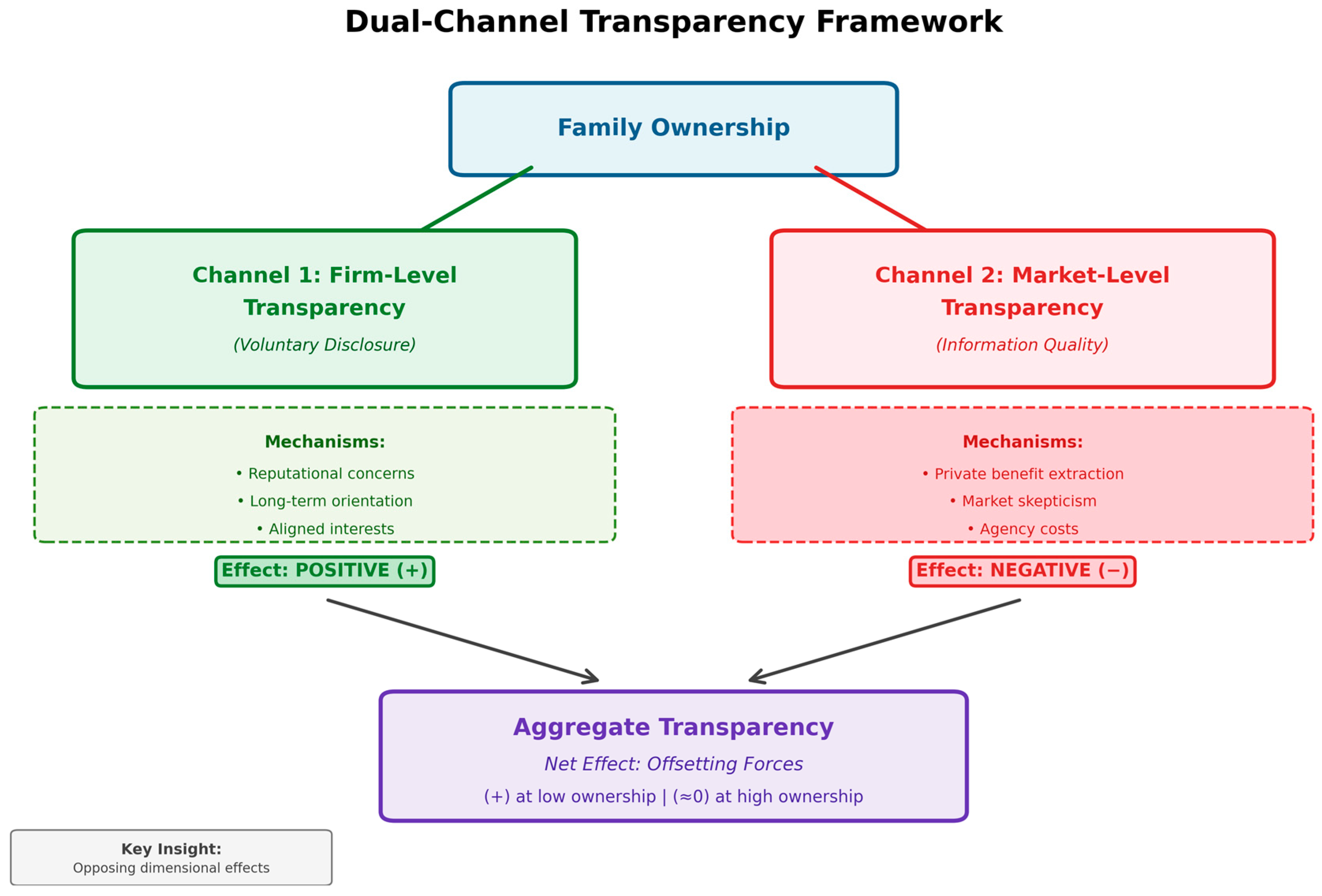
We conceptualize corporate transparency as operating through two distinct but interrelated channels. The first channel captures companies’ voluntary disclosure actions—the information they choose to provide beyond mandatory requirements. The second reflects how market participants evaluate and price the available information environment. While related, these channels can diverge substantially. Firms may increase disclosure while markets simultaneously become more uncertain about information reliability, or vice versa.
This distinction matters particularly for family firms because their disclosure incentives may differ from how markets interpret their actions. Families pursuing long-term reputation and legacy goals might genuinely enhance disclosure, yet markets might discount this effort if they believe families have both motive and opportunity to extract private benefits. Conversely, market participants might reward family firms with information premiums even when actual disclosure remains modest, if they perceive alignment between family and shareholder interests.
Figure 1 illustrates our dual-channel transparency framework, showing how family ownership influences corporate information environments through two distinct pathways with opposing effects.
2.2. Family Ownership and Firm-Level Transparency
Several factors suggest family ownership should positively influence voluntary disclosure. First, socioemotional wealth theory highlights that families value non-financial objectives including reputation, identity, and dynasty perpetuation (
Gómez-Mejía et al., 2007). These long-horizon concerns create incentives for transparent communication that build stakeholder trust and organizational legitimacy. Unlike transient shareholders or hired managers, family owners bear reputational consequences of disclosure choices across generations, encouraging more forthcoming communication practices.
Second, families often maintain concentrated holdings that align their interests with firm value maximization. This alignment reduces the classic agency problem between dispersed shareholders and management, potentially translating into superior disclosure as families recognize that information quality affects firm valuation (
Anderson & Reeb, 2003). When families hold substantial stakes, they internalize more completely the costs of poor disclosure, including higher capital costs and reduced market confidence.
Third, family firms frequently exhibit longer investment horizons than non-family counterparts. This temporal orientation encourages disclosure practices that support sustainable stakeholder relationships rather than short-term earnings management or information manipulation. Families planning to maintain control across generations benefit from establishing patterns of transparent communication that reduce information risk and lower their cost of capital.
Based on these arguments, we develop our first hypothesis:
Hypothesis 1. Family ownership is positively associated with firm-level transparency.
2.3. Family Ownership and Market-Level Transparency
Even if families improve actual disclosure, market participants may assess information quality differently in family-controlled settings. Several theoretical considerations suggest markets might discount information from family firms. Intuitively, this discount occurs because investors recognize that families possess both the motivation (extracting private benefits) and the means (control over information flows) to present information in ways that may not fully reveal economic reality. Even transparent disclosure may be strategically selective, emphasizing favorable aspects while obscuring related-party transactions or tunneling activities. Consequently, markets rationally apply a “family firm discount” to information quality assessments, demanding higher returns to compensate for this residual uncertainty.
First, concentrated family ownership creates potential for private benefit extraction from minority shareholders (
Shleifer & Vishny, 1997). When families control both board composition and management, they possess significant discretion over information flows and operational decisions. Rational market participants recognizing this structural feature may demand higher risk premiums, reflecting uncertainty about whether disclosed information fully captures economic reality. This skepticism manifests in wider bid–ask spreads, reduced analyst following, or lower earnings quality assessments.
Second, information intermediaries such as analysts, institutional investors, and sophisticated traders face greater difficulty interpreting information from family firms. The complex interplay between family business interests, personal wealth considerations, and inter-generational transfer planning creates unique information processing challenges. Even when families disclose considerable information, markets may struggle to assess its implications for firm value, leading to higher-perceived information asymmetry.
Third, minority shareholders in family firms face distinct agency costs. While family ownership may reduce traditional principal–agent problems, it potentially exacerbates conflicts between controlling and non-controlling shareholders (
Claessens et al., 2002). Markets that understand this tension may rationally assign lower information quality assessments to family-controlled firms, independent of actual disclosure volume or comprehensiveness.
These considerations lead to our second hypothesis:
Hypothesis 2. Family ownership is negatively associated with market-level transparency.
2.4. Net Effects on Aggregate Transparency
If both hypotheses 1 and 2 hold simultaneously, family ownership exerts opposing forces on different transparency dimensions. Improved firm disclosure (positive effect) competes with diminished market confidence (negative effect). The net impact on aggregate transparency depends on these forces’ relative magnitudes. When roughly balanced, we would observe negligible aggregate relationships despite significant dimensional associations.
Furthermore, these offsetting effects may exhibit nonlinear patterns with respect to ownership concentration. At moderate family ownership levels, disclosure improvements might dominate market skepticism, producing positive net transparency effects. However, as family control intensifies, market concerns about entrenchment and private benefit extraction may strengthen, offsetting disclosure gains and eliminating significant aggregate relationships. This suggests potential threshold effects wherein the family ownership–transparency relationship changes character at different concentration levels, and thus leads to our third hypothesis:
Hypothesis 3. The relationship between family ownership and aggregate transparency varies nonlinearly with ownership concentration, with moderate levels showing positive associations and high concentration showing negligible relationships.
In summary, our theoretical framework proposes that family ownership operates through dual channels with opposing transparency effects. Hypothesis 1 predicts enhanced firm-level disclosure driven by reputational concerns and long-term orientation. Hypothesis 2 anticipates reduced market-level transparency as investors rationally discount information quality in family-controlled settings. Hypothesis 3 posits nonlinear aggregate effects, with moderate family ownership showing positive transparency associations that disappear at higher concentration levels as market skepticism intensifies. Together, these hypotheses capture the complex, multidimensional relationship between family control and corporate information environments.
3. Variables and Methodology
3.1. Transparency Measurement Framework
Measuring corporate transparency requires capturing multiple facets of information environments. We develop three distinct indices following established methodologies but adapting them to our specific research context. Each index employs principal component analysis to combine multiple underlying metrics into composite measures. We choose PCA over alternative aggregation methods (such as simple averaging or factor analysis) because it objectively weights variables according to their variation without imposing arbitrary assumptions, extracts the maximum common information from correlated metrics, and provides a data-driven approach that minimizes measurement error while maintaining transparency in construction. This method has become standard in transparency research precisely because it efficiently captures latent constructs when multiple imperfect proxies exist.
3.1.1. Firm-Level Transparency Index
Our firm-level index captures voluntary disclosure quality through earnings attributes that reflect management’s reporting choices. We include four specific metrics drawn from accounting research: accrual quality, earnings persistence, earnings predictability, and earnings smoothness. These measures collectively indicate how management exercises discretion in financial reporting.
Accrual quality reflects the precision of accrual-based earnings in capturing underlying cash flows. We estimate firm-specific regressions of working capital accruals on past, current, and future operating cash flows following
Dechow and Dichev (
2002), using the residual standard deviation as our quality metric; lower values indicate higher quality. Earnings persistence measures the extent to which current earnings predict future earnings through autoregressive specifications. Higher persistence suggests more sustainable, informative earnings. Earnings predictability captures how accurately past earnings forecast future realizations, calculated as the standard deviation of earnings forecast errors from historical data. Lower values indicate more predictable earnings. Earnings smoothness examines the ratio of earnings variability to cash flow variability, with lower ratios suggesting smoother, potentially more informative earnings patterns. These proxies collectively capture whether reported earnings provide reliable signals about firm performance: high-quality accruals indicate earnings closely track cash generation, persistent earnings suggest sustainable profitability rather than transitory fluctuations, predictable earnings enable better forecasting by investors, and appropriate smoothness balances informativeness against artificial manipulation. Together, they reveal the management’s commitment to transparent, decision-useful financial reporting.
We combine these four metrics through principal component analysis after appropriate standardization to ensure comparability. The first principal component captures the common variation across metrics, providing a comprehensive firm-level disclosure index. Higher values indicate superior voluntary disclosure quality.
3.1.2. Market-Level Transparency Index
Market-level transparency reflects how market participants assess and respond to available information. We measure this through four dimensions: analyst coverage, analyst forecast accuracy, stock liquidity, and price informativeness.
Analyst coverage counts the number of financial analysts actively following each firm. More extensive coverage suggests lower information acquisition costs and greater market confidence in the information environment. Analyst forecast accuracy measures the precision of analyst earnings predictions, calculated as the absolute forecast error scaled by stock price. Lower errors indicate analysts can more reliably interpret available information. Stock liquidity captures trading ease through several metrics including bid–ask spreads, trading volume, and turnover ratios. Higher liquidity suggests lower information asymmetry and greater market confidence. Price informativeness examines how much current prices predict future earnings, following methodologies from
Collins et al. (
1997). More informative prices indicate that market participants successfully incorporate available information into valuations.
We again employ principal component analysis to combine these metrics into a unified market-level index after appropriate transformations and standardizations. Higher values indicate that market participants assess information quality more favorably.
3.1.3. Overall Transparency Index
Our overall transparency index combines firm-level and market-level transparency into a comprehensive measure. We construct this composite using principal component analysis applied to both dimensional indices simultaneously. This approach allows both dimensions to contribute to the aggregate measure while accounting for their correlation structure. Higher aggregate values indicate superior overall transparency.
3.2. Family Ownership Measurement
We define family ownership as the aggregate equity stake held by family members including founders, their relatives, and entities they control. Korean disclosure requirements mandate detailed ownership reporting, enabling precise identification of family holdings. We measure family ownership as the percentage of outstanding shares controlled by the family group.
To examine potential nonlinearities, we partition our sample into family ownership categories. Based on institutional features of Korean markets and empirical distribution characteristics, we establish a 30% threshold that balances statistical power across groups while capturing meaningful economic differences in control levels. This threshold proves particularly relevant in Korean corporate governance where 30% ownership typically conveys substantial control. Specifically, under Korean Commercial Code and securities regulations, shareholders holding 30% or more can effectively block special resolutions requiring two-thirds approval, nominate multiple board members, and exercise significant influence over major corporate decisions including mergers, amendments to articles of incorporation, and executive appointments. This concentration level marks a qualitative shift in governance power, transforming families from influential minority shareholders into dominant controlling parties with both the incentive and capability to shape information disclosure policies and extract private benefits—dynamics directly relevant to our theoretical framework regarding market skepticism toward family-controlled firms.
3.3. Control Variables
We include numerous control variables addressing alternative explanations for transparency variation. Firm size, measured as log total assets, captures economies of scale in disclosure and systematic differences in information production across size categories. Leverage, calculated as total debt divided by total assets, reflects financial risk and potential information sensitivity. Profitability, measured through return on assets, controls for performance-related disclosure incentives. Growth opportunities, proxied by market-to-book ratios, account for differences in information asymmetry across growth versus value stocks. Firm age, measured from incorporation, captures reputation development and organizational maturity. Operating cash flows control for fundamental cash generation capability distinct from accounting earnings.
Additionally, we control for industry membership through fixed effects based on two-digit Korean Standard Industrial Classification codes. This addresses systematic transparency differences across sectors. We include year fixed effects to account for time trends in disclosure practices, regulatory changes, and macroeconomic conditions.
3.4. Empirical Specification
We estimate panel regressions examining relationships between family ownership and our transparency measures. Our baseline specification takes the form:
where Transparency represents alternatively our firm-level, market-level, or aggregate transparency indices; FamilyOwnership measures family equity stakes; Controls encompasses the variables described above; and we include industry and year fixed effects. We cluster standard errors at the firm level to address potential serial correlation in residuals.
To examine nonlinearities, we estimate specifications including indicator variables for family ownership thresholds, allowing coefficients to differ across ownership ranges. We also estimate continuous specifications with quadratic terms to capture smooth nonlinear patterns.
4. Data and Descriptive Statistics
Our analysis focuses on non-financial companies which traded on the Korea Stock Exchange between 2001 and 2007, yielding 895 firm-year data points after removing entities with incomplete information.
Financial statement data came from DART (Data Analysis, Retrieval, and Transfer System), the mandatory electronic filing platform administered by Korea’s Financial Supervisory Service where all publicly traded Korean companies submit their reports. Analyst coverage metrics—including forecast accuracy, analyst counts, and forecast variation—originated from FnGuide, a Korean financial data provider covering both domestic and international markets. Trading data for calculating bid–ask spreads was sourced from Koscom DataMall, a joint initiative of the stock exchange and Finance Ministry that tracks all Korean securities transactions. Business group affiliation information was obtained from OPNI (Online Provision of Enterprises Information System), another KFTC-operated platform. Variable definitions appear in
Table 1.
Table 2’s Panel A displays summary statistics for transparency metrics at both company and market levels, where higher scores indicate greater openness.
Panel B examines how transparency varies across family ownership brackets (under 5%, 5–10%, 10–30%, 30–50%, above 50%). The aggregate transparency score rises from the lowest ownership tier to the 5–10% bracket, then declines toward the 10–30% range, after which the three highest ownership groups exhibit similar scores. Company-level transparency peaks at 5–10% family ownership while generally trending upward with increasing ownership stakes. Conversely, market-level transparency demonstrates a clear inverse relationship with family ownership concentration.
Table 3 contains correlation analyses. Panel A shows relationships between individual corporate transparency proxies, firm-level, market-level and overall transparency indices. Firm-level and market-level indices correlate positively (0.15). Firm-level and overall transparency indices relate positively to all corporate transparency proxies except forecast error. The market-level index shows varied associations with the four firm-level transparency proxies and negative correlation with forecast dispersion. Panel B presents correlations involving family ownership and control factors—firm age, size, risk profile, and leverage ratio—which appear in all models. Industry and year effects are controlled via dummy variables throughout. We include age and size because established, larger corporations typically face greater scrutiny and visibility, potentially affecting transparency. Size also directly impacts certain measures like bid–ask spreads and analyst attention. Risk is controlled since unstable firms may deliberately maintain information opacity to obscure vulnerabilities. Leverage matters due to creditor oversight mechanisms. Dividend yield and export intensity appear here as they serve as instruments in our two-stage least squares approach addressing endogeneity. Variance inflation factor tests confirmed no multicollinearity concerns, with values around or below 2, well under the threshold of 10.
5. Main Results
Section 2 outlines our hypotheses regarding ownership patterns and transparency. Here we present tests examining how different family, institutional, and foreign stakeholders influence various transparency dimensions.
5.1. Family Stake Effects Across Transparency Indices
Our initial analysis explores the relationship of family ownership with aggregate transparency. Column 1 of Panel A in
Table 4 reveals no meaningful association between family stakes and the overall transparency measure, suggesting offsetting forces may be at work. Disaggregated results confirm this intuition and tell a more nuanced story. The firm-level transparency component exhibits a strong positive association with family ownership concentration, consistent with reputational motivations: controlling families seek to avoid valuation penalties stemming from perceived opacity, given their concentrated wealth positions and extended investment horizons. In contrast, the market-level transparency component demonstrates an inverse relationship—family concentration correlates negatively with market-assessed information quality, supporting concerns about entrenchment and monitoring difficulties. Thus, the null aggregate result reflects these offsetting forces operating simultaneously across the two transparency dimensions, with families improving disclosure while markets remain skeptical about information quality.
This divergence suggests an interesting dynamic: as family stakes grow, controlling shareholders increasingly prioritize protecting their concentrated holdings and maintaining long-term firm value. They avoid market penalties for information deficits and pursue benefits like favorable capital costs. Consequently, they enhance disclosure quality and reporting timeliness, elevating company-level transparency. However, market participants simultaneously perceive greater opacity in family-dominated entities. This perception gap may stem from governance structure obscurity and communication barriers specific to family enterprises, or simply from general market beliefs that family control heightens principal-agent conflicts. Even when financial reporting quality matches or exceeds non-family peers, external stakeholders face higher costs by accessing internal information and interpreting decisions made within insular family management circles. Thus, family owners enhance disclosure practices as stakes increase, yet market information environments deteriorate—supporting Hypothesis 3.
5.2. Effect of Family Ownership on Individual Transparency Proxies
Having established opposing relationships between family stakes and the two transparency dimensions, we now examine individual components of transparency to obtain a more detailed picture of the relationship. For firm-level transparency proxies (accrual quality, persistence, value relevance, timeliness),
Table 5 Panel A shows family ownership correlates positively and significantly with three of four measures; only persistence fails to reach significance. This pattern indicates family control generally improves financial reporting quality.
Market-level transparency proxies yield mixed patterns. Family stakes correlate negatively and significantly with bid–ask spreads and analyst coverage but show statistically insignificant positive associations with forecast error and dispersion. The significant negative relationships with spreads and coverage likely capture market participant perceptions. The insignificant forecast accuracy relationships suggest analysts produce comparable information quality for family-controlled entities despite reduced coverage and elevated information acquisition costs—possibly because enhanced company-level disclosures partially offset information access barriers and agency-related skepticism.
5.3. Effect of Different Family Ownership Levels on Firm-Level, Market-Level, and Overall Transparency Indices
Previous analyses treated family ownership continuously. We now examine discrete ownership thresholds defining family firms: 5%, 10%, 30%, and 50% cutoffs (creating binary indicators for ownership exceeding each threshold). These multiple benchmarks capture heterogeneity in family influence—lower thresholds (5%, 10%) represent stakes enabling influence without formal control; higher thresholds (30%, 50%) represent proxy-effective control and majority ownership per standard literature conventions. This approach assesses whether ownership–transparency relationships vary across control regimes, enhancing robustness and comparability.
Table 6 presents regressions of transparency indices on family firm indicators. For aggregate transparency, entities exceeding 5% and 10% thresholds show significant positive effects; those exceeding 30% and 50% show positive but insignificant effects. Thus, reputational motivations dominate at moderate family stakes (5–10%).
Disaggregated analyses provide clarity.
Table 7 shows all four family firm indicators correlate positively and significantly with firm-level transparency—a key finding supporting reputational theory.
Table 8 reveals all family indicators (except the 5% threshold) correlate negatively and significantly with market-level transparency; the 5% threshold shows negative but insignificant effects. These contrasting patterns across the two transparency dimensions further support Hypothesis 3: family ownership enhances firm-level transparency while diminishing market-level transparency and the overall effect varies across family ownership levels.
6. Robustness and Discussion
We will conduct two robustness checks: examining business group affiliation effects and addressing endogeneity concerns, then provide a discussion of our overall results.
6.1. Business Groups Controlled by Family Owners
Business conglomerates dominate non-U.S. economies—collections of legally separate entities linked through ownership and informal ties (e.g., kinship) operating cohesively. Family dominance in these structures and their associated agency conflicts are well-documented. Severe agency problems include tunneling: pyramidal or circular ownership creates divergence between control and cash flow rights, enabling minority shareholder expropriation. Controlling families may divert resources from low-cash-flow-rights entities toward high-cash-flow-rights entities. This could incentivize opacity to mask such behavior, though concentrated wealth and long horizons might simultaneously motivate transparency.
We incorporate an interaction term: group affiliation × family ownership.
Table 9 shows no differential aggregate transparency effect for family versus non-family group ownership. For firm-level transparency, both family and non-family group ownership correlate positively and significantly, with family group ownership showing stronger effects. For market-level transparency, family ownership exhibits negative significance, with family group ownership showing more positive effects. These results confirm the null aggregate effect of family ownership masks positive firm-level and negative market-level relationships, again validating Hypothesis 3.
6.2. Endogeneity
Prior analyses treated transparency as determined by family ownership and controls including group affiliation. We now address two endogeneity concerns: First, families may maintain higher transparency to preserve wealth, or alternatively, entrenched families may persist despite control-cash flow rights divergence undetectable in our cash-flow-ownership data. This divergence intensifies in group-affiliated entities facing additional control issues from group headquarters.
We employ instrumental variables via two-stage least squares (2SLS). Stage one estimates endogenous variables (family ownership, group affiliation) using instruments. Stage two regresses estimated ownership measures on transparency indices.
Table 10 presents results for instrumented family ownership and group affiliation. Aggregate transparency shows no significant relationship with estimated family ownership. Disaggregated analyses reveal estimated family ownership positively impacts firm-level transparency but negatively impacts market-level transparency—identical to
Table 4 results, confirming robustness after controlling endogeneity.
6.3. Discussion of Overall Results
Our results overall reveal a nuanced picture of how family ownership shapes corporate information environments. Families appear genuinely committed to superior disclosure practices, consistent with reputational concerns and long-term orientation. However, market participants systematically discount these efforts, possibly due to elevated information acquisition costs, particularly when family control intensifies. This divergence between disclosure behavior and market assessment explains why aggregate transparency measures show negligible family ownership associations despite strong dimensional relationships.
Our findings connect directly to recent international research on family firms and transparency.
Like Liao et al. (
2025) who document that U.S. family firms produce clearer annual reports when reputational stakes are high, we find enhanced firm-level disclosure in family firms. However, our market-level results complement
Susanto et al.’s (
2025) Indonesian evidence showing that despite engaging quality auditors, family firms face persistent investor skepticism. Similarly, our nonlinear threshold effects resonate with
Liu et al.’s (
2016) Taiwanese findings that institutional ownership and board independence can moderate the transparency effects of family ownership—suggesting control concentration fundamentally alters how markets assess information quality. The contrasting dimensional effects we document may also explain why
Lee and Bose (
2025) observe increased CEO dismissals following poor accounting performance in Chinese family firms, as boards recognize the growing gap between disclosure efforts and market confidence. Together with
Zehri’s (
2025) Saudi Arabian evidence on audit quality and board diversity, these studies collectively suggest that the transparency challenge of family firms transcends individual institutional contexts, reflecting a fundamental tension between controlling shareholders’ disclosure incentives and minority investors’ information processing capabilities across diverse emerging markets.
Several research avenues emerge: First, investigating whether firm-market transparency gaps narrow as institutional environments develop. Second, distinguishing actual versus perceived transparency may explain why governance reforms and ESG initiatives produce unexpected market responses. Third, examining how different intermediary types—foreign analysts, institutional investors—mediate ownership–transparency relationships.
7. Implications and Conclusions
7.1. Implications
For corporate practice, family enterprises seeking to optimize information environments face a challenging situation. Simply improving disclosure quality may prove insufficient without addressing structural concerns about control and private benefits. Families might benefit from complementary governance reforms including independent directors, related-party transaction protocols, or enhanced disclosure beyond requirements.
For investors, our findings highlight the importance of distinguishing actual disclosure quality from market-assessed information environments. Sophisticated investors capable of independently evaluating disclosure might identify opportunities in family firms where market skepticism exceeds genuine information risk.
For policymakers, our results suggest that mandatory disclosure enhancements alone may inadequately address information concerns in family firms. More effective approaches might directly address structural governance features underlying market skepticism, such as strengthening minority rights, enhancing independent director requirements, or mandating special procedures for related-party transactions. Our findings carry specific practical implications for family-controlled firms seeking to build investor confidence and reduce their cost of capital. First, families should recognize that transparency operates through dual channels—both firm disclosure and market perception—requiring strategies that address both dimensions simultaneously. Simply improving disclosure quality without addressing governance structure may prove insufficient. Second, family firms approaching or exceeding 30% ownership thresholds face heightened market skepticism that can negate disclosure improvements. At these concentration levels, families should consider proactive governance reforms including: appointing truly independent directors (not family associates) to audit and compensation committees, establishing transparent related-party transaction policies with board approval requirements, creating family governance charters that formalize succession planning and dividend policies, and voluntarily adopting disclosure practices exceeding regulatory minimums particularly regarding related-party transactions and beneficial ownership structures. Third, families might benefit from credible commitment mechanisms that signal alignment with minority shareholders, such as equity-linked compensation for independent directors, long-term shareholding commitments, or participation in voluntary governance ratings. Fourth, engaging high-quality external auditors and maintaining consistent analyst relations can help bridge the firm-market transparency gap by providing independent validation of disclosure quality. Finally, families should recognize that the transparency discount intensifies with ownership concentration, suggesting that strategic decisions about ownership structure carry information environment implications beyond traditional control considerations.
7.2. Limitations
Our analysis focuses on Korean markets during a specific period. While institutional features resemble many emerging markets, cross-country research would illuminate how legal systems and cultural factors moderate these relationships. Our transparency measures, while comprehensive, do not capture all information dimensions. Alternative proxies could verify generalizability. We cannot definitively establish causality despite multiple endogeneity tests. Future research might exploit quasi-natural experiments for stronger causal inference.
7.3. Conclusions
This study demonstrates that the transparency of family ownership implications prove considerably more intricate than previously recognized. By explicitly separating firm-level disclosure from market-level information assessment, we uncover important offsetting dynamics. Family enterprises implement genuinely superior disclosure practices, yet confront systematic market skepticism intensifying with ownership concentration.
Our dimensional approach yields key insights. Transparency operates through multiple channels that do not necessarily move together. Governance structures may simultaneously improve certain dimensions while constraining others. Aggregate measures potentially obscure important patterns that dimensional decomposition reveals.
As family enterprises continue dominating corporate landscapes globally, understanding these complex relationships becomes increasingly important. Our research advances this understanding by revealing how families simultaneously improve disclosure while facing persistent market skepticism. These insights should inform corporate strategies, investment decisions, and regulatory policies seeking to enhance governance, promote efficiency, and protect minority interests in family-controlled firms.