1. Introduction
In the current pension environment, non-traditional plans such as cash balance and pension equity plans offer one-time lump sum payouts to their participants. According to the Bureau of Labor Statistics, 90% of these plans offer a lump sum payment option compared to 36% for traditional pension plans (
U.S. Bureau of Labor Statistics, 2018).
The choice of whether to take a pension as a lump sum distribution or as an annuity is an important yet difficult decision to make. It depends upon such factors as retirement age, health status, tax concerns, wealth level, and marriage status, among other considerations. There have been studies investigating pensions and the preferences of the retirees with respect to these issues.
In the economic literature, with respect to annuitizing one’s wealth,
Benartzi et al. (
2011) state “Rational choice theory predicts that households will find annuities attractive at the onset of retirement because they address the risk of outliving one’s income, but in fact, relatively few of those facing retirement choose to annuitize a substantial portion of their wealth.”
Many studies look at annuity choices and the “annuity puzzle,” which shows that retirees often do not fully use annuities even though they are theoretically beneficial.
Yaari (
1965) showed that, with uncertain lifetimes and no desire to leave money behind, people would choose annuities to smooth income in retirement.
Richard (
1975) developed models for optimal spending with uncertain lifetimes, and
Milevsky (
2001) and
Hainaut and Devolder (
2006) show the financial value of annuities and why some people do not use them. Our study builds on this work, limited to a linear utility function, because we want to focus on morbidity-adjusted life expectancy to see how health and medical conditions affect the value of annuities compared to lump sum payments.
Cappelletti et al. (
2013) further this argument: “Consider a worker on the verge of retirement who has to choose the level of consumption for the coming years, given their level of wealth. Without annuities, workers would be exposed to both sides of longevity risk: if they live longer than expected, they could outlive their resources; if on the contrary their lifespan turns out to be shorter than expected, some resources are wasted. By buying an annuity, longevity risk is shifted onto the insurance company.”
“Your health and expected longevity should play an important role in determining which form of payment is right for you. Monthly annuity payments may be a prudent choice if you are in good health and expect to have an above average life span.”
Most experts would agree that, for most retirees, a guaranteed stream of income for life is a better option than a lump sum. However, there are some situations where a lump sum payment might be more advantageous. One is where the retiree has no surviving spouse and has an expected short lifespan due to serious health conditions. Another is when the retiree already has substantial assets or another secure source of adequate income, such as with a spouse’s pension.
Despite the general consensus for receiving annuities,
Beshears et al. (
2014) state how previous studies have shown that 50% to 75% of US households have taken the lump sum distribution instead of the annuity for defined benefit pensions when that option is available.
One of the factors mentioned above that affects individual choices about pension distributions is taxes. An indication of how taxes might influence these decisions is seen in a study based in Switzerland (
Bütler & Ramsden, 2017). They found that “… taxation matters in individual decisions to cash out pension wealth: the lower the relative tax burden on the annuity (compared to the lump sum), the higher the annuity rate”.
This paper investigates how morbidity alters the realized economic value of pension payment options—lump sums, single life annuities, and joint life annuities—relative to actuarial equivalence under standard mortality assumptions. Methodologically, it introduces a morbidity-based evaluation framework that incorporates normalized life expectancy and impaired mortality into standard pension formulas, extending actuarial practice from pricing to decision-oriented benefit evaluation.
A key limitation of this study is that it evaluates pension options based on expected life expectancy rather than incorporating utility-based analysis. While life expectancy, which corresponds to a linear utility function, provides a useful and direct measure of realized benefits, a utility function approach would offer a more comprehensive framework for understanding the annuitization choices of individuals and couples, accounting for risk preferences and consumption smoothing over uncertain lifetimes. Extending the analysis to explicitly incorporate utility functions is left for future research.
The previous studies reviewed all focus on aspects such as the impact of medical conditions on life expectancy, annuity evaluation, and actuarial pricing calculations independently. In contrast, this paper bridges these independent factors to evaluate the impact of various medical conditions on pension evaluation and retirement benefits.
The paper proceeds by first developing morbidity-adjusted life expectancy and impaired mortality tables, then applying these to evaluate and compare lump sum and annuity pension options under varying health and tax scenarios, and finally concluding with implications for retirement planning.
2. Life Expectancy
Morbidities and their life expectancies have been well studied in medical research. For example,
Neild (
2017) investigates how life expectancy for patients with chronic kidney disease is reduced. Another example is provided by
Crimmins et al. (
2008) where they discuss how for people with heart disease at age 50, women are expected to live 7.9 years compared to 6.7 years for men. Likewise, life expectancy tables were constructed for people with type 2 diabetes (
Leal et al., 2009). Similarly,
Tom et al. (
2015) investigate how life expectancy for people with dementia decreases with age.
Table 1 below summarizes morbidity-adjusted life expectancy (
Cho et al., 2013) based on 407,749 Medicare beneficiaries aged 66 and above, between 1992 and 2015, without a history of cancer. The overall categorization includes no comorbidity, low/med level of comorbidity, and high level of comorbidity based on survival probabilities. Also, we include three common morbidity conditions: diabetes, chronic obstructive pulmonary disease (COPD), and congestive heart failure (CHF).
The Charlson Index (
Charlson et al., 1987) was utilized to help include different levels of comorbidity conditions. This index was developed where specific health conditions are assigned values of 1, 2, 3, or 6. Higher values are assigned to conditions which are more serious and associated with a lower life expectancy. For people over 50, more points can be added incrementally, depending on the specific age, and all these values are combined into an overall score to help predict life expectancy over a 10-year period. For example, a score of 2 would translate into a 90% probability of survival over 10 years. This calculation can be completed at
https://www.mdcalc.com/calc/3917/charlson-comorbidity-index-cci (accessed on 19 November 2025).
Life expectancy is broken down into five categories:
Low/Med includes individuals with low or medium comorbidity levels as defined by the Charlson Comorbidity Index (CCI): low risk (CCI = 0) indicates no recorded comorbidities, while medium risk (CCI = 1–2) reflects a mild to moderate comorbidity burden; for example, a patient with hypertension alone (not scored in the CCI) would have CCI = 0, while a patient with a history of myocardial infarction (CCI = 1) or myocardial infarction plus chronic pulmonary disease (CCI = 2) would be classified as Low/Med.
High includes individuals with a high level of comorbidity as defined by the Charlson Comorbidity Index (CCI): high risk (CCI ≥ 3) indicates a substantial comorbidity burden and is associated with a significantly higher mortality risk; for example, a patient with congestive heart failure (CCI = 1), chronic pulmonary disease (CCI = 1), and renal disease (CCI = 2), yielding a total CCI score of 4, would be classified as High.
Diabetes includes diabetes only or diabetes with other conditions except COPD and CHF.
Note that COPD signifies COPD only or COPD with other conditions except CHF.
Table 1 presents the morbidity-adjusted life expectancies by men and women, where age 65 results are linearly extrapolated based on data from age 66 to 90. By definition, in the pension industry, age 65 is the most common Normal Retirement Age. It is used as the starting point for evaluation throughout this study.
The results reported in
Table 1 require normalization to ensure consistency with life expectancies calculated from standard pension mortality tables. Under the Pension Protection Act of 2006, mortality tables used for defined benefit lump-sum and many annuity conversions are standardized, and we therefore use the IRS mortality table as the baseline for average U.S. retired employees. While morbidity-adjusted life expectancy estimates are available from medical research, discrepancies exist between the life expectancy of individuals without comorbidities reported in medical studies and the life expectancy implied by IRS mortality tables. To reconcile these differences, we normalize life expectancy for individuals with comorbidities by applying the relative impact of comorbidities on life expectancy, rather than using medical-study life expectancy levels directly. This approach ensures that employee benefit evaluations remain consistent with IRS mortality assumptions while incorporating medically documented comorbidity effects.
To create the life expectancy of average US retired employees, we use the standard 2020 mortality improvement rates (
Internal Revenue Service, 2019). The table is unisex, blending the mortality rates for males and females to create the same expected lifetime at each age. This common expected lifetime among males and females guarantees the same conversion to optional forms of payment between lump sums and annuities. However, for the purposes of determining a true present value for an individual, we will calculate the standard pension mortality for males and females unblended. The basic expected lifetime formula (
Bowers et al., 1997) uses the annual death probabilities for all years (ages 65 through 120) and is computed as follows:
= life expectancy of a retired employee whose age is x
= probability of a retired employee whose age is x survives t years
Normalized life expectancy (Norm LE) is defined as the following:
For example, the normalized life expectancy of a 65-year-old retired female employee with Diabetes (16.0 = 16.7/22.7*21.8) equals Female LE with Diabetes at age 65 (16.7), divided by Female LE with no morbidity at age 65 (22.7), multiplied by average US retired employee LE at age 65 (21.8).
The determined benefits are calculated based on the IRS standard mortality table, ensuring compliance with current IRS rules. However, the actual benefits an individual or couple can realize are directly affected by their health status. Put simply, a healthy individual is likely to receive higher benefits than someone with multiple high-risk comorbidities. The baseline for comparison is the life expectancy of a typical U.S. retired employee. Morbidity studies provide a relative assessment, showing how individuals with specific health conditions fare compared to those without such conditions.
3. Impaired Mortality
Next, we apply a fixed impaired mortality factor across all ages to the standard pension mortality table which provides a consistent life expectancy relationship between the average US retired employee and the employee with morbidity. In the insurance industry, adding a constant force of mortality due to extra risk for individuals who are ineligible for standard rates is a common actuarial practice (
Dickson et al., 2013). For example, a financial strategy evaluation for individuals with Down Syndrome was based on impaired mortalities (
Niu et al., 2018). The impairment factor is a factor to adjust a standard mortality table to reflect the respective group’s mortality due to morbidity. It adjusts each year’s survival probability by an exponential factor α. When α is greater than 1, the survival probability rate decreases, and mortality rate increases. Importantly, the impairment factor
is age-specific and depends on the initially considered (attained) age, but once determined, it is applied uniformly to all future annual survival probabilities.
The impairment factor α is defined by solving the following equation:
is the normalized life expectancy with morbidity presented in
Table 2.
are survival probabilities based on the standard pension mortality table. Constant impairment factors α are calculated for each select age, level of morbidity, and gender.
Table 3 presents calculated impairment factors. High impairment factors correspond to high constant force of mortality and lower life expectancy; this is consistent with
Table 2.
For a 65-year-old male with low or medium morbidity, his life expectancy is 16.9 years, and he has an impairment of factor of 1.51 compared with the average US retired employee. For a 65-year-old male with high morbidity, his life expectancy is 10.9 years and has a much higher impairment factor of 3.82.
With an impairment factor, we can construct mortality tables for individuals with morbidity from standard pension mortalities. The tables are differentiated by age, gender, and level of morbidity.
4. Retirement Benefit Evaluation and Comparison
Retirement benefit evaluation has been studied from various perspectives. In general, lump sum and annuitization are the major choices retired employees need to make. Factors such as smoking status directly impact the decision between choosing a lump sum and an annuity (
Hurwitz & Sade, 2020). Advanced statistical tools, such as utility functions, can be utilized for evaluation (
Kifmann, 2008).
We implement impairment factors to evaluate three basic optional forms of retirement benefit payments. This is generally a one-time choice made by the retiree at the time the employee chooses to begin payments:
The three benefit options are generally approximately equal in actuarial value. For example, the single life annuity that is paid over the retiree’s future lifetime is expected to be approximately equal to the lump sum payment offering, accounting for interest and mortality. However, these “equivalent” payment options are based on a healthy person. For example, a retiree may be offered to select from among the following payments:
The rules of a specific pension plan may use a formula that produces a lump sum amount or single life annuity. Conversion to other optional forms is then based on economic conditions at the time of retirement.
Our results will compare the relative worth of these benefit offerings when considering impaired mortality. The actual benefits retired employees receive are different depending on the actual number of years lived and are largely driven by health conditions. In general, the lump sum option is preferred for those with suboptimal health conditions and shorter life expectancies. Financial evaluation is complicated with the introduction of the retirement starting age, gender, morbidity, and beneficiary contingencies. We consider all the above factors and provide a general approach for evaluation and comparison.
Three major categories of retirement plans are considered. First is lump sum, which means the retired employee will cash out all of the account value. Second is complete annuitization without beneficiary or contingencies, which means when the retired employee dies, the benefit will terminate. Third is complete annuitization with different levels of contingencies, which means after the death of the primary retired employee, his or her spouse will continue to receive a certain level of benefit until the death of the spouse. The level could be a 100% contingency such that the annual benefit equals what the primary retired employee received when he/she was alive. It is also common to see 75% and 50% contingencies.
4.1. Single Life Payment Option
The single life annuity due factor is defined as the actuarial present value of a benefit of 1/12 of $1 payable each month until the death of the annuitant. Annuity due signifies that the first payment occurs at the beginning of the first retirement month as opposed to the life annuity immediate, which represents the first payment occurring at the end of the first retirement month.
What a pension offers are determined by the US average unisex mortality table. Actual realized annuity factors are calculated by the impaired mortality table. The single life annuity due factor at age
is defined using the following standard actuarial pension formula (
Bowers et al., 1997):
where
is the discount factor
, and
is the annual effective interest rate.
Total Retirement Amount at Retirement = Annuity Factor × Annual Benefit (
Bowers et al., 1997). The annuity factor is determined by the IRS based on the retiree’s age at retirement, while the annual benefit is set by the plan. The IRS annuity factor does not differentiate by gender because, for the same account value at retirement, women would otherwise receive a lower annual benefit due to their longer life expectancy—an outcome considered socially unacceptable. However, when accounting for the realized medical impact on life expectancy, differences between men and women emerge. For example, low/medium comorbidity has a smaller effect on a 65-year-old female, reducing the annuity factor from 15.39 to 13.37. For males, the impact is larger, decreasing the annuity factor from 15.39 to 12.79. As a result, men with similar comorbidities would realize a lower total retirement benefit due to the greater reduction in their annuity factor.
Table 4 shows the single life annuity factors based on various interest rate assumptions. Note that the male/female rates from pension mortality are used to re-compute morbidity annuity factors in the table.
If a particular pension account value is
$1,000,000, an older retired annuitant will have a higher annual benefit as
Table 5 presents (4% rate assumption). Age-specific annual benefits are fixed, regardless of any impairments. We multiply the annual benefit by the realized single life annuity factor to obtain the equivalent total benefit. Severe morbidity such as categories High and CHF have much lower equivalent total benefits due to shorter life expectancy. For all five categories of morbidity, the equivalent total benefits do not change linearly by retirement age. Impaired health impacts the total benefit value for each age.
The interest rate impact on annuity factor calculations is significant, which impacts the annual life annuity. However, the ratio of the factors does not have a major impact on the relative values of the payment options. For example, for an age 65 male with diabetes (vs. plan offers) at a 4% rate, the annuity factor ratio is 10.16/12.45 = 81.6%, whereas at a 6% rate, the ratio is 8.64/10.30 = 83.9% from
Table 4. Payment option selection is not significantly impacted by the difference.
Ultimately, the payment option choices are based on the relative values of the annuity factors between plan offerings and those with morbidity. Thus, this study focuses on the factors such as morbidity and tax that impact the choice between lump sum and annuity options. We have chosen the fixed interest rate of 4% to provide a general long-term pension evaluation assumption. However, using different discount rates for pricing and evaluation could provide a more comprehensive and robust analysis, and would also be more consistent with utility theory. This is because the discount rate assumed by an individual or couple—largely influenced by their risk appetite—often differs from the rate used by the plan provider.
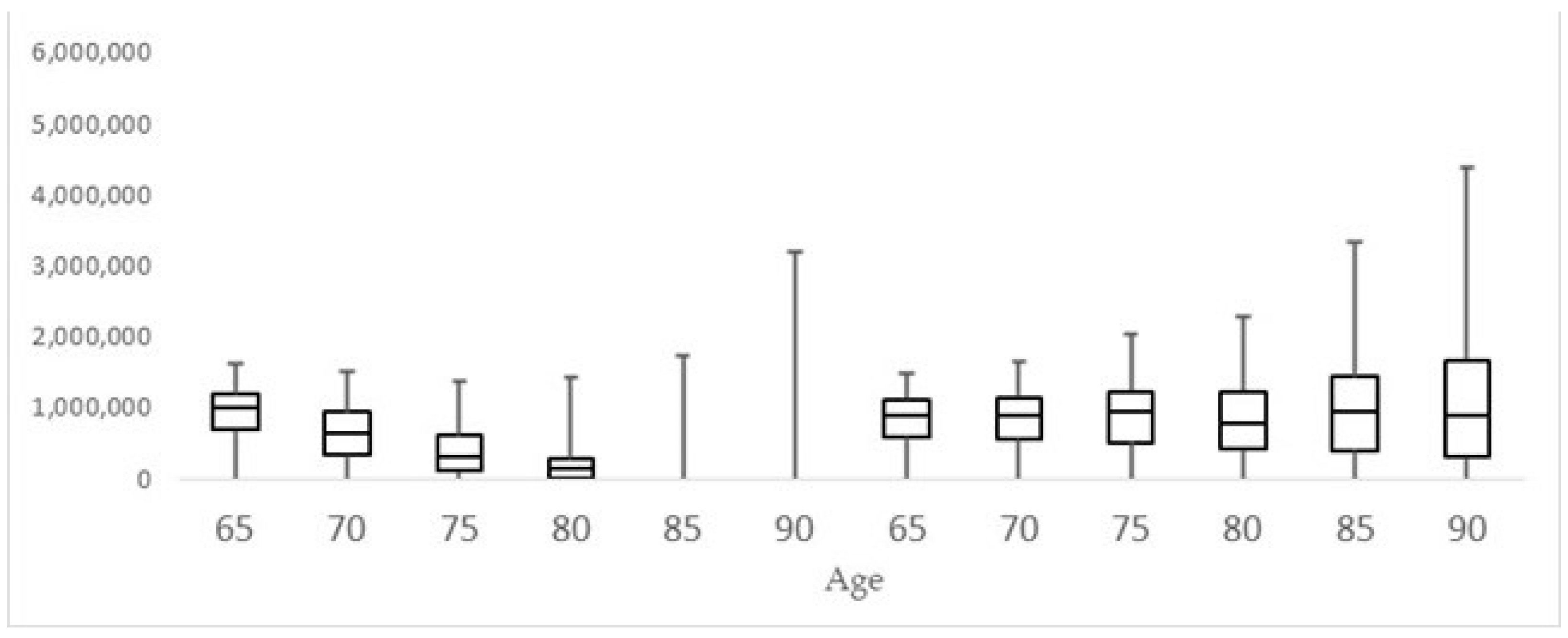
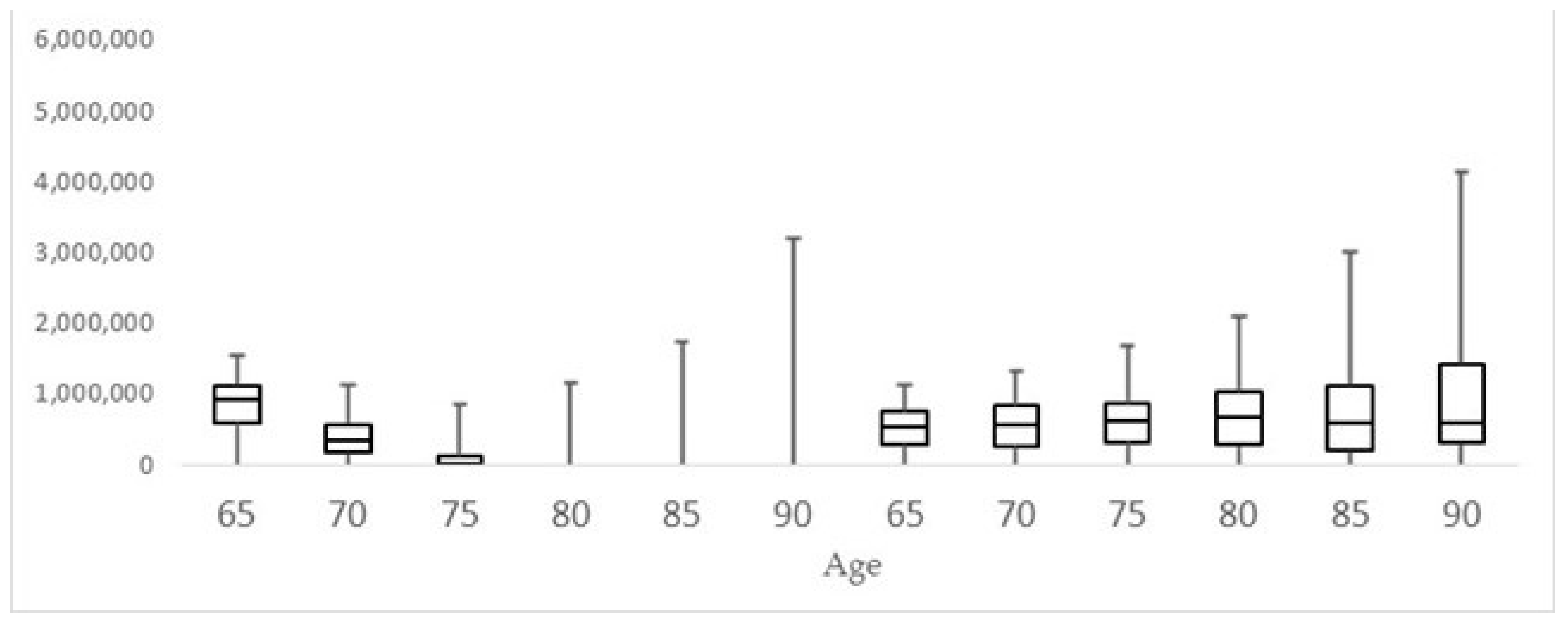
To provide a comprehensive evaluation, in addition to the actuarial present value calculations, we conducted mortality simulations across multiple factors, including retirement age, morbidity status, and gender, for a representative U.S. retired employee. The primary focus is on morbidity level.
We begin with static male and female mortality tables, converting annual mortality rates to survival probabilities. Survival probabilities are then adjusted for morbidity by applying exponential impairment factors (
Table 3) and converted back to impaired annual mortality rates. The simulation proceeds in annual time steps. At each age, a uniform random variable U~(0,1) is drawn; if U is less than the impaired mortality rate for that age, the individual is declared dead and remains dead thereafter. Individuals are simulated by sex, retirement age (65, 70, 75, 80, 85, and 90), and morbidity level (Average U.S. Retired Employee, Low/Medium, High, Diabetes, COPD, and CHF). If the individual is alive in a given year, an annual benefit—precomputed based on the retirement plan (
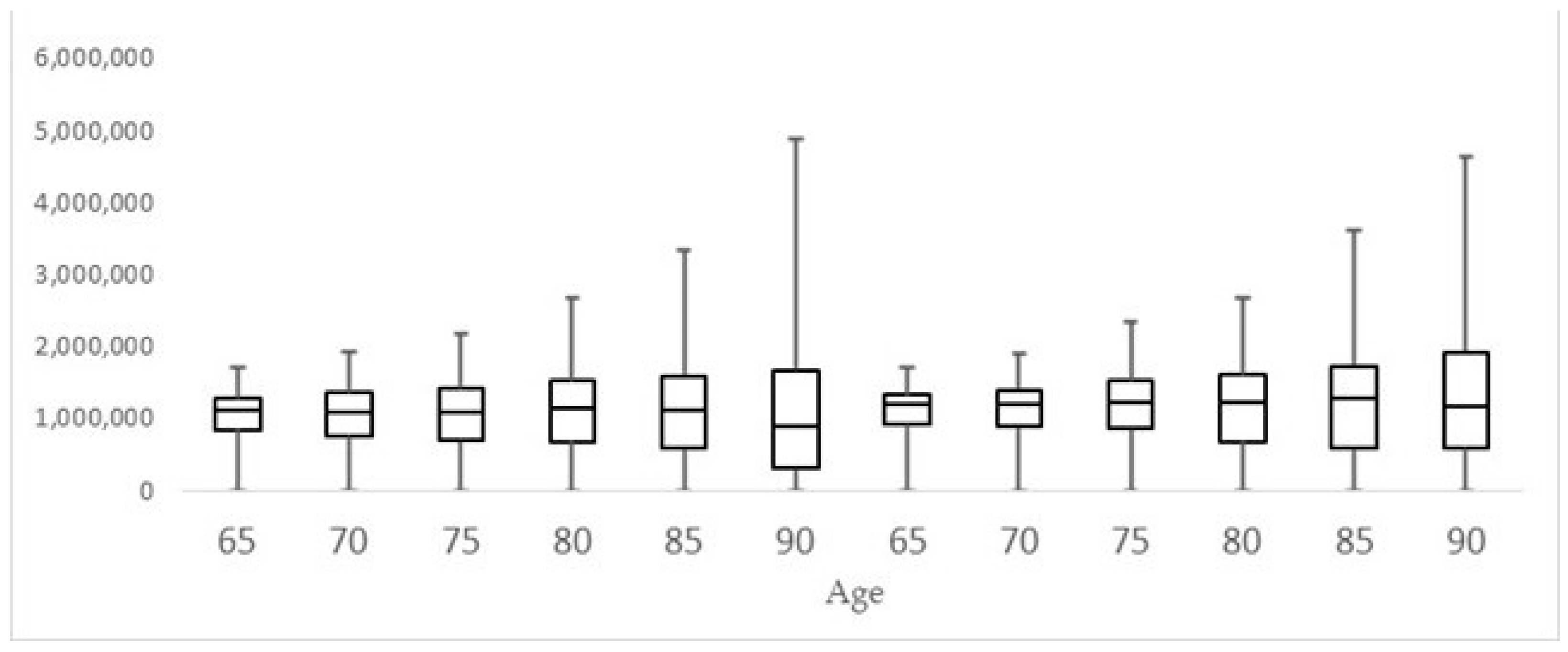
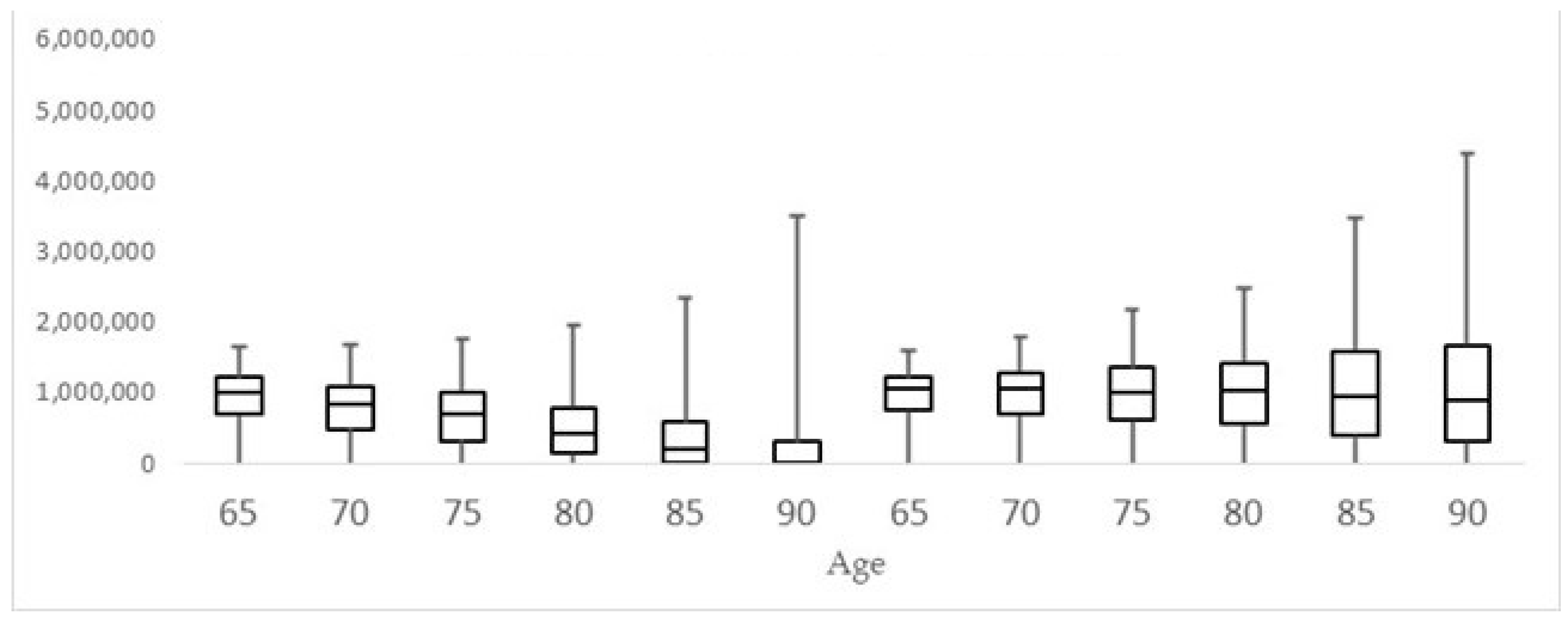
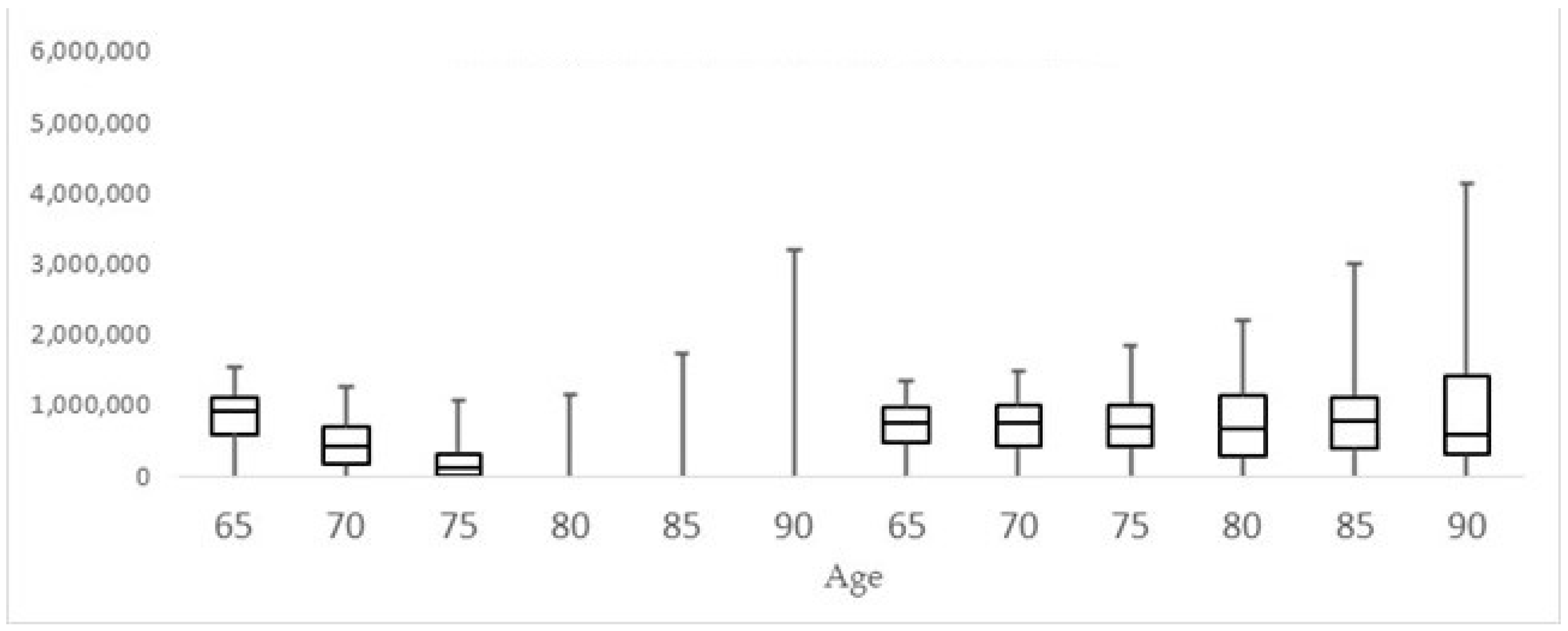
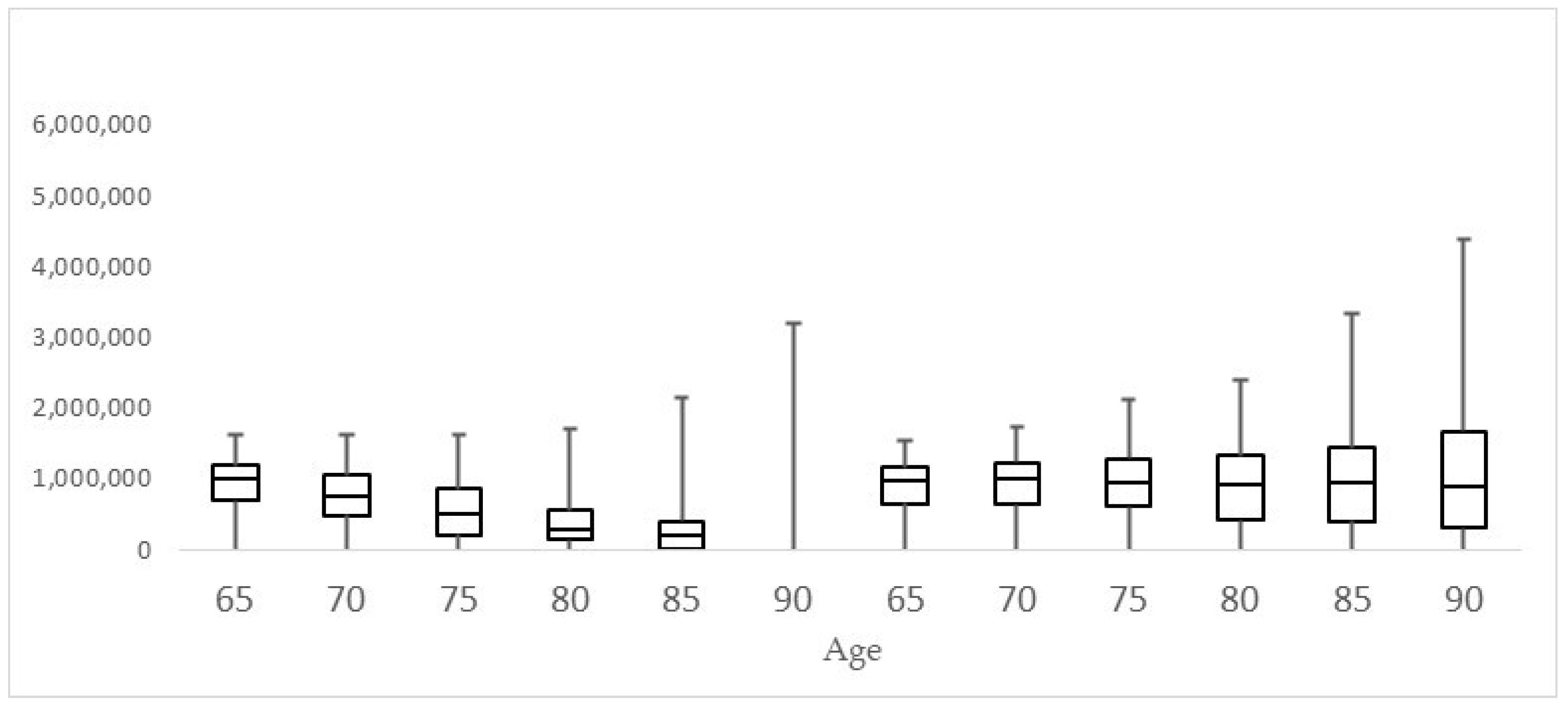
Table 5)—is received; no benefits are paid after death. All realized benefits are discounted to the retirement age using a constant annual discount rate of 4%. Each simulation terminates at death or age 120, whichever occurs first. For each sex–retirement age–morbidity combination, the simulation is repeated 10,000 times, with each run representing one individual’s lifetime realized discounted benefit (e.g., an 80-year-old male with diabetes may receive benefits for only the years survived before death).
Morbidity affects not only the average total realized benefit but also substantially alters the distribution of realized benefits. The coefficient of variation, defined as the ratio of the standard deviation to the mean, for the U.S. average retiree’s simulated realized total benefit is significantly lower than that of individuals with morbidity. This relationship implies that individuals with morbidity face greater risk in the realization of their benefits. For example, an 80-year-old U.S. average male has a coefficient of variation of 53.7% (
$573,045/
$1,067,565 from
Table 6 and
Table 7), whereas an 80-year-old male with diabetes has a coefficient of variation of 87.6% (
$307,216/
$350,755 from
Table 6 and
Table 7).
Each scenario was simulated 10,000 times, as our results showed that the outcomes had already converged and become stable.
Table 6 presents the average total realized benefit for the representative individual, while
Table 7 reports the standard deviation of total realized benefits from the simulations. Results for individuals with specific morbidities are presented in
Appendix C,
Appendix D,
Appendix E,
Appendix F,
Appendix G and
Appendix H, where the simulated distributions box plots are shown using box plots.
4.2. Joint Life Payment Option
Next, we evaluate common choices of pension annuitization that include beneficiary contingencies. We evaluate the retirement benefit through the second to die annuity due with considerations of age, gender, morbidity, and contingent level. Let x be the primary annuitant and y be the beneficiary annuitant.
Let
be the probability both annuitant x and y survive t years.
Let
be the probability annuitant x or y survives t years.
Let
be the annuity factor that represents the present value of a unit annual benefit that pays when both annuitant x and y survive, or the first to die joint life annuity factor.
Let
be the annuity factor that represents present value of a unit annual benefit that pays when annuitant x or y survives, or the second to die joint life annuity factor.
An amount of 100% contingent means that after the death of the primary annuitant, the beneficiary will receive 100% of what the primary annuitant had received annually.
Reduced contingent levels such as 75% and 50% are also commonly selected. After the death of the primary annuitant, the beneficiary will receive the reduced level (r) of what the primary annuitant had received annually.
represents the annuity factor that y survives only.
A total of 0% contingent means that after the death of the primary annuitant, the pension benefit terminates. When r = 0, the bottom portion of the above formula becomes , which is equivalent to the singe life annuity factor.
Regardless of whether the pension plan offers a single life annuity or lump sum as the formula benefit, the conversion to a contingent payment option is calculated based on standard unisex mortality tables. When the primary or beneficiary has a morbidity, the realized annuitized retirement benefit is reduced.
If the beneficiary has a morbidity, it is optimal to choose the minimum level of the contingent plan because it is less likely the beneficiary will outlive the primary annuitant to receive the benefit. However, benefit reduction is determined by age, contingent level, and gender. Next, we present the detailed evaluation and comparison of such reductions.
4.2.1. Healthy Primary and Beneficiary with Morbidity
We calculate the joint life annuity factor and annual benefit based on a starting
$1,000,000 retirement asset.
Table 8 shows that the annual benefit the plan offers decreases as the contingent level increases and increases as the starting retirement age increases. We also calculate the realized annual benefit if one of the annuitants has a morbidity; the results are compared with what the plan offers and are presented as a percentage.
For a healthy male primary annuitant and a female beneficiary who has diabetes, where both are 65 years old with a 100% contingent plan, the pension plan offers annual benefit of
$67,621. However, the realized annual benefit should be
$73,303. This is because the female beneficiary is expected to have a shorter life expectancy, but the pension plan treated all retirees as healthy annuitants. The annual benefit ratio of what the plan offers to what the annuitants should receive is 92% (
$67,621/
$73,303).
Table 8 shows the ratios of other morbidity scenarios.
When the primary annuitant is healthy and the beneficiary has a morbidity, the high contingent level will decrease the overall realized benefit. This is because the beneficiary is expected to have a shorter life expectancy, but the benefit was reduced more heavily based on a healthy mortality. Both
Table 8 and
Table 9 show a downward trend by contingent level for all ages and all morbidity levels. Darker shading indicates a lower percentage, highlighting the overall pattern more clearly.
Male mortality is higher than that for a female, which implies that it is also higher than unisex mortality. The pension plan offers a benefit based on unisex mortality, and therefore, the benefit offered has a negative bias for males. When contingent level equals zero, the joint life payment option becomes equivalent to the single life payment. In this case,
Table 8 shows the same benefit percentage, regardless of the beneficiary’s morbidity level.
Table 8 also shows that annuity payment options are suboptimal, regardless of the contingent level and age.
When the primary annuitant is female, the pension plan offers could outperform the realized benefit when choosing the minimum contingent level (0%). And overall, a healthy female primary joint life annuitization performs better than a male primary annuitant.
Table 9 shows that a higher contingent level will reduce the benefit level because of the male beneficiary with a morbidity impact.
4.2.2. Primary with Morbidity and Healthy Beneficiary
When the primary annuitant has a morbidity and the beneficiary is healthy, the higher contingent level will increase the overall realized benefit. This is because the beneficiary is expected to live up to the computed life expectancy and should receive an amount closer to the equivalent benefit. Both
Table 10 and
Table 11 show an upward trend by contingent levels for all ages and all morbidity levels.
Benefit level decreases as the morbidity severeness increases.
Table 10 shows that, with a healthy beneficiary, the impact of the primary having a morbidity can be mitigated by a higher contingent level selection.
Table 11 shows the benefit level for a female primary with a morbidity and a healthy male beneficiary. It has a similar pattern to
Table 10, but the benefit level is generally higher than for the male primary, due to longer life expectancy of the female primary annuitant.
4.2.3. Both Primary and Beneficiary with Morbidity
In the case where both annuitants have morbidities, the value of a pension annuity is suboptimal. Alternatively, the lump sum option, or using the lump sum to purchase an annuity based on the actual annuitants’ characteristics from the market, are financially sound options. The impact is quantitatively measured through impaired mortality tables and presented in
Appendix A and
Appendix B. For example, when both annuitants are 65 years old and have diabetes, a male primary and female beneficiary with 100% contingent would only realize 85% of what the pension plan offers.
4.3. Basic Tax Consideration
Retirement is a difficult individual decision, particularly in terms of timing and payment options. There are significant tax consequences based on the one-time payment form election. A lump sum payment option is taxed heavily in the year received, whereas an annuity form of payment is taxed less since it is payable (and therefore taxed) over the lifetime of the retiree and, potentially, the lifetime of the selected beneficiary.
For a married retiree, qualified pension plans are required to offer both a 50% continuation option for the surviving spouse (50% contingent), and a 75% continuation option (75% contingent). In addition, many plans also offer a 100% option.
Table 12 shows an example of payment options for a healthy individual:
Not all states tax pension income or tax Social Security. Personal state income taxes range from 0% to over 10%. We chose for our example Rhode Island, which taxes both pensions and Social Security (though Social Security tax is exempted for lower income). In addition, it was chosen since it is a middle-of-the-road example with a moderate tax rate ranging from 3.75% to 5.99%. In this case, 2021 federal and Rhode Island state taxes have been combined and applied to the pension benefits. The Rhode Island tax rate is 4.75% for the annuity income represented above. Our goal was not to provide a full tax analysis. Rhode Island is just used as an example to show how pre-tax benefits might be affected by state-level taxes. The Rhode Island case is meant to give some context, not to limit the generalizability of our findings.
Pre-tax, all three payment options are considered to have an equivalent actuarial value ($717,471). Taxation on the lump sum option is applied all in the first year and therefore is taxed at a high rate (42.99%). In contrast, annuity taxation is applied over all future years lived. The present value of all the future taxation is deducted from the present value of all benefit payments to obtain the after-tax net value.
Alternatively, consider the same exact plan offerings to a male retiree with kidney disease on dialysis. The pension plan will offer the same exact payment options to a disabled retiree as it would to a healthy retiree. However, these payment options will not have actuarially equal value because of the shortened expected lifetime of the primary annuitant. The total pre- and post-taxation values of the payment forms are shown in
Table 13 below:
For the disabled retiree, the pre-tax value of the single life monthly annuity ($5000 per month) is very low due to a shortened expected lifetime ($219,381). The pre-tax value of a 100% contingent monthly option is only modestly lower than the lump sum option because the healthy beneficiary is expected to receive a substantial benefit after the disabled retiree dies.
Just as in the healthy life case, the lump sum taxation is all applied in the first year—42.99%. Once again, for the four annuity options, annuity taxation is applied over all future years lived. The present value of all the future taxation is deducted from the present value of all benefit payments to obtain the after tax net value. In this case, the optimum after tax payment option is the 100% contingent monthly annuity.
5. Conclusions and Future Research
This paper contributes a systematic framework for evaluating pension benefits based on morbidity-adjusted mortality. By developing impaired mortality tables and normalization methods, we bridge medical research on life expectancy with actuarial pension calculations. The key findings indicate that health status and comorbidities substantially influence the realized value of pension benefits. Healthy retirees generally benefit more from annuitization, while impaired retirees may find lump sums or high-contingent annuities with healthy beneficiary more advantageous. Gender differences also affect realized benefits, with females typically receiving higher annuity payouts due to longer life expectancy, whereas lump sums are unaffected by gender.
U.S. pension plans feature a variety of benefit structures, and the tables presented in this paper display generally comparable payment options based on factors such as form of payment, age, impairment, and contingent level. The actuarial assumptions rely on standard conversion factors and a fixed interest rate, and results may vary depending on specific plan provisions and prevailing interest rates. Life annuity factors have also been calculated at multiple interest rates.
Comparisons between healthy and impaired individuals highlight the significant impact of impairment on the present value of a pension. For example, a 65-year-old retiree with congestive heart failure will realize, on average, only about 45.5% of the value of a single life annuity relative to a healthy individual. Across all scenarios, females receive higher annuity pensions than males, reflecting their longer life expectancy, while lump sum payments remain identical for both genders since life expectancy does not factor in.
Tax considerations play a major role in the choice of payment option. The lump sum option incurs a much larger immediate tax than annuity options, and state tax structures vary—Rhode Island was chosen as an example of a moderate tax rate. When taxes are considered, annuities (single life or joint life) generally provide higher post-tax value for healthy individuals and contingent beneficiaries, with approximately 25% greater value over the life of the pension compared to the lump sum. Conversely, for impaired retirees, a single life annuity is the least valuable form of payment, and the post-tax value of a lump sum may be two to three times that of an annuity. For impaired retirees with a healthy contingent beneficiary, higher contingent percentages can enhance post-tax pension value, and a 100% contingent option may even exceed the lump sum.
The contribution of this paper lies in the creation of a standard impaired mortality table for pension evaluation, alongside a preliminary tax comparison of pension payment options. Future research could extend this methodology to a broader range of morbidities and comorbidities, as well as provide a more in-depth analysis of tax implications across different income levels, tax rates, and other relevant factors.