Article

A Cointegrated Ising Spin Model for Asynchronously Traded Futures Contracts: Spread Trading with Crude Oil Futures


by
Kostas Giannopoulos
Department of Accounting and Finance, Neapolis University, Pafos 8042, Cyprus
J. Risk Financ. Manag. 2026, 19(1), 79; https://doi.org/10.3390/jrfm19010079
Submission received: 14 October 2025 / Revised: 9 January 2026 / Accepted: 11 January 2026 / Published: 19 January 2026
(This article belongs to the Special Issue Financial Innovations and Derivatives)

Abstract

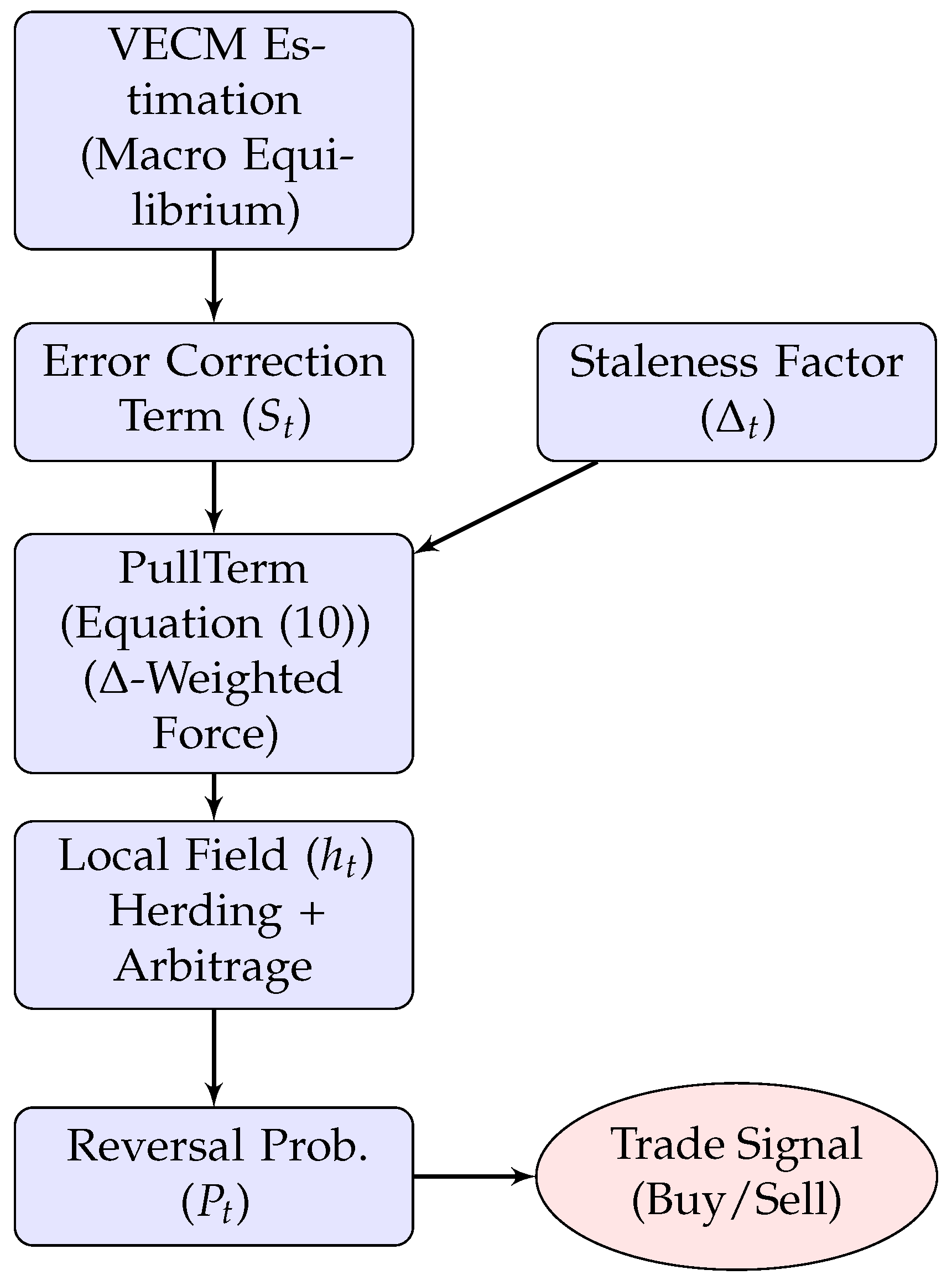
Pairs trading via futures calendar spreads offers a robust market-neutral approach to exploiting transient mispricings, yet real-time implementation is hindered by asynchronous trading. This paper introduces a Cointegrated Ising Spin Model, CISM, for real-time signal generation in high-frequency spread trading. The model links the macro-level equilibrium of cointegration with micro-level agent interactions, representing prices as magnetizations in an agent-based system. A novel Δ-weighted arbitrage force dynamically adjusts agents’ corrective behavior to account for information staleness. Calibrated on tick-by-tick Brent crude oil futures, the model produces a time-varying probability of spread reversion, enabling probabilistic trading decisions. Backtesting demonstrates a 74.65% success rate, confirming the CISM’s ability to generate stable, data-driven arbitrage signals in asynchronous environments. The model bridges macro-level cointegration with micro-level agent interactions, representing prices as magnetizations within an agent-based Ising system. A novel feature is a Δ-weighted arbitrage force, where the corrective pressure applied by agents in response to the standard Error Correction Term is dynamically amplified based on information staleness. The model is calibrated on historical tick data and designed to operate in real time, continuously updating its probability-based trading signals as new quotes arrive. The model is framed within the context of Discrete Choice Theory, treating agent transitions as utility-maximizing decisions within a Vector Logistic Autoregressive (VLAR) framework.
Keywords: statistical arbitrage; pairs trading; agent-based; ising model; high-frequency cointegration statistical arbitrage; pairs trading; agent-based; ising model; high-frequency cointegration