
Article

Tokenisation Opportunities in Voluntary Carbon Markets: A Sectoral Diagnostic

by
Massimo Preziuso
1,2
1
Department of Finance and Economics, ISM University of Management and Economics, LT-01103 Vilnius, Lithuania
2
Department of Economics and Finance, College of Business, Arts and Social Sciences, Brunel University London, London UB8 3PH, UK
J. Risk Financial Manag. 2026, 19(1), 28; https://doi.org/10.3390/jrfm19010028
Submission received: 17 November 2025 / Revised: 23 December 2025 / Accepted: 27 December 2025 / Published: 2 January 2026
(This article belongs to the Special Issue Green Finance and Corporate Strategy: Challenges and Opportunities)

Abstract

Voluntary carbon markets (VCMs) are growing rapidly but remain structurally fragmented due to verification delays, lifecycle opacity, inconsistent metadata, and capital mobilisation bottlenecks. While blockchain is often proposed as a digitalisation layer to improve transparency and traceability, this paper reframes tokenisation as a sector-aware financial infrastructure capturing the full lifecycle of carbon credits. Rather than treating it as a digital overlay, this study argues that tokenisation functions as a modular, automated architecture capable of absorbing sector-specific frictions within VCMs. Drawing on 1495 registry-compliant projects from the Berkeley Voluntary Offsets Database (BVOD v2025-06), the study develops the sector tokenisation opportunity matrix (STOM). This diagnostic framework maps registry-derived indicators—issuance volume, credit retirement ratio, and average credits per project—to three tokenisation functions: market expansion, retirement acceleration, and structuring for scale and fragmentation. STOM reveals how tokenisation can address VCM fragmentation by mobilising capital, reinforcing lifecycle integrity, and enabling assets to be packaged across diverse project types. By linking friction diagnostics to governance-sensitive infrastructure design, the research proposes a sector-aware blueprint for climate finance infrastructure and positions tokenisation as a strategic tool for scaling high-integrity climate action.

1. Introduction

Without meaningful action, climate change could reduce global GDP by up to 14% (Swiss Re, 2021). As many as 1.2 billion people could be displaced by climate-related factors by 2050, creating a wave of climate refugees (Zurich Insurance Group, 2023). Despite these risks, in 2021, global climate finance flows amounted to only USD 850–940 billion—roughly 20% of the estimated USD 4.3 trillion required annually by 2030 to meet the Paris Agreement goals (European Parliament, 2023).
In this context, carbon pricing mechanisms—namely carbon taxes and carbon markets—have become central tools for incentivising emissions reductions (Azizi et al., 2025). While carbon taxes impose direct levies on greenhouse gas emissions, carbon markets allow emission allowances or credits to be traded, offering flexibility and cost-efficiency. These markets operate via extensive compliance regimes, such as the EU Emissions Trading Scheme (ETS), as well as an expanding range of voluntary carbon markets (VCMs). By late 2024, compliance carbon credit markets were valued at USD 113.1 billion, with over 80% of that value concentrated in the EU ETS. ETSs are increasingly recognised as market-based instruments that are essential to global environmental governance; they facilitate carbon pricing and incentivise industries to adopt cleaner technologies and practices (Jiang et al., 2023).
VCMs, while smaller in scale, are projected to reach USD 40–50 billion by 2040, driven by rising demand and improvements in credit quality (AlliedOffsets, 2025). Yet, despite this momentum, the infrastructure underpinning VCMs remains fragmented, opaque, and cost-intensive—limiting broader participation and scalability (World Economic Forum & Bain & Company, 2023). However, there are persistent frictions—ranging from verification and credit issuance to secondary liquidity, metadata consistency, and access to structured finance—that continue to constrain participation, particularly for small-scale and undercapitalised projects (Carbon Direct, 2024b). These frictions reflect bottlenecks across the three phases of the carbon credit lifecycle (Carbon Direct, 2024a): design and project development, issuance, and retirement. There is thus a clear need for infrastructure solutions rather than incremental digitalisation fixes.
Blockchain technologies are frequently proposed as solutions to these inefficiencies. However, in most cases, their implementation has remained registry-centric: legacy processes are digitised without addressing deeper financial and operational bottlenecks. The OECD (2021) has highlighted how fragmented digital infrastructure, inconsistent metadata standards, and regulatory uncertainty hinder the tokenisation of assets, including carbon credits. However, as McKinsey (2024) observes, most tokenisation efforts remain at the pilot stage, replicating traditional systems without fully leveraging smart contracts or composability. Similarly, IBM (2025) notes that many tokenisation models rely on vault-based or reversible architectures, which often reproduce legacy constraints rather than enabling decentralised finance or programmable asset flows.
Blockchain’s potential to enhance validation, monitoring, trading, and retirement of carbon credits has been explored in the literature, but its adoption in carbon markets is still in its infancy. Critically, existing studies tend to treat tokenisation as a generic digitalisation layer and are primarily focused on transparency, traceability, and registry integration. Few examine its capacity to respond to sector-specific frictions or support differentiated deployment strategies (Ballesteros-Rodríguez et al., 2024; Laoli & Alamsyah, 2025; Merlo et al., 2025). This paper addresses this gap by reframing tokenisation as a friction-responsive financial infrastructure rather than registry digitisation. The central research question is as follows: How can tokenisation be designed to absorb sectoral frictions in VCMs and enhance scalability and integrity?
This study positions blockchain-driven tokenisation as a second-layer infrastructure: modular, programmable, and lifecycle-aware, designed to absorb structural frictions and increase liquidity across VCMs. We operationalise this thesis by developing the sector tokenisation opportunity matrix (STOM), a diagnostic framework built on registry-verified data from the Berkeley Voluntary Offsets Database (BVOD v2025-06). STOM evaluates nine macro-sectors using three indicators: total credits issued, credit retirement ratio, and average credits per project. It then maps these to three tokenisation functions: market expansion, retirement acceleration, and structuring for scale and fragmentation. Through a case study on the transportation sector, we illustrate how these tokenisation functions can support VCM development and inform governance-sensitive infrastructure design.
The study makes four contributions: (1) it develops STOM as a methodological bridge between registry data and programmable tokenisation logic; (2) it reframes tokenisation as a friction-responsive infrastructure designed to resolve lifecycle and scale asymmetries; (3) it offers sector-specific deployment strategies grounded in empirical diagnostics; and (4) aligns sectoral opportunity with jurisdiction-level regulatory capacity, clarifying governance and capital-mobilisation implications of tokenisation. In doing so, it advances a friction-aware approach to climate finance infrastructure that links registry signals to programmable deployment logic and governance-sensitive design, echoing the economic coordination logic of tokenisation (Catalini & Gans, 2020) and the principles of polycentric governance (Ostrom et al., 2020).
The remainder of the paper proceeds as follows: Section 2 contains a review of the literature on VCMs and tokenisation; Section 3 introduces the STOM framework and dataset; Section 4 maps sectoral frictions using registry-derived indicators and illustrates these through a transportation case study; Section 5 sets out a discussion of sectoral differentiation, governance pathways, the geographic readiness matrix, and the paper’s theoretical contributions and policy implications; and Section 6 concludes with reflections on infrastructure design, policy relevance, and the study’s limitations.

2. Literature Review

2.1. The Role and Challenges of VCMs

VCMs allow individuals and organisations to offset greenhouse gas emissions by purchasing carbon credits from certified mitigation projects—typically represented as verified carbon units (VCUs). A VCU denotes one metric tonne of CO2 equivalent either avoided or removed from the atmosphere. These tradable instruments are issued by third-party registries such as Verra, following stringent validation and verification procedures (Verra, 2024). The carbon credit lifecycle typically spans project design and development, issuance, and retirement (Carbon Direct, 2024a). The design phase involves planning, validating, and verifying mitigation activities. In the issuance phase, verified outcomes are recorded in registries and in retirement, the final stage, credits are permanently cancelled to claim climate benefits.
Operating alongside compliance regimes, VCMs are often lauded for their flexibility, amenability to innovation, and ability to mobilise private finance toward climate goals (Espenan, 2023). Robust measurement, reporting, and verification (MRV) systems are considered essential for ensuring the credibility of carbon credits. Despite this, many VCMs suffer from fragmented standards, inconsistent methodologies, an absence of harmonised verification regimes, and limited pricing data, all of which undermine trust and scalability (Blaufelder et al., 2021; World Bank, 2022). Meitner (2024) identifies key structural risks in VCMs, including insufficient transparency and compromised environmental integrity due to issues of additionality, permanence, double counting, carbon leakage, rebound effects, and adverse social impacts. In particular, projects identified as reducing emissions from deforestation and forest degradation (REDD+) have faced scrutiny over claims that many of the associated credits issued do not correspond to genuine emissions reductions as project-level baselines are frequently misaligned with the actual dynamics of deforestation (West et al., 2020; The Guardian et al., 2023). These methodological gaps reflect more general lifecycle bottlenecks in credit design and monitoring.
Five foundational principles have been identified in recent normative frameworks for natural climate solutions (NCS)—defined as conservation, restoration, and improved land management interventions that enhance carbon storage or reduce greenhouse gas emissions in natural ecosystems. These foundational principles require that measures be nature-based, sustainable, climate-additional, measurable, and equitable. Of these, measurability demands conservative accounting and dynamic baselining to ensure credits represent genuine, time-sensitive mitigation outcomes (Ellis et al., 2024). Recent work has also advanced frameworks for evaluating the net social benefit of impermanent nature-based credits. Among the ideas proposed are dynamic accounting methods that integrate time-sensitive additionality, risk-adjusted reversals, and post-credit monitoring (Balmford et al., 2023).
Sierra (2025) proposes a time-integrated metric for carbon sequestration (CS) that reframes permanence as a measurable quantity. This approach enables more precise accounting of temporary storage and reversals, providing a generalisable basis for lifecycle integrity across nature-based and engineered removals. It also informs Article 6.4 of the Paris Agreement, which establishes mechanisms for voluntary cooperation in achieving climate targets (IGES, 2025). Recent work by Pachama (2023) introduces a dynamic baseline methodology using satellite data and AI-powered control-area matching to improve baseline accuracy and quantify uncertainty in REDD+ projects. This offers a promising pathway for strengthening additionality assessments and lifecycle integrity.
These approaches offer useful tools for improving credit comparability but simultaneously underscore the complexity of ensuring environmental integrity across diverse project types. At the same time, persistent concerns over credit quality and reputational risk undermine investor confidence and discourage institutional participation, exacerbating liquidity frictions—even as global demand for offsets continues to rise. For instance, forward-offtake commitments in high-durability carbon dioxide removal markets remain heavily concentrated among a small number of first movers (Carbon Direct, 2024b). Although project developers typically have ambitious plans for upscaling, financing has been secured for less than half the VCUs volume required to meet 2030 climate targets, leaving both nature-based and engineered removal projects structurally underfunded. Asymmetry also persists at the level of market access, as the VCM infrastructure—from registries to exchanges—remains fragmented, resulting in low interoperability and high transaction costs. This effectively sidelines community-scale and nature-based initiatives from mainstream participation, as they often lack the resources and technical capacity to navigate complex registry and exchange systems (World Economic Forum & Bain & Company, 2023). Taken together, these structural frictions—lifecycle bottlenecks, liquidity constraints, and limited access to market infrastructure—highlight the need for infrastructure solutions across the VCM architecture.
In terms of geographic concentration, recent reviews highlight Latin America and Asia as dominant sources of new VCM issuances (Climate Focus, 2025; Ecosystem Marketplace, 2025). However, the United States retains its historical leadership across multiple sectors—including forestry, agriculture, carbon capture, and waste management—accounting for over one-fifth of global voluntary credits to date (Bipartisan Policy Center, 2025).

2.2. Blockchain in Environmental Markets

Distributed ledger technologies (DLTs) are an evolving form of data infrastructure capable of recording, synchronising, and securing transactions across decentralised networks (Natarajan et al., 2017). By disintermediating the conventional financial architecture, DLTs ensure tamper-resistant recordkeeping and programmable trust, features that are particularly valuable for inclusion-oriented systems. For instance, DLTs can embed verification directly within the protocol layer, lowering the procedural barriers that disproportionately hinder small-scale or distributed actors in carbon markets. Marsal-Llacuna (2020) reinforces this institutional framing by highlighting the potential of blockchain to support the United Nations’ climate governance priorities, which include strengthening national land registries, automating MRV processes and linking heterogeneous carbon markets. These applications reflect blockchain’s potential as a trusted infrastructure for global coordination among diverse stakeholders.
Blockchain is a subclass of DLT systems, distinguished by its sequential data structure, consensual method and public verifiability (Ballandies et al., 2022). In general, its combination of security, transparency and decentralisation makes blockchain uniquely capable of driving efficiency, trust, and innovation across diverse applications, including carbon markets and efforts to advance environmental sustainability (Khan et al., 2022). Blockchain’s distinctive contribution lies in its embedded coordination layer. It employs smart contracts to enforce rules without centralised intermediaries, enhancing auditability, traceability, and composability across carbon credit lifecycles (De Filippi & Wright, 2018).
Arshad et al. (2023) identify four key domains of blockchain deployment in environmental finance: MRV automation, decentralised registries, smart contract governance, and digital asset infrastructure. The authors caution, however, that technical viability must be matched by institutional fit and legal coherence; stakeholder pluralism and procedural safeguards are needed to align its application with Goal 13 (climate action) of the Sustainable Development Goals (SDGs). Blockchain’s effectiveness in climate finance depends on the institutional architecture through which it operates—particularly the permissioning, deployment, and incentive structures encoded in smart contracts (Schulz & Feist, 2021).
Blockchain’s key challenges are discussed by Merlo et al. (2025), who highlight the concerns around interoperability, legitimacy assurance, and verification replication in blockchain-enabled carbon markets. The authors call for hybrid models of governance that integrate registry authority, project developer autonomy, and automation-compatible compliance logic. In this way, blockchain can be embedded within frameworks that balance decentralised automation and institutional oversight. Chen and Lloyd (2024) reinforce this perspective through an empirical study of blockchain adoption by China’s developing carbon markets. Drawing on the theory of technological frames, they identify five types of barriers to adoption: social, political–legal, data, organisational, and economic. Their findings suggest that even when adopting blockchain is technically viable, adoption may stall due to a misalignment in stakeholder perceptions, regulatory ambiguity, or institutional inertia. This underscores the need for context-sensitive governance models that accommodate diverse market structures and policy environments.

2.3. Tokenisation of VCMs

Tokenisation represents one of blockchain’s most transformative VCM applications. At its core, it involves the conversion of registry-issued credits into cryptographically secured digital tokens. Rich metadata and unique identifiers are embedded that enable end-to-end lifecycle visibility, on-chain compliance logic, and programmable governance (Osler, 2025). These features underpin secure transfer of ownership, instant settlement, and enhanced traceability (De Filippi & Wright, 2018; IBM, 2025; McKinsey, 2024).
The high-level taxonomy of tokenisation structures in Lavayssière (2025) distinguishes between direct, indirect, and incomplete forms based on the legal enforceability of the token–asset relationship. The taxonomy clarifies how legal certainty underpins the viability of tokenised assets, particularly in cross-border and multi-jurisdictional contexts. Nathan et al. (2023) identify protocol-level risks—including custody, trading, and decentralisation—that must be mitigated to ensure auditability and trust.
The viability of tokenisation is already transforming asset-backed financial markets. Delle Foglie et al. (2025) show how smart contracts and fractional ownership streamline the issue of Shariah-compliant instruments. By reducing reliance on intermediaries and enhancing transparency, smart contracts offer a model that is transferable to the tokenisation of carbon credits. Blockchain-enabled supply chain finance has been shown to support modular bundling, lifecycle tracking and traceability, key features for managing carbon credit portfolios (Modgil et al., 2024). Ioannou and Demirel (2022) reinforce this point by highlighting how blockchain enhances visibility and interoperability across fragmented financial ecosystems. Their insights are directly applicable to VCMs, where fragmentation and opacity hinder liquidity and trust. However, as the OECD (2021) point out, a fragmented digital infrastructure, inconsistent metadata standards, and regulatory uncertainty continue to constrain the full realisation of tokenisation’s potential in environmental markets.
As climate fintech, tokenisation mobilises capital by converting illiquid carbon assets into programmable instruments with fractionalised exposure and expanded access. Tokenisation is identified as a key enabler for bridging the multi-trillion-dollar climate finance gap (Kshetri et al., 2024; Loukoianova et al., 2024). Schletz et al. (2020) show that tokenised securities can reduce transaction costs through disintermediation and automation, enhance transparency, and lower size and liquidity requirements, thereby expanding access to green finance. UNCTAD (2023) positions tokenised instruments as SDG-aligned investment vehicles that enhance transparency, efficiency, and investor confidence in climate-related sectors.
Early tokenisation pilots such as KlimaDAO and Toucan exposed the critical misalignment between the logic of tokenisation and the lifecycle realities of carbon credits. These platforms encountered challenges related to credit legitimacy, price volatility, and fragmented governance structures (Ballesteros-Rodríguez et al., 2024; CarbonPlan, 2022). In contrast, the architecture of second-generation platforms like CarbonPlace and Climate Impact X is institutionally anchored, integrating auction mechanisms, compliance-grade verification, and sovereign partnerships to restore credibility and unlock liquidity (Rosales, 2023).

2.4. Tokenisation Functions for VCMs

As outlined in Section 2.1, VCMs face persistent structural frictions, ranging from liquidity constraints and lifecycle bottlenecks to limited access for distributed actors. Section 2.2 examined how blockchain architecture provides the technical substrate to address these inefficiencies, including registry integration, MRV automation, and compliance logic. Section 2.3 extended the analysis to tokenisation, which is emerging as a foundational infrastructural layer for VCMs and facilitates new modalities of access, trust, and scale. By embedding programmability, traceability, and composability into carbon credit instruments, tokenisation transforms static offsets into dynamic financial primitives.
The study operationalises this proposition by identifying three core tokenisation functions linked to the three phases of the carbon credit lifecycle (Carbon Direct, 2024a): market expansion (issuance), retirement acceleration (retirement), and structuring for scale and fragmentation (design and project development). These functions respond to distinct VCM sectoral frictions. In this way, tokenisation is understood not as a digitalisation layer but as an infrastructural layer that captures the full lifecycle of carbon credits, embedding automation and trust from project inception through issuance to final retirement.

2.4.1. Market Expansion

Tokenisation can expand market access in VCMs by fractionalising carbon credits and lowering entry barriers for broader participation at the issuance stage of a carbon credit. PwC Middle East (2024) demonstrates how tokenised carbon credits can unlock access for retail investors and small-scale developers, allowing banks to build new financial ecosystems around digital environmental assets. In addition, Loukoianova et al. (2024) identify tokenisation as a climate fintech tool that fractionalises illiquid assets and mobilises capital, especially for underserved actors. UNCTAD (2023) similarly positions tokenised instruments as SDG-aligned investment vehicles, capable of bridging the climate finance gap and expanding participation in sustainability-linked markets.
Brühl (2021) argues that tokenisation reduces reliance on traditional intermediaries, enabling fractionalised access and dynamic issuance across capital markets. The author frames tokenisation as critical to decentralised finance with implications for environmental asset classes. This framing is reinforced by Kshetri et al. (2024), who note how tokenisation enhances transparency and unlocks private capital flows in climate-related markets.
Smart contracts are pivotal in this transformation. By automating verification, validation, and compliance logic, they enhance transparency and reliability, fostering trust among stakeholders and facilitating the participation of smaller emitters who face onboarding and compliance-related barriers (Merlo et al., 2025). These programmable features also support real-time lifecycle tracking, a key prerequisite for scalable market expansion.
Boumaiza (2024) extends this logic by proposing a blockchain-peer-to-peer trading framework that integrates carbon and energy trades. The system allows prosumers to exchange carbon allowances directly, outside traditional aggregator models. The system introduces dynamic pricing mechanisms and decentralised reward systems that incentivise low-carbon behaviours. This model exemplifies how tokenisation can reconfigure participation logic and transform passive offsetting into active lifecycle engagement.
Finally, Marsal-Llacuna (2020) draws attention to blockchain’s potential to support decentralised governance and institutional trust, which are foundational elements for expanding participation in environmental markets.

2.4.2. Retirement Acceleration

Tokenisation can accelerate the retirement of carbon credits by embedding automation, traceability, and trust into the retirement stage of the lifecycle of carbon assets. Mechanisms such as smart-contract-triggered retirement, insurance wrappers, and programmable verification systems reduce friction in the final stage of the credit lifecycle; in this stage, opacity, manual processes, and reputational risk often undermine market confidence.
For instance, in their study of compliance carbon markets, Sadawi et al. (2021) propose a hierarchical blockchain architecture to automate emissions tracking and credit retirement. By embedding MRV logic into connected devices and decentralised ledgers, the system enhances lifecycle transparency and reduces coordination frictions in the final stage of credit issuance.
Basu et al. (2024) propose blockchain-enabled supply chains that integrate real-time MRV data. This allows credits to retire seamlessly once mitigation thresholds are met, supporting attribution certainty and lifecycle integrity. Tsai (2025) demonstrates how blockchain-based visualisation techniques enhance transparency and fraud detection in carbon credit markets. Hsieh et al. (2018) show how decentralised autonomous organisations (DAOs) can embed governance directly into the protocol logic to support programmable retirement, treasury management, and stakeholder voting. By facilitating real-time monitoring of offset activities and supporting automated retirement logic, such tools provide critical decision-support infrastructure that reinforces trust throughout the carbon credit lifecycle and operational efficiency.
Beyond automation, trust-enhancing instruments such as insurance wrappers are critical to de-risking retirement. Cabiyo and Field (2025) and Caston et al. (2025) identify such insurance tools as essential for buyer confidence, especially in highly durable or nature-based projects in which permanence and additionality risks are more pronounced.
However, accelerating retirement is insufficient on its own. Without harmonised verification standards and interoperable registry logic, tokenised retirement may become siloed or non-fungible across platforms. This risk is emphasised by Espenan (2023), who argues that without standardised blockchain protocols and registry integration, VCMs may remain disjointed and opaque, limiting the scalability of tokenised retirement systems.

2.4.3. Structuring for Scale & Fragmentation

Tokenisation offers a dual pathway for structuring VCM projects during the design and development phase. It makes it possible to aggregate micro-projects into investable baskets and facilitates the syndication of large-scale infrastructure through modular financing structures. These mechanisms transform fragmented or capital-intensive projects into structured portfolios in which lifecycle integrity is embedded, thereby unlocking institutional investors participation across diverse project formats.
In micro-projects, tokenisation supports vault aggregation, that is, the pooling of small-scale initiatives into thematic baskets that reduce transaction costs and allow scalable packaging. Hogan Lovells (2025) highlights the role of tokenisation in bundling fragmented assets into dynamic investment opportunities. As Favero and Hinkel (2024) demonstrate, bundling logic and smart contracts reduce transaction costs and unlock scalable investment pathways, reinforcing how tokenisation can transform fragmented assets into investable structures. Structured issuance is supported by special-purpose-vehicle-based bundling frameworks (Schwarcz, 2023) and by blockchain-enabled supply chain finance models that enhance traceability and reduce transaction costs in fragmented asset environments (Modgil et al., 2024). Sorensen (2023) points to the importance of standardised templates that harmonise metadata across registries to allow automated credit comparison and bundle logic.
BNP Paribas and EDF ENR (2022)’s tokenised green bond exemplifies the above approach, with small renewable energy projects bundled into investable units with granular MRV and ESG-linked attributes. Although tokenisation enables bundling and aggregation at scale, its architecture must also reflect the principle of equity in climate mitigation (Ellis et al., 2024). This principle requires that diverse governance models, community-led verification, and locally relevant baselining be accommodated to ensure the inclusion of vulnerable groups. Without these considerations, tokenised structures risk reproducing the exclusionary dynamics they aim to disrupt.
In terms of the scale of infrastructure, tokenisation allows capital-intensive projects to use distributed project finance by aggregating retail and micro-investors into structured syndicates. Fractional ownership models allow broader participation, but syndicated token offerings segment capital flows across investor tiers, facilitating modular financing and risk stratification. Smart escrow contracts link capital deployment to verified milestones, reducing upfront lock-in and enhancing lifecycle integrity. S&P Global (2025) shows how tokenisation supports structured finance tools that are tailored for high-risk, long-term projects, and Ripple and Boston Consulting Group (2025) illustrate how escrowed instruments tied to milestone verification can activate dormant credits and reduce capital inefficiencies. Finally, Guidi and Michienzi (2023) introduce NFT-2.0 features, namely composability, fractional ownership, and dynamic metadata, that support flexible and interoperable asset structures.
Taken together, these three tokenisation functions show how programmable infrastructures can be tailored to lifecycle frictions in VCMs. Section 3 introduces STOM, which operationalises this logic through registry-derived indicators and reproducible diagnostics.

3. Methodology

This study adopts a quantitative empirical methodology to operationalise STOM through structured data analysis. Registry filtering, the construction of indicators, and min–max normalisations are combined to generate dimensionless sectoral scores. These scores are then translated into friction profiles, which inform strategies for programmable infrastructure deployment. Our framework supports reproducible diagnostics across sectors and comparative analysis of tokenisation readiness.

3.1. Registry Integrity and Project Selection

We ensure analytical precision by drawing on the BVOD (Haya et al., 2025), which aggregates project-level data from major registries. From a total of 10,513, we focus on a subset of 1495 listed projects that meet the following two criteria: (1) formal registration (projects must be validated and officially registered); (2) remaining credits (projects must have at least one VCU available, ensuring lifecycle activation). This filtering ensures that the selected projects are operationally active and registry-compliant for a robust sectoral analysis.

3.2. Sector Indicator Construction and Normalisation

Building on the friction logic introduced in Section 2.4, we construct three registry-derived sectoral indicators:
(1)
Total VCUs issued, signalling onboarding velocity and market throughput.
(2)
Percentage of credits retired, which captures liquidity constraints, attribution opacity, and weak buyer trust.
(3)
Average VCUs issued per project, which diagnoses bundling constraints (in micro-projects) or project financing constraints (in the case of large-scale infrastructure).
Total VCUs Issued and Average VCUs Issued per Project are normalised using min–max scaling, producing dimensionless scores ranging from 0 to 1. The resulting scores preserve interpretability while supporting the construction of friction profiles that guide the strategic deployment of tokenised infrastructure.
All data processing steps, including Python 3.10 scripts for registry filtering, indicator construction and normalisation, and sectoral geographic concentration, are documented in the Supplementary Information to ensure transparency and reproducibility.

3.3. STOM Operational Logic: Mapping Frictions to Tokenisation Functions

Building on the three sectoral indicators, STOM maps registry-derived indicators—Total VCUs Issued, Percentage of Credits Retired, and Average VCUs per Project—to three tokenisation functions, each explicitly linked to a carbon credit lifecycle phase: market expansion (issuance phase), retirement acceleration (retirement phase), and structuring for scale and fragmentation (design and project development phase).
Table 1 summarises the translation of registry-derived indicators into lifecycle frictions and how these inform tokenisation functions tailored to sectoral constraints.
These mappings are the analytical foundation for the sectoral diagnostics explored in detail below.

4. Results

This section presents sector-level insights derived from registry data in the BVOD. Each sector is analysed individually to surface specific frictions, highlighting where tokenisation mechanisms may unlock financial and operational value by addressing asymmetries in scale, liquidity, and capital intensity. All tables and figures are generated using Python 3.10 scripts applied to the BVOD dataset, with the full processing workflow and code documented in the Supplementary Information to ensure transparency and reproducibility.

4.1. Sectoral Diagnostics: STOM Indicators

From a registry base of 10,513 projects (1996–2025), only 1495 meet the criteria of formal registration and remaining credits (Table 2). These constitute the empirical foundation of the STOM framework.
The STOM indicators, presented in Table 3, expose structural asymmetries in nine sectors that may be addressed through tokenisation.
Table 4 shows that the top three countries per sector account for the majority of issuance volume, from around 50% in the forestry and land use and the household and community sectors to over 90% in sectors such as waste management, chemical processes, and transportation. VCM implementation is clearly clustered in a limited number of jurisdictions.

4.2. Tokenisation Deployment Logic

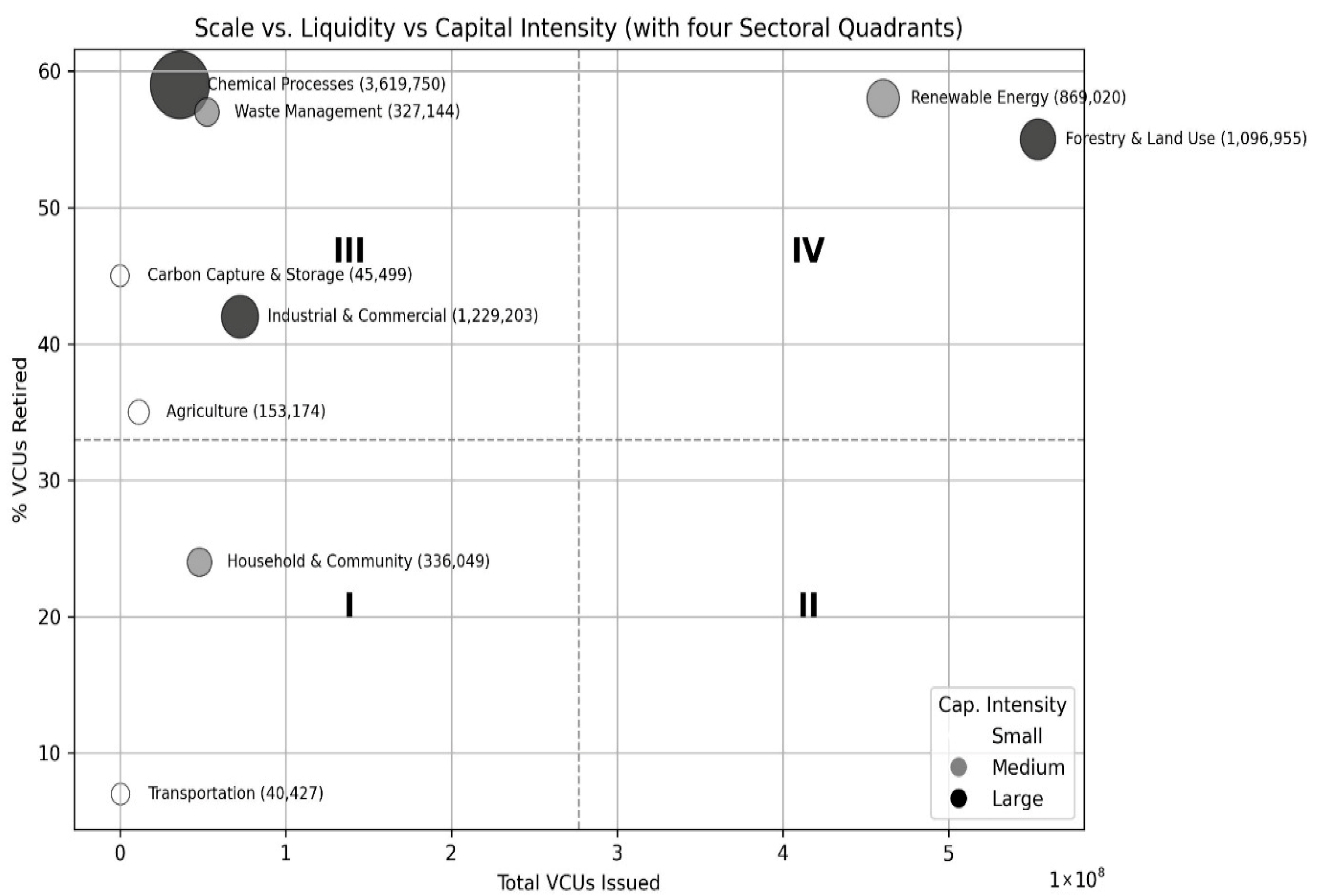
Building on the sectoral diagnostics presented in Section 4.1, registry-derived frictions are translated into strategic deployment pathways for tokenisation. The three STOM’s lifecycle indicators—total VCUs issued, percentage of credits retired, and average VCUs per project—are mapped to three programmable tokenisation functions. These functions are market expansion, retirement acceleration, and structuring for scale and fragmentation. The sectoral asymmetries revealed by STOM are interpreted by positioning each sector within one of four quadrants defined by scale and retirement ratios. This process is visualised in Figure 1, which maps nine sectors using normalised STOM indicators for scale (total VCUs issued), liquidity (% VCUs retired), and capital intensity (average VCUs issued per project).
Each indicator is rescaled via min–max normalisation to produce dimensionless scores between 0 and 1. Cross-sector comparison is thus possible despite disparities in market volume. The normalisation is defined as:
x = x min x max x min x
where x is the raw value, and x’ is the normalised score.
The resulting quadrant framework situates sectors according to their relative scale (issued credits) and liquidity (retirement ratios), divided into low and high levels. This provides a diagnostic lens for friction-responsive tokenisation strategies.
Each quadrant of Figure 1 depicts a distinct combination of lifecycle bottlenecks and deployment constraints, offering a strategic lens for targeted intervention.
Quadrant I is particularly interesting in terms of tokenisation potential. It shows the least mature VCM sectors, denoted by a low number of total VCUs issued and a low percentage of VCUs retired. It includes the transportation (associated with projects of low capital intensity) and household and community (associated with projects of medium capital intensity) sectors. In the former, tokenisation can support market expansion, retirement acceleration, and bundling logic to overcome fragmentation and facilitate scale. In the latter case, tokenisation can support market expansion, retirement acceleration, and more advanced structuring through fragmentation of investments, including ESG-linked instruments.
Quadrant II is empty, indicating that no sectors are characterised by high total VCUs issued and a low percentage of retired VCUs. Quadrant III comprises sectors with low total VCUs issued and (relatively) high percentages of VCUs retired. It includes five sectors, each with a different capital intensity per project. In agriculture, carbon capture and storage, as well as waste management (which are associated with projects with low to medium capital intensity), tokenisation can support market expansion and bundling logic to mobilise capital and scale participation. In sectors such as the industrial and commercial, and chemical processes sectors (which are characterised by projects with large capital intensity), tokenisation can support market expansion alongside more advanced structuring.
Quadrant IV reflects the most mature VCM sectors, the forest and land use and the renewable energy sectors. These are associated with a relatively high level of total VCUs issued and a relatively high percentage of VCUs retired. The forestry and land use sector features high capital intensity per project; hence, tokenisation can support advanced structuring. The renewable energy sector has medium capital intensity per project; tokenisation can thus serve as a catalyst by supporting bundling logic and aggregating mid-scale projects into investable portfolios that reduce transaction costs and mobilise additional capital. This bundling function is particularly relevant given the sector’s heterogeneous project formats (e.g., solar, wind, and hydro). In such cases, tokenisation can harmonise credit structures and enhance liquidity across otherwise fragmented sub-markets.
Table 5 consolidates the quadrant logic into a sector–function mapping, illustrating how tokenisation can be tailored to address specific bottlenecks across diverse project types.

4.3. Sectoral Application: Transportation (Low Scale, Low Retirement %, Low Capital Intensity)

The transportation sector is a compelling use case for friction-calibrated tokenisation. It suffers from low issuance volume, minimal retirement activity, and small project scale. This makes it a candidate for all three tokenisation functions: market expansion, retirement acceleration, and structuring for scale and fragmentation.
The ten transportation projects (Table 6), which range from EV charging infrastructure to modal shift initiatives, are methodologically diverse and fragmented issuances, underscoring the need for programmable infrastructure that can absorb verification complexity and unlock liquidity. These projects can be aggregated into thematic baskets with harmonised metadata and lifecycle tracking. Fractional ownership and escrow-linked capital deployment support scalability, enabling broader participation and milestone-based financing.
Below, we discuss the three largest projects as these stand out for their diversity and strategic relevance.
VCS2073—Electric Vehicle Charger Premier Aggregation (US)—is the largest in the sector, with 223,957 VCUs issued, but only 2.3% retired. The project’s fragmented EV infrastructure presents onboarding and lifecycle-related challenges. Tokenisation can address these through fractionalised tokens that support retail participation, smart contracts that automate usage-based crediting (market expansion), and oracle-linked MRV systems that trigger automated retirement (retirement acceleration). Vault logic aggregates geographically dispersed EV chargers into bundled instruments with harmonised metadata and milestone-linked capital deployment. This enhances both scalability and lifecycle integrity (structuring for scale).
VCS1142—Ticket Log Fleet Fuel Substitution (Brazil)—has a different profile, with a moderate issuance (43,429 VCUs) and a relatively high retirement ratio of 44.8%. Focused on fleet-level fuel switching, this project is well-suited to embedding smart contract logic tied to verified substitution events (retirement acceleration). Tokenised credits could also be linked to fleet-performance dashboards, facilitating dynamic pricing and ESG-linked instruments (market expansion). Syndication across similar fleet-switch projects could support pooled issuance and risk stratification, reinforcing the sector’s structuring potential (structuring for scale).
VCS1884—Bikes for the Planet (Brazil)—is a micro-scale initiative with just 5068 VCUs issued, but a relatively strong retirement ratio of 44%. Focused on a lightweight modal shift, this project exemplifies how tokenisation can support behavioural incentives—such as ride-to-retire models—and thematic bundling across urban mobility projects (market expansion). Vault aggregation across urban mobility projects could support thematic bundling (structuring for scale). In addition, community-led verification and localised baselining could be embedded into DAO governance logic, bolstering trust and ensuring equity in lifecycle oversight (retirement acceleration).
These project profiles illustrate how friction-calibrated tokenisation can be customised to diverse scales and retirement behaviours in the transportation sector. Section 5 extends this logic across sectors, situating STOM within broader lifecycle, governance, and geographic readiness contexts.

5. Discussion

Blockchain is widely touted as enhancing transparency and validation in VCMs. However, the extent to which it addresses sector-specific frictions through modular infrastructure remains underexamined. In recent models, such as that in Laoli and Alamsyah (2025), blockchain-based tokenisation frameworks are proposed that improve transparency and automate lifecycle tracking. However, they remain sector-agnostic and registry-centric. These approaches focus on technical efficiency but fail to address differentiated deployment strategies across VCM segments. STOM advances this conversation by linking registry-derived friction diagnostics to targeted tokenisation functions.
Rather than generic digitisation, tokenisation, as operationalised through STOM, functions as a second-layer financial architecture—modular, programmable, and tailored to sector-specific constraints. This reframing emphasises the place of tokenisation as an infrastructural layer that can reduce coordination frictions and enable programmable market design across fragmented systems.
In VCMs, tokenisation absorbs lifecycle frictions through smart contract automation, API-linked metadata, and vault-based aggregation. Eze and Ameyaw (2025) extend this logic to public–private infrastructure partnerships, showing that blockchain-enabled smart contracts succeed only when the deployment design ensures institutional alignment and modularity. This approach is supported by Boumaiza (2024), who highlights how peer-to-peer infrastructure and dynamic pricing mechanisms can activate underutilised credit pools in low-scale sectors. Similarly, Merlo et al. (2025) emphasise how registry integration and smart contract automation reduce onboarding friction and enhance lifecycle traceability.
The transportation sector exemplifies this logic. According to STOM, this sector is among the most friction-heavy domains. It is marked by low issuance, low retirement, and low credit volumes per project. Many real-world decarbonisation initiatives in the transportation sector (e.g., EV fleets, charging infrastructure, and modal shift programmes) remain outside formal VCM channels due to onboarding barriers and financing constraints. However, projects such as VCS2073 and VCS1142 demonstrate how fragmented issuance and methodological diversity can be addressed through programmable infrastructure that automates onboarding, links MRV systems to retirement triggers, and allows pooled capital deployment. These mechanisms complement rather than replace registries, embedding coordination, trust, and scale into carbon markets.

5.1. Sectoral Differentiation and Lifecycle Integrity

Tokenisation offers a programmable pathway to reinforce lifecycle integrity in VCMs. Smart-contract-based retirement logic, as proposed by Basu et al. (2024), facilitates automated credit retirement once mitigation thresholds are met, thereby reducing manual friction and enhancing buyer confidence. Schwarcz (2023) extends this logic to securitisation, showing how tokenised instruments can embed lifecycle triggers and insurance wrappers to de-risk retirement and ensure performance-linked closure.
Cabiyo and Field (2025) provide further support for this by demonstrating how insurance-linked tokenisation can reduce buyer risk and improve retirement velocity in high-integrity projects. Favero and Hinkel (2024) also highlight bundling logic as a key enabler for transforming fragmented micro-projects into scalable instruments.
STOM’s friction diagnostics enable sector-specific deployment of these mechanisms. In high-retirement projects like VCS1142, Ticket Log Fleet Fuel Substitution (Brazil), tokenisation can reinforce existing lifecycle trust through performance-linked instruments and dynamic pricing. In low-retirement projects like VCS2073, Electric Vehicle Charger Premier Aggregation (US), programmable retirement logic and oracle-linked MRV systems can restore credibility and unlock liquidity. In fragmented projects like VCS1884, Bikes for the Planet (Brazil), bundling logic and vault aggregation can transform micro-projects into investable baskets with harmonised metadata and lifecycle tracking.
As Sylvera (2025) reports, retirement volumes are rising globally, but buyer confidence remains concentrated in high-integrity credits. This is a reminder of the importance of tokenisation mechanisms that reinforce liquidity and trust. Jain and Deshmukh (2025) note that the Core Carbon Principles developed by the Integrity Council for the Voluntary Carbon Market (2024) are reshaping retirement dynamics, suggesting that programmable retirement logic must evolve alongside emerging standards. Without standardised blockchain protocols and registry integration, VCMs may remain fragmented and opaque, limiting the scalability of tokenised retirement systems (Espenan, 2023).

5.2. Design-Led Governance Pathways

Tokenisation’s transformative potential lies in its ability to embed governance logic alongside technical automation. STOM’s friction-calibrated framework responds to calls for stakeholder-sensitive and institutionally grounded governance (Hsieh et al., 2018; Ellis et al., 2024) and offers a blueprint for instruments that are both programmable and accountable.
Governance-sensitive tokenisation must account for the networked nature of VCMs. Bassi et al. (2025) show that platform affiliation and standardisation methods shape influence within blockchain-based carbon ecosystems, and there is a clear need for inclusive, hybrid governance. Similarly, Merlo et al. (2025) identify governance fragmentation as a core barrier to blockchain adoption in carbon markets, a reminder of the importance of stakeholder-aligned design.
As Schulz and Feist (2021) argue, blockchain systems are inherently design-dependent—shaped by permissioning rules, registry integration, and stakeholder incentives. For registries, STOM is a diagnostic interface that makes it possible to assess sectoral bottlenecks and inform API-linked integration strategies. For regulators, it allows modular oversight that is calibrated to opacity, risk exposure, and scale dynamics. For developers and investors, it supports infrastructure design tools and programmable instruments aligned to lifecycle integrity.
The transportation sector illustrates these governance challenges most clearly, as its projects span multiple typologies and require token formats that are legally enforceable across borders (De Filippi & Wright, 2018; Lavayssière, 2025). Sorensen (2023) highlights the importance of harmonising metadata and registry-linked governance layers in multi-jurisdictional deployments. Guidi and Michienzi (2023) also demonstrate how DAO-based governance and NFT composability can support decentralised oversight and community-led verification.
STOM’s diagnostic interface can help registries and regulators identify governance bottlenecks and tailor their oversight mechanisms accordingly. In this framing, tokenisation becomes a governance-sensitive infrastructure logic, absorbing sectoral frictions and translating them into modular oversight architectures. STOM then operationalises governance-sensitive tokenisation and provides institutional actors with a strategic scaffold for programmable, accountable climate finance.

5.3. Geographic Readiness

Beyond technical automation and governance factors, geographic and institutional context also shape the viability of tokenisation. As shown in Table 4, VCM implementation is concentrated in a limited set of jurisdictions. These patterns confirm recent market reviews (Bipartisan Policy Center, 2025; Climate Focus, 2025; Ecosystem Marketplace, 2025) that highlight the dominance of emerging economies (Asia and Latin America) in new issuances, with the historical lead of the United States continuing.
However, issuance concentration does not determine where tokenisation can be deployed. Because it operates at the intersection of digital asset regulation and financial-market infrastructure, the viability of tokenisation depends on the level of development of national regulatory frameworks. Jurisdictions with clearer digital asset rules and stronger innovation ecosystems are better positioned to support a tokenised carbon-market architecture. Yet CCAF (2024) shows that regulatory frameworks relevant to tokenisation remain underdeveloped. Across jurisdictions, tokenised financial instruments are generally governed through retrofitted securities rules rather than bespoke digital asset legislation, and approaches to classification, custody, and settlement vary widely.
Building on this foundation, ‘tokenisation readiness’ is measured using two country-level indicators (digital asset regulation and regulatory innovation) from the Global Regulatory Innovation Dashboard (CCAF, 2025). Jurisdictions with comprehensive or AML-based regulatory frameworks and active innovation structures (e.g., sandboxes, innovation offices, or pilot programmes) score higher; those with unregulated environments or no institutional experimentation score lower. For clarity and interpretability, readiness is classified into three tiers (high, medium, and low), capturing the degree to which a jurisdiction’s regulatory and institutional environment can support tokenised VCM infrastructure.
Table 7 presents a country–sector geographic readiness matrix, with issuance concentration and tokenisation readiness aligning or diverging, and ‘strategic fit’ identified on three levels (strong, medium, and weak) for tokenisation deployment in VCMs.
Strong-fit jurisdictions—such as the United States, the Netherlands, and South Korea—combine substantial VCM participation with regulatory environments that, while not always fully comprehensive, provide sufficient clarity, supervisory engagement, and innovation capacity to support tokenised market infrastructure. In these countries, the presence of large-scale sectors creates a clear pipeline of assets that can benefit from tokenisation.
Medium-fit jurisdictions, including India, Brazil, Indonesia, and Thailand, exhibit meaningful VCM activity but only partial regulatory preparedness. Their sectoral footprints offer viable opportunities for tokenisation. However, the absence of fully integrated digital asset frameworks or uneven innovation ecosystems limits the scalability of deployment. In these contexts, tokenisation is feasible but requires targeted, sector-specific implementation aligned with existing supervisory capacity.
By contrast, weak-fit jurisdictions—such as China, Turkey, Peru, Vietnam, Bangladesh, Malawi, Dominican Republic, and Bolivia—either lack the enabling regulatory conditions and/or exhibit minimal VCM activity in the sectors most amenable to tokenisation. Even where there are sizeable project volumes, restrictive or fragmented regulatory environments, combined with limited innovation infrastructure, significantly constrain the viability of tokenised architectures. In these settings, tokenisation would require foundational regulatory reforms before sector-level deployment would be realistic.

5.4. Theoretical Contributions and Policy Implications

STOM is consistent with emerging governance-sensitive design principles (Ellis et al., 2024; Hsieh et al., 2018; Ostrom et al., 2020), supports lifecycle integrity through automated retirement logic (Basu et al., 2024; Schwarcz, 2023), and enables modular deployment architectures that complement legacy systems (Eze & Ameyaw, 2025). It reflects bundling and syndication strategies for fragmented micro-projects (Favero & Hinkel, 2024) and supports insurance-linked instruments that de-risk retirement and enhance buyer confidence (Cabiyo & Field, 2025). These mechanisms reinforce STOM’s relevance across technical and institutional domains.
As climate finance is increasingly aligned with SDG-linked infrastructure goals, STOM offers a way to bridge registry logic with broader sustainability frameworks. This responds to the UNCTAD (2023) call to scale up SDG-linked investment and climate finance. Its friction-calibrated architecture supports escrow-linked capital deployment and milestone-based financing models that activate underutilised credit pools (Ripple & Boston Consulting Group, 2025). As such, STOM echoes the economic logic of tokenisation as a coordination technology that reduces verification and networking costs (Catalini & Gans, 2020).
Existing blockchain tokenisation models in VCMs—including recent technical architectures such as Laoli and Alamsyah (2025)—prioritise transparency, automation, and registry integration. While these contributions advance process efficiency, they remain sector-agnostic and do not engage with differentiated deployment needs across VCM segments.
By contrast, STOM introduces a friction-calibrated diagnostic framework that links registry-derived indicators to differentiated tokenisation functions. The framework thus offers a sector-aware infrastructure logic responsive to lifecycle bottlenecks, granularity constraints, and asymmetries in capital mobilisation.
In policy terms, STOM offers a friction-calibrated blueprint for registry-linked deployment, modular oversight, and trust-enhancing systems. This advances environmental integrity while expanding capital mobilisation. STOM is relevant to regulatory supervision, credit standardisation, and stakeholder integration. Yet, its effectiveness depends on robust attribution logic, ecosystem-aligned audit tools, and interoperable digital infrastructure.
The recent digitalisation pilots by leading registries—Gold Standard (2025) on digital MRV and Verra (2025) on insurance-linked credits—reveal the growing institutional commitment to lifecycle integrity and programmable infrastructure. However, these initiatives remain registry-centric. STOM complements these by providing a sector-aware diagnostic that bridges registry signals with programmable infrastructure design.
Recent applied research confirms the feasibility of registry-integrated tokenisation models. Boonrat et al. (2025) develop a dual-token architecture for a forest carbon project that combines MRV-verified carbon tokens with a security-like revenue-sharing token for community stakeholders.
STOM’s friction-calibrated logic offers differentiated value across VCM stakeholders. Registries gain a diagnostic interface to assess sectoral bottlenecks and inform API-linked integration strategies. This makes dynamic credit attribution and lifecycle tracking possible without displacing institutional authority. Financial regulators can deploy modular supervisory layers calibrated to opacity, risk exposure, and scale dynamics. Rather than imposing one-size-fits-all rules, authorities can fine-tune policy requirements relative to quantified friction levels, thereby improving precision and oversight adaptability. STOM gives developers a tool to design infrastructure that mobilises dispersed capital via fractional-ownership tokens and vault aggregation. Investors benefit from programmable instruments that embed usage-linked and oracle-driven retirement triggers or reputational guarantees into purchase agreements. Credit lifecycles are thus structured around offtake commitments and performance metrics. Finally, STOM’s three tokenisation functions align directly with the three phases of the carbon credit lifecycle (Carbon Direct, 2024a), confirming its role as infrastructure rather than a digital overlay.

6. Conclusions

This paper reconceptualises tokenisation in VCMs as friction-responsive financial engineering, designed to resolve structural asymmetries in liquidity, scale, and structuring, rather than mere digital augmentation. STOM is developed as a diagnostic framework built on project-level registry data to evaluate sectoral performance through three indicators: total credits issued (throughput and onboarding efficiency), percentage of credits retired (liquidity constraints, lifecycle closure and investor trust), and average credits per project (granularity, aggregation constraints, and capital intensity across micro- and large-scale architectures).
By converting registry signals into actionable friction diagnostics, STOM reveals deployment pathways that account for sector-specific constraints. Section 5 demonstrated this translation through emblematic sector clusters and illustrative mechanisms. The analysis revealed how friction diagnostics inform the selection of tokenisation functions, whether these target market activation, lifecycle absorption, or structural bundling.
This research relies on registry-reported project data, which may underrepresent informal or unlisted project flow. Moreover, while STOM’s current indicator suite effectively maps key friction dimensions, future iterations could incorporate ecological variability, place-based constraints, methodological nuances, and socio-environmental co-benefits. Future research could also explore STOM’s applicability to compliance carbon markets and how friction-responsive functions support regulatory offset frameworks. Investigating cross-tokenisation mechanisms that bridge voluntary and compliance regimes may unlock new pathways for climate finance mobilisation aligned with broader SDGs. An international sandbox on the tokenisation of VCMs, coordinated by the Global Financial Innovation Network, for example, could test programmable retirement, bundling logic, and cross-jurisdictional compliance. Such initiatives would empirically validate STOM’s deployment logic and accelerate institutional adoption of tokenised carbon markets.

Supplementary Materials

The following supporting information can be downloaded at: https://www.mdpi.com/article/10.3390/jrfm19010028/s1.

Funding

This research received no external funding.

Institutional Review Board Statement

Not applicable.

Informed Consent Statement

Not applicable.

Data Availability Statement

Data supporting the findings of this study are available in the Supplementary Information file. Registry data are drawn from the Berkeley Voluntary Offsets Database (BVOD v2025-06).

Conflicts of Interest

The author declares no conflicts of interest.

References

  1. AlliedOffsets. (2025, March). Voluntary carbon market forecast report. Available online: https://alliedoffsets.com/wp-content/uploads/2025/04/AlliedOffsets-Forecast-Report-March-2025.pdf (accessed on 5 October 2025).
  2. Arshad, A., Shahzad, F., Ur Rehman, I., & Sergi, B. S. (2023). A systematic literature review of blockchain technology and environmental sustainability: Status quo and future research. International Review of Economics & Finance, 88, 1602–1622. [Google Scholar] [CrossRef]
  3. Azizi, M. I., Xu, X., Duan, X., Qin, H., & Xu, B. (2025). Carbon pricing strategies and policies for a unified global carbon market. Atmosphere, 16(7), 836. [Google Scholar] [CrossRef]
  4. Ballandies, M. C., Dapp, M. M., & Pournaras, E. (2022). Decrypting distributed ledger design—Taxonomy, classification and blockchain community evaluation. Cluster Computing, 25, 1817–1838. [Google Scholar] [CrossRef]
  5. Ballesteros-Rodríguez, A., De-Lucio, J., & Sicilia, M.-Á. (2024). Tokenized carbon credits in voluntary carbon markets: The case of KlimaDAO. Frontiers in Blockchain, 7, 1474540. [Google Scholar] [CrossRef]
  6. Balmford, A., Keshav, S., Venmans, F., Coomes, D., Groom, B., Madhavapeddy, A., & Swinfield, T. (2023). Realizing the social value of impermanent carbon credits. Nature Climate Change, 13(11), 1172–1178. [Google Scholar] [CrossRef]
  7. Bassi, E., Lustenberger, M., & Letina, S. (2025). Blockchain-based voluntary carbon market: Strategic insights into network structure. Frontiers in Blockchain, 8, 1603695. [Google Scholar] [CrossRef]
  8. Basu, P., Deb, P., & Singh, A. (2024). Blockchain and the carbon credit ecosystem: Sustainable management of the supply chain. Journal of Business Strategy, 45(1), 33–40. [Google Scholar] [CrossRef]
  9. Bipartisan Policy Center. (2025). Innovation, jobs, and exports: America’s strategic edge in the voluntary carbon market. Bipartisan Policy Center. [Google Scholar]
  10. Blaufelder, C., Levy, C., Mannion, P., & Pinner, D. (2021). A blueprint for scaling voluntary carbon markets to meet the climate challenge. McKinsey & Company. Available online: https://www.mckinsey.com/capabilities/sustainability/our-insights/a-blueprint-for-scaling-voluntary-carbon-markets-to-meet-the-climate-challenge (accessed on 5 October 2025).
  11. BNP Paribas & EDF ENR. (2022, July 12). BNP Paribas and EDF ENR partner on first renewable project bond as a digital asset. BNP Paribas Group. Available online: https://group.bnpparibas/en/press-release/bnp-paribas-and-edf-enr-partner-on-first-renewable-project-bond-as-a-digital-asset (accessed on 5 October 2025).
  12. Boonrat, P., Hartmann, N., & Werapun, W. (2025). Tokenisation of forest carbon project: A blockchain-based approach for community engagement. Journal of Tropical Ecology, 41, e23. [Google Scholar] [CrossRef]
  13. Boumaiza, A. (2024). A blockchain-centric P2P trading framework incorporating carbon and energy trades. Energy Strategy Reviews, 54, 101466. [Google Scholar] [CrossRef]
  14. Brühl, V. (2021). Decentralised finance—How tokenisation is changing the financial industry. Wirtschaftsdienst, 101(8), 629–637. [Google Scholar] [CrossRef]
  15. Cabiyo, B., & Field, C. B. (2025). Embracing imperfection: Carbon offset markets must learn to mitigate the risk of overcrediting. PNAS Nexus, 4(5), pgaf091. [Google Scholar] [CrossRef] [PubMed]
  16. Cambridge Centre for Alternative Finance. (2024). 2nd global cryptoasset regulatory landscape study—Emerging practices and early lessons learned. Cambridge Judge Business School, University of Cambridge. Available online: https://www.jbs.cam.ac.uk/wp-content/uploads/2024/10/2024-2nd-global-cryptoasset-regulatory-landscape-study.pdf (accessed on 5 October 2025).
  17. Cambridge Centre for Alternative Finance. (2025). Global regulatory innovation dashboard. Cambridge Judge Business School, University of Cambridge. Available online: https://ccaf.io/grid/ob/map (accessed on 25 October 2025).
  18. Carbon Direct. (2024a, June 28). The carbon credit lifecycle explained. Available online: https://www.carbon-direct.com/insights/the-carbon-credit-lifecycle-explained (accessed on 5 October 2025).
  19. Carbon Direct. (2024b, November 7). Carbon direct releases 2024 state of the voluntary carbon market report. Available online: https://www.carbon-direct.com/press/carbon-direct-releases-2024-state-of-the-voluntary-carbon-market-report (accessed on 5 October 2025).
  20. CarbonPlan. (2022, April 7). Zombies on the blockchain. Available online: https://carbonplan.org/research/toucan-crypto-offsets (accessed on 5 October 2025).
  21. Caston, J., Moudgal, K., Ryan, J., & Sharma, N. (2025). Carbon markets reimagined: Scale, resiliency, and transparency through digital assets. Available online: https://www.jpmorgan.com/kinexys/documents/carbon-markets-reimagined-digital-assets.pdf (accessed on 5 October 2025).
  22. Catalini, C., & Gans, J. S. (2020). Some simple economics of the blockchain. Communications of the ACM, 63(7), 80–90. [Google Scholar] [CrossRef]
  23. Chen, X., & Lloyd, A. D. (2024). Understanding the challenges of blockchain technology adoption: Evidence from China’s developing carbon markets. Information Technology & People, 38(3), 1328–1362. [Google Scholar] [CrossRef]
  24. Climate Focus. (2025). Voluntary carbon market 2024 review. Available online: https://climatefocus.com/publications/vcm-review-2024 (accessed on 5 October 2025).
  25. De Filippi, P., & Wright, A. (2018). Blockchain and the law: The rule of code. Harvard University Press. [Google Scholar]
  26. Delle Foglie, A., Panetta, I. C., Boukrami, E., & Vento, G. (2025). The impact of the blockchain technology on the global Sukuk industry: Smart contracts and asset tokenisation. Technology Analysis & Strategic Management, 37(4), 417–431. [Google Scholar] [CrossRef]
  27. Ecosystem Marketplace. (2025). State of the voluntary carbon market 2025 (SOVCM). Forest Trends Association. Available online: https://www.ecosystemmarketplace.com/publications/2025-state-of-the-voluntary-carbon-market-sovcm (accessed on 5 October 2025).
  28. Ellis, P. W., Page, A. M., Wood, S., Fargione, J., Masuda, Y. J., Carrasco Denney, V., Moore, C., Kroeger, T., Griscom, B., Sanderman, J., Atleo, T., Cortez, R., Leavitt, S., & Cook-Patton, S. C. (2024). The principles of natural climate solutions. Nature Communications, 15(1), 547. [Google Scholar] [CrossRef]
  29. Espenan, N. P. (2023). Improving voluntary carbon markets through standardization and blockchain technology. Wyoming Law Review, 23(1), 141–177. [Google Scholar] [CrossRef]
  30. European Parliament. (2023). Briefing: The role of the EU budget in international climate finance. Policy Department for Budgetary Affairs. PE 742.134. Available online: https://www.europarl.europa.eu/cmsdata/263452/Briefing%20-%20Climate%20Finance.pdf (accessed on 5 October 2025).
  31. Eze, E. C., & Ameyaw, E. E. (2025). A strategic framework for bolstering the adoption of blockchain-enabled smart contracts in infrastructure public–private partnerships projects. Construction Innovation. Advance online publication. [Google Scholar] [CrossRef]
  32. Favero, F., & Hinkel, J. (2024). Key innovations in financing nature-based solutions for coastal adaptation. Climate, 12(4), 53. [Google Scholar] [CrossRef]
  33. Gold Standard. (2025, February 18). Gold Standard drives digital transformation with three new digital monitoring, reporting and verification pilots. Available online: https://www.goldstandard.org/news/gold-standard-drives-digital-transformation-with-3-new-dmrv-pilots (accessed on 5 October 2025).
  34. Guidi, B., & Michienzi, A. (2023). From NFT 1.0 to NFT 2.0: A review of the evolution of non-fungible tokens. Future Internet, 15(6), 189. [Google Scholar] [CrossRef]
  35. Haya, B. K., Bernard, T., Abayo, A., Rong, X., So, I. S., & Elias, M. (2025). Voluntary registry offsets database v2025-06. Berkeley Carbon Trading Project, University of California, Berkeley. Available online: https://gspp.berkeley.edu/berkeley-carbon-trading-project/offsets-database (accessed on 16 August 2025).
  36. Hogan Lovells. (2025, May 7). Tokenization for net zero: The opportunities and challenges of digitalizing voluntary carbon markets. Global Digital Finance. Available online: https://www.hoganlovells.com/en/publications/tokenization-for-net-zero-the-opportunities-and-challenges-of-digitalizing-voluntary-carbon-markets (accessed on 5 October 2025).
  37. Hsieh, Y.-Y., Vergne, J.-P., Anderson, P., Lakhani, K. R., & Reitzig, M. (2018). Bitcoin and the rise of decentralized autonomous organizations. Journal of Organization Design, 7(1), 14. [Google Scholar] [CrossRef]
  38. IBM. (2025). What is tokenization? Available online: https://www.ibm.com/think/topics/tokenization (accessed on 5 October 2025).
  39. IGES. (2025). The Paris Agreement Article 6 implementation status report: 2025 Edition. Institute for Global Environmental Strategies. Available online: https://www.iges.or.jp/en/pub/paris-agreement-article-6-implementation-status-report-2025-edition/en (accessed on 30 October 2025).
  40. Integrity Council for the Voluntary Carbon Market. (2024). Core carbon principles. Available online: https://icvcm.org/core-carbon-principles/ (accessed on 5 October 2025).
  41. Ioannou, I., & Demirel, G. (2022). Blockchain and supply chain finance: A critical literature review at the intersection of operations, finance and law. Journal of Banking and Financial Technology, 6(1), 83–107. [Google Scholar] [CrossRef]
  42. Jain, G., & Deshmukh, S. (2025, September 11). How to fully operationalize Article 6 of the Paris Agreement. Center on Global Energy Policy, Columbia University. Available online: https://www.energypolicy.columbia.edu/publications/how-to-fully-operationalize-article-6-of-the-paris-agreement (accessed on 5 October 2025).
  43. Jiang, H., Wang, J., Yu, S., Zheng, X., & Wang, C. (2023). Exploring global carbon market link mechanism: Efficiency evaluation in the context of carbon neutrality. Journal of Cleaner Production, 420, 138474. [Google Scholar] [CrossRef]
  44. Khan, A. A., Laghari, A. A., Shaikh, Z. A., Dacko-Pikiewicz, Z., & Kot, S. (2022). Internet of Things (IoT) security with blockchain technology: A state-of-the-art review. IEEE Access, 10, 122679–122695. [Google Scholar] [CrossRef]
  45. Kshetri, N., Loukoianova, E., & Voas, J. (2024). Fintech applications for climate finance and sustainable development. IEEE Computer, 57(2), 160–165. [Google Scholar] [CrossRef]
  46. Laoli, E., & Alamsyah, A. (2025). Blockchain-Based Carbon Credit Tokenization Model: Enhancing Market Transparency and Trust. In Proceedings of the 2025 International Conference on Advancement in Data Science, E-learning and Information System (ICADEIS) (pp. 1–6). IEEE. [Google Scholar] [CrossRef]
  47. Lavayssière, X. (2025). Legal structures of tokenised assets. European Journal of Risk Regulation, 16(1), 1–13. [Google Scholar] [CrossRef]
  48. Loukoianova, E., Natalucci, F. M., Wang, Y. D., & Kanada, S. (2024). Fintech applications for boosting climate finance. IMF Staff Climate Notes. Available online: https://www.elibrary.imf.org/view/journals/066/2024/008/article-A001-en.xml (accessed on 5 October 2025).
  49. Marsal-Llacuna, M.-L. (2020). Future living framework: Is blockchain the next enabling network? Technological Forecasting and Social Change, 161, 120254. [Google Scholar] [CrossRef]
  50. McKinsey. (2024). What is tokenization? Available online: https://www.mckinsey.com/featured-insights/mckinsey-explainers/what-is-tokenization (accessed on 5 October 2025).
  51. Meitner, M. (2024). Voluntary carbon markets: A critical assessment (Working Paper No. 246). IPE Berlin. Available online: https://www.ipe-berlin.org/fileadmin/institut-ipe/Dokumente/Working_Papers/Meitner_WP_246.pdf (accessed on 5 October 2025).
  52. Merlo, A. L. C., Mendonça, D. S., Santos, J., Carvalho, S. T., Guerra, R., & Brandão, D. (2025). Blockchain for the carbon market: A literature review. Discover Environment, 3(1), 68. [Google Scholar] [CrossRef]
  53. Modgil, S., Gupta, S., Zhang, B., & Bag, S. (2024). Blockchain-enabled supply chain finance strategies for a circular economy revolution. Business Strategy and the Environment, 33(4), 7006–7020. [Google Scholar] [CrossRef]
  54. Natarajan, H., Krause, S., & Gradstein, H. (2017). Distributed ledger technology (DLT) and blockchain (World Bank FinTech Note No. 1). The World Bank. Available online: https://documents.worldbank.org/en/publication/documents-reports/documentdetail/9e5b04f124bc4900893cd23438f7f7e0 (accessed on 5 October 2025).
  55. Nathan, A., Kaponis, D., & Lustgarten, S. (2023). Understanding and managing blockchain protocol risks. Journal of Risk Management in Financial Institutions, 16(4), 337–353. [Google Scholar] [CrossRef]
  56. OECD. (2021). Regulatory approaches to the tokenisation of assets. Organisation for Economic Co-operation and Development. Available online: https://www.oecd.org/en/publications/regulatory-approaches-to-the-tokenisation-of-assets_aea35466-en.html (accessed on 5 October 2025).
  57. Osler. (2025). Tokenized carbon credits: How blockchain is revolutionizing carbon markets. Available online: https://www.osler.com/en/insights/updates/tokenized-carbon-credits-blockchain-revolutionizing-markets/?pdf=1 (accessed on 5 October 2025).
  58. Ostrom, E., Dew, N., Sarasvathy, S. D., & Venkataraman, S. (2020). Beyond Markets and States: Polycentric governance of complex economic systems. In Shaping entrepreneurship research (1st ed., Vol. 1, pp. 353–392). Routledge. [Google Scholar] [CrossRef]
  59. Pachama. (2023, January 23). A description and initial validation of a dynamic baseline for avoided deforestation projects. Available online: https://pachama.com/blog/pachama-research-brief-a-description-and-initial-validation-of-a-dynamic-baseline-for-avoided-deforestation-projects (accessed on 5 October 2025).
  60. PwC Middle East. (2024). Carbon credit tokenisation. Available online: https://www.pwc.com/m1/en/publications/carbon-credit-tokenization.html (accessed on 5 October 2025).
  61. Ripple & Boston Consulting Group. (2025). Approaching the tokenization tipping point: How tokenized assets will transform financial infrastructure. Ripple. Available online: https://ripple.com/insights/asset-tokenization-financial-services/ (accessed on 5 October 2025).
  62. Rosales, R. C. (2023). Global voluntary carbon markets and market infrastructure: Paving the road to increased market efficiency. Imperial College London, Centre for Climate Finance & Investment. [Google Scholar]
  63. Sadawi, A. A., Madani, B., Saboor, S., Ndiaye, M., & Abu-Lebdeh, G. (2021). A comprehensive hierarchical blockchain system for carbon emission trading utilizing blockchain of things and smart contract. Technological Forecasting and Social Change, 173, 121124. [Google Scholar] [CrossRef]
  64. Schletz, M., Nassiry, D., & Lee, M.-K. (2020). Blockchain and tokenized securities: The potential for green finance. ADBI Working Paper Series No. 1079. Asian Development Bank Institute. Available online: https://www.adb.org/publications/blockchain-tokenized-securities-potential-green-finance (accessed on 5 October 2025).
  65. Schulz, K., & Feist, M. (2021). Leveraging blockchain technology for innovative climate finance under the Green Climate Fund. Earth System Governance, 7, 100084. [Google Scholar] [CrossRef]
  66. Schwarcz, S. L. (2023). Next-generation securitization: NFTs, tokenization, and the monetization of “things”. Boston University Law Review, 103(4), 967–1003. [Google Scholar] [CrossRef]
  67. Sierra, C. A. (2025). Integrating time in definitions of carbon sequestration and greenhouse gas accounting. Royal Society Open Science, 12(2), 242095. [Google Scholar] [CrossRef] [PubMed]
  68. Sorensen, D. (2023). Tokenized carbon credits. Ledger, 8, 294. [Google Scholar] [CrossRef]
  69. S&P Global. (2025). Accelerating value flow in financial markets through tokenization. Available online: https://www.spglobal.com/en/research-insights/special-reports/look-forward/future-of-capital-markets/tokenization-financial-markets-value-flow (accessed on 5 October 2025).
  70. Swiss Re. (2021, April). The economics of climate change: No action not an option. Swiss Re Institute. Available online: https://www.swissre.com/dam/jcr:e73ee7c3-7f83-4c17-a2b8-8ef23a8d3312/swiss-re-institute-expertise-publication-economics-of-climate-change.pdf (accessed on 5 October 2025).
  71. Sylvera. (2025, July 1). Q2 2025 carbon data snapshot. Sylvera. Available online: https://www.sylvera.com/blog/carbon-data-q2-2025 (accessed on 5 October 2025).
  72. The Guardian, Die Zeit, & SourceMaterial. (2023, January 18). Revealed: More than 90% of rainforest carbon offsets by biggest certifier are worthless, analysis shows. The Guardian. Available online: https://www.theguardian.com/environment/2023/jan/18/revealed-forest-carbon-offsets-biggest-provider-worthless-verra-aoe (accessed on 5 October 2025).
  73. Tsai, Y.-C. (2025). Enhancing transparency and fraud detection in carbon credit markets through blockchain-based visualization techniques. Electronics, 14(1), 157. [Google Scholar] [CrossRef]
  74. UNCTAD. (2023). SDG investment trends monitor: Issue 4. United Nations Conference on Trade and Development. Available online: https://unctad.org/publication/sdg-investment-trends-monitor-issue-4 (accessed on 5 October 2025).
  75. Verra. (2024). Verified Carbon Units (VCUs). Verra. Available online: https://verra.org/programs/verified-carbon-standard/verified-carbon-units-vcus/ (accessed on 5 October 2025).
  76. Verra. (2025, July 16). Verra releases criteria for insurance products for CORSIA-eligible carbon credits. Available online: https://verra.org/verra-releases-criteria-for-insurance-products-for-corsia-eligible-carbon-credits (accessed on 5 October 2025).
  77. West, T. A., Börner, J., Sills, E. O., & Kontoleon, A. (2020). Overstated carbon emission reductions from voluntary REDD+ projects in the Brazilian Amazon. Proceedings of the National Academy of Sciences, 117(39), 24188–24194. [Google Scholar] [CrossRef]
  78. World Bank. (2022, July 27). What you need to know about the measurement, reporting, and verification (MRV) of carbon credits. Available online: https://www.worldbank.org/en/news/feature/2022/07/27/what-you-need-to-know-about-the-measurement-reporting-and-verification-mrv-of-carbon-credits (accessed on 5 October 2025).
  79. World Economic Forum & Bain & Company. (2023). Scaling voluntary carbon markets: A playbook for corporate action. Available online: https://www3.weforum.org/docs/WEF_Scaling_Voluntary_Carbon_Markets_2023.pdf (accessed on 5 October 2025).
  80. Zurich Insurance Group. (2023, June). There could be 1.2 billion climate refugees by 2050. Here’s what you need to know. Available online: https://www.zurich.com/en/media/magazine/2022/there-could-be-1-2-billion-climate-refugees-by-2050-here-s-what-you-need-to-know (accessed on 5 October 2025).
Figure 1. STOM sectors visualisation.
Jrfm 19 00028 g001
Table 1. The sector tokenisation opportunity matrix.
IndicatorLifecycle PhaseFriction
Diagnosed (Asymmetry)
Tokenisation FunctionSupporting Literature (See Section 2.4)
Total VCUs issuedIssuanceOnboarding bottlenecks, market throughput (scale)Market ExpansionBoumaiza (2024), Brühl (2021), Kshetri et al. (2024), Loukoianova et al. (2024), OECD (2021), PwC Middle East (2024), UNCTAD (2023)
% of credits retiredRetirementLiquidity constraints, attribution opacity, weak buyer trust (liquidity)Retirement AccelerationBasu et al. (2024), Cabiyo and Field (2025), Espenan (2023), Hsieh et al. (2018), Caston et al. (2025), Sadawi et al. (2021), Tsai (2025)
Average VCUs Issued per ProjectDesign and project developmentBundling friction, syndication (capital intensity)Structuring for Scale & FragmentationBNP Paribas and EDF ENR (2022), Ellis et al. (2024), Favero and Hinkel (2024), Guidi and Michienzi (2023), Hogan Lovells (2025), Modgil et al. (2024), Ripple and Boston Consulting Group (2025), S&P Global (2025), Schwarcz (2023), Sorensen (2023)
Table 2. Active projects.
MetricValue
Total registry projects10,513
Registered + issuing projects1495
Share of active projects (%)Around 14%
Table 3. STOM Indicators.
SectorsActive ProjectsTotal VCUs Issued% VCUs RetiredAverage VCUs
Issued per Project
Agriculture7511,488,02335153,174
Carbon capture & storage290,9984545,499
Chemical processes1036,197,501593,619,750
Forestry & land use505553,962,054551,096,955
Household & community14348,055,02024336,049
Industrial & commercial5972,522,973421,229,203
Renewable energy530460,580,52158869,020
Transportation10404,273740,427
Waste management16152,670,17257327,144
TOTAL14951,235,971,535 7,717,220
Table 4. Top 3 countries in each sector 1 (total VCUs issued).
SectorsCountryTotal VCUs Issued
AgricultureChina5,051,024
AgricultureUnited States3,959,531
AgricultureNetherlands1,241,840
Carbon capture & storageUnited States82,851
Carbon capture & storageBolivia8147
Chemical processesUnited States36,173,844
Chemical processesDominican Republic23,657
Forestry & Land UseUnited States109,053,885
Forestry & land usePeru84,171,788
Forestry & land useIndonesia73,623,906
Household & communityVietnam9,898,193
Household & communityMalawi8,191,922
Household & communityIndia8,007,830
Industrial & commercialSouth Korea22,127,119
Industrial & commercialBangladesh20,494,852
Industrial & commercialChina11,819,704
Renewable energyIndia227,623,806
Renewable energyChina96,809,889
Renewable energyTurkey45,678,684
TransportationUnited States223,957
TransportationBrazil48,497
TransportationThailand44,844
Waste managementUnited States30,591,494
Waste managementChina13,589,030
Waste managementTurkey3,961,461
1 Note: Because this filtered dataset includes only registry-verified projects with remaining credits, some countries with historically large VCM portfolios do not appear in the Top 3 for certain sectors. For example, according to our dataset, Brazil hosts only 19 forestry and land use projects across multiple registries and ranks sixth in this sector with 35,402,132 VCUs issued.
Table 5. Sector–function deployment.
QuadrantSectorKey FrictionsTokenisation Functions
ITransportationLow issuance, low retirement, small projectsMarket expansion, retirement acceleration, structuring for scale
IHousehold & communityLow issuance, low retirement, medium projectsMarket expansion, retirement acceleration, structuring for scale
IIIChemical processesLow issuance, high retirement, large projectsMarket expansion, structuring for fragmentation
IIICarbon capture & storageLow issuance, high retirement, small projectsMarket expansion, structuring for scale
IIIAgricultureLow issuance, high retirement, small projectsMarket expansion, structuring for scale
IIIWaste managementLow issuance, high retirement, medium projectsMarket expansion, structuring for scale
IIIIndustrial & commercialLow issuance, high retirement, large projectsMarket expansion, structuring for fragmentation
IVForestry & land useHigh issuance, high retirement, large projectsStructuring for fragmentation
IVRenewable energyHigh issuance, high retirement, medium projectsStructuring for scale
Table 6. Projects in the transportation sector.
Project IDProject NameCountryMethodologyTotal Credits IssuedRetirement %Registration Date
VCS2073Electric Vehicle Charger Premier AggregationUnited StatesVM0038 Methodology for Electric Vehicle Charging Systems223,9572.322 October 2020
VCS1852Northern Fuel Pipeline Transportation Project, ThailandThailandAM0110 Modal shift in transportation of liquid fuels44,844010 November 2020
VCS1142Ticket Log Fleet Fuel SubstitutionBrazilVM0019 Fuel Switch from Gasoline to Ethanol in Flex-Fuel Vehicle Fleets43,42944.806 April 2020
VCS4824Turu EV Charging Network ProjectSouth
Korea
VM0038 Methodology for Electric Vehicle Charging Systems25,418214 November 2024
VCS4335Grouped Commercial Electric Vehicles Project of Intelligent LinkChinaAMS-III.C. Emission reductions by electric and hybrid vehicles25,1050.429 February 2024
VCS2348Motion Energy EV Industry Charger ProjectAustraliaVM0038 Methodology for Electric Vehicle Charging Systems20,4330.627 April 2022
VCS3922Isorka: Electric Vehicle Charging in IcelandIcelandVM0038 Methodology for Electric Vehicle Charging Systems12,51417.826 March 2024
VCS1884Bikes for the Planet—BrazilBrazilAMS-III.BM. Lightweight two and three-wheeled personal transportation50684404 June 2020
VCS2708BluSmart EV Project in IndiaIndiaAMS-I.F. Renewable electricity generation for captive use and mini-grid; AMS-III.C. Emission reductions by electric and hybrid vehicles3440217 July 2022
VCS3657Grouped Commercial Vehicle EV Project in IndiaIndiaAMS-I.F. Renewable electricity generation for captive use and mini-grid; AMS-III.C. Emission reductions by electric and hybrid vehicles65005 September 2023
Table 7. Country–sector geographic readiness matrix for VCM tokenisation.
CountryVCM Implementation Sector(s)Tokenisation Readiness (CCAF, 2025)Strategic Fit
United StatesForestry & land use (109M), chemical processes (36.1M), waste management (30.6M), agriculture (3.9M), transportation (0.22M), CCS (0.08M)Medium: AML-based regulatory approach with approved stablecoin rules and limited federal rulemaking; extensive innovation activity, including multiple federal innovation offices and several state-level regulatory sandboxes.Strong
NetherlandsAgriculture (1.24M)High: Comprehensive digital asset framework under EU MiCA with regulated stablecoins and approved AML rules; additional EU Pilot Regime for tokenised financial instruments; active innovation ecosystem including a joint AFM–DNB regulatory sandbox and a national innovation hub.Strong
South KoreaIndustrial & commercial (22.1M)Medium: Comprehensive digital asset regulatory regime with AML-based licensing and user-protection rules; stablecoins remain unregulated; active innovation environment including a regulatory sandbox, innovation office, and pilot programmes.Strong
IndiaRenewable energy (227.6M), household & community (8.0M), transportation (0.2M)Medium: AML-based regulatory approach with no comprehensive framework and unregulated stablecoins; innovation activity present through IRDAI and SEBI regulatory sandboxes.Medium
BrazilTransportation (0.048M)Medium: Comprehensive framework under development with approved AML rules; stablecoins remain unregulated; innovation activity present through a CVM regulatory sandbox.Medium
IndonesiaForestry & land use (73.6M)Medium: AML-based regulatory approach with fragmented oversight and no comprehensive framework; unregulated stablecoins; strong innovation environment with four initiatives across Bank Indonesia and OJK.Medium
ThailandTransportation (0.044M)Medium: Comprehensive digital asset framework with approved AML rules and clear licensing requirements; stablecoin regulation remains unimplemented; strong innovation environment with sandboxes operated by the Bank of Thailand, the SEC, and the Office of Insurance Commission.Medium
ChinaRenewable energy (96.8M), waste management (13.6M), industrial & commercial (11.8M), agriculture (5.0M)Low: Crypto asset activity is banned; no legal basis for tokenised assets; innovation limited to a state-controlled sandbox.Weak
TurkeyRenewable energy (45.7M), waste management (3.9M), agriculture (1.2M)Low: AML-based approach with incomplete implementation; no comprehensive framework or innovation initiatives.Weak
PeruForestry & land use (84.2M)Medium: AML-based regime with no comprehensive framework; innovation limited to a single SBS sandbox.Weak
VietnamHousehold & community (9.9M)Low: Unregulated environment with no AML or comprehensive framework; minimal innovation limited to a single State Bank sandbox.Weak
BangladeshIndustrial & commercial (20.5M)Low: Crypt assets are banned; no AML or comprehensive framework; no innovation initiatives.Weak
MalawiHousehold & community (8.1M)Low: Unregulated environment with only planned AML and comprehensive frameworks; no innovation initiatives.Weak
Dominican RepublicChemical processes (0.023M)Low: Unregulated environment with financial institutions barred from crypto activity; innovation limited to a single Central Bank hub.Weak
BoliviaCarbon capture & storage (0.008M)Low: Unregulated environment with no AML or comprehensive framework; no innovation initiatives despite the recent lifting of the crypto ban.Weak
Disclaimer/Publisher’s Note: The statements, opinions and data contained in all publications are solely those of the individual author(s) and contributor(s) and not of MDPI and/or the editor(s). MDPI and/or the editor(s) disclaim responsibility for any injury to people or property resulting from any ideas, methods, instructions or products referred to in the content.