1. Introduction
Green finance refers to financial activities that utilize financial instruments, such as credit, bonds, investments, and insurance, to direct financial funds towards energy conservation, emission reduction, environmental protection, and the development of green industries, aiming to promote the harmonious development of the economy and the ecological environment (
World Bank, 2018;
OECD, 2020). Therefore, green finance is considered a key policy tool for alleviating environmental constraints and promoting high-quality economic development. In recent years, as the world’s largest developing country and a major carbon emitter, despite the continuous advancement of China’s green finance system, its overall development level remains low, resulting in inefficient allocation of green financial resources and negative impacts on society and the environment. On the supply side, an insufficient supply of green finance has led to a lack of adequate green funding in some regions, allowing high-pollution and high-energy-consuming industries to continue occupying a large proportion of the market (
Lv et al., 2021). This prevents fiscal resources from effectively flowing to truly ecologically beneficial financial projects. In terms of the institutional environment, inadequate information disclosure and imperfect incentive mechanisms in green finance make it difficult for investors to assess the risks and returns of green investments accurately (
R. Wang et al., 2025), resulting in insufficient public confidence in green finance and hindering widespread social participation and green consumption.
In recent years, against the backdrop of multiple obstacles to the development of green finance, the Chinese government has continued to promote reforms in government auditing and fiscal budget performance management. As a crucial component of public finance operations and government governance systems, government auditing plays a governance role in fiscal execution, promoting the improvement and development of green finance (
Bo et al., 2020;
Cao et al., 2022). Specifically, Audit institutions at all levels regularly conduct audits of budget execution, fiscal final accounts, and special funds, systematically revealing and rectifying problems in fiscal execution efficiency. Improved fiscal execution efficiency enables the government to invest budgetary funds in green finance projects more promptly (
H. Liu et al., 2024). Furthermore, the government actively and continuously promotes the environmental resource auditing system. This auditing system focuses on reviewing the compliance and efficiency of fiscal funds for ecological protection, pollution control, and green industries, providing resource supply and institutional guarantees for the development of green finance (
Fu et al., 2023;
L. Sun et al., 2025).
However, there remains a lack of reliable empirical evidence demonstrating whether government audits can overcome the challenges of insufficient resource supply and imperfect institutional environments in green finance development by enhancing fiscal execution efficiency to reduce delays, idleness, and wastage of funds. Particularly within China’s institutional context, the intrinsic logical relationship among government audits, fiscal execution efficiency, and green finance has yet to be fully elucidated. Existing research predominantly emphasizes the pivotal role of green finance in promoting harmonious economic and environmental development in China (
Ma & Xi, 2025;
Y. Sun et al., 2024;
C. Wang et al., 2023). Few studies have empirically demonstrated the influence of government audits on the development of green finance. This absence of robust empirical evidence makes it difficult to accurately assess the governance role of government audit in enhancing fiscal execution efficiency. Consequently, governments may encounter policy implementation challenges when allocating resources for green finance, thereby undermining the effectiveness of green finance development.
Based on panel data from 30 provinces in China from 2010 to 2021, this study further explores the impact of Chinese government auditing on green finance and examines whether fiscal execution efficiency plays a mediating role. This study makes a positive contribution by focusing on the core issue of whether government auditing can effectively promote green finance development by improving fiscal execution efficiency. Theoretically, this study incorporates government auditing and fiscal execution efficiency into a unified analytical framework, enriching the theoretical explanation of green finance development. Practically, by providing reliable empirical evidence, this study offers practical guidance and reference for government auditing and fiscal execution policies in promoting green finance development. This helps optimize China’s government auditing system and fiscal governance framework, and is particularly relevant for similar developing countries.
2. Literature Review and Hypotheses
Public governance theory emphasizes the core role of institutional constraints and accountability mechanisms in government governance. Furthermore, it stresses the cyclical governance process of policy formulation, implementation, and feedback (
Rhodes, 1996). Based on this theory, fiscal efficiency is a crucial link connecting government policy and the feedback loop of green finance development (
Alqooti, 2020). By constraining and monitoring the execution of fiscal budgets and the use of public funds, government auditing effectively reduces waste and inefficient allocation of fiscal resources. Against the backdrop of numerous obstacles to the development of green finance in China, government auditing significantly improves fiscal efficiency by revealing and reducing delays in fiscal payments and resource waste. This helps green finance overcome the challenges of insufficient resource supply and a weak institutional environment, ultimately promoting the sustainable development of green financial instruments such as green credit and green bonds.
2.1. Green Finance and Government Auditing
Due to varying government policies worldwide, most countries’ government audits currently lack a focus on green environmental governance. Consequently, international research on the relationship between government audits and green finance is relatively scarce. However, several studies (
Bostan et al., 2021;
Goolsarran, 2007;
Gulmammadov, 2025;
Sułkowski & Dobrowolski, 2021;
van Leeuwen, 2004) agree that government audits play a positive role in environmental protection, resource conservation, climate change mitigation, and sustainable development. In recent years, with the Chinese government’s establishment of an environmental resource auditing system, the academic community has increasingly focused on whether this system has a governance role in promoting green finance development. Some studies (
R. Huang & Zou, 2025;
X. Li et al., 2023;
L. Sun et al., 2025;
W. Wang et al., 2023) argue that by strengthening oversight of environmental responsibility fulfillment, green project implementation, and the use of pollution control funds, government auditing can effectively improve the green investment environment and reduce policy uncertainty for green projects.
Particularly in resource and environmental auditing,
Sitompul et al. (
2023) and
You and Wang (
2025) point out that government auditing is considered a crucial system for improving the quality of environmental governance; its audit results can encourage companies to raise their environmental awareness, thereby increasing their likelihood of obtaining green loans, green bonds, and other green financial instruments.
F. Chen et al. (
2025) and
Hou et al. (
2024) found that the public disclosure of government audit results can reduce information asymmetry in the green finance market, enhance the reliability of financial institutions’ environmental information judgments, and encourage them to expand credit investment and capital allocation for green industries and projects.
This study acknowledges the previous role of the Chinese government’s auditing in resource and environmental matters, arguing that government auditing strengthens environmental governance responsibility by revealing and correcting the misuse of public funds. This can rectify resource allocation distortions, thereby creating a favorable institutional environment for the development of green finance. Furthermore, the public disclosure of audit information enhances the transparency of green projects, strengthens investor confidence in green industries, and expands and strengthens financing channels. Thus, government auditing plays a comprehensive role in the green finance system, acting as a constraint, incentive, and credit enhancement mechanism. This study proposes the following hypotheses:
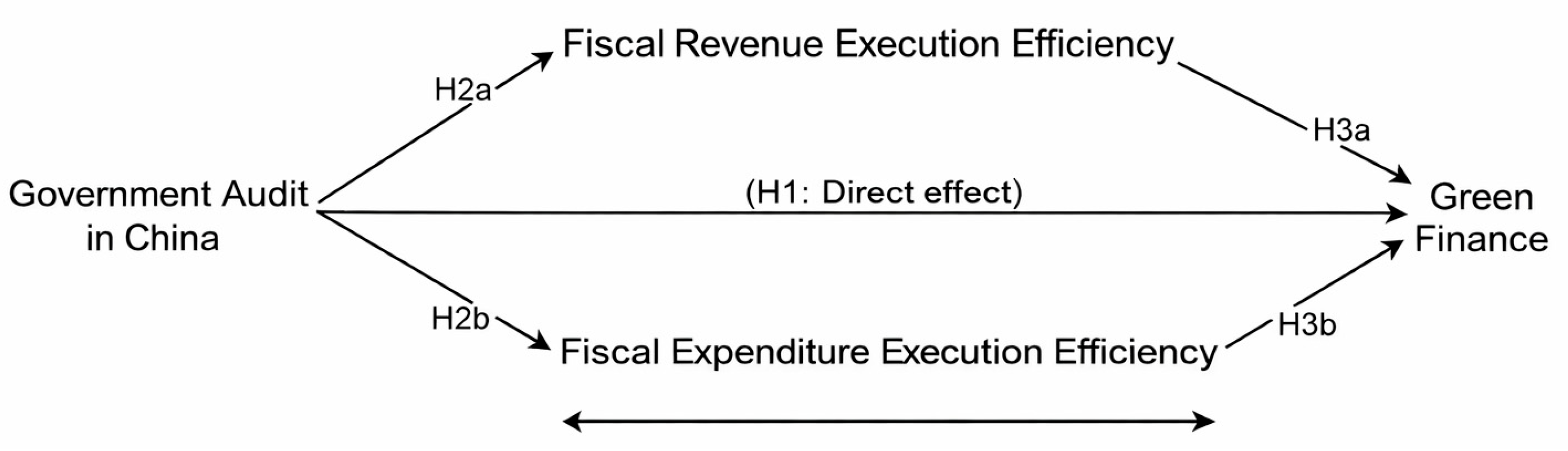
H1. Chinese government audits have a positive impact on the development of green finance.
2.2. Fiscal Execution Efficiency and Government Auditing
Despite the differences in government auditing systems across countries, international research generally agrees that government auditing plays a significant role in enhancing fiscal efficiency, particularly in countries that implement budget performance management, fiscal transparency, and accountable government systems (
OECD, 2025). Some international studies (
Bednarek & Ciak, 2022;
Blume & Voigt, 2011;
Bostan et al., 2021;
Šalienė et al., 2024) have empirically demonstrated that audit oversight of budget execution and public project expenditures helps reduce fiscal waste, lower the risk of corruption, and improve the accuracy of budget allocation. Several studies (
Cordery & Hay, 2019;
Otia & Bracci, 2022;
Volodina & Grossi, 2025) argue that if auditing synergizes with budget performance systems, fiscal transparency reforms, and electronic budgeting systems, it can significantly enhance fiscal efficiency and the creation of public value.
With the deepening reforms of China’s government auditing and fiscal policies, Chinese studies generally agree that government auditing plays a crucial external supervisory role in improving the efficiency of fiscal fund utilization and standardizing budget execution (
Cao et al., 2022;
J. Liu, 2017). Some studies (
F. Chen et al., 2023;
Z. Chen & Hu, 2025;
Fang et al., 2024;
D. Zhang et al., 2022) empirically demonstrate that local governments with stronger and broader audit capabilities tend to exhibit higher efficiency in the allocation and execution of fiscal funds. Furthermore, some Chinese studies suggest that government auditing influences fiscal execution efficiency through three mechanisms: regulatory constraint (
Lu et al., 2025), information enhancement (
Fang et al., 2024;
OECD, 2025;
H. Wang et al., 2024), and rectification and promotion (
J. Chen & Aidi, 2025;
Fang et al., 2025). Other studies (
Assakaf et al., 2018;
F. Chen et al., 2023,
2025) also point out that the impact of government auditing on fiscal execution efficiency exhibits significant heterogeneity across regions, fiscal structures, and institutional environments for auditing.
This study argues that Chinese government auditing, as a crucial external oversight force for national fiscal operations, effectively improves overall fiscal efficiency by uncovering irregularities in fiscal revenue and expenditure. Regarding the efficiency of fiscal revenue execution, the timeliness, completeness, and accuracy of fiscal revenue are legally ensured through audit monitoring and rectification mechanisms, which contribute to the improved predictability and stability of budgetary revenue (
W. Li et al., 2019;
J. Liu & Lin, 2012). Regarding the efficiency of fiscal expenditure execution, government auditing, through accountability and penalty mechanisms, regulates budgetary expenditure, promotes performance management of funds, and curbs waste, thereby significantly enhancing expenditure efficiency (
J. Liu, 2015;
Yali, 2023). Therefore, the following hypotheses are proposed:
H2. Chinese government audits have a positive impact on fiscal execution efficiency.
H2a. Chinese government audits have a positive impact on fiscal revenue execution efficiency.
H2b. Chinese government audits have a positive impact on fiscal expenditure execution efficiency.
2.3. The Mediating Effect of Fiscal Execution Efficiency on Government Auditing in Promoting Green Finance
While international and Chinese studies have confirmed the positive role of government auditing in promoting green finance and fiscal efficiency, the relationship among these three factors remains largely unexplored. In the context of green development, Chinese government audits enhance revenue execution efficiency by strengthening oversight of fiscal revenue collection, thus contributing to a robust and transparent fiscal foundation (
Guo et al., 2024). This empowers the government to provide long-term support for green finance service projects (
Xia, 2024). Furthermore, higher fiscal revenue execution efficiency reduces financial risk, enabling financial institutions to more accurately assess the potential benefits of green finance, thereby increasing the availability of green credit and green financial products (
W. Wang et al., 2023).
Regarding fiscal expenditure, government auditing, through accountability mechanisms, performance audits, and rectification, has effectively corrected the problems of delayed, wasteful, and inefficient fiscal spending. This will encourage the government to allocate its limited fiscal resources more rationally to areas related to green development (
You & Wang, 2025). Furthermore, improved efficiency in fiscal expenditure execution not only enhances the credibility of green finance but also increases the transparency and certainty of green investment, thereby alleviating information asymmetry for financial institutions in green credit and investment decisions, and further boosting public expectations and confidence in green finance investment (
L. Sun et al., 2025). Therefore, this study argues that these three factors form a transmission chain of “audit constraints—improved fiscal administration efficiency—enhanced green financial services.” The efficiency of fiscal revenue and expenditure execution can play a significant mediating role in the process by which government auditing influences the development of green finance.
H3. Fiscal execution efficiency has the effect of mediating between the Chinese government audit and Green finance.
H3a. Fiscal revenue execution efficiency has the effect of mediating between the Chinese government audit and Green finance.
H3b. Fiscal expenditure execution efficiency has the effect of mediating between the Chinese government audit and Green finance.
3. Materials and Methods
3.1. Research Variables and Data Sources
Dependent variable: The dependent variable in this study is green finance (GF), and the Entropy Method is used for weighted calculation. The entropy method is an objective weighting method based on the dispersion of indicators. The greater the dispersion of an indicator across regions, the more information it provides, and the greater its weight in the comprehensive evaluation. Therefore, the entropy method can effectively avoid subjective weighting and fully reflect the differences and information contributions of indicators. Referring to
H. K. Liu and He (
2021),
S. Zhang and Ren (
2024),
Xie and Zhou (
2023), and
Mao and Wang (
2024), this study selects seven green finance indices as primary indicators (
Table 1).
All indicator data were standardised according to entropy requirements to eliminate differences in measurement units, thereby ensuring comparability across provincial levels. Data sources: Various authoritative statistical yearbooks of China, including the Statistical Yearbook of Science and Technology in China, Statistical Yearbook of Energy in China, Financial Yearbook of China, Statistical Yearbook of Agriculture in China, Statistical Yearbook of Industry in China, and Statistical Yearbook of the Tertiary Industry in China.
Independent variable: The dependent variable in this study is Chinese government auditing (CGA). Following the research methodology of
J. Chen and Aidi (
2025), based on the principle of variance contribution rate weighting, employ weighted principal component analysis (WPCA) to calculate this variable. Specifically, the three indicators of Chinese government auditing (
Table 2) are weighted according to the ratio of each principal component’s eigenvalue to the total eigenvalue. The principal component scores are then weighted and summed to construct a composite index. Since the larger the eigenvalue of the principal component, the greater the variance contribution rate, and the more variance explained to the original variable, this method has high objectivity and reliability. Data are sourced from the annual China Auditing Yearbook.
As shown in
Table 2 above, the overall KMO value for the audit (WPCA) is 0.5546, which exceeds 0.5, indicating that the data are suitable for principal component analysis. Although the structure is not robust enough, it can still be used for dimensionality reduction.
Kaiser (
1974) and
Hutcheson and Sofroniou (
1999) both noted that a KMO value greater than 0.5 and less than 0.6 still meets the minimum requirements for principal component analysis. At the same time, the diagonality test of the covariance matrix (MVTEST) is significant (
p < 0.001), indicating a significant correlation between the indicators. Therefore, the data is generally suitable for weighted principal component analysis (WPCA).
Mediating and Control Variables: drawing on studies by
Jin and Zou (
2005) and
Wen et al. (
2025), this study utilizes the ratio of the settlement amount to the budget amount of fiscal revenue and expenditure for each Chinese province to measure the efficiency of fiscal revenue (RE) and expenditure (EE). Data for these two mediating variables are sourced from the China Fiscal Yearbook for each year. Additionally, referring to studies by
Fang et al. (
2024) and
Zhu et al. (
2021), this study uses the ratio of each Chinese province’s foreign trade volume to GDP to measure the degree of openness to the outside world (OP). The industrialization level (IL) is the ratio of industrial added value to GDP, used to measure the degree of industrialization in each province. Performance level (PV) is the ratio of each province’s total enterprise revenue to GDP. Data for these three control variables are all sourced from the China Statistical Yearbook for each year.
3.2. Scope of the Study and Descriptive Statistical Analysis
This study uses panel data from 30 provinces in China from 2010 to 2021 as its research scope. Descriptive statistical analysis (
Table 3) shows that the standard deviations for green finance (GF) and government audit (CGA) are 0.1211 and 0.7593, respectively, indicating significant unevenness in the development of green finance and government audit capabilities among Chinese provinces. Regarding fiscal execution efficiency, the mean execution rates of fiscal revenue (RE) and expenditure (EE) are 103.36 and 92.92, respectively, indicating that most provinces can meet or even exceed their annual budget revenue targets. Furthermore, the minimum and maximum values of openness to the outside world (OP) and industrialization level (IL) indicate significant differences in openness and industrialization levels among provinces. The standard deviation for performance level (RV) is 0.0317, showing a moderate degree of difference in provincial enterprise performance and economic vitality.
Notably,
Table 3 shows that the minimum value of the composite index CGA is negative, and the mean is close to zero. This characteristic stems from the weighted average analysis (WPCA) method of CGA. Specifically, its numerical results reflect the degree of deviation of each observation from the sample average level, rather than the absolute value (
I. Jolliffe, 2011). Therefore, a negative value only indicates that the overall level of the region is lower than the sample average level, and does not imply a negative economic meaning. Additionally, the zero mean indicates that the composite measure is centered at the sample mean, resulting from the standardization procedure (
I. T. Jolliffe & Cadima, 2016). This characteristic is consistent with the statistical properties of constructing composite indices using principal component analysis and aligns with standard practices in existing empirical studies.
3.3. Research Model
This study uses provincial panel data from China from 2010 to 2021 as its research object and employs Stata 17.0 for data analysis. Based on the hypotheses proposed in the previous section and following the three steps of testing the classic mediation effect proposed by
Baron and Kenny (
1986), this study first verifies the direct impact of government auditing on green finance (Model 1), then verifies the effect of government auditing on the fiscal revenue (expenditure) execution efficiency (Models 2 and 3), and finally verifies the mediating role of revenue (expenditure) (Models 4 and 5). To mitigate the bias of omitted variables in the model and ensure that the research conclusions accurately reflect the effects of government auditing and fiscal execution efficiency, thereby enhancing the reliability of the recommendations, this study draws on the research of
Heckman et al. (
1999). It selects openness to the outside world (OP), industrialization level (IL), and performance level (PV) as control variables for the model. As indicated in
Figure 1, the research framework of this study is as follows:
The model is based on Hypothesis 1:
Based on Hypotheses 2 (2a, 2b), the following model was designed:
Based on Hypotheses 3 (3a, 3b), the following model was designed:
The data contains provinces (i) and periods (t). Individual, regional, and time effects are controlled by dummy variables (αi, βi, and λt), and the error term is represented by ε.
4. Results Analysis
4.1. Data Quality Testing
Before conducting the Hausman test, this study performed a series of data quality checks on the sample data, including Pearson correlation coefficient analysis, a multicollinearity test (VIF), a heteroscedasticity test, and an autocorrelation test. The correlation coefficient and VIF tests help identify potentially high correlations between variables, avoiding the instability of coefficient estimates and standard error inflation caused by multicollinearity. Heteroscedasticity and autocorrelation tests are used to determine whether the error term violates classical regression assumptions, thus avoiding statistical inference distortion. Through these data quality diagnoses, this study ensured the reliability and robustness of the Hausman test and panel regression results.
4.1.1. Pearson Coefficient and VIF Test
This study performed the Pearson coefficient and VIF tests (
Table 4). Clearly, the correlations among the variables were low, with the absolute values of the Pearson coefficients not exceeding 0.52, and far below the commonly used threshold of 0.70 for assessing the risk of multicollinearity. This suggests that there is no significant linear correlation among the main explanatory variables in this study. The variance inflation factor (VIF) test results indicate that the VIF values for each variable range from 1.07 to 1.85, which is far below the empirically used threshold of 5, suggesting very weak correlations among the variables. This further confirms that the model is not subject to multicollinearity.
4.1.2. Heteroscedasticity and Autocorrelation Test
The
Wooldridge (
2010) test results in this study (
Table 5) showed that the model had significant first-order autocorrelation (F = 35.794,
p < 0.001). This study further performed first-order differencing on the core variables, and the autocorrelation test results were no longer significant after differencing (F = 0.023,
p = 0.882), indicating that serial correlation had been effectively eliminated. Furthermore, the Breusch–Pagan test results in this study showed that the heteroscedasticity test results of the original model were not significant (
p = 0.081), and the test results after logarithmic transformation of the variables were also not significant (
p = 0.205). This indicates that the model does not have significant heteroscedasticity issues.
4.2. Hausman Test Results
From the results of the F-statistic and Prob > F (
Table 6), except for Model 2, the F-values of the other models are all higher than 10. However, the Prob > F values for all models are significantly lower than 0.01, indicating that the overall regression of each model is significant and the explanatory variables have a certain explanatory power for the dependent variable. The R values range from 0.0584 to 0.5210, indicating that there are differences in the explanatory power of different models. Among them, the model containing the mediating variable performs better, and its explanatory power is significantly improved. In addition, the chi2 (4) test of all models is significant (Prob > chi2 < 0.05), which further verifies the robustness of the overall model estimation.
The empirical results of Model 1 (
Table 3) show that government auditing (CGA) has a significant positive effect on the development of green finance (GF). This result is consistent with Hypothesis 1 and also indicates that government auditing improves the transparency and reliability of green finance projects by regulating fiscal execution and supervising the use of local funds. Furthermore, the results of Models 2 and 3 show that CGA has a significant negative effect on the efficiency of fiscal revenue execution (RE) and a significant positive impact on the efficiency of fiscal expenditure execution (EE). Finally, the RE and EE variables in Models 4 and 5 are both highly significant. However, in Model 4, the variable CGA is highly significant, but its coefficient (0.0094) is smaller than that in Model 1 (0.0126). According to the mediation criterion of
Baron and Kenny (
1986), the results suggest that RE partially mediates the relationship between CGA and GF. In Model 5, the variable CGA becomes insignificant, suggesting that EE plays a complete mediating role in the relationship between CGA and GF.
4.3. Endogeneity Testing
Following the methodologies of studies
Wooldridge (
2010) and
Cameron and Trivedi (
2005), and employing the Durbin-Wu-Hausman (DWH) method, this study uses lagged terms of independent variables as instrumental variables to test for endogeneity issues in all models. This study combines the first-stage F-test criterion proposed by
Stock and Yogo (
2002) with the R
2 test criterion proposed by
Shea (
1997) to identify problems associated with weak instrumental variables.
This study evaluated the endogeneity of independent variables and the effectiveness of instrumental variables in five models (
Table 7). The F-values and
p-values of the Durbin-Wu-Hausman (DWH) test showed that no significant endogeneity issues existed in the independent variables of any of the five models (all
p-values were greater than 0.05). Furthermore, the test results (
Table 7) showed that the first-stage F-values for Models 1, 2, and 3 were 18.3367, 18.3367, and 12.701, respectively, all significantly higher than the commonly used weak instrument judgment threshold of 10, indicating that these three models did not have significant endogeneity issues. Meanwhile, the Shea partial R
2 for CGA and EE were 0.5505 and 0.7458, respectively, indicating that the corresponding instrumental variables had strong explanatory power. In contrast, the Shea partial R
2 for RE in Model 4 was only 0.0556, suggesting a certain risk of weak instrumentality for this instrumental variable, but the overall impact was manageable.
4.4. Placebo Test
Following the methods proposed by
Hagemann (
2019) and
Lei and Sudijono (
2024), this study randomly generated a set of placebo variables independent of the main explanatory variables. It incorporated them into the Hausman panel regression models, which include both fixed and random effects, to replace the core independent variables in the regression analysis. In this study (
Table 8), none of the placebo variables in any model showed significance (
p > 0.05), indicating that the results of all previous Hausman tests in this study were not spurious regression results, ruling out the possibility of model misspecification or other random factors leading to spurious relationships. Thus supporting the robustness of the previous model results.
5. Discussion
The results of Model 1 support Hypothesis 1, namely that Chinese government auditing has a positive impact on the level of green finance. The findings are similar to those of studies by
L. Sun et al. (
2025) and
L.-Q. Huang et al. (
2024). Therefore, this study provides further empirical evidence that government auditing promotes the development of green finance. This result suggests that government auditing, as an external oversight mechanism, helps mitigate information asymmetry in the green finance market, the public disclosure of audit results increases the transparency of government departments and project implementing units, thereby enhancing investors’ ability to identify risks in green credit, green bonds, and green investments, and enabling financial institutions and investors to more accurately assess the risks and expected returns of green projects, thereby enhancing the service quality of green finance.
Furthermore, the results of Model 2 show that government auditing hurts the efficiency of fiscal revenue execution, which is inconsistent with Hypothesis 2 and also indicates that government auditing does not play a positive role in promoting revenue execution. This may stem from the highly institutionalized and mandatory nature of the fiscal revenue collection mechanism, with limited autonomy for local governments in the tax collection process. Relying solely on auditing is unlikely to improve revenue execution efficiency directly (
Amyulianthy, 2022). Furthermore, auditing intervention may increase administrative burdens in the short term, leading to a certain degree of decline in revenue execution efficiency. Conversely, Model 3 shows that government auditing significantly improves the efficiency of fiscal expenditure execution, supporting Hypothesis 3. This is because fiscal expenditure processes have greater discretionary power, such as project approval, budget allocation, fund disbursement, and performance evaluation (
Afonso et al., 2024). Auditing can directly intervene in these key stages, correcting irregular, delayed, and inefficient expenditure behaviors, thereby significantly improving the efficiency of fiscal fund utilization.
The results of Models 4 and 5 indicate that the efficiency of fiscal revenue execution plays a partial mediating role in the mechanism by which audits influence green finance, while the efficiency of fiscal expenditure execution plays a full mediating role. This means that the role of auditing in promoting green finance is mainly achieved by improving the standardization, transparency, and performance of fiscal expenditures (
Allen et al., 2013). On the one hand, although government auditing can provide a more stable funding base for green finance by strengthening revenue, this channel is not the only way auditing influences green finance. Its role in promoting green finance still partially depends on other institutional factors (
Campiglio, 2016), such as budget management systems, the degree of coordination in financial supervision, and the effectiveness of implementing green industry policies.
The efficiency of fiscal expenditure execution exhibits a complete mediating effect, indicating that the primary mechanism by which government auditing promotes green finance development lies in improving the efficiency of fiscal expenditure. By standardizing budget execution, strengthening performance supervision, and reducing irregular expenses and waste of funds, auditing enables fiscal resources to be more effectively directed towards green industries, energy conservation and emission reduction projects, and environmental infrastructure construction (
Montes et al., 2019). This not only improves the efficiency of public fund utilization but also effectively reduces information asymmetry and risk expectations for investors in green project financing (
W. Li et al., 2023), thereby significantly enhancing the expected benefits of green finance, such as green credit and green investment.
6. Conclusions
Based on panel data from 30 provinces in China from 2010 to 2021, this study finds that government auditing has a significant positive impact on the development of green finance in China. While the efficiency of fiscal revenue execution has a partial mediating effect on this relationship, the efficiency of fiscal expenditure execution has a full mediating effect. This implies that although the impact of fiscal revenue execution efficiency is relatively limited, it can still provide beneficial resource guarantees and support for the development of green finance. However, to fully leverage the role of government auditing in promoting green finance, it should focus on improving the efficiency of fiscal expenditure execution by standardizing and optimizing fiscal expenditure processes to achieve efficient and transparent use of funds.
Implications: Theoretically, this study enriches the theoretical perspectives on government auditing, fiscal execution efficiency, and green finance research. The findings reveal the promoting role and mechanism of government auditing in green finance, clarifying the fully mediating role of fiscal expenditure execution efficiency, and expanding the existing theoretical framework on how government auditing influences green finance development through fiscal efficiency. Secondly, this study distinguishes the different roles of fiscal revenue and fiscal expenditure execution efficiency in the relationship between auditing and green finance. This reflects the explanation of institutional implementation differences and governance efficiency by public governance theory, providing a more refined reference for subsequent research on green finance. This finding helps to understand the economic effects of government governance on green finance under different fiscal backgrounds, expanding new perspectives and policy implications for green finance research.
In practice, this study underscores the pivotal role of government auditing in promoting green finance development, particularly by facilitating efficient resource allocation and risk management through enhanced effectiveness in fiscal expenditure execution. To further leverage the function of auditing, policymakers should focus on improving fiscal expenditure management mechanisms, optimizing budget approval, fund disbursement, and performance evaluation processes, as well as enhancing the transparency and standardization of public funds. Furthermore, the public disclosure of audit results should be strengthened to reduce information asymmetry in the green finance market and improve the ability of financial institutions and investors to assess the risks and returns of green projects, thereby promoting the sound development of green finance.
Limitations and Suggestions for Future Research: This study acknowledges certain limitations. First, this study is primarily based on provincial-level macroeconomic data, which may not fully reflect the heterogeneity among local governments at different levels. Second, the variables selected in this study only cover a portion of the indicators related to government auditing, green finance, and fiscal execution efficiency, which may not comprehensively characterize the proper relationship among the three. Therefore, future research could consider incorporating data from more administrative levels, as well as variables of more dimensions and types, to more precisely identify the interaction mechanisms among the three at different levels and time periods, thereby gaining a more comprehensive understanding of the role of Chinese government auditing and fiscal execution efficiency in promoting the development of green finance.
Author Contributions
Conceptualization, J.C.; methodology, J.C.; software, J.C.; validation, J.C.; resources, J.C.; writing—original draft preparation, J.C.; writing—review and editing, A.A.; supervision, Z.S. All authors have read and agreed to the published version of the manuscript.
Funding
No financial assistance was provided to the authors of this article to complete the research, authorship, and/or publishing of this article.
Institutional Review Board Statement
Not applicable.
Informed Consent Statement
Not applicable.
Data Availability Statement
Data supporting the findings of this study are available from the corresponding author upon reasonable request.
Conflicts of Interest
The authors declare no conflicts of interest.
References
- Afonso, A., Jalles, J. T., & Venâncio, A. (2024). A tale of government spending efficiency and trust in the state. Public Choice, 200(1), 89–118. [Google Scholar] [CrossRef] [Scilit]
- Allen, R., Hemming, R., & Potter, B. H. (2013). Introduction: The meaning, content and objectives of public financial management. In The international handbook of public financial management (pp. 1–12). Springer. [Google Scholar] [CrossRef] [Scilit]
- Alqooti, A. A. (2020). Public governance in the public sector: Literature review. EuroMid Journal of Business and Tech-Innovation, 14–25. [Google Scholar] [CrossRef] [Scilit]
- Amyulianthy, R. (2022). The effect of audit results, performance measurement system, and good governance on local government performance. Universiti Teknologi MARA (UiTM). [Google Scholar]
- Assakaf, E. A., Samsudin, R. S., & Othman, Z. (2018). Public sector auditing and corruption: A literature. Asian Journal of Finance & Accounting, 10, 226–241. [Google Scholar] [CrossRef] [Scilit]
- Baron, R. M., & Kenny, D. A. (1986). The moderator–mediator variable distinction in social psychological research: Conceptual, strategic, and statistical considerations. Journal of Personality and Social Psychology, 51(6), 1173. [Google Scholar] [CrossRef] [PubMed]
- Bednarek, P., & Ciak, J. (2022). Performance audit effectiveness indicators: Evidence from Poland. Journal of Public Governance, 61(3), 43–56. [Google Scholar] [CrossRef] [Scilit]
- Blume, L., & Voigt, S. (2011). Does organizational design of supreme audit institutions matter? A cross-country assessment. European Journal of Political Economy, 27(2), 215–229. [Google Scholar] [CrossRef] [Scilit]
- Bo, S., Wu, Y., & Zhong, L. (2020). Flattening of government hierarchies and misuse of public funds: Evidence from audit programs in China. Journal of Economic Behavior & Organization, 179, 141–151. [Google Scholar] [CrossRef] [Scilit]
- Bostan, I., Tudose, M. B., Clipa, R. I., Chersan, I. C., & Clipa, F. (2021). Supreme audit institutions and sustainability of public finance. Links and evidence along the economic cycles. Sustainability, 13(17), 9757. [Google Scholar] [CrossRef] [Scilit]
- Cameron, A. C., & Trivedi, P. K. (2005). Microeconometrics: Methods and applications. Cambridge University Press. [Google Scholar]
- Campiglio, E. (2016). Beyond carbon pricing: The role of banking and monetary policy in financing the transition to a low-carbon economy. Ecological Economics, 121, 220–230. [Google Scholar] [CrossRef] [Scilit]
- Cao, H., Li, M., Lu, Y., & Xu, Y. (2022). The impact of strengthening government auditing supervision on fiscal sustainability: Evidence from China’s auditing vertical management reform. Finance Research Letters, 47, 102825. [Google Scholar] [CrossRef] [Scilit]
- Chen, F., Dong, B., Zhang, M., & Chen, Q. (2025). Government environmental auditing and synergistic governance outcomes: Evidence from Chinese cities. Sustainability, 17(19), 8962. [Google Scholar] [CrossRef] [Scilit]
- Chen, F., Guo, Q., & Jiang, B. (2023). Government audit supervision and fiscal sustainability: Evidence from interprovincial China. SSRN, 4474309. [Google Scholar] [CrossRef] [Scilit]
- Chen, J., & Aidi, A. (2025). Chinese government auditing and economic growth: The mediating effect of corruption. Veredas Do Direito, 22(2), e3124. [Google Scholar] [CrossRef] [Scilit]
- Chen, Z., & Hu, M. (2025). Does national auditing improve local fiscal transparency? Evidence from China. International Studies of Economics, 20(2), 153–161. [Google Scholar] [CrossRef] [Scilit]
- Cordery, C. J., & Hay, D. (2019). Supreme audit institutions and public value: Demonstrating relevance. Financial Accountability & Management, 35(2), 128–142. [Google Scholar] [CrossRef] [Scilit]
- Fang, C. J., Ahmi, A., & Sharif, Z. (2024). Government auditing, government transparency, and corruption: Empirical evidence from provincial levels in China. South Eastern European Journal of Public Health, 2024, 1780–1796. [Google Scholar] [CrossRef] [Scilit]
- Fang, C. J., Ahmi, A., & Sharif, Z. (2025). Fiscal decentralization and corruption: The moderating role of economic responsibility audit in China. International Journal of Innovative Research and Scientific Studies, 8(1), 854–863. [Google Scholar] [CrossRef] [Scilit]
- Fu, C., Lu, L., & Pirabi, M. (2023). Advancing green finance: A review of sustainable development. Digital Economy and Sustainable Development, 1(1), 20. [Google Scholar] [CrossRef] [Scilit]
- Goolsarran, S. A. (2007). The evolving role of supreme audit institutions. The Journal of Government Financial Management, 56(3), 28. [Google Scholar]
- Gulmammadov, V. (2025). Involvement of supreme audit institutions in climate performance assessment: International and local experiences, realities and challenges. International Journal of Government Auditing, 52(1), 66–72. [Google Scholar]
- Guo, Y., Wang, J., Wang, H., & Zhang, F. (2024). The impact of big data tax collection and management on inefficient investment of enterprises—A quasi-natural experiment based on the golden tax project III. International Review of Economics & Finance, 92, 678–689. [Google Scholar] [CrossRef] [Scilit]
- Hagemann, A. (2019). Placebo inference on treatment effects when the number of clusters is small. Journal of Econometrics, 213(1), 190–209. [Google Scholar] [CrossRef] [Scilit]
- Heckman, J. J., LaLonde, R. J., & Smith, J. A. (1999). The economics and econometrics of active labor market programs. In Handbook of labor economics (Vol. 3, pp. 1865–2097). Elsevier. [Google Scholar] [CrossRef] [Scilit]
- Hou, H., Wang, Y., & Zhang, M. (2024). Impact of environmental information disclosure on green finance development: Empirical evidence from China: H. Hou et al. Environment, Development and Sustainability, 26(8), 20279–20309. [Google Scholar] [CrossRef] [Scilit]
- Huang, L.-Q., Li, Y. J., & Xu, H. (2024). Government environmental audit and corporate green governance. Journal of University of Electronic Science and Technology of China (Social Sciences Edition), 26(4), 98–112. [Google Scholar]
- Huang, R., & Zou, X. (2025). Accountability audits of natural resources and industrial green total factor productivity: Evidence from China. Humanities and Social Sciences Communications, 12(1), 1–17. [Google Scholar] [CrossRef] [Scilit]
- Hutcheson, G. D., & Sofroniou, N. (1999). The multivariate social scientist: Introductory statistics using generalized linear models. Sage Publications. [Google Scholar]
- Jin, J., & Zou, H.-f. (2005). Fiscal decentralization, revenue and expenditure assignments, and growth in China. Journal of Asian Economics, 16(6), 1047–1064. [Google Scholar] [CrossRef] [Scilit]
- Jolliffe, I. (2011). Principal component analysis. In International encyclopedia of statistical science (pp. 1094–1096). Springer. [Google Scholar]
- Jolliffe, I. T., & Cadima, J. (2016). Principal component analysis: A review and recent developments. Philosophical transactions of the royal society A: Mathematical, Physical and Engineering Sciences, 374(2065), 20150202. [Google Scholar] [CrossRef] [Scilit]
- Kaiser, H. F. (1974). An index of factorial simplicity. Psychometrika, 39(1), 31–36. [Google Scholar] [CrossRef] [Scilit]
- Lei, L., & Sudijono, T. (2024). Inference for synthetic controls via refined placebo tests. arXiv, arXiv:2401.07152. [Google Scholar] [CrossRef] [Scilit]
- Li, W., Pittman, J. A., & Wang, Z.-T. (2019). The determinants and consequences of tax audits: Some evidence from China. The Journal of the American Taxation Association, 41(1), 91–122. [Google Scholar] [CrossRef] [Scilit]
- Li, W., Xia, L., & Zhang, Q. (2023). Fiscal-audit separation and government disclosure quality. Journal of Accounting and Public Policy, 42(4), 107100. [Google Scholar] [CrossRef] [Scilit]
- Li, X., Tang, J., Feng, C., & Chen, Y. (2023). Can government environmental auditing help to improve environmental quality? Evidence from China. International Journal of Environmental Research and Public Health, 20(4), 2770. [Google Scholar] [CrossRef] [Scilit] [PubMed]
- Liu, H., Jafri, M. A. H., Zhu, P., & Hafeez, M. (2024). Fiscal policy-green growth nexus: Does financial efficiency matter in top carbon emitter economies? Environment, Development & Sustainability, 26(8). [Google Scholar] [CrossRef] [Scilit]
- Liu, H. K., & He, C. (2021). Mechanisms and Validation of green finance in promoting high-quality urban economic development: Empirical evidence from 272 prefecture-level cities in China. Investment Research, 40, 37–52. [Google Scholar]
- Liu, J. (2015). Study on the auditing theory of socialism with Chinese characteristics. John Wiley & Sons. [Google Scholar]
- Liu, J. (2017). Study on the auditing system of socialism with Chinese characteristics. John Wiley & Sons. [Google Scholar]
- Liu, J., & Lin, B. (2012). Government auditing and corruption control: Evidence from China’s provincial panel data. China Journal of Accounting Research, 5(2), 163–186. [Google Scholar] [CrossRef] [Scilit]
- Lu, F., Ren, Q., Sun, J., & Wang, H. (2025). Natural disasters and local governments’ fiscal misconduct: Evidence from five earthquakes in China. Policy Studies Journal. [Google Scholar] [CrossRef] [Scilit]
- Lv, C., Bian, B., Lee, C.-C., & He, Z. (2021). Regional gap and the trend of green finance development in China. Energy Economics, 102, 105476. [Google Scholar] [CrossRef] [Scilit]
- Ma, R., & Xi, C. (2025). Can green financial policies promote green urbanization? Evidence from China. Frontiers in Sustainable Cities, 7, 1637944. [Google Scholar] [CrossRef] [Scilit]
- Mao, X., & Wang, R. (2024). Green finance and new productivity: Promotion or repression?—A perspective based on technological innovation and environmental concern. Journal of Shanghai University of Finance and Economics, 26(5), 31–45. [Google Scholar] [CrossRef]
- Montes, G. C., Bastos, J. C. A., & de Oliveira, A. J. (2019). Fiscal transparency, government effectiveness and government spending efficiency: Some international evidence based on panel data approach. Economic Modelling, 79, 211–225. [Google Scholar] [CrossRef] [Scilit]
- OECD. (2020). Developing sustainable finance definitions and taxonomies: Green finance and investment. OECD Publishing. [Google Scholar] [CrossRef] [Scilit]
- OECD. (2025). Quality budget institutions: Developments in OECD countries. OECD Publishing. [Google Scholar]
- Otia, J. E., & Bracci, E. (2022). Digital transformation and the public sector auditing: The SAI’s perspective. Financial Accountability & Management, 38(2), 252–280. [Google Scholar] [CrossRef] [Scilit]
- Rhodes, R. A. W. (1996). The new governance: Governing without government. Political Studies, 44(4), 652–667. [Google Scholar] [CrossRef] [Scilit]
- Shea, J. (1997). Instrument relevance in multivariate linear models: A simple measure. Review of Economics and Statistics, 79(2), 348–352. [Google Scholar] [CrossRef] [Scilit]
- Sitompul, R., Sanusi, Z. M., Alsayegh, M. F., Erum, N., Kazemian, S., & Hitam, M. (2023). Enhancing green investment efficiency through audit quality. European Proceedings of Social and Behavioural Sciences, 131, 1260–1269. [Google Scholar] [CrossRef] [Scilit]
- Stock, J. H., & Yogo, M. (2002). Testing for weak instruments in linear IV regression. National Bureau of Economic Research. [Google Scholar]
- Sułkowski, Ł., & Dobrowolski, Z. (2021). The role of supreme audit institutions in energy accountability in EU countries. Energy Policy, 156, 112413. [Google Scholar] [CrossRef] [Scilit]
- Sun, L., Luo, K., Zhou, C., & Yan, J. (2025). Can the government environmental audits improve corporate green investment? Evidence from China. International Review of Economics & Finance, 97, 103782. [Google Scholar] [CrossRef] [Scilit]
- Sun, Y., Zhong, H., Wang, Y., Pan, Y., & Tang, D. (2024). The effect of green finance on the transformation and upgrading of manufacturing industries in the Yangtze River economic belt of China. Frontiers in Environmental Science, 12, 1473621. [Google Scholar] [CrossRef] [Scilit]
- Šalienė, A., Tamulevičienė, D., & Tvaronavičienė, M. (2024). Focus of performance audit recommendations on the approach of public value creation: The case of the National Audit Office of Lithuania. Journal of International Studies, 17(4), 1–28. [Google Scholar] [CrossRef] [Scilit]
- van Leeuwen, S. (2004). Auditing international environmental agreements: The role of supreme audit institutions. Environmentalist, 24(2), 93–99. [Google Scholar] [CrossRef] [Scilit]
- Volodina, T., & Grossi, G. (2025). Digital transformation in public sector auditing: Between hope and fear. Public Management Review, 27(5), 1444–1468. [Google Scholar] [CrossRef] [Scilit]
- Wang, C., Qiao, G., Ahmad, M., & Ahmed, Z. (2023). The role of the government in green finance, foreign direct investment, technological innovation, and industrial structure upgrading: Evidence from China. Sustainability, 15(19), 14069. [Google Scholar] [CrossRef] [Scilit]
- Wang, H., Tang, Z., Zhang, Z., & Deng, W. (2024). Can government environmental auditing and fiscal transparency promote the green development of heavy-polluting firms? Environmental Research Letters, 19(7), 074054. [Google Scholar] [CrossRef] [Scilit]
- Wang, R., Duan, Y., & Li, D. (2025). Beyond scale to efficiency: A dual-perspective framework for green finance in China. Discover Sustainability, 6(1), 483. [Google Scholar] [CrossRef] [Scilit]
- Wang, W., Wang, Z., & Mei, Y. (2023). Have government environmental auditing contributed to the green transformation of Chinese cities? Heliyon, 9(12), e22709. [Google Scholar] [CrossRef] [Scilit]
- Wen, M., Guo, X., & Luo, X. (2025). Do government audits reduce budgetary non-compliance?—An empirical analysis of budget execution audits in central government departments in China. Chinese Studies, 14(2), 71–90. [Google Scholar] [CrossRef]
- Wooldridge, J. M. (2010). Econometric analysis of cross section and panel data. MIT Press. [Google Scholar]
- World Bank. (2018). Introduction to green finance. Available online: https://documents1.worldbank.org/curated/en/405891487108066678/pdf/112831-WP-PUBLIC-Introduction-to-Green-Finance.pdf?utm_source=chatgpt.com (accessed on 20 November 2025).
- Xia, Z. (2024). The impact of smart audit on green finance: Evidence from China. Advances in Economics and Management Research, 12(1), 744. [Google Scholar] [CrossRef] [Scilit]
- Xie, F., & Zhou, M. (2023). A study on the impact of green finance on the digital economy and green development. Chongqing Social Sciences, 7, 35–50. [Google Scholar] [CrossRef]
- Yali, L. (2023). Performance audit: The development conditions in China. Φинaнcы: Тeopия и Пpaктикa, 27(4), 80–92. [Google Scholar] [CrossRef] [Scilit]
- You, C., & Wang, J. (2025). State audit digitization and green technology innovation in state-owned enterprises. SAGE Open, 15(2), 21582440251335996. [Google Scholar] [CrossRef] [Scilit]
- Zhang, D., Shen, X., & Peng, C. (2022). National audit, media attention, and efficiency of local fiscal expenditure: A spatial econometric analysis based on provincial panel data in China. Sustainability, 15(1), 532. [Google Scholar] [CrossRef] [Scilit]
- Zhang, S., & Ren, C. (2024). The impact of green finance on high-quality agricultural development—an examination based on threshold and mediation effect models. Cutting-Edge Engineering Management Technology, 4, 72–78. Available online: https://link.cnki.net/urlid/34.1013.N.20241128.0949.008 (accessed on 20 November 2025).
- Zhu, W., Zhu, Y., Lin, H., & Yu, Y. (2021). Technology progress bias, industrial structure adjustment, and regional industrial economic growth motivation—Research on regional industrial transformation and upgrading based on the effect of learning by doing. Technological Forecasting and Social Change, 170, 120928. [Google Scholar] [CrossRef] [Scilit]
| Disclaimer/Publisher’s Note: The statements, opinions and data contained in all publications are solely those of the individual author(s) and contributor(s) and not of MDPI and/or the editor(s). MDPI and/or the editor(s) disclaim responsibility for any injury to people or property resulting from any ideas, methods, instructions or products referred to in the content. |