


Article

Resilience, Valuation, and Governance Interactions in Shaping Financial Accounting Manipulation: Evidence from Asia

by
Janet Claresta Wibowo
1,
Moch. Doddy Ariefianto
2,
Lizvin Laurence
1,* and
Gatot Soepriyanto
2
1
Finance Department, School of Accounting, Bina Nusantara University, Jakarta 11480, Indonesia
2
Accounting Department, School of Accounting-Master Accounting, Bina Nusantara University, Jakarta 11480, Indonesia
*
Author to whom correspondence should be addressed.
J. Risk Financial Manag. 2025, 18(12), 719; https://doi.org/10.3390/jrfm18120719
Submission received: 30 October 2025 / Revised: 8 December 2025 / Accepted: 10 December 2025 / Published: 16 December 2025
(This article belongs to the Special Issue Corporate Finance: Financial Management of the Firm)

Abstract

Financial accounting manipulation (FAM) remains a persistent concern in emerging Asian markets, yet existing studies typically assess firm resilience, market valuation, and institutional governance separately. This study addresses this gap by examining how the Resilience Factor (RF), Market Valuation (VAL), and Country Governance Index (CGI), along with their interaction effects, shape FAM. Using a panel dataset of 4303 non-financial firms across 17 Asian countries from 2012 to 2023 (51,636 observations), the analysis employs an Instrumental Variable–Two-Stage Least-Squares (IV-2SLS) approach to address endogeneity related to simultaneity and omitted variable bias. The results show that financially resilient firms are more prone to manipulation, market valuation reduces manipulation incentives, and stronger country governance constrains manipulation. Moreover, valuation moderates the governance–manipulation relationship, suggesting complementary monitoring roles between markets and institutions. Robustness checks across regions, industries, and the COVID-19 period confirm the findings. The study contributes to agency and institutional theory by highlighting how firm-level and country-level mechanisms jointly influence manipulation, offering policy implications for regulators and investors in Asian capital markets.

1. Introduction

Financial accounting manipulation (FAM) remains a critical concern for regulators, investors, and academics because it undermines the credibility of financial reporting, distorts resource allocation, and erodes confidence in capital markets (Baigon et al., 2024). Recent evidence shows that enforcement actions, restatements, and fraud cases continue to emerge in both developed and emerging markets, indicating that manipulation risk has not diminished and is often linked to complex business models and cross-border transactions (Kovjanić, 2020). These developments highlight that understanding why firms engage in FAM, and under which institutional conditions they are more likely to do so, remains an important and timely research problem, especially in regions with heterogeneous institutional quality such as Asia.
Existing literature has advanced each of these perspectives, but mostly in isolation. Prior studies have examined how firm fundamentals, financial flexibility, or resilience affect manipulation and earnings-management risk (Bui, 2024), how market valuation and overpricing shape managerial reporting incentives and exert a disciplining effect on reported earnings (C. Duong & Pescetto, 2019), and how country-level governance constrains opportunistic behavior through stronger enforcement and investor protection (Y. Huang et al., 2021). More recent studies also document the importance of country-level characteristics—such as rule of law, regulatory quality, and corruption control—for financial reporting outcomes and earnings quality in different regions, including emerging markets (Mos, 2024). However, there is still limited evidence on how firm-level resilience and valuation interact with the quality of country-level governance in shaping FAM, particularly in a large multi-country Asian setting.
This study addresses that gap by adopting an interaction-based perspective on three key constructs: the Resilience Factor (RF) as a firm-level measure of financial resilience and flexibility, Market Valuation (VAL) as a proxy for external expectations and visibility, and the Country Governance Index (CGI) as a summary of national governance quality. Rather than treating RF, VAL, and CGI as independent, additive drivers of manipulation, the study examines how they jointly shape FAM through interaction terms, focusing on whether governance and valuation moderate the relationship between resilience and manipulation, and whether valuation itself is more or less disciplinary under strong country-level governance (H. K. Duong et al., 2022). This interaction-based approach responds directly to recent calls for more nuanced, context-sensitive models of corporate behavior and financial reporting in international settings (Carmona et al., 2023).
Asia provides a particularly suitable empirical setting for this analysis. The region combines highly developed markets with strong governance and deep investor bases with emerging economies where legal enforcement, investor protection, and regulatory capacity are still evolving (Siddika & Sarwar, 2023). Asian firms are also characterized by ownership structures such as business groups and family-controlled conglomerates, which can generate complex agency problems and incentives for tunneling, propping, or earnings management. In addition, Asian capital markets have grown rapidly and become increasingly important for global investors, amplifying the consequences of FAM for both domestic and international stakeholders (Capital markets and key sustainability issues in Asia, 2023).
A crucial contribution of this study lies in the utilization of an extensive panel dataset comprising 4303 non-financial firms across 17 diverse Asian economies over a 12-year period (2012–2023). This broad coverage yields unique insights by explicitly capturing institutional heterogeneity and cross-subregional variations that are often overlooked in single-country or smaller regional studies. By integrating data from East Asia, Southeast Asia, South Asia, and West Asia, the sample allows us to assess whether the interplay between resilience, valuation, and governance is universal or contextually dependent on the structural differences and varying regulatory qualities inherent across Asian markets. This approach significantly enhances the generalizability and robustness of our findings, providing a more comprehensive understanding of reporting behavior under diverse institutional pressures.
Against this backdrop, the study addresses the following research questions: (1) how do RF, VAL, and CGI individually influence FAM? and (2) how do RF, VAL, and CGI interact with each other to shape FAM in Asian firms?. To answer these questions, the study employs an extensive panel of 4303 non-financial firms from 17 Asian countries over 2012–2023 and estimates an Instrumental Variable–Two-Stage Least-Squares (IV-2SLS) model to address endogeneity concerns such as simultaneity and omitted variable bias. By integrating firm-level resilience and valuation with country-level governance quality and explicitly modeling their interactions, the study contributes to agency and institutional theory, enriches the visibility/market-pressure literature, and offers practical implications for regulators and investors in Asian capital markets (Tekin & Polat, 2021).

2. Literature Review and Hypothesis Construction

This chapter provides a brief review of literature relevant to our hypothesis construction. Section 2.1 defines FAM and discusses its measurement, highlighting the prominence of the Dechow et al. (2011) F-Score. Section 2.2 examines the role of RF, VAL, and CGI to FAM individually. Finally, Section 2.3 discuss the role of interaction terms.

2.1. Financial Accounting Manipulation

Financial accounting manipulation (FAM) is commonly conceptualized as deliberate managerial intervention in the financial reporting process to mislead users or influence contractual outcomes, ranging from earnings management to outright fraud (Chtaoui, 2024). Recent studies show that such practices increase information asymmetry, impair capital allocation, and lead to market-wide losses in investor confidence, particularly in emerging markets with weaker enforcement (J. Huang & Ke, 2021). In this study, FAM is measured using the Dechow-type F-Score, which aggregates multiple red flags related to accounting quality, financial performance, and non-financial indicators, and has been widely adopted in recent research on misreporting, fraud risk, and enforcement outcomes (Xu et al., 2023).
While early models based on discretionary accruals laid important foundations, more recent work highlights that single-dimensional proxies may misclassify firms with extreme performance or unusual business models (Du Jardin et al., 2019). Composite measures such as the F-Score improve detection by combining accrual-based indicators with signals from performance, growth, and other non-financial factors (Andrew et al., 2022). This multidimensional measurement is particularly suitable for cross-country settings, where differences in accounting regimes and enforcement may affect individual indicators but are more reliably captured through a comprehensive misreporting risk score.
Theoretically, this study is grounded in three complementary perspectives: agency theory, institutional theory, and the visibility or market-pressure view. Agency theory suggests that managers may exploit information asymmetries to pursue private benefits—such as bonus maximization or career preservation—by manipulating reported performance when monitoring is weak (Eckles, 2021). Institutional theory emphasizes that national governance frameworks—legal enforcement, investor protection, and control of corruption—shape the “rules of the game” and determine the costs and benefits of opportunistic reporting (Zattoni et al., 2020). The visibility perspective argues that firms facing intense scrutiny from analysts and sophisticated investors may have weaker incentives to manipulate because misreporting is more likely to be detected and penalized, particularly when governance is strong (Y. Chen et al., 2021).

2.2. Resilience Factor, Valuation, and Country Governance

Financial resilience and flexibility can influence manipulation incentives in complex ways. Financial resilience can also expand managerial discretion, enabling firms to respond opportunistically when performance expectations are high. Traditional arguments emphasize that distressed firms have stronger incentives to manage earnings to avoid covenant violations or negative market reactions, but newer evidence suggests that financially resilient firms with abundant slack may also be tempted to manipulate when managerial overconfidence and aggressive growth expectations are present (Wang et al., 2024). Firms with strong balance sheets and operating flexibility may feel better able to “manage” short-term performance to meet expectations, believing they can absorb future adjustments, which can link resilience to higher manipulation risk under certain conditions (Cumming et al., 2020). In this study, the Resilience Factor (RF) captures such financial resilience using established bankruptcy and distress prediction models adapted to a large multi-country Asian sample.
Market valuation (VAL) reflects how investors and analysts interpret a firm’s prospects and risk and thus captures both pressure and visibility dimensions. On one hand, firms with high valuation multiples may face pressure to sustain performance and meet ambitious expectations, creating incentives to manipulate earnings (Chu et al., 2019). On the other hand, these firms are typically subject to closer scrutiny from analysts, institutional investors, and ESG-oriented stakeholders, which can deter opportunistic reporting and encourage higher earnings quality (A. H. Chen & Wu, 2022). Recent studies document that higher valuation and greater visibility are often associated with lower misreporting when strong external monitoring and governance are present, especially in emerging markets (Fassas et al., 2023).
Country Governance Index (CGI) represents the national institutional environment that shapes corporate behavior and financial reporting practices. Drawing on institutional theory, stronger institutions—better rule of law, regulatory quality, and control of corruption—raise the expected costs of manipulation through higher detection probability and more severe penalties, thereby constraining managerial opportunism (Boateng et al., 2021). Recent corporate-governance and earnings-management studies employing updated governance indices consistently show that countries with stronger governance frameworks tend to display higher reporting quality, lower earnings manipulation, and stronger investor protection. This study uses a country-level governance index based on widely used international indicators to capture these institutional differences across Asian markets.
Prior empirical research has typically examined RF, VAL, and governance factors separately, focusing on either firm-level characteristics or country-level institutions in isolation. More recent contributions highlight the importance of considering both levels jointly, but there is still limited evidence on how the institutional environment conditions the relationship between firm-level resilience, market valuation, and manipulation risk, especially in multi-country Asian contexts (Martens, 2024). This study responds to that gap by specifying hypotheses that incorporate both main effects and interaction terms, consistent with recent calls for more context-sensitive approaches to earnings management and FAM.
Based on the above discussion, the first set of hypotheses focuses on the main effects of resilience, valuation, and country-level governance on financial accounting manipulation. Recent evidence suggests that financially resilient and flexible firms may exhibit stronger incentives and greater capacity to manage reported performance, particularly when managers are overconfident or face ambitious growth targets (Kettering, 2023). This view implies that resilience can be associated with higher manipulation risk under certain conditions.
H1. 
Resilience factor (RF) is positively associated with financial accounting manipulation (FAM); that is, firms with higher financial resilience are more likely to engage in FAM.
Market valuation reflects how investors and analysts interpret a firm’s prospects and risk, embedding both performance expectations and external scrutiny. While high valuation can create pressure to sustain reported performance, recent studies show that firms with higher valuation and stronger visibility often experience more intense monitoring from analysts and institutional investors, which is associated with better earnings quality and lower misreporting. This suggests that, on balance, higher valuation can have a disciplining effect on FAM when monitoring is effective.
H2. 
Market valuation (VAL) is negatively associated with financial accounting manipulation (FAM); that is, firms with higher market valuation are less likely to engage in FAM.
Country-level governance captures the institutional environment in which firms operate, including rule of law, regulatory quality, and control of corruption. Recent governance and earnings-management studies indicate that stronger governance frameworks lead to higher reporting quality, lower manipulation, and stronger investor protection. In such settings, the expected costs of misreporting increase due to higher detection risk and more stringent sanctions, which should discourage opportunistic reporting.
H3. 
Country-level governance (CGI) is negatively associated with financial accounting manipulation (FAM); that is, firms operating in countries with stronger governance are less likely to engage in FAM.

2.3. Role of Interaction Terms and Hypotheses

The interaction-based framework of this study is grounded in the idea that firm-level incentives and constraints do not operate in a vacuum but are conditioned by external governance and market visibility. First, if high valuation is accompanied by strong governance, the disciplinary effects of visibility and enforcement may reinforce each other, making it more difficult for managers to sustain manipulation without detection. In such settings, analysts, institutional investors, and regulators jointly monitor firms, so misreporting is more likely to be identified and sanctioned (Xue, 2020). This logic suggests that the negative relationship between valuation and FAM should be stronger in countries with higher CGI, forming the basis for the moderating hypothesis on VAL × CGI.
H4. 
The negative effect of market valuation (VAL) on financial accounting manipulation (FAM) is stronger in countries with higher country-level governance (CGI); that is, CGI strengthens the disciplining impact of VAL on FAM.
Second, the relationship between resilience and manipulation is expected to depend on governance quality. In weak-governance environments, financially resilient firms may translate their resources and flexibility into greater room for opportunistic reporting because the expected costs of misreporting remain low (Synn & Williams, 2023). By contrast, in strong-governance environments, the same resilience may be channeled toward more sustainable value creation, as managers face higher detection risk, stricter enforcement, and stronger investor protection (Keum, 2021). Consequently, institutional quality is likely to attenuate any positive association between resilience and manipulation, which motivates the second moderating hypothesis.
H5. 
Country-level governance (CGI) weakens the positive effect of resilience factor (RF) on financial accounting manipulation (FAM); that is, stronger CGI reduces the tendency of resilient firms to engage in FAM.
Third, the interaction between RF and VAL captures the interplay between internal capacity and external market pressure. Resilient firms with high valuation may face strong incentives to smooth or boost reported earnings in order to maintain favorable market perceptions, but their high visibility also exposes them to greater scrutiny by analysts and sophisticated investors (T.-W. R. Kim & Shawn, 2022). Recent evidence on visibility and overconfident managers suggests that stronger external monitoring can mitigate opportunistic tendencies, implying that valuation may weaken or even reverse the positive link between resilience and FAM under certain conditions (Cho et al., 2021). This view leads to the third interaction hypothesis, which focuses on the moderating role of market valuation in the resilience–manipulation relationship (see Figure 1).
H6. 
Market valuation (VAL) weakens the positive effect of resilience factor (RF) on financial accounting manipulation (FAM); that is, higher VAL reduces the propensity of resilient firms to engage in FAM.

3. Data and Methods

3.1. Model Specification

To address the research objective of examining how firm-level resilience, market valuation, and country-level governance jointly shape financial accounting manipulation, this study employs an interaction-based linear panel regression model. The specification is adapted and extended from Tulcanaza-Prieto and Lee (2022), integrating theoretical insights from agency theory and institutional theory. Financially resilient firms may possess greater operational slack that can widen managerial discretion, while firms with high valuation ratios face external monitoring pressure from capital markets. Meanwhile, country-level governance may either constrain or enable opportunistic reporting, depending on institutional strength. To capture these conditional relationships, three interaction terms—RF × VAL, RF × CGI, and VAL × CGI—are included to evaluate how firm fundamentals interact with market-based incentives and national governance environments.
Thus, the interactions are theoretically grounded, not merely statistical extensions. Beyond their additive effects, interaction terms enable the estimation of conditional marginal effects that capture second-order relationships. This is important because the influence of resilience on manipulation may vary depending on market pressure and governance strength. The empirical model is presented as follows:
F A M = α 0 + α 1 ( R F i t ) + α 2 V A L i t ) + α 3 ( C G I j t + α 4 ( R F i t V A L i t ) + α 5 ( R F i t C G I j t ) + α 6 V A L i t C G I j t       + α 7 D E R i t + α 8 ( S I Z E i t ) + ε i t
Thus, the inclusion of the three interaction terms (RF × VAL, RF × CGI, VAL × CGI) is theoretically supported by agency theory and institutional theory, allowing the model to capture conditional marginal effects rather than relying on simple additive relationships. The overall diagnostic results also show that the linear IV–2SLS specification remains an appropriate, parsimonious, and theoretically coherent modeling approach.

3.2. Variable Definition and Measurement

The study employs a set of variables grounded in recent empirical literature on financial reporting quality, corporate resilience, valuation pressure, and institutional governance. Table 1 presents the operational definitions, proxies, and references. The dependent variable—Financial Accounting Manipulation (FAM)—is constructed using the Dechow-type F-Score, which integrates two key dimensions: accrual quality and financial performance red flags. This composite metric is specifically chosen for its improved detection capability and cross-country suitability compared to single-dimensional proxies and has been widely used in contemporary studies examining misreporting behavior in emerging and developed markets (Bortomeu et al., 2021). FAM serves as a continuous, continuous measure in which higher values indicate a greater risk of financial accounting manipulation. The Dechow F-Score is chosen over Beneish M-Score because it captures broader manipulation patterns beyond fraud-like anomalies, making it more suitable for cross-country variation in earnings quality.
Firm Resilience (RF) captures a firm’s capacity to withstand financial distress and operational shocks. Two resilience proxies are employed (RF1: Altman Z-Score and RF2: Grover G-Score) following recommendations from recent resilience and risk-management study (Meng et al., 2023). The economic interpretation of RF is financial slack/flexibility that can enable opportunistic behavior. Using two resilience proxies enhances measurement validity and minimizes the risk that findings depend on a single model’s specification.
Market Valuation (VAL) is measured using the Price-to-Earnings (P/E) ratio (VAL1) and Price-to-Book (P/B) ratio (VAL2). These proxies are used extensively in the valuation and earnings management literature as indicators of market pressure and investor expectations (H. Kim, 2024). VAL is primarily used as a proxy for market scrutiny/pressure. High valuation environments may heighten incentives for opportunistic reporting, making VAL a critical determinant of financial behavior.
Country Governance Index (CGI) is explicitly stated as the Worldwide Governance Indicator (WGI), confirming its source and status as a standard cross-country measure of institutional quality. The WGI is calculated across six key dimensions of governance: Voice and Accountability, Political Stability and Absence of Violence/Terrorism, Government Effectiveness, Regulatory Quality, Rule of Law, and Control of Corruption. Data are collected from a wide range of sources, including household surveys, commercial business information providers, and expert assessments, covering over 200 countries and territories. To construct the composite index, Kaufmann et al. (2010) employ an unobserved components model (UCM) that aggregates hundreds of individual indicators into the six dimensions, weighting them according to their precision and reliability. This statistical approach ensures that the scores reflect both the central tendency of governance perceptions and the margins of error, producing standardized estimates on a scale from approximately –1.50 (weak governance) to +1.50 (strong governance). CGI data are retrieved from the WGI database, updated annually and publicly accessible through the World Bank Data Catalog. Recent studies highlight the WGI’s validity in capturing institutional conditions that influence corporate transparency and reporting integrity (Demiraj et al., 2025; Imran et al., 2022). For further methodological details, readers are referred to “The worldwide governance indicators: methodology and analytical issues”.
A preliminary inspection of the variable distributions indicates that all variables exhibit moderate dispersion, with RF and VAL showing greater cross-sectional variability compared to CGI. Descriptive statistics and distributional checks confirm that no extreme patterns distort the data after winsorization. The control variables—leverage (DER) and firm size (SIZE)—are included based on their established relevance in moderating reporting incentives, asymmetric information, and financial constraints (Yan et al., 2022; Alharbi et al., 2021). Overall, the measurement strategy follows best practices in empirical corporate finance and ensures cross-country comparability across diverse institutional settings. All ratio-based variables are scaled consistently to maintain comparability across countries and firm sizes, following standard practice in cross-country accounting research.
To ensure methodological and theoretical relevance, the bibliography supporting the variable definitions and measurement framework has been updated to include the most recent studies published between 2019 and 2024.

3.3. Data Sources and Sample Construction

Firm-level financial and market data are obtained from Refinitiv Eikon, which provides standardized, globally comparable financial statements, market prices, and metadata. Refinitiv is widely recognized for its comprehensive coverage of Asian emerging markets, high update frequency, and strong alignment with IFRS reporting frameworks. Several recent studies in corporate finance and governance have validated Refinitiv as a reliable research data source (Casquel Júnior et al., 2023; Menicucci & Paolucci, 2023; Benuzzi et al., 2023). To verify data accuracy, a random manual cross-check of firm-year observations with original annual reports was conducted and confirmed consistency (Table 2).
The initial dataset comprises approximately 15,000 non-financial publicly listed firms across 17 Asian economies from 2012 to 2023. The 17 countries were selected based on the availability of IFRS-aligned reporting, sufficient market depth, and measurable governance indicators, ensuring comparability of financial reporting practices. The 2012–2023 period captures the post-IFRS convergence era in Asia, ensuring greater consistency in reporting standards. A structured multi-stage filtering procedure is implemented to ensure data completeness and consistency:
(1)
Removal of financial sector firms due to their distinct reporting structures and regulatory environments.
(2)
Elimination of firms with missing values required for constructing FAM (Dechow F-Score), RF proxies, and valuation ratios.
(3)
Screening for extreme inconsistencies and outliers before winsorization.
(4)
Harmonization of industry classification using GICS and regional grouping following World Bank regional definitions.
Analytical steps in our study can be described as follows. First, the authors construct descriptive statistics table for all variables employed in the model. Descriptive statistics table is important since it will provide us whether there is substantial deviation of data (like outlier) that might hamper our empirical results. Following standard practice in empirical corporate finance (Sullivan et al., 2021), all continuous variables were winsorized at the 1st and 99th percentiles to mitigate the influence of extreme values and ensure robust estimation. As part of descriptive statistics, this study also include pair wise correlation to detect possible multi collinearity.
Second, this study identifies the type of heterogeneity and endogeneity detection. In panel data analysis, the appropriate method hinges on the type of heterogeneity that exists in the data. Following Chrysikou and Kapetanios (2024), this study employs a sequence of panel regression, OLS, Fixed Effect (FE) and Random Effect (RE) and corresponding Wald Test, Breusch–Pagan Test and Hausman Test, to characterize the most suitable heterogeneity in our data. In addition, the study examines key diagnostic properties of the panel structure. Autocorrelation is assessed using an updated version of the Breusch–Godfrey approach for panel data, which supersedes the original Breusch (1978) formulation. Heteroscedasticity is evaluated using a modern adaptation of the White Test suitable for panel settings. To address potential endogeneity, the study employs an over-identification procedure based on Parente and Smith (2017), which integrates the Sargan and Hansen Tests to verify instrument exogeneity and model specification. These updated procedures ensure that the diagnostic analysis reflects current econometric practice and aligns with the standards of recent empirical finance research.
The most suitable method for our study is Instrumental Variable–Two-Stage Least-Squares (IV-2SLS) developed by Ikpere and Aronu (2024) with corrected standard errors as the main estimation technique. The choice of 2SLS is motivated by two findings. First, our model and data are best characterized by (statistically) insignificance time varying heterogeneity (see Table 5, page 17) along with significant heteroscedasticity. Second, overidentification test (see Table 5, page 17), shows that endogeneity is present and statistically significant. Under such conditions, the Ordinary Least-Squares (OLS) estimator becomes biased and inconsistent since some independent variables are correlated with the error term.
The IV-2SLS technique provides more consistent coefficient estimates by using appropriate instruments. Following Kiviet and Kripfganz (2021), this study use one-period lag of RF, VAL, and RF × VAL as instruments. The use of lagged explanatory variables as instruments is common in addressing potential endogeneity arising from simultaneity or reverse causality in panel data settings, ensuring that the instrumented regressors are correlated with the endogenous variables but uncorrelated with the error term.
The selection of the Instrumental Variable–Two-Stage Least-Squares (IV–2SLS) model is justified by the explicit identification of core endogeneity concerns, specifically simultaneity and omitted variable bias, associated with the key firm-level variables (RF, VAL, and FAM). Although standard panel methods (FE/RE) are commonly utilized, the results of the Hausman Test indicated that these simpler specifications were inappropriate for this context, thereby necessitating the IV approach to adequately address endogeneity. To ensure the consistency of the estimates, the first- and second-lagged values of the potentially endogenous firm-level variables (RF and VAL) were utilized as instruments. This approach is aligned with established practices in the dynamic corporate finance literature (Arellano & Bond, 1991; Wintoki et al., 2012): lagged values satisfy the conditions of relevance (strong correlation with current values) and exogeneity (uncorrelated with the current period’s unobserved error term.
Lastly, the authors perform an array of robustness checks to ensure that our key findings are not overtly sensitive to reasonable change in empirical design. The first scheme is alternative proxies, where the authors replaced our main variables of interests (RF1 and VAL1, our baseline model with its respective alternatives RF2 and VAL2). There are four combinations: FAM-RF1-VAL1, FAM-RF1-VAL2, FAM-RF2-VAL1, and FAM-RF2-VAL2. The second is subsampling, in which the authors rerun the baseline regression with the subset of the sample comprising (1) region, (2) industry classification, and (3) COVID-19 and non-COVID-19. The authors employ the region subsample by World Bank classification (East Asia, Southeast Asia, South Asia, and West Asia). Industry was regrouped into five major categories (Energy and Utilities, Industry and Infrastructure, Consumer and Lifestyle, Service and Communication, and Property and Natural Resources) with reference to the Global Industry Classification Standard (GICS) grouping. Lastly, sample periods are divided into non-COVID-19 (<2020) and COVID-19 (>2020) eras.

4. Results and Discussion

4.1. Descriptive Statistics and Pairwise Correlation

Table 3 presents descriptive statistics for the main variables used in the analysis, including Financial Accounting Manipulation (FAM), Stock Market Valuation (VAL1 and VAL2), Resilience Factor (RF1 and RF2), Country Governance Index (CGI), Debt-to-Equity Ratio (DER), and firm size (SIZE). The means, dispersion levels, and percentile distributions indicate well-behaved data without extreme skewness or irregular outliers. This reflects a stable and representative cross-country dataset suitable for empirical estimation across diverse industries.
These distributional characteristics underscore the importance of firm fundamentals and institutional environments in shaping reporting behavior (Yan et al., 2022; Tulcanaza-Prieto & Lee, 2022). The dataset thus provides credible variation for capturing cross-country and cross-firm patterns of financial manipulation.
This table reports descriptive statistics of all variables used in the study. The reported statistics are mean, median (p50), standard deviation, minimum, maximum, percentile 5, percentile 95, and number of observations (N).
Table 4 shows the pairwise correlations among regressors. All correlation values fall well below conventional multicollinearity thresholds, with no pair exhibiting excessively strong association. This suggests that multicollinearity is unlikely to distort coefficient estimates and that identification conditions are satisfactorily met.
This table reports pairwise correlations of all independent variables (regressor) used in the study.
To further ensure the model is free from strong multicollinearity, the Variance Inflation Factor (VIF) test was conducted. All VIF values, including those for the interaction terms after appropriate centering, were well below the conservative threshold of 5, confirming that multicollinearity is not a significant concern.

4.2. Heterogeneity Character and Endogeneity Test

Table 5 presents three core diagnostic tests that evaluate model specification and estimation validity. First, both the Fixed Effects (FE) and Random Effects (RE) tests yield insignificant results (p > 0.10), indicating minimal time-varying unobserved heterogeneity. This suggests that firm-specific latent characteristics do not systematically bias the estimated relationships between the explanatory variables and FAM—consistent with the notion that broader institutional forces exert stronger influence on reporting practices than idiosyncratic firm-level factors (Sidney & Liao, 2025).
Second, the heterogeneity test indicates the presence of non-constant error variance, reinforcing the need for robust standard errors to obtain consistent inference.
Third, the endogeneity test is highly significant at the 1% level, demonstrating that key regressors are correlated with the disturbance term (Amer et al., 2025). This confirms that OLS estimates would be biased due to endogenous relationships.
Taken together, these three diagnostics justify the implementation of IV-2SLS with robust standard errors as the most reliable and appropriate estimation strategy for this study (Khatib, 2024).

4.3. Baseline Model

Table 6 reports the baseline IV-2SLS results. RF1 shows a positive and strongly significant effect on FAM, while VAL1 exhibits a negative and significant coefficient. CGI also has a significant negative association with manipulation. Among the interaction terms, only VAL1 × CGI is statistically significant; all interactions involving resilience (RF1 × VAL1 and RF1 × CGI) remain insignificant across specifications. Instrument validity is strongly supported. The Under-Identification Test (Kleibergen–Paap rk LM statistic) is highly significant (p < 0.01), confirming instrument relevance. The Weak Identification Test (Kleibergen–Paap rk Wald F-statistic) exceeds both the conservative rule-of-thumb of 10 and the Stock and Yogo (2005) critical values, mitigating concerns over weak instruments. The Over-identification Test (Sargan/Hansen J-statistic) is non-significant, indicating that instruments are exogenous and correctly specified (Hansen, 1982). Regarding model fit, the study reports the centered R2 of 0.086, consistent with econometric guidance that centered—not uncentered—R2 should be used in IV/2SLS settings, because uncentered R2 can be artificially inflated and lacks meaningful variance decomposition (Baum et al., 2007; Wooldridge, 2010). These diagnostics jointly confirm that IV-2SLS with robust standard errors is an appropriate and consistent estimation strategy for the data structure (Khatib, 2024).
The significant positive effect of RF1 supports the argument that financially resilient firms—with greater operational slack—possess broader discretionary capacity that may facilitate opportunistic reporting (Li et al., 2024). This finding is consistent with emerging evidence that resilience can increase—not decrease—manipulation incentives when combined with managerial confidence or growth-driven expectations (Cumming et al., 2020). The negative coefficient of VAL1 aligns with capital–market discipline perspectives, suggesting that firms facing higher valuation are subject to stronger investor scrutiny that discourages manipulation (Zhang et al., 2024). Likewise, the negative effect of CGI reinforces institutional theory predictions that robust governance and enforcement structures reduce managerial opportunism (Ali et al., 2022). The positive and significant VAL × CGI interaction indicates that valuation pressure becomes an effective disciplinary mechanism only when embedded within strong institutional environments. This pattern is consistent with complementary monitoring: market visibility amplifies the role of governance in constraining opportunistic reporting. The marginal effects analysis further confirms that valuation’s restraining impact on FAM is substantially stronger in high-CGI countries.
By contrast, the non-significant interactions involving resilience suggest that neither market valuation nor governance meaningfully alters the resilience–manipulation relationship on average. This result reflects a balance between competing forces: resilience may increase managerial discretion, while valuation and governance exert moderating pressures that are insufficient—individually—to offset resilience-driven incentives in the Asian context. Overall, the baseline model points to a multi-layered monitoring environment where internal financial strength tends to expand discretion, while valuation pressure and governance frameworks operate as external constraints with varying intensity across institutional settings.

4.4. Robustness Check

Table 7 provides robustness checks using alternative proxy specifications for FAM, RF, VAL, and CGI. Across Models 1–4, the coefficients for the resilience variable (RF) remain positive and statistically significant, while CGI consistently shows a negative and significant association with manipulation. These results indicate that the main RF–FAM and CGI–FAM relationships are stable and not driven by the operationalization of the constructs. The interaction terms display greater variation. In some specifications, the VAL × CGI interaction remains significant, whereas in others it becomes weaker or insignificant. Similarly, the resilience-related interaction terms (RF × VAL and RF × CGI) remain statistically insignificant across most alternative models. Standard diagnostic statistics—including F-statistics, first-stage fit indicators, and significance levels—remain within acceptable ranges, confirming consistency of estimation performance under alternative proxies.
The robustness tests reinforce the internal validity of the core findings. The stability of RF and CGI effects across multiple proxy combinations suggests that resilience consistently increases managerial discretion relevant to manipulation—while strong governance reduces opportunistic behavior—regardless of measurement choice. This pattern is consistent with prior literature on reporting quality and cross-country governance effects (Martens & Andersson, 2024). In contrast, the variability of interaction effects indicates that moderating mechanisms—especially those involving valuation and governance—are more sensitive to how the underlying constructs are defined. This suggests contextual dependence: while the core effects of resilience and governance are structurally stable, the channels through which valuation and governance interact may shift depending on model specification and proxy selection. These findings highlight the importance of considering measurement sensitivity when interpreting interaction-based relationships in multi-country settings.
Table 8 shows that the main coefficients remain broadly consistent across East Asia, Southeast Asia, South Asia, and West Asia. RF retains its positive and significant sign in the two largest regions (East and Southeast Asia), which together represent over 75% of the sample. VAL generally shows a negative effect in regions with stronger monitoring environments, while CGI remains significant mainly in regions with higher institutional quality. Interaction terms such as VAL × CGI and RF × CGI vary in significance across regions, indicating that moderating effects depend on local institutional structures. First-stage F-statistics and under-identification and over-identification tests all remain within acceptable thresholds, confirming instrument validity across subsamples.
These results indicate that the RF–FAM relationship is robust across Asia, but its magnitude strengthens in regions with weaker governance systems. In South Asia and West Asia—where institutional enforcement is relatively limited—resilient firms appear more inclined to engage in manipulation. The moderating role of valuation also weakens in these environments, as market discipline cannot fully substitute for weak governance. Overall, the regional analysis confirms that institutional context shapes the strength of resilience-driven reporting behavior.
Table 9 reports industry-level robustness estimates. The RF–FAM relationship remains positive and significant across several major sectors, particularly consumer and lifestyle, property, and natural resources, all of which display similar coefficient directions to the baseline model. These sectors are characterized by higher volatility and competitive pressure, which increase room for discretionary reporting. In contrast, infrastructure, energy, and utilities exhibit weaker RF–FAM relationships. These industries operate under more stringent regulatory environments and higher compliance standards, which constrain managerial discretion. Governance effects (CGI and its interactions) are more pronounced in industries with stronger oversight. All first-stage diagnostic tests (under-identification, weak-identification F-stat, and over-identification) remain within acceptable ranges, confirming instrument validity across industries.
Overall, the results indicate that industry context moderates how resilience shapes manipulation behavior. Resilience has a stronger effect in sectors where business cycles are volatile and external scrutiny is weaker, heightening incentives for opportunistic reporting. Conversely, in sectors with stricter regulation—such as infrastructure and energy—the capacity of firms to leverage resilience for manipulation is more limited (Francis et al., 2005; Wiśniewska et al., 2024).
Table 10 shows that the RF–FAM relationship remains robust across both COVID-19 and non-COVID-19 periods. However, the effect of RF is noticeably stronger during the pandemic, indicating that heightened macroeconomic uncertainty increases managerial incentives to adjust reported figures as a stabilization response (Ding et al., 2021; Park, 2025).
By contrast, the effects of VAL and CGI weaken during COVID-19, suggesting that market-based and institutional monitoring became less effective when investor expectations shifted, and regulatory attention was directed toward crisis management. Overall, resilience remains structurally influential across periods, but monitoring mechanisms are less binding during systemic shocks, making RF a relatively stronger determinant of reporting behavior.
Across all robustness tests—including alternative proxies, regional subsamples, industry contexts, and crisis versus non-crisis periods—the results consistently demonstrate that firm resilience (RF) increases the likelihood of financial accounting manipulation. This relationship remains structurally persistent, confirming that resilience enhances managerial discretion and incentives for opportunistic reporting.
Meanwhile, market valuation (VAL) generally suppresses manipulation through enhanced investor monitoring, particularly when supported by strong governance systems. Similarly, CGI serves as a powerful institutional constraint across most settings, reducing manipulation incentives by strengthening legal enforcement and regulatory oversight.
However, the moderating roles of valuation and governance vary across institutional environments, industry structures, and macroeconomic conditions, indicating that external monitoring mechanisms are context-dependent.

5. Conclusions

This study investigates how firm-level resilience (RF), market valuation (VAL), and country-level governance (CGI)—together with their interaction effects—shape financial accounting manipulation (FAM) among 4303 non-financial firms across 17 Asian countries from 2012 to 2023. The results show that firms with higher financial resilience are more likely to engage in opportunistic reporting, indicating that financial slack enhances managerial discretion. In contrast, higher market valuation is associated with lower manipulation, while stronger country-level governance significantly constrains manipulation. The analysis further reveals that valuation reinforces the disciplining effect of governance, whereas the moderating roles of governance and valuation in the resilience–manipulation relationship are comparatively weak or inconsistent across robustness tests. These findings highlight important boundary conditions for how resilience translates into reporting behavior.
From a theoretical perspective, the results contribute to agency theory by demonstrating that manipulation incentives arise not only from firm-level conditions, but also from the interplay between internal flexibility, market expectations, and institutional environments. The findings also support institutional theory by showing that strong governance systems act as effective external monitoring mechanisms, especially in markets where firms face high valuation pressure. The interaction-based evidence further refines the understanding of market pressure, indicating that valuation acts as a disciplinary force only when embedded within robust institutional frameworks.
The study also offers several policy insights for Asian markets. Policymakers should strengthen governance enforcement and regulatory oversight to enhance the credibility of financial reporting. For investors and analysts, assessing manipulation risk requires a combined evaluation of firm fundamentals, market valuation, and the surrounding institutional context. For standard setters, the findings support continued efforts to harmonize governance codes and reporting standards across Asian countries to reduce institutional disparities and improve the comparability of financial information.
Finally, this study identifies several avenues for future research. Possible directions include exploring non-linear or threshold effects in the relationship between valuation, governance, and manipulation risk; examining which specific components of national governance (such as judicial quality or regulatory enforcement) are most effective in limiting manipulation; and analyzing how firm-level governance mechanisms interact with RF, VAL, and CGI. Future studies may also consider how extreme economic conditions alter the strength of monitoring forces, further enriching the understanding of financial reporting behavior in emerging markets.

Author Contributions

Conceptualization and idea development, M.D.A.; methodology, L.L.; software, L.L.; validation, G.S.; formal analysis, L.L.; investigation and information gathering, J.C.W.; resources, L.L.; data curation, L.L.; writing—original draft preparation, J.C.W.; writing—review and editing, J.C.W. and L.L.; visualization, J.C.W.; supervision (lead supervision), M.D.A.; final review and approval, G.S.; project administration, L.L.; funding acquisition, L.L. All authors have read and agreed to the published version of the manuscript.

Funding

This research received no external funding.

Institutional Review Board Statement

Not applicable.

Informed Consent Statement

Not applicable.

Data Availability Statement

The data used in this study were obtained from Refinitiv Eikon, a subscription-based and proprietary financial database. Due to licensing restrictions and the paid nature of the dataset, the data cannot be made publicly available. Access to Refinitiv Eikon is limited to authorized users with an institutional or individual subscription. Processed or aggregated data supporting the findings may be provided by the authors upon reasonable request, subject to compliance with data-use restrictions.

Conflicts of Interest

The author declares no conflict of interest.

References

  1. Alharbi, S., Al Mamun, M., & Atawnah, N. (2021). Uncovering real earnings management: Pay attention to risk-taking behavior. International Journal of Financial Studies, 9(4), 53. [Google Scholar] [CrossRef]
  2. Ali, H., Amin, H. M. G., Mostafa, D., & Mohamed, E. K. A. (2022). Earnings management and investor protection during the COVID-19 pandemic: Evidence from G-12 countries. Managerial Auditing Journal, 37(8), 951–973. [Google Scholar] [CrossRef]
  3. Altman, E. I. (1968). Financial ratios, discriminant analysis and the prediction of corporate bankruptcy. The Journal of Finance, 23(4), 589–609. [Google Scholar] [CrossRef]
  4. Amer, A. M., Azimli, A., & Adedokun, M. W. (2025). Earnings management and IFRS adoption influence on corporate sustainability performance: The moderating roles of institutional ownership and board independence. Sustainability, 17, 7981. [Google Scholar] [CrossRef]
  5. Andrew, A., Candy, C., & Robin, R. (2022). Detecting fraudulent financial statements using fraud s.c.o.r.e model and financial distress. International Journal of Economics, Business and Accounting Research, 6(1), 696–707. [Google Scholar] [CrossRef]
  6. Arellano, M., & Bond, S. (1991). Some tests of specification for panel data: Monte Carlo evidence and an application to employment equations. The Review of Economic Studies, 58(2), 277–297. [Google Scholar] [CrossRef]
  7. Baigon, T. E., Amanova, G., & Saparbaeva, S. S. (2024). Exploring the impact of financial statement manipulations on stakeholders. Vestnik Torajgyrov Universiteta, 2, 44–55. [Google Scholar] [CrossRef]
  8. Baum, C. F., Schaffer, M. E., & Stillman, S. (2007). Enhanced routines for instrumental variables/GMM estimation and testing. The Stata Journal, 7(4), 465–506. [Google Scholar] [CrossRef]
  9. Benuzzi, M., Bax, K., Paterlini, S., & Taufer, E. (2023). Chasing ESG performance: How methodologies shape outcomes. International Review of Financial Analysis, 104, 104239. [Google Scholar] [CrossRef]
  10. Boateng, A., Wang, Y., Ntim, C. G., & Glaister, K. W. (2021). National culture, corporate governance and corruption: A cross-country analysis. International Journal of Finance & Economics, 26(3), 3852–3874. [Google Scholar] [CrossRef]
  11. Bortomeu, J., Cheynel, E., Li, E. X., & Liang, Y. (2021). How pervasive is earnings management? Evidence from a structural model. Management Science, 67(8), 5145–5162. [Google Scholar] [CrossRef]
  12. Breusch, T. S. (1978). Testing for autocorrelation in dynamic linear models. Australian Economic Papers, 17(31), 334–355. [Google Scholar] [CrossRef]
  13. Bui, T. H. (2024). Past, present, and future of earnings management research. Cogent Business & Management, 11, 2300517. [Google Scholar] [CrossRef]
  14. Capital markets and key sustainability issues in Asia. (2023). Corporate Governance. [CrossRef]
  15. Carmona, S., Filatotchev, I., Fisch, J. H., & Livne, G. (2023). Integrating contemporary accounting and international business research: Progress so far and opportunities for the future. Accounting and Business Research, 54(4), 369–391. [Google Scholar] [CrossRef]
  16. Casquel Júnior, F. L., Gaio, L. E., Belli, M. M., Dos Santos, L. H., & Povedano, R. (2023). ESG index impact on the performance of education sector companies. Bohrium Research Repository, 17(2), e10. [Google Scholar] [CrossRef]
  17. Chen, A. H., & Wu, R. Y. (2022). Mediating effect of brand image and satisfaction on loyalty through experiential marketing: A case study of a sugar heritage destination. Sustainability, 14(12), 7122. [Google Scholar] [CrossRef]
  18. Chen, Y., Cheng, C. S. A., Li, S., & Zhao, J. (2021). The monitoring role of the media: Evidence from earnings management. Journal of Business Finance & Accounting, 48(3–4), 533–563. [Google Scholar] [CrossRef]
  19. Cho, K.-M., Kim, H. J., Mun, S., & Han, S. H. (2021). Do confident CEOs increase firm value under competitive pressure? Applied Economics Letters, 28(17), 1491–1498. [Google Scholar] [CrossRef]
  20. Christie, A. (1987). Equity risk, the opportunity set, production costs, and debt [Working paper]. University of Rochester. [Google Scholar]
  21. Chrysikou, K., & Kapetanios, G. (2024). Heterogeneous grouping structures in panel data. arXiv. [Google Scholar] [CrossRef]
  22. Chtaoui, A. (2024). The manipulation of financial statements: A theoretical explanation. Educational Administration: Theory and Practice, 30(4), 3218–3224. [Google Scholar] [CrossRef]
  23. Chu, J., Dechow, P. M., Hui, K. W., & Wang, A. Y. (2019). Maintaining a reputation for consistently beating earnings expectations and the slippery slope to earnings manipulation. Contemporary Accounting Research, 36(4), 1966–1998. [Google Scholar] [CrossRef]
  24. Cumming, D. J., Ji, S., Peter, R., & Tarsalewska, M. (2020). Market manipulation and innovation. Journal of Banking and Finance, 120, 105957. [Google Scholar] [CrossRef]
  25. Dechow, P. M., Ge, W., Larson, C. R., & Sloan, R. G. (2011). Predicting material accounting misstatements. Contemporary Accounting Research, 28(1), 17–82. [Google Scholar] [CrossRef]
  26. Demiraj, R., Demiraj, E., & Dsouza, S. (2025). The moderating role of worldwide governance indicators on ESG–firm performance relationship: Evidence from Europe. Journal of Risk and Financial Management, 18(4), 213. [Google Scholar] [CrossRef]
  27. Ding, W., Levine, R., Lin, C., & Xie, W. (2021). Corporate immunity to the COVID-19 pandemic. Journal of Financial Economics, 141(2), 802–830. [Google Scholar] [CrossRef]
  28. Du Jardin, P., Veganzones, D., & Séverin, E. (2019). Forecasting corporate bankruptcy using accrual-based models. Computational Economics, 54(1), 7–43. [Google Scholar] [CrossRef]
  29. Duong, C., & Pescetto, G. (2019). Overvaluation and earnings management: Does the degree of overvaluation matter? Accounting and Business Research, 49(2), 121–146. [Google Scholar] [CrossRef]
  30. Duong, H. K., Kang, H., & Salter, S. B. (2022). The joint effect of internal and external governance on earnings management and firm performance. Journal of Corporate Accounting & Finance, 33(2), 68–90. [Google Scholar] [CrossRef]
  31. Eckles, D. L. (2021). Asymmetry in earnings management surrounding targeted ratings. SSRN Electronic Journal. [Google Scholar] [CrossRef]
  32. Fama, E. F., & French, K. R. (1992). The cross-section of expected stock returns. The Journal of Finance, 47(2), 427–465. [Google Scholar] [CrossRef]
  33. Fassas, A., Nerantzidis, M., Tsakalos, I., & Asimakopoulos, I. (2023). Earnings quality and firm valuation: Evidence from several European countries. Corporate Governance, 23(6), 1298–1313. [Google Scholar] [CrossRef]
  34. Francis, J., LaFond, R., Olsson, P. M., & Schipper, K. (2005). The market pricing of accruals quality. Journal of Accounting and Economics, 39(2), 295–327. [Google Scholar] [CrossRef]
  35. Graham, B., & Dodd, D. L. (1934). Security analysis. McGraw–Hill. [Google Scholar]
  36. Grover, J. (1998). A new bankruptcy prediction model for U.S. firms. Journal of Management and Leadership. [Google Scholar]
  37. Hansen, L. P. (1982). Large sample properties of generalized method of moments estimators. Econometrica, 50(4), 1029–1054. [Google Scholar] [CrossRef]
  38. Huang, J., & Ke, B. (2021). How does reduced timeliness of public enforcement affect corporate disclosure behavior in a developing financial market? SSRN Electronic Journal. [Google Scholar] [CrossRef]
  39. Huang, Y., Li, X., & Wei, K. C. J. (2021). Investor protection and resource allocation: International evidence. International Review of Economics & Finance, 75, 625–645. [Google Scholar] [CrossRef]
  40. Ikpere, C. O., & Aronu, C. O. (2024). Improved two-stage least square estimation with permutation methods for solving endogeneity problems. Earthline Journal of Mathematical Sciences, 14(6), 1213–1228. [Google Scholar] [CrossRef]
  41. Imran, Z. A., Wong, W. C., & Binti Ismail, R. (2022). Governance quality and momentum returns: International evidence. Journal of Economic and Administrative Sciences, 41(1), 70–87. [Google Scholar] [CrossRef]
  42. Kaufmann, D., Kraay, A., & Zoido-Lobatón, P. (2010). The worldwide governance indicators: Methodology and analytical issues. World Bank working paper 5430. World Bank. [Google Scholar] [CrossRef]
  43. Kettering, C. (2023). Hypothesis development. In The Effect of COVID-19 on loan loss provisions and earnings management of European banks. BesMasters. Springer. [Google Scholar] [CrossRef]
  44. Keum, D. D. (2021). Innovation, short-termism, and the cost of strong corporate governance. Strategic Management Journal, 42(1), 3–29. [Google Scholar] [CrossRef]
  45. Khatib, S. F. A. (2024). An assessment of methods to deal with endogeneity in corporate governance and reporting research. Corporate Governance: The International Journal of Business in Society, 25(3), 606–630. [Google Scholar] [CrossRef]
  46. Kim, H. (2024). ESG activities and value relevance: Break down the market-to-book ratio into growth opportunities and misvaluation measures. Korean Management Review, 53(1), 197–224. [Google Scholar] [CrossRef]
  47. Kim, T.-W. R., & Shawn, H. (2022). Conservative financial reporting and resilience to the financial crisis. Sustainability, 14(14), 8535. [Google Scholar] [CrossRef]
  48. Kiviet, J. F., & Kripfganz, S. (2021). Instrument approval by the Sargan test and its consequences for coefficient estimation. Economics Letters, 205, 109935. [Google Scholar] [CrossRef]
  49. Kothari, S. P., Mizik, N., & Roychowdhury, S. (2016). Managing for the moment: The role of earnings management via real activities versus accruals in SEO valuation. The Accounting Review, 91(2), 559–586. [Google Scholar] [CrossRef]
  50. Kovjanić, M. (2020). Fraudulent financial reporting as a permanent problem for decision makers. Available online: https://portal.finiz.singidunum.ac.rs/Media/files/2020/73-77.pdf (accessed on 28 October 2025). [CrossRef]
  51. Li, Y., Wang, X., & Xu, F. (2024). Survive the economic downturn: Operating flexibility, productivity, and stock crash. Journal of Operations Management, 71(4), 483–515. [Google Scholar] [CrossRef]
  52. Martens, W. (2024). Beyond the barriers: Institutional strength as a shield in curbing earnings manipulation. Available online: https://www.qeios.com/read/33ZFSO (accessed on 28 October 2025). [CrossRef]
  53. Martens, W., & Andersson, D. E. (2024). From M-score to F-score: Moderating the relationship between earnings management and stock performance. Available online: https://www.qeios.com/read/RI1NIL/pdf (accessed on 28 October 2025). [CrossRef]
  54. Meng, T., Zhang, T., Chen, M., & Cao, J. (2023). Factors influencing enterprise organizational resilience: Evidence based on machine learning. Managerial and Decision Economics, 45(2), 578–589. [Google Scholar] [CrossRef]
  55. Menicucci, E., & Paolucci, G. (2023). ESG dimensions and bank performance: An empirical investigation in Italy. Corporate Governance, 23(3), 563–586. [Google Scholar] [CrossRef]
  56. Mos, C. (2024). Determinants of financial reporting quality: A review of existing literature. Review of Economic Studies and Research “Virgil Madgearu”, 17(2), 101–152. [Google Scholar] [CrossRef]
  57. Myers, S. C. (1977). Determinants of corporate borrowing. Journal of Financial Economics, 5(2), 147–175. [Google Scholar] [CrossRef]
  58. Parente, P. M. D. C., & Smith, R. (2017). Tests of additional conditional moment restrictions. Journal of Econometrics, 200(1), 1–16. [Google Scholar] [CrossRef]
  59. Park, Y. H. (2025). Effects of COVID-19 on financial reporting in the U.S. life science industry. Journal of Accounting and Finance, 25(2). [Google Scholar] [CrossRef]
  60. Siddika, A., & Sarwar, A. (2023). The evolution of corporate governance in Asian markets. In Cases on uncovering corporate governance challenges in Asian markets. IGI Global Scientific Publishing. [Google Scholar] [CrossRef]
  61. Sidney, M. T., & Liao, G. (2025). Greenwashing, environmental performance, and financial outcome through panel VAR/GMM analysis. Sustainability, 17(9), 3906. [Google Scholar] [CrossRef]
  62. Stock, J. H., & Yogo, M. (2005). Testing for weak instruments in linear IV regression. In D. W. K. Andrews, & J. H. Stock (Eds.), Identification and inference for econometric models (pp. 80–108). Cambridge University Press. [Google Scholar]
  63. Sullivan, J. H., Warkentin, M., & Wallace, L. (2021). So many ways for assessing outliers: What really works and does it matter? Journal of Business Research, 132, 530–543. [Google Scholar] [CrossRef]
  64. Synn, C., & Williams, C. D. (2023). Financial reporting quality and optimal capital structure. Journal of Business Finance & Accounting, 51(5–6), 885–910. [Google Scholar] [CrossRef]
  65. Tekin, H., & Polat, A. (2021). Is leverage a substitute or outcome for governance? Evidence from financial crises. International Journal of Emerging Markets, 18(4), 1007–1030. [Google Scholar] [CrossRef]
  66. Tulcanaza-Prieto, A. B., & Lee, Y. (2022). Real earnings management, firm value, and corporate governance: Evidence from the Korean market. International Journal of Financial Studies, 10(1), 19. [Google Scholar] [CrossRef]
  67. Wang, S.-F., Kim, Y., Kim, S., & Song, K. (2024). Refinancing risk, earnings management, and stock return. Research in International Business and Finance, 70, 102393. [Google Scholar] [CrossRef]
  68. Wintoki, M. B., Linck, J. S., & Netter, J. M. (2012). Endogeneity and the dynamics of internal corporate governance. Journal of Financial Economics, 105(3), 581–606. [Google Scholar] [CrossRef]
  69. Wiśniewska, D., Czapiewski, L., & Lizińska, J. (2024). Company financial distress and earnings manipulation. In Earnings management and corporate finance. Routledge. [Google Scholar] [CrossRef]
  70. Wooldridge, J. M. (2010). Econometric analysis of cross section and panel data (2nd ed.). MIT Press. [Google Scholar]
  71. Xu, H., Shi, W., Xia, J., & Liu, M. (2023). M-score and F-score from the financial statement for company fraud prediction. Advances in Economics, Management and Political Sciences, 19(1), 196–205. [Google Scholar] [CrossRef]
  72. Xue, W. (2020). Costly regulatory institutions of enforcement, extent of the market, and rational expectations. SSRN. [Google Scholar] [CrossRef]
  73. Yan, H., Liu, Z., Wang, H., Zhang, X., & Zheng, X. (2022). How does COVID-19 affect earnings management: Empirical evidence from China. Research in International Business and Finance, 63, 101772. [Google Scholar] [CrossRef] [PubMed]
  74. Zattoni, A., Dedoulis, E., Leventis, S., & van Ees, H. (2020). Corporate governance and institutions—A review and research agenda. Corporate Governance: An International Review, 28(6), 465–487. [Google Scholar] [CrossRef]
  75. Zhang, W., Li, H., & Liu, J. (2024). How does ESG constrain corporate earnings management? Evidence from China. Finance Research Letters, 64, 104983. [Google Scholar] [CrossRef]
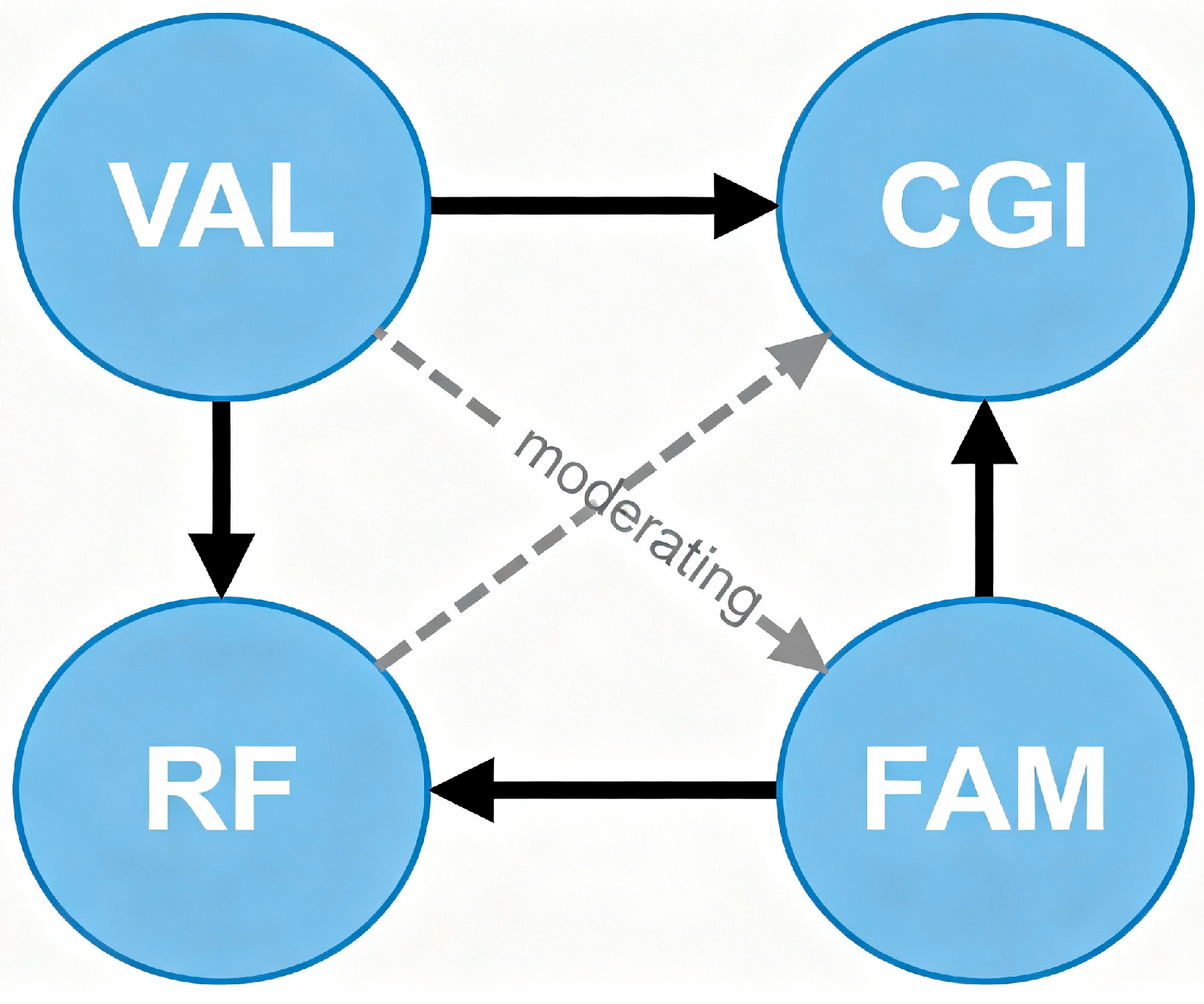
Figure 1. Conceptual Framework: Interaction Model of Resilience Factor (RF), Market Valuation (VAL), and Country Governance Index (CGI) in Shaping Financial Accounting Manipulation (FAM).
Jrfm 18 00719 g001
Table 1. Variable definition.
VariableDefinition of VariablesProxy/DescriptionReference and Data Source
Financial Accounting Manipulation (FAM)The practice of companies changing or engineering financial reports to make them look better than the actual conditions. D e c h o w   F S c o r e = A c c r u a l   Q u a l i t y + F i n a n c i a l   P e r f o r m a n c e
A c c r u a l   Q u a l i t y =
C h a n g e   i n   W o r k i n g   C a p i t a l   +   C h a n g e   i n   N o n   C u r r e n t   O p e r a t i n g   A s s e t s   +   C h a n g e   i n   F i n a n c i n g   A c t i v i t i e s A v e r a g e   T o t a l   A s s e t s
F i n a n c i a l   P e r f o m a n c e = C h a n g e   i n   A c c o u n t s   R e c e i v a b l e     C h a n g e   i n   I n v e n t o r y     C h a n g e   i n   C o m m o n   S t o c k     C h a n g e   i n   N e t   I n c o m e A v e r a g e   T o t a l   A s s e t s
References: Dechow et al. (2011).
Sources: Refinitiv Eikon
Stock Market Valuation (VAL)Market valuation of a company, usually measured by financial ratios such as Price-to-Earnings (PE) or Price-to-Book (PB). P r i c e   t o   E a r n i n g s   V A L 1 = M a r k e t   P r i c e   o f   C o m p a n y   S t o c k E a r n i n g s
P r i c e   t o   B o o k   V A L 2 = M a r k e t   P r i c e   o f   C o m p a n y   S t o c k B o o k   V a l u e   o f   E q u i t y
B o o k   V a l u e   o f   E q u i t y = T o t a l   A s s e t T o t a l   L i a b i l i t i e s
References: Graham and Dodd (1934).
Fama and French (1992).
Sources: Refinitiv Eikon
Resilience Factor (RF)A measure of a company’s financial resilience to the risk of bankruptcy, for example, using the Altman Z-score or Grover Model. A l t m a n   Z S c o r e   R F 1        = 1.2 × W o r k i n g   C a p i t a l T o t a l   A s s e t s + 1.4 × R e t a i n e d   E a r n i n g s T o t a l   A s s e t s        + 3.3 × E a r n i n g s   B e f o r e   I n t e r e s t   &   T a x e s T o t a l   A s s e t s + 0.6 × M a r k e t   V a l u e   o f   E q u i t y T o t a l   A s s e t s        + 1.0 × S a l e s T o t a l   A s s e t s
G r o v e r   G S c o r e   R F 2        = 1.650 × W o r k i n g   C a p i t a l T o t a l   A s s e t s + 3.404 × E a r n i n g s   B e f o r e   I n t e r e s t   &   T a x e s T o t a l   A s s e t s        0.016 × N e t   I n c o m e T o t a l   A s s e t s + 0.057
References: Altman (1968)
Grover (1998)
Sources: Refinitiv Eikon
Country Governance Index (CGI)World bank Country Governance Indicators Worldwide Governance Indicator (WGI) developed by Kaufmann et al. (2010).
(Voice and Accountability, Political Stability, Government Effectiveness, Regulatory Quality, Rule of Law, and Control of Corruption)
Reference:
Kaufmann et al. (2010)
Source:
Website World Bank (www.worldbank.org, 28 October 2025)
Interaction Term 1 (RF × VAL)The interaction between a company’s financial resilience and market valuation. I T 1 = R e s i l i e n c e   F a c t o r × S t o c k   M a r k e t   V a l u a t i o n Sources: Refinitiv Eikon
Interaction Term 2 (VAL × CGI)The interaction between market valuation and the quality of state governance. I T 2 = S t o c k   M a r k e t   V a l u a t i o n × C o u n t r y   G o v e r n a n c e   I n d e x   Sources: Refinitiv Eikon
Interaction Term 3 (RF × CGI)The interaction between corporate financial resilience and the quality of state governance. I T 3 = R e s i l i e n c e   F a c t o r × C o u n t r y   G o v e r n a n c e   I n d e x   Sources: Refinitiv Eikon
Debt to Equity Ratio (DER)The debt-to-equity ratio indicates the company’s funding structure. D E R = T o t a l   D e b t T o t a l   E q u i t y References:
Myers (1977)
Sources: Refinitiv Eikon
Firm Size (SIZE)Company size, generally proxied by the logarithm of total assets. S I Z E = l n T o t a l   A s s e t s   i n   U S D References:
Christie (1987)
Sources: Refinitiv Eikon
Table 2. Dataset description.
IndustryFreq.PercentCum.RegionsFreq.PercentCum.
Energy and Utilities12362.392.39East Asia25,16448.7348.73
Industry and Infrastructure12,02423.2925.68Southeast Asia15,98430.9679.69
Consumer and Lifestyle26,47251.2776.95South Asia624012.0891.77
Service and Communication33486.4883.43West Asia42488.23100
Property and Natural Resources855616.57100
Total51,636100 Total51,636100
This table presents the sample distribution by industry classification and regional grouping across Asian countries.
Table 3. Descriptive statistics.
StatsFAMVAL1VAL2RF1RF2CGIDERSIZE
Mean−3.3966.6501.5234.8341.5980.2581.16218.855
p500.0000.0001.0183.5150.814−0.1070.82018.725
SD37.21212.4271.4094.3471.7970.6731.0611.962
Min−97.884−1.5110.1860.141−0.306−1.1620.0897.048
Max65.37044.5735.61217.3775.8141.6284.05526.700
p5−97.884−1.5110.1860.141−0.306−0.5270.08915.874
p9565.37044.5735.61217.3775.8141.3234.05522.303
N50,77751,54751,54751,63351,63651,63651,63651,636
Table 4. Pairwise correlation.
VAL1VAL2RF1RF2CGIDERSIZE
VAL11
VAL20.2751
RF10.0750.3221
RF2−0.0600.0060.6411
CGI0.094−0.035−0.213−0.4771
DER−0.0400.072−0.385−0.182−0.0771
SIZE0.342−0.025−0.167−0.1580.2030.1781
Table 5. Heterogeneity character and endogeneity test.
VariableOLSFERE
VAL10.100 ***
(0.021)
0.104 ***
(0.029)
0.100 ***
(0.023)
RF10.275 ***
(0.052)
0.297 ***
(0.069)
0.275 ***
(0.048)
CGI−2.222 ***
(0.403)
38.14 ***
(1.813)
−2.222 ***
(0.402)
DER−0.999 ***
(0.187)
−2.245 ***
(0.293)
−0.999 ***
(0.174)
SIZE1.777 ***
(0.098)
12.08 ***
(0.369)
1.777 ***
(0.095)
VAL1 × CGI−0.028
(0.018)
−0.000
(0.027)
−0.028
(0.020)
RF1 × CGI0.221 ***
(0.065)
−0.161
(0.101)
0.221 ***
(0.063)
VAL1 × RF1−0.00564 **
(0.003)
−0.001
(0.00365)
−0.00564 **
(0.003)
Constant−37.06 ***
(1.903)
−240.4 ***
(6.858)
−37.06 ***
(1.763)
FE Test 0.91
RE Test 0.32
Auto1.148
Heterogeneity345.55 ***
Endogeneity 22.412 ***
Observations50,68950,68950,689
R-squared0.0110.041
This table presents regression estimates from Ordinary Least-Squares (OLS), Fixed Effects (FE), and Random Effects (RE) models to examine heterogeneity characteristics and potential endogeneity in the relationship between firm-specific and governance variables. Robust standard errors are reported in parentheses. *** p < 0.01, ** p < 0.05, * p < 0.1.
Table 6. Baseline regression.
VariableCoefficient
RF10.546 ***
(0.097)
VAL1−0.129 **
(0.060)
CGI−1.060 **
(0.450)
DER0.064
(0.230)
SIZE1.832 ***
(0.128)
RF1 × VAL10.009
(0.006)
VAL1 × CGI0.061 **
(0.027)
RF1 × CGI0.005
(0.071)
Constant−34.27 ***
(2.419)
Over-id Test5.24
Under-id Test1342.048 ***
F Stat42.99 ***
Observations38,617
R-squared0.007
This table reports baseline IV-2SLS regression estimates analyzing the impact of RF, VAL, and CGI on FAM, including control variables and interaction effects. Robust standard errors are in parentheses. *** p < 0.01, ** p < 0.05, * p < 0.1.
Table 7. Robustness check alternative proxies.
VARIABLESBaselineFAM-RF1-VAL2FAM-RF2-VAL1FAM-RF2-VAL2
RF#0.546 ***0.413 ***1.654 ***2.709 ***
(0.097)(0.112)(0.278)(0.340)
VAL#−0.129 **0.495 *−0.0012.332 ***
(0.060)(0.300)(0.0310)(0.414)
CGI−1.060 **−1.584 ***−1.592 ***0.301
(0.450)(0.478)(0.451)(0.580)
DER0.064−0.107−0.122−0.354 *
(0.230)(0.258)(0.205)(0.194)
SIZE1.832 ***1.648 ***1.629 ***1.645 ***
(0.128)(0.098)(0.124)(0.097)
RF * × VAL *0.0090.203 *0.194 **−0.528 ***
(0.006)(0.108)(0.085)(0.159)
VAL * × CGI0.061 **0.1650.527 ***−0.719 **
(0.027)(0.256)(0.201)(0.306)
RF * × CGI0.0050.829 ***1.713 ***1.744 ***
(0.071)(0.243)(0.267)(0.263)
Constant−34.27 ***−31.42 ***−30.82 ***−34.46 ***
(2.419)(2.079)(2.229)(2.056)
Over-id Test5.2425.42114.31411.403
Under-id Test1342.048 ***3097.409 ***3233.547 ***3162.18 ***
F Stat42.99 ***56.99 ***58.22 ***62.53 ***
Observations38,61738,61738,62138,621
R-squared0.0070.0110.0150.013
Note: This table presents robustness 2SLS-IV regression results using alternative proxies of the main variables. Interaction terms with RF2 and VAL2 are tested to capture moderating effects. Robust standard errors are in parentheses. *** p < 0.01, ** p < 0.05, * p < 0.1. When the analysis is performed by country region (East Asia, Southeast Asia, South Asia, and West Asia, see Table 8), most of the main results remain consistent in terms of both the direction and significance of the coefficients relative to the baseline model. Given that more than 75% of the sample is drawn from East and Southeast Asia, these findings confirm that the relationship between RF and FAM is generally robust. However, variations in statistical significance across regions indicate that institutional strength and governance infrastructure may moderate this relationship. In other words, the influence of RF on FAM tends to be stronger in countries with relatively weaker legal systems and monitoring mechanisms, suggesting that the effect is contextually sensitive to differences in regional governance quality.
Table 8. Robustness check: country region.
VariableBaselineEast AsiaSoutheast
Asia
South AsiaWest Asia
RF10.546 ***2.340 ***0.840 ***1.813 ***−1.266 **
(0.097)(0.632)(0.199)(0.359)(0.543)
VAL1−0.129 **−0.019−0.274 **−0.278 *−0.973 ***
(0.060)(0.127)(0.112)(0.167)(0.260)
CGI−1.060 **2.771−3.783 **−12.01 ***14.06 ***
(0.450)(2.409)(1.491)(3.630)(4.471)
DER0.064−0.4920.6701.366 **−0.507
(0.230)(0.372)(0.408)(0.551)(0.881)
SIZE1.832 ***1.412 ***2.098 ***1.478 ***3.259 ***
(0.128)(0.187)(0.222)(0.325)(0.512)
RF1 × VAL10.009−0.0080.012−0.0100.130 ***
(0.006)(0.0107)(0.011)(0.012)(0.030)
VAL1 × CGI0.061 **0.0859−0.003−0.662 **−0.278
(0.027)(0.0837)(0.052)(0.269)(0.204)
RF1 × CGI0.005−1.855 ***0.713 **2.967 ***−2.678 ***
(0.071)(0.536)(0.284)(0.633)(0.689)
Constant−34.27 ***−29.59 ***−40.25 ***−35.83 ***−52.05 ***
(2.419)(5.170)(4.031)(6.004)(8.812)
Over-id Test5.2411.9944.2226.3033.925
Under-id Test1342.048 ***464.278 ***325.298 ***197.103 ***161.23 ***
F Stat42.99 ***22.82 ***15.84 ***6.64 ***9.9 ***
Observations38,61718,80211,95846753182
R-squared0.007−0.0050.005−0.026−0.007
Note: This table reports regional robustness IV-2SLS regression for East Asia, Southeast Asia, South Asia, and West Asia. Interaction terms test the moderating roles of firm resilience and governance quality. Robust standard errors in parentheses. *** p < 0.01, ** p < 0.05, * p < 0.1. Robustness tests across industry (see Table 9) indicate that most relationship patterns remain consistent, particularly in the consumer and lifestyle and property and natural resources sectors, which show similar coefficient signs and significance levels to the baseline model. This finding suggests that the influence of RF on FAM is relatively stable in industries characterized by volatile business cycles and strong reputational pressures. In contrast, the relationship appears weaker in infrastructure- and energy-intensive sectors, implying that regulatory constraints and higher leverage may restrict managerial discretion in earnings management. Overall, the RF–FAM relationship can be considered robust, though it remains context-dependent across industries with stronger external monitoring mechanisms.
Table 9. Robustness check: industry.
VariableBaselineEnergy
and Utilities
Industry
and Infrastructure
Consumer
and Lifestyle
Service
and Communication
Property
and Natural Resources
RF10.546 ***1.6410.2290.410 **0.3494.626 ***
(0.097)(1.466)(0.249)(0.175)(0.776)(1.136)
VAL1−0.129 **−0.029−0.250 **−0.223 *−0.044−2.090
(0.060)(0.356)(0.111)(0.134)(0.274)(1.734)
CGI−1.060 **−2.0300.467−1.479−4.173−54.89 ***
(0.450)(3.121)(1.316)(1.080)(2.696)(18.31)
DER0.0640.9690.184−0.904 **0.1051.456 ***
(0.230)(1.271)(0.433)(0.362)(0.824)(0.520)
SIZE1.832 ***1.395 *2.372 ***1.444 ***0.947 ***2.512 ***
(0.128)(0.750)(0.268)(0.190)(0.338)(0.356)
RF1 × VAL10.0090.0010.031 **0.0130.0060.015
(0.006)(0.076)(0.013)(0.011)(0.029)(0.049)
VAL1 × CGI0.061 **−0.122−0.124 **0.186 **0.048−5.319
(0.027)(0.112)(0.058)(0.075)(0.111)(4.452)
RF1 × CGI0.0050.9700.031−0.1840.07911.41 ***
(0.071)(1.493)(0.290)(0.119)(0.292)(3.144)
Constant−34.27 ***−32.04 *−43.30 ***−24.44 ***−13.51 *−66.92 ***
(2.419)(19.13)(4.929)(3.601)(8.006)(9.192)
Over-id Test5.242.1766.4763.42812.8459.069
Under-id Test1342.048 ***33.532 ***487.221 ***405.555 ***91.148 ***9.193 ***
F Stat42.99 ***1.27 ***15.3 ***14.69 ***6.27 ***10.67 ***
Observations38,617927900819,78525106387
R-squared0.007−0.0340.0160.0030.015−0.044
Note: This table presents robustness IV-2SLS regression across major industry sectors to test the consistency of results. Interaction terms evaluate the moderating effects of firm resilience factors and governance quality. Robust standard errors are in parentheses. *** p < 0.01, ** p < 0.05, * p < 0.1. The robustness analysis comparing the COVID-19 (vs non-COVID-19) periods (see Table 10) reveals that the relationship between firm resilience (RF) and financial accounting manipulation (FAM) remains stable across both periods. This finding reinforces the interpretation that corporate resilience serves as a fundamental determinant of firms’ financial reporting behavior. However, the slightly higher level of significance during the pandemic period suggests that macroeconomic uncertainty may intensify managerial incentives to adjust financial statements to sustain market confidence (Kothari et al., 2016; Ding et al., 2021). Overall, the results indicate that the influence of RF on FAM is robust across crisis and non-crisis conditions, with its magnitude becoming stronger under extreme economic environments—reflecting firms’ strategic adaptability to external shocks.
Table 10. Robustness check: COVID-19 and non-COVID-19.
VariableBaselineCOVID-19Non-COVID-19
RF10.546 ***0.848 ***0.167
(0.097)(0.130)(0.147)
VAL1−0.129 **−0.035−0.245 ***
(0.060)(0.078)(0.088)
CGI−1.060 **0.457−3.350 ***
(0.450)(0.562)(0.746)
DER0.0640.713 **−0.861 **
(0.230)(0.297)(0.362)
SIZE1.832 ***1.656 ***2.134 ***
(0.128)(0.162)(0.207)
RF1 × VAL10.009−0.0040.025 ***
(0.006)(0.008)(0.009)
VAL1 × CGI0.061 **0.03820.098 **
(0.027)(0.036)(0.040)
RF1 × CGI0.005−0.1090.172
(0.071)(0.093)(0.110)
Constant−34.27 ***−34.30 ***−35.45 ***
(2.419)(3.045)(3.933)
Over-id Test5.244.1634.459
Under-id Test1342.048 ***709.029 ***672.537 ***
F Stat42.99 ***24.17 ***23.43 ***
Observations38,61721,47317,144
R-squared0.0070.0050.006
Note: This table reports IV-2SLS regression estimates assessing the impact of RF, VAL, and CGI on FAM across COVID-19 and non-COVID-19 periods. The model addresses potential endogeneity. Under-id and Over-id test statistics indicate instrument validity. Robust standard errors in parentheses. *** p < 0.01, ** p < 0.05, * p < 0.1.
Disclaimer/Publisher’s Note: The statements, opinions and data contained in all publications are solely those of the individual author(s) and contributor(s) and not of MDPI and/or the editor(s). MDPI and/or the editor(s) disclaim responsibility for any injury to people or property resulting from any ideas, methods, instructions or products referred to in the content.


