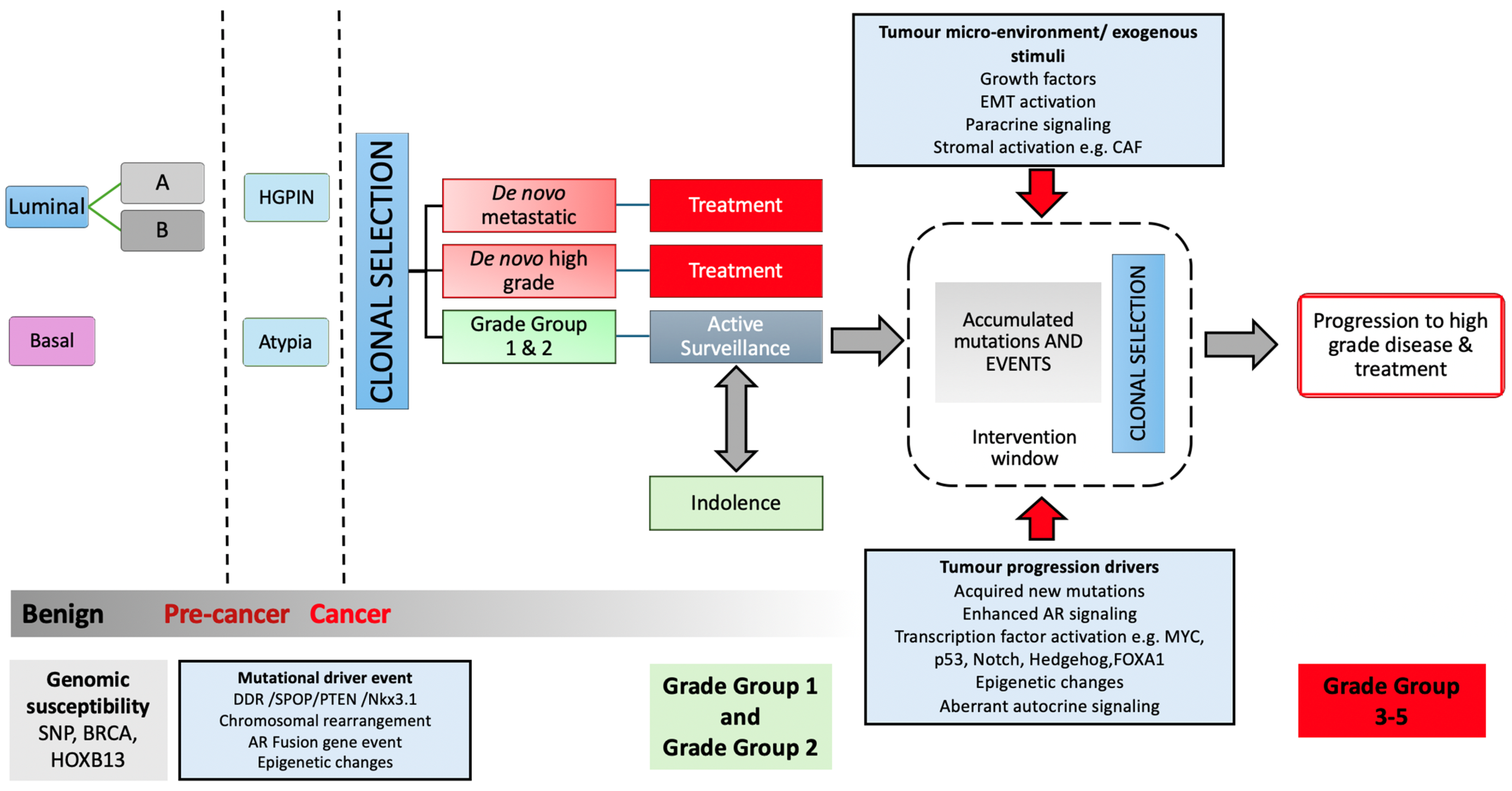
Mechanisms of Progression and Challenges for Intervention in the Natural History of Early Prostate Cancer: A Narrative Review




Simple Summary
Abstract
1. Introduction
2. Literature Review Strategy
3. Cellular and Molecular Factors in Prostate Cancer
3.1. Genetic Predisposition
3.2. Chromosomal Rearrangements
3.3. Androgen Receptor (AR) Signalling
3.4. Other Common Molecular/Genetic Perturbations
3.5. Epigenetic Changes
3.6. Aberrant Signalling Pathways
3.7. Cell Type Composition
3.8. The Tumour Microenvironment (TME)
4. Modelling Early Disease Progression
5. Opportunities for Therapeutics in Early Cancer Intervention
6. Conclusions
Author Contributions
Funding
Data Availability Statement
Acknowledgments
Conflicts of Interest
References
- Rawla, P. Epidemiology of Prostate Cancer. World J. Oncol. 2019, 10, 63–89. [Google Scholar] [CrossRef] [PubMed]
- Gnanapragasam, V.J.; Barrett, T.; Pacey, S.; Warren, A. Does modern active surveillance offer an opportunity for new therapeutic strategies in early prostate cancer? BJU Int. 2021, 127, 628–629. [Google Scholar] [CrossRef] [PubMed]
- Gnanapragasam, V. Shifting the paradigm in the management of early prostate cancer. Br. J. Cancer 2024, 130, 1075–1077. [Google Scholar] [CrossRef] [PubMed]
- Gnanapragasam, V.J.; Keates, A.; Lophatananon, A.; Thankapannair, V. The 5-year results of the Stratified Cancer Active Surveillance programme for men with prostate cancer. BJU Int. 2025, 135, 851–859. [Google Scholar] [CrossRef] [PubMed]
- Penney, K.L.; Stampfer, M.J.; Jahn, J.L.; Sinnott, J.A.; Flavin, R.; Rider, J.R.; Finn, S.; Giovannucci, E.; Sesso, H.D.; Loda, M.; et al. Gleason grade progression is uncommon. Cancer Res. 2013, 73, 5163–5168. [Google Scholar] [CrossRef] [PubMed]
- Rider, J.R.; Sandin, F.; Andrén, O.; Wiklund, P.; Hugosson, J.; Stattin, P. Long-term Outcomes Among Noncuratively Treated Men According to Prostate Cancer Risk Category in a Nationwide, Population-based Study. Eur. Urol. 2013, 63, 88–96. [Google Scholar] [CrossRef] [PubMed]
- Salami, S.S.; Tosoian, J.J.; Nallandhighal, S.; Jones, T.A., Jr.; Brockman, S.; Elkhoury, F.F.; Bazzi, S.; Plouffe, K.R.; Siddiqui, J.; Liu, C.J.; et al. Serial Molecular Profiling of Low-grade Prostate Cancer to Assess Tumor Upgrading: A Longitudinal Cohort Study. Eur. Urol. 2021, 79, 456–465. [Google Scholar] [CrossRef] [PubMed]
- Englman, C.; Adebusoye, B.; Maffei, D.; Stavrinides, V.; Bridge, J.; Kirkham, A.; Allen, C.; Dickinson, L.; Pendse, D.; Punwani, S.; et al. Magnetic Resonance Imaging-led Risk-adapted Active Surveillance for Prostate Cancer: Updated Results from a Large Cohort Study. Eur. Urol. 2025, 88, 167–175. [Google Scholar] [CrossRef] [PubMed]
- Sowalsky, A.G.; Kissick, H.T.; Gerrin, S.J.; Schaefer, R.J.; Xia, Z.; Russo, J.W.; Arredouani, M.S.; Bubley, G.J.; Sanda, M.G.; Li, W.; et al. Gleason Score 7 Prostate Cancers Emerge through Branched Evolution of Clonal Gleason Pattern 3 and 4. Clin. Cancer Res. 2017, 23, 3823–3833. [Google Scholar] [CrossRef] [PubMed]
- Huntley, C.; Torr, B.; Sud, A.; Rowlands, C.F.; Way, R.; Snape, K.; Hanson, H.; Swanton, C.; Broggio, J.; Lucassen, A.; et al. Utility of polygenic risk scores in UK cancer screening: A modelling analysis. Lancet Oncol. 2023, 24, 658–668. [Google Scholar] [CrossRef] [PubMed]
- Vickers, A.J.; Sud, A.; Bernstein, J.; Houlston, R. Polygenic risk scores to stratify cancer screening should predict mortality not incidence. npj Precis. Oncol. 2022, 6, 32. [Google Scholar] [CrossRef] [PubMed]
- Siltari, A.; Lönnerbro, R.; Pang, K.; Shiranov, K.; Asiimwe, A.; Evans-Axelsson, S.; Franks, B.; Kiran, A.; Murtola, T.J.; Schalken, J.; et al. How Well do Polygenic Risk Scores Identify Men at High Risk for Prostate Cancer? Systematic Review and Meta-Analysis. Clin. Genitourin. Cancer 2023, 21, 316.e1–316.e11. [Google Scholar] [CrossRef] [PubMed]
- Sud, A.; McNeill, A.; Vickers, A.J. Comparison of Results from the BARCODE1 Study and Contemporary Prostate Cancer Screening Trials. Eur. Urol. Oncol. 2025, in press. [Google Scholar] [CrossRef] [PubMed]
- Lophatananon, A.; Muir, K.R.; Gnanapragasam, V.J. The efficacy of different biomarkers and endpoints to refine referrals for suspected prostate cancer: The TARGET study (Tiered integrAted tests for eaRly diaGnosis of clinically significant ProstatE Tumours). BMC Med. 2024, 22, 440. [Google Scholar] [CrossRef] [PubMed]
- Klein, R.J.; Vertosick, E.; Sjoberg, D.; Ulmert, D.; Ronn, A.C.; Haggstrom, C.; Thysell, E.; Hallmans, G.; Dahlin, A.; Stattin, P.; et al. Prostate cancer polygenic risk score and prediction of lethal prostate cancer. npj Precis. Oncol. 2022, 6, 25. [Google Scholar] [CrossRef] [PubMed]
- Goss, L.B.; Liu, M.; Zheng, Y.; Guo, B.; Conti, D.V.; Haiman, C.A.; Kachuri, L.; Catalona, W.J.; Witte, J.S.; Lin, D.W.; et al. Polygenic Risk Score and Upgrading in Patients With Prostate Cancer Receiving Active Surveillance. JAMA Oncol. 2025, 11, 168–171. [Google Scholar] [CrossRef] [PubMed]
- Abeshouse, A.; Ahn, J.; Akbani, R.; Ally, A.; Amin, S.; Andry, C.D.; Annala, M.; Aprikian, A.; Armenia, J.; Arora, A.; et al. The Molecular Taxonomy of Primary Prostate Cancer. Cell 2015, 163, 1011–1025. [Google Scholar] [CrossRef] [PubMed]
- Stephens, P.J.; Greenman, C.D.; Fu, B.; Yang, F.; Bignell, G.R.; Mudie, L.J.; Pleasance, E.D.; Lau, K.W.; Beare, D.; Stebbings, L.A.; et al. Massive genomic rearrangement acquired in a single catastrophic event during cancer development. Cell 2011, 144, 27–40. [Google Scholar] [CrossRef] [PubMed]
- Baca, S.C.; Prandi, D.; Lawrence, M.S.; Mosquera, J.M.; Romanel, A.; Drier, Y.; Park, K.; Kitabayashi, N.; MacDonald, T.Y.; Ghandi, M.; et al. Punctuated evolution of prostate cancer genomes. Cell 2013, 153, 666–677. [Google Scholar] [CrossRef] [PubMed]
- Kim, I.E.; Kim, S.; Srivastava, A.; Saraiya, B.; Mayer, T.; Kim, W.-J.; Kim, I.Y. Similar incidence of DNA damage response pathway alterations between clinically localized and metastatic prostate cancer. BMC Urol. 2019, 19, 33. [Google Scholar] [CrossRef] [PubMed]
- Rajwa, P.; Quhal, F.; Pradere, B.; Gandaglia, G.; Ploussard, G.; Leapman, M.S.; Gore, J.L.; Paradysz, A.; Tilki, D.; Merseburger, A.S.; et al. Prostate cancer risk, screening and management in patients with germline BRCA1/2 mutations. Nat. Rev. Urol. 2023, 20, 205–216. [Google Scholar] [CrossRef] [PubMed]
- O’Connor, M.J. Targeting the DNA Damage Response in Cancer. Mol. Cell 2015, 60, 547–560. [Google Scholar] [CrossRef] [PubMed]
- Robinson, D.; Van Allen, E.M.; Wu, Y.M.; Schultz, N.; Lonigro, R.J.; Mosquera, J.M.; Montgomery, B.; Taplin, M.E.; Pritchard, C.C.; Attard, G.; et al. Integrative Clinical Genomics of Advanced Prostate Cancer. Cell 2015, 162, 454. [Google Scholar] [CrossRef] [PubMed]
- Pritchard, C.C.; Mateo, J.; Walsh, M.F.; De Sarkar, N.; Abida, W.; Beltran, H.; Garofalo, A.; Gulati, R.; Carreira, S.; Eeles, R.; et al. Inherited DNA-Repair Gene Mutations in Men with Metastatic Prostate Cancer. N. Engl. J. Med. 2016, 375, 443–453. [Google Scholar] [CrossRef] [PubMed]
- Castro, E.; Goh, C.; Olmos, D.; Saunders, E.; Leongamornlert, D.; Tymrakiewicz, M.; Mahmud, N.; Dadaev, T.; Govindasami, K.; Guy, M.; et al. Germline BRCA mutations are associated with higher risk of nodal involvement, distant metastasis, and poor survival outcomes in prostate cancer. J. Clin. Oncol. 2013, 31, 1748–1757. [Google Scholar] [CrossRef] [PubMed]
- Thurtle, D.R.; Greenberg, D.C.; Lee, L.S.; Huang, H.H.; Pharoah, P.D.; Gnanapragasam, V.J. Individual prognosis at diagnosis in nonmetastatic prostate cancer: Development and external validation of the PREDICT Prostate multivariable model. PLoS Med. 2019, 16, e1002758. [Google Scholar] [CrossRef] [PubMed]
- Carter, H.B.; Helfand, B.; Mamawala, M.; Wu, Y.; Landis, P.; Yu, H.; Wiley, K.; Na, R.; Shi, Z.; Petkewicz, J.; et al. Germline Mutations in ATM and BRCA1/2 Are Associated with Grade Reclassification in Men on Active Surveillance for Prostate Cancer. Eur. Urol. 2019, 75, 743–749. [Google Scholar] [CrossRef] [PubMed]
- Chen, Y.; Cao, J.; Huang, R.; Lou, J.; Gu, J.; Luo, Z.; Yao, T.; Xie, J. PARP Inhibitors in the Treatment of Prostate Cancer: An Analysis of the Clinical Trial Landscape. Cancer Med. 2025, 14, e71298. [Google Scholar] [CrossRef] [PubMed]
- Clark, J.P.; Cooper, C.S. ETS gene fusions in prostate cancer. Nat. Rev. Urol. 2009, 6, 429–439. [Google Scholar] [CrossRef] [PubMed]
- De Cecco, F.; Chellini, L.; Riccioni, V.; Paronetto, M.P. Oncogenic Fusions Harboring ETS Genes: Exploring Novel Targetable Opportunities in Prostate Cancer. Cancers 2025, 17, 1657. [Google Scholar] [CrossRef] [PubMed]
- Camacho, N.; Van Loo, P.; Edwards, S.; Kay, J.D.; Matthews, L.; Haase, K.; Clark, J.; Dennis, N.; Thomas, S.; Kremeyer, B.; et al. Appraising the relevance of DNA copy number loss and gain in prostate cancer using whole genome DNA sequence data. PLoS Genet. 2017, 13, e1007001. [Google Scholar] [CrossRef] [PubMed]
- O’Malley, D.E.; Raspin, K.; Melton, P.E.; Burdon, K.P.; Dickinson, J.L.; FitzGerald, L.M. Acquired copy number variation in prostate tumours: A review of common somatic copy number alterations, how they are formed and their clinical utility. Br. J. Cancer 2024, 130, 347–357. [Google Scholar] [CrossRef] [PubMed]
- Hayes, V.; Jiang, J.; Tapinos, A.; Huang, R.; Bornman, R.; Stricker, P.; Mutambirwa, S.; Wedge, D.; Jaratlerdsiri, W. Kataegis associated mutational processes linked to adverse prostate cancer presentation in African men. Res. Sq. 2024, rs.3.rs–4597464. [Google Scholar] [CrossRef] [PubMed]
- Koh, G.; Degasperi, A.; Zou, X.; Momen, S.; Nik-Zainal, S. Mutational signatures: Emerging concepts, caveats and clinical applications. Nat. Rev. Cancer 2021, 21, 619–637. [Google Scholar] [CrossRef] [PubMed]
- Gerhauser, C.; Favero, F.; Risch, T.; Simon, R.; Feuerbach, L.; Assenov, Y.; Heckmann, D.; Sidiropoulos, N.; Waszak, S.M.; Hübschmann, D.; et al. Molecular Evolution of Early-Onset Prostate Cancer Identifies Molecular Risk Markers and Clinical Trajectories. Cancer Cell 2018, 34, 996–1011.e1018. [Google Scholar] [CrossRef] [PubMed]
- Kovtun, I.V.; Murphy, S.J.; Johnson, S.H.; Cheville, J.C.; Vasmatzis, G. Chromosomal catastrophe is a frequent event in clinically insignificant prostate cancer. Oncotarget 2015, 6, 29087–29096. [Google Scholar] [CrossRef] [PubMed]
- Cortes-Ciriano, I.; Lee, J.J.; Xi, R.; Jain, D.; Jung, Y.L.; Yang, L.; Gordenin, D.; Klimczak, L.J.; Zhang, C.Z.; Pellman, D.S.; et al. Comprehensive analysis of chromothripsis in 2,658 human cancers using whole-genome sequencing. Nat. Genet. 2020, 52, 331–341. [Google Scholar] [CrossRef] [PubMed]
- Yamaguchi, T.N.; Houlahan, K.E.; Zhu, H.; Kurganovs, N.; Livingstone, J.; Fox, N.S.; Yuan, J.; Sietsma Penington, J.; Jung, C.H.; Schwarz, T.; et al. The Germline and Somatic Origins of Prostate Cancer Heterogeneity. Cancer Discov. 2025, 15, 988–1017. [Google Scholar] [CrossRef] [PubMed]
- Maekawa, S.; Takata, R.; Obara, W. Molecular Mechanisms of Prostate Cancer Development in the Precision Medicine Era: A Comprehensive Review. Cancers 2024, 16, 523. [Google Scholar] [CrossRef] [PubMed]
- Waltering, K.K.; Helenius, M.A.; Sahu, B.; Manni, V.; Linja, M.J.; Janne, O.A.; Visakorpi, T. Increased expression of androgen receptor sensitizes prostate cancer cells to low levels of androgens. Cancer Res. 2009, 69, 8141–8149. [Google Scholar] [CrossRef] [PubMed]
- Santer, F.R.; Erb, H.H.; McNeill, R.V. Therapy escape mechanisms in the malignant prostate. Semin. Cancer Biol. 2015, 35, 133–144. [Google Scholar] [CrossRef] [PubMed]
- Taylor, B.S.; Schultz, N.; Hieronymus, H.; Gopalan, A.; Xiao, Y.; Carver, B.S.; Arora, V.K.; Kaushik, P.; Cerami, E.; Reva, B.; et al. Integrative genomic profiling of human prostate cancer. Cancer Cell 2010, 18, 11–22. [Google Scholar] [CrossRef] [PubMed]
- Huang, Y.; Jiang, X.; Liang, X.; Jiang, G. Molecular and cellular mechanisms of castration resistant prostate cancer. Oncol. Lett. 2018, 15, 6063–6076. [Google Scholar] [CrossRef] [PubMed]
- Haile, S.; Sadar, M.D. Androgen receptor and its splice variants in prostate cancer. Cell. Mol. Life Sci. 2011, 68, 3971–3981. [Google Scholar] [CrossRef] [PubMed]
- Antonarakis, E.S.; Lu, C.; Wang, H.; Luber, B.; Nakazawa, M.; Roeser, J.C.; Chen, Y.; Mohammad, T.A.; Chen, Y.; Fedor, H.L.; et al. AR-V7 and resistance to enzalutamide and abiraterone in prostate cancer. N. Engl. J. Med. 2014, 371, 1028–1038. [Google Scholar] [CrossRef] [PubMed]
- Zhao, S.G.; Chang, S.L.; Erho, N.; Yu, M.; Lehrer, J.; Alshalalfa, M.; Speers, C.; Cooperberg, M.R.; Kim, W.; Ryan, C.J.; et al. Associations of Luminal and Basal Subtyping of Prostate Cancer With Prognosis and Response to Androgen Deprivation Therapy. JAMA Oncol. 2017, 3, 1663–1672. [Google Scholar] [CrossRef] [PubMed]
- Gao, S.; Patten, N.D.; Cai, C. Alterations in AR-FOXA1 signaling in prostate cancer progression and therapeutic resistance. J. Natl. Cancer Cent. 2025, 6, 58–72. [Google Scholar] [CrossRef] [PubMed]
- Weischenfeldt, J.; Simon, R.; Feuerbach, L.; Schlangen, K.; Weichenhan, D.; Minner, S.; Wuttig, D.; Warnatz, H.-J.; Stehr, H.; Rausch, T.; et al. Integrative Genomic Analyses Reveal an Androgen-Driven Somatic Alteration Landscape in Early-Onset Prostate Cancer. Cancer Cell 2013, 23, 159–170. [Google Scholar] [CrossRef] [PubMed]
- Shore, N.D.; Renzulli, J.; Fleshner, N.E.; Hollowell, C.M.P.; Vourganti, S.; Silberstein, J.; Siddiqui, R.; Hairston, J.; Elsouda, D.; Russell, D.; et al. Enzalutamide Monotherapy vs Active Surveillance in Patients With Low-risk or Intermediate-risk Localized Prostate Cancer: The ENACT Randomized Clinical Trial. JAMA Oncol. 2022, 8, 1128–1136. [Google Scholar] [CrossRef] [PubMed]
- Ross, A.E.; Iwata, K.K.; Elsouda, D.; Hairston, J.; Russell, D.; Davicioni, E.; Proudfoot, J.A.; Shore, N.D.; Schaeffer, E.M. Transcriptome-Based Prognostic and Predictive Biomarker Analysis of ENACT: A Randomized Controlled Trial of Enzalutamide in Men Undergoing Active Surveillance. JCO Precis. Oncol. 2024, 8, e2300603. [Google Scholar] [CrossRef] [PubMed]
- Barrett, T.; Pacey, S.; Leonard, K.; Wulff, J.; Funingana, I.G.; Gnanapragasam, V. A Feasibility Study of the Therapeutic Response and Durability of Short-term Androgen-targeted Therapy in Early Prostate Cancer Managed with Surveillance: The Therapeutics in Active Prostate Surveillance (TAPS01) Study. Eur. Urol. Open Sci. 2022, 38, 17–24. [Google Scholar] [CrossRef] [PubMed]
- Wedge, D.C.; Gundem, G.; Mitchell, T.; Woodcock, D.J.; Martincorena, I.; Ghori, M.; Zamora, J.; Butler, A.; Whitaker, H.; Kote-Jarai, Z.; et al. Sequencing of prostate cancers identifies new cancer genes, routes of progression and drug targets. Nat. Genet. 2018, 50, 682–692. [Google Scholar] [CrossRef] [PubMed]
- Barbieri, C.E.; Baca, S.C.; Lawrence, M.S.; Demichelis, F.; Blattner, M.; Theurillat, J.P.; White, T.A.; Stojanov, P.; Van Allen, E.; Stransky, N.; et al. Exome sequencing identifies recurrent SPOP, FOXA1 and MED12 mutations in prostate cancer. Nat. Genet. 2012, 44, 685–689. [Google Scholar] [CrossRef] [PubMed]
- Zakari, S.; Rotimi, S.O.; Bholah, C.T.; Ogunlana, O.O. Updates on SPOP Gene Mutations in Prostate Cancer and Computational Insights From TCGA cBioPortal Database. Scientifica 2025, 2025, 4084224. [Google Scholar] [CrossRef] [PubMed]
- Zhang, H.; Kong, L.; Li, J.; Liu, Z.; Zhao, Y.; Lv, X.; Wu, L.; Chai, L.; You, H.; Jin, J.; et al. SPOP mutations increase PARP inhibitor sensitivity via CK2/PIAS1/SPOP axis in prostate cancer. JCI Insight 2025, 10, e186871. [Google Scholar] [CrossRef] [PubMed]
- Liu, Y.; Tavana, O.; Gu, W. p53 modifications: Exquisite decorations of the powerful guardian. J. Mol. Cell Biol. 2019, 11, 564–577. [Google Scholar] [CrossRef] [PubMed]
- Teroerde, M.; Nientiedt, C.; Duensing, A.; Hohenfellner, M.; Stenzinger, A.; Duensing, S. Revisiting the Role of p53 in Prostate Cancer. In Prostate Cancer; Bott, S.R.J., Ng, K.L., Eds.; Exon Publication: Brisbane, Australia, 2021. [Google Scholar]
- Nishikawa, S.; Iwakuma, T. Drugs Targeting p53 Mutations with FDA Approval and in Clinical Trials. Cancers 2023, 15, 429. [Google Scholar] [CrossRef] [PubMed]
- Gerhardt, J.; Montani, M.; Wild, P.; Beer, M.; Huber, F.; Hermanns, T.; Muntener, M.; Kristiansen, G. FOXA1 promotes tumor progression in prostate cancer and represents a novel hallmark of castration-resistant prostate cancer. Am. J. Pathol. 2012, 180, 848–861. [Google Scholar] [CrossRef] [PubMed]
- Jin, H.-J.; Zhao, J.C.; Ogden, I.; Bergan, R.C.; Yu, J. Androgen Receptor-Independent Function of FoxA1 in Prostate Cancer Metastasis. Cancer Res. 2013, 73, 3725–3736. [Google Scholar] [CrossRef] [PubMed]
- McMenamin, M.E.; Soung, P.; Perera, S.; Kaplan, I.; Loda, M.; Sellers, W.R. Loss of PTEN expression in paraffin-embedded primary prostate cancer correlates with high Gleason score and advanced stage. Cancer Res. 1999, 59, 4291–4296. [Google Scholar] [PubMed]
- Mulholland, D.J.; Tran, L.M.; Li, Y.; Cai, H.; Morim, A.; Wang, S.; Plaisier, S.; Garraway, I.P.; Huang, J.; Graeber, T.G.; et al. Cell autonomous role of PTEN in regulating castration-resistant prostate cancer growth. Cancer Cell 2011, 19, 792–804. [Google Scholar] [CrossRef] [PubMed]
- Jamaspishvili, T.; Berman, D.M.; Ross, A.E.; Scher, H.I.; De Marzo, A.M.; Squire, J.A.; Lotan, T.L. Clinical implications of PTEN loss in prostate cancer. Nat. Rev. Urol. 2018, 15, 222–234. [Google Scholar] [CrossRef] [PubMed]
- Massie, C.; Gnanapragasam, V.J.; Barrett, T.; Warren, A.; Anand, S.; Keates, A.; Pacey, S. Implementation and yield of upfront genomic profiling in a clinical prostate cancer diagnostic pathway. BJU Int. 2023, 132, 499–501. [Google Scholar] [CrossRef] [PubMed]
- Fizazi, K.; Clarke, N.W.; De Santis, M.; Uemura, H.; Fay, A.P.; Karadurmus, N.; Kwiatkowski, M.; Alvarez-Fernandez, C.; Jiang, S.; Sotelo, M.; et al. Capivasertib plus abiraterone in PTEN-deficient metastatic hormone-sensitive prostate cancer: CAPItello-281 phase III study. Ann. Oncol. 2025, 37, 53–68. [Google Scholar] [CrossRef] [PubMed]
- Armenia, J.; Wankowicz, S.A.M.; Liu, D.; Gao, J.; Kundra, R.; Reznik, E.; Chatila, W.K.; Chakravarty, D.; Han, G.C.; Coleman, I.; et al. The long tail of oncogenic drivers in prostate cancer. Nat. Genet. 2018, 50, 645–651. [Google Scholar] [CrossRef] [PubMed]
- Yang, B.; Bhusari, S.; Kueck, J.; Weeratunga, P.; Wagner, J.; Leverson, G.; Huang, W.; Jarrard, D.F. Methylation profiling defines an extensive field defect in histologically normal prostate tissues associated with prostate cancer. Neoplasia 2013, 15, 399–408. [Google Scholar] [CrossRef] [PubMed]
- Mehrotra, J.; Varde, S.; Wang, H.; Chiu, H.; Vargo, J.; Gray, K.; Nagle, R.B.; Neri, J.R.; Mazumder, A. Quantitative, spatial resolution of the epigenetic field effect in prostate cancer. Prostate 2008, 68, 152–160. [Google Scholar] [CrossRef] [PubMed]
- Muletier, R.; Bourgne, C.; Guy, L.; Douge, A. DNA Methylation in Prostate Cancer: Clinical Implications and Potential Applications. Cancer Med. 2025, 14, e70528. [Google Scholar] [CrossRef] [PubMed]
- Partin, A.W.; Van Neste, L.; Klein, E.A.; Marks, L.S.; Gee, J.R.; Troyer, D.A.; Rieger-Christ, K.; Jones, J.S.; Magi-Galluzzi, C.; Mangold, L.A.; et al. Clinical validation of an epigenetic assay to predict negative histopathological results in repeat prostate biopsies. J. Urol. 2014, 192, 1081–1087. [Google Scholar] [CrossRef] [PubMed]
- Zhao, S.; Leonardson, A.; Geybels, M.S.; McDaniel, A.S.; Yu, M.; Kolb, S.; Zong, H.; Carter, K.; Siddiqui, J.; Cheng, A.; et al. A five-CpG DNA methylation score to predict metastatic-lethal outcomes in men treated with radical prostatectomy for localized prostate cancer. Prostate 2018, 78, 1084–1091. [Google Scholar] [CrossRef] [PubMed]
- Wang, X.; Jordahl, K.M.; Zhu, C.; Livingstone, J.; Rhie, S.K.; Wright, J.L.; Grady, W.M.; Boutros, P.C.; Stanford, J.L.; Dai, J.Y. Methylation Subtypes of Primary Prostate Cancer Predict Poor Prognosis. Cancer Epidemiol. Biomark. Prev. 2022, 31, 1473–1482. [Google Scholar] [CrossRef] [PubMed]
- Chao, C.R.; Slezak, J.; Siegmund, K.; Cannavale, K.; Shu, Y.H.; Chien, G.W.; Chen, X.F.; Shi, F.; Song, N.; Van Den Eeden, S.K.; et al. Genome-wide methylation profiling of diagnostic tumor specimens identified DNA methylation markers associated with metastasis among men with untreated localized prostate cancer. Cancer Med. 2023, 12, 18837–18849. [Google Scholar] [CrossRef] [PubMed]
- Selmani, Z.; Peixoto, P.; Overs, A.; Hervouet, E. The Years 2015-2025 as a Prospective Decade for the Identification of Specific Methylation Biomarkers of Prostate Cancer. Biomolecules 2025, 15, 1334. [Google Scholar] [CrossRef] [PubMed]
- Ahmad, A.S.; Vasiljevic, N.; Carter, P.; Berney, D.M.; Moller, H.; Foster, C.S.; Cuzick, J.; Lorincz, A.T. A novel DNA methylation score accurately predicts death from prostate cancer in men with low to intermediate clinical risk factors. Oncotarget 2016, 7, 71833–71840. [Google Scholar] [CrossRef] [PubMed]
- Lleshi, E.; Milne-Clark, T.; Lee Yu, H.; Martin, H.W.; Hanson, R.; Lach, R.; Rossi, S.H.; Riediger, A.L.; Görtz, M.; Sültmann, H.; et al. Prostate cancer detection through unbiased capture of methylated cell-free DNA. iScience 2024, 27, 110330. [Google Scholar] [CrossRef] [PubMed]
- Kopytov, S.A.; Sagitova, G.R.; Guschin, D.Y.; Egorova, V.S.; Zvyagin, A.V.; Rzhevskiy, A.S. Circulating Tumor DNA in Prostate Cancer: A Dual Perspective on Early Detection and Advanced Disease Management. Cancers 2025, 17, 2589. [Google Scholar] [CrossRef] [PubMed]
- Conteduca, V.; Hess, J.; Yamada, Y.; Ku, S.Y.; Beltran, H. Epigenetics in prostate cancer: Clinical implications. Transl. Androl. Urol. 2021, 10, 3104–3116. [Google Scholar] [CrossRef] [PubMed]
- Weichert, W.; Röske, A.; Gekeler, V.; Beckers, T.; Stephan, C.; Jung, K.; Fritzsche, F.R.; Niesporek, S.; Denkert, C.; Dietel, M.; et al. Histone deacetylases 1, 2 and 3 are highly expressed in prostate cancer and HDAC2 expression is associated with shorter PSA relapse time after radical prostatectomy. Br. J. Cancer 2008, 98, 604–610. [Google Scholar] [CrossRef] [PubMed]
- Rana, Z.; Diermeier, S.; Hanif, M.; Rosengren, R.J. Understanding Failure and Improving Treatment Using HDAC Inhibitors for Prostate Cancer. Biomedicines 2020, 8, 22. [Google Scholar] [CrossRef] [PubMed]
- Gan, L.; Zheng, L.; Zou, J.; Luo, P.; Chen, T.; Zou, J.; Li, W.; Chen, Q.; Cheng, L.; Zhang, F.; et al. MicroRNA-21 in urologic cancers: From molecular mechanisms to clinical implications. Front. Cell Dev. Biol. 2024, 12, 1437951. [Google Scholar] [CrossRef] [PubMed]
- Kallinikas, G.; Ektesabi, A.M.; Vaswani, C.M.; Haronis, G.; Kallinika, E.; Kozyrakis, D.; Rodinos, E.; Filios, A.; Filios, P.; Mityliniou, D.; et al. A Brief Review of MicroRNA Profiling in Human Prostate Cancer Tissues and Plasma. Biomolecules 2025, 15, 1156. [Google Scholar] [CrossRef] [PubMed]
- Moghbeli, M. MicroRNAs as the critical regulators of bone metastasis during prostate tumor progression. Int. J. Biol. Macromol. 2025, 309, 142912. [Google Scholar] [CrossRef] [PubMed]
- Gandellini, P.; Ciniselli, C.M.; Rancati, T.; Marenghi, C.; Doldi, V.; El Bezawy, R.; Lecchi, M.; Claps, M.; Catanzaro, M.; Avuzzi, B.; et al. Prediction of Grade Reclassification of Prostate Cancer Patients on Active Surveillance through the Combination of a Three-miRNA Signature and Selected Clinical Variables. Cancers 2021, 13, 2433. [Google Scholar] [CrossRef] [PubMed]
- Liu, R.S.C.; Olkhov-Mitsel, E.; Jeyapala, R.; Zhao, F.; Commisso, K.; Klotz, L.; Loblaw, A.; Liu, S.K.; Vesprini, D.; Fleshner, N.E.; et al. Assessment of Serum microRNA Biomarkers to Predict Reclassification of Prostate Cancer in Patients on Active Surveillance. J. Urol. 2018, 199, 1475–1481. [Google Scholar] [CrossRef] [PubMed]
- Zhao, F.; Vesprini, D.; Liu, R.S.C.; Olkhov-Mitsel, E.; Klotz, L.H.; Loblaw, A.; Liu, S.K.; Bapat, B. Combining urinary DNA methylation and cell-free microRNA biomarkers for improved monitoring of prostate cancer patients on active surveillance. Urol. Oncol. 2019, 37, 297.e9–297.e17. [Google Scholar] [CrossRef] [PubMed]
- He, Y.; Xu, W.; Xiao, Y.T.; Huang, H.; Gu, D.; Ren, S. Targeting signaling pathways in prostate cancer: Mechanisms and clinical trials. Signal Transduct. Target. Ther. 2022, 7, 198. [Google Scholar] [CrossRef] [PubMed]
- Papanikolaou, S.; Vourda, A.; Syggelos, S.; Gyftopoulos, K. Cell Plasticity and Prostate Cancer: The Role of Epithelial-Mesenchymal Transition in Tumor Progression, Invasion, Metastasis and Cancer Therapy Resistance. Cancers 2021, 13, 2795. [Google Scholar] [CrossRef] [PubMed]
- Goncharov, A.P.; Dicusari Elissaiou, C.; Ben Aharon Farzalla, E.; Akhvlediani, G.; Vashakidze, N.; Kharaishvili, G. Signalling pathways in a nutshell: From pathogenesis to therapeutical implications in prostate cancer. Ann. Med. 2025, 57, 2474175. [Google Scholar] [CrossRef] [PubMed]
- Gurel, B.; Iwata, T.; Koh, C.M.; Jenkins, R.B.; Lan, F.; Van Dang, C.; Hicks, J.L.; Morgan, J.; Cornish, T.C.; Sutcliffe, S.; et al. Nuclear MYC protein overexpression is an early alteration in human prostate carcinogenesis. Mod. Pathol. 2008, 21, 1156–1167. [Google Scholar] [CrossRef] [PubMed]
- Qiu, X.; Boufaied, N.; Hallal, T.; Feit, A.; de Polo, A.; Luoma, A.M.; Alahmadi, W.; Larocque, J.; Zadra, G.; Xie, Y.; et al. MYC drives aggressive prostate cancer by disrupting transcriptional pause release at androgen receptor targets. Nat. Commun. 2022, 13, 2559. [Google Scholar] [CrossRef] [PubMed]
- Yang, G.; Goltsov, A.A.; Ren, C.; Kurosaka, S.; Edamura, K.; Logothetis, R.; DeMayo, F.J.; Troncoso, P.; Blando, J.; DiGiovanni, J.; et al. Caveolin-1 upregulation contributes to c-Myc-induced high-grade prostatic intraepithelial neoplasia and prostate cancer. Mol. Cancer Res. 2012, 10, 218–229. [Google Scholar] [CrossRef] [PubMed]
- Rebello, R.J.; Pearson, R.B.; Hannan, R.D.; Furic, L. Therapeutic Approaches Targeting MYC-Driven Prostate Cancer. Genes 2017, 8, 71. [Google Scholar] [CrossRef] [PubMed]
- Whitfield, J.R.; Soucek, L. MYC in cancer: From undruggable target to clinical trials. Nat. Rev. Drug Discov. 2025, 24, 445–457. [Google Scholar] [CrossRef] [PubMed]
- Song, H.; Zhang, B.; Watson, M.A.; Humphrey, P.A.; Lim, H.; Milbrandt, J. Loss of Nkx3.1 leads to the activation of discrete downstream target genes during prostate tumorigenesis. Oncogene 2009, 28, 3307–3319. [Google Scholar] [CrossRef] [PubMed]
- Budreika, A.; Phoenix, J.T.; Kostlan, R.J.; Deegan, C.D.; Ferrari, M.G.; Young, K.S.; Fanning, S.W.; Kregel, S. The Homeobox Transcription Factor NKX3.1 Displays an Oncogenic Role in Castration-Resistant Prostate Cancer Cells. Cancers 2025, 17, 306. [Google Scholar] [CrossRef] [PubMed]
- Orio, F., Jr.; Terouanne, B.; Georget, V.; Lumbroso, S.; Avances, C.; Siatka, C.; Sultan, C. Potential action of IGF-1 and EGF on androgen receptor nuclear transfer and transactivation in normal and cancer human prostate cell lines. Mol. Cell. Endocrinol. 2002, 198, 105–114. [Google Scholar] [CrossRef] [PubMed]
- Joshi, G.; Singh, P.K.; Negi, A.; Rana, A.; Singh, S.; Kumar, R. Growth factors mediated cell signalling in prostate cancer progression: Implications in discovery of anti-prostate cancer agents. Chem. Biol. Interact. 2015, 240, 120–133. [Google Scholar] [CrossRef] [PubMed]
- Teishima, J.; Hayashi, T.; Nagamatsu, H.; Shoji, K.; Shikuma, H.; Yamanaka, R.; Sekino, Y.; Goto, K.; Inoue, S.; Matsubara, A. Fibroblast Growth Factor Family in the Progression of Prostate Cancer. J. Clin. Med. 2019, 8, 183. [Google Scholar] [CrossRef] [PubMed]
- Awad, D.; Pulliam, T.L.; Lin, C.; Wilkenfeld, S.R.; Frigo, D.E. Delineation of the androgen-regulated signaling pathways in prostate cancer facilitates the development of novel therapeutic approaches. Curr. Opin. Pharmacol. 2018, 41, 1–11. [Google Scholar] [CrossRef] [PubMed]
- ScarSari, T.; Shain, S.A. Androgen regulation of prostate cancer cell FGF-1, FGF-2, and FGF-8: Preferential down-regulation of FGF-2 transcripts. Growth Factors 1998, 16, 69–87. [Google Scholar] [CrossRef] [PubMed]
- Mansour, M.A.; Caputo, V.S.; Aleem, E. Highlights on selected growth factors and their receptors as promising anticancer drug targets. Int. J. Biochem. Cell Biol. 2021, 140, 106087. [Google Scholar] [CrossRef] [PubMed]
- Wallden, B.; Storhoff, J.; Nielsen, T.; Dowidar, N.; Schaper, C.; Ferree, S.; Liu, S.; Leung, S.; Geiss, G.; Snider, J.; et al. Development and verification of the PAM50-based Prosigna breast cancer gene signature assay. BMC Med. Genom. 2015, 8, 54. [Google Scholar] [CrossRef] [PubMed]
- Zhao, S.G.; Chen, W.S.; Das, R.; Chang, S.L.; Tomlins, S.A.; Chou, J.; Quigley, D.A.; Dang, H.X.; Barnard, T.J.; Mahal, B.A.; et al. Clinical and Genomic Implications of Luminal and Basal Subtypes Across Carcinomas. Clin. Cancer Res. 2019, 25, 2450–2457. [Google Scholar] [CrossRef] [PubMed]
- Cooperberg, M.R.; Erho, N.; Chan, J.M.; Feng, F.Y.; Fishbane, N.; Zhao, S.G.; Simko, J.P.; Cowan, J.E.; Lehrer, J.; Alshalalfa, M.; et al. The Diverse Genomic Landscape of Clinically Low-risk Prostate Cancer. Eur. Urol. 2018, 74, 444–452. [Google Scholar] [CrossRef] [PubMed]
- Boutros, P.A.-O.; Fraser, M.; Harding, N.J.; de Borja, R.A.-O.; Trudel, D.; Lalonde, E.; Meng, A.; Hennings-Yeomans, P.H.; McPherson, A.A.-O.; Sabelnykova, V.Y.; et al. Spatial genomic heterogeneity within localized, multifocal prostate cancer. Nat. Genet. 2015, 47, 736–745. [Google Scholar] [CrossRef] [PubMed]
- Haffner, M.C.; Mosbruger, T.; Esopi, D.M.; Fedor, H.; Heaphy, C.M.; Walker, D.A.; Adejola, N.; Gurel, M.; Hicks, J.; Meeker, A.K.; et al. Tracking the clonal origin of lethal prostate cancer. J. Clin. Investig. 2013, 123, 4918–4922. [Google Scholar] [CrossRef] [PubMed]
- Buhigas, C.; Warren, A.Y.; Leung, W.K.; Whitaker, H.C.; Luxton, H.J.; Hawkins, S.; Kay, J.; Butler, A.; Xu, Y.; Woodcock, D.J.; et al. The architecture of clonal expansions in morphologically normal tissue from cancerous and non-cancerous prostates. Mol. Cancer 2022, 21, 183. [Google Scholar] [CrossRef] [PubMed]
- Kwon, J.T.W.; Bryant, R.J.; Parkes, E.E. The tumor microenvironment and immune responses in prostate cancer patients. Endocr. Relat. Cancer 2021, 28, T95–T107. [Google Scholar] [CrossRef] [PubMed]
- Bonollo, F.; Thalmann, G.N.; Kruithof-de Julio, M.; Karkampouna, S. The Role of Cancer-Associated Fibroblasts in Prostate Cancer Tumorigenesis. Cancers 2020, 12, 1887. [Google Scholar] [CrossRef] [PubMed]
- Xu, X.; Zheng, L.; Yuan, Q.; Zhen, G.; Crane, J.L.; Zhou, X.; Cao, X. Transforming growth factor-beta in stem cells and tissue homeostasis. Bone Res. 2018, 6, 2. [Google Scholar] [CrossRef] [PubMed]
- Lorenzo, G.; Hughes, T.J.R.; Dominguez-Frojan, P.; Reali, A.; Gomez, H. Computer simulations suggest that prostate enlargement due to benign prostatic hyperplasia mechanically impedes prostate cancer growth. Proc. Natl. Acad. Sci. USA 2019, 116, 1152–1161, Correction in Proc. Natl. Acad. Sci. USA 2019, 116, 12572. https://doi.org/10.1073/pnas.1908514116.. [Google Scholar] [CrossRef] [PubMed]
- Hirz, T.; Mei, S.; Sarkar, H.; Kfoury, Y.; Wu, S.; Verhoeven, B.M.; Subtelny, A.O.; Zlatev, D.V.; Wszolek, M.W.; Salari, K.; et al. Dissecting the immune suppressive human prostate tumor microenvironment via integrated single-cell and spatial transcriptomic analyses. Nat. Commun. 2023, 14, 663. [Google Scholar] [CrossRef] [PubMed]
- Alexandrov, L.B.; Stratton, M.R. Mutational signatures: The patterns of somatic mutations hidden in cancer genomes. Curr. Opin. Genet. Dev. 2014, 24, 52–60. [Google Scholar] [CrossRef] [PubMed]
- Rani, A.; Dasgupta, P.; Murphy, J.J. Prostate Cancer: The Role of Inflammation and Chemokines. Am. J. Pathol. 2019, 189, 2119–2137. [Google Scholar] [CrossRef] [PubMed]
- Woodcock, D.J.; Sahli, A.; Teslo, R.; Bhandari, V.; Gruber, A.J.; Ziubroniewicz, A.; Gundem, G.; Xu, Y.; Butler, A.; Anokian, E.; et al. Genomic evolution shapes prostate cancer disease type. Cell Genom. 2024, 4, 100511. [Google Scholar] [CrossRef] [PubMed]
- Orzechowska, M.J.; Bednarek, A.K. Molecular Landscape of Prostate Cancer Across Age Groups: Impact on Prognosis and Treatment Outcomes. Int. J. Mol. Sci. 2025, 26, 9777. [Google Scholar] [CrossRef] [PubMed]
- Gnanapragasam, V.J.; Barrett, T.; Thankapannair, V.; Thurtle, D.; Rubio-Briones, J.; Domínguez-Escrig, J.; Bratt, O.; Statin, P.; Muir, K.; Lophatananon, A. Using prognosis to guide inclusion criteria, define standardised endpoints and stratify follow-up in active surveillance for prostate cancer. BJU Int. 2019, 124, 758–767. [Google Scholar] [CrossRef] [PubMed]
- Targeted Drug Intervention in Men at Risk of Progression on Active Surveillance for Early Prostate Cancer: A Randomised Trial—Therapeutics in Active Prostate Cancer Surveillance (TAPS02). 2021. Available online: https://clinicaltrials.gov/study/NCT05191680 (accessed on 1 April 2026).
- Aurilio, G.; Cimadamore, A.; Mazzucchelli, R.; Lopez-Beltran, A.; Verri, E.; Scarpelli, M.; Massari, F.; Cheng, L.; Santoni, M.; Montironi, R. Androgen Receptor Signaling Pathway in Prostate Cancer: From Genetics to Clinical Applications. Cells 2020, 9, 2653. [Google Scholar] [CrossRef] [PubMed]
- Zhang, W.; van Gent, D.C.; Incrocci, L.; van Weerden, W.M.; Nonnekens, J. Role of the DNA damage response in prostate cancer formation, progression and treatment. Prostate Cancer Prostatic Dis. 2020, 23, 24–37, Erratum in Correction to Prostate Cancer Prostatic Dis. 2020, 23, 194. https://doi.org/10.1038/s41391-019-0162-1.. [Google Scholar] [CrossRef] [PubMed]
- Tomuleasa, C.; Tigu, A.B.; Munteanu, R.; Moldovan, C.S.; Kegyes, D.; Onaciu, A.; Gulei, D.; Ghiaur, G.; Einsele, H.; Croce, C.M. Therapeutic advances of targeting receptor tyrosine kinases in cancer. Signal Transduct. Target. Ther. 2024, 9, 201. [Google Scholar] [CrossRef] [PubMed]
- Kesch, C.; Hadaschik, B.A. Re: Active Surveillance Plus Enzalutamide Monotherapy vs Active Surveillance Alone in Patients with Low-risk or Intermediate-risk Localized Prostate Cancer: The ENACT Randomized Clinical Trial. Eur. Urol. 2022, 82, 572. [Google Scholar] [CrossRef] [PubMed]
- Gill, S.; Chen, R.; Lamb, B.W.; Moore, C.M.; Catto, J.W.F.; Cuzick, J.; Sasieni, P.D.; Rajan, P. Interventions for patients with prostate cancer on active surveillance: A narrative review. BJU Int. 2025, 136, 990–1001. [Google Scholar] [CrossRef] [PubMed]
- Fleshner, N.E.; Lucia, M.S.; Egerdie, B.; Aaron, L.; Eure, G.; Nandy, I.; Black, L.; Rittmaster, R.S. Dutasteride in localised prostate cancer management: The REDEEM randomised, double-blind, placebo-controlled trial. Lancet 2012, 379, 1103–1111. [Google Scholar] [CrossRef] [PubMed]
- Cumberbatch, M.; North, B.; Kealy, R.; Smith, S.; Hubbard, R.; Kennish, S.; Bhattrai, S.; Cross, W.; Chahal, R.; Bryant, R.; et al. Protocol for a randomised phase 3 trial evaluating the role of Finasteride in Active Surveillance for men with low and intermediate-risk prostate cancer: The FINESSE Study. BMJ Open 2025, 15, e096431. [Google Scholar] [CrossRef] [PubMed]
- Shore, N.; Tutrone, R.; Roehrborn, C.G. Efficacy and safety of fexapotide triflutate in outpatient medical treatment of male lower urinary tract symptoms associated with benign prostatic hyperplasia. Ther. Adv. Urol. 2019, 11, 1756287218820807. [Google Scholar] [CrossRef] [PubMed]
- Sugimoto, M.; Kakehi, Y.; Horie, S.; Hirao, Y.; Akaza, H. A randomized controlled trial evaluating the effect of low-dose chlormadinone in patients with low-risk prostate cancer: PROSAS study. Jpn. J. Clin. Oncol. 2022, 52, 187–196. [Google Scholar] [CrossRef] [PubMed]
- Parsons, J.K.; Pinto, P.A.; Pavlovich, C.P.; Uchio, E.; Nguyen, M.N.; Kim, H.L.; Gulley, J.L.; Sater, H.A.; Jamieson, C.; Hsu, C.H.; et al. A Phase 2, Double-blind, Randomized Controlled Trial of PROSTVAC in Prostate Cancer Patients on Active Surveillance. Eur. Urol. Focus. 2023, 9, 447–454. [Google Scholar] [CrossRef] [PubMed]
- Fleshner, N.E.; Bernardino, R.M.; Izawa, J.; Drachenberg, D.; Saranchuk, J.W.; Fairey, A.; Tanguay, S.; Leveridge, M.; Saad, F.; Breau, R.H.; et al. Metformin Active Surveillance Trial in Low-Risk Prostate Cancer. J. Clin. Oncol. 2025, 43, 3662–3671. [Google Scholar] [CrossRef] [PubMed]


| Genetic /Molecular/Cellular Events Implicated in Prostate Cancer | Targetable and Drug Available for Clinical Use | Tested in Early Prostate Cancers Trials |
|---|---|---|
| Genetic predisposition | ||
| Polygenic Risk Scores | NA | NA |
| HOXB1 | NA | NA |
| BRCA | PARP inhibitors Indicated in metastatic castration-resistant prostate cancer) | No |
| Chromosomal rearrangements Kataegis Chromothripsis Somatic copy-number alterations Translocations/fusions | NA | NA |
| Androgen Receptor Pathway | 5 alpha reductase inhibitors LHRH analogues Androgen receptor inhibitors Main indication in locally advanced, metastatic and aggressive prostate cancer | Yes (Finasteride and Dutasteride) Yes (Enzalutamide and Apalutamide) |
| Oncogenes | ||
| SPOP | NA | NA |
| p53 | In pre-clinical stage/phase 1 | NA |
| FOXA1 | In pre-clinical stage/phase 1 | NA |
| PTEN-phosphatidylinositol 3-kinase (PI3K)-Akt | Capiversetib (Indicated in metastatic castration-resistant prostate cancer) | No |
| Epigenetic | ||
| DNA methylation | DNA methyltransferase (DNMT) inhibitors azacytidine and decitabine (Indicated in Leukaemia and Myelodysplasia) None indicated for prostate cancer | No |
| Histone modification | In pre-clinical stage/early phase | NA |
| microRNA | In pre-clinical stage/early phase | NA |
| Signalling pathways Notch Wnt MYC NF-κB Nkx-3.1 | Various drugs In pre-clinical stage/early phase Some in clinical use None indicated for prostate cancer | NA |
| Growth factors Insulin-like Growth Factor Epidermal Growth Factor Fibroblast Growth Factor Transforming Growth Factor | Various drugs In pre-clinical stage/early phase and some in clinical use e.g. Erlotinib and gefitinib (EGFR inhibitors), Paltusotine (IGF inhibitor), Erdafitibin (FGF inhibitor) None indicated for prostate cancer | No |
| Cell type composition PAM 50 Luminal/basal phenotypes | NA | NA |
| Tumour microenvironment Extracellular matrix Carcinoma-associated fibroblasts Tumour immunology | NA | NA |
Disclaimer/Publisher’s Note: The statements, opinions and data contained in all publications are solely those of the individual author(s) and contributor(s) and not of MDPI and/or the editor(s). MDPI and/or the editor(s) disclaim responsibility for any injury to people or property resulting from any ideas, methods, instructions or products referred to in the content. |
© 2026 by the authors. Licensee MDPI, Basel, Switzerland. This article is an open access article distributed under the terms and conditions of the Creative Commons Attribution (CC BY) license.
Share and Cite
Sandhu, K.; Pacey, S.; Brewer, D.S.; Gnanapragasam, V.J. Mechanisms of Progression and Challenges for Intervention in the Natural History of Early Prostate Cancer: A Narrative Review. Curr. Oncol. 2026, 33, 370. https://doi.org/10.3390/curroncol33060370
Sandhu K, Pacey S, Brewer DS, Gnanapragasam VJ. Mechanisms of Progression and Challenges for Intervention in the Natural History of Early Prostate Cancer: A Narrative Review. Current Oncology. 2026; 33(6):370. https://doi.org/10.3390/curroncol33060370
Chicago/Turabian StyleSandhu, Kieran, Simon Pacey, Daniel S. Brewer, and Vincent J. Gnanapragasam. 2026. "Mechanisms of Progression and Challenges for Intervention in the Natural History of Early Prostate Cancer: A Narrative Review" Current Oncology 33, no. 6: 370. https://doi.org/10.3390/curroncol33060370
APA StyleSandhu, K., Pacey, S., Brewer, D. S., & Gnanapragasam, V. J. (2026). Mechanisms of Progression and Challenges for Intervention in the Natural History of Early Prostate Cancer: A Narrative Review. Current Oncology, 33(6), 370. https://doi.org/10.3390/curroncol33060370