Ruptured Wilms Tumor: Clinical Features, Diagnostic Challenges, and Survival Outcomes

 , , and
Simple Summary
Abstract
1. Introduction
2. Patients and Methods
Statistical Analysis
3. Results
3.1. Patients and Clinical Characteristics
3.2. Characteristics of Patients with Ruptured WT
3.3. Diagnostic Discordance and the “Masking Effect”
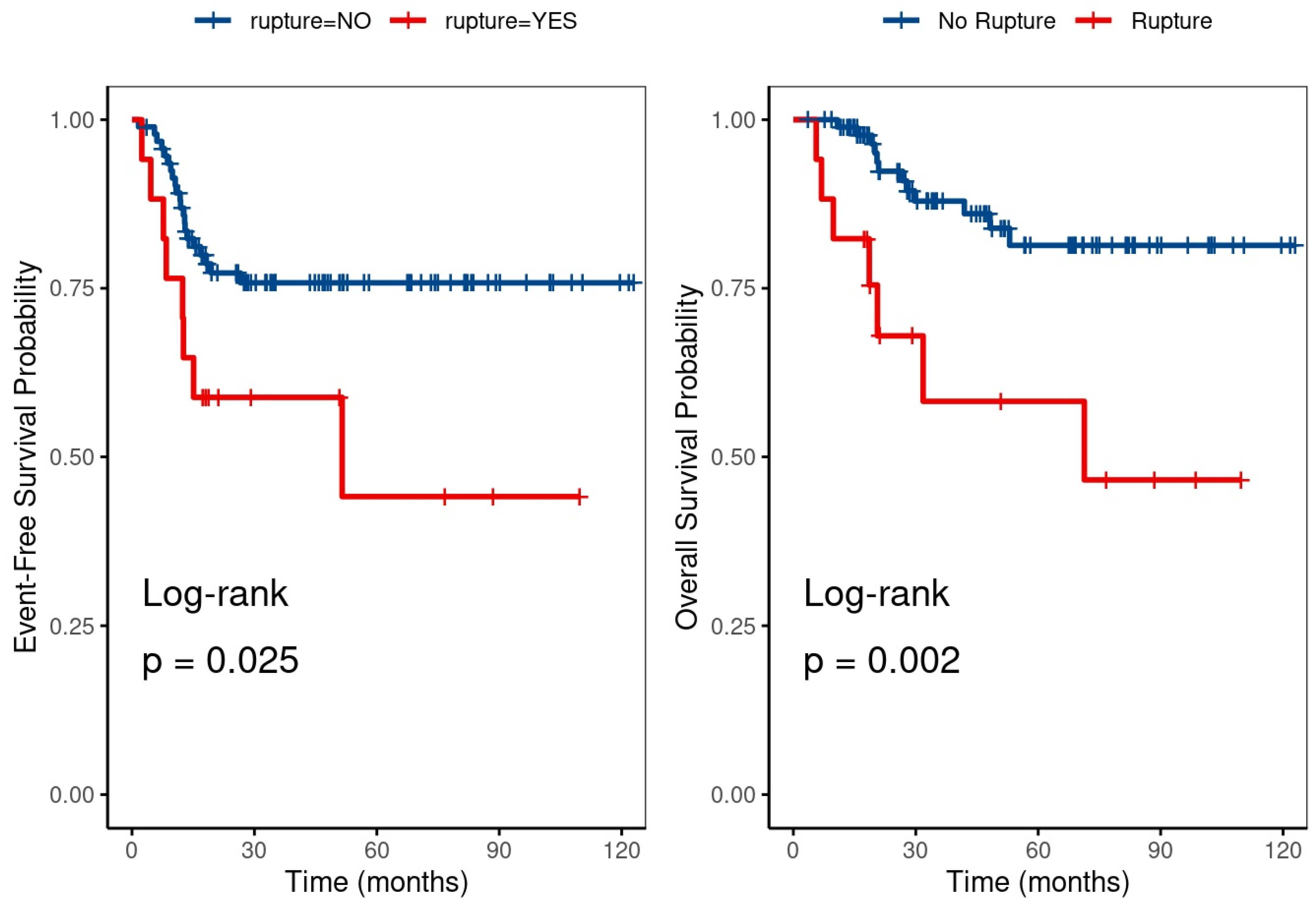
3.4. Comparison of Patients With and Without Rupture
4. Discussion
Author Contributions
Funding
Institutional Review Board Statement
Informed Consent Statement
Data Availability Statement
Conflicts of Interest
Abbreviations
| CI | Confidence interval |
| CT | Computed tomography |
| COG | Children’s Oncology Group |
| 3D-CRT | Three-Dimensional Conformal Radiation Therapy |
| EFS | Event Free Survival |
| HR | Hazard Ratio |
| IMRT | Intensity-Modulated Radiation Therapy |
| KHCC | King Hussein Cancer Center |
| MDT | Multidisciplinary Team |
| NWTS | National Wilms Tumor Study |
| OS | Overall survival |
| SIOP | International Society of Pediatric Oncology |
| WT | Wilms Tumor |
References
- Dome, J.S.; Graf, N.; Geller, J.I.; Fernandez, C.V.; Mullen, E.A.; Spreafico, F.; Van Den Heuvel-Eibrink, M.; Pritchard-Jones, K. Advances in Wilms Tumor Treatment and Biology: Progress Through International Collaboration. J. Clin. Oncol. 2015, 33, 2999–3007. [Google Scholar] [CrossRef]
- Davidoff, A.M. Wilms Tumor. Adv. Pediatr. 2012, 59, 247–267. [Google Scholar] [CrossRef] [PubMed]
- Szychot, E.; Apps, J.; Pritchard-Jones, K. Wilms’ tumor: Biology, diagnosis and treatment. Transl. Pediatr. 2014, 3, 12. [Google Scholar] [CrossRef]
- Godziński, J.; Weirich, A.; Tournade, M.-F.; Gauthier, F.; Buerger, D.; Moorman-Voestermans, C.G.M.; de Kraker, J.; Voute, P.; Ludwig, R.; Sawicz-Birkowska, K.; et al. Primary Nephrectomy for Emergency: A Rare Event in the International Society of Paediatric Oncology Nephroblastoma Trial and Study No. 9. Eur. J. Pediatr. Surg. 2001, 11, 36–39. [Google Scholar] [CrossRef]
- Zhang, Y.; Song, H.-C.; Yang, Y.-F.; Sun, N.; Zhang, W.-P.; Huang, C.-R. Preoperative Wilms tumor rupture in children. Int. Urol. Nephrol. 2020, 53, 619–625. [Google Scholar] [CrossRef]
- Khanna, G.; Naranjo, A.; Hoffer, F.; Mullen, E.; Geller, J.; Gratias, E.J.; Ehrlich, P.F.; Perlman, E.J.; Rosen, N.; Grundy, P.; et al. Detection of Preoperative Wilms Tumor Rupture with CT: A Report from the Children’s Oncology Group. Radiology 2013, 266, 610–617. [Google Scholar] [CrossRef][Green Version]
- Gow, K.W.; Barnhart, D.C.; Hamilton, T.E.; Kandel, J.J.; Chen, M.K.; Ferrer, F.A.; Price, M.R.; Mullen, E.A.; Geller, J.I.; Gratias, E.J.; et al. Primary nephrectomy and intraoperative tumor spill: Report from the Children’s Oncology Group (COG) renal tumors committee. J. Pediatr. Surg. 2013, 48, 34–38. [Google Scholar] [CrossRef] [PubMed]
- Brisse, H.J.; Schleiermacher, G.; Sarnacki, S.; Helfre, S.; Philippe-Chomette, P.; Boccon-Gibod, L.; Peuchmaur, M.; Mosseri, V.; Aigrain, Y.; Neuenschwander, S. Preoperative Wilms tumor rupture. Cancer 2008, 113, 202–213. [Google Scholar] [CrossRef] [PubMed]
- Ritchey, M.L.; Shamberger, R.C.; Haase, G.; Horwitz, J.; Bergemann, T.; E Breslow, N. Surgical Complications After Primary Nephrectomy for Wilms’ Tumor: Report from the National Wilms’ Tumor Study Group. J. Am. Coll. Surg. 2001, 192, 63–68. [Google Scholar] [CrossRef]
- Mergen, M.; Graf, N.; Welter, N.; Melchior, P.; Vokuhl, C.; Schmidt, A.; Kroiss-Benninger, S.; Kager, L.; Schenk, J.; Furtwängler, R. Efficacy of Preoperative Chemotherapy in Patients with Nephroblastoma and Imaging Findings Suggestive of Preoperative Tumor Rupture. Pediatr. Blood Cancer 2025, 73, e32111. [Google Scholar] [CrossRef]
- Fukuzawa, H.; Shiima, Y.; Mishima, Y.; Sekine, S.; Miura, S.; Yabe, K.; Yamaki, S.; Morita, K.; Okata, Y.; Hisamatsu, C.; et al. Predictive factor for intraoperative tumor rupture of Wilms tumor. Pediatr. Surg. Int. 2016, 33, 91–95. [Google Scholar] [CrossRef]
- Shamberger, R.C.; Guthrie, K.A.; Ritchey, M.L.; Haase, G.M.; Takashima, J.B.; Beckwith, J.B.; D’Angio, G.J.; Green, D.M.; Breslow, N.E. Surgery-Related Factors and Local Recurrence of Wilms Tumor in National Wilms Tumor Study 4. Ann. Surg. 1999, 229, 292–297. [Google Scholar] [CrossRef]
- A Kalapurakal, J.; Dome, J.S.; Perlman, E.J.; Malogolowkin, M.; Haase, G.M.; Grundy, P.; Coppes, M.J. Management of Wilms’ tumour: Current practice and future goals. Lancet Oncol. 2004, 5, 37–46. [Google Scholar] [CrossRef]
- Theilen, T.-M.; Braun, Y.; Bochennek, K.; Rolle, U.; Fiegel, H.C.; Friedmacher, F. Multidisciplinary Treatment Strategies for Wilms Tumor: Recent Advances, Technical Innovations and Future Directions. Front. Pediatr. 2022, 10, 852185. [Google Scholar] [CrossRef]
- Vujanić, G.M.; Gessler, M.; Ooms, A.H.; Collini, P.; Coulomb-L’Hermine, A.; D’Hooghe, E.; De Krijger, R.R.; Perotti, D.; Pritchard-Jones, K.; Vokuhl, C.; et al. The UMBRELLA SIOP–RTSG 2016 Wilms tumour pathology and molecular biology protocol. Nat. Rev. Urol. 2018, 15, 693–701. [Google Scholar] [CrossRef]
- Ko, E.Y.; Ritchey, M.L. Current management of Wilms’ tumor in children. J. Pediatr. Urol. 2009, 5, 56–65. [Google Scholar] [CrossRef] [PubMed]
- Breslow, N.E.; Lange, J.M.; Friedman, D.L.; Green, D.M.; Hawkins, M.M.; Murphy, M.F.; Neglia, J.P.; Olsen, J.H.; Peterson, S.M.; Stiller, C.A.; et al. Secondary malignant neoplasms after Wilms tumor: An international collaborative study. Int. J. Cancer 2010, 127, 657–666. [Google Scholar] [CrossRef] [PubMed]
- Green, D.M.; Breslow, N.E.; D’ANgio, G.J.; Malogolowkin, M.H.; Ritchey, M.L.; Evans, A.E.; Beckwith, J.B.; Perlman, E.J.; Shamberger, R.C.; Peterson, S.; et al. Outcome of patients with stage II/favorable histology wilms tumor with and without local tumor spill: A report from the National Wilms Tumor Study Group. Pediatr. Blood Cancer 2013, 61, 134–139. [Google Scholar] [CrossRef]
- Spreafico, F.; Fernandez, C.V.; Brok, J.; Nakata, K.; Vujanic, G.; Geller, J.I.; Gessler, M.; Maschietto, M.; Behjati, S.; Polanco, A.; et al. Wilms tumour. Nat. Rev. Dis. Prim. 2021, 7, 75. [Google Scholar] [CrossRef] [PubMed]
- Pan, Z.; He, H.; Tang, L.; Bu, Q.; Cheng, H.; Wang, A.; Lyu, J.; You, H. Loss of heterozygosity on chromosome 16q increases relapse risk in Wilms’ tumor: A meta-analysis. Oncotarget 2017, 8, 66467–66475. [Google Scholar] [CrossRef]
- Grundy, P.E.; Breslow, N.E.; Li, S.; Perlman, E.; Beckwith, J.B.; Ritchey, M.L.; Shamberger, R.C.; Haase, G.M.; D’ANgio, G.J.; Donaldson, M.; et al. Loss of Heterozygosity for Chromosomes 1p and 16q Is an Adverse Prognostic Factor in Favorable-Histology Wilms Tumor: A Report From the National Wilms Tumor Study Group. J. Clin. Oncol. 2005, 23, 7312–7321. [Google Scholar] [CrossRef]
- Gupta, R.; Mathur, P.; Rengan, V.S.; Sharma, G.; Parihar, P.S.; Mittal, P. Spontaneous Wilms Tumor Rupture: A Preoperative Clinical Diagnosis. Bull. Urooncology 2021, 20, 276–279. [Google Scholar] [CrossRef]
- Le Rouzic, M.; Mansuy, L.; Galloy, M.; Champigneulle, J.; Bernier, V.; Chastagner, P. Agreement between clinicoradiological signs at diagnosis and radiohistological analysis after neoadjuvant chemotherapy of suspected Wilms tumor rupture: Consequences on therapeutic choices. Pediatr. Blood Cancer 2019, 66, e27674. [Google Scholar] [CrossRef] [PubMed]
- Vujanić, G.M.; Sandstedt, B. The pathology of Wilms’ tumour (nephroblastoma): The International Society of Paediatric Oncology approach. J. Clin. Pathol. 2009, 63, 102–109. [Google Scholar] [CrossRef]
- Dzhuma, K.; Oostveen, M.; Watson, T.; Powis, M.; Vujanic, G.; Saunders, D.; Al-Saadi, R.; Chowdhury, T.; Lopez, A.; Brok, J.; et al. Multimodality detection of tumour rupture in children with Wilms tumour. Pediatr. Blood Cancer 2024, 71, e31226. [Google Scholar] [CrossRef]
- Alnour, O.; Rayis, M.; Almanjomi, F.; Khan, Z.U. Survival Outcomes of Wilms’ Tumor in Pediatric Patients Treated at KFMC: A Retrospective Study of 15 years from 2007–2022. OncoDaily Med. J. 2025. [Google Scholar] [CrossRef]
- Hau Duc, T.; Ba, X.H. Treatment of Nephroblastoma in Developing Countries—Experience from a Single Center in Vietnam with NWTS 5 and SIOP 2001 Protocols. Int. J. Cancer Clin. Res. 2019, 6. [Google Scholar] [CrossRef]


| Variable | All Patients, Number (Percentage) | Without Rupture, Number (Percentage) | With Rupture Number (Percentage) | p-Value |
|---|---|---|---|---|
| Total Patients | 111 | 94 | 17 | |
| Age at Diagnosis Median (range) years | 3.8 (0.4–15.1) | 3.5 (0.4–11.3) | 4.2 (2.6–15.1) | 0.030 |
| Sex Females Males | 63 (57%) 48 (43%) | 52 (55%) 42 (45%) | 11 (65%) 6 (35%) | 0.500 |
| Laterality Left Right | 63 (57%) 48 (43%) | 55 (59%) 39 (41%) | 8 (47%) 9 (53%) | 0.400 |
| Signs and symptoms Abdominal mass Hematuria Abdominal pain Hypertension | 83 (75%) 23 (21%) 38 (35%) 13 (12%) | 70 (74%) 19 (20%) 30 (32%) 9 (9.6%) | 13 (76%) 4 (24%) 8 (47%) 4 (24%) | >0.900 0.800 0.200 0.100 |
| Hemoglobin at presentation median g/dL (range) | 10.1 (5–14.3) | 10.4 (6.5–14.3) | 7.9 (5–13.2) | <0.001 |
| Maximum tumor diameter median (range) cm | 12 (2.4–23.5) | 11.7 (2.4–23.5) | 13.7 (3.0–20.3) | 0.001 |
| Histologic Subtypes Favorable Blastemal predominant Focal Anaplasia Diffuse Anaplasia | 80 (72%) 18 (16%) 5 (4.5%) 8 (7.2%) | 69 (73%) 16 (17%) 5 (5.3%) 4 (4.3%) | 11 (64.7%) 2 (11.8%) 0 (0%) 4 (23.5%) | 0.070 |
| Stage Stage I Stage II Stage III Stage IV | 32 (29.1%) 25 (22.7%) 19 (17%) 35 (32%) | 32 (34%) 25 (27%) 9 (9.6%) 28 (30%) | 0 (0%) 0 (0%) 10 (59%) 7 (41%) | <0.001 |
| Positive lymph nodes | 21 (19%) | 15 (16%) | 6 (35%) | 0.090 |
| Treatment Surgery Upfront Delayed Radiation therapy Chemotherapy Two drugs Doxorubicin-containing | 111 (100%) 16 (14%) 95 (86%) 46 (41%) 111 (100%) 50 (45%) 61 (55%) | 94 80 (85%) 14 (15%) 29 (30.9%) 94 (100%) 49 (52%) 45 (48%) | 17 2 (12%) 15 (88%) 17 (100%) 17 (100%) 1 (5.9%) 16 (94%) | >0.900 <0.001 <0.001 |
| Parameter | EFS Univariate | EFS Multivariate | |||
|---|---|---|---|---|---|
| p-Value | HR, 95% CI | p-Value | HR 95% HR CI | ||
| Gender | Male vs. Female | 0.470 | 0.76 (0.36–1.61) | - | - |
| Age at diagnosis | Mean (3.9 year) | 0.009 | 1.14 (1.03–1.26) | 0.010 | 1.22 (1.04–1.42) |
| Laterality | Right vs. left | 0.700 | 1.15 (0.55–2.40) | - | - |
| Metastasis | Yes vs. No | 0.001 | 3.93 (1.87–8.24) | 0.035 | 0.12 (0.02–0.87) |
| Rupture | Yes vs. No | 0.025 | 2.47 (1.09–5.57) | 0.010 | 8.10 (1.66–39.57) |
| LN involvement | Positive vs. negative | 0.003 | 3.20 (1.47–6.95) | 0.042 | 4.45 (1.05–18.79) |
| Parameter | OS Univariate | OS Multivariate | |||
|---|---|---|---|---|---|
| p-Value | HR, 95% CI | p-Value | HR 95% HR CI | ||
| Gender | Male vs. Female | 0.800 | 1.13 (0.48–2.66) | - | - |
| Age at diagnosis | Mean (3.9 year) | 0.010 | 1.16 (1.04–1.34) | 0.020 | 1.36 (1.09–1.69) |
| Laterality | Right vs. left | 0.260 | 1.65 (0.7–3.88) | - | - |
| Metastasis | Yes vs. No | 0.001 | 4.66 (1.93–11.26) | 0.020 | 0.03 (0.00–0.56) |
| Rupture | Yes vs. no | 0.003 | 4.02 (1.62–9.99) | 0.003 | 17.62 (2.69–115.48) |
| LN involvement | Positive vs. Negative | <0.001 | 4.47 (2.01–11.18) | 0.004 | 11.5 (2.21–59.69) |
Disclaimer/Publisher’s Note: The statements, opinions and data contained in all publications are solely those of the individual author(s) and contributor(s) and not of MDPI and/or the editor(s). MDPI and/or the editor(s) disclaim responsibility for any injury to people or property resulting from any ideas, methods, instructions or products referred to in the content. |
© 2026 by the authors. Licensee MDPI, Basel, Switzerland. This article is an open access article distributed under the terms and conditions of the Creative Commons Attribution (CC BY) license.
Share and Cite
Emadeldeen, H.; Ghandour, K.; Al-Shamaileh, T.; Ibrahimi, A.K.; Sarhan, N.; Sultan, I.; Halalsheh, H. Ruptured Wilms Tumor: Clinical Features, Diagnostic Challenges, and Survival Outcomes. Curr. Oncol. 2026, 33, 293. https://doi.org/10.3390/curroncol33050293
Emadeldeen H, Ghandour K, Al-Shamaileh T, Ibrahimi AK, Sarhan N, Sultan I, Halalsheh H. Ruptured Wilms Tumor: Clinical Features, Diagnostic Challenges, and Survival Outcomes. Current Oncology. 2026; 33(5):293. https://doi.org/10.3390/curroncol33050293
Chicago/Turabian StyleEmadeldeen, Hiba, Khalil Ghandour, Tamador Al-Shamaileh, Ahmad Kh. Ibrahimi, Nasim Sarhan, Iyad Sultan, and Hadeel Halalsheh. 2026. "Ruptured Wilms Tumor: Clinical Features, Diagnostic Challenges, and Survival Outcomes" Current Oncology 33, no. 5: 293. https://doi.org/10.3390/curroncol33050293
APA StyleEmadeldeen, H., Ghandour, K., Al-Shamaileh, T., Ibrahimi, A. K., Sarhan, N., Sultan, I., & Halalsheh, H. (2026). Ruptured Wilms Tumor: Clinical Features, Diagnostic Challenges, and Survival Outcomes. Current Oncology, 33(5), 293. https://doi.org/10.3390/curroncol33050293