Recording Medical Errors in Brain Tumor Surgery Can Facilitate Their Avoidance: Single Institution Comparative Cohort Analysis over 19 Years

Simple Summary
Abstract
1. Introduction
2. Materials and Methods
3. Results

4. Discussion
5. Limitations
6. Conclusions
Author Contributions
Funding
Institutional Review Board Statement
Informed Consent Statement
Data Availability Statement
Conflicts of Interest
Abbreviations
| CRM | Crew Resource Management |
| IOM | Institute of Medicine |
| ASA | American Society of Anesthesiologists |
| M&M | Morbidity and Mortality |
References
- Duclos, A.; Frits, M.L.; Iannaccone, C.; Lipsitz, S.R.; Cooper, Z.; Weissman, J.S.; Bates, D.W. Safety of Inpatient Care in Surgical Settings: Cohort Study. BMJ 2024, 387, e080480. [Google Scholar] [CrossRef] [PubMed]
- Institute of Medicine (US) Committee on Quality of Health Care in America; Kohn, L.T.; Corrigan, J.M.; Donaldson, M.S. To Err Is Human: Building a Safer Health System; National Academies Press: Washington, DC, USA, 2000; p. 9728.
- Sayegh, A.S.; Eppler, M.; Sholklapper, T.; Goldenberg, M.G.; Perez, L.C.; La Riva, A.; Medina, L.G.; Sotelo, R.; Desai, M.M.; Gill, I.; et al. Severity Grading Systems for Intraoperative Adverse Events. A Systematic Review of the Literature and Citation Analysis. Ann. Surg. 2023, 278, e973–e980. [Google Scholar] [CrossRef]
- Aurino, D.E.M. Human Factors and Aviation Safety: What the Industry Has, What the Industry Needs. Ergonomics 2000, 43, 952–959. [Google Scholar] [CrossRef]
- Clemente Fuentes, R.W.; Chung, C. Military, Civil and International Regulations to Decrease Human Factor Errors in Aviation. In StatPearls; StatPearls Publishing: Treasure Island, FL, USA, 2024. [Google Scholar]
- Missoni, E.; Nikolić, N.; Missoni, I. Civil Aviation Rules on Crew Flight Time, Flight Duty, And Rest: Comparison of 10 ICAO Member States. Aviat. Space Environ. Med. 2009, 80, 135–138. [Google Scholar] [CrossRef]
- Howard, S.K.; Gaba, D.M.; Fish, K.J.; Yang, G.; Sarnquist, F.H. Anesthesia Crisis Resource Management Training: Teaching Anesthesiologists to Handle Critical Incidents. Aviat. Space Environ. Med. 1992, 63, 763–770. [Google Scholar]
- Brennan, T.A.; Leape, L.L.; Laird, N.M.; Hebert, L.; Localio, A.R.; Lawthers, A.G.; Newhouse, J.P.; Weiler, P.C.; Hiatt, H.H. Incidence of Adverse Events and Negligence in Hospitalized Patients: Results of the Harvard Medical Practice Study I. N. Engl. J. Med. 1991, 324, 370–376. [Google Scholar] [CrossRef]
- Zhan, C. Excess Length of Stay, Charges, and Mortality Attributable to Medical Injuries During Hospitalization. JAMA 2003, 290, 1868–1874. [Google Scholar] [CrossRef] [PubMed]
- Kaushal, R.; Shojania, K.G.; Bates, D.W. Effects of Computerized Physician Order Entry and Clinical Decision Support Systems on Medication Safety: A Systematic Review. Arch. Intern. Med. 2003, 163, 1409–1416. [Google Scholar] [CrossRef]
- Bernstein, M.; Potvin, D.; Martin, D.K. A Qualitative Study of Attitudes Toward Error in Patients Facing Brain Tumour Surgery. Can. J. Neurol. Sci. 2004, 31, 208–212. [Google Scholar] [CrossRef]
- Haynes, A.B.; Weiser, T.G.; Berry, W.R.; Lipsitz, S.R.; Breizat, A.-H.S.; Dellinger, E.P.; Herbosa, T.; Joseph, S.; Kibatala, P.L.; Lapitan, M.C.M.; et al. A Surgical Safety Checklist to Reduce Morbidity and Mortality in a Global Population. N. Engl. J. Med. 2009, 360, 491–499. [Google Scholar] [CrossRef] [PubMed]
- Pouliot, J.D.; Neal, E.B.; Lobo, B.L.; Hargrove, F.; Gupta, R.K. The Role of Computerized Clinical Decision Support in Reducing Inappropriate Medication Administration During Epidural Therapy. Hosp. Pharm. 2018, 53, 170–176. [Google Scholar] [CrossRef] [PubMed]
- Stone, S.; Bernstein, M. Prospective Error Recording in Surgery: An Analysis of 1108 Elective Neurosurgical Cases. Neurosurgery 2007, 60, 1075–1082. [Google Scholar] [CrossRef]
- Helo, S.; Moulton, C.-A.E. Complications: Acknowledging, Managing, and Coping with Human Error. Transl. Androl. Urol. 2017, 6, 773–782. [Google Scholar] [CrossRef]
- Robertson, J.J.; Long, B. Suffering in Silence: Medical Error and Its Impact on Health Care Providers. J. Emerg. Med. 2018, 54, 402–409. [Google Scholar] [CrossRef]
- Stehman, C.; Testo, Z.; Gershaw, R.; Kellogg, A. Burnout, Drop Out, Suicide: Physician Loss in Emergency Medicine, Part I. West. J. Emerg. Med. 2019, 20, 485–494. [Google Scholar] [CrossRef]
- Holliman, D.; Bernstein, M. Patients’ Perception of Error during Craniotomy for Brain Tumour and Their Attitudes towards Pre-Operative Discussion of Error: A Qualitative Study. Br. J. Neurosurg. 2012, 26, 326–330. [Google Scholar] [CrossRef] [PubMed]
- Berlin, L. Medical Errors, Malpractice, and Defensive Medicine: An Ill-Fated Triad. Diagnosis 2017, 4, 133–139. [Google Scholar] [CrossRef]
- Oremakinde, A.A.; Bernstein, M. A Reduction in Errors Is Associated with Prospectively Recording Them: Clinical Article. J. Neurosurg. 2014, 121, 297–304. [Google Scholar] [CrossRef]
- Meyer, H.S.; Wagner, A.; Obermueller, T.; Negwer, C.; Wostrack, M.; Krieg, S.; Gempt, J.; Meyer, B. Assessment of the Incidence and Nature of Adverse Events and Their Association with Human Error in Neurosurgery. A Prospective Observation. Brain Spine 2022, 2, 100853. [Google Scholar] [CrossRef] [PubMed]
- Morris, J.A.; Carrillo, Y.; Jenkins, J.M.; Smith, P.W.; Bledsoe, S.; Pichert, J.; White, A. Surgical Adverse Events, Risk Management, and Malpractice Outcome: Morbidity and Mortality Review Is Not Enough. Ann. Surg. 2003, 237, 844–852. [Google Scholar] [CrossRef]
- Chassin, M.R. The Urgent Need to Improve Health Care Quality Institute of Medicine National Roundtable on Health Care Quality. JAMA 1998, 280, 1000–1005. [Google Scholar] [CrossRef]
- Vioque, S.M.; Kim, P.K.; McMaster, J.; Gallagher, J.; Allen, S.R.; Holena, D.N.; Reilly, P.M.; Pascual, J.L. Classifying Errors in Preventable and Potentially Preventable Trauma Deaths: A 9-Year Review Using the Joint Commission’s Standardized Methodology. Am. J. Surg. 2014, 208, 187–194. [Google Scholar] [CrossRef]
- Benassi, P.; MacGillivray, L.; Silver, I.; Sockalingam, S. The Role of Morbidity and Mortality Rounds in Medical Education: A Scoping Review. Med. Educ. 2017, 51, 469–479. [Google Scholar] [CrossRef]
- Smaggus, A.; Mrkobrada, M.; Marson, A.; Appleton, A. Effects of Efforts to Optimise Morbidity and Mortality Rounds to Serve Contemporary Quality Improvement and Educational Goals: A Systematic Review. BMJ Qual. Saf. 2018, 27, 74–84. [Google Scholar] [CrossRef] [PubMed]
- Joseph, C.W.; Garrubba, M.L.; Melder, A.M. Informing Best Practice for Conducting Morbidity and Mortality Reviews: A Literature Review. Aust. Health Rev. 2018, 42, 248–257. [Google Scholar] [CrossRef] [PubMed]
- Kim, M.J.; Fleming, F.J.; Peters, J.H.; Salloum, R.M.; Monson, J.R.; Eghbali, M.E. Improvement in Educational Effectiveness of Morbidity and Mortality Conferences with Structured Presentation and Analysis of Complications. J. Surg. Educ. 2010, 67, 400–405. [Google Scholar] [CrossRef] [PubMed]
- Miller, D.C.; Filson, C.P.; Wallner, L.P.; Montie, J.E.; Campbell, D.A.; Wei, J.T. Comparing Performance of Morbidity and Mortality Conference and National Surgical Quality Improvement Program for Detection of Complications after Urologic Surgery. Urology 2006, 68, 931–937. [Google Scholar] [CrossRef]
- Orlander, J.D.; Barber, T.W.; Fincke, B.G. The Morbidity and Mortality Conference: The Delicate Nature of Learning from Error. Acad. Med. 2002, 77, 1001–1006. [Google Scholar] [CrossRef]
- Hutter, M.M.; Rowell, K.S.; Devaney, L.A.; Sokal, S.M.; Warshaw, A.L.; Abbott, W.M.; Hodin, R.A. Identification of Surgical Complications and Deaths: An Assessment of the Traditional Surgical Morbidity and Mortality Conference Compared with the American College of Surgeons-National Surgical Quality Improvement Program. J. Am. Coll. Surg. 2006, 203, 618–624. [Google Scholar] [CrossRef]
- Studdert, D.M.; Mello, M.M.; Gawande, A.A.; Gandhi, T.K.; Kachalia, A.; Yoon, C.; Puopolo, A.L.; Brennan, T.A. Claims, Errors, and Compensation Payments in Medical Malpractice Litigation. N. Engl. J. Med. 2006, 354, 2024–2033. [Google Scholar] [CrossRef]
- Couch, N.P.; Tilney, N.L.; Rayner, A.A.; Moore, F.D. The High Cost of Low-Frequency Events: The Anatomy and Economics of Surgical Mishaps. N. Engl. J. Med. 1981, 304, 634–637. [Google Scholar] [CrossRef] [PubMed]
- Veilleux, C.; Karmur, B.S.; Yang, M.M.H. Complications During Neurosurgical Training: How Does One Not Succumb? Can. J. Neurol. Sci. 2025, 52, 739–740. [Google Scholar] [CrossRef] [PubMed]


| Word or Phrase Definition | |
|---|---|
| error | any act of omission or commission resulting in deviation from a perfect course for the patient; a perfect course was defined as one in which nothing went wrong, from the smallest detail (such as dropping a sponge) to the most obvious example (that is, one that every neurosurgeon would easily recognize) † |
| adverse event/complication | unintended result of medical treatment that results in prolonged hospital stay, morbidity, or mortality; it may also be an injury caused by medical management rather than the underlying condition of the patient |
| Type of Error † | |
| technical | problems in the use of correctly functioning equipment or the performance of an appropriate procedure (for example, aspirator inadvertently bruised brain) |
| contamination | e.g., instrument required re-sterilization |
| equipment failure or missing | e.g., instrument required re-sterilization |
| delay | e.g., long wait for a spine-localizing radiograph |
| nursing | e.g., nurse failed to properly set up piece of equipment |
| anesthesia | e.g., anesthetist prematurely extubated patient requiring urgent re-intubation |
| management/judgment | e.g., patient arrived in operating room w/an abnormal blood result missed by the team |
| communication/information | e.g., no prophylactic antibiotics administered because the anesthetist did not hear the surgeon’s request |
| Characteristics of Error Severity † | |
| major | actual or potential (near-miss) nature of error to cause complication caused actual or potential morbidity or mortality |
| minor | did not cause actual or potential morbidity or mortality |
| Clinical Impact of Error † ‡ | |
| clinical impact of error † | deals w/actual nature (impact) of errors in a more explicit way; ability of errors to cause potential problems (near-miss errors) not considered |
| none | self-explanatory |
| minimal | self-explanatory |
| transient | self-explanatory |
| permanent | self-explanatory |
| death | self-explanatory |
| preventability of error † Low (scores of 1–5) deemed non-preventable. High (scores of 6–10) deemed preventable | |
| Variable | Cohort A | Cohort B | Cohort C | p Value | |||
|---|---|---|---|---|---|---|---|
| Number patients | 1108 | 974 | 684 | ||||
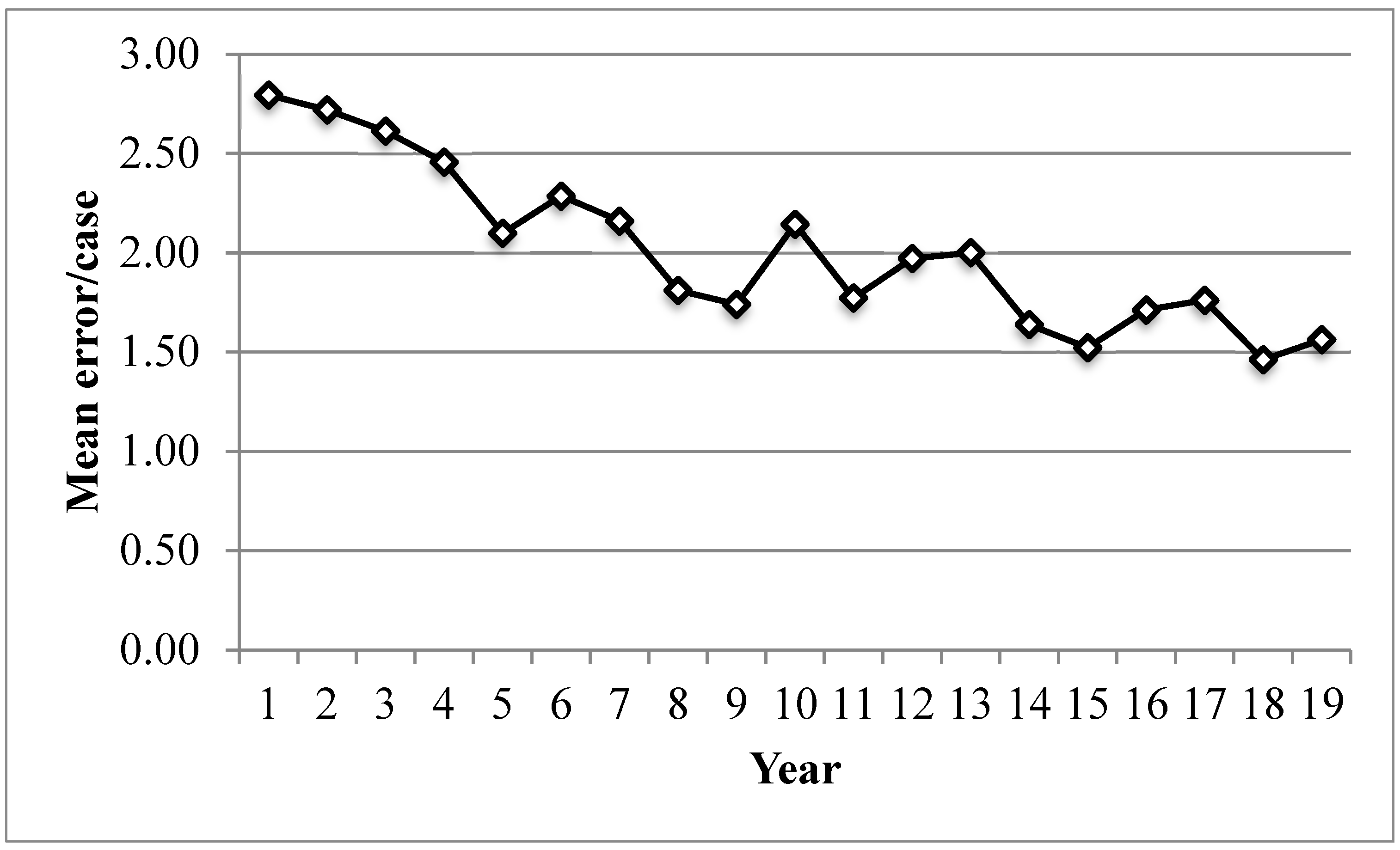
| Mean/case ± std | 2.4 ± 1.76 | 1.9 ± 1.46 | 1.8 ± 1.30 | 0.048 † | |||
| Type of procedure | |||||||
| Cranial | 843 | 76.1% | 875 | 89.8% | 658 | 96.2% | <0.00001 * |
| Spinal | 252 | 22.7% | 90 | 9.2% | 0 | 0.0% | |
| Other | 13 | 1.2% | 9 | 0.9% | 26 | 3.8% | |
| Anesthesia | |||||||
| GA | 750 | 67.7% | 550 | 56.5% | 399 | 58.3% | <0.00001 * |
| Local w or w/out neuroleptic | 358 | 32.3% | 414 | 42.5% | 285 | 41.7% | |
| Mean ASA | 2.41 ± 0.69 | 2.82 ± 0.59 | 3.00 ± 0.46 | <0.0001 † | |||
| Error Type | Cohort A | Cohort B | Cohort C | p Value * | |||
|---|---|---|---|---|---|---|---|
| Technical | 747 | 27.83% | 352 | 18.60% | 232 | 18.46% | <0.00001 |
| Contamination | 678 | 25.26% | 431 | 22.78% | 335 | 26.59% | 0.028 |
| Equipment | 489 | 18.22% | 538 | 28.44% | 269 | 21.32% | <0.00001 |
| Delay | 336 | 12.52% | 335 | 17.71% | 316 | 25.06% | <0.00001 |
| Nursing | 152 | 5.66% | 61 | 3.22% | 16 | 1.27% | <0.00001 |
| Anesthesia | 119 | 4.43% | 73 | 3.86% | 21 | 1.65% | <0.00001 |
| Management/judgment | 76 | 2.83% | 51 | 2.70% | 21 | 1.65% | 0.045 |
| Communication/info | 51 | 1.90% | 17 | 0.90% | 10 | 0.82% | 0.002 |
| Other | 36 | 1.34% | 34 | 1.80% | 40 | 3.17% | 0.0001 |
| Error Characteristics | |||||||
| Severity | |||||||
| Major | 606 | 22.58% | 558 | 29.49% | 220 | 17.45% | <0.00001 |
| Minor | 2077 | 77.38% | 1329 | 70.24% | 1019 | 80.90% | |
| Missing | 1 | 0.04% | 5 | 0.26% | 21 | 1.65% | |
| Clinical impact | |||||||
| Low ^ | 2611 | 97.3% | 1873 | 99% | 1255 | 99.6% | <0.00001 |
| High § | 73 | 2.7% | 19 | 1.0% | 5 | 0.4% | |
| Preventability | |||||||
| Low | 578 | 21.5% | 269 | 14.2% | 184 | 14.6% | <0.00001 |
| High | 2106 | 78.5% | 1623 | 85.8% | 1076 | 85.4% | |
Disclaimer/Publisher’s Note: The statements, opinions and data contained in all publications are solely those of the individual author(s) and contributor(s) and not of MDPI and/or the editor(s). MDPI and/or the editor(s) disclaim responsibility for any injury to people or property resulting from any ideas, methods, instructions or products referred to in the content. |
© 2026 by the authors. Licensee MDPI, Basel, Switzerland. This article is an open access article distributed under the terms and conditions of the Creative Commons Attribution (CC BY) license.
Share and Cite
Asha, M.J.; Steadman, P.E.; Samienezhad, A.; Bernstein, M. Recording Medical Errors in Brain Tumor Surgery Can Facilitate Their Avoidance: Single Institution Comparative Cohort Analysis over 19 Years. Curr. Oncol. 2026, 33, 281. https://doi.org/10.3390/curroncol33050281
Asha MJ, Steadman PE, Samienezhad A, Bernstein M. Recording Medical Errors in Brain Tumor Surgery Can Facilitate Their Avoidance: Single Institution Comparative Cohort Analysis over 19 Years. Current Oncology. 2026; 33(5):281. https://doi.org/10.3390/curroncol33050281
Chicago/Turabian StyleAsha, Mohammed J., Patrick E. Steadman, Ashkan Samienezhad, and Mark Bernstein. 2026. "Recording Medical Errors in Brain Tumor Surgery Can Facilitate Their Avoidance: Single Institution Comparative Cohort Analysis over 19 Years" Current Oncology 33, no. 5: 281. https://doi.org/10.3390/curroncol33050281
APA StyleAsha, M. J., Steadman, P. E., Samienezhad, A., & Bernstein, M. (2026). Recording Medical Errors in Brain Tumor Surgery Can Facilitate Their Avoidance: Single Institution Comparative Cohort Analysis over 19 Years. Current Oncology, 33(5), 281. https://doi.org/10.3390/curroncol33050281