Outcomes of Double-Hit and Single High-Risk Cytogenetic Newly Diagnosed Myeloma in Transplant-Eligible Patients

 , , ,
, , ,  , , , , , and
Simple Summary
Abstract
1. Introduction
2. Methods
2.1. Study Design and Setting
2.2. Patient Population
2.2.1. Cytogenetic Assessment and Risk Stratification
2.2.2. Treatment Exposure and Transplant Procedure
2.2.3. Outcomes and Response Assessments
2.3. Statistical Analysis
2.4. Ethical Approval
3. Results
3.1. Baseline Patient Characteristics

| Characteristic | Overall N = 154 1 | Double-Hit N = 91 1 | Single-Hit N = 63 1 | p-Value 2 |
|---|---|---|---|---|
| Age (IQR) | 61 (54, 66) | 61 (54, 65) | 62 (53, 68) | 0.4 |
| Unknown | 1 | 1 | 0 | |
| Gender | 0.4 | |||
| F | 74 (48%) | 41 (45%) | 33 (52%) | |
| M | 80 (52%) | 50 (55%) | 30 (48%) | |
| Race | 0.2 | |||
| AA | 39 (25%) | 27 (30%) | 12 (19%) | |
| Asian | 6 (3.9%) | 1 (1.1%) | 5 (7.9%) | |
| Hispanic | 3 (1.9%) | 2 (2.2%) | 1 (1.6%) | |
| Native American | 1 (0.6%) | 1 (1.1%) | 0 (0%) | |
| Other | 5 (3.2%) | 3 (3.3%) | 2 (3.2%) | |
| W | 100 (65%) | 57 (63%) | 43 (68%) | |
| PS | 0.4 | |||
| 0 | 24 (16%) | 16 (18%) | 8 (13%) | |
| 1 | 112 (73%) | 67 (74%) | 45 (71%) | |
| 2 | 17 (11%) | 8 (8.8%) | 9 (14%) | |
| 3 | 1 (0.6%) | 0 (0%) | 1 (1.6%) | |
| Stage R-ISS | 0.9 | |||
| 1 | 8 (5.4%) | 4 (4.5%) | 4 (6.8%) | |
| 2 | 87 (59%) | 53 (60%) | 34 (58%) | |
| 3 | 53 (36%) | 32 (36%) | 21 (36%) | |
| Unknown | 6 | 2 | 4 | |
| High Risk Cytogenetics | ||||
| t(4:14) | 59 (38%) | 37 (41%) | 22 (35%) | |
| Del(17p) | 26 (17%) | 10 (11%) | 16 (25%) | |
| t(14;16) | 23 (15%) | 14 (15%) | 9 (14%) | |
| 1q gain | 89 (58%) | 57 (63%) | 32 (51%) | |
| Type of Myeloma | 0.3 | |||
| Free Kappa | 15 (9.7%) | 8 (8.8%) | 7 (11%) | |
| Free Lambda | 7 (4.5%) | 5 (5.5%) | 2 (3.2%) | |
| IgA Kappa | 29 (19%) | 15 (16%) | 14 (22%) | |
| IgA Lambda | 13 (8.4%) | 9 (9.9%) | 4 (6.3%) | |
| IgG Kappa | 55 (36%) | 37 (41%) | 18 (29%) | |
| IgG Lambda | 33 (21%) | 17 (19%) | 16 (25%) | |
| Non-sec | 2 (1.3%) | 0 (0%) | 2 (3.2%) |
| Characteristic | Overall N = 154 1 | Double-Hit N = 91 1 | Single-Hit N = 63 1 |
|---|---|---|---|
| EMD Status | |||
| Para-skeletal (Bone-related) | 11 (7.1%) | 6 (6.6%) | 5 (7.9%) |
| Plasmacytoma | 7 (4.5%) | 2 (2.2%) | 5 (7.9%) |
| Spine/Sacrum/Sacral Soft Tissue | 4 (2.6%) | 4 (4.4%) | 0 (0.0%) |
| Extraosseous (Soft Tissue/Organ) | 4 (2.6%) | 2 (2.2%) | 2 (3.2%) |
| CNS/orbital | 1 (0.6%) | 0 (0.0%) | 1 (1.6%) |
| Lymph nodes | 1 (0.6%) | 0 (0.0%) | 1 (1.6%) |
| Muscle/Hepatic | 1 (0.6%) | 1 (1.1%) | 0 (0.0%) |
| Pleural | 1 (0.6%) | 1 (1.1%) | 0 (0.0%) |
| No EMD (N/A) | 139 (90.3%) | 83 (91.2%) | 56 (88.9%) |
3.2. Response to Induction Therapy
| Overall (N = 154) 1 | Double-Hit (N = 91) 1 | Single-Hit (N = 63) 1 | p-Value 2 | |
|---|---|---|---|---|
| ORR After First Induction | 0.7 | |||
| ORR achieved (≥PR) | 135 (88%) | 79 (87%) | 56 (89%) | |
| No response (<PR) | 19 (12%) | 12 (13%) | 7 (11%) | |
| Best Response After First Induction * | 0.3 | |||
| sCR | 8 (5.5%) | 7 (8.3%) | 1 (1.6%) | |
| CR | 29 (20%) | 15 (18%) | 14 (23%) | |
| VGPR | 56 (39%) | 32 (38%) | 24 (39%) | |
| PR | 40 (28%) | 24 (29%) | 16 (26%) | |
| SD | 2 (1.4%) | 0 (0%) | 2 (3.3%) | |
| PD | 10 (6.9%) | 6 (7.1%) | 4 (6.6%) | |
| Not evaluable | 9 | 7 | 2 | |
| ORR After Second Induction ** | >0.9 | |||
| ORR achieved (≥PR) | 31 (65%) | 20 (65%) | 11 (65%) | |
| No response (<PR) | 17 (35%) | 11 (35%) | 6 (35%) | |
| Not evaluable | 106 | 60 | 46 | |
| Best Response After Second Induction | 0.8 | |||
| sCR | 1 (3.0%) | 1 (4.5%) | 0 (0%) | |
| CR | 8 (24%) | 6 (27%) | 2 (18%) | |
| VGPR | 20 (61%) | 13 (59%) | 7 (64%) | |
| PR | 4 (12%) | 2 (9.1%) | 2 (18%) | |
| Not evaluable | 121 | 69 | 52 | |
| Characteristic | Overall N = 154 1 | Double-Hit N = 91 1 | Single-Hit N = 63 1 |
|---|---|---|---|
| Induction Therapy | |||
| Doublet | |||
| Rd | 2 (1.3%) | 0 (0%) | 2 (3.2%) |
| Vd | 2 (1.3%) | 2 (2.2%) | 0 (0.0%) |
| TD | 2 (1.3%) | 0 (0%) | 2 (3.2%) |
| Triplet | |||
| VRd/RVd | 92 (60%) | 58 (64%) | 34 (54%) |
| CyBorD | 22 (14%) | 12 (13.2%) | 10 (15.9%) |
| KRd | 7 (4.5%) | 5 (5.5%) | 2 (3.2%) |
| KCd | 2 (1.3%) | 0 (0.0%) | 2 (3.2%) |
| VTd | 2 (1.3%) | 2 (2.2%) | 0 (0.0%) |
| DRd | 2 (1.3%) | 1 (1.1%) | 1 (1.6%) |
| DVd | 1 (0.6%) | 1 (1.1%) | 0 (0.0%) |
| Quadruplet | |||
| Dara-VRd | 13 (8.4%) | 6 (6.6%) | 7 (11.1%) |
| Intensive | |||
| D-PACE | 1 (0.6%) | 1 (1.1%) | 0 (0.0%) |
| VDPACE | 2 (1.3%) | 2 (2.2%) | 0 (0.0%) |
| VTDPACE | 2 (1.3%) | 0 (0.0%) | 2 (3.2%) |
| Linvoseltamab | 1 (0.6%) | 0 (0.0%) | 1 (1.6%) |
| N/A | 1 (0.6%) | 1 (1.1%) | 0 (0.0%) |
3.3. Response Following Autologous Stem Cell Transplantation
| Characteristic | Overall N = 154 1 | Double-Hit N = 91 1 | Single-Hit N = 63 1 | p-Value 2 |
|---|---|---|---|---|
| Response Status After ASCT * | 0.006 | |||
| N | 18 (12%) | 16 (18%) | 2 (3.2%) | |
| Y | 136 (88%) | 75 (82%) | 61 (97%) | |
| Best Response After ASCT | 0.2 | |||
| CR | 52 (35%) | 27 (32%) | 25 (40%) | |
| PD | 11 (7.5%) | 9 (11%) | 2 (3.2%) | |
| PR | 7 (4.8%) | 3 (3.5%) | 4 (6.5%) | |
| sCR | 26 (18%) | 18 (21%) | 8 (13%) | |
| VGPR | 51 (35%) | 28 (33%) | 23 (37%) | |
| Unknown | 7 | 6 | 1 | |
| ORR achieved (≥PR) | 136 (88%) | 75 (82%) | 61 (97%) | |
| No response (<PR) | 18 (12%) | 16 (18%) | 2 (3%) |
3.4. Treatment Exposure and Maintenance Therapy After ASCT
| Maintenance Class | Overall 154 (%) 1 | Double Hit 91 (%) 1 | Single Hit 63 (%) 1 | p-Value 2 |
|---|---|---|---|---|
| IMiD based | 69 (44.8%) | 42 (46.2%) | 27 (42.9%) | |
| PI-based | 16 (10.4%) | 7 (7.7%) | 9 (14.3%) | |
| IMiD + PI | 36 (23.4%) | 23 (25.3%) | 13 (20.6%) | |
| Anti-CD38-based | 13 (8.4%) | 7 (7.7%) | 6 (9.5%) | |
| No/unknown maintenance | 20 (13.0%) | 12 (13.2%) | 8 (12.7%) | |
| Best Response After 6 Months of Maintenance Therapy | 0.2 | |||
| CR | 40 (31%) | 19 (25%) | 21 (39%) | |
| PD | 21 (16%) | 16 (21%) | 5 (9.3%) | |
| PR | 1 (0.8%) | 0 (0%) | 1 (1.9%) | |
| sCR | 22 (17%) | 15 (19%) | 7 (13%) | |
| SD | 2 (1.5%) | 2 (2.6%) | 0 (0%) | |
| VGPR | 27 (21%) | 15 (19%) | 12 (22%) | |
| Unknown or Response achieved, depth not specified | 41 (26.6%) | 24 (26.4%) | 17 (27%) | |
| Characteristic | Overall N = 154 1 | Double-Hit N = 91 1 | Single-Hit N = 63 1 | p-Value 2 |
|---|---|---|---|---|
| Velcade exposure | 0.6 | |||
| N | 12 (7.8%) | 6 (6.6%) | 6 (9.5%) | |
| Y | 142 (92%) | 85 (93%) | 57 (90%) | |
| Velcade refractory | 0.4 | |||
| N | 122 (79%) | 70 (77%) | 52 (83%) | |
| Y | 32 (21%) | 21 (23%) | 11 (17%) | |
| Carfilzomib exposure | >0.9 | |||
| N | 119 (77%) | 70 (77%) | 49 (78%) | |
| Y | 35 (23%) | 21 (23%) | 14 (22%) | |
| Carfilzomib refractory | 0.8 | |||
| N | 133 (86%) | 78 (86%) | 55 (87%) | |
| Y | 21 (14%) | 13 (14%) | 8 (13%) | |
| PI exposure | 0.064 | |||
| N | 8 (5.2%) | 2 (2.2%) | 6 (9.5%) | |
| Y | 146 (95%) | 89 (98%) | 57 (90%) | |
| PI refractory | 0.4 | |||
| N | 119 (77%) | 68 (75%) | 51 (81%) | |
| Y | 35 (23%) | 23 (25%) | 12 (19%) | |
| Len exposure | 0.5 | |||
| N | 15 (9.7%) | 10 (11%) | 5 (7.9%) | |
| Y | 139 (90%) | 81 (89%) | 58 (92%) | |
| Len refractory | 0.7 | |||
| N | 122 (79%) | 71 (78%) | 51 (81%) | |
| Y | 32 (21%) | 20 (22%) | 12 (19%) | |
| IMiD exposure | 0.7 | |||
| N | 14 (9.1%) | 9 (9.9%) | 5 (7.9%) | |
| Y | 140 (91%) | 82 (90%) | 58 (92%) | |
| IMiD refractory | 0.7 | |||
| N | 120 (78%) | 70 (77%) | 50 (79%) | |
| Y | 34 (22%) | 21 (23%) | 13 (21%) | |
| Dara exposure | 0.064 | |||
| N | 108 (70%) | 69 (76%) | 39 (62%) | |
| Y | 46 (30%) | 22 (24%) | 24 (38%) | |
| Dara refractory | 0.6 | |||
| N | 125 (81%) | 75 (82%) | 50 (79%) | |
| Y | 29 (19%) | 16 (18%) | 13 (21%) | |
| Triple RRMM | 0.7 | |||
| N | 131 (86%) | 76 (85%) | 55 (87%) | |
| Y | 21 (14%) | 13 (15%) | 8 (13%) | |
| Unknown | 2 | 2 | 0 |
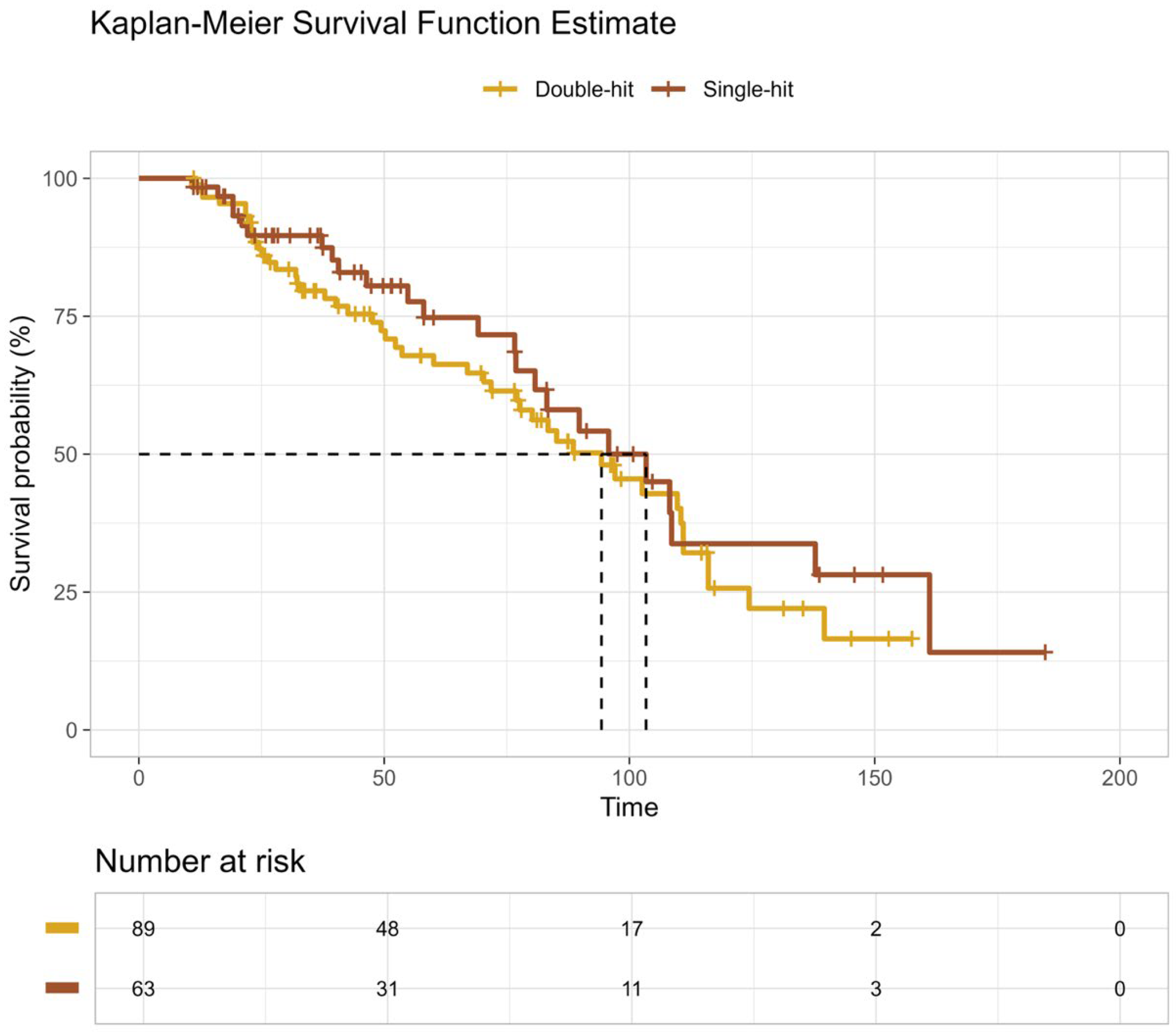
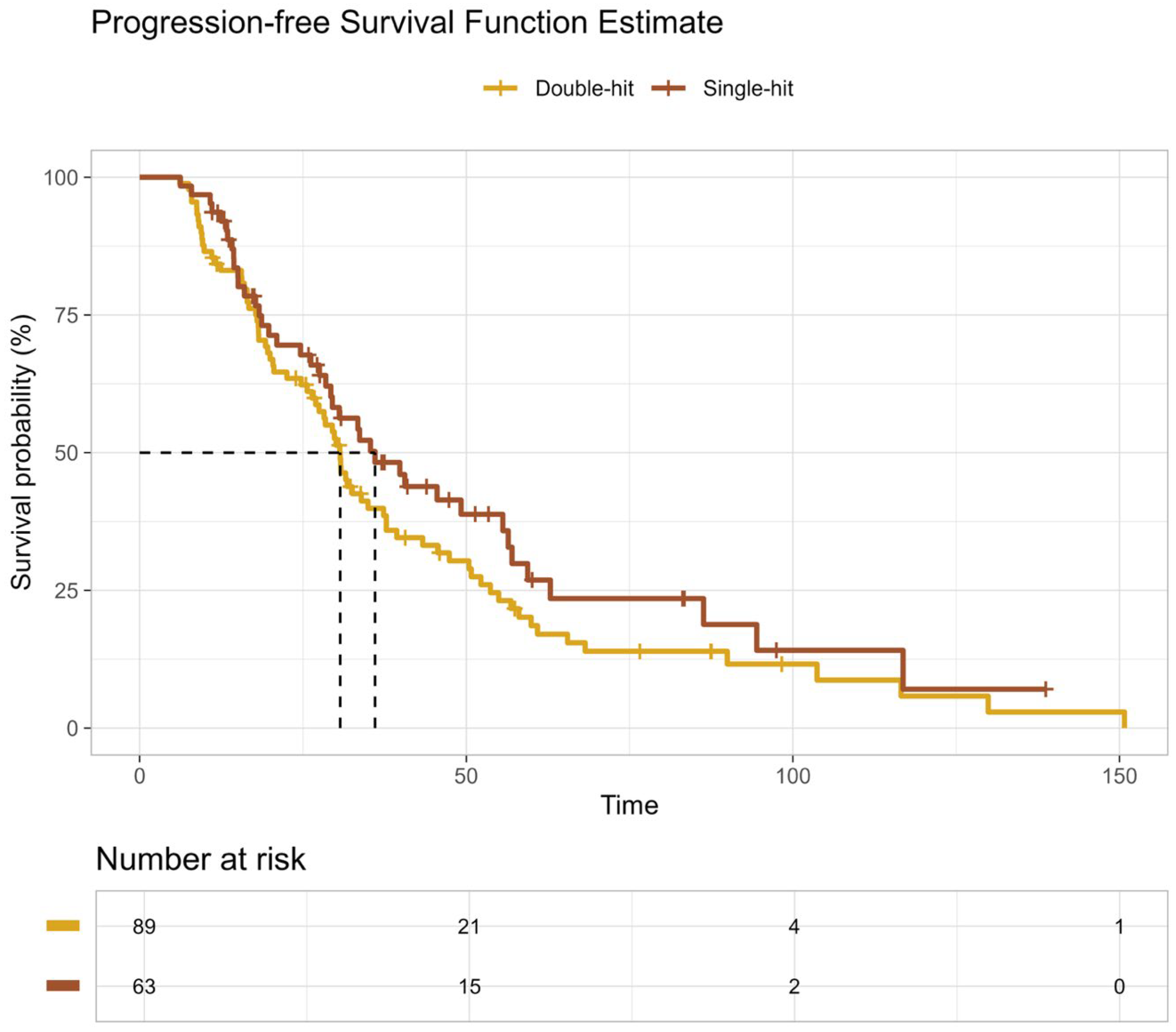
3.5. Progression Free Survival and Overall Survival
| (A) | ||||
| Characteristic | N | Event N | Median OS (in Months) * | p-Value 1 |
| Hit type | 152 | 70 | 0.4 | |
| Double hit | 94 (77, 111) | |||
| Single hit | 103 (81, NR) | |||
| (B) | ||||
| Characteristic | N | Event N | Median PFS (in months) ** | p-value 1 |
| Hit type | 152 | 115 | 0.2 | |
| Double hit | 31 (27, 38) | |||
| Single hit | 36 (29, 56) | |||
4. Discussion
5. Conclusions
Author Contributions
Funding
Institutional Review Board Statement
Informed Consent Statement
Data Availability Statement
Conflicts of Interest
References
- Rajkumar, S.V. Multiple myeloma: 2024 update on diagnosis, risk-stratification, and management. Am. J. Hematol. 2024, 99, 1802–1824. [Google Scholar] [CrossRef] [PubMed]
- González-Calle, V.; Rodriguez-Otero, P.; Calasanz, M.J.; Guijarro, M.; Martínez-López, J.; Rosiñol, L.; Hernández, M.T.; Teruel, A.I.; Gironella, M.; Oriol, A.; et al. High-risk cytogenetic abnormalities in multiple myeloma: PETHEMA-GEM experience. Hemasphere 2024, 8, e70031. [Google Scholar] [CrossRef] [PubMed]
- Shah, V.; Sherborne, A.L.; Walker, B.A.; Johnson, D.C.; Boyle, E.M.; Ellis, S.; Begum, D.B.; Proszek, P.Z.; Jones, J.R.; Pawlyn, C.; et al. Prediction of outcome in newly diagnosed myeloma: A meta-analysis of the molecular profiles of 1905 trial patients. Leukemia 2018, 32, 102–110. [Google Scholar] [CrossRef]
- Avet-Loiseau, H.; Davies, F.E.; Samur, M.K.; Corre, J.; D’Agostino, M.; Kaiser, M.F.; Raab, M.S.; Weinhold, N.; Gutierrez, N.C.; Paiva, B.; et al. International Myeloma Society/International Myeloma Working Group Consensus Recommendations on the Definition of High-Risk Multiple Myeloma. J. Clin. Oncol. 2025, 43, 2739–2751. [Google Scholar] [CrossRef]
- Mohan Lal, B.; van Rhee, F.; Al Hadidi, S. Current State of Evidence on Definitions and Management of High-Risk Multiple Myeloma. Curr. Oncol. Rep. 2025, 27, 258–277. [Google Scholar] [CrossRef]
- Yang, G.Z.; Wang, G.R.; Li, Y.C.; Wu, Y.; Gao, W.; Chen, W.M. Autologous peripheral blood stem cell transplantation as front-line therapy for myeloma with double-hit and triple-hit in a real-world study. Chin. Med. J. 2021, 134, 1991–1993. [Google Scholar] [CrossRef]
- Baysal, M.; Demirci, U.; Umit, E.; Kirkizlar, H.O.; Atli, E.I.; Gurkan, H.; Gulsaran, S.K.; Bas, V.; Mail, C.; Demir, A.M. Concepts of Double Hit and Triple Hit Disease in Multiple Myeloma, Entity and Prognostic Significance. Sci. Rep. 2020, 10, 5991. [Google Scholar] [CrossRef]
- Rajkumar, S.V.; Dimopoulos, M.A.; Palumbo, A.; Blade, J.; Merlini, G.; Mateos, M.V.; Kumar, S.; Hillengass, J.; Kastritis, E.; Richardson, P.; et al. International Myeloma Working Group updated criteria for the diagnosis of multiple myeloma. Lancet Oncol. 2014, 15, e538–e548. [Google Scholar] [CrossRef]
- Marcon, C.; Simeon, V.; Deias, P.; Facchin, G.; Corso, A.; Derudas, D.; Montefusco, V.; Offidani, M.; Petrucci, M.T.; Zambello, R.; et al. Experts’ consensus on the definition and management of high risk multiple myeloma. Front. Oncol. 2023, 12, 1096852. [Google Scholar] [CrossRef]
- Weinhold, N.; Ashby, C.; Rasche, L.; Chavan, S.S.; Stein, C.; Stephens, O.W.; Tytarenko, R.; Bauer, M.A.; Meissner, T.; Deshpande, S.; et al. Clonal selection and double-hit events involving tumor suppressor genes underlie relapse in myeloma. Blood 2016, 128, 1735–1744. [Google Scholar] [CrossRef] [PubMed]
- Walker, B.A.; Mavrommatis, K.; Wardell, C.P.; Ashby, T.C.; Bauer, M.; Davies, F.; Rosenthal, A.; Wang, H.; Qu, P.; Hoering, A.; et al. A high-risk, Double-Hit, group of newly diagnosed myeloma identified by genomic analysis. Leukemia 2019, 33, 159–170. [Google Scholar] [CrossRef]
- Panopoulou, A.; Cairns, D.A.; Holroyd, A.; Nichols, I.; Cray, N.; Pawlyn, C.; Cook, G.; Drayson, M.; Boyd, K.; Davies, F.E.; et al. Optimizing the value of lenalidomide maintenance by extended genetic profiling: An analysis of 556 patients in the Myeloma XI trial. Blood 2023, 141, 1666–1674. [Google Scholar] [CrossRef]
- Ozga, M.; Zhao, Q.; Huric, L.; Miller, C.; Rosko, A.; Khan, A.; Umyarova, E.; Benson, D.; Cottini, F. Concomitant 1q+ and t(4;14) influences disease characteristics, immune system, and prognosis in double-hit multiple myeloma. Blood Cancer J. 2023, 13, 167. [Google Scholar] [CrossRef] [PubMed]
- Corre, J.; Perrot, A.; Caillot, D.; Belhadj, K.; Hulin, C.; Leleu, X.; Mohty, M.; Facon, T.; Buisson, L.; Do Souto, L.; et al. del(17p) without TP53 mutation confers a poor prognosis in intensively treated newly diagnosed patients with multiple myeloma. Blood 2021, 137, 1192–1195. [Google Scholar] [CrossRef] [PubMed]
- Liang, D.; Li, X.; Bai, S.; Wang, Q.; Zeng, M.; Feng, D.; Lu, B.; Li, X.; Sun, Z.; Li, J.; et al. Clinical Outcome of Induction Treatment in the Era of Novel Agents and the Impact of the Number of High-Risk Cytogenetic Abnormalities (HRA) on Prognosis of Patients with Newly Diagnosed Multiple Myeloma (NDMM): Insights from a Multicenter Study. Cancer Med. 2024, 13, e70270. [Google Scholar] [CrossRef]
- Benda, M.; Reimann, P.; Bletzacher, E.; Muendlein, A.; Bernhard, B.; Hartmann, B.; Huynh, M.; Gasser, K.; Zojer, N.; Lang, T.; et al. Real-World Data on the Efficacy of Daratumumab in Patients with Relapsed/Refractory Multiple Myeloma and Amplification 1q. Cancers 2025, 17, 1261. [Google Scholar] [CrossRef]
- Ansari-Pour, N.; Samur, M.; Flynt, E.; Gooding, S.; Towfic, F.; Stong, N.; Estevez, M.O.; Mavrommatis, K.; Walker, B.; Morgan, G.; et al. Whole-genome analysis identifies novel drivers and high-risk double-hit events in relapsed/refractory myeloma. Blood 2023, 141, 620–633. [Google Scholar] [CrossRef] [PubMed]
- Truger, M.S.; Duell, J.; Zhou, X.; Heimeshoff, L.; Ruckdeschel, A.; John, M.; Riedel, A.; Hüper, S.; Peter, J.; Walter, W.; et al. Single- and double-hit events in genes encoding immune targets before and after T cell–engaging antibody therapy in MM. Blood Adv. 2021, 5, 3794–3798. [Google Scholar] [CrossRef]
- Tao, Y.; Jin, S.; Yang, D.; Pan, M.; Ouyang, W.; Liu, Y.; Wang, Y.; Zhang, W.; Mi, J. Real-world advantage and challenge of post-autologous stem cell transplantation MRD negativity in high-risk patients with double-hit multiple myeloma. BMC Cancer 2024, 24, 406. [Google Scholar] [CrossRef]
- Kaiser, M.F.; Sonneveld, P.; Cairns, D.A.; Raab, M.S.; San-Miguel Izquierdo, J.; Zhang, R.; Acosta, J.; Larocca, A.; Popat, R.; Li, C.; et al. Co-Occurrence of Cytogenetic Abnormalities and High-Risk Disease in Newly Diagnosed and Relapsed/Refractory Multiple Myeloma. J. Clin. Oncol. 2025, 43, 2679–2691. [Google Scholar] [CrossRef]
- Ziccheddu, B.; Vià, M.C.D.; Lionetti, M.; Maeda, A.; Morlupi, S.; Dugo, M.; Todoerti, K.; Oliva, S.; D’AGostino, M.; Corradini, P.; et al. Functional Impact of Genomic Complexity on the Transcriptome of Multiple Myeloma. Clin. Cancer Res. 2021, 27, 6479–6490. [Google Scholar] [CrossRef]
- Jin, X.; Li, H.; Zhang, D.; Liu, S.; Song, Y.; Zhang, F.; Li, Z.; Zhuang, J. Myc rearrangement redefines the stratification of high-risk multiple myeloma. Cancer Med. 2024, 13, e7194. [Google Scholar] [CrossRef] [PubMed]
- Liang, X.; Xu, W.; Zhou, F.; Huang, W.; Yi, X.; Zhang, Y.; Yan, Y.; Zhang, N.; Wang, J.; Sun, X.; et al. Dissecting the high-risk property of 1q gain/amplification in patients with newly diagnosed multiple myeloma. Am. J. Cancer Res. 2025, 15, 501–516. [Google Scholar] [CrossRef] [PubMed]
- Martello, M.; Poletti, A.; Borsi, E.; Solli, V.; Dozza, L.; Barbato, S.; Zamagni, E.; Tacchetti, P.; Pantani, L.; Mancuso, K.; et al. Clonal and subclonal TP53 molecular impairment is associated with prognosis and progression in multiple myeloma. Blood Cancer J. 2022, 12, 15. [Google Scholar] [CrossRef] [PubMed]


Disclaimer/Publisher’s Note: The statements, opinions and data contained in all publications are solely those of the individual author(s) and contributor(s) and not of MDPI and/or the editor(s). MDPI and/or the editor(s) disclaim responsibility for any injury to people or property resulting from any ideas, methods, instructions or products referred to in the content. |
© 2026 by the authors. Licensee MDPI, Basel, Switzerland. This article is an open access article distributed under the terms and conditions of the Creative Commons Attribution (CC BY) license.
Share and Cite
Rahman, R.; Zayad, A.; Awadallah, C.; Wang, B.; Wu, J.; Khaliq, A.; Mewawalla, P.; Atrash, S.; Mudaranthakam, D.P.; McGuirk, J.; et al. Outcomes of Double-Hit and Single High-Risk Cytogenetic Newly Diagnosed Myeloma in Transplant-Eligible Patients. Curr. Oncol. 2026, 33, 246. https://doi.org/10.3390/curroncol33050246
Rahman R, Zayad A, Awadallah C, Wang B, Wu J, Khaliq A, Mewawalla P, Atrash S, Mudaranthakam DP, McGuirk J, et al. Outcomes of Double-Hit and Single High-Risk Cytogenetic Newly Diagnosed Myeloma in Transplant-Eligible Patients. Current Oncology. 2026; 33(5):246. https://doi.org/10.3390/curroncol33050246
Chicago/Turabian StyleRahman, Raeef, Anas Zayad, Carmel Awadallah, Beining Wang, Jianzheng Wu, Aroog Khaliq, Prerna Mewawalla, Shebli Atrash, Dinesh Pal Mudaranthakam, Joseph McGuirk, and et al. 2026. "Outcomes of Double-Hit and Single High-Risk Cytogenetic Newly Diagnosed Myeloma in Transplant-Eligible Patients" Current Oncology 33, no. 5: 246. https://doi.org/10.3390/curroncol33050246
APA StyleRahman, R., Zayad, A., Awadallah, C., Wang, B., Wu, J., Khaliq, A., Mewawalla, P., Atrash, S., Mudaranthakam, D. P., McGuirk, J., Mahmoudjafari, Z., Mushtaq, M. U., Abdallah, A.-O., Ahmed, N., Snyder, J., Mazloom, A., Alkharabsheh, O., & Shah, M. R. (2026). Outcomes of Double-Hit and Single High-Risk Cytogenetic Newly Diagnosed Myeloma in Transplant-Eligible Patients. Current Oncology, 33(5), 246. https://doi.org/10.3390/curroncol33050246