Predictors and Patterns of Recurrence After a Watchful Waiting Approach following Clinical Complete Response to Neoadjuvant Radiochemotherapy for Esophageal Cancer
by
 , , , ,
Sarah Gerber
1, 
Martin D. Berger
2,
Hossein Hemmatazad
3,
Pauline Aeschbacher
1 ,
,
Dino Kröll
1,
Daniel Candinas
1 and
Yves Borbély
1,* 1
Department of Visceral Surgery and Medicine, Inselspital, Bern University Hospital, University of Bern, 3010 Bern, Switzerland
2
Department of Medical Oncology, Inselspital, Bern University Hospital, University of Bern, 3010 Bern, Switzerland
3
Department of Radiation Oncology, Inselspital, Bern University Hospital, University of Bern, 3010 Bern, Switzerland
*
Author to whom correspondence should be addressed.
Curr. Oncol. 2026, 33(3), 170; https://doi.org/10.3390/curroncol33030170
Submission received: 22 January 2026
/
Revised: 6 March 2026
/
Accepted: 11 March 2026
/
Published: 16 March 2026
(This article belongs to the Section Gastrointestinal Oncology)
Simple Summary
Esophageal cancer is usually treated with chemotherapy and radiation followed by surgery, but surgery can be risky and cause serious complications. For some patients who respond completely to initial treatment, a “watchful waiting” approach—delaying or avoiding surgery unless the cancer returns—is increasingly considered. In this study, we analyzed patients managed with watchful waiting to identify factors linked to cancer recurrence. We found that having adenocarcinoma (one of the main types of esophageal cancer), larger tumor size, and signs of weakness or difficulty swallowing after initial treatment were associated with a higher risk of recurrence. Patients whose cancer did return could often be treated successfully. These findings may help guide follow-up care, identify high-risk patients early, and reduce unnecessary surgeries, improving quality of life while maintaining good outcomes. They also provide a basis for future research to refine personalized treatment strategies for esophageal cancer.
Abstract
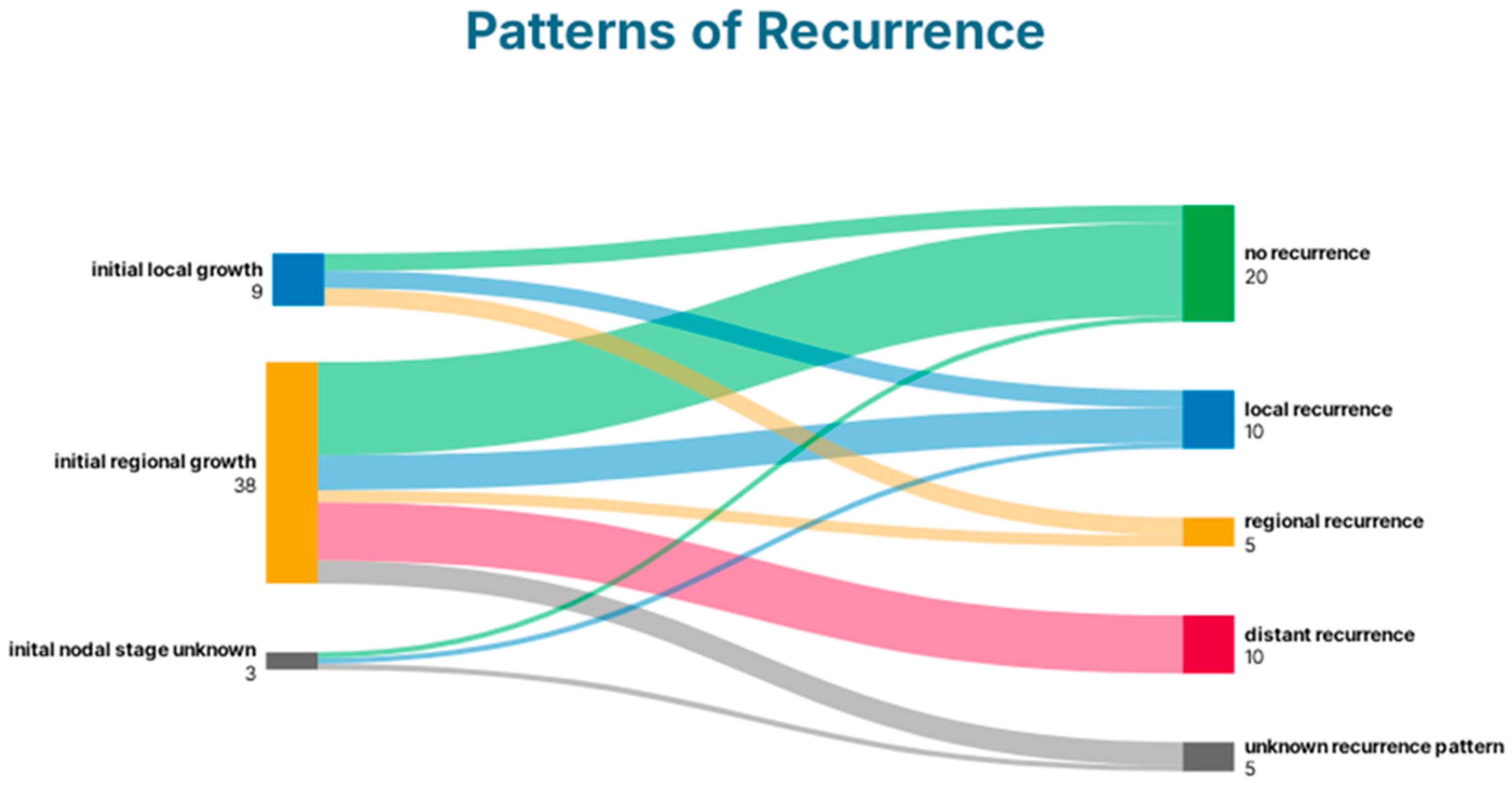
(1) Background: Treatment of esophageal cancer (EC) traditionally consists of neoadjuvant radiochemotherapy (RCT) followed by resection; however, esophagectomy is associated with substantial morbidity, particularly in patients with relevant comorbidities. Therefore, a watchful waiting (WW) strategy has been increasingly adopted for patients achieving a complete response to RCT. This study aimed to identify independent predictors and recurrence patterns in EC patients managed with WW. (2) Methods: We retrospectively analyzed all patients with potentially curable EC and complete response to RCT treated at a tertiary university hospital between 2014 and 2022. Comprehensive staging and restaging were performed using computed tomography, endoscopy with ultrasound and biopsies, and positron-emission tomography, followed by structured surveillance. Recurrence patterns and associated clinical and tumor-related factors were assessed using multivariate regression analysis. (3) Results: Among 50 included patients, 30 (60%) developed recurrence after a median of 202 days. Patients with initially nodal-negative disease did not develop distant recurrence, whereas nodal-positive patients showed metastatic recurrence in 26% and local regrowth in 16%. (4) Discussion: Adenocarcinoma, circumferential tumor extent greater than 50%, dysphagia, fatigue, and deterioration of general condition at restaging were independently associated with recurrence. These findings support risk-adapted surveillance and may facilitate personalized management in EC patients undergoing WW.