Patient Journey for Triple-Negative Breast Cancer: Optimal Care Pathways vs. Reality of Care in Italian Breast Units

 , , , , , ,
Simple Summary
Abstract
1. Introduction
2. Materials and Methods
2.1. Survey Construction and Survey Aims
- Members of the scientific group and key stakeholders evaluated the relevance and applicability of each of the 117 previously defined statements, using a pre-determined rating scale to express their level of agreement.
- A consensus threshold was established, typically defined as the agreement of at least 75% of the participants on the relevance of a statement, in line with standard clinical content validation procedures.
- To streamline the process and facilitate consensus, the sessions were supported by expert methodologists. In instances where a consensus could not be reached, the statements were discussed, revised based on expert feedback, and subjected to a re-voting cycle. In the event that consensus was not reached after three rounds, the statement was classified as belonging to an area of uncertainty or non-relevance for the working group, ensuring that the final set was robust, clinically applicable, and widely shared.
- 2 statements on the multidisciplinary team;
- 2 statements on prevention;
- 4 statements on diagnosis (11 including sub-statements);
- 8 statements on patient intake (15 including sub-statements);
- 4 statements on therapy;
- 4 statements on follow-up (12 including sub-statements).
2.2. Data Analysis
- Importance of the statement subscale: It was determined that ratings of 4, i.e., “important” or higher, indicated a strong consensus, while ratings of 3, i.e., “quite important” or lower, indicated a weak consensus. The level of consensus regarding the perceived importance of each statement was quantified by calculating a mean score for the five macro-areas of interest, as well as an overall score.
- Degree of implementation subscale: scores of 4, i.e., “properly implemented” or above, were considered to indicate a satisfactory level of reported implementation; a score of 3, i.e., “enough implemented”, indicated a moderate level; and a score of 2, i.e., “slightly implemented” or below, reflected a poor level of reported implementation. As with the importance subscale, a mean score was calculated for each macro-area and for the total.
- In order to identify items that may require additional efforts or targeted programs, the difference between perceived importance and reported implementation was examined. For the purpose of emphasizing the findings, a discrepancy greater than 0.75 was arbitrarily defined as indicating a substantial critical issue in the implementation of the statements. In contrast, discrepancies between 0.25 and 0.75 were indicated as less severe concerns.
3. Results
3.1. Demographics
3.2. Importance and Implementation Levels
3.2.1. Importance
3.2.2. Implementation
3.2.3. The Gap in the Statements: Perceived Importance vs. Reported Implementation
3.2.4. Implementation Higher than or Equal to Importance
4. Discussion
5. Conclusions
Supplementary Materials
Author Contributions
Funding
Institutional Review Board Statement
Informed Consent Statement
Data Availability Statement
Acknowledgments
Conflicts of Interest
Abbreviations
| TNBC | Triple-Negative Breast Cancer |
| BU | Breast Unit |
| GPPs | Good Practice Points |
| BC | Breast Cancer |
| OS | Overall Survival |
| RFI | Relapse-Free Interval |
| GP | General Practitioner |
| ER | Oestrogen Receptor |
| PR | Progesterone Receptor |
| HER2 | Human Epidermal Growth Factor Receptor 2 |
| ADP | Adenosine Diphosphate |
| PARP | Poly ADP-Ribose Polymerase |
| gPV | Germline Pathogenic Variant |
| CDK | Cycline-Dependent kinase |
| PI3K/AKT/mTOR | Phosphatidylinositol 3-kinase, Protein Kinase B, Mammalian Target of Rapamycin |
| TKI | Tyrosine Kinase Inhibitor |
| PD-1 | Programmed Cell Death protein 1 |
| PD-L1 | Programmed Death Ligand 1 |
| PJ | Patient Journey |
| PET | Positron Emission Tomography |
| PDTA | Percorsi Diagnostico Terapeutici Assistenziali (Diagnostic and Therapeutic Care Pathways) |
| CAWI | Computer-Assisted Web Interviewing |
| MRI | Magnetic Resonance Imaging |
References
- Bray, F.; Laversanne, M.; Sung, H.; Ferlay, J.; Siegel, R.L.; Soerjomataram, I.; Jemal, A. Global Cancer Statistics 2022: GLOBOCAN Estimates of Incidence and Mortality Worldwide for 36 Cancers in 185 Countries. CA Cancer J. Clin. 2024, 74, 229–263. [Google Scholar] [CrossRef]
- AIOM. I Numeri del Cancro in Italia. Available online: https://www.aiom.it/i-numeri-del-cancro-in-italia/ (accessed on 14 November 2025).
- Kumar, P.; Aggarwal, R. An Overview of Triple-Negative Breast Cancer. Arch. Gynecol. Obstet. 2016, 293, 247–269. [Google Scholar] [CrossRef] [PubMed]
- Wu, Q.; Siddharth, S.; Sharma, D. Triple Negative Breast Cancer: A Mountain Yet to Be Scaled Despite the Triumphs. Cancers 2021, 13, 3697. [Google Scholar] [CrossRef] [PubMed]
- Aysola, K.; Desai, A.; Welch, C.; Xu, J.; Qin, Y.; Reddy, V.; Matthews, R.; Owens, C.; Beech, D.; Piyathilake, C.; et al. Triple Negative Breast Cancer—An Overview. Hered. Genet. 2013, 2013, 001. [Google Scholar] [CrossRef]
- Foulkes, W.D.; Smith, I.E.; Reis-Filho, J.S. Triple-Negative Breast Cancer. N. Engl. J. Med. 2010, 363, 1938–1948. [Google Scholar] [CrossRef]
- Choupani, E.; Mahmoudi Gomari, M.; Zanganeh, S.; Nasseri, S.; Haji-allahverdipoor, K.; Rostami, N.; Hernandez, Y.; Najafi, S.; Saraygord-Afshari, N.; Hosseini, A. Newly Developed Targeted Therapies Against the Androgen Receptor in Triple-Negative Breast Cancer: A Review. Pharmacol. Rev. 2023, 75, 309–327. [Google Scholar] [CrossRef]
- Xiong, N.; Wu, H.; Yu, Z. Advancements and Challenges in Triple-Negative Breast Cancer: A Comprehensive Review of Therapeutic and Diagnostic Strategies. Front. Oncol. 2024, 14, 1405491. [Google Scholar] [CrossRef]
- Jain, A.; Barge, A.; Parris, C.N. Combination Strategies with PARP Inhibitors in BRCA-Mutated Triple-Negative Breast Cancer: Overcoming Resistance Mechanisms. Oncogene 2025, 44, 193–207. [Google Scholar] [CrossRef]
- Bonnefoi, H.; Lerebours, F.; Pulido, M.; Arnedos, M.; Tredan, O.; Dalenc, F.; Guiu, S.; Teixeira, L.; Mollon, D.; Levy, C.; et al. Darolutamide or Capecitabine in Triple-Negative, Androgen Receptor-Positive, Advanced Breast Cancer (UCBG 3-06 START): A Multicentre, Non-Comparative, Randomised, Phase 2 Trial. Lancet Oncol. 2025, 26, 355–366. [Google Scholar] [CrossRef]
- Lim, B.; Seth, S.; Yam, C.; Huo, L.; Fujii, T.; Lee, J.; Bassett, R.; Nasser, S.; Ravenberg, L.; White, J.; et al. Phase 2 Study of Neoadjuvant Enzalutamide and Paclitaxel for Luminal Androgen Receptor-Enriched TNBC: Trial Results and Insights into “ARness”. Cell Rep. Med. 2024, 5, 101595. [Google Scholar] [CrossRef]
- Wu, J.; Wang, W.; Gao, L.; Shao, X.; Wang, X. Cyclin-Dependent Kinase Inhibitors Enhance Programmed Cell Death Protein 1 Immune Checkpoint Blockade Efficacy in Triple-Negative Breast Cancer by Affecting the Immune Microenvironment. Cancer 2024, 130, 1449–1463. [Google Scholar] [CrossRef] [PubMed]
- Mustafa, E.H.; Laven-Law, G.; Kikhtyak, Z.; Nguyen, V.; Ali, S.; Pace, A.A.; Iggo, R.; Kebede, A.; Noll, B.; Wang, S.; et al. Selective Inhibition of CDK9 in Triple Negative Breast Cancer. Oncogene 2024, 43, 202–215. [Google Scholar] [CrossRef] [PubMed]
- Jaradat, S.K.; Ayoub, N.M.; Al Sharie, A.H.; Aldaod, J.M. Targeting Receptor Tyrosine Kinases as a Novel Strategy for the Treatment of Triple-Negative Breast Cancer. Technol. Cancer Res. Treat. 2024, 23, 15330338241234780. [Google Scholar] [CrossRef] [PubMed]
- Hassan, A.; Aubel, C. The PI3K/Akt/mTOR Signaling Pathway in Triple-Negative Breast Cancer: A Resistance Pathway and a Prime Target for Targeted Therapies. Cancers 2025, 17, 2232. [Google Scholar] [CrossRef]
- Islam, R.; Yen, K.P.; Rani, N.N.I.M.; Hossain, S. Recent Advancement in Developing Small Molecular Inhibitors Targeting Key Kinase Pathways against Triple-Negative Breast Cancer. Bioorganic Med. Chem. 2024, 112, 117877. [Google Scholar] [CrossRef]
- Miles, D.; Gligorov, J.; André, F.; Cameron, D.; Schneeweiss, A.; Barrios, C.; Xu, B.; Wardley, A.; Kaen, D.; Andrade, L.; et al. Primary Results from IMpassion131, a Double-Blind, Placebo-Controlled, Randomised Phase III Trial of First-Line Paclitaxel with or without Atezolizumab for Unresectable Locally Advanced/Metastatic Triple-Negative Breast Cancer. Ann. Oncol. 2021, 32, 994–1004. [Google Scholar] [CrossRef]
- Schmid, P.; Cortes, J.; Dent, R.; McArthur, H.; Pusztai, L.; Kümmel, S.; Denkert, C.; Park, Y.H.; Hui, R.; Harbeck, N.; et al. Overall Survival with Pembrolizumab in Early-Stage Triple-Negative Breast Cancer. N. Engl. J. Med. 2024, 391, 1981–1991. [Google Scholar] [CrossRef]
- Cortes, J.; Rugo, H.S.; Cescon, D.W.; Im, S.-A.; Yusof, M.M.; Gallardo, C.; Lipatov, O.; Barrios, C.H.; Perez-Garcia, J.; Iwata, H.; et al. Pembrolizumab plus Chemotherapy in Advanced Triple-Negative Breast Cancer. N. Engl. J. Med. 2022, 387, 217–226. [Google Scholar] [CrossRef]
- Bardia, A.; Rugo, H.S.; Tolaney, S.M.; Loirat, D.; Punie, K.; Oliveira, M.; Brufsky, A.; Kalinsky, K.; Cortés, J.; Shaughnessy, J.O.; et al. Final Results From the Randomized Phase III ASCENT Clinical Trial in Metastatic Triple-Negative Breast Cancer and Association of Outcomes by Human Epidermal Growth Factor Receptor 2 and Trophoblast Cell Surface Antigen 2 Expression. J. Clin. Oncol. 2024, 42, 1738–1744. [Google Scholar] [CrossRef]
- Modi, S.; Jacot, W.; Iwata, H.; Park, Y.H.; Vidal Losada, M.; Li, W.; Tsurutani, J.; Ueno, N.T.; Zaman, K.; Prat, A.; et al. Trastuzumab Deruxtecan in HER2-Low Metastatic Breast Cancer: Long-Term Survival Analysis of the Randomized, Phase 3 DESTINY-Breast04 Trial. Nat. Med. 2025, 31, 4205–4213. [Google Scholar] [CrossRef]
- Li, Y.; Zhang, H.; Merkher, Y.; Chen, L.; Liu, N.; Leonov, S.; Chen, Y. Recent Advances in Therapeutic Strategies for Triple-Negative Breast Cancer. J. Hematol. Oncol. 2022, 15, 121. [Google Scholar] [CrossRef] [PubMed]
- Mirza, L.; Steventon, L.; Roylance, R.; Hughes, C.; Creed, C.; Morris, E.; Purcell, I.; Frank, S.; Masters, N.; Chambers, P. Regional Differences in Neo/Adjuvant Chemotherapy Timing in Patients with Early-Stage Triple-Negative Breast Cancer in England. Breast Cancer Res. Treat. 2025, 209, 139–146. [Google Scholar] [CrossRef] [PubMed]
- Tinterri, C.; Gentile, D.; Caruso, F.; Cortesi, L.; De Laurentiis, M.; Fortunato, L.; Santini, D.; Turchetti, D.; Ferrari, A.; Zambelli, A.; et al. BRCA Testing for Patients Treated in Italy: A National Survey of Breast Centers Associated with Senonetwork. Curr. Oncol. 2024, 31, 3815–3825. [Google Scholar] [CrossRef] [PubMed]
- Diamond, I.R.; Grant, R.C.; Feldman, B.M.; Pencharz, P.B.; Ling, S.C.; Moore, A.M.; Wales, P.W. Defining Consensus: A Systematic Review Recommends Methodologic Criteria for Reporting of Delphi Studies. J. Clin. Epidemiol. 2014, 67, 401–409. [Google Scholar] [CrossRef]
- Roetzheim, R.G.; Ferrante, J.M.; Lee, J.-H.; Chen, R.; Love-Jackson, K.M.; Gonzalez, E.C.; Fisher, K.J.; McCarthy, E.P. Influence of Primary Care on Breast Cancer Outcomes Among Medicare Beneficiaries. Ann. Fam. Med. 2012, 10, 401–411. [Google Scholar] [CrossRef]
- Chen, H.; Wu, J.; Zhang, Z.; Tang, Y.; Li, X.; Liu, S.; Cao, S.; Li, X. Association Between BRCA Status and Triple-Negative Breast Cancer: A Meta-Analysis. Front. Pharmacol. 2018, 9, 909. [Google Scholar] [CrossRef]
- McCarthy, A.M.; Armstrong, K. The Role of Testing for BRCA1 and BRCA2 Mutations in Cancer Prevention. JAMA Intern. Med. 2014, 174, 1023–1024. [Google Scholar] [CrossRef]
- Vande Perre, P.; Toledano, D.; Corsini, C.; Escriba, E.; Laporte, M.; Bertet, H.; Yauy, K.; Toledano, A.; Galibert, V.; Baudry, K.; et al. Role of the General Practitioner in the Care of BRCA1 and BRCA2 Mutation Carriers: General Practitioner and Patient Perspectives. Mol. Genet. Genom. Med. 2018, 6, 957–965. [Google Scholar] [CrossRef]
- Wallner, L.P.; Li, Y.; McLeod, M.C.; Gargaro, J.; Kurian, A.W.; Jagsi, R.; Radhakrishnan, A.; Hamilton, A.S.; Ward, K.C.; Hawley, S.T.; et al. Primary Care Provider-Reported Involvement in Breast Cancer Treatment Decisions. Cancer 2019, 125, 1815–1822. [Google Scholar] [CrossRef]
- Klitzman, R.; Chung, W. The Process of Deciding about Prophylactic Surgery for Breast and Ovarian Cancer: Patient Questions, Uncertainties, and Communication. Am. J. Med. Genet. Part A 2010, 152A, 52–66. [Google Scholar] [CrossRef]
- Rubin, G.; Berendsen, A.; Crawford, S.M.; Dommett, R.; Earle, C.; Emery, J.; Fahey, T.; Grassi, L.; Grunfeld, E.; Gupta, S.; et al. The Expanding Role of Primary Care in Cancer Control. Lancet Oncol. 2015, 16, 1231–1272. [Google Scholar] [CrossRef]
- Riva, S.; Efficace, F.; Di Maio, M.; Bryce, J.; Del Campo, L.; De Lorenzo, F.; Frontini, L.; Giannarelli, D.; Gitto, L.; Iannelli, E.; et al. A Qualitative Analysis and Development of a Conceptual Model Assessing Financial Toxicity in Cancer Patients Accessing the Universal Healthcare System. Support. Care Cancer 2021, 29, 3219–3233. [Google Scholar] [CrossRef]



| Region | Senonetwork | Sample | % Represented |
|---|---|---|---|
| Abruzzo | 3 | 3 | 100.0% |
| Basilicata | 2 | 1 | 50.0% |
| Calabria | 3 | 0 | 0.0% |
| Campania | 8 | 4 | 50.0% |
| Emilia-Romagna | 12 | 9 | 75.0% |
| Friuli-Venezia Giulia | 4 | 4 | 100.0% |
| Lazio | 15 | 8 | 53.3% |
| Liguria | 5 | 2 | 40.0% |
| Lombardy | 34 | 26 | 76.5% |
| Marche | 2 | 2 | 100.0% |
| Molise | 0 | - | - |
| Piedmont | 15 | 9 | 60.0% |
| Puglia | 10 | 2 | 20.0% |
| Sardinia | 2 | 1 | 50.0% |
| Sicily | 9 | 5 | 55.6% |
| Tuscany | 12 | 9 | 75.0% |
| Trentino-Alto Adige/Südtirol | 3 | 3 | 100.0% |
| Umbria | 4 | 3 | 75.0% |
| Valle d’Aosta/Vallée d’Aoste | 1 | 1 | 100.0% |
| Veneto | 12 | 10 | 83.3% |
| Total | 156 | 102 | 65.4% |
| Number | Statement |
|---|---|
| Team | |
| I | Professions present in the Breast Unit (BU) |
| II | Frequency of BU meetings |
| Importance | Implementation | |||||||||
|---|---|---|---|---|---|---|---|---|---|---|
| Prevention | Diagnosis | Patient Intake | Therapy | Follow-Up | Prevention | Diagnosis | Patient Intake | Therapy | Follow-Up | |
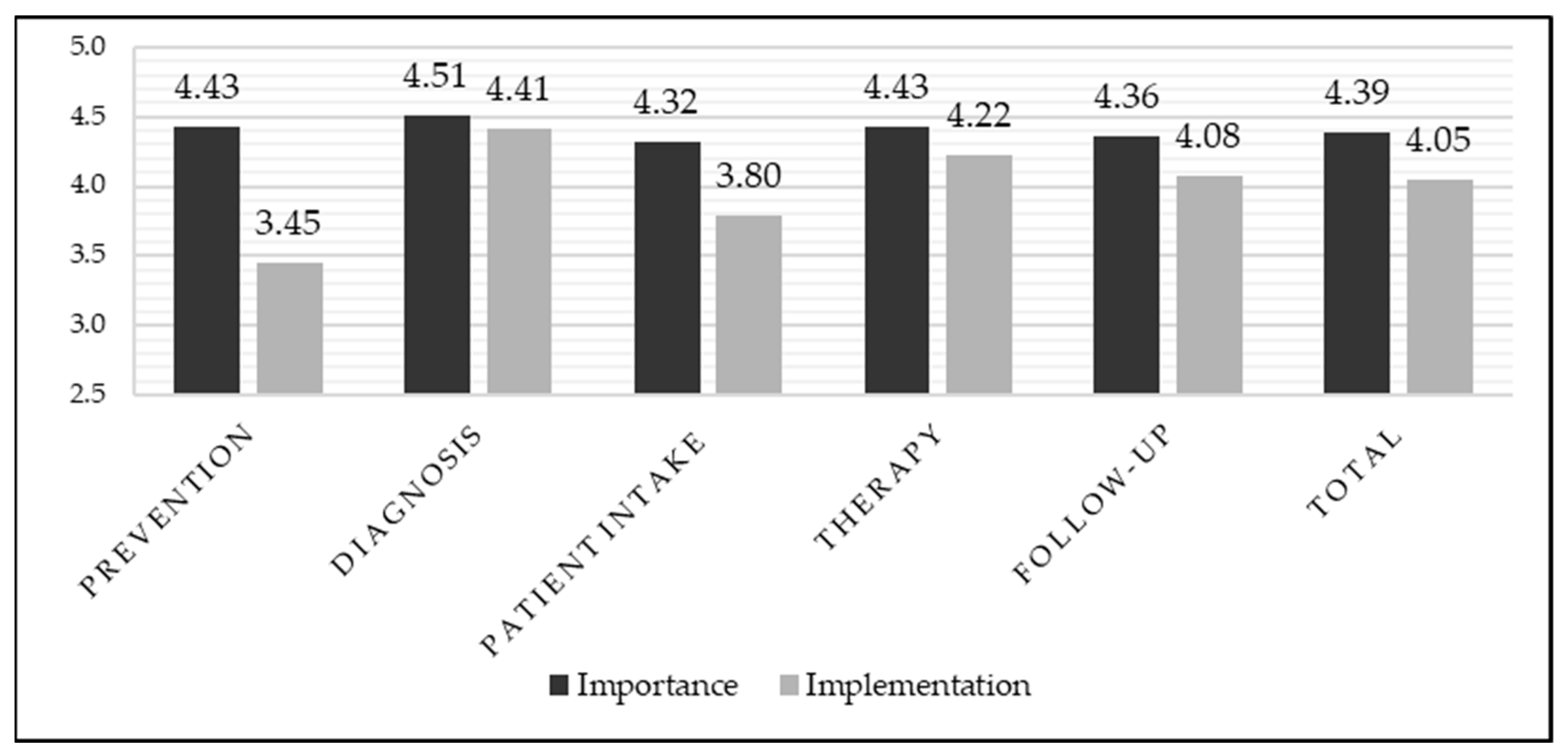
| Mean | 4.43 | 4.51 | 4.32 | 4.43 | 4.36 | 3.45 | 4.41 | 3.80 | 4.22 | 4.08 |
| Std deviation | 0.84 | 0.79 | 0.83 | 0.87 | 0.82 | 1.17 | 0.89 | 1.07 | 1.01 | 0.99 |
| Mode | 5 | 5 | 5 | 5 | 5 | 4 | 5 | 4 | 5 | 5 |
| Median | 5 | 5 | 5 | 5 | 5 | 4 | 5 | 4 | 5 | 4 |
| Q1 | 4 | 4 | 4 | 4 | 4 | 2 | 4 | 3 | 4 | 4 |
| Q3 | 5 | 5 | 5 | 5 | 5 | 4 | 5 | 5 | 5 | 5 |
| IQR | 1 | 1 | 1 | 1 | 1 | 2 | 1 | 2 | 1 | 1 |
| N | Importance | |
|---|---|---|
| Diagnosis | ||
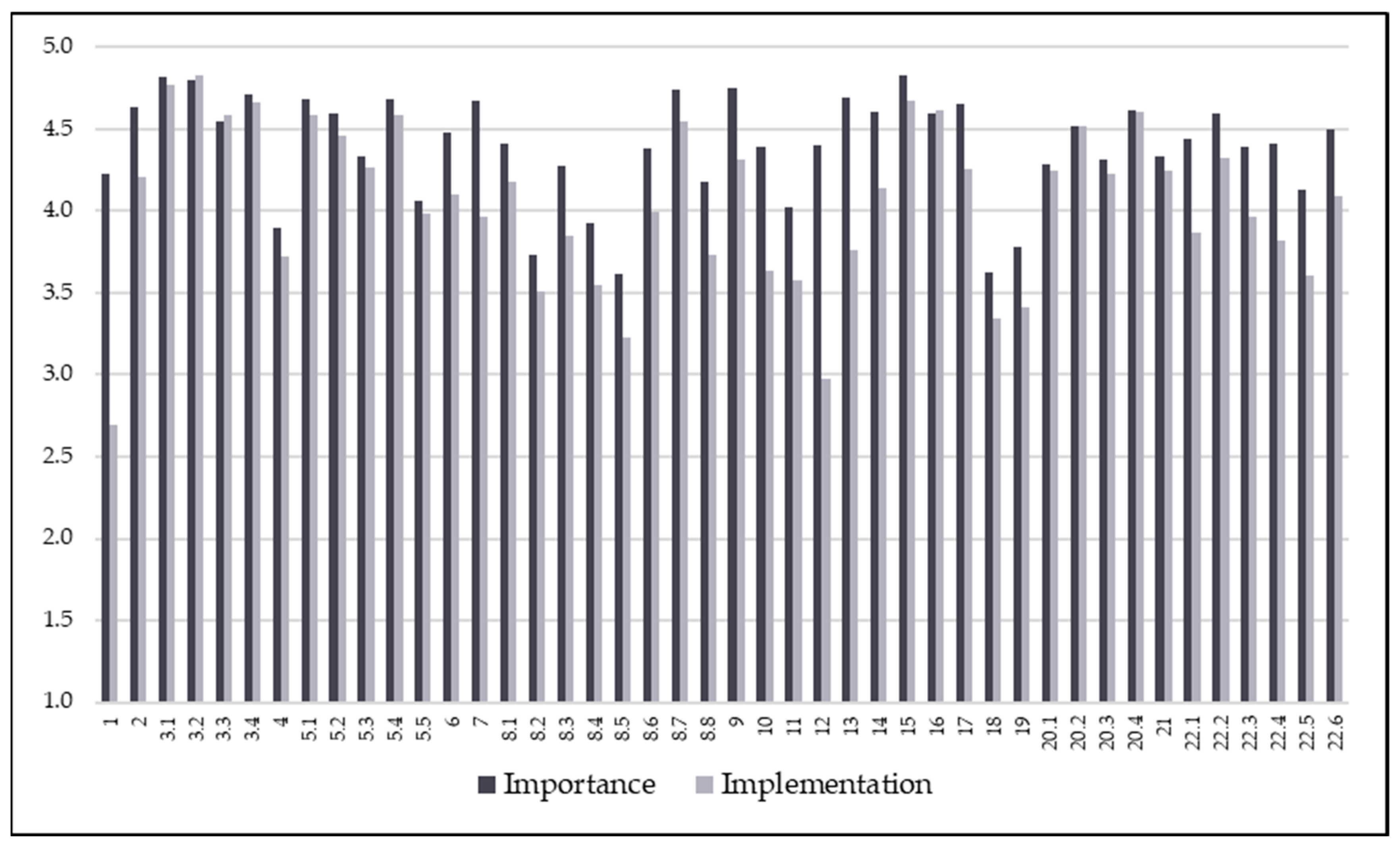
| 4 | During diagnosis, PET may be recommended for patients with triple-negative carcinoma at clinical stage ≥ II. | 3.89 |
| Patient intake | ||
| 8.2 | From the onset: Consultation with a cardiologist. | 3.74 |
| 8.4 | From the onset: The presence of a bone specialist. | 3.92 |
| 8.5 | From the onset: Dental assessment in cases where anti-blastic treatment is planned. | 3.62 |
| Therapy | ||
| 18 | In the field of gynaecological health, for patients with triple-negative cancer, the possibility of using hormone therapy should not be overlooked. | 3.63 |
| Follow-up | ||
| 19 | Follow-up management entrusted to the oncologist, with possible management by the GP one year after diagnosis (for low-risk breast cancer). | 3.78 |
| N | Gap | |
|---|---|---|
| Prevention | ||
| 1 | Systematic medical history review by the GP for familiarity with BRCA gPVs. | 1.53 |
| Patient intake | ||
| 10 | Waiting lists for gynaecological services not over 72 h. | 0.75 |
| 12 | Coordination between the multidisciplinary team and the GP, through access to medical reports and an open channel of communication. | 1.43 |
| 13 | Regions should update and publish the lists of recognized BUs annually/biannually. | 0.93 |
| N | Importance | Implementation | Gap | |
|---|---|---|---|---|
| Diagnosis | ||||
| 3.2 | Initial identification and staging with: Ultrasound (including axillary lymph nodes). | 4.79 | 4.82 | −0.03 |
| 3.3 | Initial identification and staging with contrast-enhanced MRI or contrast-enhanced mammography. | 4.55 | 4.59 | −0.04 |
| Therapy | ||||
| 16 | Breast-conserving surgery (quadrantectomy) and axillary-conserving surgery (sentinel lymph node biopsy) for women with early-stage cancer, without axillary lymph node involvement, not undergone neoadjuvant chemotherapy. | 4.60 | 4.62 | −0.02 |
| Follow-up | ||||
| 20.2 | Follow-up examinations: Physical examination every 6–12 months from the fourth to fifth year | 4.52 | 4.52 | 0.00 |
| 20.4 | Follow-up examinations: Bilateral mammography (or contralateral if previous mastectomy) performed annually, supplemented by ultrasound and MRI if appropriate (not for bilateral mastectomy) | 4.62 | 4.61 | 0.01 |
Disclaimer/Publisher’s Note: The statements, opinions and data contained in all publications are solely those of the individual author(s) and contributor(s) and not of MDPI and/or the editor(s). MDPI and/or the editor(s) disclaim responsibility for any injury to people or property resulting from any ideas, methods, instructions or products referred to in the content. |
© 2026 by the authors. Licensee MDPI, Basel, Switzerland. This article is an open access article distributed under the terms and conditions of the Creative Commons Attribution (CC BY) license.
Share and Cite
La Verde, N.; Brogonzoli, L.; Cona, M.S.; Cortesi, L.; Iannelli, E.; Massari, E.; Panizza, P.; Papa, R.; Piccirillo, M.C.; Sala, E.; et al. Patient Journey for Triple-Negative Breast Cancer: Optimal Care Pathways vs. Reality of Care in Italian Breast Units. Curr. Oncol. 2026, 33, 83. https://doi.org/10.3390/curroncol33020083
La Verde N, Brogonzoli L, Cona MS, Cortesi L, Iannelli E, Massari E, Panizza P, Papa R, Piccirillo MC, Sala E, et al. Patient Journey for Triple-Negative Breast Cancer: Optimal Care Pathways vs. Reality of Care in Italian Breast Units. Current Oncology. 2026; 33(2):83. https://doi.org/10.3390/curroncol33020083
Chicago/Turabian StyleLa Verde, Nicla, Luisa Brogonzoli, Maria Silvia Cona, Laura Cortesi, Elisabetta Iannelli, Eva Massari, Pietro Panizza, Roberto Papa, Maria Carmela Piccirillo, Elisa Sala, and et al. 2026. "Patient Journey for Triple-Negative Breast Cancer: Optimal Care Pathways vs. Reality of Care in Italian Breast Units" Current Oncology 33, no. 2: 83. https://doi.org/10.3390/curroncol33020083
APA StyleLa Verde, N., Brogonzoli, L., Cona, M. S., Cortesi, L., Iannelli, E., Massari, E., Panizza, P., Papa, R., Piccirillo, M. C., Sala, E., Scandali, V. M., Sgarella, A., Valentini, L., & Iardino, R. (2026). Patient Journey for Triple-Negative Breast Cancer: Optimal Care Pathways vs. Reality of Care in Italian Breast Units. Current Oncology, 33(2), 83. https://doi.org/10.3390/curroncol33020083