Culinary Nutrition Interventions for Those Living with and Beyond Cancer and Their Support Networks: A Systematic Review


Simple Summary
Abstract
1. Introduction
2. Materials and Methods
2.1. Eligibility Criteria
2.1.1. Inclusion and Exclusion Criteria
2.1.2. Search Criteria
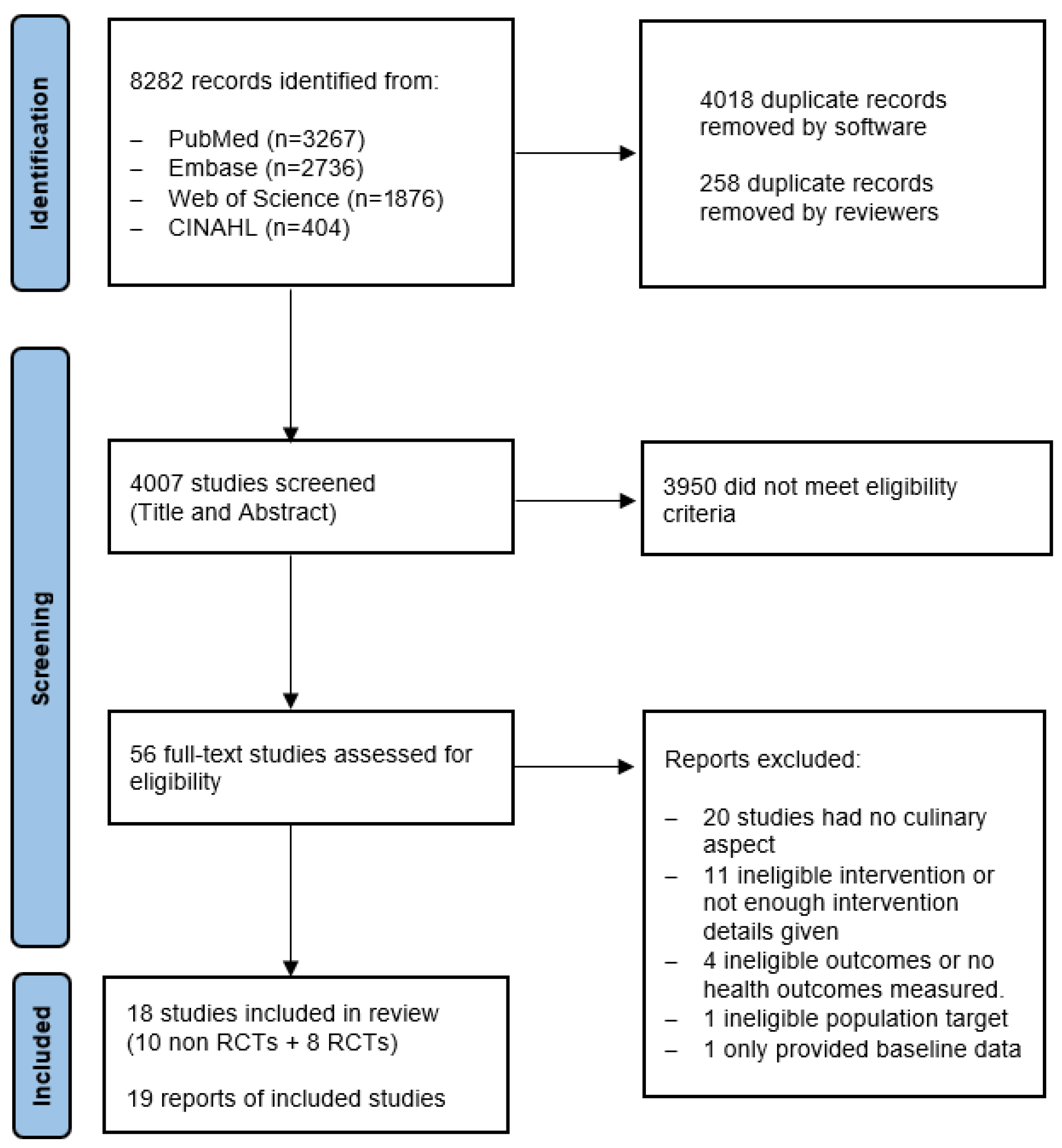
2.2. Study Selection
2.3. Data Extraction
2.4. Data Analysis
2.5. Study Risk of Bias Assessment
3. Results
3.1. Characteristics of the Studies
3.2. Characteristics of Interventions
3.3. Nutrition Component of the Interventions
3.4. Outcome Measures
3.4.1. Dietary Intake
3.4.2. Quality of Life
3.4.3. Other Psychosocial Outcomes and Health-Related Outcomes
3.4.4. Anthropometric Measures
3.4.5. Clinical and Metabolic Outcomes
3.4.6. Feasibility and Qualitative Outcomes
3.5. Risk of Bias
4. Discussion
4.1. Quality of the Evidence
4.2. Strengths and Limitations
4.3. Implications for Research and Practice
5. Conclusions
Supplementary Materials
Author Contributions
Funding
Data Availability Statement
Conflicts of Interest
References
- Zhao, J.; Xu, L.; Sun, J.; Song, M.; Wang, L.; Yuan, S.; Zhu, Y.; Wan, Z.; Larsson, S.; Tsilidis, K.; et al. Global Trends in Incidence, Death, Burden and Risk Factors of Early-Onset Cancer from 1990 to 2019. BMJ Oncol. 2023, 2, e000049. [Google Scholar] [CrossRef]
- World Health Organization. Cancer. Available online: https://www.who.int/news-room/fact-sheets/detail/cancer (accessed on 18 November 2025).
- Allemani, C.; Matsuda, T.; Di Carlo, V.; Harewood, R.; Matz, M.; Niksic, M.; Bonaventure, A.; Valkov, M.; Johnson, C.J.; Esteve, J.; et al. Global Surveillance of Trends in Cancer Survival 2000-14 (Concord-3): Analysis of Individual Records for 37,513,025 Patients Diagnosed with One of 18 Cancers from 322 Population-Based Registries in 71 Countries. Lancet 2018, 391, 1023–1075. [Google Scholar] [CrossRef]
- World Health Organization. Global Cancer Burden Growing, Amidst Mounting Need for Services. Available online: https://www.who.int/news/item/01-02-2024-global-cancer-burden-growing--amidst-mounting-need-for-services (accessed on 18 November 2025).
- Wagle, N.S.; Nogueira, L.; Devasia, T.P.; Mariotto, A.B.; Yabroff, K.R.; Islami, F.; Jemal, A.; Alteri, R.; Ganz, P.A.; Siegel, R.L. Cancer Treatment and Survivorship Statistics, 2025. CA Cancer J. Clin. 2025, 75, 308–340. [Google Scholar] [CrossRef]
- Li, Z.; Ding, X.; Chen, Y.; Keaver, L.; Champ, C.E.; Fink, C.L.; Lebovits, S.C.; Corroto, M.; Zhang, F.F. Review of Nutrition Guidelines and Evidence on Diet and Survival Outcomes for Cancer Survivors: Call for Integrating Nutrition into Oncology Care. J. Nutr. 2024, 154, 2346–2362. [Google Scholar] [CrossRef]
- Castro-Espin, C.; Agudo, A. The Role of Diet in Prognosis among Cancer Survivors: A Systematic Review and Meta-Analysis of Dietary Patterns and Diet Interventions. Nutrients 2022, 14, 348. [Google Scholar] [CrossRef] [PubMed]
- Chen, G.; Leary, S.; Niu, J.; Perry, R.; Papadaki, A. The Role of the Mediterranean Diet in Breast Cancer Survivorship: A Systematic Review and Meta-Analysis of Observational Studies and Randomised Controlled Trials. Nutrients 2023, 15, 2099. [Google Scholar] [CrossRef] [PubMed]
- Keaver, L.; O’Callaghan, N.; Douglas, P. Nutrition Support and Intervention Preferences of Cancer Survivors. J. Hum. Nutr. Diet. 2023, 36, 526–539. [Google Scholar] [CrossRef] [PubMed]
- Keaver, L.; Douglas, P.; O’Callaghan, N. Perceived Barriers and Facilitators to a Healthy Diet among Cancer Survivors: A Qualitative Exploration Using the Tdf and Com-B. Dietetics 2023, 2, 123–139. [Google Scholar] [CrossRef]
- Baughman, C.; Norman, K.; Mukamal, K. Adherence to American Cancer Society Nutrition and Physical Activity Guidelines among Cancer Survivors. JAMA Oncol. 2024, 10, 789–792. [Google Scholar] [CrossRef]
- Wu, Y.P.; Yi, J.; McClellan, J.; Kim, J.; Tian, T.; Grahmann, B.; Kirchhoff, A.C.; Holton, A.; Wright, J. Barriers and Facilitators of Healthy Diet and Exercise among Adolescent and Young Adult Cancer Survivors: Implications for Behavioral Interventions. J. Adolesc. Young Adult Oncol. 2015, 4, 184–191. [Google Scholar] [CrossRef]
- Keaver, L.; McGough, A.M.; Du, M.; Chang, W.; Chomitz, V.; Allen, J.D.; Attai, D.J.; Gualtieri, L.; Zhang, F.F. Self-Reported Changes and Perceived Barriers to Healthy Eating and Physical Activity among Global Breast Cancer Survivors: Results from an Exploratory Online Novel Survey. J. Acad. Nutr. Diet. 2021, 121, 233–241.e8. [Google Scholar] [CrossRef]
- Keaver, L.; Richmond, J.; Rafferty, F.; Douglas, P. Sources of Nutrition Advice and Desired Nutrition Guidance in Oncology Care: Patient’s Perspectives. J. Hum. Nutr. Diet. 2023, 36, 434–442. [Google Scholar] [CrossRef]
- Johnston, E.A.; van der Pols, J.C.; Ekberg, S. Needs, Preferences, and Experiences of Adult Cancer Survivors in Accessing Dietary Information Post-Treatment: A Scoping Review. Eur. J. Cancer Care 2021, 30, e13381. [Google Scholar] [CrossRef] [PubMed]
- Beeken, R.J.; Williams, K.; Wardle, J.; Croker, H. “What About Diet?” A Qualitative Study of Cancer Survivors’ Views on Diet and Cancer and Their Sources of Information. Eur. J. Cancer Care 2016, 25, 774–783. [Google Scholar] [CrossRef] [PubMed]
- Baguley, B.J.; Benna-Doyle, S.; Drake, S.; Curtis, A.; Stewart, J.; Loeliger, J. Access to Nutrition Services and Information after Active Cancer Treatment: A Mixed Methods Study. J. Cancer Surviv. 2024, 18, 176–185. [Google Scholar] [CrossRef] [PubMed]
- Ryding, H.G.; Mitchell, L.J.; Rigby, R.R.; Ball, L.; Hobby, J.; Williams, L.T. Effectiveness of Dietetic Care for Cancer Survivors in the Primary Care Setting: A Systematic Review and Meta-Analysis of Randomized Controlled Trials. J. Cancer Surviv. 2025, 19, 1694–1725. [Google Scholar] [CrossRef]
- Wu, L.M.; Chen, C.M.; Hsu, H.T.; Liu, Y.; Su, H.L. Tailored Education Enhances Healthy Behaviour Self-Efficacy in Childhood Cancer Survivors: A Randomised Controlled Study with a 4-Month Follow-Up. Eur. J. Cancer Care 2019, 28, e13063. [Google Scholar] [CrossRef]
- Thompson, J.; Silliman, K.; Clifford, D.E. Impact of an Early Education Multimedia Intervention in Managing Nutrition-Related Chemotherapy Side Effects: A Pilot Study. Springerplus 2013, 2, 179. [Google Scholar] [CrossRef]
- Croxford, S.; Stirling, E.; MacLaren, J.; McWhorter, J.W.; Frederick, L.; Thomas, O.W. Culinary Medicine or Culinary Nutrition? Defining Terms for Use in Education and Practice. Nutrients 2024, 16, 603. [Google Scholar] [CrossRef]
- Lang, R.D.; Jennings, M.C.; Lam, C.; Yeh, H.C.; Zhu, C.; Kumra, T. Community Culinary Workshops as a Nutrition Curriculum in a Preventive Medicine Residency Program. Med. Ed. Portal 2019, 15, 10859. [Google Scholar] [CrossRef]
- Hasan, B.; Thompson, W.G.; Almasri, J.; Wang, Z.; Lakis, S.; Prokop, L.J.; Hensrud, D.D.; Frie, K.S.; Wirtz, M.J.; Murad, A.L.; et al. The Effect of Culinary Interventions (Cooking Classes) on Dietary Intake and Behavioral Change: A Systematic Review and Evidence Map. BMC Nutr. 2019, 5, 29. [Google Scholar] [CrossRef] [PubMed]
- Marshall, H.; Albin, J. Food as Medicine: A Pilot Nutrition and Cooking Curriculum for Children of Participants in a Community-Based Culinary Medicine Class. Matern. Child Health J. 2021, 25, 54–58. [Google Scholar] [CrossRef]
- Garcia, A.L.; Reardon, R.; McDonald, M.; Vargas-Garcia, E.J. Community Interventions to Improve Cooking Skills and Their Effects on Confidence and Eating Behaviour. Curr. Nutr. Rep. 2016, 5, 315–322. [Google Scholar] [CrossRef]
- Muzaffar, H.; Guenther, E.; Bosse, O.; Nii-Aponsah, H. Effectiveness of Gardening-Only, Cooking-Only and Combined Cooking and Gardening Programs in Elementary Schools to Improve Fruit and Vegetable Intake: A Systematic Review. Nutrients 2023, 15, 3008. [Google Scholar] [CrossRef]
- Farmer, N.; Touchton-Leonard, K.; Ross, A. Psychosocial Benefits of Cooking Interventions: A Systematic Review. Health Educ. Behav. 2018, 45, 167–180. [Google Scholar] [CrossRef] [PubMed]
- Johnston, E.A.; Ayre, S.K.; Au-Yeung, Y.T.; Goodwin, B.C. A Scoping Review of Group Nutrition Education and Cooking Programs for People Affected by Cancer. J. Acad. Nutr. Diet. 2024, 124, 1302–1327. [Google Scholar] [CrossRef]
- Higgins, J.P.T.; Thomas, J.; Chandler, J.; Cumpston, M.; Li, T.; Page, M.J.; Welch, V.A. (Eds.) Cochrane Handbook for Systematic Reviews of Interventions; John Wiley & Sons: Hoboken, NJ, USA, 2024. [Google Scholar]
- Page, M.J.; McKenzie, J.E.; Bossuyt, P.M.; Boutron, I.; Hoffmann, T.C.; Mulrow, C.D.; Shamseer, L.; Tetzlaff, J.M.; Akl, E.A.; Brennan, S.E.; et al. The Prisma 2020 Statement: An Updated Guideline for Reporting Systematic Reviews. BMJ 2021, 372, n71. [Google Scholar] [CrossRef]
- Foecke Munden, E.; Kemp, M.; Guth, A.; Chang, A.M.; Worster, B.; Olarewaju, I.; Denton, M.; Rising, K.L. Patient-Important Needs and Goals Related to Nutrition Interventions During Cancer Treatment. Nutr. Cancer 2023, 75, 1143–1150. [Google Scholar] [CrossRef]
- Campbell, M.; McKenzie, J.E.; Sowden, A.; Katikireddi, S.V.; Brennan, S.E.; Ellis, S.; Hartmann-Boyce, J.; Ryan, R.; Shepperd, S.; Thomas, J.; et al. Synthesis without Meta-Analysis (Swim) in Systematic Reviews: Reporting Guideline. BMJ 2020, 368, l6890. [Google Scholar] [CrossRef]
- Sterne, J.A.C.; Savović, J.; Page, M.J.; Elbers, R.G.; Blencowe, N.S.; Boutron, I.; Cates, C.J.; Cheng, H.Y.; Corbett, M.S.; Eldridge, S.M.; et al. Rob 2: A Revised Tool for Assessing Risk of Bias in Randomised Trials. BMJ 2019, 366, l4898. [Google Scholar] [CrossRef] [PubMed]
- Sterne, J.A.; Hernán, M.A.; Reeves, B.C.; Savović, J.; Berkman, N.D.; Viswanathan, M.; Henry, D.; Altman, D.G.; Ansari, M.T.; Boutron, I.; et al. Robins-I: A Tool for Assessing Risk of Bias in Non-Randomised Studies of Interventions. BMJ 2016, 355, i4919. [Google Scholar] [CrossRef]
- Zuniga, K.E.; Parma, D.L.; Muñoz, E.; Spaniol, M.; Wargovich, M.; Ramirez, A.G. Dietary Intervention among Breast Cancer Survivors Increased Adherence to a Mediterranean-Style, Anti-Inflammatory Dietary Pattern: The Rx for Better Breast Health Randomized Controlled Trial. Breast Cancer Res. Treat. 2019, 173, 145–154. [Google Scholar] [CrossRef]
- Sheppard, V.B.; Hicks, J.; Makambi, K.; Hurtado-de-Mendoza, A.; Demark-Wahnefried, W.; Adams-Campbell, L. The Feasibility and Acceptability of a Diet and Exercise Trial in Overweight and Obese Black Breast Cancer Survivors: The Stepping Stone Study. Contemp. Clin. Trials 2016, 46, 106–113. [Google Scholar] [CrossRef]
- Sheean, P.; Matthews, L.; Visotcky, A.; Banerjee, A.; Moosreiner, A.; Kelley, K.; Chitambar, C.R.; Papanek, P.E.; Stolley, M. Every Day Counts: A Randomized Pilot Lifestyle Intervention for Women with Metastatic Breast Cancer. Breast Cancer Res. Treat. 2021, 187, 729–741. [Google Scholar] [CrossRef]
- Parekh, N.; Jiang, J.; Buchan, M.; Meyers, M.; Gibbs, H.; Krebs, P. Nutrition Literacy among Cancer Survivors: Feasibility Results from the Healthy Eating and Living against Breast Cancer (Heal-Bca) Study: A Pilot Randomized Controlled Trial. J. Cancer Educ. 2018, 33, 1239–1249. [Google Scholar] [CrossRef]
- Morato-Martínez, M.; Santurino, C.; López-Plaza, B.; Arcos-Castellanos, L.; Clavero-Fraile, M.; Valero-Pérez, M.; Palma Milla, S.; Valero, M.; Gómez Candela, C. A Standardized, Integral Nutritional Intervention and Physical Activity Program Reduces Body Weight in Women Newly Diagnosed with Breast Cancer. Nutr. Hosp. 2021, 38, 575–584. [Google Scholar] [CrossRef] [PubMed]
- Miller, M.F.; Li, Z.; Habedank, M. A Randomized Controlled Trial Testing the Effectiveness of Coping with Cancer in the Kitchen, a Nutrition Education Program for Cancer Survivors. Nutrients 2020, 12, 3144. [Google Scholar] [CrossRef] [PubMed]
- Greenlee, H.; Rillamas-Sun, E.; Yung, R.L.; Cobos, S.; Donzella, S.M.; Huang, Y.; Schattenkerk, L.; Ueland, K.; VanDoren, M.; Myers, S.A.; et al. Cook and Move for Your Life, an Ehealth Intervention for Women with Breast Cancer. NPJ Breast Cancer 2024, 10, 62. [Google Scholar] [CrossRef] [PubMed]
- Greenlee, H.; Ogden Gaffney, A.; Aycinena, A.C.; Koch, P.; Contento, I.; Karmally, W.; Richardson, J.M.; Shi, Z.; Lim, E.; Tsai, W.Y.; et al. Long-Term Diet and Biomarker Changes after a Short-Term Intervention among Hispanic Breast Cancer Survivors: The ¡Cocinar Para Su Salud! Randomized Controlled Trial. Cancer Epidemiol. Biomark. Prev. 2016, 25, 1491–1502. [Google Scholar] [CrossRef]
- Greenlee, H.; Gaffney, A.O.; Aycinena, A.C.; Koch, P.; Contento, I.; Karmally, W.; Richardson, J.M.; Lim, E.; Tsai, W.Y.; Crew, K.; et al. ¡Cocinar Para Su Salud!: Randomized Controlled Trial of a Culturally Based Dietary Intervention among Hispanic Breast Cancer Survivors. J. Acad. Nutr. Diet. 2015, 115, 709–723.e3. [Google Scholar] [CrossRef]
- Spees, C.K.; Braun, A.C.; Hill, E.B.; Grainger, E.M.; Portner, J.; Young, G.S.; Kleinhenz, M.D.; Chitchumroonchokchai, C.; Clinton, S.K. Impact of a Tailored Nutrition and Lifestyle Intervention for Overweight Cancer Survivors on Dietary Patterns, Physical Activity, Quality of Life, and Cardiometabolic Profiles. J. Oncol. 2019, 2019, 1503195. [Google Scholar] [CrossRef]
- Raber, M.; Costigan, M.; Chandra, J.; Basen-Engquist, K. Cooking after Cancer: The Structure and Implementation of a Community-Based Cooking Program for Cancer Survivors. J. Cancer Educ. 2022, 37, 539–545. [Google Scholar] [CrossRef]
- Pritlove, C.; Capone, G.; Ramasamy, M.; Avery, L.; Fierini, D.; Ferguson, S.E.; Han, K.; Jones, J.M. Eliminating Digestive Irregularities Caused by Late Effects: A Pilot Study of an Innovative Culinary Nutrition Intervention for Reducing Gastrointestinal Toxicity in Gynecologic Cancer Patients Who Have Undergone Pelvic Radiotherapy. Nutrients 2024, 16, 4227. [Google Scholar] [CrossRef] [PubMed]
- Pritlove, C.; Capone, G.; Kita, H.; Gladman, S.; Maganti, M.; Jones, J.M. Cooking for Vitality: Pilot Study of an Innovative Culinary Nutrition Intervention for Cancer-Related Fatigue in Cancer Survivors. Nutrients 2020, 12, 2760. [Google Scholar] [CrossRef]
- Kondo, K.; Kim, S.; Noguchi, N.; Akiyama, R.; Murata, W.; Lee, B. Improvements in Psychological Distress in Patients Participating in a Cooking Programme Following Digestive Cancer Surgery: A Retrospective, Propensity Score-Matched Pilot Study. Br. J. Occup. Ther. 2023, 86, 615–621. [Google Scholar] [CrossRef]
- Jackson, M.K.; Ehlers, D.K.; Bilek, L.D.; Graeff-Armas, L.; Acquazzino, M.; Hébert, J.R.; Price, S.; Beaudoin, R.; Hanson, C.K. The Impact of a Virtual Educational Cooking Class on the Inflammatory Potential of Diet in Cancer Survivors. Appl. Sci. 2024, 14, 5332. [Google Scholar] [CrossRef]
- Huang, S.; Riccardi, D.; Pflanzer, S.; Redwine, L.S.; Gray, H.L.; Carson, T.L.; McDowell, M.; Thompson, Z.; Hubbard, J.J.; Pabbathi, S. Survivors Overcoming and Achieving Resiliency (Soar): Mindful Eating Practice for Breast Cancer Survivors in a Virtual Teaching Kitchen. Nutrients 2023, 15, 4205. [Google Scholar] [CrossRef]
- Golubić, M.; Schneeberger, D.; Kirkpatrick, K.; Bar, J.; Bernstein, A.; Weems, F.; Ehrman, J.; Perko, J.; Doyle, J.; Roizen, M. Comprehensive Lifestyle Modification Intervention to Improve Chronic Disease Risk Factors and Quality of Life in Cancer Survivors. J. Altern. Complement. Med. 2018, 24, 1085–1091. [Google Scholar] [CrossRef]
- Barak-Nahum, A.; Haim, L.B.; Ginzburg, K. When Life Gives You Lemons: The Effectiveness of Culinary Group Intervention among Cancer Patients. Soc. Sci. Med. 2016, 166, 1–8. [Google Scholar] [CrossRef]
- Allen-Winters, S.; Wakefield, D.; Gaudio, E.; Moore, S.; Boone, K.; Morris, S.; Schwartz, D.L. “Eat to Live”-Piloting a Culinary Medicine Program for Head & Neck Radiotherapy Patients. Support. Care Cancer 2020, 28, 2949–2957. [Google Scholar] [CrossRef] [PubMed]
- Rock, C.L.; Thomson, C.A.; Sullivan, K.R.; Howe, C.L.; Kushi, L.H.; Caan, B.J.; Neuhouser, M.L.; Bandera, E.V.; Wang, Y.; Robien, K.; et al. American Cancer Society Nutrition and Physical Activity Guideline for Cancer Survivors. CA Cancer J. Clin. 2022, 72, 230–262. [Google Scholar] [CrossRef]
- American Institute for Cancer Research. Cancer Prevention. Available online: https://www.aicr.org/cancer-prevention/ (accessed on 23 October 2025).
- Contento, I.R. Nutrition Education: Linking Research, Theory, and Practice; Jones & Barlett Learning: Burlington, MA, USA, 2007. [Google Scholar]
- Bandura, A. Human Agency in Social Cognitive Theory. Am. Psychol. 1989, 44, 1175–1184. [Google Scholar] [CrossRef]
- Prochaska, J.O.; Velicer, W.F. The Transtheoretical Model of Health Behavior Change. Am. J. Health Promot. 1997, 12, 38–48. [Google Scholar] [CrossRef]
- Aycinena, A.C.; Jennings, K.A.; Gaffney, A.O.; Koch, P.A.; Contento, I.R.; Gonzalez, M.; Guidon, E.; Karmally, W.; Hershman, D.; Greenlee, H. Cocinar Para Su Salud! Development of a Culturally Based Nutrition Education Curriculum for Hispanic Breast Cancer Survivors Using a Theory-Driven Procedural Model. Health Educ. Behav. 2017, 44, 13–22. [Google Scholar] [CrossRef]
- Ueland, K.; Sanchez, S.C.; Rillamas-Sun, E.; Shen, H.; Schattenkerk, L.; Garcia, G.; VanDoren, M.; Myers, S.A.; Santiago-Torres, M.; Di, C.; et al. A Digital Health Intervention to Improve Nutrition and Physical Activity in Breast Cancer Survivors: Rationale and Design of the Cook and Move for Your Life Pilot and Feasibility Randomized Controlled Trial. Contemp. Clin. Trials 2022, 123, 106993. [Google Scholar] [CrossRef] [PubMed]
- Stacey, F.G.; James, E.L.; Chapman, K.; Courneya, K.S.; Lubans, D.R. A Systematic Review and Meta-Analysis of Social Cognitive Theory-Based Physical Activity and/or Nutrition Behavior Change Interventions for Cancer Survivors. J. Cancer Surviv. 2015, 9, 305–338. [Google Scholar] [CrossRef] [PubMed]
- Spark, L.C.; Reeves, M.M.; Fjeldsoe, B.S.; Eakin, E.G. Physical Activity and/or Dietary Interventions in Breast Cancer Survivors: A Systematic Review of the Maintenance of Outcomes. J. Cancer Surviv. 2013, 7, 74–82. [Google Scholar] [CrossRef] [PubMed]
- Flannery, M. Self-Determination Theory: Intrinsic Motivation and Behavioral Change. Oncol. Nurs. Forum 2017, 44, 155–156. [Google Scholar] [CrossRef]
- Bandura, A. Self-Efficacy: Toward a Unifying Theory of Behavioral Change. Psychol. Rev. 1977, 84, 191–215. [Google Scholar] [CrossRef]
- Graffigna, G.; Barello, S. Spotlight on the Patient Health Engagement Model (Phe Model): A Psychosocial Theory to Understand People’s Meaningful Engagement in Their Own Health Care. Patient Prefer. Adherence 2018, 12, 1261–1271. [Google Scholar] [CrossRef]
- Borek, A.J.; Abraham, C. How Do Small Groups Promote Behaviour Change? An Integrative Conceptual Review of Explanatory Mechanisms. Appl. Psychol. Health Wellbeing 2018, 10, 30–61. [Google Scholar] [CrossRef]
- Golant, M.; Thiboldeaux, K. The Wellness Community’s Integrative Model of Evidence-Based Psychosocial Programs, Services, and Interventions. In Psychooncology; Oxford University Press: Oxford, UK, 2010. [Google Scholar] [CrossRef]
- Leszcz, M.; Goodwin, P.J. The Rationale and Foundations of Group Psychotherapy for Women with Metastatic Breast Cancer. Int. J. Group Psychother. 1998, 48, 245–273. [Google Scholar] [CrossRef] [PubMed]
- Aranceta Bartrina, J.; Grupo Colaborativo de la Sociedad Espanola de Nutricion, C.; Arija Val, V.V.; Maiz Aldalur, E.; Martinez de Victoria Munoz, E.; Ortega Anta, R.M.; Perez-Rodrigo, C.; Quiles Izquierdo, J.; Rodriguez Martin, A.; Roman Vinas, B.; et al. Dietary Guidelines for the Spanish Population (Senc, Diciembre 2016); the New Graphic Icon of Healthy Food. Nutr. Hosp. 2016, 33, 1–48. [Google Scholar] [CrossRef]
- World Health Organization. WHO Guidelines on Physical Activity and Sedentary Behaviour; World Health Organization: Geneva, Switzerland, 2020. [Google Scholar]
- Pinto, B.M.; Floyd, A. Theories Underlying Health Promotion Interventions among Cancer Survivors. Semin. Oncol. Nurs. 2008, 24, 153–163. [Google Scholar] [CrossRef] [PubMed]
- Ajzen, I. The Theory of Planned Behavior. Organ. Behav. Hum. Decis. Process 1991, 50, 179–211. [Google Scholar] [CrossRef]
- Bandura, A. Health Promotion by Social Cognitive Means. Health Educ. Behav. 2004, 31, 143–164. [Google Scholar] [CrossRef]
- Ramirez, A.G.; Parma, D.L.; Munoz, E.; Mendoza, K.D.; Harb, C.; Holden, A.E.C.; Wargovich, M. An Anti-Inflammatory Dietary Intervention to Reduce Breast Cancer Recurrence Risk: Study Design and Baseline Data. Contemp. Clin. Trials 2017, 57, 1–7. [Google Scholar] [CrossRef]
- Skouroliakou, M.; Grosomanidis, D.; Massara, P.; Kostara, C.; Papandreou, P.; Ntountaniotis, D.; Xepapadakis, G. Serum Antioxidant Capacity, Biochemical Profile and Body Composition of Breast Cancer Survivors in a Randomized Mediterranean Dietary Intervention Study. Eur. J. Nutr. 2018, 57, 2133–2145. [Google Scholar] [CrossRef]
- Sureda, A.; Bibiloni, M.D.M.; Julibert, A.; Bouzas, C.; Argelich, E.; Llompart, I.; Pons, A.; Tur, J.A. Adherence to the Mediterranean Diet and Inflammatory Markers. Nutrients 2018, 10, 62. [Google Scholar] [CrossRef]
- Mazzocchi, M.; Brasili, C.; Sandri, E. Trends in Dietary Patterns and Compliance with World Health Organization Recommendations: A Cross-Country Analysis. Public Health Nutr. 2008, 11, 535–540. [Google Scholar] [CrossRef]
- Michie, S.; Richardson, M.; Johnston, M.; Abraham, C.; Francis, J.; Hardeman, W.; Eccles, M.P.; Cane, J.; Wood, C.E. The Behavior Change Technique Taxonomy (V1) of 93 Hierarchically Clustered Techniques: Building an International Consensus for the Reporting of Behavior Change Interventions. Ann. Behav. Med. 2013, 46, 81–95. [Google Scholar] [CrossRef]
- Serra-Majem, L.; Roman, B.; Estruch, R. Scientific Evidence of Interventions Using the Mediterranean Diet: A Systematic Review. Nutr. Rev. 2006, 64, S27–S47. [Google Scholar] [CrossRef]
- Harris, M.A.; Oelbaum, R.; Flomo, D. State of the Art Reviews: Changing and Adhering to Lifestyle Changes: What Are the Keys? Am. J. Lifestyle Med. 2007, 1, 214–219. [Google Scholar] [CrossRef]
- Porciello, G.; Montagnese, C.; Crispo, A.; Grimaldi, M.; Libra, M.; Vitale, S.; Palumbo, E.; Pica, R.; Calabrese, I.; Cubisino, S.; et al. Mediterranean Diet and Quality of Life in Women Treated for Breast Cancer: A Baseline Analysis of Dedica Multicentre Trial. PLoS ONE 2020, 15, e0239803. [Google Scholar] [CrossRef] [PubMed]
- Warren, J.M.; Smith, N.; Ashwell, M. A Structured Literature Review on the Role of Mindfulness, Mindful Eating and Intuitive Eating in Changing Eating Behaviours: Effectiveness and Associated Potential Mechanisms. Nutr. Res. Rev. 2017, 30, 272–283. [Google Scholar] [CrossRef] [PubMed]
- Morris, M.C.; Tangney, C.C.; Wang, Y.; Sacks, F.M.; Barnes, L.L.; Bennett, D.A.; Aggarwal, N.T. Mind Diet Slows Cognitive Decline with Aging. Alzheimers Dement. 2015, 11, 1015–1022. [Google Scholar] [CrossRef]
- van den Brink, A.C.; Brouwer-Brolsma, E.M.; Berendsen, A.A.M.; van de Rest, O. The Mediterranean, Dietary Approaches to Stop Hypertension (Dash), and Mediterranean-Dash Intervention for Neurodegenerative Delay (Mind) Diets Are Associated with Less Cognitive Decline and a Lower Risk of Alzheimer’s Disease—A Review. Adv. Nutr. 2019, 10, 1040–1065. [Google Scholar] [CrossRef]
- Morris, T.H. Experiential Learning—A Systematic Review and Revision of Kolb’s Model. Interact. Learn. Environ. 2020, 28, 1064–1077. [Google Scholar] [CrossRef]
- Zick, S.M.; Colacino, J.; Cornellier, M.; Khabir, T.; Surnow, K.; Djuric, Z. Fatigue Reduction Diet in Breast Cancer Survivors: A Pilot Randomized Clinical Trial. Breast Cancer Res. Treat. 2017, 161, 299–310. [Google Scholar] [CrossRef]
- Michie, S.; Ashford, S.; Sniehotta, F.F.; Dombrowski, S.U.; Bishop, A.; French, D.P. A Refined Taxonomy of Behaviour Change Techniques to Help People Change Their Physical Activity and Healthy Eating Behaviours: The Calo-Re Taxonomy. Psychol. Health 2011, 26, 1479–1498. [Google Scholar] [CrossRef]
- Hollywood, L.; Surgenor, D.; Reicks, M.; McGowan, L.; Lavelle, F.; Spence, M.; Raats, M.; McCloat, A.; Mooney, E.; Caraher, M.; et al. Critical Review of Behaviour Change Techniques Applied in Intervention Studies to Improve Cooking Skills and Food Skills among Adults. Crit. Rev. Food Sci. Nutr. 2018, 58, 2882–2895. [Google Scholar] [CrossRef]
- Eckel, R.H.; Jakicic, J.M.; Ard, J.D.; de Jesus, J.M.; Houston Miller, N.; Hubbard, V.S.; Lee, I.M.; Lichtenstein, A.H.; Loria, C.M.; Millen, B.E.; et al. 2013 Aha/Acc Guideline on Lifestyle Management to Reduce Cardiovascular Risk: A Report of the American College of Cardiology/American Heart Association Task Force on Practice Guidelines. J. Am. Coll. Cardiol. 2014, 63, 2960–2984. [Google Scholar] [CrossRef]
- Spees, C.K.; Hill, E.B.; Grainger, E.M.; Buell, J.L.; White, S.E.; Kleinhenz, M.D.; Clinton, S.K. Feasibility, Preliminary Efficacy, and Lessons Learned from a Garden-Based Lifestyle Intervention for Cancer Survivors. Cancer Control 2016, 23, 302–310. [Google Scholar] [CrossRef] [PubMed]
- Hartmann, C.; Dohle, S.; Siegrist, M. A Self-Determination Theory Approach to Adults’ Healthy Body Weight Motivation: A Longitudinal Study Focussing on Food Choices and Recreational Physical Activity. Psychol. Health 2015, 30, 924–948. [Google Scholar] [CrossRef]
- Marchetti, P.; Fovez, Q.; Germain, N.; Khamari, R.; Kluza, J. Mitochondrial Spare Respiratory Capacity: Mechanisms, Regulation, and Significance in Non-Transformed and Cancer Cells. FASEB J. 2020, 34, 13106–13124. [Google Scholar] [CrossRef]
- Terranova, C.O.; Protani, M.M.; Reeves, M.M. Overall Dietary Intake and Prognosis after Breast Cancer: A Systematic Review. Nutr. Cancer 2018, 70, 153–163. [Google Scholar] [CrossRef]
- Raji Lahiji, M.; Vafa, S.; de Souza, R.J.; Zarrati, M.; Sajadian, A.; Razmpoosh, E.; Jaberzadeh, S. Effect of Dietary-Based Lifestyle Modification Approaches on Anthropometric Indices and Dietary Intake Parameters in Women with Breast Cancer: A Systematic Review and Meta-Analysis of Randomized Controlled Trials. Adv. Nutr. 2022, 13, 1974–1988. [Google Scholar] [CrossRef] [PubMed]
- Micek, A.; Godos, J.; Brzostek, T.; Gniadek, A.; Favari, C.; Mena, P.; Libra, M.; Del Rio, D.; Galvano, F.; Grosso, G. Dietary Phytoestrogens and Biomarkers of Their Intake in Relation to Cancer Survival and Recurrence: A Comprehensive Systematic Review with Meta-Analysis. Nutr. Rev. 2021, 79, 42–65. [Google Scholar] [CrossRef]
- O’Callaghan, N.; Douglas, P.; Keaver, L. A Qualitative Study into Cancer Survivors’ Relationship with Nutrition Post-Cancer Treatment. J. Hum. Nutr. Diet. 2023, 36, 406–414. [Google Scholar] [CrossRef] [PubMed]
- Leung, M.W.; Yen, I.H.; Minkler, M. Community Based Participatory Research: A Promising Approach for Increasing Epidemiology’s Relevance in the 21st Century. Int. J. Epidemiol. 2004, 33, 499–506. [Google Scholar] [CrossRef]
- Collins, S.E.; Clifasefi, S.L.; Stanton, J.; The Leap Advisory Board; Straits, K.J.E.; Gil-Kashiwabara, E.; Rodriguez Espinosa, P.; Nicasio, A.V.; Andrasik, M.P.; Hawes, S.M.; et al. Community-Based Participatory Research (Cbpr): Towards Equitable Involvement of Community in Psychology Research. Am. Psychol. 2018, 73, 884–898. [Google Scholar] [CrossRef] [PubMed]
- Monllor-Tormos, A.; Garcia-Vigara, A.; Morgan, O.; Garcia-Perez, M.A.; Mendoza, N.; Tarin, J.J.; Cano, A. Mediterranean Diet for Cancer Prevention and Survivorship. Maturitas 2023, 178, 107841. [Google Scholar] [CrossRef] [PubMed]
- Khalifa, A.; Guijarro, A.; Nencioni, A. Advances in Diet and Physical Activity in Breast Cancer Prevention and Treatment. Nutrients 2024, 16, 2262. [Google Scholar] [CrossRef] [PubMed]
- Dinas, P.C.; On Behalf of the Students of Module Introduction to Systematic Reviews; Karaventza, M.; Liakou, C.; Georgakouli, K.; Bogdanos, D.; Metsios, G.S. Combined Effects of Physical Activity and Diet on Cancer Patients: A Systematic Review and Meta-Analysis. Nutrients 2024, 16, 1749. [Google Scholar] [CrossRef]
- Bye, A.; Sandmael, J.A.; Stene, G.B.; Thorsen, L.; Balstad, T.R.; Solheim, T.S.; Pripp, A.H.; Oldervoll, L.M. Exercise and Nutrition Interventions in Patients with Head and Neck Cancer During Curative Treatment: A Systematic Review and Meta-Analysis. Nutrients 2020, 12, 3233. [Google Scholar] [CrossRef]


| First Author (Year) Programme Place | Participants, Cancer Type, Timepoint, Sample, Gender, Mean Age | Study Design | Nutrition Content | Delivery | Design: (a) Resources; (b) Theoretical Framework; (c) Co-design | Outcome Measures |
|---|---|---|---|---|---|---|
| Randomised Controlled Trials (RCT) | ||||||
| Greenlee et al. 2015 [43] “¡Cocinar Para Su Salud!” USA | Hispanic adult women Breast cancer Posttreatment Int n = 34 Control n = 36 100% female 56 ± 9.5 yo | RCT Nutrition single component Quantitative | Nutrition education roundtables, cooking lessons and shopping trips: healthy eating, food groups and nutrients, cooking skills, healthy and budget friendly shopping, meal planning and preparation, portion size, meal sharing, food taste, food labels Culturally tailored | Group In person 9 sessions 12 weeks 24 h total Monthly calls | (a) AICR and ACS Guidelines [54,55]. (b) Contento’s Model [56], Social Cognitive Theory [57], The Transtheoretical Model of Health Behaviour Change [58] (c) Community Interviews and Focus Groups. | Primary—Dietary Intake Secondary—Anthropometric Timepoints M3 and M6 |
| Greenlee et al. 2016 [42] “¡Cocinar Para Su Salud!” USA | Hispanic adult women Breast cancer Posttreatment Int n = 34 Control n = 36 100% female 56 ± 9.5 yo | RCT Nutrition single component Quantitative | Nutrition education roundtables, cooking lessons and shopping trips: healthy eating, food groups and nutrients, cooking skills, healthy and budget friendly shopping, meal planning and preparation, portion size, meal sharing, food taste, food labels. Culturally tailored | Group In person 9 sessions 12 weeks 24 h total Monthly calls | (a) AICR and ACS Guidelines [54,55]. (b) Contento’s Model [56], Social Cognitive Theory [57,59], The Transtheoretical Model of Health Behaviour Change [58]. (c) Community Interviews and Focus groups. | Primary—Dietary Intake. Secondary—Anthropometric, Clinical and Metabolic Timepoint M12 |
| Greenlee et al. 2024 [41,60] “Cook and Move for Your Life” USA | Adult women Early stage breast cancer Posttreatment Int n = 38 Control n = 36 100% female 58 ± 10 yo | RCT Multicomponent Nutrition and Physical Activity Quantitative | Nutrition and physical activity education, hands-on skill building culinary cooking lessons: healthy eating, food groups and nutrients, cooking skills, meal planning and preparation, portion size, meal sharing, food labels, eating out. | Group Online Text messages Newsletters 12 sessions 1.5 h/session 6 months 18 h total | (a) AICR and ACS Guidelines [54,55]. (b) Social Cognitive Theory [61,62], Self-Determination Theory [63] (c) None Reported. | Primary—Feasibility. Secondary—Effectiveness (Dietary Intake, Anthropometric, And Psychosocial) Timepoint M6 |
| Miller et al. 2020 [40] “Coping with Cancer in the Kitchen” USA | Adults Any cancer types Posttreatment Int = 27 Control = 27 92% female 61 ± 10.5 | RCT Nutrition single component Quantitative | Nutrition education, group learning and support, cooking demonstrations, eating together, goal setting: plant-based healthy eating, food groups and nutrients, cooking skills, meal planning and preparation, portion size, meal sharing, eating together, food taste. | Group In-person 8 sessions 1.5 h/session 9 weeks 12 h total | (a) AICR Guidelines [55]. (b) Social Cognitive Theory [64], The Transtheoretical Model of Health Behaviour Change [58,65], Other behaviour change techniques [66,67,68], Smart Goal Setting. (c) Co-design With Stakeholders. | Primary—Nutrition Knowledge. Secondary—Dietary Intake, Psychosocial Outcomes. Timepoints WK9 and WK15 |
| Morato-Martínez et al. 2021 [39] Spain | Adult women Breast cancer During treatment Int = 32 Control = 33 100% female 50 ± 9.43 yo | RCT Multicomponent Nutrition and Physical Activity Quantitative | Nutrition and physical activity education, individualised diets: obesity-related complications, healthy eating, food groups and nutrients, cooking skills, meal planning and preparation, portion size, shopping, food labels, eating out, food myths, anxiety management. | Group In-person 5 sessions 1 h/session 6 months 5 h in total 4 PA sessions per week | (a) Spanish Society of Community Nutrition Guidelines [69], WHO Physical Activity Guidelines [70]. (b) None Reported. (c) None Reported. | Primary—Anthropometric Secondary—Physical Activity, Dietary intake, Clinical and Metabolic Timepoints WK24 and WK48 |
| Parekh et al. 2018 [38] “The HEAL-BCa Study” USA | Adult women Breast cancer Posttreatment Int = 31 Control = 28 100% female 58 ± 10.3 yo | RCT Multicomponent Nutrition and Physical Activity Mixed methods | Nutrition education, interactive physical activity education sessions, cooking demonstrations, hands-on culinary cooking: cancer and diet, healthy eating, food groups and nutrients, cooking skills, meal planning and preparation, portion size, food shopping, food labels, pathophysiology of breast cancer and modifiable risk factors. | Group In-person 6 sessions 2 h/session 3 months 12 h total | (a) AICR and ACS Guidelines [54,55]. (b) Social Cognitive Theory [71]. (c) None Reported. | Dietary Intake, Anthropometric, Feasibility Qualitative Timepoint M3 |
| Sheean et al. 2021 [37] “Every day counts” USA | Adult women Metastatic breast cancer During treatment Int = 17 Control = 18 100% female 55 ± 12.3 yo | RCT Multicomponent Nutrition and Physical Activity Quantitative | Nutrition education written materials, hands-on culinary cooking, supervised physical activity: healthy eating, food groups and nutrients, plant-based cooking skills, meal planning and preparation, portion size, barriers, behaviour change strategies. Tailored physical activity guidance. | Group In-person and telephone 12 weeks, 12 weekly phone calls and text messages 4 PA sessions 3 hands-on culinary cooking sessions | (a) ACS Guidelines [54]. (b) Social Cognitive Theory. (c) Community Advisory Board. | Dietary Intake, Anthropometric, Psychosocial, Symptom Management, Clinical and Metabolic. Qualitative Timepoints WK12 |
| Sheppard et al. 2016 [36] “The Stepping STONE study” USA | African American adult women Breast cancer Posttreatment Int = 15 Control = 16 100% female 55 ± 9.8 | RCT Multicomponent Nutrition, Physical Activity and Behaviour Change Mixed methods | Nutrition and PA education, cooking demonstrations, supervised PA, interviews: healthy eating, food groups and nutrients, cooking skills, meal planning and preparation, portion size, barriers, behaviour change strategies, survivorship concerns. Culturally tailored | Group In-person and telephone 12 weeks 6 sessions 1.5 h/session 6 phone motivation interviews | (a) ACS Guidelines [54]. (b) Theory of Planned Behaviour [72] and Social Cognitive Theory [73]. (c) None Reported. | Dietary Intake, Physical activity, Anthropometric, Psychosocial, Clinical and Metabolic, Intervention Satisfaction. Qualitative Timepoint WK12 |
| Zuniga et al. 2019 [35] USA | Adult women Breast cancer Posttreatment Int = 60 Control = 65 100% female 57 ± 9.3 yo | RCT Nutrition single component Quantitative | Nutrition education, cooking demonstrations, newsletters, motivation interviews: diet-cancer relationship, anti-inflammatory Mediterranean healthy eating, food groups and nutrients, cooking skills, meal planning and preparation, recipes, portion size, food taste, food shopping, barriers, behaviour change strategies, goal setting. Tailored anti-inflammatory dietary prescription. | Group In-person and telephone 6 sessions Session duration not specified 6 months 6 phone motivation interviews 6 Newsletters | (a) Mediterranean Diet Guidelines [74,75,76]. (b) Stages of Change [73]. (c) None Reported. | Dietary Intake Timepoint WK12 |
| Non-randomised Controlled Trials (Non-RCT) | ||||||
| Allen-Winters et al. 2020 [53] “Eat to live” USA | Caucasian adults Head and Neck cancer patients and caregivers 3 patients-1 care giver 33% female 67 yo | Non-RCT Nutrition single component Quantitative | Nutrition education, cooking sessions adapted for H&N cancer patients: healthy eating, food groups and nutrients, cooking skills, meal planning and preparation, recipes, portion size, food taste, food shopping, barriers, eating together, behaviour change | Group In-person 3 sessions 2 h/session 3 months | (a) WHO’s Nutrient Intake Goal [77]. (b) The Transtheoretical Model of Health Behaviour Change. (c) Pre-Intervention Surveys Informed Recipe Design. | Dietary Intake, Behaviours and Preferences, Sensory Timepoint M6 |
| Barak-Nahum et al. 2016 [52] Israel | Adults Any cancer types During and posttreatment Int = 96 Control = 88 93% female 58 ± 9.7 yo | Non RCT Multicomponent Nutrition and Psychosocial education Mixed methods | Core element was hands-on cooking, nutrition education, psychosocial education, eating and chatting together: Mediterranean healthy eating, food groups and nutrients, cooking skills, meal planning and preparation, recipes, portion size, food taste, barriers, eating together, psychosocial aspect of eating, behaviour change, mindful eating, improvisation, creativity. Culturally tailored | Group In-person 10 sessions 2 h/session 10 weeks | (a) AICR Guidelines [55]. (b) Other Behaviour Change Techniques [78]. (c) Participants Brainstormed to Define Themes. | Psychosocial Timepoint WK10 |
| Golubić et al. 2018 [51] Lifestyle180® USA | Adults Any cancer types Posttreatment n = 58 No control 76% female 64 ± 8.7 yo | Non RCT Multicomponent Nutrition, Physical Activity and Mental Health Quantitative | Lifestyle intervention added to treatment plans, education on nutrition, physical activity, stress management, cooking skills: Mediterranean healthy eating, food groups and nutrients, cooking skills, meal planning and preparation, recipes, portion size, food taste, food shopping, food labels, lifestyle behaviour change. As well as physical activity and stress management skills | Group In-person 12 sessions 4 h/session 6 weeks Follow-up sessions (week 10, 18 and 30) 30 newsletters Buddy system | (a) Mediterranean Diet Guidelines [79]. (b) Lifestyle Behaviour Change Framework [80]. (c) None Reported. | Dietary Intake, Anthropometric, Clinical and Metabolic, Psychosocial. Timepoints M12 |
| Huang et al. 2023 [50] “SOAR” USA | Adult women Breast cancer Posttreatment Int = 102 No control 98% female 68% over 55 yo | Non RCT Multicomponent Nutrition, Physical Activity, and Mental Health Quantitative | Virtual teaching kitchen with culinary-cooking demonstrations delivered by a culinary expert, followed by dietitian-led discussion at each session, nutrition education, mental health, exercise and behaviour change: Mediterranean healthy eating, food groups and nutrients, cooking skills, recipes, food shopping, mindful eating, emotional health, yoga and meditation, art, life after cancer treatment. | Group Virtual 9 sessions Duration of sessions not specified 9 weeks | (a) AICR Guidelines [55], Mediterranean Diet Guidelines [81] (b) Other Behaviour Change Techniques [82]. (c) Participants Identified Learning Objectives. | Psychosocial Timepoint WK9 |
| Jackson et al. 2024 [49] USA | Adult Any cancer types Posttreatment n = 24 No control 100% female 61.5 yo median (19.5 IQR) | Non RCT Nutrition single component Quantitative | Virtual cooking class, nutrition education with extra education materials provided: healthy eating, focus on anti-inflammatory diet, food groups and nutrients, recipes, cooking skills. | Group Virtual 1 session | (a) AICR Guidelines [55], Mediterranean Diet [83,84]. (b) None Reported. (c) None Reported. | Dietary Intake, Psychosocial. Timepoint M1 |
| Kondo et al. 2023 Japan | Adults Digestive cancer During—Post surgery Int = 13 Control = 11 83% female 68 yo median | Non RCT Nutrition single component Retrospective Quantitative | Hands-on cooking, disease management, mental health: cooking skills, post-surgery management, emotional wellbeing. | Individual In-person One session 1.5 h | (a) None Reported. (b) Experiential Learning Theory [85]. (c) Participants Decided on Recipes. | Psychosocial. Timepoint Before Hospital Discharge. |
| Pritlove et al. 2020 [47] “Cooking for vitality” Canada | Adults experiencing cancer-related fatigue Patients and caregivers Any cancer types Posttreatment n = 58 No control 88% female 58 ± 12.3 yo | Non RCT Nutrition single component Mixed methods | Hands-on cooking, education on nutrition and cancer-related fatigue (CRF): healthy eating for CRF, food groups and nutrients, meal planning and preparation, recipes, cooking skills, barriers, goal setting. | Group In-person 2 sessions 1.5 h/session 6 support emails 6 weeks | (a) Fatigue Reduction Diet In Breast Cancer Survivors [86]. (b) Social Cognitive Theory, Social Learning Theory [64], Experiential Learning Theory [85], Other Behaviour Change Techniques [87,88]. (c) None Reported. | Feasibility, Psychosocial Timepoint WK6 and WK18 |
| Pritlove et al. 2024 [46] “EDIBLE” Canada | Adult women Non-metastatic Gynaecological cancer and caregivers Post-radiation treatment Int = 53 patients No control 100% female 63.1 ± 10.5 yo | Non RCT Nutrition single component Mixed methods | Nutrition education, hands-on cooking: healthy eating, food groups and nutrients, cancer side effects, self-management, nutrition counselling, cooking skills, recipes, shopping lists. | Group In-person 2 sessions 1.5 h/session 7 weeks | (a) Nutrition, Cancer, and Gastrointestinal Complications Guidelines. (b) Social Cognitive Theory and Social Learning Theory [64], Experiential Learning Theory [85], Other Behaviour Change Techniques [87,88]. (c) None reported. | Feasibility and Psychosocial Qualitative. Timepoint WK9 and WK12 |
| Raber et al. 2022 [45] “Cooking after cancer” USA | Adults Any cancer types Posttreatment n = 20 No control Age and gender not reported | Non RCT Nutrition single component Quantitative | Food prep demonstration and hands-on cooking, nutrition education: plant-based healthy eating, food groups and nutrients, food safety, food and meal prep, recipes, food labels, cooking skills, specific needs for cancer survivors. | Group In-person 6 sessions 1.5 h/session 6 weeks | (a) The Happy Kitchen’s Standard Community Cooking Class Curriculum, AICR Guidelines [55]. (b) None Reported. (c) None Reported. | Psychosocial Timepoint WK6 |
| Spees et al. 2019 [44] USA | Adults Any cancer types Posttreatment n = 35 83% female 58 yo | Non RCT Multicomponent Nutrition and Physical Activity Mixed methods | Hands-on vegetable gardening education, nutrition and lifestyle education, cooking demonstrations: plant-based healthy eating, food groups and nutrients, health lifestyle, cooking skills, using garden veg, recipes, food and meal prep, physical activity, coaching, targeted information for cancer side effects, supportive technologies (pedometer, resources website) | Group In person Virtual coaching 24 garden sessions 24 education sessions 6 months | (a) AICR Guidelines [55], AHA/ACC Guidelines [89], Garden-Based Lifestyle Interventions [90]. (b) Self-Determination Theory [91]. (c) None Reported. | Feasibility, Dietary Intake, Physical Activity, Anthropometric, Clinical and Metabolic, Psychosocial. Qualitative Timepoint M6 |
| Study Details | Outcomes Measures | Outcome Measures—Results | Risk of Bias * |
|---|---|---|---|
| Randomised Controlled Trials | |||
| Greenlee et al. 2015 [43] Nutrition single component RCT Quantitative USA | Primary—Dietary intake (calorie, fruit and veg, fat). Secondary—Anthropometric (weight, BMI, waist/hip ratio). Timepoints M3 and M6 | Dietary Intake 24 h dietary recall and questionnaires. Significant increase in daily F/V servings (+2, p = 0.005), with changes maintained at M6. Significantly lower percent calories from total fat (−7.1%, p = 0.01) and saturated fat (−3.8%, p < 0.001) at 3 months. Anthropometrics No significant change in weight (−2.5%, p = 0.22). Marginally significant waist circumference reduction at M6 (−1.6 cm, p = 0.05). | Some concerns (D2.1, D2.2, D4, D5) |
| Greenlee et al. 2016 [42] Nutrition single component RCT Quantitative USA | Primary—Dietary intake (calorie, fruit and veg, fat). Secondary—Anthropometric (weight, BMI, waist/hip ratio). C&M (carotenoids, glycaemic markers, inflammation, DNA methylation). Timepoint M6 and M12 follow up. | Dietary Intake Maintained significant increases in mean daily F/V servings (+2.3, p < 0.01), maintained significantly higher intake of citrus fruit, dark-green vegetables, and deep-yellow vegetables. Non-significant change in the % of calories from total fat (−3.1%, p = 0.29) and saturated fat (−1.6%, p = 0.1) at M12. Anthropometric Non-significant changes in weight (−3.1%, p = 0.5), BMI (−2.8%, p = 0.59), and maintained waist circumference. Clinical and Metabolic Measures Significant increase in plasma lutein at M6 (+13.8% p < 0.01) and M12 (+20.4%, p < 0.01). Glycaemic markers—At M6, non-significant changes in fasting glucose, improved insulin, and insulin sensitivity (HOMA-IR). Values not reported. No change at M12. Inflammation markers—non-significant change in IL1a, IL6, IL10, TNFa, and CRP-hs at M6 (values not reported). At M12, the level of inflammatory markers increased in both groups, but the intervention group showed non-significant changes in GM-CSF, IL-6, IL-8, and TNF-a. DNA methylation—At M6, non-significant change in global DNA methylation (+0.9% vs. p = 0.56); and maintained a borderline significant change at 12 months (+0.8%, p = 0.06). | Some concerns (D2.1, D2.2, D5) |
| Greenlee et al. 2024 [41] Multicomponent RCT Quantitative USA | Primary— Feasibility (accrual rate, adherence, retention, and acceptability). Secondary— Effectiveness: Dietary intake, Anthropometric (BMI), Psychosocial (Anxiety scores). Timepoint M6 | Dietary Intake 24 h dietary recall: Significant increase in F/V serving per day (+1.5, p = 0.007), more servings of veg/day (+1.1, p = 0.006), reduced daily calorie intake (−170 kCal, p = 0.026), reduced saturated fat intake (−4.6 g, p = 0.006) and total fat (−10 g, p = 0.048). Anthropometric No significant changes in BMI (−0.24, p = 0.66) or weight (−0.51, p = 0.63). Psychosocial No significant changes in anxiety scores (+2.53, p = 0.1) or physical functioning scores (−0.56, p = 0.12) (PROMIS). Feasibility Attendance was high (84% high-dose; 94% low-dose). Low-dose participants responded to more texts (p = 0.03), while high-dose participants accessed the website more often (84% vs. 67% p = 0.08). Retention was excellent (92–97%). 90% of high-dose participants found sessions more helpful (p = 0.001). | Some concerns (D1, D2.1, D2.2, D4) |
| Miller et al. 2020 [40] Nutrition single component RCT Quantitative USA | Primary— Nutrition knowledge, confidence and skills regarding plant-based diets. Secondary— Dietary (dietary intake, perceived barriers to eating more fruit and veg). Psychosocial (QoL, psychological distress, fatigue, emotional support, perceived control over cancer) Timepoints WK9 and WK15 | Dietary Intake Significantly improved plant-based nutrition knowledge (WK9&15), confidence (WK9&15) and skills (WK9&15). Scale points increase of +0.8/+06, +0.6/+0.7 and +0.6/+04 respectively (p < 0.05) (NCIDSQ). No-significant change in F/V intake and whole grains. No significant differences in perceived barriers to eating more F/V. Psychosocial Quality-of-life outcomes (FACT-G7), psychological distress (PHQ4), and fatigue (FSI) were not significantly different. Perceived control was stable across groups (SOC8). | High (all domains) |
| Morato-Martínez et al. 2021 [39] Multi-component RCT Quantitative Spain | Primary—Anthropometric (BMI, waist circumference, body weight, skinfold thickness measurements) Secondary—Physical Activity, Dietary intake (food frequency), C&M (blood pressure, HR, lipid profile) Timepoints WK24 and WK48 | Dietary Intake Non-significant differences, both groups increased daily intake of grains, fruits, oily fish, dairy products, and oils, and reduced consumption of red meat and sweets via 72 h dietary recall and food intake frequency questionnaire. Anthropometric Significant changes in body weight (−1.87 kg, p = 0.005) and BMI (−0.61 kg/m2, p = 0.011). Non-significant differences between groups in waist circumference or in skinfold thickness. Clinical and Metabolic No significant changes were observed in blood pressure or heart rate. Significant reduction in LDL cholesterol in the intervention group at WK24 and WK48 (−35.29 mg/dL and −12.5 mg/dL, p = 0.003), and total cholesterol at WK24 and WK48 (−29.29 mg/dL and −32.92 mg/dL, p = 0.005). No changes were reported in triglycerides, glucose, HDL cholesterol, or protein. Physical activity Intervention group was significantly less sedentary at WK48 (−2.7 h, p = 0.04) Both groups showed increased physical activity at 1 year, with no group differences. | Some concerns (all domains) |
| Parekh et al. 2018 [38] Multicomponent RCT Mixed methods USA | Dietary Intake (nutrition knowledge, F/V, health literacy), Anthropometric (BMI). Feasibility (recruitment, acceptability) Qualitative. Timepoint M3 | Dietary Intake High baseline nutrition/health literacy except for food portions (NLit-BCa/NVS). Similar baseline dietary patterns across groups (Block screener). Alcohol intake declined in both groups; no significant intervention effect. Anthropometric BMI decreased slightly in controls and more in the intervention group (−0.69 kg/m2, p = 0.044); significant only in age-adjusted model. Intervention associated with lower risk of higher BMI (RR = 0.52; 95% CI 0.28–0.99). Feasibility Recruitment goals were met within 6 months. Among intervention participants with complete data, 52% attended all sessions, 32% attended five sessions, and 16% attended four. Qualitative findings indicated high acceptability, helpful hands-on cooking sessions, strong group support, suggestions for more tailored resources and continued free access, and interest in booster sessions. | High (all domains) |
| Sheean et al. 2021 [37] Multicomponent RCT-Mixed USA | Dietary Intake (energy, intake of wholegrains, fruit and veg, processed and red meat, alcohol), Anthropometric (BMI, body composition, hand-grip), Psychosocial (QoL, depression, anxiety, perceived stress), Symptoms management (breast cancer, endocrine and fatigue symptoms), C&M (respiratory capacity). Qualitative Timepoints WK12 | Dietary Intake. Dietary changes were not evident across groups due to high baseline adherence. Anthropometric No changes in BMI or body composition. Visceral fat decreased in all groups (−89 g, p < 0.05). Non-significant changes for sarcopenia (20% vs. 14%; p = 0.938). Handgrip strength improved in intervention (+4.9 kg, p = 0.002). Psychosocial Significant increases in QOL scores (FACT General) between groups (+4.9, p = 0.003) and for women in the intervention group (p = 0.001), driven by improvements in physical (+ 1.6, p = 0.003), emotional (+1.4, p = 0.01) and functional wellbeing (+1.2, p = 0.06). Depression decreased more in the intervention vs. control (−0.9, p = 0.03) (HADS). Anxiety decreased in both groups, only significant in control group (between groups: −1.2, p = 0.021; intervention and control: −1.1, p = 0.085 vs. −1.3, p = 0.024, respectively). Perceived stress significantly declined in both groups (intervention and control: −3.1, p = 0.003 vs. −2.5, p = 0.001 respectively) but larger change in intervention group (−2.8, p = 0.001). Symptoms Management Intervention group improved breast cancer (+6.8, p = 0.001) and endocrine (+ 8.7, p = 0.002) symptoms. Fatigue also improved in the intervention group (+1.6, p= 0.037). Clinical and Metabolic Spare respiratory capacity increased (+69.7%, p = 0.24), indicating potential cellular changes in muscle function. Qualitative Recommendations included the desire for a longer intervention with additional support. | High (D2.1, D2.2, D4, D5) |
| Sheppard et al. 2016 [36] Multicomponent RCT-Mixed USA | Primary—Dietary Intake (daily energy intake, % energy from fat, and grams of fat and fibre), Physical activity, anthropometric weight, BMI, waist and hip circumference), Psychosocial (self-efficacy, satisfaction), C&M (VO2 max), Intervention satisfaction. Qualitative Timepoint WK12 | Dietary Intake Non-significant changes in total energy intake, total fat, % energy from fat, and fibre intake in intervention group. Physical Activity Total physical activity levels increased in the intervention group 3.6-fold. Anthropometric Non-significant changes in weight, BMI, and lower waist/hip ratio in the intervention group. Psychosocial. Self-efficacy, participants had high perceived control in achieving and maintaining their dietary and physical activity goals. Overall satisfaction was high (86%). Clinical and Metabolic VO2 max changes were not statistically significant. Qualitative Participants suggested including more opportunities to enhance interaction with other group members and the study staff and tailoring the programme to a greater extent to their condition. | Some concerns (All domains) |
| Zuniga et al. 2019 [35] Nutrition single component RCT Quantitative USA | Dietary intake (Mediterranean diet intake, spices and herbs intake, calorie intake). Timepoint M6 | Dietary Intake Mediterranean diet adherence increased in the intervention vs. control group (+22.5%, p < 0.001), with greater adherence to fish/shellfish, reduced red meat, and limited sweets. Use of spices/herbs also increased more in the intervention group (+146.2%, p < 0.001), including higher intake of cinnamon, turmeric, garlic, ginger, black pepper, and rosemary. Calorie intake decreased in intervention vs. control (−195.5 kcal, p = 0.045); no differences for macronutrients, sodium, fibre, or fruit/vegetable intake. | Some concerns (All domains) |
| Non-randomised controlled trials | |||
| Allen-Winters et al. 2020 [53] Nutrition single component Non-RCT Quantitative USA | Dietary intake, behaviours and preferences (eating habits, dietary preferences, cooking habits, meal planning habits, cooking perception), Sensory (taste function) Timepoint M6 | Dietary Intake, behaviours and preferences Improvements in dietary choices, (limited small sample size) despite disruptions of taste sensations. Healthful eating scores increased modestly from start to finish of the class (1.5 to 1.7 on a 3-point scale). | Critical (not eligible for RoB assessment) |
| Barak-Nahum et al. 2016 [52] Multicomponent Non-RCT Mixed Israel | Psychosocial (QoL, subjective wellbeing, Intuitive eating). Timepoint WK10 | Psychosocial Overtime, intervention group showed higher health-related quality of life (SF12) (+13.23, p = 0.005) and lower subjective wellbeing’s negative affect (+28, p < 0.001), and positive affect (40.57, p < 0.001). Intuitive eating increased (IES) over time (p < 0.001): unconditional permission to eat (+25.1), eating for physical rather than emotional rea-sons (+22.9), and reliance on hunger and satiety cues (+37.3). In the wait-list group, no changes occurred in unconditional permission to eat or eating for physical reasons, and reliance on hunger cues decreased (p = 0.012). | Moderate (D1, D6) |
| Golubić et al. 2018 [51] Multicomponent Non-RCT Quantitative USA | Dietary intake (food diary), Anthropometric (BMI, waist circumference), C&M (cardiometabolic—resting heart rate, blood pressure; glycaemic and lipid profiles; inflammation US-CRP), Psychosocial (QoL, perceived stress, depression). Timepoints M12 | Anthropometrics BMI decreased significantly by 2.4 kg/m2 (−7%, p < 0.001), lost 7% body weight (p < 0.001) and 6.6 cm waist reduction (p < 0.001). Clinical and Metabolic Blood pressure changes were not significant, though 30% participants reduced BP medications while 15% increased their medication. Increased HDL (+3.3 mg/dL, p < 0.05), decreased triglycerides (−23.0 mg/dL, p < 0.01), ultrasensitive CRP (−1.3 mg/L, p < 0.01), fasting insulin (−4.2 mU/mL, p < 0.05), and HOMA-IR (−1.5, p < 0.01). Lipid-lowering medication use decreased (12% reduced vs. 3% increased). Non-significant changes in LDL (−6.2 mg/dL p = 0.06) and fasting glucose (−8.8 mg/dL, p = 0.17). Psychosocial Significant decrease in perceived stress (PSS-4) (−20%, p < 0.05). Physical (+62%, p < 0.01), mental (+51%, p < 0.05) and overall health quality of life (+54%, p < 0.001) scores significantly increased (VR-12). Depression unchanged (CES-D 10). Dietary Intake Despite limited complete data (for dietary intake only, ~10%), weekly dietary fat intake decreased significantly (n = 6, p = 0.007), and fruit/vegetable/fibre servings showed non-significant changes (p = 0.13). | Critical (not eligible for RoB assessment) |
| Huang et al. 2023 [50] Multicomponent Non-RCT Quantitative USA | Psychosocial (mindful eating) Timepoint WK9 | Psychosocial Significant increase in Mindful Eating Questionnaire summary scores (scale mean change 0.12, p < 0.001); all subscales improved except for the distraction subscale. | Critical (not eligible for RoB assessment) |
| Jackson et al. 2024 [49] Nutrition single component Non-RCT Quantitative USA | Dietary intake (dietary inflammatory index) Psychosocial (cognitive function) Timepoint M1 | Dietary Intake Diet History Questionnaire (DHQIII) and Dietary Inflammatory Index (DII): The Energy-Adjusted Dietary Inflammatory Index (E-DII) decreased, indicating a more anti-inflammatory diet (−0.4, p = 0.005). Psychosocial Cognitive outcomes improved significantly, including perceived cognitive impairment, comments from others about cognition, and cognition-related quality of life (all p < 0.001). There were significant increases in cognition (FACT-Cog), including perceived cognitive impairment (COG-PCI, Δmedian −38 p < 0.001), comments from others (COG-OTH, Δmedian −16, p < 0.001), and quality of life (COG-QOL, Δmedian −10, p < 0.001). A change in calories was a significant predictor of a change in perceived cognitive ability (COG-PCA) after. No significant correlations between E-DII and cognitive variables at follow-up. | Critical (not eligible for RoB assessment) |
| Kondo et al. 2023 [48] Nutrition single component Non- RCT Quantitative Japan | Psychosocial (anxiety and depression, daily living activity) Timepoint before hospital discharge | Psychosocial Improvements on the Hospital Anxiety and Depression Scale (HADS) were observed in the cooking group for both anxiety (−4 scale points, p = 0.035) and depression (−6 scale points, p = 0.045). The Functional Independence Measure improved in both groups (p = 0.008). | Moderate (D1, D3, D6, D7) |
| Pritlove et al. 2020 [47] Nutrition single component Non-RCT Mixed Canada | Feasibility (recruitment, retention, adherence, qualitative feedback). Psychosocial (symptoms management, fatigue, energy levels, disability) Timepoint WK6 and WK18 | Feasibility Recruitment (70%) and retention (72%) rates, together with the qualitative findings, support the feasibility of the intervention. Acceptability and satisfaction were also high. Symptoms management Fatigue scores (FACT-F) improved significantly from baseline to T1 and T2 (+5 and +7.75, p < 0.001). Disability (WHO-DAS 2.0) decreased from baseline to T2 (−2.43, p = 0.006). Energy levels (Profile of Mood States) increased from baseline to T1 (+1.46, p = 0.018) and T2 (+1.63, p = 0.013). Cooking confidence in managing fatigue improved from baseline to T1 and T2 (+7.74, +11.07, p < 0.001). | Critical (not eligible for RoB assessment) |
| Pritlove et al. 2024 [46] Nutrition single component Non-RCT Mixed Canada | Feasibility (recruitment, retention, adherence, qualitative feedback) Psychosocial (symptom management, nutrition knowledge, and self-efficacy) Qualitative. Timepoint WK9 and M3 | Psychosocial Symptoms management assessment via the IBDQ disease-specific health-related QoL questionnaire reported significant improvements (p = 0.003) in all dimensions: bowel (p = 0.004), systemic (p = 0.01), social p = 0.03), and emotional (p = 0.04) at M3. Both nutrition knowledge and self-efficacy significantly improved across all areas at M3 (p < 0.001). Feasibility and qualitative Qualitative interviews supported strong perceptions of intervention feasibility; however, the recruitment (32%) and retention (72%) rates were modest, indicating that alternate formats for programme delivery may be needed. High ratings on measures of satisfaction and utility, with program recommendations being increased in-class sessions and program expansion. | Critical (not eligible for RoB assessment) |
| Raber et al. 2022 [45] Nutrition single component Non-RCT Quantitative USA | Psychosocial (nutrition knowledge and food behaviour) Timepoint WK6 | Psychosocial Food knowledge and behaviours, assessed via Healthy Cooking Questionnaire (HCIQ2), no significant difference in baseline vs. post intervention Healthy Cooking Index (HCI) scores. | Critical (not eligible for RoB assessment) |
| Spees et al. 2019 [44] Multicomponent Non-RCT Mixed USA | Feasibility (recruitment, retention, adherence, qualitative feedback), Dietary Intake (food frequency), Physical Activity (steps), Anthropometric (weight, BMI, waist circumference) C&M (blood pressure, carotenoids, lipid profile, average glucose, inflammatory markers, hormone profile), Psychosocial (QoL, behaviour risk, self-efficacy). Qualitative Timepoint M6 | Dietary Intake Significant changes in dietary intake, Healthy Eating Index total score increased by 5.2 points (p = 0.006). Daily energy intake decreased by 250 kcal (p = 0.012). Vegetable intake increased by 1.05 servings (p < 0.001); fruit intake increased by 0.41 servings (p = 0.022). Added sugar intake decreased by 2.37 tsp (p = 0.036). Physical Activity Physical activity increased, with mean daily steps rising by 18.9% (p = 0.033). Anthropometric Significant reductions (all p < 0.001) occurred in body weight (−3.9 kg), BMI (−1.5 kg/m2), and waist circumference (−5.5 cm). Clinical and metabolic Significant decrease in systolic blood pressure (−9.5 mmHg, p = 0.006). Total cholesterol and triglycerides significantly decreased (6% and 14%, p = 0.04 and p = 0.01, respectively). No significant changes for HDL and LDL cholesterol. Inflammatory markers declined, hs-CRP (−28%, p = 0.004) and IGFBP-3 (−5%, p = 0.005); No significant changes for average blood glucose (HbA1c) and insulin. Carotenoid status improved, with total dietary carotenoids increasing 66% (p < 0.001) and total plasma carotenoids increasing 35% (p < 0.001). Individual plasma carotenoids also increased (alpha-carotene (p < 0.001), beta-carotene (p < 0.001), lycopene (p = 0.017). Skin carotenoids increased (p = 0.015) and correlated strongly with plasma carotenoids. Psychosocial Overall quality of life improved significantly (+16.07 points, p = 0.004), with gains across physical, psychological, and spiritual wellbeing. Total self-efficacy showed no significant changes. Participants reported reduced use of medications/supplements and fewer barriers to healthy eating (e.g., cost, food preferences, preparation knowledge, access, and willpower). Feasibility and qualitative Education session attendance was high (90% overall; 84% mean session attendance). Participants attended 59% of harvest weeks; with 52% completing all weeks and 90% ≥ 80% of weeks. Most participants used the web portal (90%) and tele-motivational interviewing (59%). Email was the primary mode (71%), followed by phone (57%) and text (10%). High acceptability was reported, 93% rated the programme and harvesting as “excellent/very good.” Group education was viewed as most effective (55%), followed by harvesting (34%) and tele-motivational interviewing (18%). Most participants reported positive health impacts (97%) and a strong sense of community (93%), and 97% would recommend the program. Nearly all agreed it improved dietary patterns (97%) and physical activity (93%). All participants planned to use the information for future health decisions. | Critical (not eligible for RoB assessment) |
Disclaimer/Publisher’s Note: The statements, opinions and data contained in all publications are solely those of the individual author(s) and contributor(s) and not of MDPI and/or the editor(s). MDPI and/or the editor(s) disclaim responsibility for any injury to people or property resulting from any ideas, methods, instructions or products referred to in the content. |
© 2026 by the authors. Licensee MDPI, Basel, Switzerland. This article is an open access article distributed under the terms and conditions of the Creative Commons Attribution (CC BY) license.
Share and Cite
Iglesias-Cans, M.; Shahid, M.; Alhusseini, L.; Walsh, K.; Keaver, L. Culinary Nutrition Interventions for Those Living with and Beyond Cancer and Their Support Networks: A Systematic Review. Curr. Oncol. 2026, 33, 76. https://doi.org/10.3390/curroncol33020076
Iglesias-Cans M, Shahid M, Alhusseini L, Walsh K, Keaver L. Culinary Nutrition Interventions for Those Living with and Beyond Cancer and Their Support Networks: A Systematic Review. Current Oncology. 2026; 33(2):76. https://doi.org/10.3390/curroncol33020076
Chicago/Turabian StyleIglesias-Cans, Marina, Mizna Shahid, Lina Alhusseini, Killian Walsh, and Laura Keaver. 2026. "Culinary Nutrition Interventions for Those Living with and Beyond Cancer and Their Support Networks: A Systematic Review" Current Oncology 33, no. 2: 76. https://doi.org/10.3390/curroncol33020076
APA StyleIglesias-Cans, M., Shahid, M., Alhusseini, L., Walsh, K., & Keaver, L. (2026). Culinary Nutrition Interventions for Those Living with and Beyond Cancer and Their Support Networks: A Systematic Review. Current Oncology, 33(2), 76. https://doi.org/10.3390/curroncol33020076