Assessing Training Practices and Gaps for Staff Involved in the Delivery of Oncology Financial Navigation: A Qualitative Study


Simple Summary
Abstract
1. Introduction
2. Materials and Methods
2.1. Participants and Recruitment
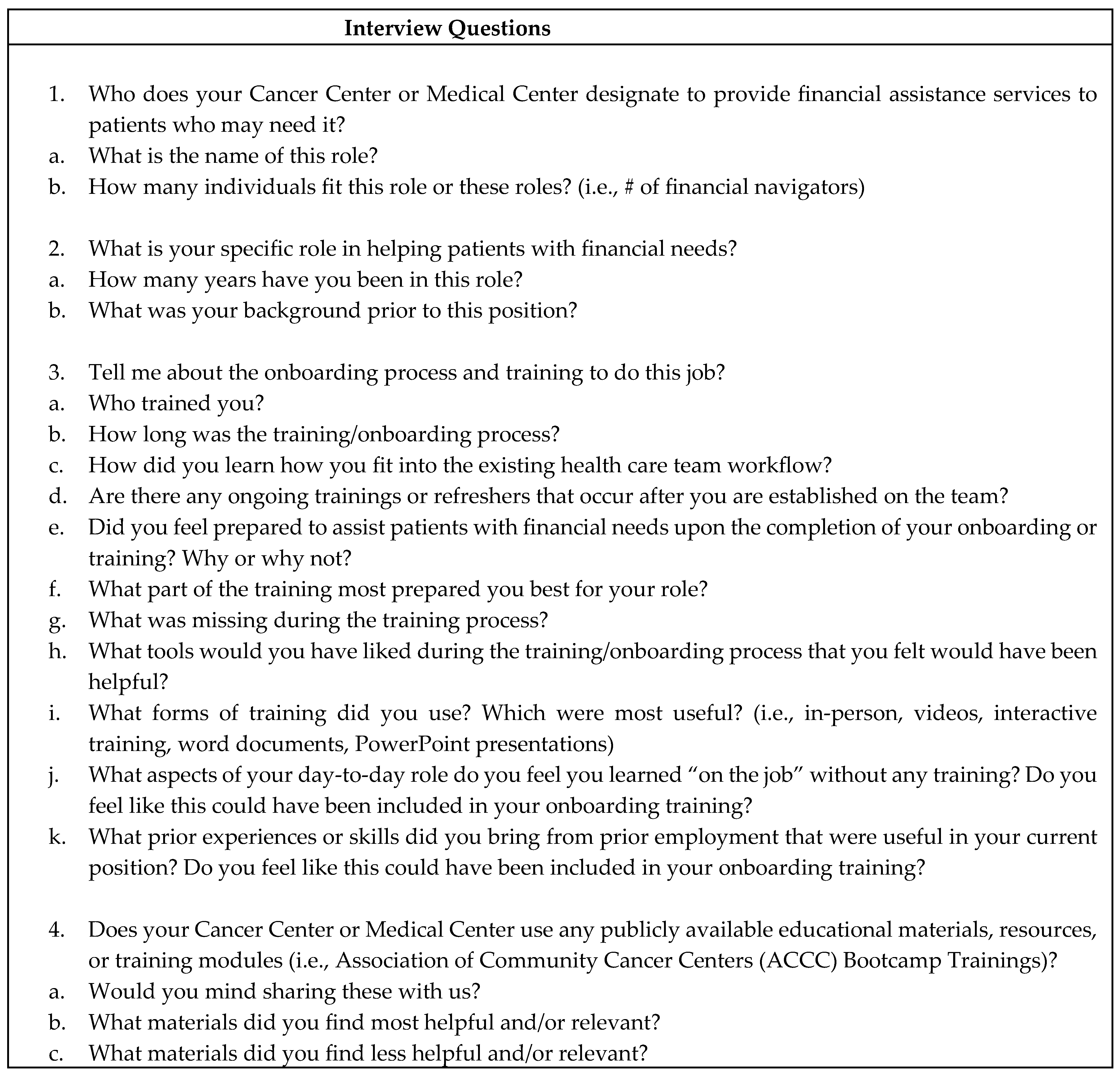
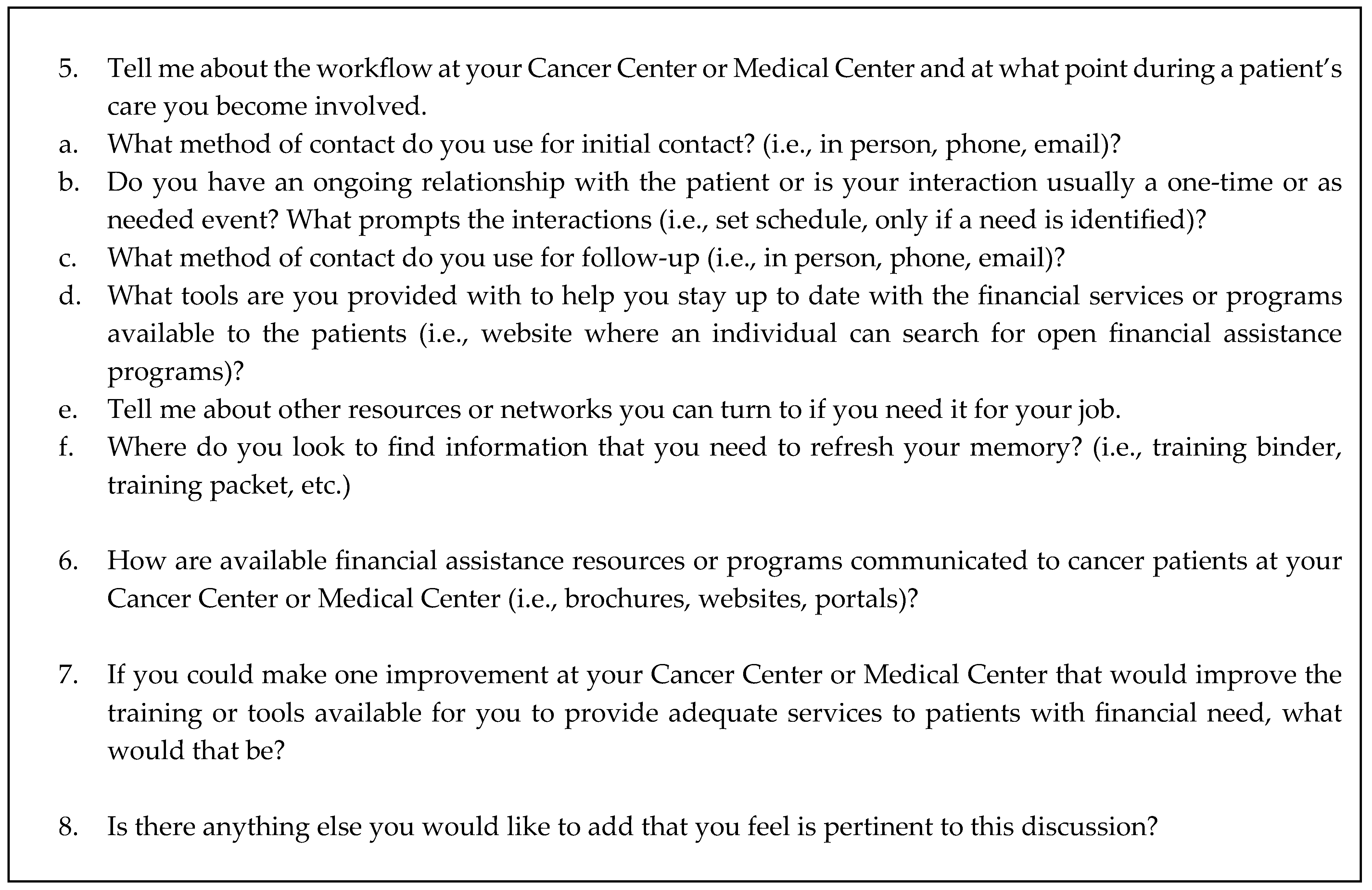
2.2. Conduct of Interviews
2.3. Analysis
2.4. Web-Based Search of Existing Training Resources
3. Results
3.1. Participant Characteristics
3.2. Construct 1. Onboarding and Training
3.2.1. Theme 1: Learning on the Job
3.2.2. Theme 2: Drawing on Previous Work Experience
3.2.3. Theme 3: Creating Self-Taught Training Guides
3.2.4. Theme 4: Using Available Online Training Resources
3.3. Construct 2: Critical Knowledge Base and Tools for Day-to-Day Operations
3.3.1. Theme 1: Fundamental Knowledge of Insurance, Drugs, and Oncology Needed
3.3.2. Theme 2: Soft Skills Training Desired
3.3.3. Theme 3: Organizational Tool Often Manually Created
3.4. Web Search for Financial Navigation Resources
4. Discussion
Author Contributions
Funding
Institutional Review Board Statement
Informed Consent Statement
Data Availability Statement
Conflicts of Interest
Abbreviations
| IRB | Institutional Review Board |
| ACCC | Association of Community Cancer Centers |
| NCI | National Cancer Institute |
| CC | Cancer Center |
| CCC | Comprehensive Cancer Center |
| LIFT | Lessening the Impact of Financial Toxicity |
Appendix A
Appendix A.1

| Name | Description | Topics | Cost |
|---|---|---|---|
| Training Resources for Role | |||
| American Cancer Society (ACS): Leadership in Oncology Navigation (LION) | Self-paced, online standardized training and credentialing program that helps navigators deliver professional patient navigation to individuals, caregivers, and families experiencing cancer. | Ten modules:
| $495 for 90 days of program access and participation |
| Association of Community Cancer Centers (ACCC): Financial Advocacy Bootcamp | Self-paced, online training designed to help financial navigators address financial toxicity in cancer care. | 1. Financial Advocacy Bootcamp Level I
| Free to members of ACCC Membership Options:
|
| George Washington Cancer Center—Financial Navigation Lesson for Oncology Patient Navigators | This training describes current evidence on drivers of financial toxicity, shares mitigation strategies and resources that prepare and equip patient navigators to effectively address financial toxicity. | Lessons
| Free |
| NaVectis Group | Educate and train healthcare providers on how to improve the process of patient financial navigation services Training: 1st part: 2 day—16 h of classroom style training on site (12 h theory, 4 h solving case scenarios) 2nd part: 12 month remote mentorship Remote: email, phone, webex call Can discuss specific patient cases to determine options to decrease financial burden/toxicity by e-mail, phone, Webex call | Training topics:
| Paid resource for health systems: base Charge—to train 1 financial navigator and provide 12 months mentorship |
| Patient Advocate Foundation (PAF)—Website Training | Resources for patient and patient counselors related to co-pay relief, financial aids, scholarships. Education Resource Library includes educational videos on choosing a healthcare plan, including education of Medicaid. National Financial Resource Directory Tour helps website users understand purpose and intent of the National Financial Resource Directory financial navigation tool | Training Topics:
| Free with e-mail sign up Free training webcast for patients, caregivers, advocates, and providers. Registration required. |
| Triage Cancer/Triage Health Finance Intensive Training Program | Training program designed specifically for oncology health care professionals and advocates. Participants will learn about health and disability insurance and finances | Sample Topics:
| Free, registration required. |
| Tools for Role | |||
| American Cancer Society (ACS) | Resource directory for cancer patients, along with services directly offered by ACS
| Free | |
| CANCERcare | List of financial resources, educational workshops, and support groups for cancer patients. Resources:
| Free resources Patients must qualify for assistance programs on a need-base basis | |
| Cancer Financial Assistance Coalition | Search tool to find financial or practical help for cancer patients, created by a coalition of cancer support organizations | Free | |
| Family Reach | Organization that provides multiple levels of financial assistance to cancer patients
| Free | |
| Medicine Assistance Tool | Search tool to find financial assistance for prescriptions. | Free | |
| Needymeds.org | Saving/Coupons on prescriptions, Free/Low-Cost/Sliding Scale Clinics, savings by diagnosis, medical transportation costs, government healthcare programs Free interactive presentation for cancer center and their staff using the GoToMeeting platform. (45 min presentation): covers how to best find assistance on the NeedyMeds website, types of healthcare cost savings assistance available and how to maximize savings with patient’s drug discount card. | Free training on use of website/resources for financial navigators | |
| TailorMed | Program that integrates with electronic medical record to help estimate costs for patients’ specific chemotherapy plans; calculates future drug co-pays and connects patients with programs for assistance. | Paid resource for health systems | |
| Triage Cancer/Triage Health | Free education on the legal and practical issues that may impact individuals diagnosed with cancer and their caregivers; educational material including recorded webinars, quick guides, animated videos, blog, and podcast Legal and Financial Navigation Program: free one-on-one help in the areas of health insurance, disability insurance, employment information, finances, other types of insurance, and estate planning | Free | |
References
- Altice, C.K.; Banegas, M.P.; Tucker-Seeley, R.D.; Yabroff, K.R. Financial Hardships Experienced by Cancer Survivors: A Systematic Review. J. Natl. Cancer Inst. 2016, 109, djw205. [Google Scholar] [CrossRef]
- Pisu, M.; Henrikson, N.B.; Banegas, M.P.; Yabroff, K.R. Costs of cancer along the care continuum: What we can expect based on recent literature. Cancer 2018, 124, 4181–4191. [Google Scholar] [CrossRef] [PubMed]
- Gordon, L.G.; Merollini, K.M.D.; Lowe, A.; Chan, R.J. A Systematic Review of Financial Toxicity Among Cancer Survivors: We Can’t Pay the Co-Pay. Patient 2017, 10, 295–309. [Google Scholar] [CrossRef] [PubMed]
- Yabroff, K.R.; Dowling, E.C.; Guy, G.P., Jr.; Banegas, M.P.; Davidoff, A.J.; Han, X.; Virgo, X.H.S.; McNeel, T.S.; Chawla, N.; Blanch-Hartigan, D.; et al. Financial Hardship Associated with Cancer in the United States: Findings from a Population-Based Sample of Adult Cancer Survivors. J. Clin. Oncol. 2016, 34, 259–267. [Google Scholar] [CrossRef] [PubMed]
- Khera, N.; Sugalski, J.; Krause, D.; Butterfield, R.; Zhang, N.; Stewart, F.M.; Carlson, R.W.; Griffin, J.M.; Zafar, S.Y.; Lee, S.J. Current Practices for Screening and Management of Financial Distress at NCCN Member Institutions. J. Natl. Compr. Cancer Netw. 2020, 18, 825–831. [Google Scholar] [CrossRef] [PubMed]
- NCI Dictionary of Cancer Terms Comprehensive Cancer Information, N.C.I. Available online: https://www.cancer.gov/publications/dictionaries/cancer-terms/def/financial-navigator (accessed on 25 August 2025).
- Wheeler, S.B.; Thom, B.; Waters, A.R.; Shankaran, V. Interventions to Address Cancer-Related Financial Hardship: A Scoping Review and Call to Action. JCO Oncol. Pract. 2025, 21, 29–40. [Google Scholar] [CrossRef]
- Doherty, M.J.; Thom, B.; Gany, F. Evidence of the Feasibility and Preliminary Efficacy of Oncology Financial Navigation: A Scoping Review. Cancer Epidemiol. Biomark. Prev. 2021, 30, 1778–1784. [Google Scholar] [CrossRef] [PubMed] [PubMed Central]
- de Moor, J.S.; Mollica, M.; Sampson, A.; Adjei, B.; Weaver, S.J.; Geiger, A.M.; Kramer, B.S.; Grenen, E.; Miscally, M.; Ciolino, H.P. Delivery of Financial Navigation Services Within National Cancer Institute-Designated Cancer Centers. JNCI Cancer Spectr. 2021, 5, pkab033. [Google Scholar] [CrossRef] [PubMed] [PubMed Central]
- Smith, S.K.; Nicolla, J.; Zafar, S.Y. Bridging the gap between financial distress and available resources for patients with cancer: A qualitative study. J. Oncol. Pract. 2014, 10, e368–e372. [Google Scholar] [CrossRef] [PubMed] [PubMed Central]
- Shiels, M.S.; Haque, A.T.; Berrington de González, A.; Camargo, M.C.; Clarke, M.A.; Lynn, B.C.D.; Engels, E.A.; Freedman, N.D.; Gierach, G.L.; Hofmann, J.N.; et al. Trends in Cancer Incidence and Mortality Rates in Early-Onset and Older-Onset Age Groups in the United States, 2010-2019. Cancer Discov. 2025, 15, 1363–1376. [Google Scholar] [CrossRef] [PubMed]
- Siegel, R.L.; Kratzer, T.B.; Wagle, N.S.; Sung, H.; Jemal, A. Cancer statistics, 2026. CA A Cancer J. Clin. 2026, 76, e70043. [Google Scholar] [CrossRef]
- Mariotto, A.B.; Enewold, L.; Zhao, J.; Zeruto, C.A.; Yabroff, K.R. Medical Care Costs Associated with Cancer Survivorship in the United States. Cancer Epidemiol. Biomark. Prev. 2020, 29, 1304–1312. [Google Scholar] [CrossRef]
- Burns, A.; Ortaliza, J.; Lo, J.; Rae, M.; Cox, C. How Will the 2025 Reconciliation Law Affect the Uninsured Rate in Each State? KFF. 3 November 2025. Available online: https://www.kff.org/uninsured/how-will-the-2025-reconciliation-law-affect-the-uninsured-rate-in-each-state/ (accessed on 19 January 2026).
- Mangir, C.; Schneider, L.; Santiago, A.; Boehmer, L.; Draper, F.; Plotkin, E.; Lucas, L. Assessing effectiveness of a self-guided training program for Oncology Financial Advocates. J. Clin. Oncol. 2021, 39, 271. [Google Scholar] [CrossRef]
- Varanasi, A.P.; Burhansstipanov, L.; Gentry, S.; Chappell, M.; Dorn, C.; McMahon, J.; Bradsher, K.; Ferrer, E.L.S.; Barnett, L.M.; Leighliter, M.; et al. Job descriptions by oncology patient navigator experience. Cancer 2025, 131, e35764. [Google Scholar] [CrossRef]
- Hendren, S.; Chin, N.; Fisher, S.; Winters, P.; Griggs, J.; Mohile, S.; Fiscella, K. Patients’ barriers to receipt of cancer care, and factors associated with needing more assistance from a patient navigator. J. Natl. Med. Assoc. 2011, 103, 701–710. [Google Scholar] [CrossRef] [PubMed] [PubMed Central]
- Mann, K.; Waters, A.R.; Park, E.R.; Perez, G.K.; Lopez, P.L.V.; Kaddas, H.K.; Warner, E.L.; Ray, N.; Tsukamoto, T.; Allen, K.; et al. HIAYA CHAT study protocol: A randomized controlled trial of a health insurance education intervention for newly diagnosed adolescent and young adult cancer patients. Trials 2022, 23, 682. [Google Scholar] [CrossRef]
- Kirchhoff, A.C.; van Thiel Berghuijs, K.M.; Waters, A.R.; Kaddas, H.K.; Warner, E.L.; Vaca Lopez, P.L.; Perez, G.K.; Ray, N.; Chevrier, A.; Allen, K.; et al. Health Insurance Literacy Improvements Among Recently Diagnosed Adolescents and Young Adults with Cancer: Results from a Pilot Randomized Controlled Trial. JCO Oncol. Pract. 2024, 20, 93–101. [Google Scholar] [CrossRef] [PubMed]
- Wheeler, S.B.; Birken, S.A.; Wagi, C.R.; Manning, M.L.; Gellin, M.; Padilla, N.; Rogers, C.; Rodriguez, J.; Biddell, C.B.; Strom, C.; et al. Core functions of a financial navigation intervention: An in-depth assessment of the Lessening the Impact of Financial Toxicity (LIFT) intervention to inform adaptation and scale-up in diverse oncology care settings. Front Health Serv. 2022, 2, 958831. [Google Scholar] [CrossRef] [PubMed]
- Espinoza Suarez, N.R.; LaVecchia, C.M.; Morrow, A.S.; Fischer, K.M.; Kamath, C.; Boehmer, K.R.; Brito, J.P. ABLE to support patient financial capacity: A qualitative analysis of cost conversations in clinical encounters. Patient Educ. Couns. 2022, 105, 3249–3258. [Google Scholar] [CrossRef] [PubMed]
- Pisu, M.; Schoenberger, Y.M.; Herbey, I.; Brown-Galvan, A.; Liang, M.I.; Riggs, K.; Meneses, K. Perspectives on Conversations About Costs of Cancer Care of Breast Cancer Survivors and Cancer Center Staff: A Qualitative Study. Ann. Intern. Med. 2019, 170, S54–S61. [Google Scholar] [CrossRef] [PubMed]
- Rocque, G.B.; Partridge, E.E.; Pisu, M.; Martin, M.Y.; Demark-Wahnefried, W.; Acemgil, A.; Kenzik, K.; Kvale, E.A.; Meneses, K.; Li, X.; et al. The Patient Care Connect Program: Transforming Health Care Through Lay Navigation. J. Oncol. Pract. 2016, 12, e633–e642. [Google Scholar] [CrossRef] [PubMed] [PubMed Central]
- Association of Cancer Care Centers. Financial Advocacy Network: 2023 Census Survey Results. Available online: https://www.accc-cancer.org/home/learn/financial-advocacy/guidelines?https://www.accc-cancer.org/home/learn/financial-advocacy/financial-advocacy-network-2023-census-survey (accessed on 9 January 2026).


| Health System Characteristics (n = 7) | |
| Size of hospital (median, range) | 500 (300–1200) |
| Type (n, %) NCI- Designated CCC Community, not-for-profit hospital County safety net hospital | 4, 57% 2, 29% 1, 14% |
| Geographic regions Northeast Southeast Southwest Midwest West | 2, 29% 2, 29% 1, 14% 1, 14% 1, 14% |
| Participant Characteristics (n = 9) | |
| Positions represented | Educator for Patient Care Management (n = 2) Patient Navigator (n = 2) Lead Oncology Financial Analyst (n = 1) Director of Social Work (n = 1) Social Worker (n = 1) Manager of Financial Counseling (n = 1) Financial Counselor (n = 1) |
| Years in current position (median, range) | 3 (1–11) |
| Length of time at current institution in years (median, range) | 10 (1–23) |
| Construct 1: Onboarding and Training |
| Theme 1: Learning on the job. |
| It was a learn as you go situation…one day at a time… going through the information, and what was needed for the position. [financial counselor, 3 years in role] |
| I got to go in and actually watch another social worker interact with these patients… I think that’s the most beneficial thing. [social worker, 3 years in role] |
| Theme 2: Drawing on previous work experience. |
| Having an oncology background, but I also worked in public health in rural communities… understanding the needs at a community level and working with the resources directly at that level was definitely helpful coming in. [educator of patient care management, 4 years in role] |
| My background as a certified public accountant and I was a bank manager… I know how to deal with these reports and how to develop the work. [lead oncology financial analyst, 1 year in role] |
| Theme 3: Creating self-taught training guides. |
| We had to basically create everything for the role. [financial counselor, 3 years in role] |
| I would have calls [with other cancer center sites] and ask them a lot of questions. And I created that as my own training. [care navigator, 2 years in role] |
| Theme 4: Using available online training resources. |
| ACCC is probably the best one out there, but we also use Triage Cancer. [manager of financial counseling, 2.5 years in role] |
| Construct 2. Critical knowledge base and tools for day-to-day operations |
| Theme 1: Fundamental knowledge of insurance, drugs, and oncology needed. |
| Benefit verification is very important when it comes to helping patients understand their out-of-pocket costs. [manager of financial counseling, 2.5 years in role] |
| I learned about chemotherapy [on the job] a lot… about the diagnosis and costs, and I didn’t know about these codes, [or] how to deal with the insurances. [lead oncology financial analyst, 1 year in role] |
| Theme 2: Soft skills training desired. |
| I’ve had patients call me and ask me for 20 bucks. I mean, that’s one of the things that’s included in boundaries. What do you do when a patient calls you and asks you for 20 bucks? [social worker, 3 years in role] |
| It’s people skills, it’s learning how to ask those difficult questions. It’s learning how to build rapport; it’s learning how to really get in and identify some of those needs. And, those are really softer skills. [social worker, 11 years in role] |
| Theme 3: Organizational tool often manually created. |
| I had a binder that I kept all my information in and…I could flip back through to help with certain information [or find] forms. [financial counselor, 3 years in role] |
| I built my own spreadsheets… with formulas to keep track of billing and claim checks received by different foundations. [lead oncology financial analyst, 1 year in role] |
| I’m printing out the specific organizations, their information, so that [when] I meet with the patient, we can then call these organizations, or we can work together to get these services. [care navigator, 2 years in role] |
Disclaimer/Publisher’s Note: The statements, opinions and data contained in all publications are solely those of the individual author(s) and contributor(s) and not of MDPI and/or the editor(s). MDPI and/or the editor(s) disclaim responsibility for any injury to people or property resulting from any ideas, methods, instructions or products referred to in the content. |
© 2026 by the authors. Licensee MDPI, Basel, Switzerland. This article is an open access article distributed under the terms and conditions of the Creative Commons Attribution (CC BY) license.
Share and Cite
Cordero, G.; Pisu, M.; Chen, S.-F.; Ward, E.; Liang, M.I. Assessing Training Practices and Gaps for Staff Involved in the Delivery of Oncology Financial Navigation: A Qualitative Study. Curr. Oncol. 2026, 33, 130. https://doi.org/10.3390/curroncol33020130
Cordero G, Pisu M, Chen S-F, Ward E, Liang MI. Assessing Training Practices and Gaps for Staff Involved in the Delivery of Oncology Financial Navigation: A Qualitative Study. Current Oncology. 2026; 33(2):130. https://doi.org/10.3390/curroncol33020130
Chicago/Turabian StyleCordero, Gaby, Maria Pisu, Shu-Fan Chen, Elizabeth Ward, and Margaret I. Liang. 2026. "Assessing Training Practices and Gaps for Staff Involved in the Delivery of Oncology Financial Navigation: A Qualitative Study" Current Oncology 33, no. 2: 130. https://doi.org/10.3390/curroncol33020130
APA StyleCordero, G., Pisu, M., Chen, S.-F., Ward, E., & Liang, M. I. (2026). Assessing Training Practices and Gaps for Staff Involved in the Delivery of Oncology Financial Navigation: A Qualitative Study. Current Oncology, 33(2), 130. https://doi.org/10.3390/curroncol33020130