SMARCA4-Deficient Carcinomas of the Small Intestine: A Systematic Review


Simple Summary
Abstract
1. Introduction
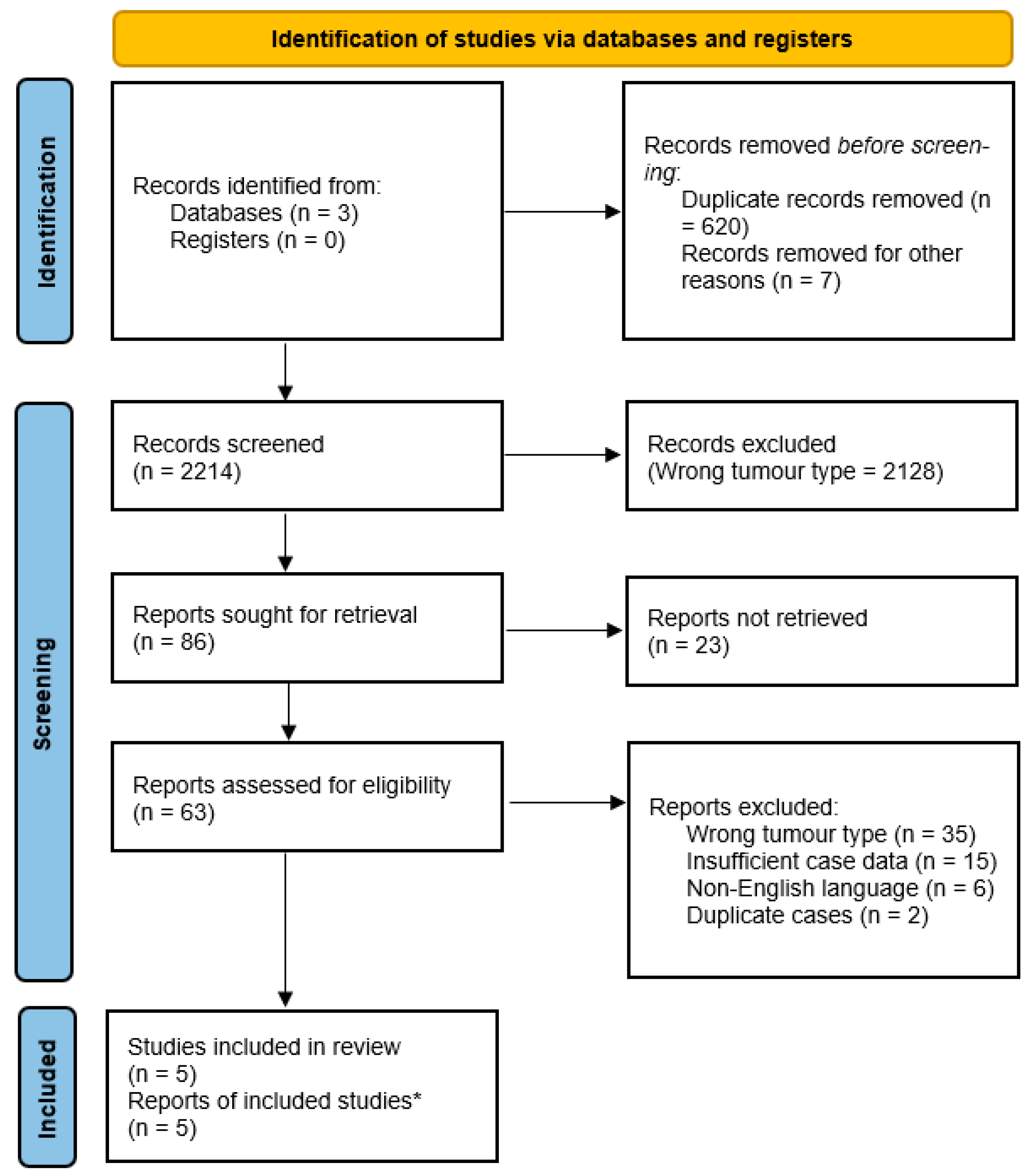
2. Methodology
- •
- Reported on primary GI carcinomas, specifically involving the small intestine (duodenum, jejunum, or ileum);
- •
- Documented loss of SMARCA4/BRG1 protein expression confirmed via immunohistochemistry or molecular analysis.
- •
- Described non-GI tract carcinomas (e.g., lung, ovarian, or soft tissue SMARCA4-deficient malignancies);
- •
- Involved small intestine metastases from other primaries;
- •
- Focused on gastric, colonic, or rectal carcinomas without small intestine involvement;
- •
- SMARCA4 status was not confirmed or was reported as intact/wild-type.
3. Summary of Reported Cases
3.1. Demographics and Clinical Presentation
3.2. Tumor Location and Macroscopic Features
3.3. Integrative Pathological and Molecular Profile
3.4. Treatment and Response
3.5. Outcomes
4. Discussion

| Feature | Thoracic SMARCA4-Deficient Carcinomas | Small Intestinal SMARCA4-Deficient Carcinomas |
|---|---|---|
| Clinical Features | ||
| Primary sites | Lung, mediastinum | Mostly duodenum, other sites include jejunum, small intestine, ampulla |
| Demographics | Predominantly middle-aged, male predominance | Middle-aged to older adults, male predominance |
| Risk factors | Strong association with tobacco exposure | No consistent environmental risk factors identified |
| Stage at diagnosis | Frequently advanced or metastatic | Often advanced |
| Clinical presentation | Chest pain, cough, dyspnea, mediastinal mass | Abdominal pain, obstruction, bleeding, perforation |
| Histology and Molecular Biology | ||
| Histologic morphology | Undifferentiated or rhabdoid carcinoma with extensive necrosis | Undifferentiated carcinoma with rhabdoid features and extensive necrosis |
| Cytokeratin expression | Absent or focal in most cases | Variable, some retained, others showed partial or complete loss in undifferentiated areas |
| Vimentin expression | Not specified | Frequently positive |
| SMARCA4 (BRG1) | Complete loss | Complete loss |
| SMARCA2 | Deficient | Often lost |
| INI1 (SMARCB1) | Not specified | Retained |
| PD-L1 expression | Heterogenous levels of expression | Not enough data |
| Treatment and Prognosis | ||
| Treatment strategies | No standard therapy | No standard therapy |
| Prognosis | Poor; median OS often <1 year | Poor; resected early-stage cases may show longer survival |
4.1. Histologic and Immunophenotypic Spectrum
4.2. Genomic Alterations
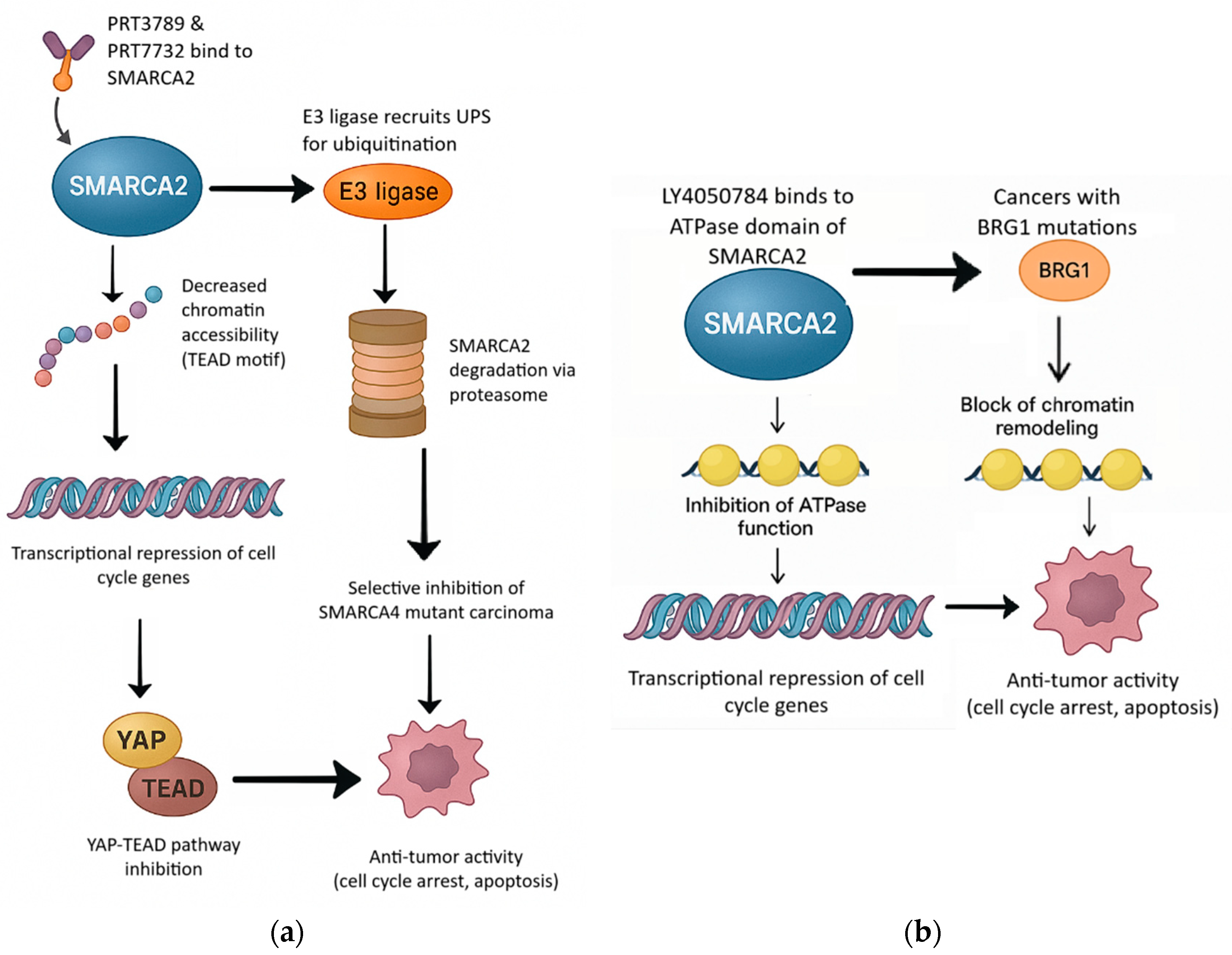
4.3. Therapeutic Challenges
5. Limitations
6. Implications
Author Contributions
Funding
Data Availability Statement
Acknowledgments
Conflicts of Interest
References
- Duan, H.; Gao, W.; Wang, L.; Cao, F.; Teng, L. Undifferentiated colonic neoplasm with SMARCA4 germline gene mutation and loss of SMARCA4 protein expression: A case report and literature review. Diagn. Pathol. 2021, 16, 30. [Google Scholar] [CrossRef]
- Peng, L.; Li, J.; Wu, J.; Xu, B.; Wang, Z.; Giamas, G.; Stebbing, J.; Yu, Z. A Pan-Cancer Analysis of SMARCA4 Alterations in Human Cancers. Front. Immunol. 2021, 12, 762598. [Google Scholar] [CrossRef]
- Guerrero-Martínez, J.A.; Reyes, J.C. High expression of SMARCA4 or SMARCA2 is frequently associated with an opposite prognosis in cancer. Sci. Rep. 2018, 8, 2043. [Google Scholar] [CrossRef] [PubMed]
- Al-Shbool, G.; Krishnan Nair, H. SMARCA4-Deficient Undifferentiated Tumor: A Rare Malignancy With Distinct Clinicopathological Characteristics. Cureus 2022, 14, e30708. [Google Scholar] [CrossRef] [PubMed]
- King, H.A.; Trotter, K.W.; Archer, T.K. Chromatin remodeling during glucocorticoid receptor regulated transactivation. Biochim. Biophys. Acta 2012, 1819, 716–726. [Google Scholar] [CrossRef] [PubMed] [PubMed Central]
- Young, R.H.; Oliva, E.; Scully, R.E. Small Cell Carcinoma of the Ovary, Hypercalcemic Type. Am. J. Surg. Pathol. 1994, 18, 1102–1116. [Google Scholar] [CrossRef] [PubMed]
- Jelinic, P.; Mueller, J.J.; Olvera, N.; Dao, F.; Scott, S.N.; Shah, R.; Gao, J.; Schultz, N.; Gonen, M.; Soslow, R.A.; et al. Recurrent SMARCA4 mutations in small cell carcinoma of the ovary. Nat. Genet. 2014, 46, 424–426. [Google Scholar] [CrossRef]
- Strehl, J.D.; Wachter, D.L.; Fiedler, J.; Heimerl, E.; Beckmann, M.W.; Hartmann, A.; Agaimy, A. Pattern of SMARCB1 (INI1) and SMARCA4 (BRG1) in poorly differentiated endometrioid adenocarcinoma of the uterus: Analysis of a series with emphasis on a novel SMARCA4-deficient dedifferentiated rhabdoid variant. Ann. Diagn. Pathol. 2015, 19, 198–202. [Google Scholar] [CrossRef]
- Stewart, C.J.R.; Crook, M.L. SWI/SNF complex deficiency and mismatch repair protein expression in undifferentiated and dedifferentiated endometrial carcinoma. Pathology 2015, 47, 439–445. [Google Scholar] [CrossRef]
- Nambirajan, A.; Singh, V.; Bhardwaj, N.; Mittal, S.; Kumar, S.; Jain, D. SMARCA4/BRG1–Deficient Non–Small Cell Lung Carcinomas: A Case Series and Review of the Literature. Arch. Pathol. Lab. Med. 2020, 145, 90–98. [Google Scholar] [CrossRef]
- Le Loarer, F.; Watson, S.; Pierron, G.; de Montpreville, V.T.; Ballet, S.; Firmin, N.; Auguste, A.; Pissaloux, D.; Boyault, S.; Paindavoine, S.; et al. SMARCA4 inactivation defines a group of undifferentiated thoracic malignancies transcriptionally related to BAF-deficient sarcomas. Nat. Genet. 2015, 47, 1200–1205. [Google Scholar] [CrossRef]
- Agaimy, A.; Daum, O.; Märkl, B.; Lichtmannegger, I.; Michal, M.; Hartmann, A. SWI/SNF Complex–deficient Undifferentiated/Rhabdoid Carcinomas of the Gastrointestinal Tract. Am. J. Surg. Pathol. 2016, 40, 544–553. [Google Scholar] [CrossRef]
- Chang, B.; Sheng, W.; Wang, L.; Zhu, X.; Tan, C.; Ni, S.; Weng, W.; Huang, D.; Wang, J. SWI/SNF Complex-deficient Undifferentiated Carcinoma of the Gastrointestinal Tract. Am. J. Surg. Pathol. 2022, 46, 889–906. [Google Scholar] [CrossRef]
- Nagtegaal, I.D.; Odze, R.D.; Klimstra, D.; Paradis, V.; Rugge, M.; Schirmacher, P.; Washington, K.M.; Carneiro, F.; Cree, I.A.; The WHO Classification of Tumours Editorial Board. The 2019 WHO classification of tumours of the digestive system. Histopathology 2019, 76, 182–188. [Google Scholar] [CrossRef] [PubMed]
- Cantley, J.; Ye, X.; Rousseau, E.; Januario, T.; Hamman, B.D.; Rose, C.M.; Cheung, T.K.; Hinkle, T.; Soto, L.; Quinn, C.; et al. Selective PROTAC-mediated degradation of SMARCA2 is efficacious in SMARCA4 mutant cancers. Nat. Commun. 2022, 13, 6814. [Google Scholar] [CrossRef] [PubMed] [PubMed Central]
- Kambe, A.; Yamamoto, Y.; Hasegawa, C.; Kakiuchi, A.; Kojima, D.; Hino, A.; Horikawa, A.; Doiuchi, T.; Kurihara, H. SMARCA4-deficient tumors in the adrenal gland and small intestines: A rare case report. Radiol. Case Rep. 2024, 19, 794–797. [Google Scholar] [CrossRef]
- Wang, J.; Elghawy, O.; Kurpiel, B.; Kaur, V. Diagnosis and management of gastrointestinal SMARCA4-deficient undifferentiated tumors. Clin. J. Gastroenterol. 2023, 16, 807–814. [Google Scholar] [CrossRef] [PubMed]
- Shi, Y.-N.; Zhang, X.-R.; Ma, W.-Y.; Lian, J.; Liu, Y.-F.; Li, Y.-F.; Yang, W.-H. PD-1 antibody in combination with chemotherapy for the treatment of SMARCA4-deficient advanced undifferentiated carcinoma of the duodenum: Two case reports. World J. Clin. Oncol. 2024, 15, 456–463. [Google Scholar] [CrossRef]
- Li, X.; Tian, S.; Shi, H.; Ta, N.; Ni, X.; Bai, C.; Zhu, Z.; Chen, Y.; Shi, D.; Huang, H.; et al. The golden key to open mystery boxes of SMARCA4-deficient undifferentiated thoracic tumor: Focusing immunotherapy, tumor microenvironment and epigenetic regulation. Cancer Gene Ther. 2024, 31, 687–697. [Google Scholar] [CrossRef] [PubMed]
- Shinno, Y.; Ohe, Y. the Lung Cancer Study Group of the Japan Clinical Oncology Group (JCOG). Thoracic SMARCA4-Deficient Undifferentiated Tumor: Current Knowledge and Future Perspectives. Jpn. J. Clin. Oncol. 2023, 54, 265–270. [Google Scholar] [CrossRef]
- Tsao, M.-S.; Nicholson, A.G.; Maleszewski, J.J.; Marx, A.; Travis, W.D. Introduction to 2021 WHO Classification of Thoracic Tumors. J. Thorac. Oncol. 2022, 17, e1–e4. [Google Scholar] [CrossRef] [PubMed]
- Takada, K.; Sugita, S.; Murase, K.; Kikuchi, T.; Oomori, G.; Ito, R.; Hayasaka, N.; Miyanishi, K.; Iyama, S.; Ikeda, H.; et al. Exceptionally rapid response to pembrolizumab in a SMARCA4-deficient thoracic sarcoma overexpressing PD-L1: A case report. Thorac. Cancer 2019, 10, 2312–2315. [Google Scholar] [CrossRef]
- Henon, C.; Blay, J.-Y.; Massard, C.; Mir, O.; Bahleda, R.; Dumont, S.; Postel-Vinay, S.; Adam, J.; Soria, J.-C.; Le Cesne, A. Long lasting major response to pembrolizumab in a thoracic malignant rhabdoid-like SMARCA4-deficient tumor. Ann. Oncol. 2019, 30, 1401–1403. [Google Scholar] [CrossRef]
- Bishop, J.A.; Antonescu, C.R.; Westra, W.H. SMARCB1 (INI-1)-deficient Carcinomas of the Sinonasal Tract. Am. J. Surg. Pathol. 2014, 38, 1282–1289. [Google Scholar] [CrossRef]
- Tessier-Cloutier, B.; Schaeffer, D.F.; Bacani, J.; Marginean, C.E.; Kalloger, S.; Köbel, M.; Lee, C. Loss of switch/sucrose non-fermenting complex protein expression in undifferentiated gastrointestinal and pancreatic carcinomas. Histopathology 2020, 77, 46–54. [Google Scholar] [CrossRef] [PubMed]
- Tsuruta, S.; Kohashi, K.; Yamada, Y.; Fujiwara, M.; Koga, Y.; Ihara, E.; Ogawa, Y.; Oki, E.; Nakamura, M.; Oda, Y. Solid-type poorly differentiated adenocarcinoma of the stomach: Deficiency of mismatch repair and SWI/SNF complex. Cancer Sci. 2020, 111, 1008–1019. [Google Scholar] [CrossRef] [PubMed]
- Huang, S.; Ng, K.; Yeh, T.; Cheng, C.; Chen, M.; Chao, Y.; Chuang, H.; Liu, Y.; Chen, T. The clinicopathological and molecular analysis of gastric cancer with altered SMARCA4 expression. Histopathology 2020, 77, 250–261. [Google Scholar] [CrossRef]
- Doyle, L.A. Surgical pathology of sarcomas. In Pathobiology of Human Disease: A Dynamic Encyclopedia of Disease Mechanisms; McManus, L.M., Mitchell, R.N., Eds.; Academic Press: Cambridge, MA, USA, 2014; pp. 3546–3562. [Google Scholar]
- Kezlarian, B.; Montecalvo, J.; Bodd, F.M.; Chang, J.C.; Riedel, E.; White, C.; Rekhtman, N.; Sauter, J.L. Diagnosis of thoracic SMARCA4-deficient undifferentiated tumor in cytology. Cancer Cytopathol. 2023, 131, 526–534. [Google Scholar] [CrossRef]
- Agaimy, A.; Rau, T.T.; Hartmann, A.; Stoehr, R. SMARCB1 (INI1)-negative Rhabdoid Carcinomas of the Gastrointestinal Tract. Am. J. Surg. Pathol. 2014, 38, 910–920. [Google Scholar] [CrossRef]
- Kuwamoto, S.; Matsushita, M.; Takeda, K.; Tanaka, N.; Endo, Y.; Yamasaki, A.; Kohashi, K.; Oda, Y.; Horie, Y. SMARCA4-deficient thoracic sarcoma: Report of a case and insights into how to reach the diagnosis using limited samples and resources. Hum. Pathol. 2017, 70, 92–97. [Google Scholar] [CrossRef]
- Meng, X.; Ma, J.; Meng, N.; Yun, T.; Niu, B. Case Report: SMARCA4 (BRG1)-deficient undifferentiated carcinoma of gallbladder with genetic analysis. Front. Oncol. 2023, 13, 1086266. [Google Scholar] [CrossRef] [PubMed]
- Wang, X.; Shi, W.; Xiao, Y.; Wang, H.; Si, H.; Kang, Y.; Si, J.; Liu, Y.; Li, S.; Jin, J. The immune desert tumor microenvironment in Thoracic SMARCA4-deficient undifferentiated tumors: Spatial distribution characteristics and prognostic significance. Lung Cancer 2025, 210, 108817. [Google Scholar] [CrossRef] [PubMed]
- Roser Pinyol Sia, D.; Llovet, J.M. Immune Exclusion-Wnt/CTNNB1 Class Predicts Resistance to Immunotherapies in HCC. Clin. Cancer Res. 2019, 25, 2021–2023. [Google Scholar]
- André, T.; Elez, E.; Van Cutsem, E.; Jensen, L.H.; Bennouna, J.; Mendez, G.; Schenker, M.; de la Fouchardiere, C.; Limon, M.L.; Yoshino, T.; et al. Nivolumab plus Ipilimumab in Microsatellite-Instability–High Metastatic Colorectal Cancer. N. Engl. J. Med. 2024, 391, 2014–2026. [Google Scholar] [CrossRef]
- Diaz, L.A.; Shiu, K.-K.; Kim, T.-W.; Jensen, B.V.; Jensen, L.H.; Punt, C.; Smith, D.; Garcia-Carbonero, R.; Benavides, M.; Gibbs, P.; et al. Pembrolizumab versus chemotherapy for microsatellite instability-high or mismatch repair-deficient metastatic colorectal cancer (KEYNOTE-177): Final analysis of a randomised, open-label, phase 3 study. Lancet Oncol. 2022, 23, 659–670. [Google Scholar] [CrossRef]
- Le, D.T.; Durham, J.N.; Smith, K.N.; Wang, H.; Bartlett, B.R.; Aulakh, L.K.; Lu, S.; Kemberling, H.; Wilt, C.; Luber, B.S.; et al. Mismatch repair deficiency predicts response of solid tumors to PD-1 blockade. Science 2017, 357, 409–413. [Google Scholar] [CrossRef]
- Kobayashi, T.; Iwama, S.; Yasuda, Y.; Okada, N.; Okuji, T.; Ito, M.; Onoue, T.; Goto, M.; Sugiyama, M.; Tsunekawa, T.; et al. Pituitary dysfunction induced by immune checkpoint inhibitors is associated with better overall survival in both malignant melanoma and non-small cell lung carcinoma: A prospective study. J. Immunother. Cancer 2020, 8, e000779. [Google Scholar] [CrossRef]
- de Klerk, L.K.; Patel, A.K.; Derks, S.; Pectasides, E.; Augustin, J.; Uduman, M.; Raman, N.; Akarca, F.G.; McCleary, N.J.; Cleary, J.M.; et al. Phase II study of pembrolizumab in refractory esophageal cancer with correlates of response and survival. J. Immunother. Cancer 2021, 9, e002472. [Google Scholar] [CrossRef] [PubMed]
- Sun, J.-M.; Shen, L.; Shah, M.A.; Enzinger, P.; Adenis, A.; Doi, T.; Kojima, T.; Metges, J.-P.; Li, Z.; Kim, S.-B.; et al. Pembrolizumab plus chemotherapy versus chemotherapy alone for first-line treatment of advanced oesophageal cancer (KEYNOTE-590): A randomised, placebo-controlled, phase 3 study. Lancet 2021, 398, 759–771. [Google Scholar] [CrossRef]
- Di Nardo, P.; Garattini, S.K.; Torrisi, E.; Fanotto, V.; Miolo, G.; Buonadonna, A.; Puglisi, F. Systemic Treatments for Advanced Small Bowel Adenocarcinoma: A Systematic Review. Cancers 2022, 14, 1502. [Google Scholar] [CrossRef]
- Naito, T.; Umemura, S.; Nakamura, H.; Zenke, Y.; Udagawa, H.; Kirita, K.; Matsumoto, S.; Yoh, K.; Niho, S.; Motoi, N.; et al. Successful treatment with nivolumab for SMARCA4-deficient non-small cell lung carcinoma with a high tumor mutation burden: A case report. Thorac. Cancer 2019, 10, 1285–1288. [Google Scholar] [CrossRef] [PubMed]
- Schoenfeld, A.J.; Bandlamudi, C.; Lavery, J.A.; Montecalvo, J.; Namakydoust, A.; Rizvi, H.; Egger, J.; Concepcion, C.P.; Paul, S.; Arcila, M.E.; et al. The Genomic Landscape of SMARCA4 Alterations and Associations with Outcomes in Patients with Lung Cancer. Clin. Cancer Res. 2020, 26, 5701–5708. [Google Scholar] [CrossRef] [PubMed]
- Tiragolumab and Atezolizumab for the Treatment of Relapsed or Refractory SMARCB1 or SMARCA4 Deficient Tumors. 2025. Available online: https://clinicaltrials.gov/study/NCT05286801 (accessed on 16 April 2025).
- A Study of PRT7732, an Oral SMARCA2 Degrader, in Patients with Advanced or Metastatic Solid Tumors with a SMARCA4 Mutation. 2025. Available online: https://clinicaltrials.gov/study/NCT06560645 (accessed on 16 April 2025).
- Ito, K.; Hulse, M.; Agarwal, A.; Carter, J.; Sivakumar, M.; Vykuntam, K.; Wang, M.; Cowart, M.; Cote, J.; Gowen-MacDonald, W.; et al. Abstract B113: Discovery of PRT3789, a first-in-class potent and selective SMARCA2 degrader in clinical trials for the treatment of patients with SMARCA4 mutated cancers. Mol. Cancer Ther. 2023, 22, B113. [Google Scholar] [CrossRef]
- Lee, J.Y.; Brooks, N.; Antonakos, B.; Perria, B.; Langan, C.; Jones, B.D.; Flack, R.S.; Li, Z.; Terry, D.; Wallace, R.; et al. Abstract PR015: Discovery of LY4050784 (FHD-909), a selective BRM (SMARCA2) ATPase inhibitor for the treatment of BRG1 (SMARCA4) mutant cancers. Mol. Cancer Ther. 2024, 23, PR015. [Google Scholar] [CrossRef]
- Jiang, J.; Chen, Z.; Gong, J.; Han, N.; Lu, H. Thoracic SMARCA4-deficient undifferentiated tumor. Discov. Oncol. 2023, 14, 51. [Google Scholar] [CrossRef]
- Tazemetostat in Treating Patients With Relapsed or Refractory Advanced Solid Tumors, Non-Hodgkin Lymphoma, or Histiocytic Disorders With EZH2, SMARCB1, or SMARCA4 Gene Mutations (A Pediatric MATCH Treatment Trial). 2025. Available online: https://clinicaltrials.gov/study/NCT03213665 (accessed on 16 April 2025).
- Iijima, Y.; Sakakibara, R.; Ishizuka, M.; Honda, T.; Shirai, T.; Okamoto, T.; Tateishi, T.; Sakashita, H.; Tamaoka, M.; Takemoto, A.; et al. Notable response to nivolumab during the treatment of SMARCA4-deficient thoracic sarcoma: A case report. Immunotherapy 2020, 12, 563–569. [Google Scholar] [CrossRef] [PubMed]

| Case | Age | Sex | Tumor Location | Clinical Presentation | Stage at Diagnosis | Histologic Features | IHC Staining | Molecular Testing | Treatment Administered | Tumor Response | Survival Outcome | ||
|---|---|---|---|---|---|---|---|---|---|---|---|---|---|
| IHC Positive | IHC Negative | ||||||||||||
| Case 1 | Akira Kambe (2024) [16] | 76 | M | Small intestine and adrenals | Bowel perforation | N.A. | Poorly differentiated adenocarcinoma | CK7+ | CK 20- BRG-1 (SMARCA4)- | SMARCA4- | N.A. | N.A. | N.A. |
| Case 2 | John Wang (2023) [17] | 39 | M | Small intestine | Intermittent abdominal pain, SBO, intussusception | T3N0M0/IIA | 3.0 × 3.0 cm polypoid mass. Sheets of epithelioid and highly pleomorphic cells, many inflammatory cells, large irregular nuclei, atypical mitoses | SMA+ vimentin+ INI1+ | S100- D2-40- pan-CK-CD34- CD31- ERG- DOG-1- HMB45-desmin-CD117- BRG-1 (SMARCA4)- | N.A. | Initially surveillance → later CT showed lung lesion growth, biopsy confirmed multiple mets → Pembrolizumab | Complete response in 4 months, maintained at 18 months | DFS 18 months, OS 18 months |
| Case 3 | Shi (2024) [18] | 51 | M | Duodenum | Upper abdominal pain > 1 month, liver metastases, retroperitoneal LN involvement | IV | Undifferentiated tumor in cords/nests, extensive necrosis | N.A. | N.A. | SMARCA4-, PD-L1 CPS 5, MSS, TP53 and CTNNB1 mutations | Bevacizumab + Oxaliplatin + Capecitabine → PD-1 antibody + Nab-paclitaxel + Gemcitabine | Progressive disease, significant liver metastases, refused further treatment | OS 6 months |
| Case 4 | Shi (2024) [18] | 43 | F | Duodenal papilla | Intermittent upper abdominal pain, supraclavicular LN enlargement | IV | Undifferentiated carcinoma | N.A. | N.A. | SMARCA4-, TP53, NCOR1, MYH9, ERBB3, RAD52, CTNNB1 mutations, TMB 10.56/Mb, PD-L1 CPS 6, MSS+ | PD-1 antibody + Nab-paclitaxel + Cisplatin (6 cycles) → Intital response → Maintenance PD-1 → disease progression at 6 months → Irinotecan + Capecitabine + Bevacizumab → Supportive care | Initial response → disease progression → second line | OS 9 months |
| Case 5 | Bin Chang (2022) [13] | 54 | M | Jejunum | N.A. | T3N0M0/IIA | Exophytic/endophytic 10 cm mass, diffuse sheets (85%), poor cohesive pseudoglandular (15%), epithelioid tumor cells, multinucleated giant cells, necrosis, rhabdoid cells | SMARCA2+ INI1+ ARIDIA+ P53 mutant Pan CK+ CK8+ | SMARCA4-CK7- | N.A. | Surgical resection, XELOX (Capecitabine + Oxaliplatin for 8 cycles) → S1 (Tegafur + Gimeracil + Oteracil + potassium capsule for 6 cycles) | N.A. | DFS 29 months, OS 29 months |
| Case 6 | Bin Chang (2022) [13] | 34 | M | Duodenal papilla | N.A. | T3N1M0/IIB | Ulcerated. Moderate adenocarcinoma (40%), undifferentiated components (60%): big nests and sheets (40%) and poor cohesive pseudoglandular (20%), epithelioid tumor cells, scattered multinucleated giant cells, necrosis. | SMARCA2(AC+) INI1+ ARIDIA+ p53 mutant Pan CK (AC+, UC+) | SMARCA4-SMARCA2 (UC-) | N.A. | Surgical resection → TACE for liver metastases, XELOX (Capecitabine + Oxaliplatin for 7 cycles) → FOLFOXIRI (Oxaliplatin + Irinotecan + Leucovorin + 5-Fluorouracil for 2 cycles) | N.A. | DFS 8 months, OS 12 months |
| Case 7 | Bin Chang (2022) [13] | 62 | M | Duodenum | N.A. | T3N3M1/IV | Sheets, rhabdoid tumor cells, necrosis. | Vimentin+ | SMARCA4-SMARCA2-Pan CK- | N.A. | Supportive care, no surgery or chemotherapy | N.A. | DFS 7 months, OS 11 months |
| Case 8 | Bin Chang (2022) [13] | 71 | M | Duodenal ampulla | N.A. | T2N2M0/IIIB | Endophytic, nests (60%), diffused sheet (30%), poor cohesive pseudoglandular (10%), epithelioid tumor cells with focal short spindle cells, necrosis. | INI1+ ARIDIA+ p53 mutant Pan CK+ Vimentin+ | SMARCA4- SMARCA2- EMA- | N.A. | Chemotherapy: GP (Gemcitabine + Cisplatin for 1 cycle) | N.A. | DFS 2 months, OS 2 months |
| Case 9 | Bin Chang (2022) [13] | 56 | M | Duodenum | N.A. | T4N1M1/IV | Exophytic circular, diffused sheets (60%), nests (30%), pseudoglandular (5%), and cords (5%), broad desmoplastic stroma, mimicking desmoplastic small round cell tumor, epithelioid tumor cells (>95%), focal clear cell cytoplasm (10%), short spindle tumor cells (<5%), scattered multinucleated giant cells, necrosis, focal rhabdoid cells | INI1+ ARIDIA+ p53 mutant | SMARCA4SMARCA2-Pan CK- | N.A. | Neoadjuvant chemotherapy: TP (Paclitaxel + Cisplatin for 6 cycles) → Progressive disease, targeted therapy: Imatinib (hematochezia, anemia) → Surgery resection, postoperative MRI indicated brain tumor metastases | N.A. | OS 11 months |
| Case 10 | Abbas Agaimy (2016) [12] | 62 | M | Small intestine + ampulla | N.A. | N.A. | Ulcerated transmural masses 4.5 + 5.5 cm, anaplastic large cells, rhabdoid cells | SMARCB1+ ARIDIA+ MLH1+ PMS2+ MSH2+ MSH6+ Pan CK+ Vimentin+ | SMARCA4-SMARCA2- CK7- CK20- CDX2- P63- | N.A. | Resection | N.A. | OS 3 months |
Disclaimer/Publisher’s Note: The statements, opinions and data contained in all publications are solely those of the individual author(s) and contributor(s) and not of MDPI and/or the editor(s). MDPI and/or the editor(s) disclaim responsibility for any injury to people or property resulting from any ideas, methods, instructions or products referred to in the content. |
© 2026 by the authors. Licensee MDPI, Basel, Switzerland. This article is an open access article distributed under the terms and conditions of the Creative Commons Attribution (CC BY) license.
Share and Cite
Syed, A.; Boumber, Y.; Malla, M. SMARCA4-Deficient Carcinomas of the Small Intestine: A Systematic Review. Curr. Oncol. 2026, 33, 107. https://doi.org/10.3390/curroncol33020107
Syed A, Boumber Y, Malla M. SMARCA4-Deficient Carcinomas of the Small Intestine: A Systematic Review. Current Oncology. 2026; 33(2):107. https://doi.org/10.3390/curroncol33020107
Chicago/Turabian StyleSyed, Aaqid, Yanis Boumber, and Midhun Malla. 2026. "SMARCA4-Deficient Carcinomas of the Small Intestine: A Systematic Review" Current Oncology 33, no. 2: 107. https://doi.org/10.3390/curroncol33020107
APA StyleSyed, A., Boumber, Y., & Malla, M. (2026). SMARCA4-Deficient Carcinomas of the Small Intestine: A Systematic Review. Current Oncology, 33(2), 107. https://doi.org/10.3390/curroncol33020107