Targeting the Uncommon: A Case Report of Osimertinib Response in Advanced NSCLC Patient with Dual EGFR (E701fs and L702fs) Frameshift Deletions

 , , , and
Simple Summary
Abstract
1. Introduction
2. Case Presentation
3. Discussion
4. Conclusions
Author Contributions
Funding
Institutional Review Board Statement
Informed Consent Statement
Data Availability Statement
Conflicts of Interest
Abbreviations
| NSCLC | Non-small cell lung cancer |
| NGS | Next-generation sequencing |
| ctDNA | Circulating tumor DNA |
| AGA | Actionable genomic alterations |
| PD-L1 | Programmed death-ligand 1 |
| EGFR | Epidermal growth factor receptor |
| ASCO | American Society of Clinical Oncology |
| NCCN | National Comprehensive Cancer Network |
| CCO | Cancer Care Ontario |
| ECOG | Eastern Cooperative Oncology Group |
| TKI | Tyrosine Kinase Inhibitor |
| MDACC | MD Anderson Cancer Center System |
| PACC | P-loop and αC-helix compressing |
| PFS | Progression-free survival |
| OS | Overall survival |
| ORR | Objective response rate |
| CI | Confidence interval |
| HR | Hazard ratio |
| DCR | Disease control rate |
References
- Torre, L.A.; Bray, F.; Siegel, R.L.; Ferlay, J.; Lortet-Tieulent, J.; Jemal, A. Global Cancer Statistics, 2012. CA Cancer J. Clin. 2015, 65, 87–108. [Google Scholar] [CrossRef]
- Sung, H.; Ferlay, J.; Siegel, R.L.; Laversanne, M.; Soerjomataram, I.; Jemal, A.; Bray, F. Global Cancer Statistics 2020: GLOBOCAN Estimates of Incidence and Mortality Worldwide for 36 Cancers in 185 Countries. CA A Cancer J. Clin. 2021, 71, 209–249. [Google Scholar] [CrossRef]
- Brenner, D.R.; Gillis, J.; Demers, A.A.; Ellison, L.F.; Billette, J.-M.; Zhang, S.X.; Liu, J.L.; Woods, R.R.; Finley, C.; Fitzgerald, N.; et al. Projected Estimates of Cancer in Canada in 2024. Can. Med. Assoc. J. 2024, 196, E615–E623. [Google Scholar] [CrossRef]
- Hendriks, L.E.L.; Remon, J.; Faivre-Finn, C.; Garassino, M.C.; Heymach, J.V.; Kerr, K.M.; Tan, D.S.W.; Veronesi, G.; Reck, M. Non-Small-Cell Lung Cancer. Nat. Rev. Dis. Primers 2024, 10, 71. [Google Scholar] [CrossRef] [PubMed]
- Seung, S.J.; Hurry, M.; Walton, R.N.; Evans, W.K. Real-World Treatment Patterns and Survival in Stage IV Non-Small-Cell Lung Cancer in Canada. Curr. Oncol. 2020, 27, e361–e367. [Google Scholar] [CrossRef]
- Ellison, L.F.; Saint-Jacques, N. Five-Year Cancer Survival by Stage at Diagnosis in Canada. Health Rep. 2023, 34, 3–15. [Google Scholar] [CrossRef] [PubMed]
- Barta, J.A.; Powell, C.A.; Wisnivesky, J.P. Global Epidemiology of Lung Cancer. Ann. Glob. Health 2019, 85, 8. [Google Scholar] [CrossRef]
- Rodak, O.; Peris-Díaz, M.D.; Olbromski, M.; Podhorska-Okołów, M.; Dzięgiel, P. Current Landscape of Non-Small Cell Lung Cancer: Epidemiology, Histological Classification, Targeted Therapies, and Immunotherapy. Cancers 2021, 13, 4705. [Google Scholar] [CrossRef]
- LoPiccolo, J.; Gusev, A.; Christiani, D.C.; Jänne, P.A. Lung Cancer in Patients Who Have Never Smoked—an Emerging Disease. Nat. Rev. Clin. Oncol. 2024, 21, 121–146. [Google Scholar] [CrossRef]
- Elkrief, A.; Joubert, P.; Florescu, M.; Tehfe, M.; Blais, N.; Routy, B. Therapeutic Landscape of Metastatic Non-Small-Cell Lung Cancer in Canada in 2020. Curr. Oncol. 2020, 27, 52–60. [Google Scholar] [CrossRef]
- Laguna, J.C.; García-Pardo, M.; Alessi, J.; Barrios, C.; Singh, N.; Al-Shamsi, H.O.; Loong, H.; Ferriol, M.; Recondo, G.; Mezquita, L. Geographic Differences in Lung Cancer: Focus on Carcinogens, Genetic Predisposition, and Molecular Epidemiology. Ther. Adv. Med. Oncol. 2024, 16, 17588359241231260. [Google Scholar] [CrossRef]
- Muthusamy, B.; Raskina, K.; Lofgren, K.T.; Li, G.; Tolba, K.; Schwed, K.; Castellanos, E.; Huang, R.S.P.; Oxnard, G.R.; Schrock, A.B.; et al. Quantifying the Value of Multigene Testing in Resected Early Stage Lung Adenocarcinoma. J. Thorac. Oncol. 2023, 18, 476–486. [Google Scholar] [CrossRef]
- Alexander, M.; Kim, S.Y.; Cheng, H. Update 2020: Management of Non-Small Cell Lung Cancer. Lung 2020, 198, 897–907. [Google Scholar] [CrossRef]
- Bazhenova, L.; Ismaila, N.; Abu Rous, F.; Alluri, K.; Freeman-Daily, J.; Halmos, B.; Malhotra, N.; Marrone, K.A.; Puri, S.; Qin, A.; et al. Therapy for Stage IV Non–Small Cell Lung Cancer With Driver Alterations: ASCO Living Guideline, Version 2024.2. J. Clin. Oncol. 2024, 42, e72–e86. [Google Scholar] [CrossRef]
- Hanna, N.H.; Robinson, A.G.; Temin, S.; Baker, S.; Brahmer, J.R.; Ellis, P.M.; Gaspar, L.E.; Haddad, R.Y.; Hesketh, P.J.; Jain, D.; et al. Therapy for Stage IV Non-Small-Cell Lung Cancer With Driver Alterations: ASCO and OH (CCO) Joint Guideline Update. J. Clin. Oncol. 2021, 39, 1040–1091. [Google Scholar] [CrossRef] [PubMed]
- Owen, D.H.; Jaiyesimi, I.A.; Leighl, N.B.; Ismaila, N.; Florez, N.; Puri, S.; Schenk, E.L.; Schneider, B.J.; Patel, J.D. Therapy for Stage IV Non–Small Cell Lung Cancer With and Without Driver Alterations: ASCO Living Guideline Clinical Insights. JCO Oncol. Pr. 2024, 20, 893–898. [Google Scholar] [CrossRef] [PubMed]
- Riely, G.J.; Wood, D.E.; Ettinger, D.S.; Aisner, D.L.; Akerley, W.; Bauman, J.R.; Bharat, A.; Bruno, D.S.; Chang, J.Y.; Chirieac, L.R.; et al. Non–Small Cell Lung Cancer, Version 4.2024, NCCN Clinical Practice Guidelines in Oncology. J. Natl. Compr. Cancer Netw. 2024, 22, 249–274. [Google Scholar] [CrossRef] [PubMed]
- Yuan, M.; Huang, L.-L.; Chen, J.-H.; Wu, J.; Xu, Q. The Emerging Treatment Landscape of Targeted Therapy in Non-Small-Cell Lung Cancer. Sig. Transduct. Target. Ther. 2019, 4, 61. [Google Scholar] [CrossRef]
- Majeed, U.; Manochakian, R.; Zhao, Y.; Lou, Y. Targeted Therapy in Advanced Non-Small Cell Lung Cancer: Current Advances and Future Trends. J. Hematol. Oncol. 2021, 14, 108. [Google Scholar] [CrossRef]
- Russano, M.; Perrone, G.; Fazio, G.R.D.; Galletti, A.; Citarella, F.; Santo, V.; Brunetti, L.; Vendittelli, A.; Vincenzi, B.; Tonini, G.; et al. Uncommon EGFR Mutations in Non-Small-Cell Lung Cancer. Precis. Cancer Med. 2022, 5, 30. [Google Scholar] [CrossRef]
- Harrison, P.T.; Vyse, S.; Huang, P.H. Rare Epidermal Growth Factor Receptor (EGFR) Mutations in Non-Small Cell Lung Cancer. Semin. Cancer Biol. 2020, 61, 167–179. [Google Scholar] [CrossRef] [PubMed]
- Robichaux, J.P.; Le, X.; Vijayan, R.S.K.; Hicks, J.K.; Heeke, S.; Elamin, Y.Y.; Lin, H.Y.; Udagawa, H.; Skoulidis, F.; Tran, H.; et al. Structure-Based Classification Predicts Drug Response in EGFR-Mutant NSCLC. Nature 2021, 597, 732–737. [Google Scholar] [CrossRef] [PubMed]
- Soria, J.-C.; Ohe, Y.; Vansteenkiste, J.; Reungwetwattana, T.; Chewaskulyong, B.; Lee, K.H.; Dechaphunkul, A.; Imamura, F.; Nogami, N.; Kurata, T.; et al. Osimertinib in Untreated EGFR-Mutated Advanced Non–Small-Cell Lung Cancer. N. Engl. J. Med. 2018, 378, 113–125. [Google Scholar] [CrossRef] [PubMed]
- Ramalingam, S.S.; Vansteenkiste, J.; Planchard, D.; Cho, B.C.; Gray, J.E.; Ohe, Y.; Zhou, C.; Reungwetwattana, T.; Cheng, Y.; Chewaskulyong, B.; et al. Overall Survival with Osimertinib in Untreated, EGFR-Mutated Advanced NSCLC. N. Engl. J. Med. 2020, 382, 41–50. [Google Scholar] [CrossRef]
- Planchard, D.; Jänne, P.A.; Cheng, Y.; Yang, J.C.-H.; Yanagitani, N.; Kim, S.-W.; Sugawara, S.; Yu, Y.; Fan, Y.; Geater, S.L.; et al. Osimertinib with or without Chemotherapy in EGFR-Mutated Advanced NSCLC. N. Engl. J. Med. 2023, 389, 1935–1948. [Google Scholar] [CrossRef]
- Breadner, D.A.; Liu, G.; Rothenstein, J.; Verma, S.; Menjak, I.; Cheema, P.K.; Juergens, R.; Mithoowani, H.; Bains, P.; Wang, Y.; et al. 1327P First-Line Osimertinib in Patients with EGFR Mutated Lung Cancer with Uncommon Mutations (OCELOT Study—Interim Analysis). Ann. Oncol. 2023, 34, S766. [Google Scholar] [CrossRef]
- Improta, G.; Zupa, A.; Natalicchio, M.I.; Sisinni, L.; Marinaccio, A.; Bozza, G.; Vita, G.; Aieta, M.; Landriscina, M. Uncommon Frame-Shift Exon 19 EGFR Mutations Are Sensitive to EGFR Tyrosine Kinase Inhibitors in Non-Small Cell Lung Carcinoma. Med. Oncol. 2018, 35, 28. [Google Scholar] [CrossRef]
- Ecancer WCLC 2025: FLAURA2 Trial Shows Osimertinib Plus Chemotherapy Improves Overall Survival in eGFR-Mutated Advanced NSCLC—Ecancer. Available online: http://ecancer.org/en/news/26998-wclc-2025-flaura2-trial-shows-osimertinib-plus-chemotherapy-improves-overall-survival-in-egfr-mutated-advanced-nsclc (accessed on 19 September 2025).
- Watanabe, S.; Minegishi, Y.; Yoshizawa, H.; Maemondo, M.; Inoue, A.; Sugawara, S.; Isobe, H.; Harada, M.; Ishii, Y.; Gemma, A.; et al. Effectiveness of Gefitinib against Non–Small-Cell Lung Cancer with the Uncommon EGFR Mutations G719X and L861Q. J. Thorac. Oncol. 2014, 9, 189–194. [Google Scholar] [CrossRef]
- Cheunkarndee, T.; Guo, M.Z.; Houseknecht, S.; Feliciano, J.L.; Hann, C.L.; Lam, V.K.; Levy, B.P.; Murray, J.C.; Brahmer, J.R.; Forde, P.M.; et al. First-Line Osimertinib for Lung Cancer With Uncommon EGFR Exon 19 Mutations and EGFR Compound Mutations. JTO Clin. Res. Rep. 2024, 5, 100686. [Google Scholar] [CrossRef]
- Yang, J.C.-H.; Schuler, M.; Popat, S.; Miura, S.; Heeke, S.; Park, K.; Märten, A.; Kim, E.S. Afatinib for the Treatment of NSCLC Harboring Uncommon EGFR Mutations: A Database of 693 Cases. J. Thorac. Oncol. 2020, 15, 803–815. [Google Scholar] [CrossRef]
- Yang, J.C.-H.; Sequist, L.V.; Geater, S.L.; Tsai, C.-M.; Mok, T.S.K.; Schuler, M.; Yamamoto, N.; Yu, C.-J.; Ou, S.-H.I.; Zhou, C.; et al. Clinical Activity of Afatinib in Patients with Advanced Non-Small-Cell Lung Cancer Harbouring Uncommon EGFR Mutations: A Combined Post-Hoc Analysis of LUX-Lung 2, LUX-Lung 3, and LUX-Lung 6. Lancet Oncol. 2015, 16, 830–838. [Google Scholar] [CrossRef]
- Wu, Y.-L.; Zhou, C.; Hu, C.-P.; Feng, J.; Lu, S.; Huang, Y.; Li, W.; Hou, M.; Shi, J.H.; Lee, K.Y.; et al. Afatinib versus Cisplatin plus Gemcitabine for First-Line Treatment of Asian Patients with Advanced Non-Small-Cell Lung Cancer Harbouring EGFR Mutations (LUX-Lung 6): An Open-Label, Randomised Phase 3 Trial. Lancet Oncol. 2014, 15, 213–222. [Google Scholar] [CrossRef]
- Borgeaud, M.; Parikh, K.; Banna, G.L.; Kim, F.; Olivier, T.; Le, X.; Addeo, A. Unveiling the Landscape of Uncommon EGFR Mutations in NSCLC-A Systematic Review. J. Thorac. Oncol. 2024, 19, 973–983. [Google Scholar] [CrossRef]
- Cho, J.H.; Lim, S.H.; An, H.J.; Kim, K.H.; Park, K.U.; Kang, E.J.; Choi, Y.H.; Ahn, M.S.; Sun, J.-M.; Lee, S.-H.; et al. MA13.04 Final Overall Survival Analysis of Osimertinib for Patients with NSCLC Harboring Uncommon EGFR Mutations (KCSG-LU15-09). J. Thorac. Oncol. 2023, 18, S145. [Google Scholar] [CrossRef]
- Okuma, Y.; Kubota, K.; Shimokawa, M.; Hashimoto, K.; Kawashima, Y.; Sakamoto, T.; Wakui, H.; Murakami, S.; Okishio, K.; Hayashihara, K.; et al. First-Line Osimertinib for Previously Untreated Patients With NSCLC and Uncommon EGFR Mutations: The UNICORN Phase 2 Nonrandomized Clinical Trial. JAMA Oncol. 2024, 10, 43–51. [Google Scholar] [CrossRef] [PubMed]
- Villaruz, L.C.; Wang, X.; Bertino, E.M.; Gu, L.; Antonia, S.J.; Burns, T.F.; Clarke, J.; Crawford, J.; Evans, T.L.; Friedland, D.M.; et al. A Single-Arm, Multicenter, Phase II Trial of Osimertinib in Patients with Epidermal Growth Factor Receptor Exon 18 G719X, Exon 20 S768I, or Exon 21 L861Q Mutations. ESMO Open 2023, 8, 101183. [Google Scholar] [CrossRef] [PubMed]
- Brazel, D.; Nagasaka, M. MARIPOSA: Can Amivantamab and Lazertinib Replace Osimertinib in the Front-Line Setting? Lung Cancer 2024, 15, 41–47. [Google Scholar] [CrossRef] [PubMed]
- Park, K.; Haura, E.B.; Leighl, N.B.; Mitchell, P.; Shu, C.A.; Girard, N.; Viteri, S.; Han, J.-Y.; Kim, S.-W.; Lee, C.K.; et al. Amivantamab in EGFR Exon 20 Insertion–Mutated Non–Small-Cell Lung Cancer Progressing on Platinum Chemotherapy: Initial Results From the CHRYSALIS Phase I Study. J. Clin. Oncol. 2021, 39, 3391–3402. [Google Scholar] [CrossRef]
- Ahn, M.-J.; Han, J.-Y.; Lee, K.H.; Kim, S.-W.; Kim, D.-W.; Lee, Y.-G.; Cho, E.K.; Kim, J.-H.; Lee, G.-W.; Lee, J.-S.; et al. Lazertinib in Patients with EGFR Mutation-Positive Advanced Non-Small-Cell Lung Cancer: Results from the Dose Escalation and Dose Expansion Parts of a First-in-Human, Open-Label, Multicentre, Phase 1-2 Study. Lancet Oncol. 2019, 20, 1681–1690. [Google Scholar] [CrossRef]
- Cho, B.C.; Wang, Y.; Felip, E.; Cui, J.; Spira, A.I.; Neal, J.W.; Baik, C.; Marmarelis, M.E.; Ichihara, E.; Lee, J.-S.; et al. Amivantamab plus Lazertinib in Atypical EGFR-Mutated Advanced Non-Small Cell Lung Cancer (NSCLC): Results from CHRYSALIS-2. J. Clin. Oncol. 2024, 42, 8516. [Google Scholar] [CrossRef]
- Park, S.; Ahn, H.K.; Lee, S.; Min, Y.J.; Kim, J.; Jung, H.A.; Sun, J.-M.; Lee, S.-H.; Ahn, J.S.; Ahn, M.-J.; et al. Lazertinib for Patients with NSCLC Harboring Uncommon EGFR Mutations: A Phase II Multicenter Trial. J. Thorac. Oncol. 2025, 20, 1279–1288. [Google Scholar] [CrossRef] [PubMed]
- Le, X.; Yu, Y.; Zhao, Y.; Planchard, D.; Cheng, Y.; Li, X.; Gadgeel, S.; Zhang, J.; Spira, A.; Hayashi, H.; et al. PL04.07 FURTHER: A Global, Randomized Study of Firmonertinib at Two Dose Levels in TKI-Naive, Advanced NSCLC with EGFR PACC Mutations. J. Thorac. Oncol. 2024, 19, S5–S6. [Google Scholar] [CrossRef]
- Ecancer WCLC 2024: Results from the FURTHER Trial Demonstrate Firmonertinib Is a Promising Potential Therapy for Patients with NSCLC with EGFR PACC Mutations—Ecancer. Available online: http://ecancer.org/en/news/25278-wclc-2024-results-from-the-further-trial-demonstrate-firmonertinib-is-a-promising-potential-therapy-for-patients-with-nsclc-with-egfr-pacc-mutations (accessed on 19 September 2025).
- Hetta, H.F.; Aljohani, H.M.; Sirag, N.; Elfadil, H.; Salama, A.; Al-Twalhy, R.; Alanazi, D.; Al-johani, M.D.; Albalawi, J.H.; Al-Otaibi, R.M.; et al. Synergizing Success: The Role of Anlotinib Combinations in Advanced Non-Small Cell Lung Cancer Treatment. Pharmaceuticals 2025, 18, 585. [Google Scholar] [CrossRef] [PubMed]
- Hetta, H.F.; Alqifari, S.F.; Alshehri, K.; Alhowiti, A.; Alharbi, S.S.; Mirghani, H.; Alrasheed, T.; Mostafa, M.E.A.; Sheikh, M.; Elodemi, M.; et al. Efficacy of Anlotinib Plus Docetaxel in Advanced NSCLC Previously Treated with Platinum-Based Chemotherapy: A Systematic Review and Meta-Analysis. Pharmaceuticals 2025, 18, 652. [Google Scholar] [CrossRef]
- Hetta, H.F.; Ali, M.A.S.; Alqifari, S.F.; Salem, H.A.; Qasem, K.A.; Alanazi, F.E.; Alhowiti, A.; Alatawi, A.M.; Mirghani, H.; Alrasheed, T.; et al. Is Anlotinib and Radiotherapy Combination Effective for Non-Small-Cell Lung Cancer with Brain Metastases? A Systematic Scoping Review and Meta-Analysis. Pharmaceuticals 2025, 18, 974. [Google Scholar] [CrossRef]
- Eng, J.; Woo, K.M.; Sima, C.S.; Plodkowski, A.; Hellmann, M.D.; Chaft, J.; Kris, M.G.; Arcila, M.E.; Ladanyi, M.; Drilon, A. Impact of Concurrent PIK3CA Mutations on Response to EGFR Tyrosine Kinase Inhibition in EGFR-Mutant Lung Cancers and on Prognosis in Oncogene-Driven Lung Adenocarcinomas. J. Thorac. Oncol. 2015, 10, 1713–1719. [Google Scholar] [CrossRef]
- Liu, X.; Mei, W.; Zhang, P.; Zeng, C. PIK3CA Mutation as an Acquired Resistance Driver to EGFR-TKIs in Non-Small Cell Lung Cancer: Clinical Challenges and Opportunities. Pharmacol. Res. 2024, 202, 107123. [Google Scholar] [CrossRef]
- Zhou, C.; Tang, K.-J.; Cho, B.C.; Liu, B.; Paz-Ares, L.; Cheng, S.; Kitazono, S.; Thiagarajan, M.; Goldman, J.W.; Sabari, J.K.; et al. Amivantamab plus Chemotherapy in NSCLC with EGFR Exon 20 Insertions. N. Engl. J. Med. 2023, 389, 2039–2051. [Google Scholar] [CrossRef]





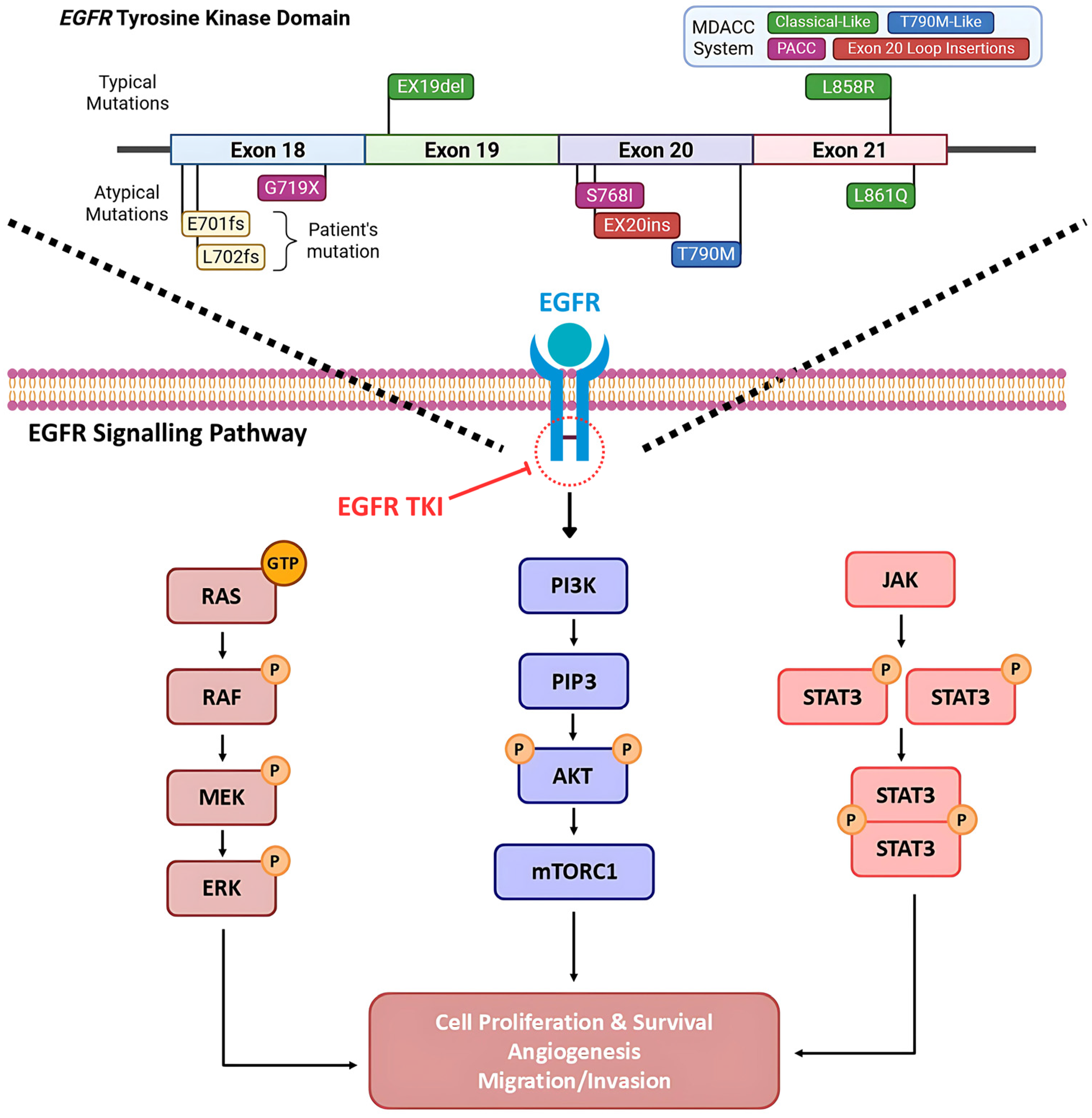
| Classical-Like | T790M-Like | Exon 20 Loop Insertion | PACC |
|---|---|---|---|
| L858R | TS90M-3S | Ex20ins-NL | Primary |
| Exon19dels | Classical/T790M | S768dupSVD | G719X |
| S720P | G719X/T790M | A767dupASV | S768I |
| L861Q/R | L747_K745del insATSPE | D770insNPG | L747P/S |
| S811F | S768I/T790M | D770del ins-GY | V769L |
| K754E | T790M-3R | Ex20ins-FL | E709_T710 delinsD |
| T725M | Ex19del/T790M/L792H | H773insNPH | Acquired |
| L833F/V | L858R/T790M/L718X | H773dupH | C797S |
| A763insFQEA | Classical/T790M/C797S | V774insAV | L792H |
| A763insLQEA | V774insPR | G724S | |
| L718X | |||
| T854I |
| Key Laboratory Parameters | At Baseline 15 August 2024 | Before Starting Osimertinib 6 November 2024 | Recent Follow-Up 5 September 2025 |
|---|---|---|---|
| LKC (×109/L) (NR: 4.0–10.0) | 11.7 | 7.2 | 8.1 |
| ERC (×1012/L) (NR: 4.50–6.50) | 4.74 | 4.45 | 4.67 |
| Hemoglobin (g/L) (NR: 135–170) | 135 | 139 | 126 |
| Thrombocytes (×109/L) (NR: 150–400) | 276 | 345 | 203 |
| Neutrophil (×109/L) (NR: 2.0–7.5) | 8.2 | 3.8 | 4.7 |
| Lymphocyte (×109/L) (NR: 1.0–4.0) | 2.3 | 2.2 | 2.4 |
| Monocyte (×109/L) (NR: 0.2–0.8) | 0.7 | 1.0 | 0.7 |
| Serum CA 19–9 (U/mL) (NR: ≤34) | 17 | 19 | 18 |
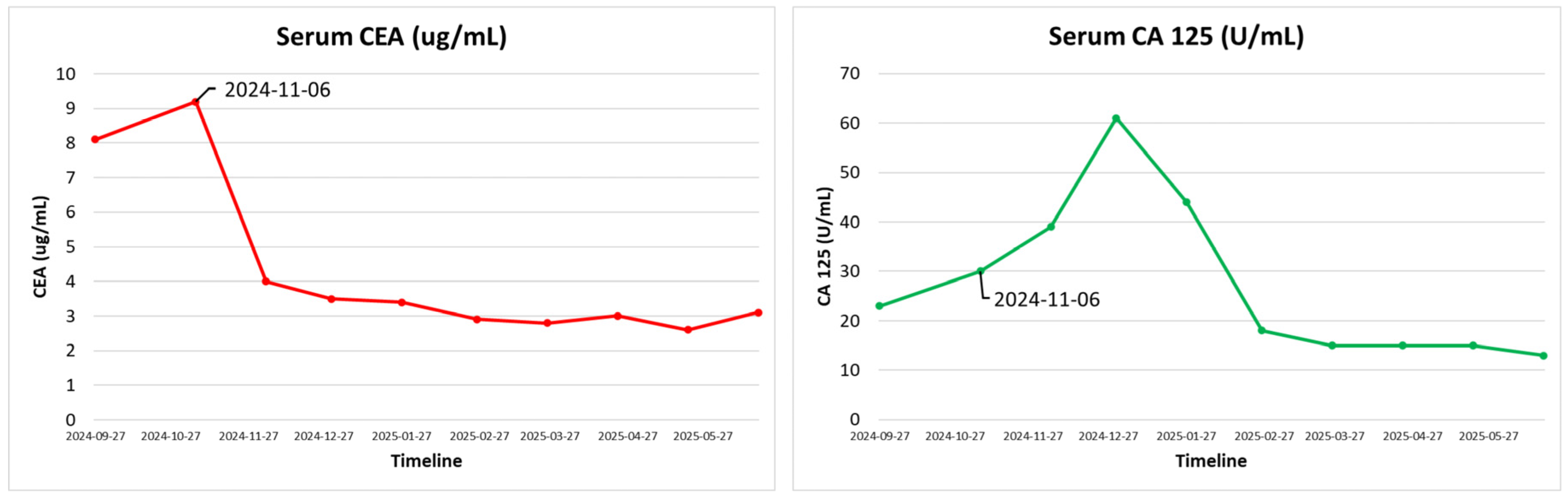
| Serum CEA (ug/L) (NR: ≤5.0) | 8.1 | 9.2 | 3.1 |
| Serum CA 125 (U/mL) (NR: ≤35) | 23 | 30 | 13 |
| ALT (U/L) (NR: <51) | 7 | 5 | 6 |
| AST (U/L) (NR: <51) | 12 | 13 | 12 |
| ALP (U/L) (NR: 40–129) | 263 | 175 | 77 |
| Serum LD (U/L) (NR: ≤225) | 144 | 181 | 196 |
| Sodium (mmol/L) (NR: 135–145) | 136 | 137 | 135 |
| Potassium (mmol/L) (NR: 3.50–5.00) | 4.4 | 4.7 | 4.6 |
| Albumin (g/L) (NR: 35–52) | 34 | 32 | 40 |
| Calcium (mmol/L) (NR: 1.06–1/29) | 2.05 | 2.08 | 2.19 |
| Creatinine (umol/L) (NR: ≤130) | 79 | 99 | 109 |
Disclaimer/Publisher’s Note: The statements, opinions and data contained in all publications are solely those of the individual author(s) and contributor(s) and not of MDPI and/or the editor(s). MDPI and/or the editor(s) disclaim responsibility for any injury to people or property resulting from any ideas, methods, instructions or products referred to in the content. |
© 2026 by the authors. Licensee MDPI, Basel, Switzerland. This article is an open access article distributed under the terms and conditions of the Creative Commons Attribution (CC BY) license.
Share and Cite
Wong, A.K.Q.; Khan, S.R.; Hadi, D.K.; Breadner, D.; Vincent, M.D. Targeting the Uncommon: A Case Report of Osimertinib Response in Advanced NSCLC Patient with Dual EGFR (E701fs and L702fs) Frameshift Deletions. Curr. Oncol. 2026, 33, 55. https://doi.org/10.3390/curroncol33010055
Wong AKQ, Khan SR, Hadi DK, Breadner D, Vincent MD. Targeting the Uncommon: A Case Report of Osimertinib Response in Advanced NSCLC Patient with Dual EGFR (E701fs and L702fs) Frameshift Deletions. Current Oncology. 2026; 33(1):55. https://doi.org/10.3390/curroncol33010055
Chicago/Turabian StyleWong, Angel Kwan Qi, Saqib Raza Khan, Danial Khan Hadi, Daniel Breadner, and Mark David Vincent. 2026. "Targeting the Uncommon: A Case Report of Osimertinib Response in Advanced NSCLC Patient with Dual EGFR (E701fs and L702fs) Frameshift Deletions" Current Oncology 33, no. 1: 55. https://doi.org/10.3390/curroncol33010055
APA StyleWong, A. K. Q., Khan, S. R., Hadi, D. K., Breadner, D., & Vincent, M. D. (2026). Targeting the Uncommon: A Case Report of Osimertinib Response in Advanced NSCLC Patient with Dual EGFR (E701fs and L702fs) Frameshift Deletions. Current Oncology, 33(1), 55. https://doi.org/10.3390/curroncol33010055