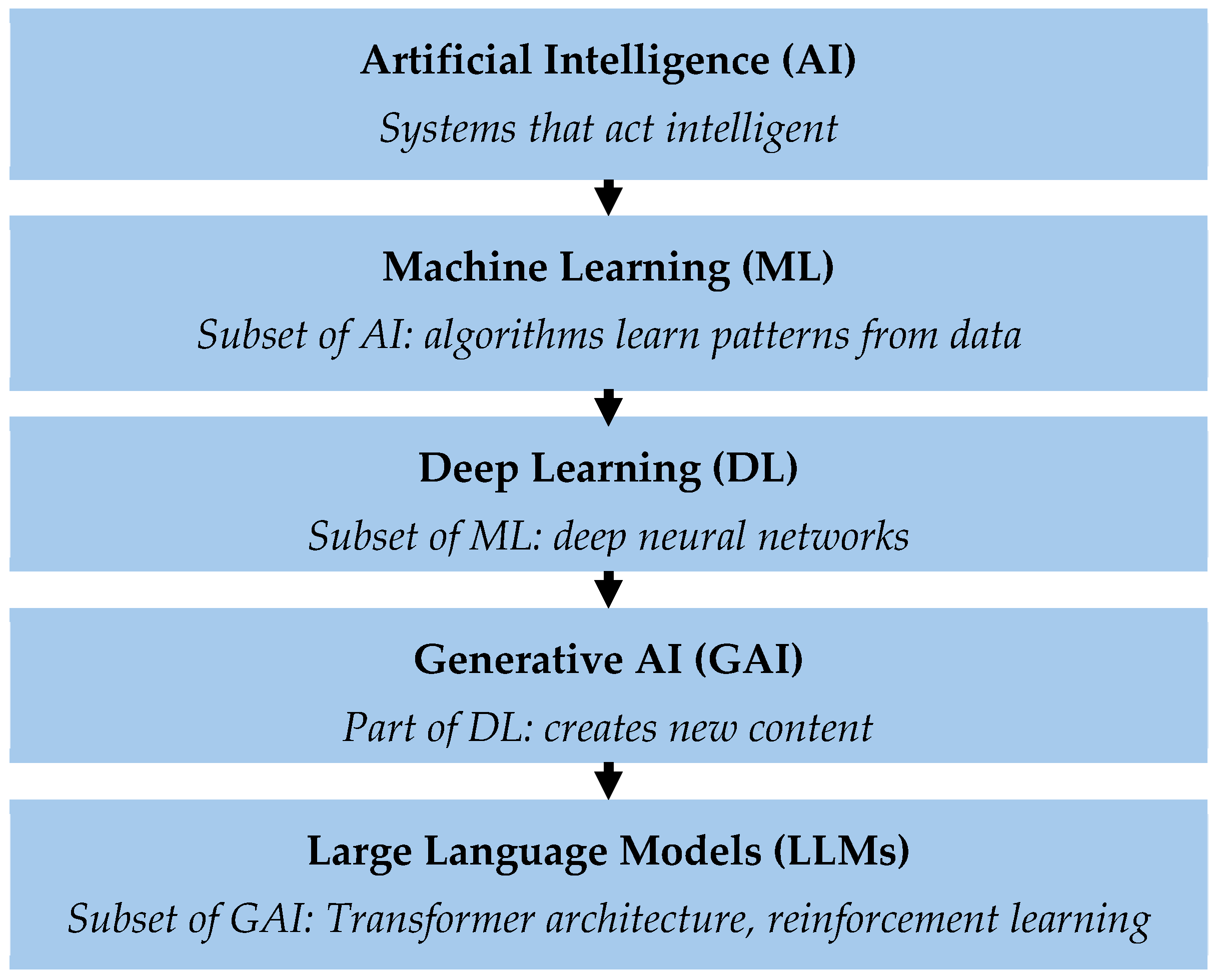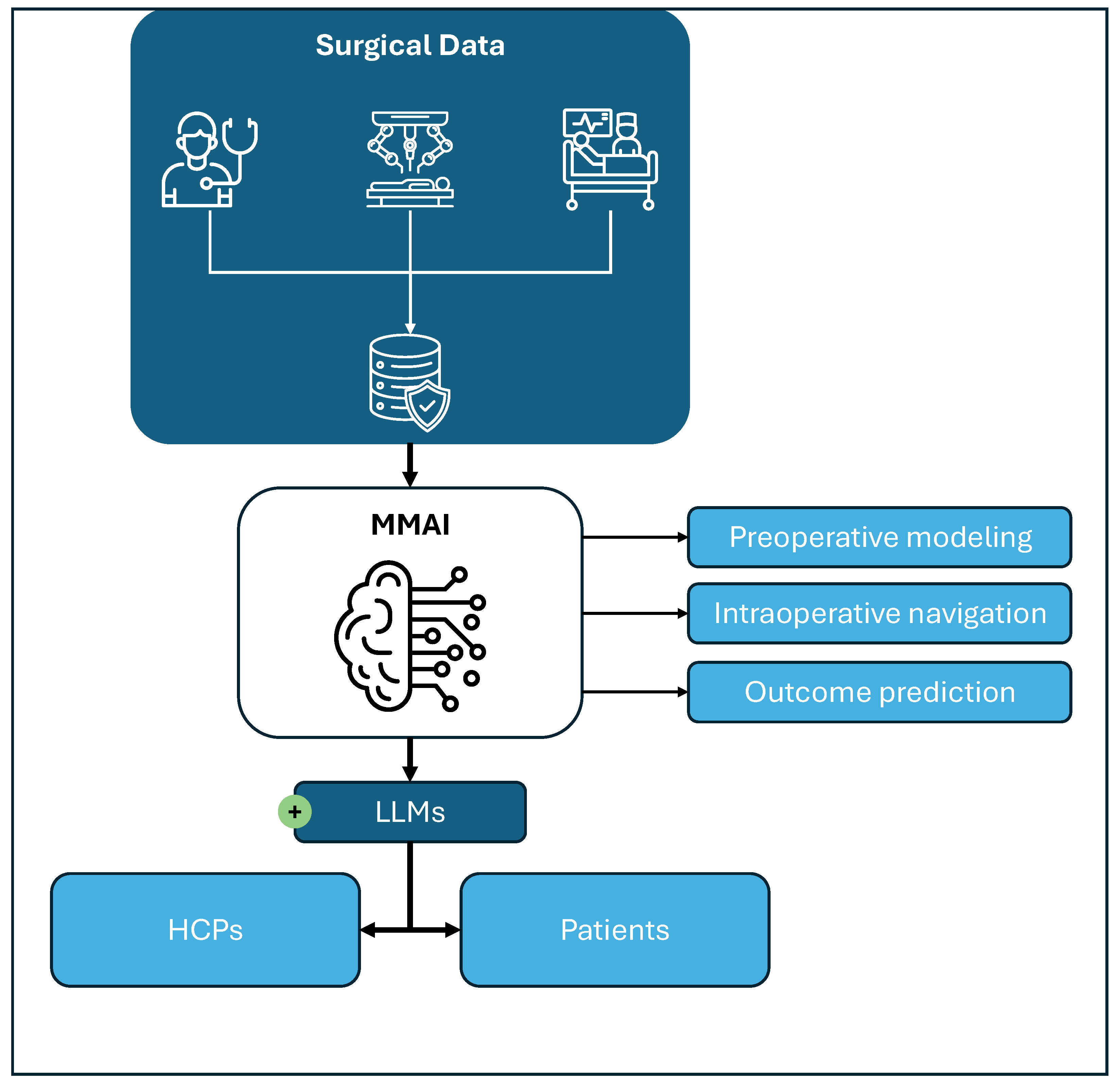
The Emerging Role of Multimodal Artificial Intelligence in Urological Surgery

 , , ,
, , ,
Simple Summary
Abstract
1. Introduction
Literature Search and Selection
2. Technological Background
3. Perioperative Applications of MMAI in Uro-Oncological Surgery
3.1. Preoperative
3.2. Intraoperative
3.3. Postoperative
3.4. MMAI in Urological Training
4. Future Directions: Risks, Opportunities and Integration into Robotic Platforms
5. Conclusions
Author Contributions
Funding
Institutional Review Board Statement
Informed Consent Statement
Data Availability Statement
Acknowledgments
Conflicts of Interest
Abbreviations
| AI | Artificial Intelligence |
| MMAI | Multimodal Artificial Intelligence |
| RARP | Robotic-Assisted Radical Prostatectomy |
| RC | Radical Cystectomy |
| PN | Partial Nephrectomy |
| ML | Machine Learning |
| DL | Deep Learning |
| GAI | Generative Artificial Intelligence |
| NLP | Natural Language Processing |
| LLM | Large Language Model |
| RLHF | Reinforcement Learning with Human Feedback |
| HER | Electronic Health Record |
| HCP | Healthcare Professionals |
| CT | Computed Tomography |
| MRI | Magnetic Resonance imaging |
| PET | Positron Emission Tomography |
| PSMA | Prostate-Specific Membrane Antigen |
| mpMRI | multiparametric MRI |
| lncRNA | long non-coding RNA |
| 3D | Three-Dimensional |
| AR | Augmented Reality |
| CLM | Confocal Laser Microscopy |
| VR | Virtual Reality |
| API | Application Programming Interface |
References
- Bhandari, M.; Zeffiro, T.; Reddiboina, M. Artificial Intelligence and Robotic Surgery: Current Perspective and Future Directions. Curr. Opin. Urol. 2020, 30, 48–54. [Google Scholar] [CrossRef] [PubMed]
- Kitaguchi, D.; Takeshita, N.; Hasegawa, H.; Ito, M. Artificial Intelligence-based Computer Vision in Surgery: Recent Advances and Future Perspectives. Ann. Gastroenterol. Surg. 2022, 6, 29–36. [Google Scholar] [CrossRef] [PubMed]
- Gögenur, I. Introducing Machine Learning-Based Prediction Models in the Perioperative Setting. Br. J. Surg. 2023, 110, 533–535. [Google Scholar] [CrossRef] [PubMed]
- Miller, B.T.; Fafaj, A.; Tastaldi, L.; Alkhatib, H.; Zolin, S.; AlMarzooqi, R.; Tu, C.; Alaedeen, D.; Prabhu, A.S.; Krpata, D.M.; et al. Capturing Surgical Data: Comparing a Quality Improvement Registry to Natural Language Processing and Manual Chart Review. J. Gastrointest. Surg. 2022, 26, 1490–1494. [Google Scholar] [CrossRef]
- Rodler, S.; Ganjavi, C.; De Backer, P.; Magoulianitis, V.; Ramacciotti, L.S.; De Castro Abreu, A.L.; Gill, I.S.; Cacciamani, G.E. Generative Artificial Intelligence in Surgery. Surgery 2024, 175, 1496–1502. [Google Scholar] [CrossRef]
- Kaczmarczyk, R.; Wilhelm, T.I.; Martin, R.; Roos, J. Evaluating Multimodal AI in Medical Diagnostics. Npj Digit. Med. 2024, 7, 205. [Google Scholar] [CrossRef]
- National Academy of Medicine. Generative Artificial Intelligence in Health and Medicine: Opportunities and Responsibilities for Transformative Innovation; The Learning Health System Series; Maddox, T., Babski, D., Embi, P., Gerhart, J., Goldsack, J., Parikh, R., Sarich, T., Krishnan, S., Elliott, A., Eds.; National Academies Press: Washington, DC, USA, 2025; p. 28907. ISBN 978-0-309-73369-4. [Google Scholar]
- Adam, G.P.; Davies, M.; George, J.; Caputo, E.; Htun, J.M.; Coppola, E.L.; Holmer, H.; Kuhn, E.; Wethington, H.; Ivlev, I.; et al. Machine Learning Tools To (Semi-)Automate Evidence Synthesis: A Rapid Review and Evidence Map; AHRQ Methods for Effective Health Care; Agency for Healthcare Research and Quality (US): Rockville, MD, USA, 2024. [Google Scholar]
- Briganti, G. A Clinician’s Guide to Large Language Models. Future Med. AI 2023, 1, 1–6. [Google Scholar] [CrossRef]
- Ong, J.C.L.; Jin, L.; Elangovan, K.; Lim, G.Y.S.; Lim, D.Y.Z.; Sng, G.G.R.; Ke, Y.H.; Tung, J.Y.M.; Zhong, R.J.; Koh, C.M.Y.; et al. Large Language Model as Clinical Decision Support System Augments Medication Safety in 16 Clinical Specialties. Cell Rep. Med. 2025, 6, 102323. [Google Scholar] [CrossRef]
- Zia, A.; Aziz, M.; Popa, I.; Khan, S.A.; Hamedani, A.F.; Asif, A.R. Artificial Intelligence-Based Medical Data Mining. J. Pers. Med. 2022, 12, 1359. [Google Scholar] [CrossRef]
- Whiting, D.; Bott, S.R. Current Diagnostics for Prostate Cancer. In Prostate Cancer; Bott, S.R., Lim Ng, K., Eds.; Exon Publications: Brisbane City, QLD, Australia, 2021; pp. 43–58. ISBN 978-0-6450017-5-4. [Google Scholar]
- Stammes, M.A.; Bugby, S.L.; Porta, T.; Pierzchalski, K.; Devling, T.; Otto, C.; Dijkstra, J.; Vahrmeijer, A.L.; De Geus-Oei, L.-F.; Mieog, J.S.D. Modalities for Image- and Molecular-Guided Cancer Surgery. Br. J. Surg. 2018, 105, e69–e83. [Google Scholar] [CrossRef]
- Mondal, S.B.; O’Brien, C.M.; Bishop, K.; Fields, R.C.; Margenthaler, J.A.; Achilefu, S. Repurposing Molecular Imaging and Sensing for Cancer Image–Guided Surgery. J. Nucl. Med. 2020, 61, 1113–1122. [Google Scholar] [CrossRef]
- KleinJan, G.H.; Van Gennep, E.J.; Postema, A.W.; Van Leeuwen, F.W.B.; Buckle, T. Hybrid Surgical Guidance in Urologic Robotic Oncological Surgery. J. Clin. Med. 2025, 14, 6128. [Google Scholar] [CrossRef] [PubMed]
- Handke, A.E.; Ritter, M.; Albers, P.; Noldus, J.; Radtke, J.P.; Krausewitz, P. Multiparametrische MRT und alternative Methoden in der Interventions- und Behandlungsplanung beim Prostatakarzinom. Urologie 2023, 62, 1160–1168. [Google Scholar] [CrossRef] [PubMed]
- Khizir, L.; Bhandari, V.; Kaloth, S.; Pfail, J.; Lichtbroun, B.; Yanamala, N.; Elsamra, S.E. From Diagnosis to Precision Surgery: The Transformative Role of Artificial Intelligence in Urologic Imaging. J. Endourol. 2024, 38, 824–835. [Google Scholar] [CrossRef] [PubMed]
- Nair, S.S.; Muhammad, H.; Jain, P.; Xie, C.; Pavlova, I.; Brody, R.; Huang, W.; Nakadar, M.; Zhang, X.; Basu, H.; et al. A Novel Artificial Intelligence–Powered Tool for Precise Risk Stratification of Prostate Cancer Progression in Patients with Clinical Intermediate Risk. Eur. Urol. 2025, 87, 728–729. [Google Scholar] [CrossRef]
- Mobadersany, P.; Tian, S.K.; Yip, S.S.F.; Greshock, J.; Khan, N.; Yu, M.K.; McCarthy, S.; Brookman-May, S.D.; Muhammad, H.; Xie, C.; et al. AI-Enabled Analysis of H&E-Stained Prostate Cancer Tissue Images: Assessing Risk for Metastasis Prior to Apalutamide (APA) Treatment of Patients with Non-Metastatic Castration-Resistant Prostate Cancer (nmCRPC). J. Clin. Oncol. 2023, 41, 5027. [Google Scholar] [CrossRef]
- Huang, W.; Randhawa, R.; Jain, P.; Iczkowski, K.A.; Hu, R.; Hubbard, S.; Eickhoff, J.; Basu, H.; Roy, R. Development and Validation of an Artificial Intelligence–Powered Platform for Prostate Cancer Grading and Quantification. JAMA Netw. Open 2021, 4, e2132554. [Google Scholar] [CrossRef]
- Huang, K.-B.; Gui, C.-P.; Xu, Y.-Z.; Li, X.-S.; Zhao, H.-W.; Cao, J.-Z.; Chen, Y.-H.; Pan, Y.-H.; Liao, B.; Cao, Y.; et al. A Multi-Classifier System Integrated by Clinico-Histology-Genomic Analysis for Predicting Recurrence of Papillary Renal Cell Carcinoma. Nat. Commun. 2024, 15, 6215. [Google Scholar] [CrossRef]
- Zhang, B.; Li, S.; Jian, J.; Ren, X.; Zhao, Z.; Guo, L.; Su, F.; Meng, Z.; Zhao, Z. From Single-Cancer to Pan-Cancer Prognosis. Am. J. Pathol. 2025, 195, 1869–1884. [Google Scholar] [CrossRef]
- Ning, Z.; Pan, W.; Chen, Y.; Xiao, Q.; Zhang, X.; Luo, J.; Wang, J.; Zhang, Y. Integrative Analysis of Cross-Modal Features for the Prognosis Prediction of Clear Cell Renal Cell Carcinoma. Bioinformatics 2020, 36, 2888–2895. [Google Scholar] [CrossRef]
- Zhang, B.; Wan, Z.; Luo, Y.; Zhao, X.; Samayoa, J.; Zhao, W.; Wu, S. Multimodal Integration Strategies for Clinical Application in Oncology. Front. Pharmacol. 2025, 16, 1609079. [Google Scholar] [CrossRef] [PubMed]
- Rivero Belenchón, I.; Congregado Ruíz, C.B.; Gómez Ciriza, G.; Gómez Dos Santos, V.; Burgos Revilla, F.J.; Medina López, R.A. Impact of 3D-Printed Models for Surgical Planning in Renal Cell Carcinoma With Venous Tumor Thrombus: A Randomized Multicenter Clinical Trial. J. Urol. 2025, 213, 568–580. [Google Scholar] [CrossRef] [PubMed]
- Stolzenburg, J.-U.; Holze, S.; Dietel, A.; Franz, T.; Thi, P.H.; Trebst, D.; Köppe-Bauernfeind, N.; Bačák, M.; Spinos, T.; Liatsikos, E.; et al. Use of Interactive Three-Dimensional Modeling for Partial Nephrectomy in the 3DPN Study. Eur. Urol. Focus 2025, 11, 8–10. [Google Scholar] [CrossRef] [PubMed]
- De Groote, R.; Vangeneugden, J.; De Backer, P.; Mottrie, A. Use of Interactive Three-Dimensional Models in Partial Nephrectomy: For, but Critical Evaluation Is Key. Eur. Urol. Focus 2025, 11, 37–39. [Google Scholar] [CrossRef]
- Schiavina, R.; Bianchi, L.; Lodi, S.; Cercenelli, L.; Chessa, F.; Bortolani, B.; Gaudiano, C.; Casablanca, C.; Droghetti, M.; Porreca, A.; et al. Real-Time Augmented Reality Three-Dimensional Guided Robotic Radical Prostatectomy: Preliminary Experience and Evaluation of the Impact on Surgical Planning. Eur. Urol. Focus 2021, 7, 1260–1267. [Google Scholar] [CrossRef]
- The ESUT Research Group; Porpiglia, F.; Bertolo, R.; Checcucci, E.; Amparore, D.; Autorino, R.; Dasgupta, P.; Wiklund, P.; Tewari, A.; Liatsikos, E.; et al. Development and Validation of 3D Printed Virtual Models for Robot-Assisted Radical Prostatectomy and Partial Nephrectomy: Urologists’ and Patients’ Perception. World J. Urol. 2018, 36, 201–207. [Google Scholar] [CrossRef]
- Engesser, C.; Brantner, P.; Gahl, B.; Walter, M.; Gehweiler, J.; Seifert, H.; Subotic, S.; Rentsch, C.; Wetterauer, C.; Bubendorf, L.; et al. 3D -printed Model for Resection of Positive Surgical Margins in Robot-assisted Prostatectomy. BJU Int. 2025, 135, 657–667. [Google Scholar] [CrossRef]
- Mei, H.; Yang, R.; Huang, J.; Jiao, P.; Liu, X.; Chen, Z.; Chen, H.; Zheng, Q. Artificial Intelligence-Assisted Segmentation of Prostate Tumors and Neurovascular Bundles: Applications in Precision Surgery for Prostate Cancer. Ann. Surg. Oncol. 2025, 32, 9391–9399. [Google Scholar] [CrossRef]
- Tempany, C.M.C.; Jayender, J.; Kapur, T.; Bueno, R.; Golby, A.; Agar, N.; Jolesz, F.A. Multimodal Imaging for Improved Diagnosis and Treatment of Cancers. Cancer 2015, 121, 817–827. [Google Scholar] [CrossRef]
- Xi, L.; Jiang, H. Image-guided Surgery Using Multimodality Strategy and Molecular Probes. WIREs Nanomed. Nanobiotechnol. 2016, 8, 46–60. [Google Scholar] [CrossRef]
- Ardic, N.; Dinc, R. Emerging Trends in Multi-Modal Artificial Intelligence for Clinical Decision Support: A Narrative Review. Health Inform. J. 2025, 31, 14604582251366141. [Google Scholar] [CrossRef] [PubMed]
- Meskó, B. The Impact of Multimodal Large Language Models on Health Care’s Future. J. Med. Internet Res. 2023, 25, e52865. [Google Scholar] [CrossRef] [PubMed]
- Mehta, N.; Benjamin, J.; Agrawal, A.; Valanci, S.; Masters, K.; MacNeill, H. Addressing Educational Overload with Generative AI through Dual Coding and Cognitive Load Theories. Med. Teach. 2025, 1–3. [Google Scholar] [CrossRef] [PubMed]
- Hershenhouse, J.S.; Mokhtar, D.; Eppler, M.B.; Rodler, S.; Storino Ramacciotti, L.; Ganjavi, C.; Hom, B.; Davis, R.J.; Tran, J.; Russo, G.I.; et al. Accuracy, Readability, and Understandability of Large Language Models for Prostate Cancer Information to the Public. Prostate Cancer Prostatic Dis. 2025, 28, 394–399. [Google Scholar] [CrossRef]
- Rodler, S.; Cei, F.; Ganjavi, C.; Checcucci, E.; De Backer, P.; Rivero Belenchon, I.; Taratkin, M.; Puliatti, S.; Veccia, A.; Piazza, P.; et al. GPT-4 Generates Accurate and Readable Patient Education Materials Aligned with Current Oncological Guidelines: A Randomized Assessment. PLoS ONE 2025, 20, e0324175. [Google Scholar] [CrossRef]
- Ihsan, M.Z.; Apriatama, D.; Amalia, R. AI-Assisted Patient Education: Challenges and Solutions in Pediatric Kidney Transplantation. Patient Educ. Couns. 2025, 131, 108575. [Google Scholar] [CrossRef]
- Bellos, T.; Manolitsis, I.; Katsimperis, S.; Juliebø-Jones, P.; Feretzakis, G.; Mitsogiannis, I.; Varkarakis, I.; Somani, B.K.; Tzelves, L. Artificial Intelligence in Urologic Robotic Oncologic Surgery: A Narrative Review. Cancers 2024, 16, 1775. [Google Scholar] [CrossRef]
- Vercauteren, T.; Unberath, M.; Padoy, N.; Navab, N. CAI4CAI: The Rise of Contextual Artificial Intelligence in Computer-Assisted Interventions. Proc. IEEE 2020, 108, 198–214. [Google Scholar] [CrossRef]
- Van Den Berg, I.; Savenije, M.H.F.; Teunissen, F.R.; Van De Pol, S.M.G.; Rasing, M.J.A.; Van Melick, H.H.E.; Brink, W.M.; De Boer, J.C.J.; Van Den Berg, C.A.T.; Van Der Voort Van Zyp, J.R.N. Deep Learning for Automated Contouring of Neurovascular Structures on Magnetic Resonance Imaging for Prostate Cancer Patients. Phys. Imaging Radiat. Oncol. 2023, 26, 100453. [Google Scholar] [CrossRef]
- Sasaki, S.; Kitaguchi, D.; Noda, T.; Matsuzaki, H.; Hasegawa, H.; Takeshita, N.; Ito, M. Deep Learning-Based Vessel and Nerve Recognition Model for Lateral Lymph Node Dissection: A Retrospective Feasibility Study. Langenbecks Arch. Surg. 2025, 410, 310. [Google Scholar] [CrossRef]
- Jiao, P.; Wu, S.; Yang, R.; Ni, X.; Wu, J.; Wang, K.; Liu, X.; Chen, Z.; Zheng, Q. Deep Learning Predicts Lymphovascular Invasion Status in Muscle Invasive Bladder Cancer Histopathology. Ann. Surg. Oncol. 2025, 32, 598–608. [Google Scholar] [CrossRef]
- Baas, D.J.H.; Vreuls, W.; Sedelaar, J.P.M.; Vrijhof, H.J.E.J.; Hoekstra, R.J.; Zomer, S.F.; Van Leenders, G.J.L.H.; Van Basten, J.A.; Somford, D.M. Confocal Laser Microscopy for Assessment of Surgical Margins during Radical Prostatectomy. BJU Int. 2023, 132, 40–46. [Google Scholar] [CrossRef]
- Ukimura, O.; Gill, I.S. Imaging-Assisted Endoscopic Surgery: Cleveland Clinic Experience. J. Endourol. 2008, 22, 803–810. [Google Scholar] [CrossRef] [PubMed]
- Shi, X.; Yang, B.; Guo, F.; Zhi, C.; Xiao, G.; Zhao, L.; Wang, Y.; Zhang, W.; Xiao, C.; Wu, Z.; et al. Artificial Intelligence Based Augmented Reality Navigation in Minimally Invasive Partial Nephrectomy. Urology 2025, 199, 20–26. [Google Scholar] [CrossRef] [PubMed]
- Yuan, K.; Srivastav, V.; Yu, T.; Lavanchy, J.L.; Marescaux, J.; Mascagni, P.; Navab, N.; Padoy, N. Learning Multi-Modal Representations by Watching Hundreds of Surgical Video Lectures. Med. Image Anal. 2025, 105, 103644. [Google Scholar] [CrossRef] [PubMed]
- Zeng, Z.; Zhuo, Z.; Jia, X.; Zhang, E.; Wu, J.; Zhang, J.; Wang, Y.; Low, C.H.; Jiang, J.; Zheng, Z.; et al. SurgVLM: A Large Vision-Language Model and Systematic Evaluation Benchmark for Surgical Intelligence. arXiv 2025, arXiv:2506.02555. [Google Scholar]
- Zaffino, P.; Moccia, S.; De Momi, E.; Spadea, M.F. A Review on Advances in Intra-Operative Imaging for Surgery and Therapy: Imagining the Operating Room of the Future. Ann. Biomed. Eng. 2020, 48, 2171–2191. [Google Scholar] [CrossRef]
- Shkolyar, E.; Jia, X.; Chang, T.C.; Trivedi, D.; Mach, K.E.; Meng, M.Q.-H.; Xing, L.; Liao, J.C. Augmented Bladder Tumor Detection Using Deep Learning. Eur. Urol. 2019, 76, 714–718. [Google Scholar] [CrossRef]
- Oliva Maza, L.; Steidle, F.; Klodmann, J.; Strobl, K.; Triebel, R. An ORB-SLAM3-Based Approach for Surgical Navigation in Ureteroscopy. Comput. Methods Biomech. Biomed. Eng. Imaging Vis. 2023, 11, 1005–1011. [Google Scholar] [CrossRef]
- Zhao, X.; Takenaka, S.; Iuchi, S.; Kitaguchi, D.; Wakabayashi, M.; Sato, K.; Arakaki, S.; Sasaki, K.; Kosugi, N.; Takeshita, N.; et al. Automatic Recognition of Surgical Phase of Robot-Assisted Radical Prostatectomy Based on Artificial Intelligence Deep-Learning Model and Its Application in Surgical Skill Evaluation: A Joint Study of 18 Medical Education Centers. Surg. Endosc. 2025, 39, 5623–5635. [Google Scholar] [CrossRef]
- Barallat, J.; Gómez, C.; Sancho-Cerro, A. AI, Diabetes and Getting Lost in Translation: A Multilingual Evaluation of Bing with ChatGPT Focused in HbA1c. Clin. Chem. Lab. Med. CCLM 2023, 61, e222–e224. [Google Scholar] [CrossRef]
- Abdelhady, A.M.; Davis, C.R. Plastic Surgery and Artificial Intelligence: How ChatGPT Improved Operation Note Accuracy, Time, and Education. Mayo Clin. Proc. Digit. Health 2023, 1, 299–308. [Google Scholar] [CrossRef]
- Hack, S.; Attal, R.; Locatelli, G.; Scotta, G.; Maniaci, A.; Parisi, F.M.; Van Der Poel, N.; Van Daele, M.; Garcia-Lliberos, A.; Rodriguez-Prado, C.; et al. Surgeon, Trainee, or GPT ? A Blinded Multicentric Study of AI -Augmented Operative Notes. Laryngoscope 2025, 1–11. [Google Scholar] [CrossRef]
- Froń, A.; Semianiuk, A.; Lazuk, U.; Ptaszkowski, K.; Siennicka, A.; Lemiński, A.; Krajewski, W.; Szydełko, T.; Małkiewicz, B. Artificial Intelligence in Urooncology: What We Have and What We Expect. Cancers 2023, 15, 4282. [Google Scholar] [CrossRef] [PubMed]
- Lipkova, J.; Chen, R.J.; Chen, B.; Lu, M.Y.; Barbieri, M.; Shao, D.; Vaidya, A.J.; Chen, C.; Zhuang, L.; Williamson, D.F.K.; et al. Artificial Intelligence for Multimodal Data Integration in Oncology. Cancer Cell 2022, 40, 1095–1110. [Google Scholar] [CrossRef] [PubMed]
- Tai-Seale, M.; Dillon, E.C.; Yang, Y.; Nordgren, R.; Steinberg, R.L.; Nauenberg, T.; Lee, T.C.; Meehan, A.; Li, J.; Chan, A.S.; et al. Physicians’ Well-Being Linked To In-Basket Messages Generated By Algorithms In Electronic Health Records. Health Aff. 2019, 38, 1073–1078. [Google Scholar] [CrossRef] [PubMed]
- Ayers, J.W.; Poliak, A.; Dredze, M.; Leas, E.C.; Zhu, Z.; Kelley, J.B.; Faix, D.J.; Goodman, A.M.; Longhurst, C.A.; Hogarth, M.; et al. Comparing Physician and Artificial Intelligence Chatbot Responses to Patient Questions Posted to a Public Social Media Forum. JAMA Intern. Med. 2023, 183, 589–596. [Google Scholar] [CrossRef]
- Zaidat, B.; Lahoti, Y.S.; Yu, A.; Mohamed, K.S.; Cho, S.K.; Kim, J.S. Artificially Intelligent Billing in Spine Surgery: An Analysis of a Large Language Model. Glob. Spine J. 2025, 15, 1113–1120. [Google Scholar] [CrossRef]
- Goldenberg, M.G. Surgical Artificial Intelligence in Urology. Urol. Clin. N. Am. 2024, 51, 105–115. [Google Scholar] [CrossRef]
- Nedbal, C.; Gauhar, V.; Herrmann, T.; Singh, A.; Talyshinskii, A.; Al Jaafari, F.; Somani, B.K. Simulation-Based Training in Minimally Invasive Surgical Therapies (MIST): Current Evidence and Future Directions for Artificial Intelligence Integration—A Systematic Review by EAU Endourology. World J. Urol. 2025, 43, 448. [Google Scholar] [CrossRef]
- Aurello, P.; Pace, M.; Goglia, M.; Pavone, M.; Petrucciani, N.; Carrano, F.M.; Cicolani, A.; Chiarini, L.; Silecchia, G.; D’Andrea, V. Enhancing Surgical Education Through Artificial Intelligence in the Era of Digital Surgery. Am. Surg. 2025, 91, 1942–1948. [Google Scholar] [CrossRef]
- Vedula, S.S.; Ghazi, A.; Collins, J.W.; Pugh, C.; Stefanidis, D.; Meireles, O.; Hung, A.J.; Schwaitzberg, S.; Levy, J.S.; Sachdeva, A.K.; et al. Artificial Intelligence Methods and Artificial Intelligence-Enabled Metrics for Surgical Education: A Multidisciplinary Consensus. J. Am. Coll. Surg. 2022, 234, 1181–1192. [Google Scholar] [CrossRef]
- Hadjichristidis, C.; Geipel, J.; Keysar, B. The Influence of Native Language in Shaping Judgment and Choice. In Progress in Brain Research; Elsevier: Amsterdam, The Netherlands, 2019; Volume 247, pp. 253–272. ISBN 978-0-444-64252-3. [Google Scholar]
- Gupta, N.; Khatri, K.; Malik, Y.; Lakhani, A.; Kanwal, A.; Aggarwal, S.; Dahuja, A. Exploring Prospects, Hurdles, and Road Ahead for Generative Artificial Intelligence in Orthopedic Education and Training. BMC Med. Educ. 2024, 24, 1544. [Google Scholar] [CrossRef]
- Rengers, T.A.; Thiels, C.A.; Salehinejad, H. Academic Surgery in the Era of Large Language Models: A Review. JAMA Surg. 2024, 159, 445. [Google Scholar] [CrossRef]
- Fahrner, L.J.; Chen, E.; Topol, E.; Rajpurkar, P. The Generative Era of Medical AI. Cell 2025, 188, 3648–3660. [Google Scholar] [CrossRef]
- Yang, Y.; Lin, M.; Zhao, H.; Peng, Y.; Huang, F.; Lu, Z. A Survey of Recent Methods for Addressing AI Fairness and Bias in Biomedicine. J. Biomed. Inform. 2024, 154, 104646. [Google Scholar] [CrossRef]
- Morris, J.X.; Campion, T.R.; Nutheti, S.L.; Peng, Y.; Raj, A.; Zabih, R.; Cole, C.L. DIRI: Adversarial Patient Reidentification with Large Language Models for Evaluating Clinical Text Anonymization. AMIA Jt. Summits Transl. Sci. Proc. AMIA Jt. Summits Transl. Sci. 2025, 2025, 355–364. [Google Scholar]
- Hou, J.; Cheng, X.; Liao, J.; Zhang, Z.; Wang, W. Ethical Concerns of AI in Healthcare: A Systematic Review of Qualitative Studies. Nurs. Ethics 2025, 09697330251385024. [Google Scholar] [CrossRef] [PubMed]
- Tang, F.; Liu, C.; Xu, Z.; Hu, M.; Huang, Z.; Xue, H.; Chen, Z.; Peng, Z.; Yang, Z.; Zhou, S.; et al. Seeing Far and Clearly: Mitigating Hallucinations in MLLMs with Attention Causal Decoding. In Proceedings of the 2025 IEEE/CVF Conference on Computer Vision and Pattern Recognition (CVPR), Nashville, TN, USA, 10 June 2025; pp. 26147–26159. [Google Scholar]
- Anh-Hoang, D.; Tran, V.; Nguyen, L.-M. Survey and Analysis of Hallucinations in Large Language Models: Attribution to Prompting Strategies or Model Behavior. Front. Artif. Intell. 2025, 8, 1622292. [Google Scholar] [CrossRef] [PubMed]
- Loftus, T.J.; Tighe, P.J.; Filiberto, A.C.; Efron, P.A.; Brakenridge, S.C.; Mohr, A.M.; Rashidi, P.; Upchurch, G.R.; Bihorac, A. Artificial Intelligence and Surgical Decision-Making. JAMA Surg. 2020, 155, 148. [Google Scholar] [CrossRef] [PubMed]
- Arjomandi Rad, A.; Vardanyan, R.; Athanasiou, T.; Maessen, J.; Sardari Nia, P. The Ethical Considerations of Integrating Artificial Intelligence into Surgery: A Review. Interdiscip. Cardiovasc. Thorac. Surg. 2025, 40, ivae192. [Google Scholar] [CrossRef]
- Lee, A.; Baker, T.S.; Bederson, J.B.; Rapoport, B.I. Levels of Autonomy in FDA-Cleared Surgical Robots: A Systematic Review. Npj Digit. Med. 2024, 7, 103. [Google Scholar] [CrossRef]
- Cannoletta, D.; Gallioli, A.; Mazzone, E.; Gaya Sopena, J.M.; Territo, A.; Bello, F.D.; Casadevall, M.; Mas, L.; Mancon, S.; Diana, P.; et al. A Global Perspective on the Adoption of Different Robotic Platforms in Uro-Oncological Surgery. Eur. Urol. Focus 2025, 11, 22–25. [Google Scholar] [CrossRef]



| Perioperative Phase | Study | AI/Data Modality | Key Application | Quantitative Outcome/Metrics | Study Design |
|---|---|---|---|---|---|
| Preoperative | Nair et al. [18] | Deep Learning (Digital Pathology) | Risk stratification in prostate cancer | n = 176; HR for BCR: 4.35 (p < 0.001); HR for metastasis: 4.66 (p < 0.001) | Retrospective |
| Huang et al. [20] | Deep Learning | PCa grading (reduction of interobserver variability) | Interobserver agreement improved from 84.0% to 90.1% (p < 0.001); Weighted κ improved from 0.76 to 0.92 | Retrospective | |
| Stolzenburg et al. (3DPN) [26] | Interactive 3D Modeling | Surgical planning (rPN) | Ongoing RCT (Target N = 370); Primary endpoint: Reduction of total console time | RCT (Protocol/Update) | |
| Intraoperative | Shkolyar et al. [51] | Deep Learning | Bladder tumor detection (cystoscopy) | Sensitivity: 90.9%; Specificity: 98.6%; Detected 95% of tumors | Prospective Validation |
| Baas et al. [45] | Confocal Laser Microscopy | Real-time margin assessment (RARP) | Median analysis time: 8 min vs. 50 min for frozen section; Concordance with pathology: κ = 0.80 | Prospective Comparative | |
| Zhao et al. [53] | Deep Learning (Video/Phase Recognition) | Skill assessment (RARP) | Skill scoring system distinguished experts from novices with 86.2% accuracy | Multi-institutional Study | |
| Postoperative | Ayers et al. [60] | Generative AI (LLM) | Patient communication and medical advice | 78.6% preference for AI responses; 3.6× higher rating for quality and 9.8× higher for empathy | Cross-sectional Comparative |
Disclaimer/Publisher’s Note: The statements, opinions and data contained in all publications are solely those of the individual author(s) and contributor(s) and not of MDPI and/or the editor(s). MDPI and/or the editor(s) disclaim responsibility for any injury to people or property resulting from any ideas, methods, instructions or products referred to in the content. |
© 2025 by the authors. Licensee MDPI, Basel, Switzerland. This article is an open access article distributed under the terms and conditions of the Creative Commons Attribution (CC BY) license (https://creativecommons.org/licenses/by/4.0/).
Share and Cite
Buck, L.; Kohler, J.; Risch, J.; Incesu, R.-B.; Hügelmann, K.; Weiss, M.-L.; Weische, O.; Schließer, P.; von Knobloch, H.C.; Blessin, N.C.; et al. The Emerging Role of Multimodal Artificial Intelligence in Urological Surgery. Curr. Oncol. 2025, 32, 665. https://doi.org/10.3390/curroncol32120665
Buck L, Kohler J, Risch J, Incesu R-B, Hügelmann K, Weiss M-L, Weische O, Schließer P, von Knobloch HC, Blessin NC, et al. The Emerging Role of Multimodal Artificial Intelligence in Urological Surgery. Current Oncology. 2025; 32(12):665. https://doi.org/10.3390/curroncol32120665
Chicago/Turabian StyleBuck, Leonhard, Jakob Kohler, Julian Risch, Reha-Baris Incesu, Konrad Hügelmann, Marie-Luise Weiss, Oscar Weische, Patricia Schließer, Hans Christoph von Knobloch, Niclas C. Blessin, and et al. 2025. "The Emerging Role of Multimodal Artificial Intelligence in Urological Surgery" Current Oncology 32, no. 12: 665. https://doi.org/10.3390/curroncol32120665
APA StyleBuck, L., Kohler, J., Risch, J., Incesu, R.-B., Hügelmann, K., Weiss, M.-L., Weische, O., Schließer, P., von Knobloch, H. C., Blessin, N. C., Bach, T., Jarczyk, J., Nuhn, P., & Rodler, S. (2025). The Emerging Role of Multimodal Artificial Intelligence in Urological Surgery. Current Oncology, 32(12), 665. https://doi.org/10.3390/curroncol32120665