Review

Evolving Therapeutic Landscape of ROS1-Positive Non-Small Cell Lung Cancer: An Updated Review


1
Department of Medical Oncology, Institut de Cancérologie Strasbourg Europe, F-67200 Strasbourg, France
2
Service de Pneumologie, Hôpital Tenon, APHP, Inserm U955, IMRB, Université Paris-Est Créteil, F-94010 Créteil, France
3
Centre de Recherche Clinique, CHI Créteil, Inserm U955, IMRB, Université Paris-Est Créteil, F-94010 Créteil, France
*
Author to whom correspondence should be addressed.
Curr. Oncol. 2025, 32(11), 626; https://doi.org/10.3390/curroncol32110626
Submission received: 15 October 2025 / Revised: 3 November 2025 / Accepted: 4 November 2025 / Published: 6 November 2025

Simple Summary

Lung cancer is the leading cause of cancer-related death worldwide. Among the different types, a small group of patients has tumors driven by changes in the ROS1 gene. These cancers often spread to the brain and require treatments that can control the disease both in the body and the brain. The first drugs developed for ROS1-positive lung cancer, such as crizotinib, were effective but showed limitations over time, particularly with brain involvement and resistance. In recent years, several new medicines have been created to overcome these challenges. This article reviews the biology of ROS1-positive lung cancer. It provides an updated overview of the many treatments now available, including drugs that are more effective against resistance and that reach the brain more effectively. Understanding these advances is important for patients, doctors, and researchers, as they will shape future care and open new opportunities for clinical research.

Abstract

ROS1 gene rearrangements define a distinct molecular subtype of non-small cell lung cancer (NSCLC), occurring in approximately 2% of cases and frequently associated with younger age, non-smoker status, and a high incidence of brain metastases. The discovery of ROS1 as an oncogenic driver has led to the development of targeted tyrosine kinase inhibitors (TKIs). Crizotinib first demonstrated substantial clinical benefit, but its limitations, including poor central nervous system (CNS) penetration and acquired resistance, highlighted the need for next-generation inhibitors. Several agents have since been developed, including entrectinib, lorlatinib, repotrectinib, taletrectinib, and zidesamtinib, each offering improved intracranial (IC) activity and efficacy against resistance mutations, notably ROS1^G2032R. Despite these advances, optimal sequencing strategies remain undefined, and resistance ultimately emerges in most patients. This review provides an updated overview of ROS1 biology, diagnostic approaches, clinical outcomes with currently available TKIs, mechanisms of resistance, and ongoing challenges, emphasizing the rapidly evolving therapeutic landscape.

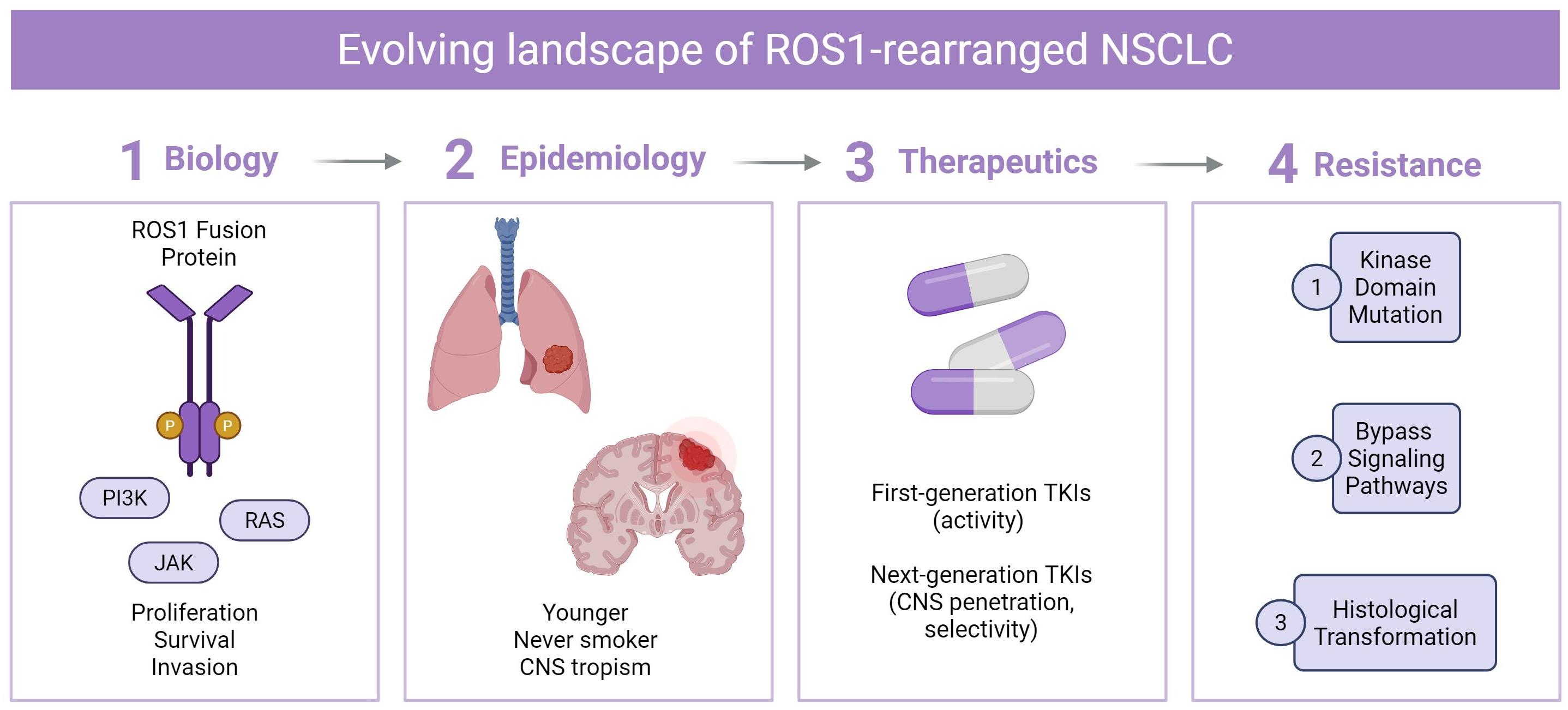
Graphical Abstract

1. Introduction

Lung cancer remains the leading cause of cancer-related mortality worldwide [1]. An increasing proportion of newly diagnosed cases occur in never-smokers, a trend likely linked to the declining prevalence of tobacco use [2]. Among the molecular alterations identified in this population and in the search for new targetable oncogenic drivers following the success of tyrosine kinase inhibitors (TKIs) against EGFR, a chromosomal translocation involving the ROS1 gene has been identified in the oncogenesis of lung cancer [3]. These fusions activate key oncogenic pathways and are associated with a higher incidence of brain metastases (BMs), highlighting the need for targeted therapies with both systemic and intracranial efficacy. Following the initial success of crizotinib, several next-generation ROS1 inhibitors have been developed to overcome resistance mutations and central nervous system (CNS) progression. This review is an update of the comprehensive review by Gendarme et al. [4], with a specific focus on the rapidly evolving therapeutic landscape of ROS1-positive non-small cell lung cancer (NSCLC).

2. ROS1 Biology

2.1. ROS1 Gene

ROS1 encodes an orphan receptor tyrosine kinase belonging to the insulin receptor superfamily. A chromosomal rearrangement involving ROS1 on chromosome 6 results in the formation of a constitutively active fusion protein that drives oncogenic transformation and activates downstream signaling pathways, including the MAPK, JAK/STAT, and PI3K cascades [5]. Phylogenetically, ROS1 is closely related to ALK, sharing 49% of its amino acid sequence [6].
The prevalence of ROS1 rearrangements is estimated to be approximately 2% in NSCLC [7,8]. Dozens of fusion partners have been identified, among which CD74, SLC34A2, EZR, and SDC4 are the most frequently reported [9]. The presence of a CD74–ROS1 fusion could be associated with prolonged survival outcomes compared with non-CD74–ROS1 rearrangements [10]. Co-mutations involving EGFR, ALK, or KRAS have been described but remain rare [11].

2.2. ROS1 Fusion Detection

ROS1 testing is recommended in all metastatic lung cancers, including mixed histologies where an adenocarcinoma component cannot be excluded, as well as in squamous-cell carcinomas occurring in never-smokers [12]. Screening for ROS1 fusions can be initiated using immunohistochemistry (IHC). All available ROS-1 antibody clones show high sensitivity (90–100%), while their specificity remains more variable (70–90%) [13]. Due to a high rate of false positives, particularly in acinar or lepidic NSCLC and in EGFR-mutated cases [14], any positive result must be confirmed by in situ hybridization (ISH) [12].
ISH remains the reference method, capable of detecting ROS1 rearrangements regardless of the fusion partner, although it does not allow partner identification. Reliable assessment requires sufficient tumor cellularity, and both false positives and false negatives may occur, especially with rare fusion variants. The technique remains costly and time-consuming. Dual ALK/ROS1 break-apart probe kits can reduce tissue requirements and allow testing on cytological samples [15]. A strategy combining IHC for initial screening and ISH for confirmation is considered the most efficient approach in terms of turnaround time, cost-effectiveness, and positive predictive value [16].
Molecular biology techniques such as reverse transcription PCR (RT-PCR) and next-generation sequencing (NGS) are increasingly being adopted, as they provide high sensitivity and can detect rare or novel fusions as well as other actionable alterations. However, RT-PCR is technically complex and prone to variability, and NGS—although comprehensive—remains limited in routine practice by its cost, longer turnaround time, and occasional discordance with IHC or ISH [12]. Finally, from a public payer perspective, systematic ROS1 testing has been demonstrated to be cost-effective [17].

3. Epidemiology

Compared to NSCLC without an oncogenic driver mutation, the prevalence of ROS1-mutated NSCLC is higher among women, younger patients, non-smokers, and Asian populations [8]. Adenocarcinomas are the predominant histological subtype. Clinically, 75–85% of patients present with metastatic disease at diagnosis [8,18], and BMs are already present at diagnosis in approximately 30% to 40% of cases [19]. Pericardial and lymph node metastases are also more frequently observed compared to other NSCLCs harboring oncogenic drivers [20]. Prognosis is particularly influenced by the development and progression of BMs, with a cumulative incidence reported as high as 75% [19].

4. Efficacy of Conventional Treatments

The efficacy of pemetrexed-based chemotherapy has been reported in patients with ROS1-rearranged tumors [21]. Compared to other oncogenic drivers such as ALK, EGFR, and KRAS, patients with ROS1 fusion–positive tumors exhibit higher overall response rates (ORR) and longer progression-free survival (PFS) when treated with pemetrexed-based regimens [22]. However, most available data come from studies using platinum-pemetrexed doublets, making it difficult to determine whether this benefit reflects intrinsic chemosensitivity or a specific sensitivity to pemetrexed. In the retrospective European EUROS1 cohort, the ORR to chemotherapy, predominantly pemetrexed-based, was 58%, with a median PFS of 7.2 months [23].
The efficacy of immune checkpoint inhibitors (ICIs) appears to be limited in patients harboring oncogenic drivers such as EGFR and ALK [24,25]. Data in ROS1-rearranged NSCLC are also limited and largely retrospective. Although some studies have reported clinical benefit with ICIs in ROS1-positive patients [26], the overall activity of ICI monotherapy remains modest in this setting, despite higher PD-L1 expression frequently observed in ROS1-rearranged tumors [27]. Chemo-immunotherapy combinations can achieve more meaningful responses (median time to treatment discontinuation 10 months, ORR 83%) [28]; however, this benefit is likely driven largely by the chemotherapy backbone rather than the immunotherapy component. Across retrospective series, findings remain inconsistent and limited by small sample sizes. Current guidelines recommend ROS1-directed TKIs as first-line therapy. Immunotherapy monotherapy is not recommended in ROS1-rearranged NSCLC, and chemo-immunotherapy is not specifically endorsed, with chemotherapy remaining the preferred option when targeted or local strategies are not appropriate.

5. Treatment of ROS-1-Positive NSCLCs

5.1. Crizotinib

Crizotinib is an oral TKI initially developed to target ALK and MET receptors, which was later found to also inhibit fusion proteins involving ROS1. Its efficacy in ROS1-rearranged NSCLC was primarily demonstrated in the PROFILE 1001 study, a phase I trial with a dedicated cohort expansion. In this cohort, which included 53 patients with advanced ROS1-positive NSCLC, crizotinib achieved an ORR of 72% (95% CI 58–83), including 6 complete responses and 32 partial responses [29]. Responses were rapid (median time to response, 7.9 weeks) and durable, with a median duration of response (DOR) of 24.7 months (95% CI 15.2–45.3). The median PFS was 19.3 months (95% CI 15.2–45.3), and the median overall survival (OS) was estimated at 51.4 (95% CI 29.3–not reached (NR)) months, with a 4-year survival probability of 51% [30]. These results were consistent across different fusion partners, suggesting that the clinical benefit of crizotinib is independent of the specific ROS1 rearrangement [30].
Treatment-related adverse events (AEs) were mostly grade 1 or 2, with the most frequent being visual disturbances (82%), nausea (40%), peripheral edema (40%), and diarrhea (44%). Grade ≥ 3 toxicities were rare, primarily hypophosphatemia and neutropenia. No AEs led to permanent treatment discontinuation, and no grade 4 or 5 events were reported.
The results of PROFILE 1001 were supported by other prospective studies. A phase II trial conducted in Asia involving 127 patients reported a similar ORR of 72% (95% CI 63–79) and a median PFS of 15.9 months [31]. A French study (AcSé) also demonstrated comparable activity (ORR 69.4%, 95% CI 53–82), although with a shorter median PFS of 5.5 (95% CI 4.2–9.1) months, likely reflecting poorer baseline performance status [32]. Similarly, the European phase II EUCROSS trial, which enrolled 34 patients, reported an ORR of 70% (95% CI 51–85) and a median PFS of 20 (95% CI 8–NR) months [33]. Consistent findings were also observed in the Italian METROS study [34].
Crizotinib thus established a new standard of care for patients with ROS1-rearranged NSCLC, leading to its approval by both the FDA and the EMA in 2016.

5.2. Entrectinib

Although crizotinib demonstrates systemic efficacy, it has limited penetration into the CNS and does not prevent CNS progression, which is common in ROS1-positive NSCLC. To address this limitation, entrectinib was developed as a TKI capable of crossing the blood–brain barrier, providing both systemic and intracranial activity. Entrectinib specifically targets ROS1, NTRK, and ALK and was designed to efficiently penetrate the blood–brain barrier [35].
In an updated integrated analysis of the ALKA-372-001, STARTRK-1, and STARTRK-2 trials, which included 168 TKI-naïve patients with advanced ROS1-positive NSCLC, entrectinib demonstrated durable systemic and intracranial efficacy [36]. The ORR was 68% (95% CI 60.2–74.8), including 13% complete responses, with a median DOR of 20.5 (95% CI 14.8–34.8) months and a median PFS of 15.7 (95% CI 12.0–21.1) months. The median OS was 47.8 (95% CI 44.1–NR) months, comparable to that reported with crizotinib [36]. Among patients with baseline BMs (n = 48), intracranial activity was notable, with an intracranial ORR of 80% (95% CI 59.3–93.2) among those with measurable disease, and a median intracranial DOR of 12.9 months (95% CI 7.1–22.1).
A specific cohort of patients who had developed isolated intracranial progression on crizotinib (n = 18) was also analyzed. In this setting, entrectinib demonstrated more modest efficacy, with a global ORR of 11% (95% CI 1.4–34.7), an intracranial ORR of 19% (95% CI 4.1–45.7), and a median PFS of 4.7 (95% CI 2.9–43.5) months, suggesting limited benefit after CNS progression on crizotinib, potentially due to underlying resistance mechanisms.
The safety profile of entrectinib was characterized by a distinct pattern of neurological adverse events, including dysgeusia, dizziness, and paresthesia, likely related to the inhibition of TRK family tyrosine kinase receptors involved in synaptic control and plasticity [37]. Metabolic toxicities, such as weight gain and elevated creatinine levels, were also observed but rarely led to treatment discontinuation.
Entrectinib subsequently became an approved treatment option for patients with ROS1-rearranged NSCLC, receiving FDA approval in 2019 and EMA approval in 2020, based on its demonstrated systemic and intracranial efficacy. A phase III trial (NCT04603807) is ongoing to compare entrectinib with crizotinib in a TKI-naïve population.

5.3. Ceritinib

Ceritinib is an oral TKI initially developed for patients with ALK-positive NSCLC but also demonstrated activity against ROS1 rearrangements due to the structural homology between these two kinases. Its efficacy was evaluated in a prospective multicenter Korean study [38] that included 32 patients with ROS1-positive NSCLC. Most patients (n = 30) were TKI-naïve but had received multiple lines of chemotherapy (median: 3 lines). The ORR was 62% (95% CI 45–77), with a median DOR of 21 (95% CI 17–25) months. Among crizotinib-naïve patients, the ORR reached 67% (95% CI 48–81), and the median PFS was 19.3 months (95% CI 1–37), figures comparable to those observed with crizotinib in the PROFILE 1001 study. The median OS in this population was 24 months (95% CI 5–43).
Regarding intracranial activity, data from this study remains limited but encouraging: among the eight patients with baseline BMs, a CNS disease control rate of 63% (95% CI 31–86) was observed, with two patients achieving an objective intracranial response. Although based on a small sample size, these findings suggest a degree of ceritinib efficacy in the CNS compartment, particularly in the absence of prior radiotherapy. These observations are supported by results from the ASCEND-1 and ASCEND-2 trials conducted in ALK-positive patients, where ceritinib demonstrated significant penetration across the blood–brain barrier [39].
In terms of safety, the most frequently observed AEs with ceritinib were gastrointestinal (diarrhea 85%, nausea 72%, vomiting 45%, anorexia 56%), predominantly grade 1–2. Dose reductions were required in 68% of patients, without major impact on treatment efficacy. However, the safety profile remains more challenging than that of newer-generation inhibitors, particularly with long-term use.
Ceritinib represents a therapeutic option for ROS1-positive NSCLC, especially in crizotinib-naïve patients. It shows systemic efficacy comparable to crizotinib and potential intracranial activity that warrants further confirmation, although its clinical development in this indication has been limited by the emergence of newer, more selective, and better-tolerated inhibitors. It is important to note that ceritinib does not have formal regulatory approval for ROS1-rearranged NSCLC in any region.

5.4. Lorlatinib

Lorlatinib is a novel generation oral TKI designed to selectively target ROS1 and ALK, with demonstrated ability to cross the blood–brain barrier by reducing the efflux mediated by P-glycoprotein-1. A prospective phase I/II study enrolled 69 patients with advanced ROS1-positive NSCLC, including 21 TKI-naïve patients and 40 patients previously treated with crizotinib [40]. Among TKI-naïve patients, the ORR was 62% (95% CI 38–82), with a median DOR of 25.3 (95% CI 7.5–31.9) months and a median PFS of 21.0 (95% CI 4.2–31.9) months. Notably, significant intracranial activity was also reported, with an intracranial ORR of 64% (95% CI 31–89) among patients with BMs at baseline [40].
In patients previously treated with crizotinib, lorlatinib demonstrated a more modest ORR (35%, 95% CI 21–52) but achieved durable responses (median DOR of 13.8 months, 95% CI 9.7–NR) and meaningful intracranial disease control (intracranial ORR of 50%, 95% CI 25–75). Interestingly, lorlatinib showed activity in some patients harboring secondary resistance mutations to crizotinib, notably ROS1^K1991E and ROS1^S1986F mutations, but exhibited limited efficacy against the commonly observed ROS1^G2032R mutation [40].
These findings were confirmed by a phase II study conducted in South Korea, dedicated to TKI-naïve ROS1-positive patients. Among the 32 patients enrolled, 66% of whom were receiving first-line treatment, the ORR reached 69% (95% CI 52–83), with a median PFS of 35.8 (95% CI NR–NR) months and an overall favorable safety profile [41].
The French real-world LORLATU study [42] provided complementary data on 80 patients treated with lorlatinib after at least one prior ROS1-targeted TKI. The ORR was 45% (95% CI not provided), with an intracranial ORR of 72% (95% CI not provided), a median PFS of 7.1 (95% CI 5.0–9.9) months, and a median OS of 19.6 (95% CI 12.3–27.5) months. Among patients with non-irradiated brain metastases, the median intracranial DOR reached 20.6 (95% CI 1.9–22.7) months. These results highlight the sustained efficacy of lorlatinib in a more heterogeneous, heavily pretreated, and real-world patient population.
The most common AEs associated with lorlatinib were neurocognitive (mood alterations, dizziness, mostly grade 1–2) and metabolic disorders, with grade 3–4 events such as hypertriglyceridemia and hypercholesterolemia also reported [40]. Treatment discontinuation due to AEs occurred in only 1% of patients in the pivotal trial [40], compared to 13% in the real-world LORLATU cohort [42].
Furthermore, mechanisms of resistance to lorlatinib have been explored in patients progressing under crizotinib or lorlatinib [43]. ROS1 mutations were identified in 38% of biopsies post-crizotinib and in 46% post-lorlatinib, with ROS1^G2032R being the most frequently observed. Novel mutations, such as ROS1^L2086F, either alone or in combination with G2032R or S1986F, were also identified following progression on lorlatinib. Preclinical models suggest that these mutations confer cross-resistance to crizotinib, entrectinib, and lorlatinib, while potentially retaining sensitivity to cabozantinib [44]. In addition, ROS1-independent resistance mechanisms have been described, including MET and KRAS amplifications as well as NRAS and MAP2K1 mutations [43].
Despite the demonstrated efficacy of lorlatinib, particularly against BMs and certain secondary mutations, resistance remains common, especially in the presence of ROS1^G2032R and ROS1^L2086F mutations. In this context, the development of next-generation inhibitors with optimized structures, such as repotrectinib, aims to overcome these resistance mechanisms.

5.5. Repotrectinib

Repotrectinib is a next-generation oral TKI designed to target ROS1, ALK, and NTRK rearrangements, including those associated with resistance mutations, notably solvent front substitutions such as ROS1^G2032R and D2033N. Its compact macrocyclic structure reduces steric hindrance and improves penetration into the CNS [45].
The clinical efficacy of repotrectinib was evaluated in the phase I/II TRIDENT-1 study [46], which enrolled 127 patients with advanced ROS1-rearranged NSCLC. Among ROS1 TKI-naïve patients (n = 71), the ORR was 79% (95% CI 68–88), with a median DOR of 34.1 months (95% CI 25.6–NR) and a median PFS of 35.7 months (95% CI 27.4–NR). Intracranial activity was also notable, with an intracranial response rate of 89% (95% CI 52–100) among patients with measurable BMs at baseline.
In patients previously treated with a ROS1-targeted TKI (n = 56), repotrectinib maintained meaningful activity, with an ORR of 38% (95% CI 25–52) and a median PFS of 9 months (95% CI 6.8–19.6). Notably, in a subset of 17 patients harboring the ROS1^G2032R resistance mutation, a response rate of 59% (95% CI 33–82) was observed, underscoring repotrectinib’s ability to overcome specific resistance mechanisms [46]. Preclinical data had already demonstrated the potent inhibitory activity of repotrectinib against ROS1^G2032R and D2033N mutations, outperforming lorlatinib and entrectinib in vitro [45].
In parallel, the safety profile was favorable, with most AEs being grade 1–2, predominantly dizziness (58%), dysgeusia (50%), and paresthesia (30%), leading to treatment discontinuation in 7% of cases [46]. Altogether, these findings position repotrectinib as a reference inhibitor for patients with ROS1-positive NSCLC, particularly in the presence of resistance mutations or CNS involvement, representing a major advance over first-generation inhibitors.
Repotrectinib received FDA approval in 2023 and conditional EMA approval in 2024, based on its demonstrated efficacy against resistance mutations and CNS metastases. A phase III trial (NCT06140836) is ongoing to compare repotrectinib with crizotinib in a TKI-naïve population.

5.6. Taletrectinib

Taletrectinib is a next-generation oral TKI, highly selective for ROS1, designed to overcome several limitations associated with first-generation inhibitors such as crizotinib and entrectinib: limited CNS penetration, neurological toxicity related to TRK inhibition, and inefficacy against certain resistance mutations, particularly ROS1^G2032R [47]. With a selectivity for ROS1 that is 11 to 20 times greater than for TRK, taletrectinib promises improved neurological tolerability and enhanced intracranial activity [47].
The recently published integrated analysis of the TRUST-I [48] and TRUST-II [47] trials evaluated the efficacy and safety of taletrectinib in 273 patients with ROS1-positive NSCLC [49,50]. Among TKI-naïve patients (n = 160), the confirmed ORR was 88.8% (95% CI 82.8–93.2), with a median DOR of 44.2 (95% CI 30.4–NR) months and a median PFS of 45.6 (95% CI 29.0–NR) months [50]. The intracranial ORR among patients with measurable BMs was 76.5% (95% CI 50.1–93.2), with a median intracranial DOR of 14.7 (95% CI 4.2–30.2) months [50].
In patients previously treated with a ROS1 TKI (n = 113, including 91% with crizotinib and 9% with entrectinib), the ORR was 55.8% (95% CI 46.1–65.1), with a median DOR of 16.6 (95% CI 10.6–27.3) months and a median PFS of 9.7 (95% CI 7.4–12.0) months [50]. Intracranial activity was also notable, with an intracranial ORR of 65.6% (95% CI 46.8–81.4). Among the 13 patients harboring the ROS1^G2032R resistance mutation, an objective response was observed in 8 patients (61.5%, 95% CI 31.6–86.1), confirming substantial activity against this frequent resistance mutation, comparable to that observed with repotrectinib [50].
The safety profile was overall favorable. The most common AEs were gastrointestinal in the first days (diarrhea 61% and nausea 44%) and biological (transaminase elevation 70%), predominantly grade 1. Neurological events (dizziness 21%, dysgeusia 15%) were infrequent and generally mild [47,48,50]. The rate of treatment discontinuation due to toxicity was 6.5% [50].
Comparison between and within Asian regional TRUST-I and global TRUST-II showed similar efficacy and safety profile across Asian and Western populations [51], confirming the broad applicability of taletrectinib’s clinical benefit. A phase III trial (NCT06564324, TRUST-III) is ongoing to compare taletrectinib with crizotinib in a TKI-naïve population. Nevertheless, the consolidated data from TRUST-I and TRUST-II already position taletrectinib as one of the most promising agents in the ROS1 inhibitor class, offering sustained efficacy, documented CNS penetration, activity against resistance mutations, and a favorable tolerability profile [50].

5.7. Zidesamtinib

Zidesamtinib (NVL-520) is a next-generation oral TKI specifically designed to overcome the limitations of previous TKIs in ROS1 fusion–positive cancers. It is distinguished by its unique triple pharmacological specificity: potent activity against ROS1 and its resistance mutations (notably G2032R), selective sparing of TRK kinases often implicated in neurological AEs, and excellent CNS penetration [52].
In preclinical studies, NVL-520 demonstrated subnanomolar inhibitory activity against wild-type ROS1 and retained remarkable potency against the ROS1^G2032R mutation (IC50 = 7.9 nM), outperforming crizotinib, entrectinib, lorlatinib, and even repotrectinib in this context [52]. This selectivity is attributed to its macrocyclic structure, which minimizes steric hindrance at the G2032R binding site while optimizing interactions with the ROS1 catalytic pocket, all while avoiding TRK kinase inhibition.
Early clinical results from the phase I/II ARROS-1 study, presented at ESMO 2024 [53] and WCLC 2025 (World Conference on Lung Cancer; 6–9 September 2025; Barcelona, Spain. Abstract 4540, not yet published), confirm these preclinical promises. Among the 117 efficacy-evaluable TKI-pretreated patients, the median number of prior therapies was 2, with half having received at least 2 prior ROS1 TKIs and 93% exposed to lorlatinib, repotrectinib, and/or taletrectinib. CNS involvement was present in 49% of patients. Durable responses were achieved even in patients with CNS disease, the ROS1^G2032R mutation, or multiple prior ROS1 TKIs. In this pretreated population, the ORR was 44% (95% CI 34–53) with a 12-month DOR rate of 78%. Patients who had only received crizotinib or entrectinib with or without chemotherapy (n = 55) achieved an ORR of 51% (95% CI 37–65) and an 18-month DOR rate of 93%. Preliminary results in TKI-naïve patients (n = 35) were particularly striking, with an ORR of 89% and a 12-month DOR rate of 96% (95% IC not provided). Intracranial activity was notable, with an IC-ORR of 83%, including four complete responses, and no CNS progression events at data cutoff.
Zidesamtinib was generally well tolerated, with the most common AEs being peripheral edema (36%), constipation (17%), creatine phosphokinase elevation (16%), fatigue (16%), and dyspnea (15%). Dose reductions occurred in 10% of patients, and treatment discontinuations in 2% (most common reason: pneumonia). Thus, zidesamtinib emerges as a highly promising candidate for overcoming resistance, particularly in cases involving the G2032R mutation or CNS involvement. Its TRK-sparing profile confers improved neurological tolerability. As its development progresses, zidesamtinib could reshape the therapeutic landscape of ROS1-positive NSCLC by addressing the two major challenges of this disease: resistance mutations and CNS dissemination. A rolling NDA submission is expected to be completed in Q3 2025, with ongoing discussions with the FDA regarding potential line-agnostic indications [54].

6. Mechanisms of Resistance

Despite the initial effectiveness of ROS1-targeted TKIs, acquired resistance inevitably develops, leading to disease progression. Resistance mechanisms can be broadly categorized into two groups: on-target and off-target alterations (Figure 1).
On-target resistance (approx. 40%) involves secondary mutations within the ROS1 kinase domain that impair TKI binding [43,55,56,57]. The most clinically relevant is ROS1^G2032R [57], a solvent-front substitution that confers high-level resistance to crizotinib, entrectinib, and lorlatinib, while maintaining some sensitivity to newer agents such as repotrectinib, taletrectinib, and zidesamtinib [44]. Other important mutations include D2033N, L2086F, L2026M, and S1986F, each associated with variable patterns of cross-resistance depending on the TKI used [58]. Notably, L2086F is particularly challenging, as it is located deeper within the ATP-binding pocket. This alteration is associated with cross-resistance to many existing TKIs, including repotrectinib, taletrectinib, and zidesamtinib. In such cases, multitargeted TKIs such as cabozantinib or gilteritinib, which display off-target ROS1 inhibitory activity, have demonstrated preclinical efficacy and could represent salvage options [44].
Off-target resistance mechanisms (approx. 60%) encompass genetic alterations that bypass ROS1 inhibition, notably MET amplification [59], KRAS mutations or amplifications, NRAS mutations [60], KIT mutation [61], and MAP2K1 mutations [62]. These bypass tracks activate alternative oncogenic pathways, sustaining tumor growth independently of ROS1 signaling. Molecular profiling at progression, including rebiopsy or liquid biopsy, is essential to adapt therapeutic strategies accordingly. Histologic transformation, although less common, has also been described as an off-target resistance mechanism, notably including transitions to small-cell lung cancer or squamous histology [63]. As seen in ALK-rearranged NSCLC, the adoption of next-generation TKIs in the first-line setting shifts the resistance landscape toward fewer on-target events and a greater proportion of off-target mechanisms, including histologic transformation [64]. A comparable pattern is likely to emerge in ROS1-rearranged disease as newer inhibitors move to the front.

7. Therapeutic Strategies and Future Directions

Table 1 provides a comparative overview of efficacy outcomes with evaluated ROS1 TKIs in the first-line setting, highlighting differences in systemic and intracranial activity. If access permits, repotrectinib and taletrectinib both appear as highly attractive options. However, these observations should be interpreted with caution, as cross-trial comparisons have inherent limitations and definitive conclusions will require head-to-head randomized studies. Repotrectinib demonstrates strong activity against solvent front mutations and offers robust intracranial control, whereas taletrectinib shows similarly impressive systemic and CNS efficacy, with an even lower rate of neurological AEs due to its TRK-sparing profile.
The choice between these agents may ultimately depend on specific patient characteristics, including baseline CNS involvement, expected tolerance, and local drug availability. Table 2 summarizes the safety profile of available ROS1 TKIs, highlighting differences in notable and grade ≥ 3 adverse events that may influence treatment selection. Pending results from ongoing phase III trials, these next-generation inhibitors may replace crizotinib as the standard initial treatment.
With disease progression, prognosis generally worsens as therapeutic pressure promotes the emergence of resistant subclones. Subsequent management depends on the pattern of relapse. For patients receiving a first-line ROS1-targeted TKI such as repotrectinib, entrectinib, crizotinib, or ceritinib, CNS progression should prompt local treatment strategies such as radiation, ablation, or surgery with continuation of the current TKI in cases of oligoprogression or alternatively switching to a ROS1 inhibitor with superior CNS penetration, including entrectinib, lorlatinib, repotrectinib, taletrectinib, or zidesamtinib. In cases of systemic progression outside the CNS, biomarker testing using liquid biopsy or tumor tissue biopsy should be performed. If a ROS1 resistance mutation is detected, treatment with a TKI active against acquired mutations, such as repotrectinib, taletrectinib, zidesamtinib, or lorlatinib, is recommended. Table 3 summarizes the clinical activity of next-generation ROS1 TKIs in pretreated patients, including intracranial outcomes and efficacy against the G2032R mutation.
If no ROS1 resistance mutation is found, it is advisable to reassess ROS1 dependence, verify the presence of alternative or additional oncogenic drivers, and adapt systemic treatment accordingly, including rational therapeutic combinations, pemetrexed-based chemotherapy if chemotherapy-naïve, or participation in clinical trials. In cases of oligoprogression outside the CNS, local ablative therapies followed by continuation of the same TKI remain appropriate options.
Optimal sequencing strategies after failure of first-line TKIs are not yet well defined. The role of immunotherapy, either alone or in combination with targeted therapies, remains to be elucidated in ROS1-positive NSCLC. Additionally, head-to-head comparisons between new-generation inhibitors are lacking, making it difficult to establish the best therapeutic approach based solely on current evidence. A selection of ongoing clinical trials is summarized in Table 4.
Although evidence in ROS1-rearranged NSCLC predominantly derives from the metastatic setting, interest in peri-operative ROS1 inhibition is emerging. Case reports and small series have described the feasibility of (neo)adjuvant TKIs [65,66,67,68]. Prospective trials are now underway, including a single-arm neoadjuvant study of WX-0593 (NCT05765877), the phase III TRUST-IV trial evaluating adjuvant taletrectinib versus placebo (NCT07154706), and the umbrella trials UPLIFT (NCT06955325) and NAUTIKA1 (NCT04302025). A similar strategy has already been validated in ALK-rearranged NSCLC, where the phase III ALINA trial established adjuvant alectinib as a standard of care, supporting a comparable evolution for ROS1-targeted therapy as randomized peri-operative data mature [69]. High-level evidence remains awaited before routine use in the curative-intent setting.

8. Conclusions

The therapeutic landscape of ROS1-positive NSCLC is rapidly evolving. The development of highly selective, brain-penetrant inhibitors capable of overcoming resistance mutations offers new hope for durable disease control. Future research should prioritize biomarker-driven sequencing strategies and head-to-head comparisons of next-generation inhibitors to optimize long-term patient outcomes.

Author Contributions

Conceptualization: H.B. and R.S.; methodology: H.B. and S.G.; validation: C.C. and R.S.; writing—original draft preparation: H.B., L.S. and R.S.; writing—review and editing: S.G., C.C. and R.S.; supervision: R.S.; project administration: R.S. All authors have read and agreed to the published version of the manuscript.

Funding

This research received no external funding.

Data Availability Statement

No new data were created or analyzed in this study.

Acknowledgments

During the preparation of this manuscript, the authors used ChatGPT-5 to check spelling and grammar. The authors have reviewed and edited the output and take full responsibility for the content of this publication.

Conflicts of Interest

The authors declare no conflicts of interest in relation to the publication of this manuscript.

Abbreviations

The following abbreviations are used in this manuscript:
AEAdverse event
ALKAnaplastic lymphoma kinase
ALTAlanine aminotransferase
ASTAspartate aminotransferase
BMsBrain metastases
CIConfidence interval
CNSCentral nervous system
CPKCreatine phosphokinase
DLTDose-limiting toxicity
DORDuration of response
EGFREpidermal growth factor receptor
EMAEuropean Medicines Agency
FDAFood and Drug Administration
ICIntracranial
IC-ORRIntracranial overall response rate
ICIImmune checkpoint inhibitor
IHCImmunohistochemistry
ISHIn situ hybridization
MAPKMitogen-activated protein kinase
METMesenchymal–epithelial transition factor
mPFSMedian progression-free survival
NGSNext-generation sequencing
NRNot reached
NSCLCNon-small cell lung cancer
ORROverall response rate
OSOverall survival
PCRPolymerase chain reaction
PD-L1Programmed death-ligand 1
PFSProgression-free survival
QTQT interval on electrocardiogram
RT-PCRReverse transcription polymerase chain reaction
TKITyrosine kinase inhibitor
TRKTropomyosin receptor kinase

References

  1. Bray, F.; Laversanne, M.; Sung, H.; Ferlay, J.; Siegel, R.L.; Soerjomataram, I.; Jemal, A. Global Cancer Statistics 2022: GLOBOCAN Estimates of Incidence and Mortality Worldwide for 36 Cancers in 185 Countries. CA Cancer J. Clin. 2024, 74, 229–263. [Google Scholar] [CrossRef]
  2. Shiels, M.S.; Graubard, B.I.; McNeel, T.S.; Kahle, L.; Freedman, N.D. Trends in Smoking-Attributable and Smoking-Unrelated Lung Cancer Death Rates in the United States, 1991–2018. J. Natl. Cancer Inst. 2024, 116, 711–716. [Google Scholar] [CrossRef]
  3. Rikova, K.; Guo, A.; Zeng, Q.; Possemato, A.; Yu, J.; Haack, H.; Nardone, J.; Lee, K.; Reeves, C.; Li, Y.; et al. Global Survey of Phosphotyrosine Signaling Identifies Oncogenic Kinases in Lung Cancer. Cell 2007, 131, 1190–1203. [Google Scholar] [CrossRef]
  4. Gendarme, S.; Bylicki, O.; Chouaid, C.; Guisier, F. ROS-1 Fusions in Non-Small-Cell Lung Cancer: Evidence to Date. Curr. Oncol. 2022, 29, 641–658. [Google Scholar] [CrossRef] [PubMed]
  5. Charest, A.; Wilker, E.W.; McLaughlin, M.E.; Lane, K.; Gowda, R.; Coven, S.; McMahon, K.; Kovach, S.; Feng, Y.; Yaffe, M.B.; et al. ROS Fusion Tyrosine Kinase Activates a SH2 Domain-Containing Phosphatase-2/Phosphatidylinositol 3-Kinase/Mammalian Target of Rapamycin Signaling Axis to Form Glioblastoma in Mice. Cancer Res. 2006, 66, 7473–7481. [Google Scholar] [CrossRef] [PubMed]
  6. Ou, S.-H.I.; Tan, J.; Yen, Y.; Soo, R.A. ROS1 as a “druggable” Receptor Tyrosine Kinase: Lessons Learned from Inhibiting the ALK Pathway. Expert Rev. Anticancer Ther. 2012, 12, 447–456. [Google Scholar] [CrossRef] [PubMed]
  7. Dugay, F.; Llamas-Gutierrez, F.; Gournay, M.; Medane, S.; Mazet, F.; Chiforeanu, D.C.; Becker, E.; Lamy, R.; Léna, H.; Rioux-Leclercq, N.; et al. Clinicopathological Characteristics of ROS1- and RET-Rearranged NSCLC in Caucasian Patients: Data from a Cohort of 713 Non-Squamous NSCLC Lacking KRAS/EGFR/HER2/BRAF/PIK3CA/ALK Alterations. Oncotarget 2017, 8, 53336–53351. [Google Scholar] [CrossRef]
  8. Bergethon, K.; Shaw, A.T.; Ou, S.-H.I.; Katayama, R.; Lovly, C.M.; McDonald, N.T.; Massion, P.P.; Siwak-Tapp, C.; Gonzalez, A.; Fang, R.; et al. ROS1 Rearrangements Define a Unique Molecular Class of Lung Cancers. J. Clin. Oncol. 2012, 30, 863–870. [Google Scholar] [CrossRef]
  9. Ou, S.-H.I.; Nagasaka, M. A Catalog of 5’ Fusion Partners in ROS1-Positive NSCLC Circa 2020. JTO Clin. Res. Rep. 2020, 1, 100048. [Google Scholar] [CrossRef]
  10. Roth, J.A.; Swisher, S.G.; Merritt, J.A.; Lawrence, D.D.; Kemp, B.L.; Carrasco, C.H.; El-Naggar, A.K.; Fossella, F.V.; Glisson, B.S.; Hong, W.K.; et al. Gene Therapy for Non-Small Cell Lung Cancer: A Preliminary Report of a Phase I Trial of Adenoviral P53 Gene Replacement. Semin. Oncol. 1998, 25, 33–37. [Google Scholar]
  11. Lin, J.J.; Ritterhouse, L.L.; Ali, S.M.; Bailey, M.; Schrock, A.B.; Gainor, J.F.; Ferris, L.A.; Mino-Kenudson, M.; Miller, V.A.; Iafrate, A.J.; et al. ROS1 Fusions Rarely Overlap with Other Oncogenic Drivers in Non-Small Cell Lung Cancer. J. Thorac. Oncol. 2017, 12, 872–877. [Google Scholar] [CrossRef]
  12. Lindeman, N.I.; Cagle, P.T.; Aisner, D.L.; Arcila, M.E.; Beasley, M.B.; Bernicker, E.H.; Colasacco, C.; Dacic, S.; Hirsch, F.R.; Kerr, K.; et al. Updated Molecular Testing Guideline for the Selection of Lung Cancer Patients for Treatment with Targeted Tyrosine Kinase Inhibitors: Guideline from the College of American Pathologists, the International Association for the Study of Lung Cancer, and the Association for Molecular Pathology. Arch. Pathol. Lab. Med. 2018, 142, 321–346. [Google Scholar] [CrossRef]
  13. Bubendorf, L.; Büttner, R.; Al-Dayel, F.; Dietel, M.; Elmberger, G.; Kerr, K.; López-Ríos, F.; Marchetti, A.; Öz, B.; Pauwels, P.; et al. Testing for ROS1 in Non-Small Cell Lung Cancer: A Review with Recommendations. Virchows Arch. 2016, 469, 489–503. [Google Scholar] [CrossRef]
  14. Wilcock, D.M.; Schmidt, R.L.; Furtado, L.V.; Matynia, A.P.; Deftereos, G.; Sirohi, D. Histologic and Molecular Characterization of Non-Small Cell Lung Carcinoma with Discordant ROS1 Immunohistochemistry and Fluorescence In Situ Hybridization. Appl. Immunohistochem. Mol. Morphol. 2022, 30, 19–26. [Google Scholar] [CrossRef]
  15. Zito Marino, F.; Rossi, G.; Cozzolino, I.; Montella, M.; Micheli, M.; Bogina, G.; Munari, E.; Brunelli, M.; Franco, R. Multiplex Fluorescence in Situ Hybridisation to Detect Anaplastic Lymphoma Kinase and ROS Proto-Oncogene 1 Receptor Tyrosine Kinase Rearrangements in Lung Cancer Cytological Samples. J. Clin. Pathol. 2020, 73, 96–101. [Google Scholar] [CrossRef]
  16. Makarem, M.; Ezeife, D.A.; Smith, A.C.; Li, J.J.N.; Law, J.H.; Tsao, M.-S.; Leighl, N.B. Reflex ROS1 IHC Screening with FISH Confirmation for Advanced Non-Small Cell Lung Cancer—A Cost-Efficient Strategy in a Public Healthcare System. Curr. Oncol. 2021, 28, 3268–3279. [Google Scholar] [CrossRef]
  17. Rojo, F.; Conde, E.; Torres, H.; Cabezón-Gutiérrez, L.; Bautista, D.; Ramos, I.; Carcedo, D.; Arrabal, N.; García, J.F.; Galán, R.; et al. Clinical and Economic Impact of “ROS1-Testing” Strategy Compared to a “No-ROS1-Testing” Strategy in Advanced NSCLC in Spain. BMC Cancer 2022, 22, 292. [Google Scholar] [CrossRef] [PubMed]
  18. Stroyakovskiy, D.; Shilo, P.; Danilova, A.; Andreiashkina, I.; Zhukova, L.; Smolin, S.; Fedyanin, M.; Pokataev, I.; Akhmadiyarova, Y.; Sokolov, N. Real-World Data on the Treatment of Patients with ROS1-Positive Non-Small Cell Lung Cancer. J. Clin. Oncol. 2025, 43, e20685. [Google Scholar] [CrossRef]
  19. Patil, T.; Smith, D.E.; Bunn, P.A.; Aisner, D.L.; Le, A.T.; Hancock, M.; Purcell, W.T.; Bowles, D.W.; Camidge, D.R.; Doebele, R.C. The Incidence of Brain Metastases in Stage IV ROS1-Rearranged Non-Small Cell Lung Cancer and Rate of Central Nervous System Progression on Crizotinib. J. Thorac. Oncol. 2018, 13, 1717–1726. [Google Scholar] [CrossRef] [PubMed]
  20. Digumarthy, S.R.; Mendoza, D.P.; Lin, J.J.; Chen, T.; Rooney, M.M.; Chin, E.; Sequist, L.V.; Lennerz, J.K.; Gainor, J.F.; Shaw, A.T. Computed Tomography Imaging Features and Distribution of Metastases in ROS1-Rearranged Non-Small-Cell Lung Cancer. Clin. Lung Cancer 2020, 21, 153–159.e3. [Google Scholar] [CrossRef]
  21. Riess, J.W.; Padda, S.K.; Bangs, C.D.; Das, M.; Neal, J.W.; Adrouny, A.R.; Cherry, A.; Wakelee, H.A. A Case Series of Lengthy Progression-Free Survival with Pemetrexed-Containing Therapy in Metastatic Non–Small-Cell Lung Cancer Patients Harboring ROS1 Gene Rearrangements. Clin. Lung Cancer 2013, 14, 592–595. [Google Scholar] [CrossRef]
  22. Chen, Y.-F.; Hsieh, M.-S.; Wu, S.-G.; Chang, Y.-L.; Yu, C.-J.; Yang, J.C.-H.; Yang, P.-C.; Shih, J.-Y. Efficacy of Pemetrexed-Based Chemotherapy in Patients with ROS1 Fusion-Positive Lung Adenocarcinoma Compared with in Patients Harboring Other Driver Mutations in East Asian Populations. J. Thorac. Oncol. 2016, 11, 1140–1152. [Google Scholar] [CrossRef]
  23. Mazières, J.; Zalcman, G.; Crinò, L.; Biondani, P.; Barlesi, F.; Filleron, T.; Dingemans, A.-M.C.; Léna, H.; Monnet, I.; Rothschild, S.I.; et al. Crizotinib Therapy for Advanced Lung Adenocarcinoma and a ROS1 Rearrangement: Results from the EUROS1 Cohort. J. Clin. Oncol. 2015, 33, 992–999. [Google Scholar] [CrossRef]
  24. Lee, C.K.; Man, J.; Lord, S.; Links, M.; Gebski, V.; Mok, T.; Yang, J.C.-H. Checkpoint Inhibitors in Metastatic EGFR-Mutated Non-Small Cell Lung Cancer—A Meta-Analysis. J. Thorac. Oncol. 2017, 12, 403–407. [Google Scholar] [CrossRef] [PubMed]
  25. Hastings, K.; Yu, H.A.; Wei, W.; Sanchez-Vega, F.; DeVeaux, M.; Choi, J.; Rizvi, H.; Lisberg, A.; Truini, A.; Lydon, C.A.; et al. EGFR Mutation Subtypes and Response to Immune Checkpoint Blockade Treatment in Non-Small-Cell Lung Cancer. Ann. Oncol. 2019, 30, 1311–1320. [Google Scholar] [CrossRef] [PubMed]
  26. Huang, Z.; Yan, H.; Zeng, L.; Xu, Q.; Guo, W.; Lin, S.; Jiang, W.; Wang, Z.; Deng, L.; Qin, H.; et al. Efficacy of Immune Checkpoint Inhibitor Plus Chemotherapy in Patients with ROS1-Rearranged Advanced Lung Adenocarcinoma: A Multicenter, Retrospective Cohort Study. JCO Precis. Oncol. 2023, 7, e2200614. [Google Scholar] [CrossRef]
  27. Lee, J.; Park, C.K.; Yoon, H.-K.; Sa, Y.J.; Woo, I.S.; Kim, H.R.; Kim, S.Y.; Kim, T.-J. PD-L1 Expression in ROS1-Rearranged Non-Small Cell Lung Cancer: A Study Using Simultaneous Genotypic Screening of EGFR, ALK, and ROS1. Thorac. Cancer 2019, 10, 103–110. [Google Scholar] [CrossRef] [PubMed]
  28. Choudhury, N.J.; Schneider, J.L.; Patil, T.; Zhu, V.W.; Goldman, D.A.; Yang, S.-R.; Falcon, C.J.; Do, A.; Nie, Y.; Plodkowski, A.J.; et al. Response to Immune Checkpoint Inhibition as Monotherapy or in Combination with Chemotherapy in Metastatic ROS1-Rearranged Lung Cancers. JTO Clin. Res. Rep. 2021, 2, 100187. [Google Scholar] [CrossRef]
  29. Shaw, A.T.; Ou, S.-H.I.; Bang, Y.-J.; Camidge, D.R.; Solomon, B.J.; Salgia, R.; Riely, G.J.; Varella-Garcia, M.; Shapiro, G.I.; Costa, D.B.; et al. Crizotinib in ROS1-Rearranged Non-Small-Cell Lung Cancer. N. Engl. J. Med. 2014, 371, 1963–1971. [Google Scholar] [CrossRef]
  30. Shaw, A.T.; Riely, G.J.; Bang, Y.-J.; Kim, D.-W.; Camidge, D.R.; Solomon, B.J.; Varella-Garcia, M.; Iafrate, A.J.; Shapiro, G.I.; Usari, T.; et al. Crizotinib in ROS1-Rearranged Advanced Non–Small-Cell Lung Cancer (NSCLC): Updated Results, Including Overall Survival, from PROFILE 1001. Ann. Oncol. 2019, 30, 1121–1126. [Google Scholar] [CrossRef]
  31. Wu, Y.-L.; Yang, J.C.-H.; Kim, D.-W.; Lu, S.; Zhou, J.; Seto, T.; Yang, J.-J.; Yamamoto, N.; Ahn, M.-J.; Takahashi, T.; et al. Phase II Study of Crizotinib in East Asian Patients with ROS1-Positive Advanced Non-Small-Cell Lung Cancer. J. Clin. Oncol. 2018, 36, 1405–1411. [Google Scholar] [CrossRef]
  32. Moro-Sibilot, D.; Cozic, N.; Pérol, M.; Mazières, J.; Otto, J.; Souquet, P.J.; Bahleda, R.; Wislez, M.; Zalcman, G.; Guibert, S.D.; et al. Crizotinib in C-MET- or ROS1-Positive NSCLC: Results of the AcSé Phase II Trial. Ann. Oncol. 2019, 30, 1985–1991. [Google Scholar] [CrossRef] [PubMed]
  33. Michels, S.; Massutí, B.; Schildhaus, H.-U.; Franklin, J.; Sebastian, M.; Felip, E.; Grohé, C.; Rodriguez-Abreu, D.; Abdulla, D.S.Y.; Bischoff, H.; et al. Safety and Efficacy of Crizotinib in Patients with Advanced or Metastatic ROS1-Rearranged Lung Cancer (EUCROSS): A European Phase II Clinical Trial. J. Thorac. Oncol. 2019, 14, 1266–1276. [Google Scholar] [CrossRef] [PubMed]
  34. Landi, L.; Chiari, R.; Tiseo, M.; D’Incà, F.; Dazzi, C.; Chella, A.; Delmonte, A.; Bonanno, L.; Giannarelli, D.; Cortinovis, D.L.; et al. Crizotinib in MET-Deregulated or ROS1-Rearranged Pretreated Non-Small Cell Lung Cancer (METROS): A Phase II, Prospective, Multicenter, Two-Arms Trial. Clin. Cancer Res. 2019, 25, 7312–7319. [Google Scholar] [CrossRef] [PubMed]
  35. Ardini, E.; Menichincheri, M.; Banfi, P.; Bosotti, R.; De Ponti, C.; Pulci, R.; Ballinari, D.; Ciomei, M.; Texido, G.; Degrassi, A.; et al. Entrectinib, a Pan-TRK, ROS1, and ALK Inhibitor with Activity in Multiple Molecularly Defined Cancer Indications. Mol. Cancer Ther. 2016, 15, 628–639. [Google Scholar] [CrossRef]
  36. Drilon, A.; Chiu, C.-H.; Fan, Y.; Cho, B.C.; Lu, S.; Ahn, M.-J.; Krebs, M.G.; Liu, S.V.; John, T.; Otterson, G.A.; et al. Long-Term Efficacy and Safety of Entrectinib in ROS1 Fusion-Positive NSCLC. JTO Clin. Res. Rep. 2022, 3, 100332. [Google Scholar] [CrossRef]
  37. Huang, E.J.; Reichardt, L.F. Neurotrophins: Roles in Neuronal Development and Function. Annu. Rev. Neurosci. 2001, 24, 677–736. [Google Scholar] [CrossRef]
  38. Lim, S.M.; Kim, H.R.; Lee, J.-S.; Lee, K.H.; Lee, Y.-G.; Min, Y.J.; Cho, E.K.; Lee, S.S.; Kim, B.-S.; Choi, M.Y.; et al. Open-Label, Multicenter, Phase II Study of Ceritinib in Patients with Non-Small-Cell Lung Cancer Harboring ROS1 Rearrangement. J. Clin. Oncol. 2017, 35, 2613–2618. [Google Scholar] [CrossRef]
  39. Crinò, L.; Ahn, M.-J.; De Marinis, F.; Groen, H.J.M.; Wakelee, H.; Hida, T.; Mok, T.; Spigel, D.; Felip, E.; Nishio, M.; et al. Multicenter Phase II Study of Whole-Body and Intracranial Activity with Ceritinib in Patients with ALK-Rearranged Non-Small-Cell Lung Cancer Previously Treated with Chemotherapy and Crizotinib: Results from ASCEND-2. J. Clin. Oncol. 2016, 34, 2866–2873. [Google Scholar] [CrossRef]
  40. Shaw, A.T.; Solomon, B.J.; Chiari, R.; Riely, G.J.; Besse, B.; Soo, R.A.; Kao, S.; Lin, C.-C.; Bauer, T.M.; Clancy, J.S.; et al. Lorlatinib in Advanced ROS1-Positive Non-Small-Cell Lung Cancer: A Multicentre, Open-Label, Single-Arm, Phase 1-2 Trial. Lancet Oncol. 2019, 20, 1691–1701. [Google Scholar] [CrossRef]
  41. Ahn, B.C.; Kim, Y.J.; Kim, D.-W.; Lee, K.H.; Lee, Y.; Han, J.-Y. Lorlatinib in TKI Naïve, Advanced ROS1-Positive Non-Small-Cell Lung Cancer: A Multicenter, Open-Label, Single-Arm, Phase 2 Trial. J. Clin. Oncol. 2024, 42, 8519. [Google Scholar] [CrossRef]
  42. Girard, N.; Galland-Girodet, S.; Avrillon, V.; Besse, B.; Duruisseaux, M.; Cadranel, J.; Otto, J.; Prevost, A.; Roch, B.; Bennouna, J.; et al. Lorlatinib for Advanced ROS1+ Non-Small-Cell Lung Cancer: Results of the IFCT-1803 LORLATU Study. ESMO Open 2022, 7, 100418. [Google Scholar] [CrossRef]
  43. Lin, J.J.; Choudhury, N.J.; Yoda, S.; Zhu, V.W.; Johnson, T.W.; Sakhtemani, R.; Dagogo-Jack, I.; Digumarthy, S.R.; Lee, C.; Do, A.; et al. Spectrum of Mechanisms of Resistance to Crizotinib and Lorlatinib in ROS1 Fusion-Positive Lung Cancer. Clin. Cancer Res. 2021, 27, 2899–2909. [Google Scholar] [CrossRef]
  44. Ou, S.-H.I.; Hagopian, G.G.; Zhang, S.S.; Nagasaka, M. Comprehensive Review of ROS1 Tyrosine Kinase Inhibitors-Classified by Structural Designs and Mutation Spectrum (Solvent Front Mutation [G2032R] and Central β-Sheet 6 [Cβ6] Mutation [L2086F]). J. Thorac. Oncol. 2024, 19, 706–718. [Google Scholar] [CrossRef]
  45. Drilon, A.; Ou, S.-H.I.; Cho, B.C.; Kim, D.-W.; Lee, J.; Lin, J.J.; Zhu, V.W.; Ahn, M.-J.; Camidge, D.R.; Nguyen, J.; et al. Repotrectinib (TPX-0005) Is a Next-Generation ROS1/TRK/ALK Inhibitor That Potently Inhibits ROS1/TRK/ALK Solvent-Front Mutations. Cancer Discov. 2018, 8, 1227–1236. [Google Scholar] [CrossRef]
  46. Drilon, A.; Camidge, D.R.; Lin, J.J.; Kim, S.-W.; Solomon, B.J.; Dziadziuszko, R.; Besse, B.; Goto, K.; de Langen, A.J.; Wolf, J.; et al. Repotrectinib in ROS1 Fusion-Positive Non-Small-Cell Lung Cancer. N. Engl. J. Med. 2024, 390, 118–131. [Google Scholar] [CrossRef]
  47. Nagasaka, M.; Ohe, Y.; Zhou, C.; Choi, C.-M.; Yang, N.; Liu, G.; Felip, E.; Pérol, M.; Besse, B.; Nieva, J.; et al. TRUST-II: A Global Phase II Study of Taletrectinib in ROS1-Positive Non-Small-Cell Lung Cancer and Other Solid Tumors. Future Oncol. 2023, 19, 123–135. [Google Scholar] [CrossRef]
  48. Li, W.; Xiong, A.; Yang, N.; Fan, H.; Yu, Q.; Zhao, Y.; Wang, Y.; Meng, X.; Wu, J.; Wang, Z.; et al. Efficacy and Safety of Taletrectinib in Chinese Patients with ROS1+ Non-Small Cell Lung Cancer: The Phase II TRUST-I Study. J. Clin. Oncol. 2024, 42, 2660–2670. [Google Scholar] [CrossRef] [PubMed]
  49. Pérol, M.; Li, W.; Lai, R.K.; Zhou, C. Reply to: “Baseline Brain Metastasis Imbalance in TRUST: Implications for Interpreting Intracranial Efficacy of Taletrectinib” and “Taletrectinib in ROS1 Fusion–Positive Non–Small Cell Lung Cancer: Promising Yet Premature?”. J. Clin. Oncol. 2025, 43, 3227–3228. [Google Scholar] [CrossRef] [PubMed]
  50. Pérol, M.; Li, W.; Pennell, N.A.; Liu, G.; Ohe, Y.; De Braud, F.; Nagasaka, M.; Felip, E.; Xiong, A.; Zhang, Y.; et al. Taletrectinib in ROS1+ Non-Small Cell Lung Cancer: TRUST. J. Clin. Oncol. 2025, 43, 1920–1929. [Google Scholar] [CrossRef] [PubMed]
  51. Perol, M.; Li, W.; Pennell, N.A.; Liu, G.; De Braud, F.G.M.; Nagasaka, M.; Felip, E.; Xiong, A.; Zhang, Y.; Fan, H.; et al. Comparable Efficacy and Safety of Taletrectinib for Advanced ROS1+ Non–Small Cell Lung Cancer across Pivotal Studies and between Races and World Regions. J. Clin. Oncol. 2025, 43, 8643. [Google Scholar] [CrossRef]
  52. Drilon, A.; Horan, J.C.; Tangpeerachaikul, A.; Besse, B.; Ou, S.-H.I.; Gadgeel, S.M.; Camidge, D.R.; van der Wekken, A.J.; Nguyen-Phuong, L.; Acker, A.; et al. NVL-520 Is a Selective, TRK-Sparing, and Brain-Penetrant Inhibitor of ROS1 Fusions and Secondary Resistance Mutations. Cancer Discov. 2023, 13, 598–615. [Google Scholar] [CrossRef]
  53. Besse, B.; Drilon, A.E.; Cho, B.C.; Camidge, D.R.; Neal, J.; Lin, C.-C.; Liu, S.V.; Nagasaka, M.; Kao, S.C.-H.; Felip, E.; et al. 1256MO Phase I/II ARROS-1 Study of Zidesamtinib (NVL-520) in ROS1 Fusion-Positive Solid Tumours. Ann. Oncol. 2024, 35, S804–S805. [Google Scholar] [CrossRef]
  54. Nuvalent Inc. Nuvalent Presents Pivotal Data from ARROS-1 Clinical Trial of Zidesamtinib for TKI Pre-Treated Patients with Advanced ROS1-Positive NSCLC at WCLC 2025. Available online: https://www.prnewswire.com/news-releases/nuvalent-presents-pivotal-data-from-arros-1-clinical-trial-of-zidesamtinib-for-tki-pre-treated-patients-with-advanced-ros1-positive-nsclc-at-wclc-2025-302548220.html (accessed on 17 September 2025).
  55. Dagogo-Jack, I.; Rooney, M.; Nagy, R.J.; Lin, J.J.; Chin, E.; Ferris, L.A.; Ackil, J.; Lennerz, J.K.; Lanman, R.B.; Gainor, J.F.; et al. Molecular Analysis of Plasma from Patients with ROS1-Positive NSCLC. J. Thorac. Oncol. 2019, 14, 816–824. [Google Scholar] [CrossRef]
  56. McCoach, C.E.; Le, A.T.; Gowan, K.; Jones, K.; Schubert, L.; Doak, A.; Estrada-Bernal, A.; Davies, K.D.; Merrick, D.T.; Bunn, P.A.; et al. Resistance Mechanisms to Targeted Therapies in ROS1 + and ALK + Non–Small Cell Lung Cancer. Clin. Cancer Res. 2018, 24, 3334–3347. [Google Scholar] [CrossRef]
  57. Gainor, J.F.; Tseng, D.; Yoda, S.; Dagogo-Jack, I.; Friboulet, L.; Lin, J.J.; Hubbeling, H.G.; Dardaei, L.; Farago, A.F.; Schultz, K.R.; et al. Patterns of Metastatic Spread and Mechanisms of Resistance to Crizotinib in ROS1-Positive Non-Small-Cell Lung Cancer. JCO Precis. Oncol. 2017, 2017, PO.17.00063. [Google Scholar] [CrossRef] [PubMed]
  58. Zhao, X.; Zhang, X.; Chen, H.; Bao, H.; Wu, X.; Wang, H.; Bao, H.; Pang, J.; Wang, S.; Wang, J. Mechanisms of Resistance to Tyrosine Kinase Inhibitors in ROS1 Fusion-Positive Nonsmall Cell Lung Cancer. Clin. Chem. 2024, 70, 629–641. [Google Scholar] [CrossRef] [PubMed]
  59. Tyler, L.C.; Le, A.T.; Chen, N.; Nijmeh, H.; Bao, L.; Wilson, T.R.; Chen, D.; Simmons, B.; Turner, K.M.; Perusse, D.; et al. MET Gene Amplification Is a Mechanism of Resistance to Entrectinib in ROS1 + NSCLC. Thorac. Cancer 2022, 13, 3032–3041. [Google Scholar] [CrossRef]
  60. Cargnelutti, M.; Corso, S.; Pergolizzi, M.; Mévellec, L.; Aisner, D.L.; Dziadziuszko, R.; Varella-Garcia, M.; Comoglio, P.M.; Doebele, R.C.; Vialard, J.; et al. Activation of RAS Family Members Confers Resistance to ROS1 Targeting Drugs. Oncotarget 2015, 6, 5182–5194. [Google Scholar] [CrossRef]
  61. Dziadziuszko, R.; Le, A.T.; Wrona, A.; Jassem, J.; Camidge, D.R.; Varella-Garcia, M.; Aisner, D.L.; Doebele, R.C. An Activating KIT Mutation Induces Crizotinib Resistance in ROS1-Positive Lung Cancer. J. Thorac. Oncol. 2016, 11, 1273–1281. [Google Scholar] [CrossRef]
  62. Sato, H.; Schoenfeld, A.J.; Siau, E.; Lu, Y.C.; Tai, H.; Suzawa, K.; Kubota, D.; Lui, A.J.W.; Qeriqi, B.; Mattar, M.; et al. MAPK Pathway Alterations Correlate with Poor Survival and Drive Resistance to Therapy in Patients with Lung Cancers Driven by ROS1 Fusions. Clin. Cancer Res. 2020, 26, 2932–2945. [Google Scholar] [CrossRef]
  63. Lin, J.J.; Langenbucher, A.; Gupta, P.; Yoda, S.; Fetter, I.J.; Rooney, M.; Do, A.; Kem, M.; Chang, K.P.; Oh, A.Y.; et al. Small Cell Transformation of ROS1 Fusion-Positive Lung Cancer Resistant to ROS1 Inhibition. npj Precis. Oncol. 2020, 4, 21. [Google Scholar] [CrossRef]
  64. Waliany, S.; Do, A.; Peterson, J.; Liang, J.; Hata, A.N.; Dagogo-Jack, I.; Gainor, J.F.; Lin, J.J. Shifting Landscape of Resistance to Next-Generation ALK Inhibitors with Evolving Treatment Paradigm in ALK+ Lung Cancer. J. Clin. Oncol. 2025, 43, 8607. [Google Scholar] [CrossRef]
  65. An, Z.; Yang, X.; Zhu, Y.; Zhao, D.; Chen, C.; Dai, C. Outcomes After Neoadjuvant Targeted Therapy in Patients with ALK or ROS1 Rearrangement Locally Advanced Non-Small Cell Lung Cancer. Ann. Surg. Oncol. 2025, 32, 7874–7882. [Google Scholar] [CrossRef] [PubMed]
  66. Xiao, S.; Shi, Y.; Li, R. Surgical Treatment of IIIb (N2), ROS1(+) Non-Small Cell Lung Cancer after Neoadjuvant Chemotherapy Combined with Targeted Therapy: A Case Report. AME Case Rep. 2025, 9, 83. [Google Scholar] [CrossRef]
  67. Chen, A.-G.; Chen, D.-S.; Li, S.; Zhao, L.; Xiao, M.-Z. Case Report: Adjuvant Crizotinib Therapy Exerted Favorable Survival Benefit in a Resectable Stage IIIA NSCLC Patient with Novel LDLR-ROS1 Fusion. Front. Oncol. 2022, 12, 837219. [Google Scholar] [CrossRef] [PubMed]
  68. Sørensen, J.B.; Urbanska, E.; Melchior, L.; Santoni-Rugiu, E. P46.03 Targeting ROS1 Gene Rearrangement by Crizotinib as Neoadjuvant Treatment Before Definitive Radiotherapy in Locally Advanced NSCLC. J. Thorac. Oncol. 2021, 16, S1094. [Google Scholar] [CrossRef]
  69. Wu, Y.-L.; Dziadziuszko, R.; Ahn, J.S.; Barlesi, F.; Nishio, M.; Lee, D.H.; Lee, J.-S.; Zhong, W.; Horinouchi, H.; Mao, W.; et al. Alectinib in Resected ALK-Positive Non-Small-Cell Lung Cancer. N. Engl. J. Med. 2024, 390, 1265–1276. [Google Scholar] [CrossRef]
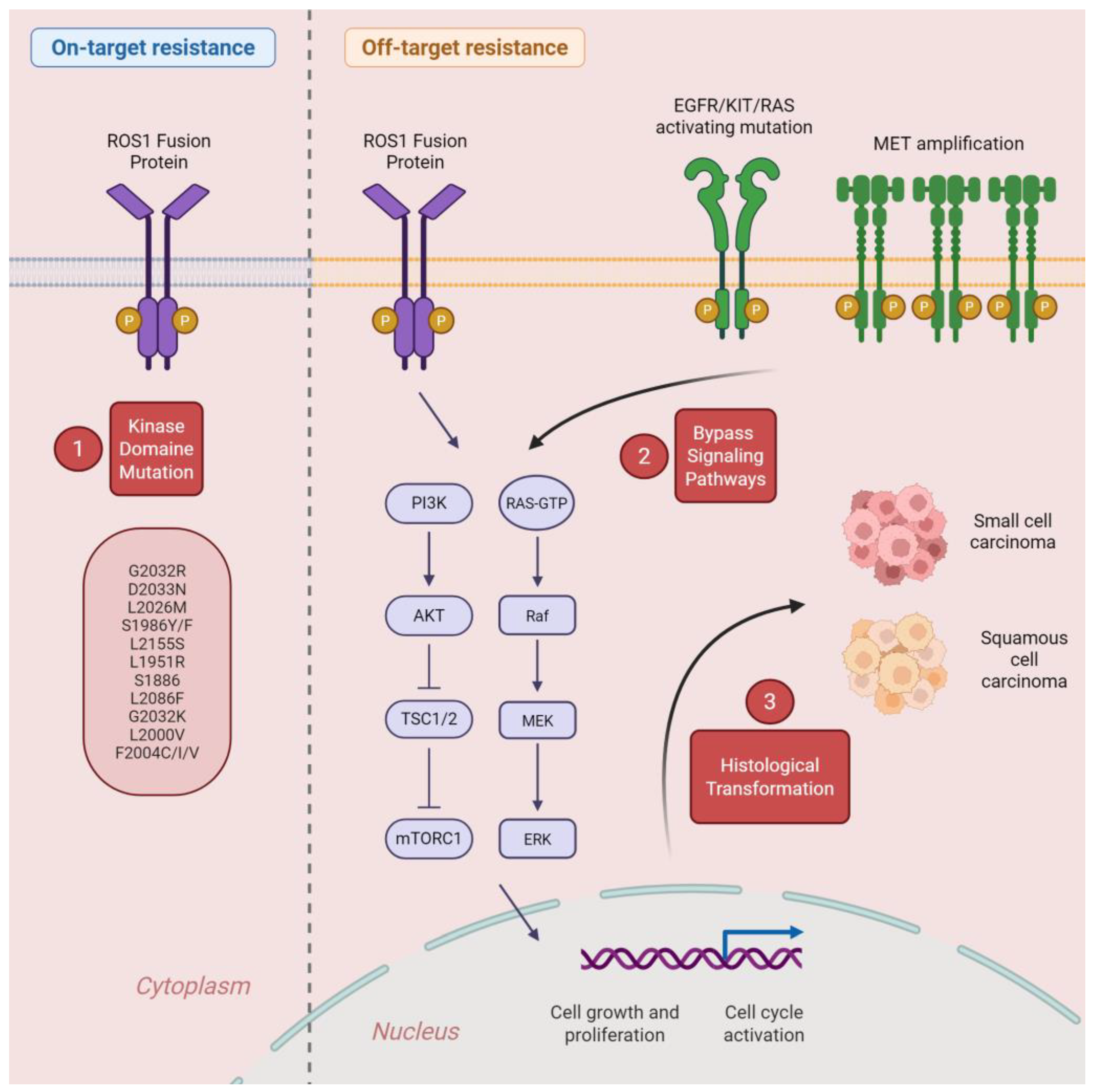
Figure 1. Mechanisms of On-target and Off-target Resistance to ROS1 Inhibitors in NSCLC. Schematic representation of downstream signaling pathways activated by ROS1 fusions and the main mechanisms of acquired resistance to ROS1-targeted TKIs. On-target resistance involves secondary mutations within the ROS1 kinase domain (e.g., G2032R, D2033N, L2086F, L2026M, S1986F) that reduce drug binding affinity. Off-target resistance includes activation of bypass signaling through amplification or mutations in alternative oncogenic drivers such as EGFR, MET, KIT, KRAS, NRAS, and MAP2K1, leading to reactivation of the MAPK and PI3K/AKT/mTOR pathways. These adaptive changes allow tumor cells to maintain proliferation and survival despite continued ROS1 inhibition. Abbreviations: ROS1: c-ros oncogene 1 receptor tyrosine kinase; EGFR: Epidermal Growth Factor Receptor; KIT: KIT proto-oncogene receptor tyrosine kinase; RAS: Rat Sarcoma viral oncogene homolog; PI3K: Phosphatidylinositol-3-kinase; AKT: Protein kinase B; TSC1/2: Tuberous Sclerosis Complex 1/2; mTORC1: Mechanistic Target of Rapamycin Complex 1; RAS-GTP: Active GTP-bound form of RAS; Raf: Rapidly Accelerated Fibrosarcoma kinase; MEK: Mitogen-Activated Protein Kinase; ERK: Extracellular Signal-Regulated Kinase; MET: Mesenchymal–Epithelial Transition factor; NSCLC: Non-Small Cell Lung Cancer. Created in BioRender. Bischoff, H. (2025) https://BioRender.com/kl23zg5 (accessed on 2 November 2025).
Curroncol 32 00626 g001
Table 1. Efficacy outcomes of ROS1 tyrosine kinase inhibitors in TKI-naïve patients with ROS1-positive NSCLC, including intracranial activity when available.
Drug
[Reference]
TargetsnTKI-Naive ORR (%)mPFS (Months)IC-ORR
(%)
Crizotinib [29]ROS1, ALK, MET507219.2/
Entrectinib [36]ROS1, TRK, ALK1686815.780 a
Ceritinib [38]ROS1, ALK306719.325 b
Lorlatinib [40]ROS1, ALK216221.064 c
Repotrectinib [46]ROS1, TRK, ALK717935.789 d
Taletrectinib [50]ROS1 (TRK-sparing)16088.845.676.5 e
Patients evaluable for intracranial ORR: n = 25 a; n = 8 b; n = 11 c; n = 9 d; n = 17 e. Abbreviations: ALK, anaplastic lymphoma kinase; IC, intracranial; mPFS, median progression-free survival; MET, mesenchymal–epithelial transition factor; NSCLC, non-small cell lung cancer; ORR, overall response rate; ROS1, c-ros oncogene 1; TRK, tropomyosin receptor kinase; TKI, tyrosine kinase inhibitor.
Table 2. Notable adverse events, main grade ≥ 3 toxicities, and discontinuation rates associated with ROS1 tyrosine kinase inhibitors in ROS1-positive NSCLC.
Drug
[Reference]
Notable AEsMain Grade ≥ 3 AEs (%)Discontinuation for AEs (%)
Crizotinib
[29]
Visual disturbances (82%), diarrhea (44%), nausea (40%), peripheral edema (40%)Hypophosphatemia (10%), neutropenia (10%)<1
Entrectinib
[36]
Dysgeusia (40%), dizziness (37%), constipation (32%), paresthesia (18%)Weight gain (11%)5
Lorlatinib
[40]
Hypercholesterolemia (80%), cognitive effects (27%), mood disorders (16%), dizziness (12%), weight gain (23%)Hypercholesterolemia (15%), hypertriglyceridemia (19%), weight gain (7%)1
Repotrectinib
[46]
Dizziness (58%), dysgeusia (50%), paresthesia (30%)Dizziness (3%), anemia (4%)7
Taletrectinib
[50]
Increased AST/ALT (70%), diarrhea (61%), nausea (44%), vomiting (41%), dizziness (15%), QT prolongation (18%)Increased AST/ALT (9%), diarrhea (3%), anemia (3%), QT prolongation (3%), neutropenia (4%)2
Zidesamtinib aPeripheral edema (36%), constipation (17%), CPK elevation (16%), fatigue (16%), dyspnea (15%)CPK elevation (3%), dyspnea (3%)2
a Reference: World Conference on Lung Cancer; 6–9 September 2025; Barcelona, Spain. Abstract 4540. Abbreviations: AE, adverse event; ALT, alanine aminotransferase; AST, aspartate aminotransferase; CPK, creatine phosphokinase; QT, QT interval on electrocardiogram.
Table 3. Clinical outcomes of next-generation ROS1 tyrosine kinase inhibitors in TKI-pretreated patients, including intracranial efficacy and activity against the G2032R resistance mutation.
Drug
[Reference]
TargetsnTKI-Pretreated ORR (%)mPFS (Months)IC-ORR
(%)
ORR if G2032R Mutation (%)
Lorlatinib [40]ROS1, ALK40628.5500
Repotrectinib [46]ROS1, TRK, ALK56389.03859
Taletrectinib [50]ROS1 (TRK-sparing)11355.89.765.667
Zidesamtinib aROS1 (TRK-sparing)117449.74883
a Reference: World Conference on Lung Cancer; 6–9 September 2025; Barcelona, Spain. Abstract 4540. Abbreviations: ALK, anaplastic lymphoma kinase; G2032R, solvent-front resistance mutation in ROS1; IC, intracranial; mPFS, median progression-free survival; ORR, overall response rate; ROS1, c-ros oncogene 1; TRK, tropomyosin receptor kinase; TKI, tyrosine kinase inhibitor.
Table 4. Selection of ongoing clinical trials investigating ROS1-targeted tyrosine kinase inhibitors in ROS1-positive NSCLC.
Trial PopulationPhasePlanned Enrollment (n)Study DrugsPrimary EndpointStatus
NCT06564324 (TRUST-III)TKI-naiveIII138Taletrectinib vs. CrizotinibPFSRecruiting
NCT06140836 (TRIDENT-3)TKI-naiveIII230Repotrectinib vs. CrizotinibPFSRecruiting
NCT04603807 (MO41552)TKI-naiveIII220Entrectinib vs. CrizotinibPFSRecruiting
NCT04621188 (ALBATROS)TKI-pretreatedII54Lorlatinib (single arm)ORRActive, not recruiting
NCT05297890TKI-pretreatedII70Lorlatinib (single arm)ORRActive, not recruiting
NCT06128148NRI54JYP0322 (single arm)DLTRecruiting
Abbreviations: DLT, dose-limiting toxicity; MTD, maximum tolerated dose; NSCLC, non-small cell lung cancer; ORR, overall response rate; PFS, progression-free survival; RP2D, recommended phase 2 dose; TKI, tyrosine kinase inhibitor.
Disclaimer/Publisher’s Note: The statements, opinions and data contained in all publications are solely those of the individual author(s) and contributor(s) and not of MDPI and/or the editor(s). MDPI and/or the editor(s) disclaim responsibility for any injury to people or property resulting from any ideas, methods, instructions or products referred to in the content.