

Management of Multiple Myeloma: A Review for General Practitioners in Oncology


Abstract
1. Introduction
2. Diagnosis and Prognosis
2.1. Diagnosis
2.2. Prognosis
3. Current Management
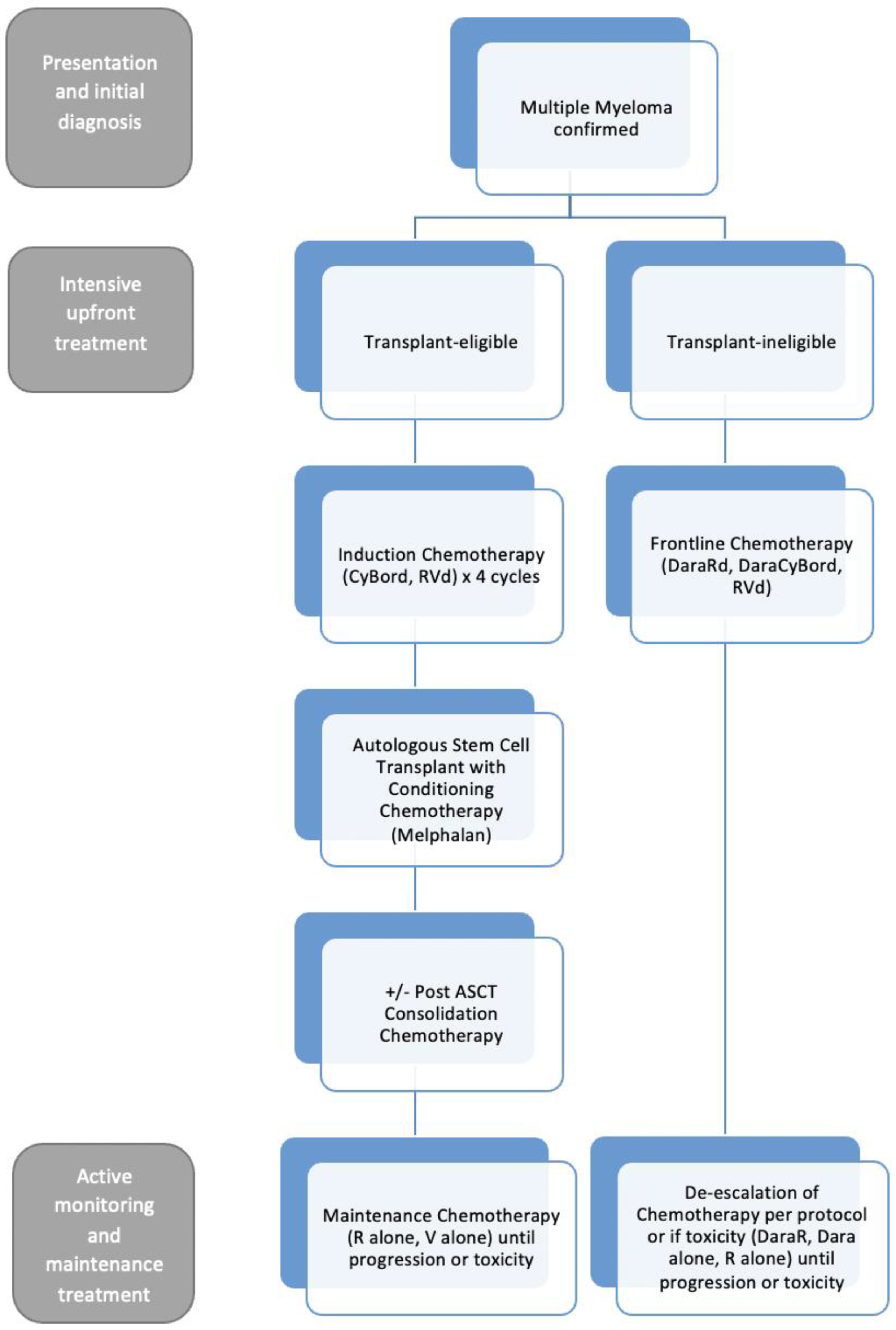
3.1. Transplant Eligible
3.2. Transplant Ineligible
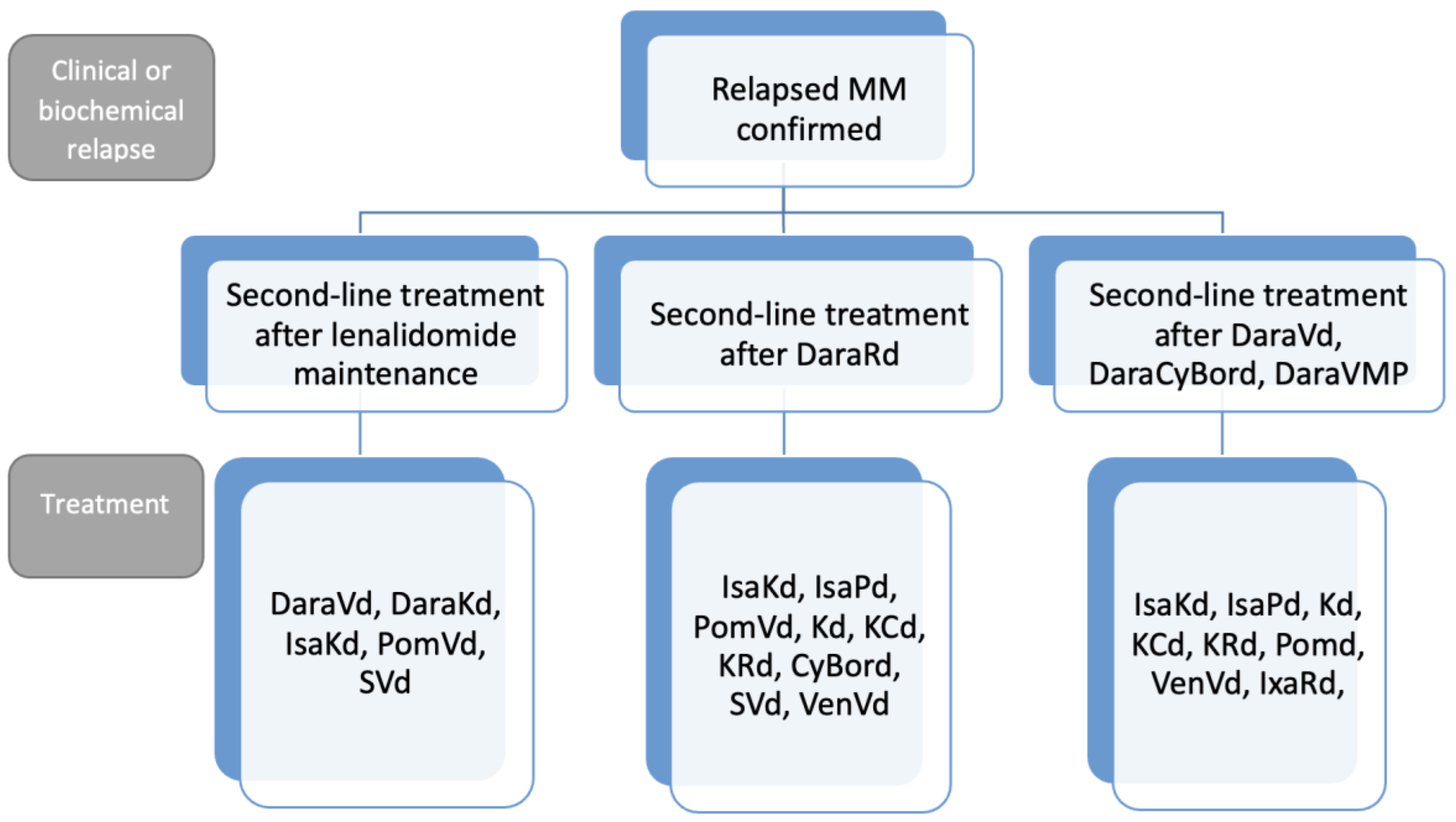
3.3. Relapsed or Refractory Disease
3.4. Monitoring of Disease
3.5. Special Populations
3.5.1. Older Adults
3.5.2. Younger Adults
4. Survivorship
4.1. Bone Disease
4.2. Renal Disease
4.3. Infections
4.4. Thrombosis
4.5. Second Malignancy
4.6. Peripheral Neuropathy
4.7. Gastrointestinal Effects
4.8. Cardiotoxicity
5. Conclusions
Key Points
- Novel therapies have increased treatment options and improved prognosis for MM.
- The assessment of fitness and frailty is increasingly being evaluated as a way of personalizing treatment for MM.
- The main treatment toxicities are infection, renal disease, peripheral neuropathy, diarrhea, and bone disease.
- Long-term therapy has changed MM into a chronic disease.
- Supportive care involving multidisciplinary teams to manage disease-, treatment- and patient-related complications is increasingly important.
Author Contributions
Funding
Conflicts of Interest
References
- Myeloma—Cancer Stat Facts. Available online: https://seer.cancer.gov/statfacts/html/mulmy.html (accessed on 5 March 2023).
- Lee, S. Cancer Statistics. Available online: https://cancer.ca/en/research/cancer-statistics (accessed on 7 March 2023).
- Costa, L.J.; Brill, I.K.; Omel, J.; Godby, K.; Kumar, S.K.; Brown, E.E. Recent Trends in Multiple Myeloma Incidence and Survival by Age, Race, and Ethnicity in the United States. Blood Adv. 2017, 1, 282–287. [Google Scholar] [CrossRef]
- Drug Formulary. Available online: https://www.cancercareontario.ca/en/cancer-treatments/chemotherapy/drug-formulary (accessed on 9 March 2023).
- Cancer Drug Manual. Available online: http://www.bccancer.bc.ca/health-professionals/clinical-resources/cancer-drug-manual (accessed on 9 March 2023).
- CADTH. Selinexor. Available online: https://www.cadth.ca/selinexor (accessed on 9 March 2023).
- Mian, H.; Reece, D.; Masih-Khan, E.; McCurdy, A.; Kardjadj, M.; Jimenez-Zepeda, V.H.; Song, K.; Louzada, M.; LeBlanc, R.; Sebag, M.; et al. Survival and Outcomes of Newly Diagnosed Multiple Myeloma Patients Stratified by Transplant Status 2007–2018: Retrospective Analysis from the Canadian Myeloma Research Group Database. Clin. Lymphoma Myeloma Leuk. 2022, 22, 608–617. [Google Scholar] [CrossRef] [PubMed]
- Durie, B.G.M. Role of New Treatment Approaches in Defining Treatment Goals in Multiple Myeloma—The Ultimate Goal Is Extended Survival. Cancer Treat. Rev. 2010, 36, S18–S23. [Google Scholar] [CrossRef] [PubMed]
- Engelhardt, M.; Ihorst, G.; Landgren, O.; Pantic, M.; Reinhardt, H.; Waldschmidt, J.; May, A.M.; Schumacher, M.; Kleber, M.; Wäsch, R. Large Registry Analysis to Accurately Define Second Malignancy Rates and Risks in a Well-Characterized Cohort of 744 Consecutive Multiple Myeloma Patients Followed-up for 25 Years. Haematologica 2015, 100, 1340–1349. [Google Scholar] [CrossRef] [PubMed]
- Seesaghur, A.; Petruski-Ivleva, N.; Banks, V.L.; Wang, J.R.; Abbasi, A.; Neasham, D.; Ramasamy, K. Clinical Features and Diagnosis of Multiple Myeloma: A Population-Based Cohort Study in Primary Care. BMJ Open. 2021, 11, e052759. [Google Scholar] [CrossRef] [PubMed]
- Wilkinson, A.N. Cancer Diagnosis in Primary Care: Six Steps to Reducing the Diagnostic Interval. Can. Fam. Physician 2021, 67, 265–268. [Google Scholar] [CrossRef] [PubMed]
- Rajkumar, S.V.; Dimopoulos, M.A.; Palumbo, A.; Blade, J.; Merlini, G.; Mateos, M.-V.; Kumar, S.; Hillengass, J.; Kastritis, E.; Richardson, P.; et al. International Myeloma Working Group Updated Criteria for the Diagnosis of Multiple Myeloma. Lancet Oncol. 2014, 15, e538–e548. [Google Scholar] [CrossRef] [PubMed]
- Greipp, P.R.; Miguel, J.S.; Durie, B.G.M.; Crowley, J.J.; Barlogie, B.; Bladé, J.; Boccadoro, M.; Child, J.A.; Avet-Loiseau, H.; Kyle, R.A.; et al. International Staging System for Multiple Myeloma. JCO 2005, 23, 3412–3420. [Google Scholar] [CrossRef]
- Palumbo, A.; Avet-Loiseau, H.; Oliva, S.; Lokhorst, H.M.; Goldschmidt, H.; Rosinol, L.; Richardson, P.; Caltagirone, S.; Lahuerta, J.J.; Facon, T.; et al. Revised International Staging System for Multiple Myeloma: A Report From International Myeloma Working Group. J. Clin. Oncol. 2015, 33, 2863–2869. [Google Scholar] [CrossRef]
- Palumbo, A.; Bringhen, S.; Mateos, M.-V.; Larocca, A.; Facon, T.; Kumar, S.K.; Offidani, M.; McCarthy, P.; Evangelista, A.; Lonial, S.; et al. Geriatric Assessment Predicts Survival and Toxicities in Elderly Myeloma Patients: An International Myeloma Working Group Report. Blood 2015, 125, 2068–2074. [Google Scholar] [CrossRef]
- Walker, B.A.; Morgan, G.J. The Genomic Features Associated with High-Risk Multiple Myeloma. Oncotarget 2018, 9, 35478–35479. [Google Scholar] [CrossRef] [PubMed]
- Walker, B.A.; Mavrommatis, K.; Wardell, C.P.; Ashby, T.C.; Bauer, M.; Davies, F.; Rosenthal, A.; Wang, H.; Qu, P.; Hoering, A.; et al. A High-Risk, Double-Hit, Group of Newly Diagnosed Myeloma Identified by Genomic Analysis. Leukemia 2019, 33, 159–170. [Google Scholar] [CrossRef] [PubMed]
- CADTH Provisional Funding Algorithms | CADTH. Available online: https://www.cadth.ca/cadth-provisional-funding-algorithms (accessed on 9 March 2023).
- Dejoie, T.; Corre, J.; Caillon, H.; Hulin, C.; Perrot, A.; Caillot, D.; Boyle, E.; Chretien, M.-L.; Fontan, J.; Belhadj, K.; et al. Serum Free Light Chains, Not Urine Specimens, Should Be Used to Evaluate Response in Light-Chain Multiple Myeloma. Blood 2016, 128, 2941–2948. [Google Scholar] [CrossRef] [PubMed]
- Foster, R.B.; Lipitz, N.G.; Torres, A.Z.; Carson, K.R. The Real-World Frequency of 24-Hour Urine Protein Electrophoresis (UPEP), Serum Free Light Chain (SFLC), and Serum Protein Electrophoresis (SPEP) Testing in Patients with Multiple Myeloma (MM). Blood 2018, 132, 3536. [Google Scholar] [CrossRef]
- Dejoie, T.; Fouquet, G.; Hulin, C.; Roussel, M.; Hebraud, B.; Karlin, L.; Kolb, B.; Araujo, C.; Meuleman, N.; Tiab, M.; et al. Light Chain Escape in Multiple Myeloma. Blood 2018, 132, 1881. [Google Scholar] [CrossRef]
- Kumar, S.; Paiva, B.; Anderson, K.C.; Durie, B.; Landgren, O.; Moreau, P.; Munshi, N.; Lonial, S.; Bladé, J.; Mateos, M.-V.; et al. International Myeloma Working Group Consensus Criteria for Response and Minimal Residual Disease Assessment in Multiple Myeloma. Lancet Oncol. 2016, 17, e328–e346. [Google Scholar] [CrossRef]
- Durie, B.G.M.; Harousseau, J.-L.; Miguel, J.S.; Bladé, J.; Barlogie, B.; Anderson, K.; Gertz, M.; Dimopoulos, M.; Westin, J.; Sonneveld, P.; et al. International Uniform Response Criteria for Multiple Myeloma. Leukemia 2006, 20, 1467–1473. [Google Scholar] [CrossRef]
- Mian, H.; McCurdy, A.; Giri, S.; Grant, S.; Rochwerg, B.; Winks, E.; Rosko, A.E.; Engelhardt, M.; Pawlyn, C.; Cook, G.; et al. The Prevalence and Outcomes of Frail Older Adults in Clinical Trials in Multiple Myeloma: A Systematic Review. Blood Cancer J. 2023, 13, 6. [Google Scholar] [CrossRef]
- Nguyen, Q.D.; Moodie, E.M.; Forget, M.-F.; Desmarais, P.; Keezer, M.R.; Wolfson, C. Health Heterogeneity in Older Adults: Exploration in the Canadian Longitudinal Study on Aging. J. Am. Geriatr. Soc. 2021, 69, 678–687. [Google Scholar] [CrossRef]
- Möller, M.-D.; Gengenbach, L.; Graziani, G.; Greil, C.; Wäsch, R.; Engelhardt, M. Geriatric Assessments and Frailty Scores in Multiple Myeloma Patients: A Needed Tool for Individualized Treatment? Curr. Opin. Oncol. 2021, 33, 648–657. [Google Scholar] [CrossRef]
- Pawlyn, C.; Khan, A.M.; Freeman, C.L. Fitness and Frailty in Myeloma. Hematology 2022, 2022, 337–348. [Google Scholar] [CrossRef]
- Fakhri, B.; Fiala, M.A.; Tuchman, S.A.; Wildes, T.M. Undertreatment of Older Patients with Newly Diagnosed Multiple Myeloma in the Era of Novel Therapies. Clin. Lymphoma Myeloma Leuk. 2018, 18, 219–224. [Google Scholar] [CrossRef]
- Mikhael, J.; Ismaila, N.; Cheung, M.C.; Costello, C.; Dhodapkar, M.V.; Kumar, S.; Lacy, M.; Lipe, B.; Little, R.F.; Nikonova, A.; et al. Treatment of Multiple Myeloma: ASCO and CCO Joint Clinical Practice Guideline. J. Clin. Oncol. 2019, 37, 1228–1263. [Google Scholar] [CrossRef] [PubMed]
- Lecat, C.S.Y.; McCourt, O.; Land, J.; Yong, K.; Fisher, A. Multiple Myeloma and Physical Activity. BMC Res. Notes 2021, 14, 171. [Google Scholar] [CrossRef] [PubMed]
- Morales Rodríguez, E.; Lorenzo Calvo, J.; Granado-Peinado, M.; Pérez-Bilbao, T.; San Juan, A.F. Effects of Exercise Programs on Psychoemotional and Quality-of-Life Factors in Adult Patients with Cancer and Hematopoietic Stem Cell Transplantation or Bone Marrow Transplantation: A Systematic Review. Int. J. Environ. Res. Public. Health 2022, 19, 15896. [Google Scholar] [CrossRef] [PubMed]
- McCourt, O.; Fisher, A.; Ramdharry, G.; Land, J.; Roberts, A.L.; Rabin, N.; Yong, K. Exercise Prehabilitation for People with Myeloma Undergoing Autologous Stem Cell Transplantation: Results from PERCEPT Pilot Randomised Controlled Trial. Acta Oncol. 2023, 15, 1–10. [Google Scholar] [CrossRef]
- Kazandjian, D. Multiple Myeloma Epidemiology and Survival, a Unique Malignancy. Semin. Oncol. 2016, 43, 676–681. [Google Scholar] [CrossRef]
- Kaloyannidis, P.; Abdulla, F.; Mutahar, E.; Al Hashim, H.; Al Harbi, S.; Estanislao, A.; Al Hashmi, H. Risk Assessment for Newly Diagnosed Fit Young Patients with Multiple Myeloma in the Era of Novel Treatment Modalities: Should There Be Additional Factors Taken into Consideration? J. Blood Med. 2022, 13, 619–630. [Google Scholar] [CrossRef]
- Bennink, C.; van der Klift, M.; Scheurer, H.; Sonneveld, P.; Duijts, S.F.A. Perspectives on Returning to Work of Multiple Myeloma Patients: A Qualitative Interview Study. Eur. J. Cancer Care 2021, 30, e13481. [Google Scholar] [CrossRef]
- Jackson, G.; Galinsky, J.; Alderson, D.E.C.; D’Souza, V.K.; Buchanan, V.; Dhanasiri, S.; Walker, S. Productivity Losses in Patients with Newly Diagnosed Multiple Myeloma Following Stem Cell Transplantation and the Impact of Maintenance Therapy. Eur. J. Haematol. 2019, 103, 393–401. [Google Scholar] [CrossRef]
- Osborne, T.R.; Ramsenthaler, C.; de Wolf-Linder, S.; Schey, S.A.; Siegert, R.J.; Edmonds, P.M.; Higginson, I.J. Understanding What Matters Most to People with Multiple Myeloma: A Qualitative Study of Views on Quality of Life. BMC Cancer 2014, 14, 496. [Google Scholar] [CrossRef]
- Baz, R.; Lin, H.M.; Hui, A.-M.; Harvey, R.D.; Colson, K.; Gallop, K.; Swinburn, P.; Laubach, J.; Berg, D.; Richardson, P. Development of a Conceptual Model to Illustrate the Impact of Multiple Myeloma and Its Treatment on Health-Related Quality of Life. Support. Care Cancer 2015, 23, 2789–2797. [Google Scholar] [CrossRef] [PubMed]
- Gonzalez-McQuire, S.; Dimopoulos, M.-A.; Weisel, K.; Bouwmeester, W.; Hájek, R.; Campioni, M.; Bennison, C.; Xu, W.; Pantiri, K.; Hensen, M.; et al. Development of an Initial Conceptual Model of Multiple Myeloma to Support Clinical and Health Economics Decision Making. MDM Policy Pract. 2019, 4, 2381468318814253. [Google Scholar] [CrossRef] [PubMed]
- Terpos, E.; Mikhael, J.; Hajek, R.; Chari, A.; Zweegman, S.; Lee, H.C.; Mateos, M.-V.; Larocca, A.; Ramasamy, K.; Kaiser, M.; et al. Management of Patients with Multiple Myeloma beyond the Clinical-Trial Setting: Understanding the Balance between Efficacy, Safety and Tolerability, and Quality of Life. Blood Cancer J. 2021, 11, 40. [Google Scholar] [CrossRef] [PubMed]
- Hussein, M.A.; Juturi, J.V.; Lieberman, I. Multiple Myeloma: Present and Future. Curr. Opin. Oncol. 2002, 14, 31. [Google Scholar] [CrossRef]
- Chakraborty, R.; Majhail, N.S. Treatment and Disease-Related Complications in Multiple Myeloma: Implications for Survivorship. Am. J. Hematol. 2020, 95, 672–690. [Google Scholar] [CrossRef]
- LeBlanc, R.; Bergstrom, D.J.; Côté, J.; Kotb, R.; Louzada, M.L.; Sutherland, H.J. Management of Myeloma Manifestations and Complications: The Cornerstone of Supportive Care: Recommendation of the Canadian Myeloma Research Group (Formerly Myeloma Canada Research Network) Consensus Guideline Consortium. Clin. Lymphoma Myeloma Leuk. 2022, 22, e41–e56. [Google Scholar] [CrossRef]
- Coleman, R.E. Metastatic Bone Disease: Clinical Features, Pathophysiology and Treatment Strategies. Cancer Treat. Rev. 2001, 27, 165–176. [Google Scholar] [CrossRef]
- Terpos, E.; Morgan, G.; Dimopoulos, M.A.; Drake, M.T.; Lentzsch, S.; Raje, N.; Sezer, O.; García-Sanz, R.; Shimizu, K.; Turesson, I.; et al. International Myeloma Working Group Recommendations for the Treatment of Multiple Myeloma–Related Bone Disease. J. Clin. Oncol. 2013, 31, 2347–2357. [Google Scholar] [CrossRef]
- Thorsteinsdottir, S.; Gislason, G.; Aspelund, T.; Sverrisdottir, I.; Landgren, O.; Turesson, I.; Björkholm, M.; Kristinsson, S.Y. Fractures and Survival in Multiple Myeloma: Results from a Population-Based Study. Haematologica 2020, 105, 1067–1073. [Google Scholar] [CrossRef]
- Terpos, E.; Ntanasis-Stathopoulos, I.; Gavriatopoulou, M.; Dimopoulos, M.A. Pathogenesis of Bone Disease in Multiple Myeloma: From Bench to Bedside. Blood Cancer J. 2018, 8, 7. [Google Scholar] [CrossRef]
- Kyle, R.A.; Gertz, M.A.; Witzig, T.E.; Lust, J.A.; Lacy, M.Q.; Dispenzieri, A.; Fonseca, R.; Rajkumar, S.V.; Offord, J.R.; Larson, D.R.; et al. Review of 1027 Patients with Newly Diagnosed Multiple Myeloma. Mayo Clin. Proc. 2003, 78, 21–33. [Google Scholar] [CrossRef] [PubMed]
- Bergstrom, D.J.; Kotb, R.; Louzada, M.L.; Sutherland, H.J.; Tavoularis, S.; Venner, C.P.; Côté, J.; LeBlanc, R.; Reiman, A.; Sebag, M.; et al. Consensus Guidelines on the Diagnosis of Multiple Myeloma and Related Disorders: Recommendations of the Myeloma Canada Research Network Consensus Guideline Consortium. Clin. Lymphoma Myeloma Leuk. 2020, 20, e352–e367. [Google Scholar] [CrossRef] [PubMed]
- Gimsing, P.; Carlson, K.; Turesson, I.; Fayers, P.; Waage, A.; Vangsted, A.; Mylin, A.; Gluud, C.; Juliusson, G.; Gregersen, H.; et al. Effect of Pamidronate 30 Mg versus 90 Mg on Physical Function in Patients with Newly Diagnosed Multiple Myeloma (Nordic Myeloma Study Group): A Double-Blind, Randomised Controlled Trial. Lancet Oncol. 2010, 11, 973–982. [Google Scholar] [CrossRef] [PubMed]
- Morgan, G.J.; Davies, F.E.; Gregory, W.M.; Cocks, K.; Bell, S.E.; Szubert, A.J.; Navarro-Coy, N.; Drayson, M.T.; Owen, R.G.; Feyler, S.; et al. First-Line Treatment with Zoledronic Acid as Compared with Clodronic Acid in Multiple Myeloma (MRC Myeloma IX): A Randomised Controlled Trial. Lancet 2010, 376, 1989–1999. [Google Scholar] [CrossRef]
- Zervas, K.; Verrou, E.; Teleioudis, Z.; Vahtsevanos, K.; Banti, A.; Mihou, D.; Krikelis, D.; Terpos, E. Incidence, Risk Factors and Management of Osteonecrosis of the Jaw in Patients with Multiple Myeloma: A Single-Centre Experience in 303 Patients. Br. J. Haematol. 2006, 134, 620–623. [Google Scholar] [CrossRef]
- Wu, X.; Geng, C.; Sun, W.; Tan, M. Incidence and Risk Factors of Osteonecrosis of Femoral Head in Multiple Myeloma Patients Undergoing Dexamethasone-Based Regimens. BioMed Res. Int. 2020, 2020, e7126982. [Google Scholar] [CrossRef]
- Heher, E.C.; Rennke, H.G.; Laubach, J.P.; Richardson, P.G. Kidney Disease and Multiple Myeloma. Clin. J. Am. Soc. Nephrol. 2013, 8, 2007–2017. [Google Scholar] [CrossRef]
- Dimopoulos, M.A.; Sonneveld, P.; Leung, N.; Merlini, G.; Ludwig, H.; Kastritis, E.; Goldschmidt, H.; Joshua, D.; Orlowski, R.Z.; Powles, R.; et al. International Myeloma Working Group Recommendations for the Diagnosis and Management of Myeloma-Related Renal Impairment. JCO 2016, 34, 1544–1557. [Google Scholar] [CrossRef]
- Blimark, C.; Holmberg, E.; Mellqvist, U.-H.; Landgren, O.; Björkholm, M.; Hultcrantz, M.; Kjellander, C.; Turesson, I.; Kristinsson, S.Y. Multiple Myeloma and Infections: A Population-Based Study on 9253 Multiple Myeloma Patients. Haematologica 2015, 100, 107–113. [Google Scholar] [CrossRef]
- Raje, N.S.; Anaissie, E.; Kumar, S.K.; Lonial, S.; Martin, T.; Gertz, M.A.; Krishnan, A.; Hari, P.; Ludwig, H.; O’Donnell, E.; et al. Consensus Guidelines and Recommendations for Infection Prevention in Multiple Myeloma: A Report from the International Myeloma Working Group. Lancet Haematol. 2022, 9, e143–e161. [Google Scholar] [CrossRef] [PubMed]
- Leebeek, F.W.G. Update of Thrombosis in Multiple Myeloma. Thromb. Res. 2016, 140, S76–S80. [Google Scholar] [CrossRef] [PubMed]
- Maclachlan, K.; Diamond, B.; Maura, F.; Hillengass, J.; Turesson, I.; Landgren, C.O.; Kazandjian, D. Second Malignancies in Multiple Myeloma; Emerging Patterns and Future Directions. Best. Pract. Res. Clin. Haematol. 2020, 33, 101144. [Google Scholar] [CrossRef] [PubMed]
- Lee, A.S.; Tsang, R.Y.; Sandhu, I. Managing Multiple Myeloma. CMAJ 2021, 193, E1349. [Google Scholar] [CrossRef] [PubMed]
- Richardson, P.G.; Delforge, M.; Beksac, M.; Wen, P.; Jongen, J.L.; Sezer, O.; Terpos, E.; Munshi, N.; Palumbo, A.; Rajkumar, S.V.; et al. Management of Treatment-Emergent Peripheral Neuropathy in Multiple Myeloma. Leukemia 2012, 26, 595–608. [Google Scholar] [CrossRef]
- Morawska, M.; Grzasko, N.; Kostyra, M.; Wojciechowicz, J.; Hus, M. Therapy-Related Peripheral Neuropathy in Multiple Myeloma Patients. Hematol. Oncol. 2015, 33, 113–119. [Google Scholar] [CrossRef]
- Plummer, C.; Driessen, C.; Szabo, Z.; Mateos, M.-V. Management of Cardiovascular Risk in Patients with Multiple Myeloma. Blood Cancer J. 2019, 9, 26. [Google Scholar] [CrossRef]
- Kistler, K.D.; Kalman, J.; Sahni, G.; Murphy, B.; Werther, W.; Rajangam, K.; Chari, A. Incidence and Risk of Cardiac Events in Patients With Previously Treated Multiple Myeloma Versus Matched Patients Without Multiple Myeloma: An Observational, Retrospective, Cohort Study. Clin. Lymphoma Myeloma Leuk. 2017, 17, 89–96.e3. [Google Scholar] [CrossRef]
- Das, A.; Dasgupta, S.; Gong, Y.; Shah, U.A.; Fradley, M.G.; Cheng, R.K.; Roy, B.; Guha, A. Cardiotoxicity as an Adverse Effect of Immunomodulatory Drugs and Proteasome Inhibitors in Multiple Myeloma: A Network Meta-Analysis of Randomized Clinical Trials. Hematol. Oncol. 2022, 40, 233–242. [Google Scholar] [CrossRef]

| Diagnosis | Criteria | |||
|---|---|---|---|---|
| Smoldering Multiple Myeloma | Both criteria required | 1 | No myeloma–defining events or amyloidosis | |
| 2 | Clonal bone marrow plasma cells 10–60% | |||
| OR | Serum monoclonal protein (IgG or IgA) ≥ 30 g/L | |||
| OR | Urinary monoclonal protein ≥ 500 mg per 24 h collection | |||
| Active Multiple Myeloma | Both criteria required | 1 | Clonal bone marrow plasma cells ≥ 10% or biopsy-proven bony or extramedullary plasmacytoma | |
| 2 | Any one or more of the following myeloma-defining events (MDEs) which include clinical CRAB features or biomarkers of malignancy | Clinical CRAB features
| ||
| Drug Class | Generic Drug Name (Trade Name) | Route of Administration | Abbreviation | Common Regimens Used in Canada |
|---|---|---|---|---|
| Immunomodulatory drugs (IMiDs) | ||||
| Thalidomide (Thalomid) | PO | T | TD | |
| Lenalidomide (Revlimid) | PO | R | RD, RVD, DRD, KRD, IxaRD | |
| Pomalidomide (Pomalyst) | PO | P or Pom | IsaPD, PD, | |
| Iberdomide (CC220) | PO | Iber | Being evaluated in clinical trials | |
| Mezigdomide (CC92480) | PO | Mezi | Being evaluated in clinical trials | |
| Proteasome Inhibitors (PIs) | ||||
| Bortezomib (Velcade), B or V | SC, IV | B or V | CyBorD/VCD, Dara- CyBorD/Dara-VCD, DVD, | |
| Carfilzomib (Krypolis), C or K | IV | C or K | KRD, KCD | |
| Ixazomib (Ninlaro), Ixa | PO | Ixa | IxaRD, Ixa | |
| Monoclonal Antibodies | ||||
| Daratumumab (Darzalex) | SC, IV | D or Dara | DRD, DVD | |
| Isatuximab (Sarclisa) | IV | Isa | IsaPD, IsaKD | |
| Elotuzumab (Empliciti) | Elo | (not approved in Canada) | ||
| Immunoconjugates | ||||
| Antibody-drug conjugate | Belantamab mafodotin/(Blenrep) | IV | Bela or Belamaf | Bela monotherapy (Health Canada approved; not routinely funded) |
| Bispecific antibody | Elranatamab, | SC | Being evaluated in clinical trials | |
| Teclistamab | SC | Being evaluated in clinical trials | ||
| Other novel mechanisms | ||||
| Selinexor (Xpovio) | PO | S or Seli | SD, SVD/SBD | |
| Venetoclax (Venclexta) | PO | Ven | VenD, VenVD/VenBD | |
| chimeric antigen receptor (CAR) T-cell | ||||
| idecabtagene vicleucel (bb2121) | IV | ide-cel | Being evaluated in clinical trials; pending regulatory approval and CADTH review | |
| Alkylating agents | ||||
| Melphalan (Alkeran) | PO, IV | M | BMP/VMP | |
| Cyclophosphamide (Cytoxan) | PO, IV | Cy | CyBorD/VCD, Dara-CyBorD/Dara-CVD | |
| Steroids | ||||
| Dexamethasone | PO, IV | D | Numerous combinations per this table | |
| Prednisone | PO | P | CycloPred, BMP/VMP | |
| Generic Drug Name (Trade Name) | Common Toxicity (>25%) | Less common Toxicity (2–25%) | Rare Toxicity (<1%) |
|---|---|---|---|
| Belantamab mafodotin/Belamaf (Blenrep) | Keratitis, keratopathy, dry eye, infections, anemia, thrombocytopenia, nausea, constitutional symptoms, fever, AST increase | Bleeding, constipation, vomiting, pneumonia, sepsis, infusion related reaction, elevated liver enzymes, renal failure, hypercalcemia | Not reported |
| Bortezomib (Velcade) | Infection (including viral reactivation), thrombocytopenia, bleeding, neuropathy (sensory, motor, autonomic), rash, nausea, diarrhea, constipation, anorexia, fatigue, headache | Dyspepsia, peripheral edema, electrolyte abnormalities, insomnia, myalgias, dizziness, cough, blurred vision | Hypertension, posterior reversible encephalopathy syndrome (PRES), congestive heart failure (CHF), acute liver failure, pneumonitis |
| Carfilzomib (Krypolis) | Infection (including viral reactivation), thrombocytopenia, bleeding, hypertension, diarrhea, nausea, vomiting, edema, fatigue, infusion related reaction, cough, dyspnea, insomnia, myalgias | Venous and arterial thromboembolism, cardiotoxicity, pulmonary hypertension, abdominal pain, dyspepsia, increased liver enzymes, abnormal electrolytes, renal failure, weakness, headaches, peripheral neuropathy, Acute respiratory distress syndrome (ARDS) | Thrombotic microangiopathy (TMA), PRES, Progressive multifocal leukoencephalopathy (PML), CHF |
| Cyclophosphamide (Cytoxan) | Myelosuppression, infections, bleeding, alopecia, nausea, vomiting | Fatigue, increased liver enzymes, myalgias, hemorrhagic cystitis | Arrhythmia, arterial and venous thromboembolism, cardio toxicity, pancreatitis, vaso-occlusive disease, rash, hypersensitivity including anaphylaxis, rhabdomyolysis, second malignancy, syndrome of inappropriate antidiuretic hormone (SIAHD), neurotoxicity, PRES, nephrotoxicity, pneumonitis, vasculitis |
| Daratumumab (Darzalex) | Infusion related reaction | Infections, bleeding, anemia, hypertension, constipation, diarrhea, nausea, vomiting, edema, fatigue, increased liver enzymes, abnormal electrolytes, myalgias, headaches, insomnia, cough, dyspnea, rhinitis | Atrial fibrillation, cardiotoxicity, pancreatitis, cytokine release syndrome (CRS), anaphylaxis |
| Dexamethasone (Decadron) | Peripheral edema, gastrointestinal upset, nausea, gastroesophageal reflux disease (GERD), insomnia, mood disturbances | Gastritis, hyperglycemia, infection, increased appetite, weight gain, hypertension, hyponatremia, hypokalemia, delayed wound healing, cataracts, skin changes, adrenal suppression, proximal muscle weakness, osteoporosis | Peptic ulcer, perforation, avascular necrosis of the femoral head, seizures, psychosis |
| Isatuximab (Sarclisa) | Infusion related reaction, myelosuppression, infection, anemia, neutropenia, thrombocytopenia, pneumonia, upper respiratory tract infection, diarrhea | Arrhythmia, atrial fibrillation, nausea, stomatitis, vomiting, edema, bronchitis, herpes viral infection, nasopharyngitis, arthralgias, weakness, myalgias, second malignancy, headache | Not reported |
| Ixazomib (Ninlaro) | Infection (including viral reactivation), thrombocytopenia, bleeding, diarrhea, constipation, nausea, vomiting, peripheral neuropathy, edema, fatigue, infusion related reaction, cough, dyspnea, insomnia, ocular disorders, | Rash, pruritis, anorexia, myalgias, hypokalemia, dizziness, headache, | Thrombotic thrombocytopenia purpura (TTP), hepatotoxicity, Steven-Johnson syndrome (SJS), Sweet’s syndrome, toxic epidermal necrolysis (TEN), Drug rash with eosinophilia and systemic symptoms (DRESS) |
| Lenalidomide (Revlimid) | Nausea, vomiting, diarrhea, constipation, infection, bleeding, edema, fatigue, myalgias, headache, cough, dyspnea | Rash, arrythmia, venous and arterial thromboembolism, HTN, abdominal pain, anorexia, peripheral neuropathy, depression, syncope, tremor, blurred visions, abnormal electrolytes, thyroid disease | SJS, TEN, DRESS, cholecystitis, pancreatitis |
| Melphalan (Alkeran) | Nausea, diarrhea, myelosuppression, infection, anemia, neutropenia, injection site reaction, flushing, rash, alopecia | Mucositis, esophagitis, vomiting, diarrhea, tumour lysis syndrome, hepatitis, infertility, amenorrhea, azoospermia, renal failure, second hematologic and solid organ malignancies | Anaphylaxis, tissue necrosis (if extravasation), pneumonitis, pulmonary fibrosis |
| Pomalidomide (Pomalyst) | Myelosuppression, infection, bleeding, diarrhea, fatigue | Atrial fibrillation, rash, anorexia, Constipation, diarrhea, nausea, vomiting, edema, increased liver enzymes, abnormal electrolytes, myalgias, dizziness, headache, insomnia, peripheral neuropathy, cough, dyspnea | Hypertension, venous thromboembolism second skin malignancies, pneumonitis, interstitial lung disease, tumor lysis syndrome, severe hypersensitivity reaction including SJS, TEN, DRESS, hepatic failure |
| Prednisone | Peripheral edema, GI upset, nausea, GERD, insomnia, mood disturbances | Gastritis, hyperglycemia, infection, increased appetite, weight gain, hypertension, hyponatremia, hypokalemia, delayed wound healing, cataracts, skin changes, adrenal suppression, proximal muscle weakness, osteoporosis | Peptic ulcer, gastrointestinal perforation, avascular necrosis of the femoral head, seizures, psychosis |
| Selinexor | Nausea, diarrhea, constipation, fatigue, decreased appetite, myelosuppression, infection, bleeding, thrombocytopenia, anemia, | Vomiting, weight loss, dehydration, renal failure, hyponatremia, hypokalemia, visual disturbances, dizziness, dyspnea, and upper respiratory tract infection, confusion, altered mental status | Arrhythmia, birth defects |
| Venetoclax | Myelosuppression, infection, neutropenia, bleeding, diarrhea, nausea, fatigue, myalgias | Rash, pruritus, abdominal pain, constipation, vomiting, edema, hemolytic anemia, abnormal electrolytes, tumour lysis syndrome, second malignancies, dizziness, headache, cough | Cholecystitis, renal failure |
| Complication | Disease Factors | Treatment Factors | Patient Factors | Supportive Management | |
| Bone disease | Lytic lesions | Dysregulation of normal bone metabolism Osteoclastic activity | Pain management Steroid Radiation Kyphoplasty Vertebroplasty Orthopedic referral | ||
| Hypercalcemia | Dysregulation of normal bone metabolism Osteoclastic activity Ig-dependent renal disease | Denosumab | Age Nutrition Gender Comorbid disease Non-antimyeloma drugs | Hydration Discontinue calcium and vitamin D Bisphosphonates | |
| Osteoporosis | Dysregulation of normal bone metabolism Osteoclastic activity | Bisphosphonates | |||
| Osteonecrosis of the jaw | Bisphosphonates | Dental hygiene Dental care Dentist referral (specialist in oral and maxillofacial dentistry if available) | |||
| Avascular necrosis | Steroids | Orthopedic referral Pain management | |||
| Renal disease | Ig-dependent | Cast nephropathy Monoclonal Ig deposition Light chain amyloidosis | Treatment dose modification Hydration Avoid nephrotoxic drugs Nephrology referral | ||
| Ig-independent | Hypercalcemia | Carfilzomib Bisphosphonates | Age Nutrition Comorbid disease Non-antimyeloma drugs | ||
| Infection | Viral | Immunoparesis (low immmunoglobulin levels, hypogammaglobulinemia) Impaired lymphocyte function | Multiple agents causing neutropenia PIs IMiDs Monoclonal antibodies | Age Nutrition Comorbid disease Non-antimyeloma drugs | Prophylactic antivirals Vaccination with inactivated vaccines |
| Bacterial | Immunoparesis (low immmunoglobulin levels, hypogammaglobulinemia) Impaired lymphocyte function Neutropenia Hyposplenism | Melphalan Steroids Bispecific T-cell engagers CAR T-cell therapy | Prophylactic antibiotics Vaccination with inactivated vaccines | ||
| Thrombosis | Venous thrombo- embolisms Arterial thrombo- embolisms | Tumor load Inflammatory cytokines | IMiDs Dexamethasone | Comorbid disease Non-antimyeloma drugs | Low molecular weight heparin (LMWH) Warfarin Acetylsalicylic acid |
| Second malignancies | Hematological | Genetics Immune dysregulation | Alkylator therapy Lenalidomide Radiation | Age Genetics Comorbid disease Environmental exposures Non-antimyeloma drugs Alcohol use disorder Smoking history | |
| Solid organ | Age-appropriate cancer screening Low-threshold for biopsy | ||||
| Peripheral neuropathy | Sensory | Monoclonal proteins Direct compression | Bortezomib Thalidomide Melphalan Bispecific T-cell engagers | Diabetes mellitus Alcohol use disorder Vitamin deficiencies Viral infections Non-antimyeloma drugs | Antiepileptics Antidepressants |
| Motor | |||||
| Gastrointestinal effects | Diarrhea | Short-term: Bortezomib, Panobinostat Late-onset: Lenalidomide | Comorbid disease Non-antimyeloma drugs | Treatment dose modification Dietary changes Loperamide Cholestyramine | |
| Cardiac toxicity | Congestive heart failure Arrhythmia | Amyloid light-chain immunoglobulin deposition | Carfilzomib | Age Gender Comorbid disease | Cardiovascular risk management Treatment dose modification Diuretics Cardiology referral |
Disclaimer/Publisher’s Note: The statements, opinions and data contained in all publications are solely those of the individual author(s) and contributor(s) and not of MDPI and/or the editor(s). MDPI and/or the editor(s) disclaim responsibility for any injury to people or property resulting from any ideas, methods, instructions or products referred to in the content. |
© 2023 by the authors. Licensee MDPI, Basel, Switzerland. This article is an open access article distributed under the terms and conditions of the Creative Commons Attribution (CC BY) license (https://creativecommons.org/licenses/by/4.0/).
Share and Cite
Monteith, B.E.; Sandhu, I.; Lee, A.S. Management of Multiple Myeloma: A Review for General Practitioners in Oncology. Curr. Oncol. 2023, 30, 4382-4401. https://doi.org/10.3390/curroncol30050334
Monteith BE, Sandhu I, Lee AS. Management of Multiple Myeloma: A Review for General Practitioners in Oncology. Current Oncology. 2023; 30(5):4382-4401. https://doi.org/10.3390/curroncol30050334
Chicago/Turabian StyleMonteith, Bethany E., Irwindeep Sandhu, and Ann S. Lee. 2023. "Management of Multiple Myeloma: A Review for General Practitioners in Oncology" Current Oncology 30, no. 5: 4382-4401. https://doi.org/10.3390/curroncol30050334
APA StyleMonteith, B. E., Sandhu, I., & Lee, A. S. (2023). Management of Multiple Myeloma: A Review for General Practitioners in Oncology. Current Oncology, 30(5), 4382-4401. https://doi.org/10.3390/curroncol30050334

