Review

Hyponatremia in Heart Failure with Preserved Ejection Fraction: Pathophysiology, Clinical Implications, and Management Challenges


1
Internal Medicine, Lebanese University, Beirut P.O. Box 6573/14, Lebanon
2
Cardiology, Lebanese University, Beirut P.O. Box 6573/14, Lebanon
*
Author to whom correspondence should be addressed.
These authors contributed equally to this work.
Cardiovasc. Med. 2026, 29(2), 19; https://doi.org/10.3390/cardiovascmed29020019
Submission received: 20 March 2026 / Revised: 24 April 2026 / Accepted: 11 May 2026 / Published: 20 May 2026

Abstract

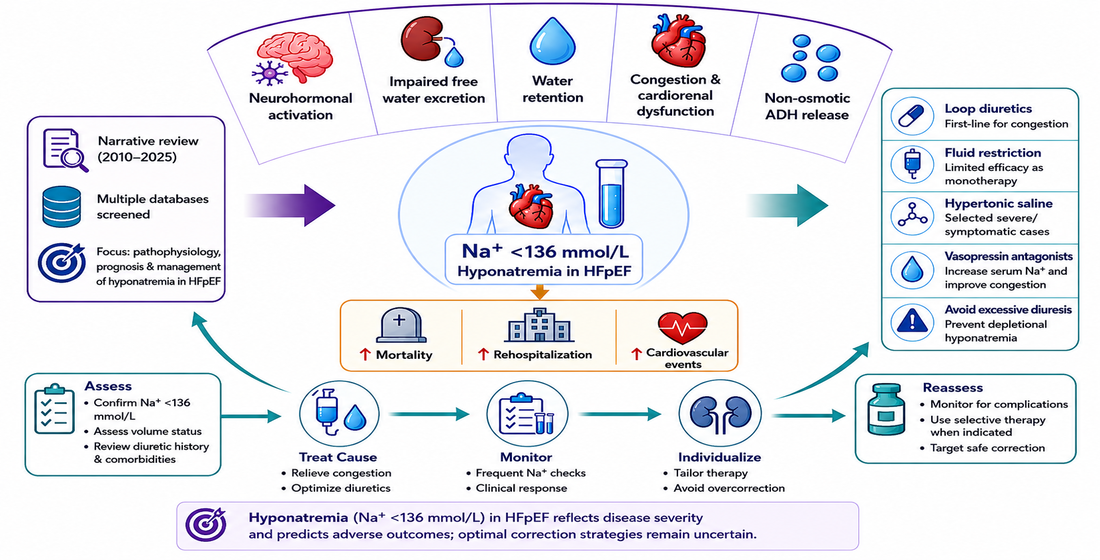
Introduction: Hyponatremia is a common electrolyte abnormality in heart failure and has been consistently associated with worse clinical outcomes. While its prognostic value is well established in heart failure with reduced ejection fraction, its significance in heart failure with preserved ejection fraction remains less clearly defined. Increasing evidence suggests that hyponatremia may reflect advanced neurohormonal activation, congestion, and cardiorenal dysfunction in this population. Methods: This study was conducted as a narrative review of the literature examining the pathophysiology, clinical implications, and management of hyponatremia in heart failure with preserved ejection fraction. Electronic databases including PubMed, EMBASE, Cochrane Library, Scopus, and Google Scholar were searched for relevant publications between 2010 and 2025. Eligible sources included clinical trials, observational studies, registry analyses, guideline documents, and review articles focusing on sodium disorders in heart failure populations. The findings were synthesized qualitatively to provide an integrated overview of the mechanisms, prognostic significance, and therapeutic considerations. Results: Available evidence indicates that hyponatremia occurs frequently in patients with heart failure with preserved ejection fraction and is associated with increased risks of mortality, rehospitalization, and cardiovascular events. The underlying mechanisms involve complex interactions between neurohormonal activation, impaired renal free water excretion, and therapeutic factors such as diuretic exposure. Hyponatremia appears to function primarily as a marker of disease severity rather than a direct mediator of adverse outcomes. Current management strategies primarily rely on general heart failure treatment principles, including optimizing diuretic therapy, managing fluid balance, and selectively using vasopressin antagonists. Conclusions: Hyponatremia represents an important biomarker of adverse prognosis in heart failure with preserved ejection fraction. Despite its clinical relevance, evidence guiding phenotype-specific management remains limited. Future research should focus on clarifying pathophysiologic mechanisms, improving risk stratification, and determining whether targeted correction of hyponatremia can improve clinical outcomes in this growing patient population.

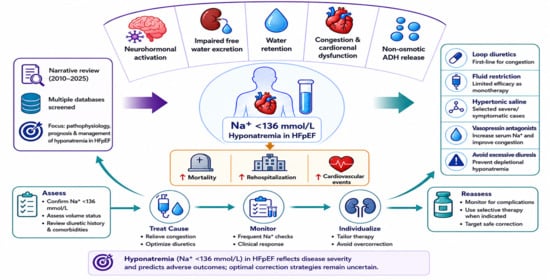
Graphical Abstract

1. Introduction

Heart failure (HF) is a complex clinical syndrome resulting from structural or functional cardiac abnormalities that impair ventricular filling or ejection, leading to inadequate cardiac output and elevated intracardiac pressures [1,2]. It is commonly classified according to left ventricular ejection fraction (LVEF) into heart failure with reduced (HFrEF), mildly reduced (HFmrEF), and preserved ejection fraction (HFpEF), the latter defined by an LVEF ≥ 50% in the presence of typical symptoms and objective evidence of cardiac dysfunction [1,2]. Both the American Heart Association (2022) and the European Society of Cardiology (2021) emphasize that HF reflects a clinical state and does not encompass asymptomatic individuals with structural heart disease or cardiomyopathies in the absence of clinical manifestations. The syndrome most commonly results from myocardial dysfunction, whether systolic, diastolic, or combined. However, valvular disease, pericardial and endocardial pathology, as well as disturbances of cardiac rhythm and conduction, may also precipitate or exacerbate HF [1,2]. Importantly, the ESC 2021 guidelines underscore the necessity of identifying the underlying etiology of cardiac dysfunction, as this directly informs prognosis and guides targeted therapeutic strategies, reinforcing the multidimensional and etiologically diverse nature of HF [2].
Heart failure (HF) is classified according to left ventricular ejection fraction (LVEF), a pragmatic framework derived from trials showing benefit in patients with LVEF ≤ 40%, despite recognition of a continuous spectrum. HFrEF is defined by LVEF ≤ 40%, HFmrEF by 41–49%, and HFpEF by LVEF ≥ 50% with symptoms and objective evidence of structural and/or functional cardiac abnormalities and/or elevated natriuretic peptides [1,2].
The diagnosis of HFpEF requires compatible clinical features, preserved LVEF, and evidence of elevated filling pressures or diastolic dysfunction. Patients with previously reduced LVEF who recover to ≥50% are classified as having improved EF rather than HFpEF. Objective diagnostic criteria include elevated natriuretic peptides and echocardiographic markers of diastolic dysfunction or increased filling pressures, such as left atrial enlargement (left atrial volume index > 32 mL/m2), increased mitral inflow velocity (E wave > 90 cm/s), reduced septal e′ velocity (<9 cm/s), elevated E/e′ ratio (>9), increased pulmonary artery systolic pressure reflected by tricuspid regurgitation velocity > 2.8 m/s or estimated pressure > 35 mmHg at rest, and evidence of left ventricular hypertrophy, defined by increased left ventricular mass index (>95 g/m2 in women and >115 g/m2 in men) and/or increased relative wall thickness (>0.42) [1,3].
According to the last Update from the American Society of Echocardiography, the diagnosis of heart failure with preserved ejection fraction (HFpEF) relies on the identification of a clinical heart failure syndrome in the presence of a preserved left ventricular ejection fraction, generally defined as ≥50%, after exclusion of alternative cardiac or noncardiac explanations for the patient’s symptoms. Both the American College of Cardiology/American Heart Association/Heart Failure Society of America and the European Society of Cardiology provide aligned definitions and structured diagnostic pathways for HFpEF, underscoring that recognition of the clinical syndrome is the essential first step. Several clinical criteria sets, including the Framingham, Boston, Gothenburg, and ESC criteria, have been proposed to support the diagnosis of heart failure, with the Framingham criteria being widely used in epidemiologic studies; however, despite high specificity, their limited sensitivity, particularly in older patients without overt decompensation, means that HFpEF may be present even when these criteria are not fully satisfied. Early manifestations are frequently nonspecific, and diagnostic suspicion should be heightened in individuals with characteristic comorbidities, including advanced age, hypertension, obesity, diabetes mellitus, and atrial fibrillation [4].
Once HFpEF is suspected based on symptoms, physical findings, and risk profile, cardiac imaging plays a central role in diagnostic evaluation. Transthoracic echocardiography is the first-line imaging modality, enabling the assessment of left ventricular systolic function, structural remodeling, and hemodynamic parameters, while also excluding alternative cardiac causes of dyspnea, such as valvular disease, pericardial pathology, and infiltrative cardiomyopathies. An LVEF ≥ 50% is consistent with HFpEF, and supportive echocardiographic findings commonly include left ventricular hypertrophy, concentric remodeling, left atrial enlargement, diastolic dysfunction, and abnormalities in myocardial strain; however, none of these features alone is diagnostic. Diastolic function should be assessed using guideline-recommended algorithms. A comprehensive echocardiographic evaluation is recommended at initial presentation. When resting echocardiography demonstrates elevated left ventricular filling pressures, reflected by grade II or III diastolic dysfunction, the diagnosis of HFpEF is established in the appropriate clinical context. Conversely, in patients with exertional symptoms and only grade I diastolic dysfunction at rest, further evaluation with diastolic stress echocardiography or invasive hemodynamic assessment is warranted. In patients with atrial fibrillation, dedicated echocardiographic criteria should be used for estimating filling pressures. Although echocardiography remains the cornerstone of HFpEF evaluation, cardiac magnetic resonance imaging provides complementary diagnostic value through detailed myocardial tissue characterization and should be considered when echocardiographic image quality is suboptimal or when infiltrative cardiomyopathies, such as cardiac amyloidosis, are suspected [4].
A 2023 scientific statement published in the Journal of the American College of Cardiology by Borlaug et al. highlights a major epidemiologic shift in the contemporary heart failure (HF) landscape. Although the overall incidence of HF in the United States has remained relatively stable, the prevalence of heart failure with preserved ejection fraction (HFpEF) continues to rise steadily. Community-based data estimate the incidence of HFpEF at approximately 27 cases per 10,000 person-years. At the same time, longitudinal observations from the Framingham Heart Study demonstrate a greater than 50% increase in HFpEF prevalence over the past two decades. This increased prevalence has been accompanied by rising hospitalization rates, and projections suggest that HFpEF will soon surpass heart failure with reduced ejection fraction (HFrEF) as the most prevalent HF phenotype. Lifetime risk estimates exceeding 10% by mid-adulthood further underscore the growing public health burden of HFpEF. Importantly, despite differences in clinical presentation and patterns of adverse outcomes, HFpEF is associated with survival rates comparable to those observed in HFrEF, with long-term mortality exceeding 75%. Patients with HFpEF experience a disproportionately higher burden of non-cardiovascular mortality and recurrent hospitalizations, with relatively fewer HF-specific readmissions, emphasizing the central role of comorbidities and the need for comprehensive, multisystem approaches to management [5].
Hyponatremia, defined as a serum sodium concentration below 136 mmol/L [6], is a well-established predictor of adverse outcomes in HFrEF; however, its prognostic significance in HFpEF remains less clear and is a subject of ongoing debate [7,8,9,10]. In a study by Yash R. Patel et al., the prognostic impact of baseline serum sodium in HFpEF was evaluated, revealing a J-shaped relationship between sodium levels and both all-cause mortality and annual hospitalization days. Low sodium levels were associated with increased HF-related hospitalizations, and even low-normal sodium values correlated with worse outcomes. As the largest study to date investigating this relationship in HFpEF, these findings highlight serum sodium as a potential marker to identify patients at higher risk of adverse events. The study also emphasizes the need for further investigation into underlying mechanisms, including the role of neurohormonal activation, and confirms that low sodium predicts both short-term (30-day) and long-term adverse outcomes, consistent with prior smaller studies [6].
Building on these observations, the objective of this review is to provide a comprehensive synthesis of current evidence on hyponatremia in HFpEF, with a focus on its pathophysiology, clinical implications, and management challenges. We aim to explore the mechanisms through which low serum sodium may contribute to adverse outcomes, such as neurohormonal dysregulation, fluid imbalance, and renal dysfunction, and examine how these pathways compare or overlap with those in HFrEF. Additionally, we will discuss the prognostic significance of both overt and low-normal hyponatremia, its impact on hospitalization and mortality, and the potential utility of serum sodium as a risk stratification tool. Finally, this review will address therapeutic considerations, highlighting current management strategies, identifying knowledge gaps, and outlining areas for future research to improve outcomes in this rapidly growing, high-risk HFpEF population.

2. Methods

This article was conducted as a narrative review aimed at synthesizing and critically appraising the existing literature on hyponatremia in heart failure with preserved ejection fraction (HFpEF). A comprehensive literature search was performed using the electronic databases PubMed, EMBASE, Cochrane Library, Scopus, and Google Scholar. The search strategy incorporated combinations of the following keywords and Medical Subject Headings (MeSH) terms: “HFpEF,” “heart failure with preserved ejection fraction,” “hyponatremia,” “sodium disorders,” “hypervolemic hyponatremia,” “arginine vasopressin,” and “vasopressin antagonists.”
The search covered publications from January 2010 to December 2025, with inclusion of selected seminal studies when necessary to support pathophysiological concepts.
A total of approximately 47 studies were included in the final qualitative synthesis. Eligible studies comprised randomized controlled trials, observational cohort studies, registry analyses, subgroup analyses of major heart failure trials, systematic reviews, and guideline-based documents, with particular emphasis on studies including HFpEF populations or reporting HFpEF-specific subgroup data. Study selection followed predefined inclusion and exclusion criteria. Inclusion criteria consisted of peer-reviewed studies addressing hyponatremia in heart failure, with a preference for HFpEF-specific data, and studies providing clinically relevant outcomes such as mortality, hospitalization, or pathophysiological insights.
Exclusion criteria included studies not focused on heart failure-related hyponatremia, case reports or small case series with limited generalizability (unless contributing to mechanistic understanding), non-peer-reviewed publications, and non-English language articles. Given the narrative nature of this review, a formal PRISMA flow diagram and quantitative meta-analysis were not employed. Instead, findings were qualitatively synthesized to provide an integrated overview of pathophysiology, prognostic implications, and management considerations related to hyponatremia in HFpEF.

3. Results

Hyponatremia is a common finding in heart failure and occurs with comparable frequency across phenotypes, including HFpEF. Its prevalence among hospitalized patients ranges from 11% to 27% [7]. While earlier studies primarily focused on HFrEF, subsequent evidence has demonstrated that hyponatremia is similarly prevalent in HFpEF populations [8,9,10]. Although mean serum sodium levels may be lower in HFrEF, overall prevalence appears comparable between the two phenotypes [11].
Most available data originate from hospitalized cohorts, with fewer studies evaluating outpatient populations [12]. Nevertheless, outpatient data suggest that hyponatremia remains common in chronic heart failure, with prevalence rates comparable to or only slightly lower than those observed in hospitalized settings [10,13,14]. In a large ambulatory cohort, hyponatremia was reported in 13.8% of patients with HFrEF and 12.9% of those with HFpEF [10], while a Danish outpatient study reported a prevalence of 17% [13].
From a clinical standpoint, HFpEF patients are typically older and exhibit a higher burden of comorbidities, including obesity, diabetes mellitus, hypertension, atrial fibrillation, and systemic diseases [15,16,17]. Despite this, most comorbid conditions confer a similar relative increase in mortality risk across HF phenotypes, with some exceptions such as chronic obstructive pulmonary disease [17,18].
Across multiple cohorts and registry analyses, hyponatremia has consistently been associated with adverse outcomes in HFpEF, including increased risks of mortality, rehospitalization, and cardiovascular events. In a cohort of 496 hospitalized HFpEF patients, baseline hyponatremia independently predicted 24-month mortality, rehospitalization, and stroke [9]. Similarly, analysis from the OPTIMIZE-HF registry demonstrated an increase in in-hospital mortality and a higher risk of death or rehospitalization at 60 days [10]. These findings were further supported by the Get with the Guidelines–Heart Failure registry, where hyponatremia was associated with both short- and long-term adverse outcomes [6].
Comparative analyses across the ejection fraction spectrum suggest that the prognostic significance of hyponatremia is largely consistent between HFpEF and HFrEF. In the MAGGIC meta-analysis (n = 14,766), hyponatremia was associated with increased 3-year mortality irrespective of LVEF [19]. However, some heterogeneity exists, as certain studies have reported that long-term prognostic significance may be attenuated in HFpEF compared with HFrEF [8].

4. Discussion

Hyponatremia is the most common electrolyte abnormality in hospitalized patients and is particularly prevalent in heart failure, where it reflects increased disease severity and clinical complexity [7]. Although historically studied in HFrEF, growing evidence confirms that hyponatremia occurs with similar frequency in HFpEF, emphasizing its relevance across the heart failure spectrum [8,9,10]. While absolute sodium levels may differ slightly, prevalence rates remain broadly comparable between phenotypes [11]. Importantly, hyponatremia is observed not only during acute decompensation but also in stable outpatient populations, suggesting that it reflects persistent pathophysiologic processes rather than transient illness alone [10,13,14].
Patients with HFpEF are typically older and have a high burden of comorbidities, including hypertension, obesity, diabetes, atrial fibrillation, and systemic illnesses [15,16,17]. This multimorbid profile contributes to heterogeneity in outcomes and may partly explain variability in the prognostic impact of hyponatremia. Nevertheless, across multiple studies, hyponatremia consistently correlates with increased mortality, rehospitalization, and cardiovascular events [6,9,10].
Large-scale registry data confirm its independent prognostic value. While short-term risks appear similar across HF phenotypes, some studies suggest weaker long-term associations in HFpEF [8]. However, meta-analytic evidence supports a consistent relationship between low serum sodium and mortality regardless of ejection fraction [19]. Serial assessment of serum sodium may therefore aid in identifying higher-risk HFpEF subgroups (Table 1).

4.1. Pathophysiology of Hyponatremia in HF

In chronic heart failure (HF), reductions in cardiac output and arterial pressure lead to activation of neurohormonal pathways, including the renin–angiotensin–aldosterone system (RAAS), arginine vasopressin (AVP), and the sympathetic nervous system. The extent of this activation generally reflects the severity of cardiac dysfunction and promotes sodium and water retention as a compensatory mechanism to preserve effective circulating volume [24].
Hyponatremia in acute decompensated heart failure (ADHF) is predominantly a consequence of impaired free water excretion rather than true sodium depletion (Table 1). Dilutional hyponatremia predominates and is primarily driven by inappropriate water retention mediated by arginine vasopressin (AVP). In ADHF, heightened sensitivity of osmotic AVP release lowers the osmotic threshold for hormone secretion, while baroreceptor activation and angiotensin II signaling promote sustained non-osmotic AVP release. These mechanisms are further amplified by impaired AVP degradation in the setting of hepatic or renal dysfunction. Concurrently, angiotensin II–mediated thirst and reduced distal nephron flow, resulting from decreased glomerular filtration and enhanced proximal tubular sodium and water reabsorption, limit free water excretion, exacerbating dilutional hyponatremia [7,25,26,27,28].
Although less frequent, depletional hyponatremia may coexist and reflect true sodium loss rather than water excess (Table 2). Contributing factors include strict dietary sodium restriction, excessive extrarenal sodium losses such as diarrhea or ascites, and exaggerated renal sodium excretion related to diuretic therapy or osmotic diuresis. In addition, intracellular sodium shifts secondary to potassium and/or magnesium deficiency may lower measured serum sodium concentrations. Collectively, these mechanisms underscore the multifactorial nature of hyponatremia in ADHF and highlight the importance of accurately identifying the predominant pathophysiologic process to guide appropriate management strategies [7,25].
Central to these abnormalities is the concept of arterial underfilling, which, whether driven by reduced cardiac output or relative peripheral vasodilation, initiates sustained neurohumoral activation. While these compensatory responses support short-term perfusion of vital organs, their chronic persistence contributes to deleterious downstream effects, including volume overload, hyponatremia, increased cardiac preload and afterload, and maladaptive ventricular remodeling. Recognition of these maladaptive pathways has informed the development of disease-modifying therapies beyond diuretics, particularly angiotensin-converting enzyme inhibitors and β-adrenergic receptor blockers, which attenuate neurohormonal activation and improve clinical outcomes in heart failure [28].

4.2. Is Hyponatremia a Marker or a Mediator of Risk in HFpEF?

Although hyponatremia is consistently associated with adverse outcomes in heart failure with preserved ejection fraction (HFpEF), current evidence suggests that it functions predominantly as a marker of disease severity and neurohormonal activation, rather than as a direct mediator of risk. In HFpEF, low serum sodium reflects advanced hemodynamic derangements, including arterial underfilling, heightened non-osmotic AVP release, activation of the RAAS, and impaired renal free water excretion, processes that are themselves central drivers of congestion, cardiorenal dysfunction, and adverse prognosis.
Importantly, interventional studies aimed at correcting serum sodium levels, particularly through the use of vasopressin antagonists, have not demonstrated sustained improvements in mortality or long-term clinical outcomes. These findings support the view that hyponatremia is largely an epiphenomenon rather than a causal factor in disease progression. Nevertheless, experimental and mechanistic data suggest that excessive AVP signaling and chronic water retention may exacerbate myocardial wall stress, inflammation, and adverse remodeling. This raises the possibility that hyponatremia may contribute indirectly to disease progression in selected high-risk HFpEF phenotypes. Accordingly, hyponatremia in HFpEF is best regarded as an integrative biomarker of advanced neurohormonal and hemodynamic dysregulation, with potential pathophysiologic relevance but limited evidence supporting direct causality. (Table 2).

4.3. Contextual Differences in Hyponatremia and Prognostic Significance

4.3.1. Acute vs. Chronic HFpEF

In acute decompensated HFpEF, hyponatremia is common and typically reflects abrupt neurohormonal activation, severe congestion, and impaired renal water handling. In this context, low serum sodium is strongly associated with short-term adverse outcomes, including in-hospital mortality and early rehospitalization. In contrast, in chronic stable HFpEF, hyponatremia appears less prevalent and may reflect persistent neurohormonal activation, advanced comorbidity burden, or chronic exposure to diuretic therapy. Prognostic associations in chronic HFpEF are more heterogeneous and often attenuated, underscoring important differences in underlying pathophysiology between acute and stable disease states [23,29].

4.3.2. Admission vs. Discharge Sodium

Accumulating evidence suggests that discharge serum sodium may carry greater prognostic relevance than admission values. Persistent or newly developed hyponatremia at discharge likely identifies patients with incomplete decongestion, ongoing neurohormonal activation, or unresolved cardiorenal dysfunction and is consistently associated with higher risks of post-discharge mortality and rehospitalization. Conversely, in-hospital correction of hyponatremia may reflect improved hemodynamic status and effective decongestive therapy, and has been associated with more favorable short-term outcomes; however, a causal relationship remains unproven [30,31].

4.3.3. Mild vs. Severe Hyponatremia

The prognostic impact of hyponatremia in HFpEF appears to follow a graded relationship, with more severe reductions in serum sodium conferring the highest risk. Importantly, several studies suggest that even mild or low-normal sodium concentrations are associated with increased hospitalization burden and mortality. These observations support the concept of serum sodium as a continuous risk marker, rather than a dichotomous variable, and highlight its potential utility as part of multiparametric risk stratification rather than as an isolated therapeutic target [23,29,32].

4.4. Critical Appraisal of the Evidence and Methodological Considerations

Although hyponatremia is consistently associated with adverse outcomes in HFpEF, important variability exists in the magnitude and temporal pattern of this relationship. While several studies demonstrate robust associations with both short- and long-term outcomes, others report attenuated or time-limited prognostic effects, particularly beyond the acute phase. Such discrepancies likely reflect underlying methodological heterogeneity rather than true biological differences.
Key limitations include variability in study design, patient selection, and definitions of hyponatremia, with inconsistent sodium thresholds and differing approaches to modeling sodium as a categorical or continuous variable; differences in cohort characteristics, including the inclusion of acute versus chronic HFpEF populations, further limit comparability. In addition, adjustment for important confounders, particularly renal dysfunction and diuretic exposure, is inconsistent across studies, raising the possibility of residual confounding.
Selection bias also warrants consideration, as many analyses are derived from hospitalized cohorts that may overrepresent patients with more advanced disease and greater comorbidity burden. The complex and multimorbid nature of HFpEF further complicates interpretation, as competing non-cardiovascular risks may attenuate the independent prognostic contribution of hyponatremia. Furthermore, variability in the timing of sodium assessment (admission versus discharge), dynamic changes during hospitalization, and differences in therapeutic strategies may influence observed associations. The predominance of observational data, along with frequent extrapolation from HFrEF or mixed heart failure populations, limits causal inference and the applicability of phenotypes.
Taken together, these limitations highlight the need for standardized definitions and systematic, longitudinal evaluation of sodium dynamics in HFpEF. Well-designed prospective studies are required to clarify the contexts in which hyponatremia retains independent prognostic value and to determine whether it represents a marker of disease severity solely or reflects distinct pathophysiologic pathways in specific HFpEF phenotypes.

5. Management

A structured biochemical evaluation is essential in assessing hyponatremia. The minimum recommended laboratory workup includes serum osmolality, urine osmolality, and urine sodium concentration, a comprehensive metabolic panel (urea, creatinine, potassium, glucose), lipid profile, and uric acid levels [33,34,35]. The initial diagnostic step is to confirm that a measured serum sodium <135 mmol/L reflects true hypotonic hyponatremia (serum osmolality < 275–280 mOsm/kg), which warrants full etiologic evaluation. This distinction excludes isotonic hyponatremia (pseudohyponatremia due to severe hyperlipidemia or paraproteinemia) and hypertonic hyponatremia caused by osmotic shifts, such as in hyperglycemia or mannitol exposure [34,35]. Calculation of effective serum tonicity (measured or calculated osmolality minus urea) further refines this differentiation [34].
Urine osmolality provides insight into renal water handling and antidiuretic hormone (ADH) activity. A value ≤ 100 mOsm/kg indicates appropriate suppression of ADH and suggests primary polydipsia or low solute intake, whereas values > 100 mOsm/kg indicate impaired free water excretion, as seen in SIADH, hypovolemia, or hypervolemic states [33,34,35]. Concurrent assessment of urine sodium helps evaluate effective arterial volume: levels < 20–30 mmol/L typically indicate hypovolemia with renal sodium conservation, while levels ≥ 30–40 mmol/L suggest euvolemic or hypervolemic conditions, including SIADH or renal salt wasting [34,36,37]. In selected clinical contexts, thyroid-stimulating hormone and morning cortisol should also be measured to exclude hypothyroidism and adrenal insufficiency, respectively [36].

5.1. Hyponatremia in Heart Failure

The diagnostic approach to hyponatremia in heart failure (HF), including HFpEF, follows the general hypotonic hyponatremia algorithm but requires additional clinical nuance. A central challenge is distinguishing between dilutional (congestion-driven) and depletional (diuretic-induced) hyponatremia, as these entities have opposing therapeutic implications [20]. In decompensated, volume-overloaded HF, dilutional hyponatremia is characterized by clinical hypervolemia, elevated urine osmolality (often >300 mOsm/kg) reflecting arginine vasopressin (AVP)-mediated water retention, and variable urine sodium levels that may remain low despite congestion due to intense neurohormonal sodium reabsorption [7,20]. Conversely, excessive diuresis, particularly with high-dose loop diuretics or the addition of thiazides, may lead to a depletional, hypovolemic state. This presentation is typically associated with orthostatic symptoms, a rising BUN-to-creatinine ratio, and relatively higher urine sodium due to renal sodium loss. In such cases, cautious isotonic saline administration and reduction in diuretic intensity are appropriate, whereas fluid restriction may be harmful [38,39].

5.2. Clinical Urgency

Acute (<48 h) or severely symptomatic hyponatremia, manifesting as seizures, coma, severe confusion, or intractable vomiting, requires immediate treatment in parallel with diagnostic evaluation. In contrast, chronic or mildly symptomatic cases allow a more gradual and etiologically focused approach [7,37,38].

5.3. Hyponatremia Management in HFpEF

Management of hyponatremia in HFpEF currently relies on general HF and hyponatremia treatment principles, as no dedicated HFpEF-specific correction algorithms exist. Most available data focus on the prognostic significance of hyponatremia rather than interventional strategies specific to this phenotype.

5.4. Dilutional Hyponatremia

Loop diuretics remain the cornerstone of therapy in congested HF patients with dilutional hyponatremia. By reducing medullary interstitial tonicity, they enhance free water excretion and promote decongestion [7]. Initial intravenous dosing should consider prior outpatient diuretic exposure, with subsequent titration guided by clinical response and diuretic efficiency. Combination diuretic therapy may be required in cases of diuretic resistance [2].
Emerging evidence suggests that the combination of loop diuretics with small-volume hypertonic saline may augment free water clearance, increase serum sodium, reduce biomarkers of cardiac wall stress, and potentially improve short-term clinical outcomes in selected patients with hyponatremic HF [36,40,41,42,43]. These effects appear more pronounced compared with loop diuretics alone [40,43]. Fluid restriction as a sole strategy has demonstrated only modest efficacy. In registry data, free water restriction increased serum sodium by approximately 2 mEq/L over 24 h, compared with >5 mEq/L with hypertonic saline or tolvaptan [24]. Similarly, longer-term studies have shown minimal sodium improvement with fluid restriction compared with vasopressin antagonism [20]. Vasopressin receptor antagonists (vaptans) promote aquaresis and reliably increase serum sodium while improving congestion; however, robust evidence for long-term mortality or rehospitalization benefit is lacking [38]. In the EVEREST trial, tolvaptan improved early dyspnea, weight loss, edema scores, and corrected hyponatremia in affected patients, with sustained effects on body weight and sodium after discharge but no survival advantage [44]. The TACTICS-HF trial demonstrated a rapid rise in serum sodium within 24 h associated with increased urine output [45]. In AQUA-AHF, tolvaptan increased serum sodium more effectively than furosemide-based regimens despite similar overall diuresis [46].

5.5. Depletional Hyponatremia

Although less common in HF, depletional hyponatremia is most frequently associated with thiazide diuretics, which impair urinary dilution in the distal tubule and predispose to disproportionate sodium loss [7,9]. Loop diuretics are comparatively less likely to cause severe hyponatremia because they impair urinary concentration ability, resulting in greater free water loss relative to sodium [7]. The combination of loop and thiazide diuretics, so-called sequential nephron blockade, used to overcome diuretic resistance, substantially increases the risk of severe electrolyte disturbances, including hyponatremia [47]. Mineralocorticoid receptor antagonists (MRAs), widely used in both HFrEF and HFpEF, may also contribute to hyponatremia by reducing distal sodium reabsorption, even in the absence of overt water excess. Although pathophysiologic considerations suggest limiting thiazides and possibly MRAs in hyponatremic HF patients, high-quality outcome data to guide definitive practice remain limited [25].

6. Conclusions

Hyponatremia in HFpEF should be regarded primarily as a marker of advanced disease and neurohormonal activation, reflecting the severity of underlying hemodynamic and cardiorenal dysfunction. Its development reflects a dynamic balance between congestion-driven neurohormonal activation and therapy-related sodium losses, particularly in patients exposed to intensive or combination diuretic regimens. Accurate differentiation between dilutional and depletional mechanisms is central to safe and effective management, as therapeutic approaches differ fundamentally. Current treatment strategies rely largely on extrapolation from general heart failure data. Loop diuretics remain the mainstay for dilutional hyponatremia, with adjunctive options such as hypertonic saline or vasopressin antagonists reserved for selected cases. In contrast, depletional hyponatremia necessitates reduction in natriuretic therapies and cautious volume repletion. Fluid restriction alone provides limited correction and should not be considered definitive therapy. Importantly, a major gap persists, as HFpEF-specific evidence regarding the pathophysiology, prognostic significance, and optimal management of hyponatremia remains limited. Most data derive from HFrEF or mixed populations, restricting their applicability. Consequently, whether hyponatremia is solely a marker or a modifiable therapeutic target in HFpEF remains uncertain. Future prospective studies are needed to clarify mechanisms, standardize definitions, and determine whether targeted interventions can improve clinical outcomes.

Author Contributions

A.R.: Conceptualization, Methodology, Literature Search, Data Curation, Writing—Original Draft, Writing—Review & Editing. A.G.H.: Conceptualization, Methodology, Literature Search, Data Curation, Writing—Original Draft, Writing—Review & Editing. M.K.: Supervision, Validation, Writing—Review & Editing. A.T.: Supervision, Validation, Writing—Review & Editing. A.E.S.: Supervision, Validation, Writing—Review & Editing. All authors have read and agreed to the published version of the manuscript.

Funding

This research received no external funding.

Institutional Review Board Statement

This study is a narrative review of previously published literature and did not involve human participants, patient data, or experimental interventions.

Informed Consent Statement

Not applicable.

Data Availability Statement

No new datasets were generated or analyzed in this study. All information was derived from previously published literature.

Acknowledgments

Grammarly software (version 14.1136.0) was used solely for grammar and language editing.

Conflicts of Interest

The authors declare no conflicts of interest.

References

  1. 2022 AHA/ACC/HFSA Guideline for the Management of Heart Failure: A Report of the American College of Cardiology/American Heart Association Joint Committee on Clinical Practice Guidelines|Circulation. Available online: https://www.ahajournals.org/doi/10.1161/CIR.0000000000001063 (accessed on 22 February 2026).
  2. McDonagh, T.A.; Metra, M.; Adamo, M.; Gardner, R.S.; Baumbach, A.; Böhm, M.; Burri, H.; Butler, J.; Čelutkienė, J.; Chi-oncel, O.; et al. 2021 ESC Guidelines for the diagnosis and treatment of acute and chronic heart failure. Eur. Heart J. 2021, 42, 3599–3726. [Google Scholar] [CrossRef]
  3. Playford, D.; Strange, G.; Celermajer, D.S.; Evans, G.; Scalia, G.M.; Stewart, S.; Prior, D.; NEDA Investigators. Diastolic dysfunction and mortality in 436 360 men and women: The National Echo Database Australia (NEDA). Eur. Heart J.-Cardiovasc. Imaging 2021, 22, 505–515. [Google Scholar] [CrossRef]
  4. Recommendations for the Evaluation of Left Ventricular Diastolic Function by Echocardiography and for Heart Failure With Preserved Ejection Fraction Diagnosis: An Update From the American Society of Echocardiography—Journal of the Amer-ican Society of Echocardiography. Available online: https://onlinejase.com/article/S0894-7317(25)00157-9/fulltext (accessed on 22 February 2026).
  5. Dunlay, S.M.; Roger, V.L.; Redfield, M.M. Epidemiology of heart failure with preserved ejection fraction. Nat. Rev. Cardiol. 2017, 14, 591–602. [Google Scholar] [CrossRef]
  6. Patel, Y.R.; Kurgansky, K.E.; Imran, T.F.; Orkaby, A.R.; McLean, R.R.; Ho, Y.; Cho, K.; Gaziano, J.M.; Djousse, L.; Gagnon, D.R.; et al. Prognostic Significance of Baseline Serum Sodium in Heart Failure With Preserved Ejection Fraction. J. Am. Heart Assoc. 2018, 7, e007529. [Google Scholar] [CrossRef] [PubMed]
  7. Rodriguez, M.; Hernandez, M.; Cheungpasitporn, W.; Kashani, K.B.; Riaz, I.; Rangaswami, J.; Herzog, E.; Guglin, M.; Krittanawong, C. Hyponatremia in Heart Failure: Pathogenesis and Management. Curr. Cardiol. Rev. 2019, 15, 252–261. [Google Scholar] [CrossRef] [PubMed]
  8. Park, J.J.; Cho, Y.-J.; Oh, I.-Y.; Park, H.-A.; Lee, H.-Y.; Kim, K.H.; Yoo, B.-S.; Kang, S.-M.; Baek, S.H.; Jeon, E.-S.; et al. Short and long-term prognostic value of hyponatremia in heart failure with preserved ejection fraction versus reduced ejection fraction: An analysis of the Korean Acute Heart Failure registry. Int. J. Cardiol. 2017, 248, 239–245. [Google Scholar] [CrossRef]
  9. Kazory, A. Hyponatremia in heart failure: Revisiting pathophysiology and therapeutic strategies. Clin. Cardiol. 2010, 33, 322–329. [Google Scholar] [CrossRef]
  10. Bavishi, C.; Ather, S.; Bambhroliya, A.; Jneid, H.; Virani, S.S.; Bozkurt, B.; Deswal, A. Prognostic significance of hyponatremia among ambulatory patients with heart failure and preserved and reduced ejection fractions. Am. J. Cardiol. 2014, 113, 1834–1838. [Google Scholar] [CrossRef]
  11. Sato, Y.; Yoshihisa, A.; Oikawa, M.; Nagai, T.; Yoshikawa, T.; Saito, Y.; Yamamoto, K.; Takeishi, Y.; Anzai, T. Hyponatremia at discharge is associated with adverse prognosis in acute heart failure syndromes with preserved ejection fraction: A report from the JASPER registry. Eur. Heart J. Acute Cardiovasc. Care 2019, 8, 623–633. [Google Scholar] [CrossRef] [PubMed]
  12. Cavusoglu, Y.; Kaya, H.; Eraslan, S.; Yilmaz, M.B. Hyponatremia is associated with occurrence of atrial fibrillation in outpatients with heart failure and reduced ejection fraction. Hell. J. Cardiol. 2019, 60, 117–121. [Google Scholar] [CrossRef]
  13. Balling, L.; Schou, M.; Videbæk, L.; Hildebrandt, P.; Wiggers, H.; Gustafsson, F. Danish Heart Failure Clinics Network Prevalence and prognostic significance of hyponatraemia in outpatients with chronic heart failure. Eur. J. Heart Fail. 2011, 13, 968–973. [Google Scholar] [CrossRef]
  14. DeWolfe, A.; Lopez, B.; Arcement, L.M.; Hebert, K. Low serum sodium as a poor prognostic indicator for mortality in congestive heart failure patients. Clin. Cardiol. 2010, 33, E13–E17. [Google Scholar] [CrossRef]
  15. Edelmann, F.; Stahrenberg, R.; Gelbrich, G.; Durstewitz, K.; Angermann, C.E.; Düngen, H.D.; Scheffold, T.; Zugck, C.; Maisch, B.; Regitz-Zagrosek, V.; et al. Contribution of comorbidities to functional impairment is higher in heart failure with preserved than with reduced ejection fraction. Clin. Res. Cardiol. 2011, 100, 755–764. [Google Scholar] [CrossRef] [PubMed]
  16. Deichl, A.; Wachter, R.; Edelmann, F. Comorbidities in heart failure with preserved ejection fraction. Herz 2022, 47, 301–307. [Google Scholar] [CrossRef]
  17. Ather, S.; Chan, W.; Bozkurt, B.; Aguilar, D.; Ramasubbu, K.; Zachariah, A.A.; Wehrens, X.H.T.; Deswal, A. Impact of noncardiac comorbidities on morbidity and mortality in a predominantly male population with heart failure and preserved versus reduced ejection fraction. J. Am. Coll. Cardiol. 2012, 59, 998–1005. [Google Scholar] [CrossRef]
  18. Mentz, R.J.; Kelly, J.P.; von Lueder, T.G.; Voors, A.A.; Lam, C.S.P.; Cowie, M.R.; Kjeldsen, K.; Jankowska, E.A.; Atar, D.; Butler, J.; et al. Noncardiac comorbidities in heart failure with reduced versus preserved ejection fraction. J. Am. Coll. Cardiol. 2014, 64, 2281–2293. [Google Scholar] [CrossRef]
  19. Rusinaru, D.; Tribouilloy, C.; Berry, C.; Richards, A.M.; Whalley, G.A.; Earle, N.; Poppe, K.K.; Guazzi, M.; Macin, S.M.; Komajda, M.; et al. Relationship of serum sodium concentration to mortality in a wide spectrum of heart failure patients with preserved and with reduced ejection fraction: An individual patient data meta-analysis(†): Meta-Analysis Global Group in Chronic heart failure (MAGGIC). Eur. J. Heart Fail. 2012, 14, 1139–1146. [Google Scholar] [CrossRef]
  20. Gheorghiade, M.; Abraham, W.T.; Albert, N.M.; Gattis Stough, W.; Greenberg, B.H.; O’Connor, C.M.; She, L.; Yancy, C.W.; Young, J.; Fonarow, G.C.; et al. Relationship between admission serum sodium concentration and clinical outcomes in patients hospitalized for heart failure: An analysis from the OPTIMIZE-HF registry. Eur. Heart J. 2007, 28, 980–988. [Google Scholar] [CrossRef] [PubMed]
  21. Vicent, L.; Alvarez-Garcia, J.; Gonzalez-Juanatey, J.R.; Rivera, M.; Segovia, J.; Worner, F.; Bover, R.; Pascual-Figal, D.; Vázquez, R.; Cinca, J.; et al. Prognostic impact of hyponatraemia and hypernatraemia at admission and discharge in heart failure patients with preserved, mid-range and reduced ejection fraction. Intern. Med. J. 2021, 51, 930–938. [Google Scholar] [CrossRef]
  22. Takei, M.; Kohsaka, S.; Shiraishi, Y.; Goda, A.; Nagatomo, Y.; Mizuno, A.; Suzino, Y.; Kohno, T.; Fukuda, K.; Yoshikawa, T. Heart Failure With Midrange Ejection Fraction in Patients Admitted for Acute Decompensation: A Report from the Japanese Multicenter Registry. J. Card. Fail. 2019, 25, 666–673. [Google Scholar] [CrossRef] [PubMed]
  23. Su, Y.; Ma, M.; Zhang, H.; Pan, X.; Zhang, X.; Zhang, F.; Lv, Y.; Yan, C. Prognostic value of serum hyponatremia for outcomes in patients with heart failure with preserved ejection fraction: An observational cohort study. Exp. Ther. Med. 2020, 20, 101. [Google Scholar] [CrossRef] [PubMed]
  24. Dunlap, M.E.; Hauptman, P.J.; Amin, A.N.; Chase, S.L.; Chiodo, J.A.; Chiong, J.R.; Dasta, J.F. Current Management of Hyponatremia in Acute Heart Failure: A Report From the Hyponatremia Registry for Patients With Euvolemic and Hypervolemic Hyponatremia (HN Registry). J. Am. Heart Assoc. 2017, 6, e005261. [Google Scholar] [CrossRef] [PubMed]
  25. Verbrugge, F.H.; Steels, P.; Grieten, L.; Nijst, P.; Tang, W.H.W.; Mullens, W. Hyponatremia in acute decompensated heart failure: Depletion versus dilution. J. Am. Coll. Cardiol. 2015, 65, 480–492. [Google Scholar] [CrossRef]
  26. Park, F.; Mattson, D.L.; Skelton, M.M.; Cowley, A.W. Localization of the vasopressin V1a and V2 receptors within the renal cortical and medullary circulation. Am. J. Physiol. 1997, 273, R243–R251. [Google Scholar] [CrossRef]
  27. Wilson, J.L.L.; Miranda, C.A.; Knepper, M.A. Vasopressin and the Regulation of Aquaporin-2. Clin. Exp. Nephrol. 2013, 17, 751–764. [Google Scholar] [CrossRef] [PubMed]
  28. Schrier, R.W.; Abraham, W.T. Hormones and hemodynamics in heart failure. N. Engl. J. Med. 1999, 341, 577–585. [Google Scholar] [CrossRef]
  29. Zhao, L.; Zhao, X.; Zhuang, X.; Zhai, M.; Wang, Y.; Huang, Y.; Zhou, Q.; Tian, P.; Liang, L.; Huang, B.; et al. Hyponatremia and lower normal serum sodium levels are associated with an increased risk of all-cause death in heart failure patients. Nurs. Open 2023, 10, 3799–3809. [Google Scholar] [CrossRef]
  30. De Vecchis, R.; Di Maio, M.; Di Biase, G.; Ariano, C. Effects of Hyponatremia Normalization on the Short-Term Mortality and Rehospitalizations in Patients with Recent Acute Decompensated Heart Failure: A Retrospective Study. J. Clin. Med. 2016, 5, 92. [Google Scholar] [CrossRef]
  31. Avcı, B.K.; Küçük, M.; Müderrisoğlu, H.; Eren, M.; Kutlu, M.; Yılmaz, M.B.; Çavuşoğlu, Y.; Öngen, Z. Relation between serum sodium levels and clinical outcomes in Turkish patients hospitalized for heart failure: A multi-center retrospective observational study. Anatol. J. Cardiol. 2017, 17, 2–7. [Google Scholar] [CrossRef]
  32. Hiki, M.; Kasai, T.; Yatsu, S.; Murata, A.; Matsumoto, H.; Kato, T.; Suda, S.; Miyazaki, T.; Takagi, A.; Daida, H. Relationship Between Serum Sodium Level Within the Low-Normal Range on Admission and Long-Term Clinical Outcomes in Patients with Acute Decompensated Heart Failure. Int. Heart J. 2018, 59, 1052–1058. [Google Scholar] [CrossRef]
  33. Spasovski, G. Hyponatraemia-treatment standard 2024. Nephrol. Dial. Transplant. 2024, 39, 1583–1592. [Google Scholar] [CrossRef]
  34. Milionis, H.J.; Liamis, G.L.; Elisaf, M.S. The hyponatremic patient: A systematic approach to laboratory diagnosis. CMAJ 2002, 166, 1056–1062. [Google Scholar]
  35. Management of Hyponatremia|AAFP. Available online: https://www.aafp.org/pubs/afp/issues/2004/0515/p2387.html#afp20040515p2387-f1 (accessed on 23 February 2026).
  36. Rout, P.; Badireddy, M. Hyponatremia. In StatPearls; StatPearls Publishing: Treasure Island, FL, USA, 2025. Available online: http://www.ncbi.nlm.nih.gov/books/NBK470386/ (accessed on 23 February 2026).
  37. Hoorn, E.J.; Zietse, R. Diagnosis and Treatment of Hyponatremia: Compilation of the Guidelines. J. Am. Soc. Nephrol. 2017, 28, 1340–1349. [Google Scholar] [CrossRef]
  38. Şorodoc, V.; Asaftei, A.; Puha, G.; Ceasovschih, A.; Lionte, C.; Sîrbu, O.; Bologa, C.; Haliga, R.E.; Constantin, M.; Coman, A.E.; et al. Management of Hyponatremia in Heart Failure: Practical Considerations. J. Pers. Med. 2023, 13, 140. [Google Scholar] [CrossRef]
  39. Managing Hyponatraemia in Heart Failure|ECR Journal. Available online: https://www.ecrjournal.com/articles/managing-hyponatraemia-heart-failure?language_content_entity=en (accessed on 23 February 2026).
  40. Tuttolomondo, A.; Maida, C.; Casuccio, A.; Di Raimondo, D.; Fonte, R.; Vassallo, V.; Puleo, M.G.; Di Chiara, T.; Mogavero, A.; Del Cuore, A.; et al. Effects of intravenous furosemide plus small-volume hypertonic saline solutions on markers of heart failure. ESC Heart Fail. 2021, 8, 4174–4186. [Google Scholar] [CrossRef]
  41. Griffin, M.; Soufer, A.; Goljo, E.; Colna, M.; Rao, V.S.; Jeon, S.; Raghavendra, P.; D’Ambrosi, J.; Riello, R.; Coca, S.G.; et al. Real World Use of Hypertonic Saline in Refractory Acute Decompensated Heart Failure: A U.S. Center’s Experience. Heart Fail. 2020, 8, 199–208. [Google Scholar] [CrossRef]
  42. Wan, Y.; Li, L.; Niu, H.; Ma, X.; Yang, J.; Yuan, C.; Mu, G.; Zhang, J. Impact of Compound Hypertonic Saline Solution on Decompensated Heart Failure. Int. Heart J. 2017, 58, 601–607. [Google Scholar] [CrossRef] [PubMed]
  43. Yayla, Ç.; Akyel, A.; Canpolat, U.; Gayretli Yayla, K.; Eyiol, A.; Akboğa, M.K.; Türkoğlu, S.; Tavil, Y.; Boyacı, B.; Çengel, A. Comparison of three diuretic treatment strategies for patients with acute decompensated heart failure. Herz 2015, 40, 1115–1120. [Google Scholar] [CrossRef]
  44. Konstam, M.A.; Gheorghiade, M.; Burnett, J.C.; Grinfeld, L.; Maggioni, A.P.; Swedberg, K.; Udelson, J.E.; Zannad, F.; Cook, T.; Ouyang, J.; et al. Effects of oral tolvaptan in patients hospitalized for worsening heart failure: The EVEREST Outcome Trial. JAMA 2007, 297, 1319–1331. [Google Scholar] [CrossRef] [PubMed]
  45. Felker, G.M.; Mentz, R.J.; Cole, R.T.; Adams, K.F.; Egnaczyk, G.F.; Fiuzat, M.; Patel, C.B.; Echols, M.; Khouri, M.G.; Tauras, J.M.; et al. Efficacy and Safety of Tolvaptan in Patients Hospitalized With Acute Heart Failure. J. Am. Coll. Cardiol. 2017, 69, 1399–1406. [Google Scholar] [CrossRef]
  46. Ng, T.M.H.; Grazette, L.P.; Fong, M.W.; Yoon, A.J.; Lou, M.; Kuo, A.; Upadhyay, R.Y.; Han, E.E.; Mehra, A.; Elkayam, U. Tolvaptan vs. furosemide-based diuretic regimens in patients hospitalized for heart failure with hyponatremia (AQ-UA-AHF). ESC Heart Fail. 2020, 7, 1927–1934. [Google Scholar] [CrossRef] [PubMed]
  47. Combination of Loop Diuretics With Thiazide-Type Diuretics in Heart Failure|JACC. Available online: https://www.jacc.org/doi/10.1016/j.jacc.2010.06.034 (accessed on 24 February 2026).

Table 1. Review of the studies involving the prognostic correlations of hyponatremia in HFpEF.
StudyNumber of Patients EnrolledKey StrengthsPotential Sources of BiasKey Findings
Rusinaru, D. 2012 [19]14,766
-
Large sample size and individual patient data
-
Long-term follow up (3 years)
-
heterogeneity across studies (included both RCTs and observational cohorts)
-
Generalizability:
Patients were mostly from Europe, New Zealand and Argentina; findings may not apply to all populations
-
Low serum sodium concentration is a strong determinant of long-term mortality in a wide spectrum of patients with HF, irrespective of LVEF. The excess risk associated with low serum sodium concentration becomes obvious below 140 mmol/mL
-
independently predicted 3-year mortality in both
Bavishi, C. 2014 [10]8862
-
large national cohort
-
Detailed multivariable analysis
-
clear definition of hyponatremia (cutoff = 135 consistent with previous studies which facilitated comparison)
-
Retrospective observational study (cannot establish causality)
-
population demographics (predominantly male veterans)
-
Hyponatremia is an independent prognostic marker of mortality across the spectrum of patients with HFpEF and HFrEF. In contrast, it is an independent predictor for hospitalization in patients with HFrEF but not in patients with HFpEF.
Park, J.-J. 2017 [8]5625
-
Large multicentric cohort
-
Detailed phenotyping (patients categorized by ejection fraction and sodium status)
-
Only patients who survived to have post-discharge sodium levels were analyzed
-
observational design: cannot establish causality
-
Hyponatremia is a significant risk factor for adverse in-hospital outcomes; however, its long-term prognostic value is limited to patients with HFrEF, but not for those with HFpEF
Gheorghiade, M. 2007 [20]48,612
-
extremely large multicentric cohort
-
Registry-based, real-world data
-
Observational design: cannot establish causality
-
Conflict of interest: supported by a pharmaceutical company with several authors disclosed financial relationships
-
Serum sodium is of prognostic importance in patients with LVSD as well as in those with preserved systolic function.
-
Hyponatremia is associated with greater in-hospital and post-discharge mortality for patients with systolic or diastolic heart failure
Sato, Y. 2019 [11]500
-
Prospective, multicentric HFpEF-specific registry
-
Relatively small sample design
-
Observational design
-
Geographic limitation (all Japanese)
-
Hyponatremia at discharge is associated with adverse prognosis in hospitalized patients with heart failure with preserved ejection fraction.
Vincent, L. 2021 [21]3465
-
Large outpatient cohort
-
Data from standardized registry data
-
Only patients referred to specialized HF clinics included
-
Observational design
-
Hyponatremia and hypernatremia at admission and discharge predict a poor outcome in patients with acute HF regardless of left ventricular ejection fraction
Patel, Y. R. 2018 [6]25,440
-
Very large national cohort
-
Strictly HFpEF
-
Long-term follow-up (3.6 years)
-
Population specificity (older male veterans)
-
Observational design

-
Hyponatremia and hypernatremia at admission and discharge predict a poor outcome in patients with acute HF regardless of left ventricular ejection fraction
Takei, M. 2019 [22]3572
-
Focused on HFmrEF
-
Comparative analysis between HF phenotypes

-
Single-region population (Tokyo)
-
Observational design
-
Hyponatremia is among the significant predictors of composite outcomes in HFmrEF
Su, Y. 2020 [23]1027
-
Equal representation of HFrEF and HFpEF
-
Single population (Chinese)
-
Observational design
-
Hyponatremia on admission was significantly associated with all-cause mortality, re-hospitalization, and stroke within 24 months.
Table 2. Pathophysiology and causes of hyponatremia in heart failure.
CategoryPathophysiologic MechanismUnderlying Drivers/Clinical Context
Dilutional Hyponatremia (Predominant Mechanism)Persistent nonosmotic AVP release despite hypo-osmolalityLow cardiac output, reduced renal blood flow, impaired arterial baroreceptor signaling due to hypotension
Increased sensitivity of osmotic AVP release (lower osmotic threshold)Enhanced hypothalamic AVP responsiveness in ADHF
Reduced AVP degradationHepatic congestion and/or renal dysfunction
Increased thirst and free water intakeRAAS activation and angiotensin II-mediated stimulation of central thirst pathways
Impaired renal free water excretionDecreased glomerular filtration and increased proximal tubular sodium and water reabsorption
Cardiorenal syndrome-associated water retentionAdvanced CKD or ESRD with low GFR limiting solute-free water clearance.
Depletional Hyponatremia (Less Common)Reduced sodium intakeStrict sodium-restricted diet
Excessive extrarenal sodium lossesDiarrhea, ascites, third-space losses
Exaggerated renal sodium lossesDiuretics (especially thiazides; less commonly loop diuretics, mineralocorticoid receptor antagonists, amiloride), osmotic diuresis
Transcellular sodium shiftsPotassium and/or magnesium deficiency
Disclaimer/Publisher’s Note: The statements, opinions and data contained in all publications are solely those of the individual author(s) and contributor(s) and not of MDPI and/or the editor(s). MDPI and/or the editor(s) disclaim responsibility for any injury to people or property resulting from any ideas, methods, instructions or products referred to in the content.