

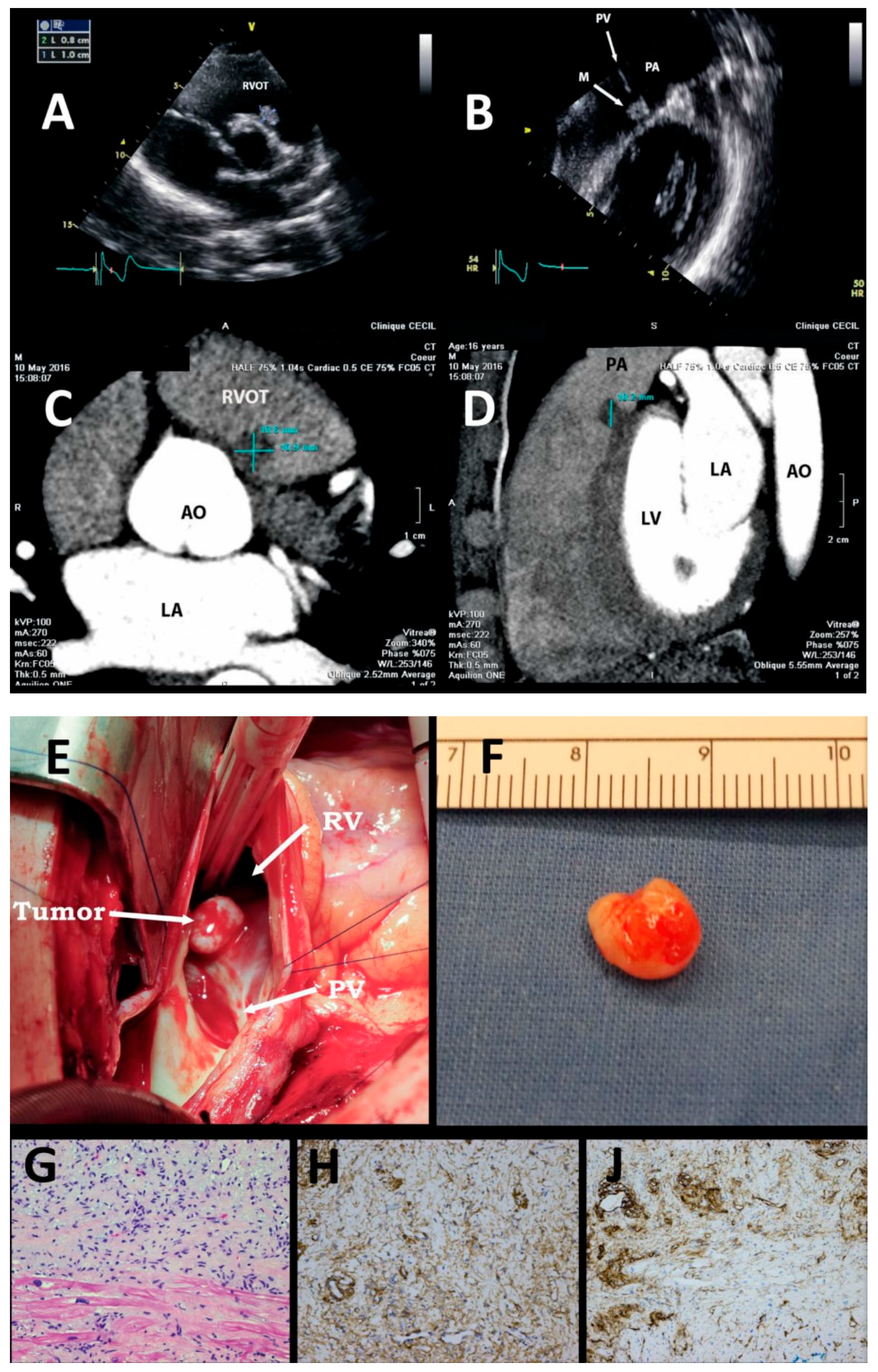
An 16-year-old male patient with a family history of hypertrophic obstructive cardiomyopathy was referred for screening echocardiography. He was asymptomatic with no medical history, took no medication and exercised regularly by playing football. Clinical status and 12-lead ECG were entirely normal. Echocaradiography showed a normal left ventricle anatomy with normal function. On transthoracic echocardiography, an 8 × 10 mm mass located in the right ventricular infundibulum, without haemodynamic obstruction, was incidentally found (Figure 1A,B). The differential diagnosis was fibroelastoma, organised thrombus, lipoma, rhabdomyoma, fibroma, or myxoma. Echocardiographic findings were confirmed on a computed tomography scan (Figure 1C,D). The mass had the same density as the septal muscle. The patient underwent surgical removal, which confirmed the presence of the mass partially attached to the pulmonary valve (Figure 1E,F). Pathophysiological analysis revealed a cardiac myxoma with a typical histopathological appearance: this lesion was composed of uniform spindle- and stellate-shaped cells with abundant eosinophilic cytoplasm, indistinct cell borders, oval and small nuclei with open chromatin. The cells were dispersed in a relatively myxoid stroma in which sparse capillarysized blood vessels were seen. The margin was not well-defined and invaded the non-atrophic cardiomyocytes on which it lay (Figure 1G). The tumour cells were diffusely positive for SMA (smooth muscle actin – Figure 1H), and for CD34 (Figure 1J). The outcome was uneventful and transthoracic echocardiography at day 30 and year 1 was normal.
Figure 1.
The mass with different imaging methods and views : by transthoracic echocardiography (Figure 1A,B), by CT scan transverse view (Figure 1C) and sagittal view (Figure 1D), surgical view of the mass, partially attached to the PV in the RVOT (Figure 1E), the surgical specimen (Figure 1F), and histopathology of the mass (Figure 1G, H, J). AO = aorta; LA = left atrium; LV = left ventricle; M = mass; PA = pulmonary artery; PV = pulmonary valve; RVOT = right ventricle outflow tract.
This is an extremely rare case of a myxoma of the right-sided cavities, especially with involvement of the pulmonary valve and right ventricular outflow tract.
Conflicts of Interest
No financial support and no other potential conflict of interest relevant to this article was reported.
References
- Gribaa, R.; Slim, M.; Kortas, C.; Kacem, S.; Ben Salem, H.; Ouali, S.; et al. Right ventricular myxoma obstructing the right ventricular outflow tract: a case report. J Med Case Rep. 2014, 8, 435. [Google Scholar] [CrossRef] [PubMed]
- Rao, P.A.; Nagendra Prakash, S.N.; Vasudev, S.; Girish, M.; Srinivas, A.; Guru Prasad, H.P.; et al. A rare case of right ventricular myxoma causing recurrent stroke. Indian Heart J. 2016, 68, 97–101. [Google Scholar] [CrossRef] [PubMed][Green Version]
© 2017 by the author. Attribution - Non-Commercial - NoDerivatives 4.0.

