

When Abnormal is Normal

Service de Cardiologie, Hôpital Cantonal Universitaire de Genève and Centre Hospitalier Universitaire Vaudois, CH-1011 Lausanne, Switzerland
Cardiovasc. Med. 2013, 16(6), 189; https://doi.org/10.4414/cvm.2013.00166
Submission received: 19 March 2013
/
Revised: 19 April 2013
/
Accepted: 19 May 2013
/
Published: 19 June 2013
1. Case History
A 36-year-old woman was seen at the Cardiac Congenital Clinic for her annual visit. She was born with a dtransposition of the great arteries (d-TGA) and underwent a Rashkind procedure shortly after birth, followed by a Senning procedure (atrial switch) in 1978. She recently went through two uncomplicated pregnancies and is asymptomatic except for occasional palpitations documented as ventricular extrasystoles and bigeminy. She does not take medication.
Her clinical status is unremarkable and cardiac auscultation reveals typical single B2.
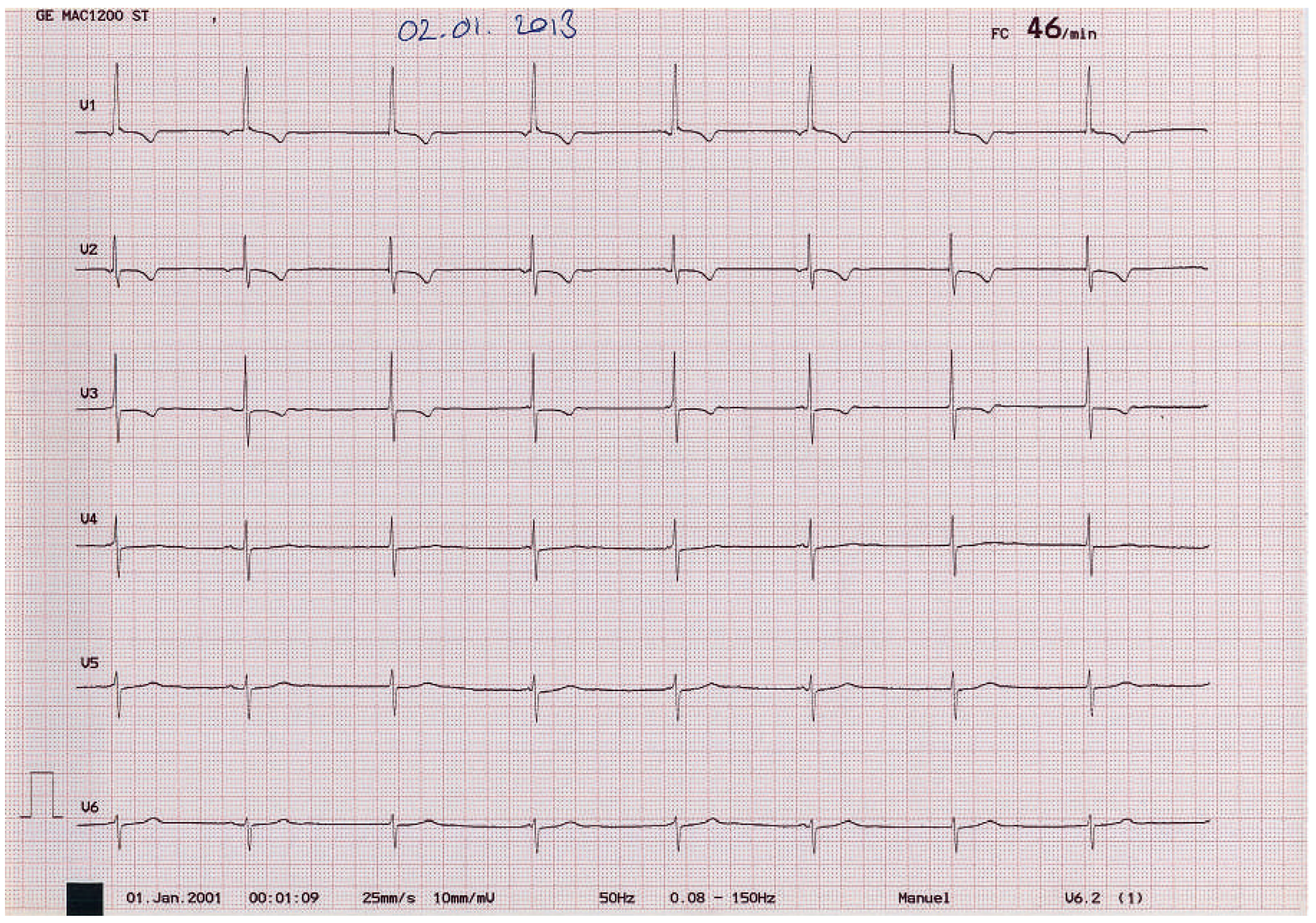
The 12-lead ECG (Figure 1 and Figure 2) shows bradycardia at 40–45 bpm with sinus rhythm alternating with junctional rhythm. There is right axis deviation with QRS axis at 170°. The PR interval is normal in sinus rhythm, and QRS is narrow. Precordial leads demonstrate right ventricular (RV) hypertrophy and there is no Q wave with a small R wave and deep S wave in lead V6.
2. Questions
- Whatisnormal/abnormalonthe12-leadECGwhentakingintoaccountthecongenitalheartdisease?
- Doesjunctionalrhythmwarrantfurtherinvestigations/interventions?
3. Commentary
In complete transposition of the great arteries, or dTGA, there is atrioventricular discordance, which means that the aorta arises from the morphological right ventricle and the pulmonary artery arises from the morphological left ventricle [1]. Nowadays, the arterial switch is the procedure of choice, as it restores the normal anatomic arrangement, but the majority of adult patients seen in adult congenital heart disease clinics underwent an atrial switch procedure. First described by Senning in 1958, it involves creation of an atrial baffle to direct the venous return to the contralateral atrioventricular valve and ventricle. Deoxygenated blood is directed to the mitral valve and left ventricle, and oxygenated blood goes to the right ventricle through the tricuspid valve. This means that the systemic ventricle is the morphological right ventricle and explains why we can see RV hypertrophy and right axis deviation. The left ventricle (the subpulmonary ventricle) is diminutive, which is reflected by the absence of Q waves, small R waves and deep S waves over the left precordial leads [2].
As a result of extensive atrial surgery, asymptomatic loss of sinus rhythm and supraventricular arrhythmias are extremely frequent after atrial switch for d-TGA [3]. In the absence of clinical repercussions and echocardiographic abnormalities, we recommend annual follow-up in a tertiary care centre with clinical examination, ECG, echocardiography, Holter monitoring and an exercise stress test to rule out chronotropic incompetence and/or symptomatic sinus node dysfunction.
Funding
No financial support.
Conflicts of Interest
No other potential conflict of interest relevant to this article was reported.
References
- Warnes, C.A. Transposition of the great arteries. Circulation 2006, 114, 2699–2709. [Google Scholar] [CrossRef] [PubMed]
- Khairy, P.; Marelli, A.J. Clinical use of electrocardiography in adults with congenital heart disease. Circulation 2007, 116, 2734–2746. [Google Scholar] [CrossRef] [PubMed]
- Gelatt, M.; Hamilton, R.M.; McCrindle, B.W.Q.; Conelly, M.; Davis, A.; Harris, L.; et al. Arrhythmia and mortality after the Mustard procedure: A 30 year single-center experience. J. Am. Coll. Cardiol. 1997, 29, 194–201. [Google Scholar] [CrossRef] [PubMed]
Figure 1.
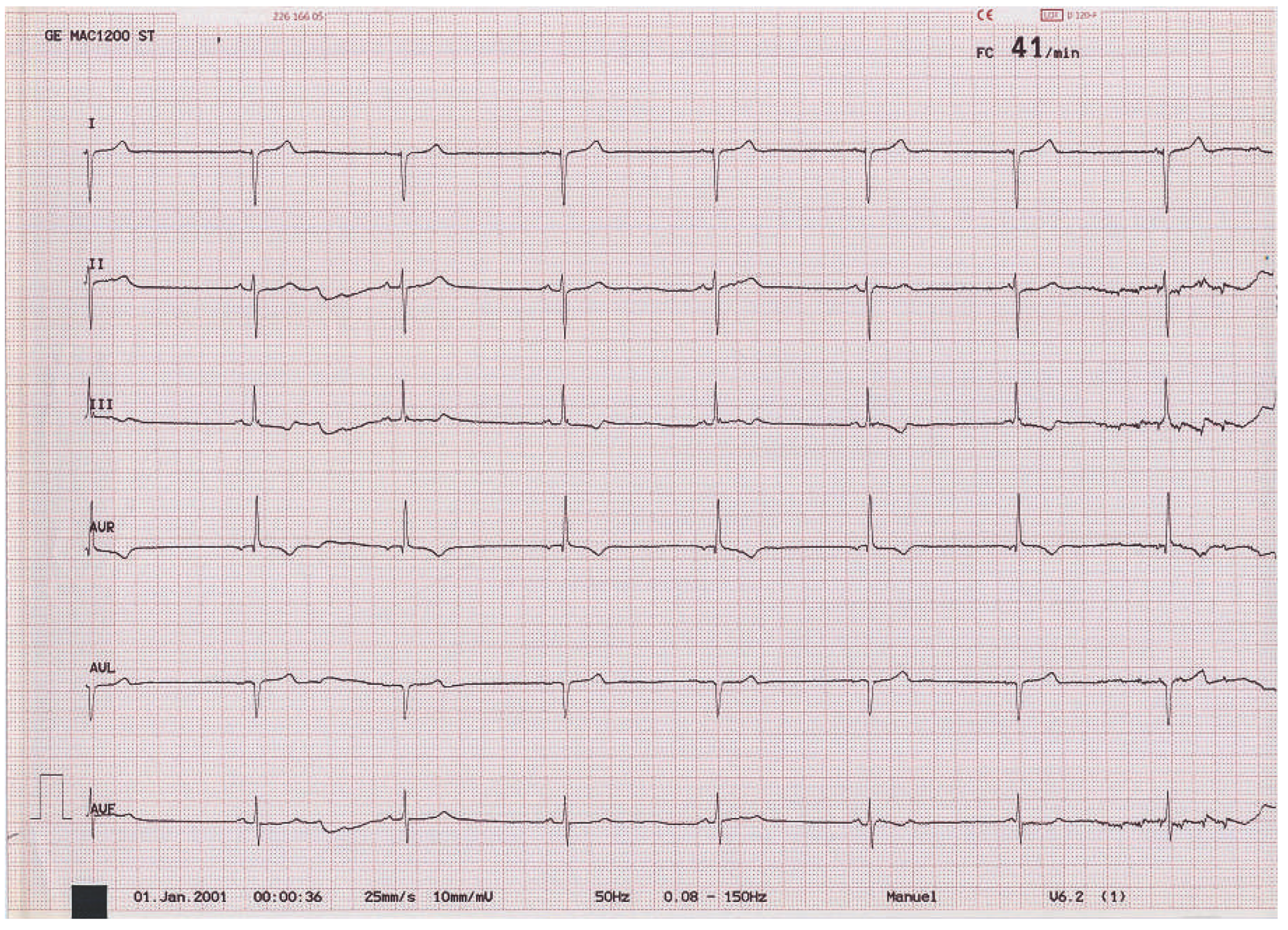
Figure 2.
© 2013 by the author. Attribution - Non-Commercial - NoDerivatives 4.0.
Share and Cite
MDPI and ACS Style
Bouchardy, J. When Abnormal is Normal. Cardiovasc. Med. 2013, 16, 189. https://doi.org/10.4414/cvm.2013.00166
AMA Style
Bouchardy J. When Abnormal is Normal. Cardiovascular Medicine. 2013; 16(6):189. https://doi.org/10.4414/cvm.2013.00166
Chicago/Turabian StyleBouchardy, Judith. 2013. "When Abnormal is Normal" Cardiovascular Medicine 16, no. 6: 189. https://doi.org/10.4414/cvm.2013.00166
APA StyleBouchardy, J. (2013). When Abnormal is Normal. Cardiovascular Medicine, 16(6), 189. https://doi.org/10.4414/cvm.2013.00166

