Zusammenfassung
Seit 1950 ist bei Männern wie Frauen ein Rückgang der Gesamtsterblichkeit und insbesondere der Sterblichkeit an Herzkreislaufkrankheiten zu verzeichnen. Im europäischen Vergleich gehört die Schweiz zu den Ländern mit tiefer Sterblichkeit an Herzkreislaufkrankheiten. Der Rückgang vorzeitig verlorener Lebensjahre durch Herzkreislaufkrankheiten war bei Frauen ausgeprägter (40% seit 1974 gegenüber 24% bei Männern). Auch die Sterblichkeit infolge cerebrovaskulärer Erkrankungen ist zurückgegangen. Bei den vorzeitig verlorenen Lebensjahren durch diese Erkrankungen ist der Geschlechtsunterschied kleiner geworden.
Im Gegensatz zu dieser insgesamt günstigen Entwicklung bei der Sterblichkeit Sind für die Risikofaktoren bescheidenere Entwicklungen zu beobachten. In der MONICA-Studie zeigen Sich zwischen 1984 und 1993 eine Abnahme des Anteils von Raucher/innen, ein geringer Rückgang der Cholesterinwerte und eine Abnahme der systolischen Blutdruckwerte bei Frauen. Hingegen lagen die systolischen Blutdruckwerte bei Männern 1993 höher, die diastolischen Blutdruckwerte bei Männern sowie Frauen. Auch der Body-Mass-lndex nahm bei Männern wie Frauen zu, der Anteil stark übergewichtiger Männer ebenfalls. Im Rahmen der MONICA-Studie erhobene Spitaldaten zeigen seit 1985 eine Abnahme der Herzkreislaufsterblichkeit von 28% bei Männern, von 19% bei Frauen sowie ein Rückgang der Hospitalisierungsrate von 10%. Wie aus der WHO-Collaborative-Study hervorgeht, ist bei Frauen die Interaktion von oraler Kontrazeption und Risikofaktoren (insbesondere Rauchen und Hypertonie) von grosser Bedeutung. Ein grosses präventives Potential liegt somit weiterhin in der Bekämpfung der kardiovaskulären Risikofaktoren.
Introduction
Epidemiology is the science which studies the distribution and determinants of health-related states or events in specified populations and the application of the study to control health problems [
1]. When I was asked to present epidemiology of arteriosclerosis and the comparison of different vascular beds, I decided to look at trends in these diseases in Switzerland. The most important data source is the Federal Office for Statistics and its mortality statistics published every year in the Statistical Year Book [
2] but there is little data available about cardiovascular morbidity. I will therefore present the first part of my reflections looking at the mortality and trends in the mortality in Switzerland and in comparison to Europe, followed by trends on cerebrovascular diseases. As a last point I should like to present trends in risk factors and discuss their contribution to the above mentioned trends. One of the focuses is on differences in trends between male and female mortality. It is important to look at the epidemiology of cardiovascular diseases differently for the different sexes: they are influenced by different risk factors in different periods of life, they demand different preventive strategies and partially different treatments. Many studies on cardiovascular diseases have concentrated on men because it is mainly men who die early of these diseases. If from these studies treatments and preventive strategies are derived, it is very important to separate them for the two sexes.
Trends in total cardiovascular mortality in Switzerland and in Europe
Switzerland belongs to the countries with
low cardiovascular mortality and low overall mortality [
3]. As cardiovascular mortality has decreased stronger than overall mortality, the proportion of cardiovascular mortality on the overall mortality has decreased considerably from 1970 to 1990 by 30% in men and 44% in women (
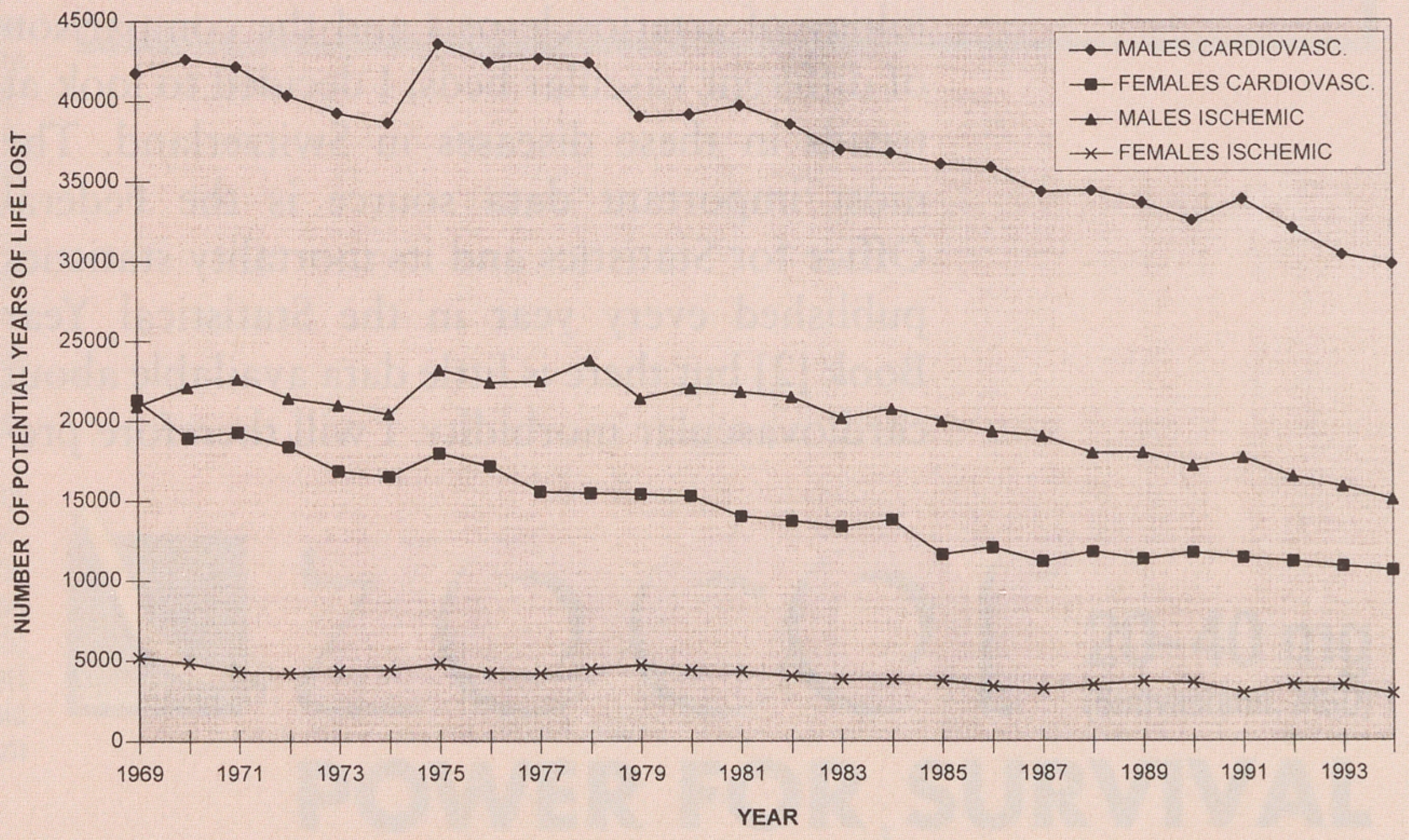
Table 1). The relationship between men and women has been remarkably stable since 1989 (1.6–1.7). In terms of potential years of life lost (i.e., years of life lost due to deaths occurring before age 70) the relationship between men and women is 2.8, meaning that men die much younger of cardiovascular diseases than women. Between 1974 and 1994, potential years of life lost decreased by only 24% for men and 40% for women (
Figure 1). Is this difference important? It shows that the changes which have led to this reduction of mortality have been more pronounced in the elderly population and in women and have not led to the same reduction in younger men.
If we want to look at cardiovascular mortality trends for Switzerland and compare them to other countries, we have to be sure that the diagnostic behaviour is comparable: there seem to be different trends for “ischaemic heart disease” and “all heart disease” between different parts of our country and between Switzerland and the surrounding countries. It is therefore safer to group them into one more reliable category including ICD-codes 400–429 [
4]. The trends in the coronary category (ICD 410–414) show a structure quite different from the overall heart disease [
5].
As compared to Europe, total mortality and cardiovascular disease have decreased in Switzerland and in France already between 1950 and 1970, whereas all other countries during this time could not show a similar decrease. Since 1970 there is still a continuous decreasing trend in women and men, the decrease in men, however, is more important than in most European countries. Since 1980 the decrease is somewhat slower. In contrast, the Eastern European countries have experienced an increase in men and only a small decrease in women. For these reasons Switzerland has become one of the countries with a very low mortality, whereas in the fifties it ranged still in the middle. All cardiac deaths have decreased around 50% in the past 25 years. This trend was already present before in younger men, the peak was reached in 1962, whereas in those over 65 the highest plateau occurred between 1963 and 1978. For women, the decrease started probably before 1951 for the younger age group, for the elderly population only after 1963.
Trends in cerebrovascular disease in Switzerland
Cerebrovascular diseases now constitute 20% of all cardiovascular deaths in men and 27% in women [
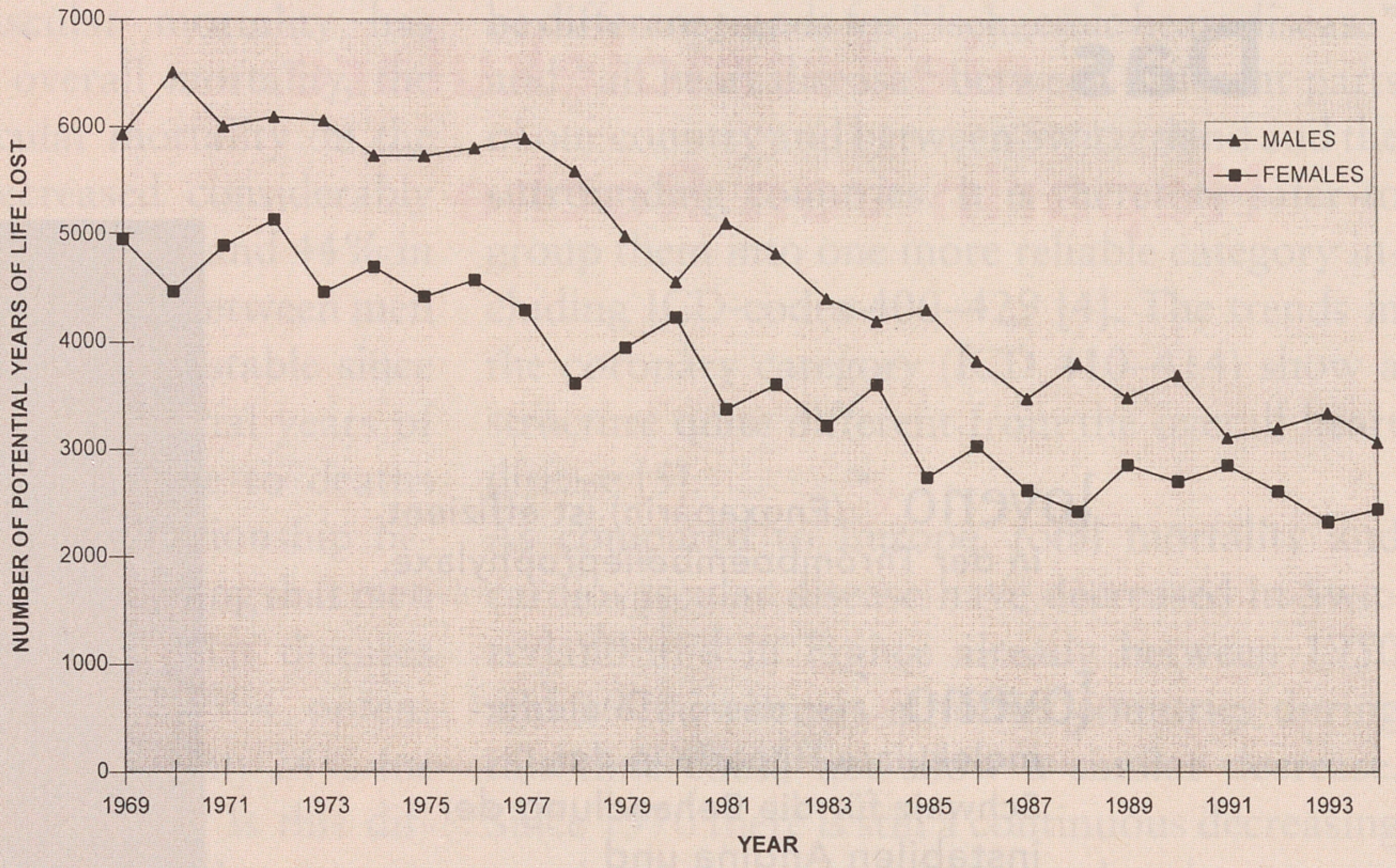
3]. In men and women the rates have decreased considerably since the fifties without any difference between men and women overall. In the younger age groups, however, there was a similar death rate in men and women in 1950, followed by a drop that was initially faster in women. The difference decreased then again very reasonably. As far as potential years of life lost are concerned, this number has decreased too. The gap between men and women became narrower and is levelling off (
Figure 2).
What do we know about risk factors?
It is surprising how low mortality is if we consider the distribution of risk factors for cardiovascular diseases in Switzerland as compared to other countries.
Switzerland belongs to the countries with many heavy smokers and we now observe an increasing number of smokers in the young generation and in females [
6,
7]. Cholesterol levels in the MONICA study show a slight decrease [
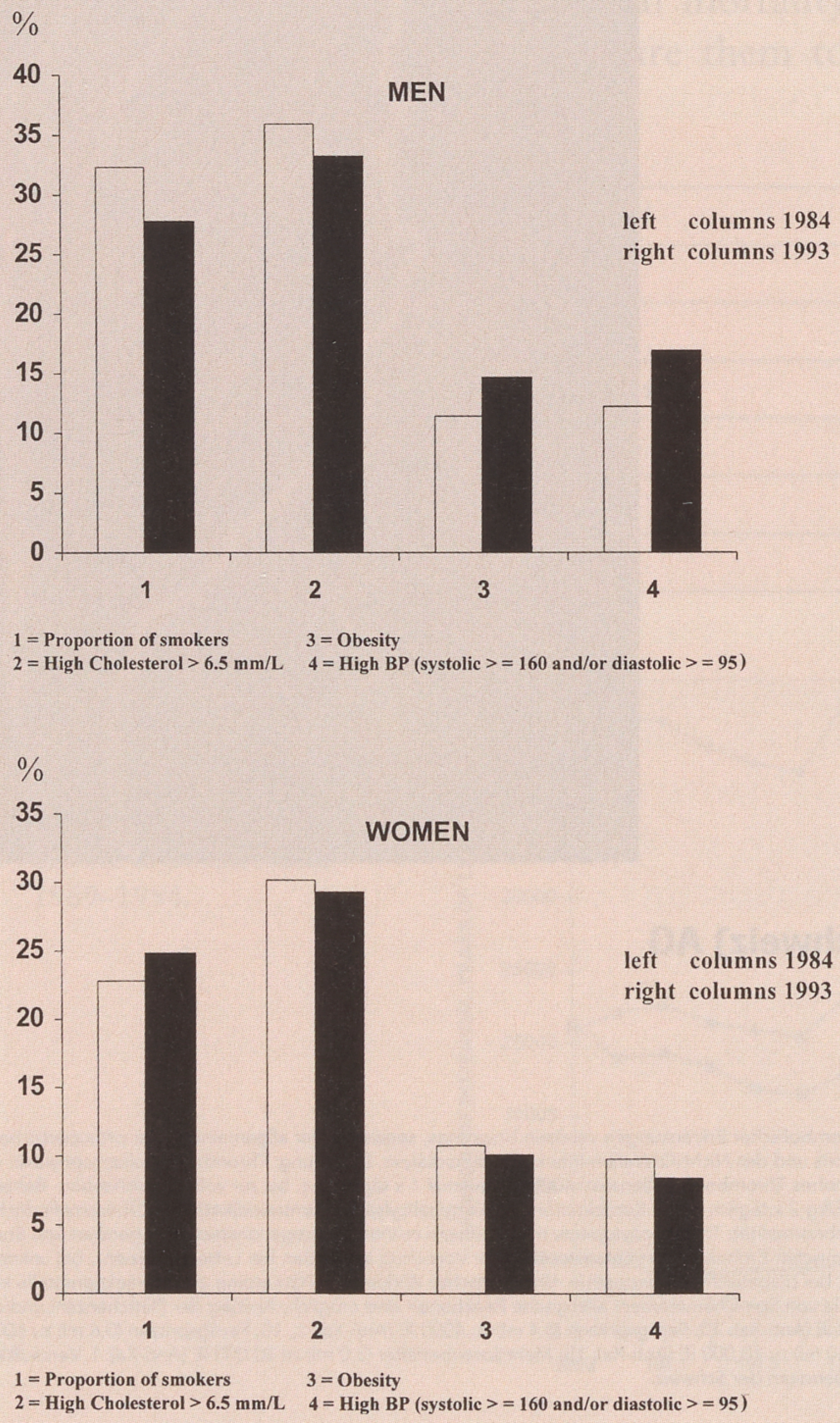
7]. However, in international comparison the cholesterol levels in Switzerland are considered to be high and this has always been a contradiction. If we assume that the decrease in cardiovascular diseases is due to changes in risk factor profiles, this is certainly wrong: the slight change in mean total cholesterol levels which was observed in the MONICA study is counteracted by a decrease in mean HDL-cholesterol as well and this change has occurred in men and women. What about the changes in cerebrovascular disease and its most important risk factor, blood pressure? The MONICA study has shown a slight decrease in systolic blood pressure for women, an increase in systolic blood pressure for men and in diastolic blood pressure for men and women (
Figure 3). The authors conclude that “the increase in prevalence of untreated hypertension among older men requires a more rigorous control from family doctors and a higher compliance for male patients” [
7].
The body mass index has been increasing for men and women alike during the study period. Prevalence of a BMI >30 has increased in men only. However, the prevalence is still considerably lower than for instance in the United States.
The MONICA study has also monitored the annual age standardised CHD mortality rate (ICD 410–414) in the population ages 25–74 and all hospital admissions due to myocardial infarction [
7]. The annual age standardised CHD mortality decreased by 28% for men (1985–1993) and by 19% for women. On the other hand, the hospitalisation rate regressed by 10% only. The overall male CHD event rate declined by 14%.
For women the interaction of oral contraception and risk factors is of importance: a recent publication of the WHO collaborative study of cardiovascular disease and steroid hormone contraception concluded for Europe that pillusers with a history of hypertension have an ODDS ratio for heart attack of 68 (95% CI: 6.18–751) as compared to non-users without hypertension [
8]. For smokers with more than ten cigarettes per day this risk increases to 87 (95% Cl: 29.8–254).
Conclusions
Cardiovascular mortality has decreased in Switzerland over the past 25 years, both in men and women. At the same time, there has been a slight change in risk factors with some of them increasing in recent years (e.g., systolic blood pressure, BMI and smoking). More than half of the decline in CHD event rate in VD/FR in the ten-year period of MONICA can be attributed to a decline in the proportion of fatal CHD events to which the recent improvements in the hospital management of myocardial infarction have most likely contributed a big part. Roughly half of the fall of CHD event rate is left to the potential impact of reduction of risk factors levels. But these risk factors do not continue to decline. There are several ways in which the profession should react: the smoking habits in the younger population should be controlled and there should be a vigorous antismoking policy. Especially in women, there should be more concern about the combination of hypertension, oral contraception and smoking. The control and treatment of hypertension in men and women is not yet optimal. It is to conclude that most of the observed trends are due to improvement in eating habits. The increase in body mass index in men between 40 and 54 and the increase in severe obesity in this group should raise concern.
Prevention of cardiovascular diseases seems to be boring: we repeat the same messages again and again and again. That it is still needed has been shown in this paper.