1. Introduction
Multiprofessional Health Residency Programs in Brazil were established in 2005 following the enactment of Law No. 11,129 and are characterized as a lato sensu postgraduate training modality based on in-service education [
1]. These programs aim to develop technical, ethical, and interpersonal competencies among health professionals from different disciplines to meet the demands of the Brazilian Unified Health System (Sistema Único de Saúde—SUS) and contribute to the development of the healthcare workforce within the broader public health system.
In recent years, the role of hospital dentistry—particularly in the care of patients with chronic diseases, with emphasis on oncology—has expanded substantially. The presence of a dentist within the multidisciplinary team of support to the cancer patient is crucial, due to the oral needs presented by these patients [
2,
3]. This growth culminated in the formal recognition of hospital dentistry as a dental specialty in Brazil through Resolution No. 262, issued by the Brazilian Federal Council of Dentistry in January 2024 [
4]. The consolidation of this field has been further strengthened by the inclusion of dentists in multiprofessional residency programs within hospital environments, especially in oncology services, contributing to the development of a specialized healthcare workforce to meet increasingly complex population health needs.
Despite these advances, dentists remain among the health professionals with the least exposure to hospital routines, end-of-life care, and experiences related to death and dying during undergraduate education. Although some Brazilian dental schools have attempted to address these gaps through isolated courses or short observational internships, such initiatives remain inconsistent and insufficient [
5]. Topics such as palliative care, grief, and bereavement are still rarely integrated into dental curricula [
6]. How can dentists’ ability to cope with death, dying, and grief evolve throughout their careers? How and when is it most appropriate to implement discussions about death, dying, and grief for undergraduate students and practicing dentists? These questions transcend dental specialties regarding the best professional training [
7]. This limited exposure may increase vulnerability, particularly when dentists are later confronted with death and suffering in oncology settings. More broadly, recent evidence indicates that healthcare professionals working in high-demand clinical settings are at increased risk of psychological burden, including anxiety, depression, occupational stress, and reduced psychological well-being, reinforcing the public health importance of preventive strategies that address both individual and organizational factors [
8].
Healthcare professionals involved in oncology care frequently experience the death of their patients. Although patient loss may generate significant emotional burden not only for families but also for healthcare professionals involved in patient care [
9,
10,
11], professional grief remains an underrecognized and insufficiently investigated phenomenon in the literature [
9,
10,
11]. Psychological burden in this context—consistently associated with reduced quality of life and impaired professional performance [
12,
13,
14,
15,
16,
17]—often manifests through interrelated responses of anxiety, depression, and grief. Evidence suggests that less experienced professionals are particularly vulnerable to these impacts due to limited coping strategies and reduced exposure to death and dying [
12,
13,
14]. Consequently, understanding how these variables interact is essential for developing effective educational and institutional support strategies.
Building on this, previous research has shown that these psychological responses are often interrelated and negatively impact quality of life and professional functioning [
15,
16,
17]. Moreover, less experienced professionals may be particularly vulnerable due to limited coping strategies and reduced prior exposure to end-of-life care situations [
12,
13,
14].
From a public health perspective, understanding and addressing the mental health of healthcare professionals is also relevant to workforce development and the sustainability of healthcare services.
Thus, the aim of this study was to assess the levels of anxiety, depression, and professional grief overload among dentists working with oncology patients in Brazilian multidisciplinary residency programs. Additionally, we aimed to analyze the correlations among these variables and quality of life, expecting to find that higher psychological burden would be associated with poorer quality of life, particularly among younger and less experienced professionals.
2. Materials and Methods
This quantitative, descriptive, cross-sectional study was approved by the Research Ethics Committee of the Faculty of Philosophy, Sciences and Letters of the University of São Paulo (CAAE: 600230022.3.0000.5407). This model dictates that a study should have a pre-established start and end date for data collection. In this investigation, the data collection period was delimited to three months, from 1 June 2025 to 1 September 2025. This study was conducted and reported in accordance with the Strengthening the Reporting of Observational Studies in Epidemiology (STROBE) guidelines.
2.1. Sample Selection
The sample consisted of resident dentists enrolled in multiprofessional oncology residency (RMS) programs and preceptors (licensed dentists responsible for supervising and mentoring residents during their clinical training) affiliated with Brazilian health services. The sample size was determined based on feasibility, considering the limited number of multiprofessional oncology residency programs including dentists in Brazil, which restricts the size of the accessible population. To meet the study’s inclusion criteria, participants had to: be associated with an oncology multiprofessional residency program, have had at least six months of contact with the residency, work directly with seriously ill patients and be available to voluntarily collaborate with the research.
Professionals were excluded if they: had no affiliation with multiprofessional residencies, had no direct contact with patients during the residency, had recently entered the residency program (less than six months), and were absent, regardless of the reason, from residency activities.
2.2. Data Collection Instruments:
2.2.1. Sociodemographic and Professional Questionnaire
Data were collected using a structured sociodemographic and professional questionnaire developed for this study. The instrument included information on age, gender, marital status, religious affiliation, profession/area of expertise, years since graduation, and years of professional experience (including residency training). This questionnaire aimed to characterize the study population and contextualize the subsequent analyses.
2.2.2. Medical Outcomes Short-Form Health Survey (SF-36)
The SF-36 is a multidimensional instrument for generic health assessment, originally developed by Ware and Sherbourne [
18] and later adapted for cross-cultural use and validated for the Brazilian population by Ciconelli et al. [
19]. The Brazilian adaptation included translation, cultural adaptation, and psychometric evaluation.
The validation process assessed measurement properties including reproducibility (test–retest reliability using intraclass correlation coefficients), construct validity, and known-groups validity, demonstrating adequate ability of the instrument to discriminate between different health conditions.
The SF-36 comprises 36 items distributed across eight domains, organized into two components: Physical Component Summary (PCS) and Mental Component Summary (MCS). The PCS includes physical functioning, role limitations due to physical problems, bodily pain, and general health perceptions, while the MCS includes vitality, social functioning, role limitations due to emotional problems, and mental health. In the present study, the SF-36 demonstrated adequate to excellent internal consistency across domains, with Cronbach’s alpha values ranging from 0.74 to 0.93.
2.2.3. Professional Grief Overload Scale (ESPL)
The Professional Grief Overload Scale (ESPL) assesses the emotional and psychological impact of cumulative losses and professional grief among healthcare professionals, particularly in contexts of frequent exposure to death and critically ill patients. It was originally developed within the framework of occupational grief and emotional burden in healthcare settings by Gama and Vieira [
20] and later adapted and validated for the Brazilian context by Farias et al. [
21].
In the present study, the use of the total score of the SLP-Br was chosen, obtained by summing all items, to represent a global measure of professional grief burden. This decision is justified by the statistical robustness of the instrument as a whole; in the Brazilian validation study, the scale showed a total Cronbach’s alpha of 0.85 (and a Guttman’s Lambda 2 of 0.85 as well), indicating good internal consistency and reliability for measuring the phenomenon as a single construct.
The ESPL consists of 15 items rated on a Likert-type scale ranging from 1 (strongly disagree) to 5 (strongly agree), distributed across four dimensions: Tormented Confinement, reflecting feelings of emotional entrapment, cumulative exposure to patient losses, and restrictions in personal life due to professional demands; Emotional Effort in Caregiving, referring to the emotional burden and psychological difficulties associated with caring for seriously ill and terminally ill patients; Nostalgic Loss, encompassing feelings of absence, longing, and emptiness related to deceased patients; and Misunderstood Sharing, reflecting difficulties in having grief experiences acknowledged, validated, or understood by family members, friends, or colleagues. These dimensions can be aggregated into a total score, representing an overall measure of professional grief overload. In the present study, analyses were conducted using the total ESPL score, calculated as the sum of all 15 items. The instrument demonstrated good internal consistency in the present sample (Cronbach’s α = 0.87).
Because the Professional Grief Overload Scale (PGOS) has no validated clinical cut-off scores for severity classification, the total PGOS score was analyzed primarily as a continuous variable. For descriptive purposes, the distribution of scores was additionally examined using sample-derived tertiles. These tertile categories were derived from the distribution of scores in the present sample and were used solely for descriptive purposes; they do not represent validated clinical cut-off scores or indicate levels of severity.
2.2.4. Hospital Anxiety and Depression Scale (HADS)
The Hospital Anxiety and Depression Scale (HADS) was originally developed by Zigmond and Snaith [
22] and is widely used for screening symptoms of anxiety and depression in clinical and non-clinical populations. The Brazilian Portuguese version was translated, cross-culturally adapted, and validated by Botega et al. [
23].
The validation study evaluated internal consistency, construct validity, sensitivity, and specificity. The instrument demonstrated acceptable psychometric properties for screening purposes, with Cronbach’s alpha values of approximately 0.68 for anxiety, 0.77 for depression, and around 0.80 for the total scale.
The HADS consists of two subscales, anxiety (HADS-A) and depression (HADS-D), each containing seven items, with scores ranging from 0 to 21 per subscale. Higher scores indicate a greater likelihood of clinically significant symptoms. In the present study, standard cut-off scores (≥8) were adopted for possible cases of anxiety and depression. The HADS demonstrated good internal consistency, with Cronbach’s alpha values of 0.84 (total scale), 0.82 (anxiety), and 0.80 (depression).
2.3. Collection Procedure
Invitation emails containing information about the study and a link to the online questionnaire were sent to dentists (residents and preceptors) affiliated with Brazilian oncology residency programs using contact information provided by the residency program management committees (COREMUS). The questionnaire was distributed by email through the Multiprofessional Residency Committees (COREMUS), inviting dentists linked to 11 national health services to participate in the research. Professionals who agreed to participate accessed a link that directed them to the research form. All questions required mandatory answers, and the form could only be submitted after complete filling.
On the initial page of the online form, the Free and Informed Consent Form was presented, explaining the purpose of the research, the format of the questions, the possible harms, that there will be no financial or other type of remuneration, and clarifying that non-participation would not entail any loss or harm. At the end of this description, the participant could answer, considering the above, whether they agreed or disagreed to participate in the research. By agreeing, the respondent proceeded to the first group of questions on the form; otherwise, the form was submitted and participation ended. After obtaining informed consent, the participant would answer some identification questions (sex, age, marital status, religion, profession, years since graduation, years of residency) and then be directed to the questionnaires.
2.4. Statistical Analysis
Anxiety, depression, and professional grief were considered outcome (-dependent) variables. Quality of life domains and sociodemographic/professional characteristics were treated as independent variables in the analyses. Data were initially recorded and organized using Microsoft Excel, while all statistical analyses were subsequently conducted using R (version 4.4.2; packages: stats, cluster, factoextra) and Python (version 3.12.7; libraries: pandas, scipy, scikit-learn). Continuous variables were summarized as means, standard errors, or confidence intervals, depending on data distribution, while categorical variables were presented as frequencies and percentages. Data distribution was assessed using the Shapiro–Wilk test, and the choice between parametric and non-parametric tests was made accordingly.
Associations between anxiety, depression, and grief-related distress and quality of life domains were evaluated using Spearman’s correlation coefficient. Comparisons between binary groups were performed using Student’s t-test.
To explore potential psychological profiles within the sample based on anxiety, depression, and professional grief scores, an exploratory K-means cluster analysis was conducted. The optimal number of clusters (k = 3) was determined using the elbow method in combination with interpretability criteria. K-means clustering was performed using standardized Anxiety, Depression, and Grief scores. This approach was selected because the variables were numeric and the aim was to identify homogeneous symptom-profile groups. To reduce sensitivity to local optima, the algorithm was estimated with 100 random starts. Cluster validity was examined using internal validation indices. The 3-cluster solution yielded an average silhouette coefficient of 0.35, indicating weak to moderate cluster separation, with a Calinski–Harabasz index of 36.7 and a Davies–Bouldin index of 1.06, confirming the exploratory nature of these findings. Differences in quality-of-life domains across clusters were assessed using the Kruskal–Wallis test, followed by Dunn’s post hoc test with Bonferroni correction for multiple comparisons. Associations between clusters and categorical demographic variables were examined using Pearson’s chi-square test. Fisher’s exact test was used when the assumptions of Pearson’s chi-square test were not met due to small expected cell frequencies. A two-sided significance level of 5% (p < 0.05) was adopted for all analyses.
3. Results
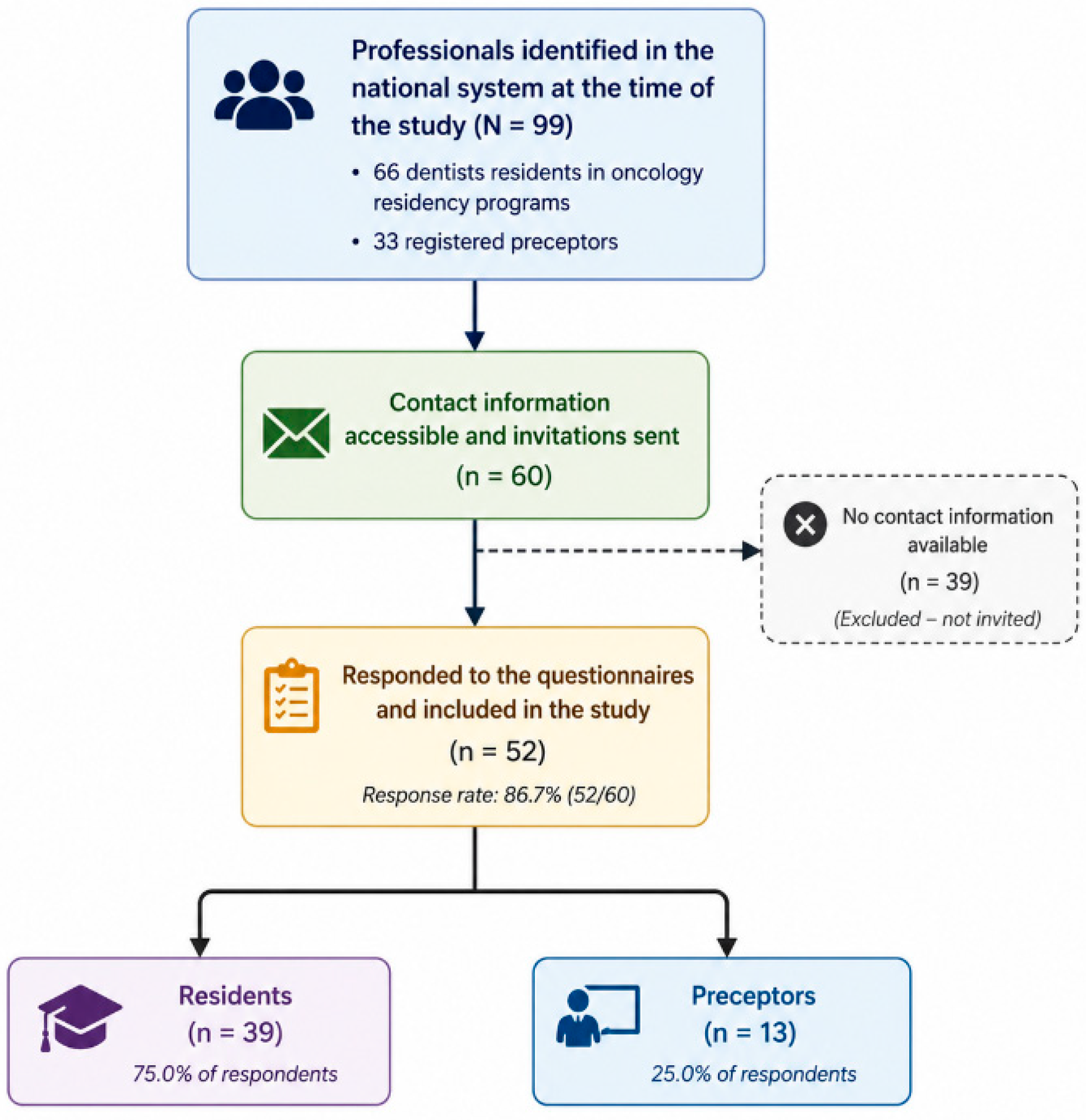
At the time of the study, the Brazilian national residency database identified 13 active oncology residency programs offering training positions for dentists (six in the Southeast, three in the Northeast, two in the Central-West, and two in the South), comprising 66 residents and 33 registered preceptors (99 eligible professionals). Contact information was obtained for 60 professionals from 11 residency programs after requests to the respective COREMUs. The remaining two programs (one from the Southwest and the other from the Northeast) did not provide contact information despite repeated requests. All 60 eligible professionals for whom contact information was available were invited to participate, and 52 completed the questionnaires (response rate: 86.7%), as shown in
Figure 1.
The median age was 30 years (range: 22–52 years). The sample was predominantly female (69.2%), single (80.8%), and composed of resident dentists (75.0%), most of whom were in the second year of training. The majority of participants reported having a religious affiliation (84.6%), and over half had between one and two years since graduation. Detailed demographic and professional characteristics are presented in
Table 1.
Quality of life results indicated high scores in physical functioning, whereas lower scores were observed in vitality, social functioning, role limitations due to emotional problems, and mental health, suggesting relevant psychosocial impairment among participants. Overall, 28.9% of the study population presented mild anxiety (8–10), whereas 32.7% exhibited moderate to severe anxiety (≥11). In terms of depression, 23.1% of participants presented mild symptoms (8–10) and 13.5% exhibited moderate to severe depression (≥11). The mean score was 37.6 points (SD = 9.8; interquartile range [IQR], 31.5–44.3). For descriptive purposes, participants were categorized according to tertiles derived from the distribution of scores in the present sample. Overall, 61.5% of participants had scores within the second or third tertile, while 28.8% had scores within the upper tertile. These tertile-based categories were used solely to describe the distribution of Professional Grief Overload Scale scores in the sample and do not represent validated clinical cut-off scores or indicate levels of severity. A summary of these results, including internal consistency estimates, is presented in
Table 2.
Among the Professional Grief Overload Scale subscales, Tormented Confinement presented the highest mean score (M = 16.54; SD = 5.27), followed by Emotional Effort in Care (M = 9.27; SD = 2.61), Misunderstood Sharing (M = 6.60; SD = 2.51), and Nostalgic Loss (M = 5.19; SD = 2.03).
The outcome variables—anxiety, depression, and professional grief—were positively correlated with each other. A strong correlation was observed between anxiety and depression (ρ = 0.71,
p < 0.0001), while anxiety showed a moderate correlation with professional grief (ρ = 0.55,
p: 0.0002), and depression showed a weaker correlation with professional grief (ρ = 0.39,
p: 0.0035).
Table 3 presents the Spearman correlation results between anxiety, depression, and grief versus quality of life.
Higher levels of anxiety, depression, and professional grief were associated with lower quality of life scores. Anxiety and depression demonstrated consistent negative correlations with most quality-of-life domains, whereas professional grief showed weaker and more limited associations, being significantly correlated with general health, vitality, social functioning, and mental health.
No statistically significant differences were found between the outcome variables (anxiety, depression, and professional grief overload) and gender, marital status, professional position, residency year, time since graduation, area of expertise, or religious affiliation based on Student’s t-test or Kruskal–Wallis comparisons.
The exploratory cluster analysis based on anxiety, depression, and professional grief scores identified three exploratory psychological profiles within the study sample. Cluster 0 was characterized by lower levels of anxiety, depression, and professional grief overload, Cluster 1 by higher levels, and Cluster 2 by intermediate levels. Descriptive statistics for each cluster are presented in
Table 4.
Differences in quality of life across clusters followed a consistent pattern, with Cluster 0 showing the highest scores and Cluster 1 the lowest across most domains. Statistically significant differences were observed for all quality of life domains except bodily pain. The largest differences were found in vitality, social functioning, and mental health. Regarding demographic characteristics, significant differences between clusters were observed for marital status, professional position, and time since graduation, with Cluster 0 including a higher proportion of individuals who were married or in a stable relationship, preceptors, and professionals with longer time since graduation. No significant differences were found for gender, residency year, or religious affiliation. These results are detailed in
Table 5.
4. Discussion
The present study aimed to characterize levels of anxiety, depression, and professional grief overload among Brazilian dentists working with oncology patients in hospital settings, specifically within multiprofessional residency programs. By including both residents and preceptors, the study sought to explore the influence of professional experience and demographic factors on psychological outcomes in a context marked by intense emotional demands, prolonged exposure to suffering, and frequent encounters with death.
The mean ESPL score observed in the present sample suggests a relevant cumulative burden of professional grief among oncology dentists. Although the ESPL does not provide validated clinical cutoff values, higher scores reflect greater emotional burden related to repeated patient losses rather than a diagnosable mental health condition. This finding is consistent with persistent emotional demands that may contribute to psychological distress, emotional exhaustion, and poorer quality of life among healthcare professionals. Our results align with previous evidence indicating that grief experiences among healthcare professionals are highly individual and influenced by personal coping strategies, social support networks, and professional roles [
5,
6].
Although dentists are directly involved in the care of severely ill patients, their clinical trajectory and patterns of patient interaction differ from those of physicians and nursing staff, which may influence how grief is experienced and processed. The dentist’s role—situated between technical care and sustained patient contact—may generate a distinct form of emotional exposure characterized by repeated losses that are often insufficiently acknowledged within institutional contexts. Furthermore, among the ESPL dimensions, Tormented Confinement presented the highest mean score. This dimension may reflect cumulative exposure to patient losses, feelings of emotional entrapment, and restrictions in personal life arising from professional demands, suggesting that professional grief overload in this population may be more closely related to the ongoing emotional burden of oncology care than to feelings of longing or nostalgic attachment to deceased patients.
Professional grief overload should be distinguished from other forms of occupational psychological burden commonly described among healthcare professionals. Although professional grief overload has been positively associated with burnout, compassion fatigue, secondary traumatic stress, insomnia, and depression, these constructs represent related but distinct phenomena. Professional grief overload specifically reflects the emotional response to repeated patient loss and cumulative bereavement experiences, whereas burnout is primarily characterized by emotional exhaustion, depersonalization, and reduced personal accomplishment resulting from chronic occupational stress. Compassion fatigue and secondary traumatic stress are more directly linked to prolonged empathic engagement with patients’ suffering and exposure to traumatic experiences. Importantly, previous studies have shown that professional grief overload explains unique variance in burnout dimensions, suggesting that it constitutes an independent construct rather than merely another manifestation of occupational stress. Social support has consistently been identified as a protective factor and has been associated with lower levels of professional grief overload and burnout [
24]. Although burnout, compassion fatigue, and secondary traumatic stress were not directly assessed in the present study, distinguishing these constructs from professional grief overload is important for interpreting the observed associations with anxiety, depression, and quality of life.
The experience of death and bereavement is deeply shaped by social, cultural, historical, and symbolic meanings, which influence how loss is interpreted and expressed [
6]. In healthcare settings, unresolved or cumulative grief can manifest as psychological burden, including anxiety and depression, and other alterations associated with chronic stress, with direct repercussions on quality of life [
25]. Anxiety and depression were negatively associated with several quality-of-life domains. These findings are consistent with the previous literature indicating that psychological suffering among healthcare professionals extends beyond emotional symptoms and significantly compromises psychosocial well-being and daily functioning [
9,
10]. However, these associations should be interpreted with caution, as anxiety and depression were measured using the same instrument (HADS), which may inflate the observed correlations due to shared method variance.
The strong correlation observed between anxiety and depression, along with their association with poorer quality of life indicators, suggests that these conditions may co-occur as related dimensions of psychological burden rather than representing entirely independent constructs. Professional overload, emotional exhaustion, and difficulties in processing loss have been associated with psychological vulnerability in healthcare workers [
11,
12,
26]. Menacho-Rivera et al. (2025) observed that dental students with chronic stress and depression were 3.7 times more likely to exhibit emotional exhaustion compared to those without these conditions [
27]. Nevertheless, given the cross-sectional design of this study, causal relationships between these variables cannot be established.
The 3-cluster solution, while showing weak to moderate separation (silhouette coefficient = 0.35), identified meaningful psychological profiles that warrant further investigation in larger samples. The previous methodological literature suggests that exploratory cluster analysis may provide clinically meaningful descriptive patterns even in relatively small samples when a limited number of variables are analyzed and findings are interpreted cautiously [
28,
29,
30,
31]. Accordingly, an exploratory cluster analysis was performed to identify potential psychological profiles within the sample. Given the sample size and the absence of formal cluster stability validation procedures, these findings should be considered hypothesis-generating rather than confirmatory. Three exploratory psychological profiles were identified. Participants in the high-burden cluster reported poorer quality of life, particularly in vitality, social functioning, and mental health, whereas those in the low-burden cluster demonstrated more favorable outcomes across domains. Differences in marital status, professional position, and time since graduation were also observed between clusters. Although these findings do not support causal or predictive inferences, they may suggest that factors such as social support and professional experience are associated with greater emotional resilience. Marital status has been linked to improved emotional regulation and coping capacity [
32], while greater professional seniority may reflect increased experience in managing emotionally demanding clinical situations [
8,
13,
33].
The demographic profile of the sample—predominantly young, female professionals with fewer than five years since graduation and a higher proportion of residents—reflects the current structure of multiprofessional residency programs in Brazil. These programs typically maintain a ratio of one preceptor for every three to five residents and attract recently graduated professionals who often enter residency immediately after completing undergraduate training [
1]. This sample composition should be considered when interpreting the findings, as it may limit the generalizability of the results to more experienced professionals or different clinical contexts.
Contrary to some studies that report greater emotional vulnerability among female healthcare professionals [
14,
34], no significant differences were observed in anxiety, depression, or professional grief overload according to sex in the present sample. Similarly, no significant association was observed between religious affiliation and psychological outcomes. This finding should be interpreted with caution, particularly given the limited sample size. Although spirituality has been described as a potential coping resource [
15,
35], the present findings do not support a significant association, possibly due to the limited sample size.
Taken together, these findings highlight the psychological burden experienced by dentists working in hospital-based oncology care, particularly in a sample predominantly composed of young and recently graduated professionals. These findings should be interpreted cautiously and considered hypothesis-generating rather than conclusive. The observed psychological burden may be related, among other factors, to limited exposure to hospital environments, death, dying, and palliative care during undergraduate dental education [
1,
6]. No significant association was observed between time since graduation and anxiety or professional grief overload.
Beyond educational initiatives, these findings also have broader implications for occupational health and public health policies. Healthcare institutions and residency programs should consider implementing structured mental health promotion strategies, including routine psychological support, clinical supervision, peer-support groups, and accessible counseling services for professionals working in emotionally demanding oncology settings. Such initiatives may contribute to reducing psychological burden, improving workforce retention, and promoting healthier work environments. At the policy level, incorporating competencies related to grief management, emotional self-care, and mental health into national residency training guidelines may strengthen the preparation of dental professionals for oncology practice and support the development of preventive strategies aimed at protecting the mental health of the healthcare workforce.
Future research should include larger and longitudinal designs to confirm the psychological profiles identified in this study, examine potential causal relationships, and further investigate the influence of demographic and professional factors on psychological outcomes among dentists working in oncology care.
The incorporation of structured education on death, dying, and grief into dental curricula is essential, including opportunities for emotional support and reflection. Such training should address not only technical aspects, but also psychological, social, and ethical dimensions of end-of-life care [
35]. Unlike other health professions, dental training has traditionally emphasized technical competence, offering limited preparation for the emotional and existential dimensions of caring for patients with life-threatening illnesses [
3]. From an institutional and educational perspective, these findings underscore the need for training on death, dying, grief, and emotional self-care in dental curricula and multiprofessional residency programs. Formal spaces for reflection, supervision, and peer support may help mitigate psychological distress and promote healthier coping strategies among dentists working in oncology settings, particularly during the early stages of professional development [
36,
37].
The relatively small sample size should be considered when interpreting the findings, particularly those from subgroup analyses. Small sample sizes within demographic subgroups may have limited the precision of the estimates and the ability to detect small associations. This limitation is especially relevant for comparisons according to sex, religious affiliation, residency status, and other demographic variables, for which no statistically significant associations were observed. Consequently, these negative findings should be interpreted cautiously, as they may reflect Type II error rather than the true absence of an association. Despite the relatively small sample size, this study included more than half (52.5%) of the entire population of dentists and preceptors registered in Brazilian oncology multiprofessional residency programs and achieved an 86.7% response rate among invited professionals. The sample consisted of a substantial proportion of this small and professionally isolated national population.
The use of a convenience sample and voluntary participation may introduce selection bias, as individuals experiencing higher or lower levels of psychological burden may have been more or less likely to participate. In addition, potential nonresponse bias should be considered, as differences between respondents and non-respondents could not be assessed. The reliance on self-reported measures may also introduce response bias, including social desirability bias, which may lead participants to underreport symptoms of psychological burden, particularly in relation to anxiety, depression, and professional grief overload.
The cross-sectional design precludes causal inference and does not allow for the assessment of temporal relationships. Therefore, it is not possible to determine the directionality of associations between psychological burden and quality of life. In addition, no adjustments were made for potential confounding variables. Finally, the cluster analysis was exploratory in nature and should be interpreted with caution due to the lack of formal validation and the limited sample size and the absence of replication.
In addition to these methodological limitations, the generalizability of these findings should also be considered in light of the specific characteristics of the Brazilian healthcare system and multiprofessional residency model. Cultural factors, educational pathways, and organizational aspects of oncology care may influence how dentists experience professional grief overload and psychological burden. Therefore, caution is warranted when extrapolating these findings to other countries with different healthcare systems, residency structures, and professional roles for dentists. Nevertheless, the emotional challenges associated with repeated exposure to severe illness, patient suffering, and death are common across oncology settings, suggesting that the need for emotional preparedness, institutional support, and mental health promotion may have broader relevance for healthcare professionals working in similar contexts internationally.
Despite these methodological and contextual limitations, this study suggests that dentists working in oncology care within multidisciplinary residency programs may experience relevant levels of anxiety, depression, and professional grief overload, with potential impacts on quality of life. The cluster analysis findings should be interpreted as exploratory descriptive profiles rather than stable population-derived classifications.





 ,
,