Caregiver-Mediated Adherence and Perceived Health System Factors Associated with Viral Suppression Among Children Receiving Antiretroviral Therapy in Rural South Africa




Highlights
- Achieving viral suppression among children receiving antiretroviral therapy (ART) remains a critical challenge for paediatric HIV programmes in rural sub-Saharan Africa.
- This study examines how caregiver-mediated adherence and perceived health system factors are associated with treatment outcomes among children on ART.
- The findings demonstrate a strong association between reported caregiver-mediated adherence and viral suppression, highlighting the importance of household-level adherence support in paediatric HIV treatment success.
- Perceived healthcare access and service quality were not significantly associated with viral suppression, suggesting that behavioural and caregiving dynamics may play a more proximal role in this context.
- Strengthening caregiver-focused adherence support interventions appears to be critical for improving and sustaining paediatric HIV treatment outcomes in rural health systems.
- Further research through robust, large-scale longitudinal designs is warranted to more accurately explain the complex interaction between caregiver adherence support and health system performance within paediatric HIV care.
Abstract
1. Introduction
2. Material and Methods
2.1. Study Design and Setting
2.2. Study Population and Sampling
2.3. Data Collection and Measures
2.4. Statistical Analysis
2.5. Ethical Considerations
3. Results
3.1. Participant Characteristics
3.2. Prevalence of Viral Suppression and ART Adherence
3.3. Association Between Caregiver-Reported Adherence and Viral Suppression
3.4. Diagnostic Performance and Effect Size of Adherence
3.5. Association Between Perceived Healthcare Access and Viral Suppression
3.6. Association Between Perceived Service Quality and Viral Suppression
4. Discussion
4.1. Study Limitations
4.2. Conclusions
Supplementary Materials
Author Contributions
Funding
Institutional Review Board Statement
Informed Consent Statement
Data Availability Statement
Acknowledgments
Conflicts of Interest
References
- World Health Organization. HIV Statistics, Globally and by WHO Region, 2023; World Health Organization: Geneva, Switzerland, 2023. [Google Scholar]
- Pham, M.D.; Nguyen, H.V.; Anderson, D.; Crowe, S.; Luchters, S. Viral load monitoring for people living with HIV in the era of test and treat: Progress made and challenges ahead—A systematic review. BMC Public Health 2022, 22, 1203. [Google Scholar] [CrossRef] [PubMed]
- Cardenas, M.C.; Farnan, S.; Hamel, B.L.; Mejia Plazas, M.C.; Sintim-Aboagye, E.; Littlefield, D.R.; Behl, S.; Punia, S.; Enninga, E.A.L.; Johnson, E. Prevention of the Vertical Transmission of HIV. A Recap of the Journey so Far. Viruses 2023, 15, 849. [Google Scholar] [CrossRef] [PubMed]
- UNAIDS. UNAIDS Global AIDS Update 2024: The Urgency of Now: AIDS at a Crossroads; Stylus Publishing, LLC: Sterling, VA, USA, 2024. [Google Scholar]
- Davies, C.; Vaida, F.; Otwombe, K.; Cotton, M.F.; Browne, S.H.; Innes, S. Pulse wave velocity in early-treated children living with perinatal HIV infection is similar to uninfected children. Aids 2023, 37, 1115–1123. [Google Scholar] [CrossRef] [PubMed]
- Meyers, T.; Moultrie, H.; Naidoo, K.; Cotton, M.; Eley, B.; Sherman, G. Challenges to pediatric HIV care and treatment in South Africa. J. Infect. Dis. 2007, 196, S474–S481. [Google Scholar] [CrossRef] [PubMed]
- Hunt, G.M.; Yousif, M.; Levin, L.; Ledwaba, J.; Steegen, K.; Kufa, T.; Zwane, H.; Kalimashe, M.; Kana, V.; Aynalem, G. Resistance is common in paediatric patients failing ART in South Africa. J. Antimicrob. Chemother. 2023, 78, 1160–1167. [Google Scholar] [CrossRef] [PubMed]
- Barron, P.; Pillay, Y.; Doherty, T.; Sherman, G.; Jackson, D.; Bhardwaj, S.; Robinson, P.; Goga, A. Eliminating mother-to-child HIV transmission in South Africa. Bull. World Health Organ. 2013, 91, 70–74. [Google Scholar] [CrossRef] [PubMed]
- Mthini, S. Linkage to Care of HIV Clients Following Diagnosis in Engcobo Sub-District, Eastern Cape. Ph.D. Thesis, University of Fort Hare, Alice, South Africa, 2022. [Google Scholar]
- Makiwane, M.; Gumede, N.A.; Zembe-Mkabile, W. Reflections from the Margins: Complexities, Transitions and Developmental Challenges: The Case of the Eastern Cape Province, South Africa; African Sun Media: Stellenbosch, South Africa, 2021. [Google Scholar]
- Hodes, R.; Cluver, L.; Toska, E.; Vale, B. Pesky metrics: The challenges of measuring ART adherence among HIV-positive adolescents in South Africa. Crit. Public Health 2020, 30, 179–190. [Google Scholar] [CrossRef]
- Stover, J.; Glaubius, R. Methods and assumptions for estimating key HIV indicators in the UNAIDS annual estimates process. JAIDS J. Acquir. Immune Defic. Syndr. 2024, 95, e5–e12. [Google Scholar] [CrossRef] [PubMed]
- Harris, E.; Ali, S.; Mungurere-Baker, J.; Mompe, A.; Maru, C.; Korgaonkar, B.; Srihari, S.; Molla, Y. Indicators and implementation guidance to advance value-based HIV care through people-centered metrics. Glob. Health Sci. Pract. 2024, 12, e2300220. [Google Scholar] [CrossRef] [PubMed]
- Myers, C.; Apondi, E.; Enane, L.A. Children and Adolescents Living with and Affected by HIV in African Countries: Converging Crises, Vulnerability, and Resilience. In Routledge Handbook of Childhood Studies and Global Development; Routledge: Oxford, UK, 2024; pp. 319–337. [Google Scholar]
- Kamau, S.G.; Akatusasira, R.; Namatovu, A.; Kibet, E.; Ssekitto, J.M.; Mamun, M.A.; Kaggwa, M.M. The level of antiretroviral therapy (ART) adherence among orphan children and adolescents living with HIV/AIDS: A systematic review and meta-analysis. PLoS ONE 2024, 19, e0295227. [Google Scholar] [CrossRef] [PubMed]
- Şensoy, Ö.; Aydın, A.; Bayraktar, S.; Somer, A.; Demirbuğa, A.; Atasever, N.M.; Dede, E.; Törün, S.H. Barriers and facilitators of pediatric adherence to antiretroviral therapy: Perspectives from caregivers in Türkiye. Turk. J. Pediatr. 2025, 67, 501–513. [Google Scholar] [CrossRef] [PubMed]
- Meloni, S.T.; Agaba, P.; Chang, C.A.; Yiltok, E.; Oguche, S.; Ejeliogu, E.; Agbaji, O.; Okonkwo, P.; Kanki, P.J. Longitudinal evaluation of adherence, retention, and transition patterns of adolescents living with HIV in Nigeria. PLoS ONE 2020, 15, e0236801. [Google Scholar] [CrossRef] [PubMed]
- Zhou, S.; Toska, E.; Langwenya, N.; Edun, O.; Cluver, L.; Knight, L. Exploring self-reported adherence measures to screen for elevated HIV viral load in adolescents: A South African cohort study. AIDS Behav. 2023, 27, 3537–3547. [Google Scholar] [CrossRef] [PubMed]
- Smith, R.; Villanueva, G.; Probyn, K.; Sguassero, Y.; Ford, N.; Orrell, C.; Cohen, K.; Chaplin, M.; Leeflang, M.M.; Hine, P. Accuracy of measures for antiretroviral adherence in people living with HIV. Cochrane Database Syst. Rev. 2022, 7, CD013080. [Google Scholar] [PubMed]
- Bruzzesi, E.; Muccini, C.; Castagna, A. Pharmacokinetic evaluation of bictegravir+emtricitabine+tenofovir alafenamide in HIV treatment. Expert Opin. Drug Metab. Toxicol. 2025, 21, 229–236. [Google Scholar] [CrossRef] [PubMed]
- Omotoso, B.R.; Dheda, M.; Sempa, J.B.; Tabane, E.; Baleni, R.; Jiane, T.; Mofokeng, T.R. Establishment of antiretroviral pediatric registry: Efforts toward achieving the UNAIDS 95-95-95 targets in the Free State Province, South Africa. Front. Public Health 2025, 13, 1623386. [Google Scholar] [CrossRef] [PubMed]
- Mulqueeny, D.M.; Taylor, M. Patient-centred care: Reality or rhetoric—patients’ experiences at ARV clinics located in public hospitals in KwaZulu-Natal, South Africa. AIDS Res. Ther. 2022, 19, 41. [Google Scholar] [CrossRef] [PubMed]
- Moran, J.A.; Turner, S.R.; Marsden, M.D. Contribution of sex differences to HIV immunology, pathogenesis, and cure approaches. Front. Immunol. 2022, 13, 905773. [Google Scholar] [CrossRef] [PubMed]
- Campbell, L.; Masquillier, C.; Thunnissen, E.; Ariyo, E.; Tabana, H.; Sematlane, N.; Delport, A.; Dube, L.T.; Knight, L.; Kasztan Flechner, T. Social and structural determinants of household support for ART adherence in low-and middle-income countries: A systematic review. Int. J. Environ. Res. Public Health 2020, 17, 3808. [Google Scholar] [CrossRef] [PubMed]
- Kaiser, J.L.; Trowbridge, E.; Vian, T.; Haberer, J.E.; Paudel, R.; DeMaria, J.; Orrell, C.; Jennings, L.; Gifford, A.L.; Halim, N. Complexity of Adherence Challenges: Understanding Syndemic Factors Affecting HIV Treatment Adherence During Treatment Initiation in Cape Town, South Africa. AIDS Behav. 2025, 3, 1–21. [Google Scholar] [CrossRef] [PubMed]


| Adherence Status | Suppressed n (%) | Not Suppressed n (%) | Total n (%) |
|---|---|---|---|
| Adherent | 15 (100.0%) | 0 (0.0%) | 15 (17.4%) |
| Non-adherent | 52 (73.2%) | 19 (26.8%) | 71 (82.6%) |
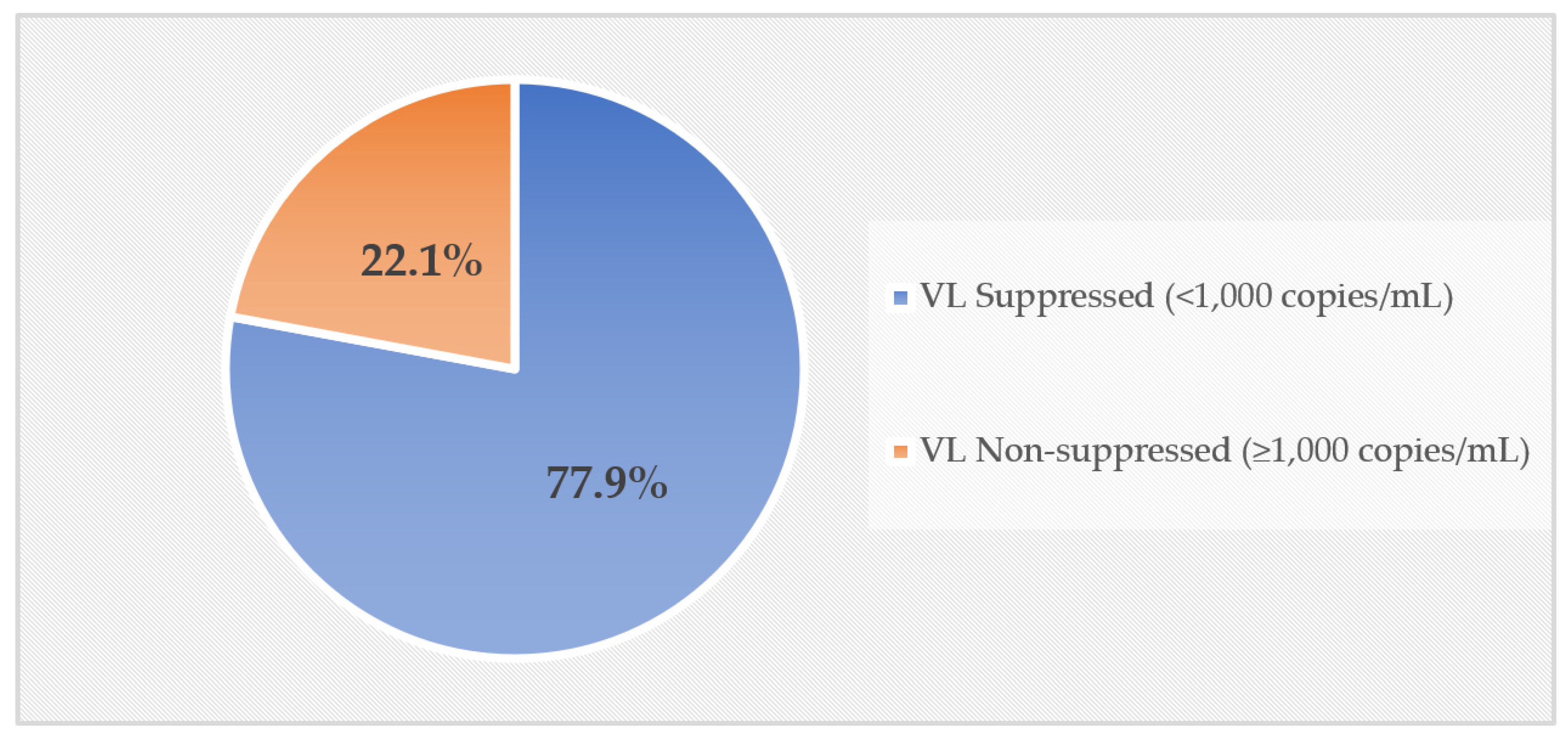
| Total | 67 (77.9%) | 19 (22.1%) | 86 (100%) |
| Part 1. Contingency Table | |||
| Reported Adherence | Viral Suppressed | Not Suppressed | Total |
| Adherent | 15 (TP) | 0 (FP) | 15 |
| Non-adherent | 52 (FN) | 19 (TN) | 71 |
| Total | 67 | 19 | 86 |
| Part 2. Performance Metrics | |||
| Diagnostic Metric | Value (%) | Interpretation | |
| Sensitivity | 22.4 | Poor sensitivity (ability) for identifying virally suppressed children | |
| Specificity | 100.0 | High specificity for identifying non-suppressed children | |
| Positive Predictive Value | 100.0 | High probability of viral suppression given reported adherence | |
| Negative Predictive Value | 26.8 | Frequent viral suppression despite reported non-adherence | |
| Risk Difference | 26.8 * | Higher probability of viral suppression among adherent group | |
| Healthcare Access | Suppressed n (%) | Not Suppressed n (%) | Total n (%) |
|---|---|---|---|
| Good | 55 (82.1%) | 13 (68.4%) | 68 (79.1%) |
| Fair | 11 (16.4%) | 6 (31.6%) | 17 (19.8%) |
| Poor | 1 (1.5%) | 0 (0.0%) | 1 (1.2%) |
| Total | 67 (100%) | 19 (100%) | 86 (100%) |
| Service Quality | Suppressed n (%) | Not Suppressed n (%) | Total n (%) |
|---|---|---|---|
| Good | 36 (53.7%) | 7 (36.8%) | 43 (50.0%) |
| Fair | 30 (44.8%) | 11 (57.9%) | 41 (47.7%) |
| Poor | 1 (1.5%) | 1 (5.3%) | 2 (2.3%) |
| Total | 67 (100%) | 19 (100%) | 86 (100%) |
Disclaimer/Publisher’s Note: The statements, opinions and data contained in all publications are solely those of the individual author(s) and contributor(s) and not of MDPI and/or the editor(s). MDPI and/or the editor(s) disclaim responsibility for any injury to people or property resulting from any ideas, methods, instructions or products referred to in the content. |
© 2026 by the authors. Licensee MDPI, Basel, Switzerland. This article is an open access article distributed under the terms and conditions of the Creative Commons Attribution (CC BY) license.
Share and Cite
Mamane, S.; Faleni, M.; Pulido Estrada, G.A.; Ncane, Z.; Gonah, L. Caregiver-Mediated Adherence and Perceived Health System Factors Associated with Viral Suppression Among Children Receiving Antiretroviral Therapy in Rural South Africa. Int. J. Environ. Res. Public Health 2026, 23, 780. https://doi.org/10.3390/ijerph23060780
Mamane S, Faleni M, Pulido Estrada GA, Ncane Z, Gonah L. Caregiver-Mediated Adherence and Perceived Health System Factors Associated with Viral Suppression Among Children Receiving Antiretroviral Therapy in Rural South Africa. International Journal of Environmental Research and Public Health. 2026; 23(6):780. https://doi.org/10.3390/ijerph23060780
Chicago/Turabian StyleMamane, Sinentlahla, Monwabisi Faleni, Guillermo Alfredo Pulido Estrada, Ziphelele Ncane, and Laston Gonah. 2026. "Caregiver-Mediated Adherence and Perceived Health System Factors Associated with Viral Suppression Among Children Receiving Antiretroviral Therapy in Rural South Africa" International Journal of Environmental Research and Public Health 23, no. 6: 780. https://doi.org/10.3390/ijerph23060780
APA StyleMamane, S., Faleni, M., Pulido Estrada, G. A., Ncane, Z., & Gonah, L. (2026). Caregiver-Mediated Adherence and Perceived Health System Factors Associated with Viral Suppression Among Children Receiving Antiretroviral Therapy in Rural South Africa. International Journal of Environmental Research and Public Health, 23(6), 780. https://doi.org/10.3390/ijerph23060780