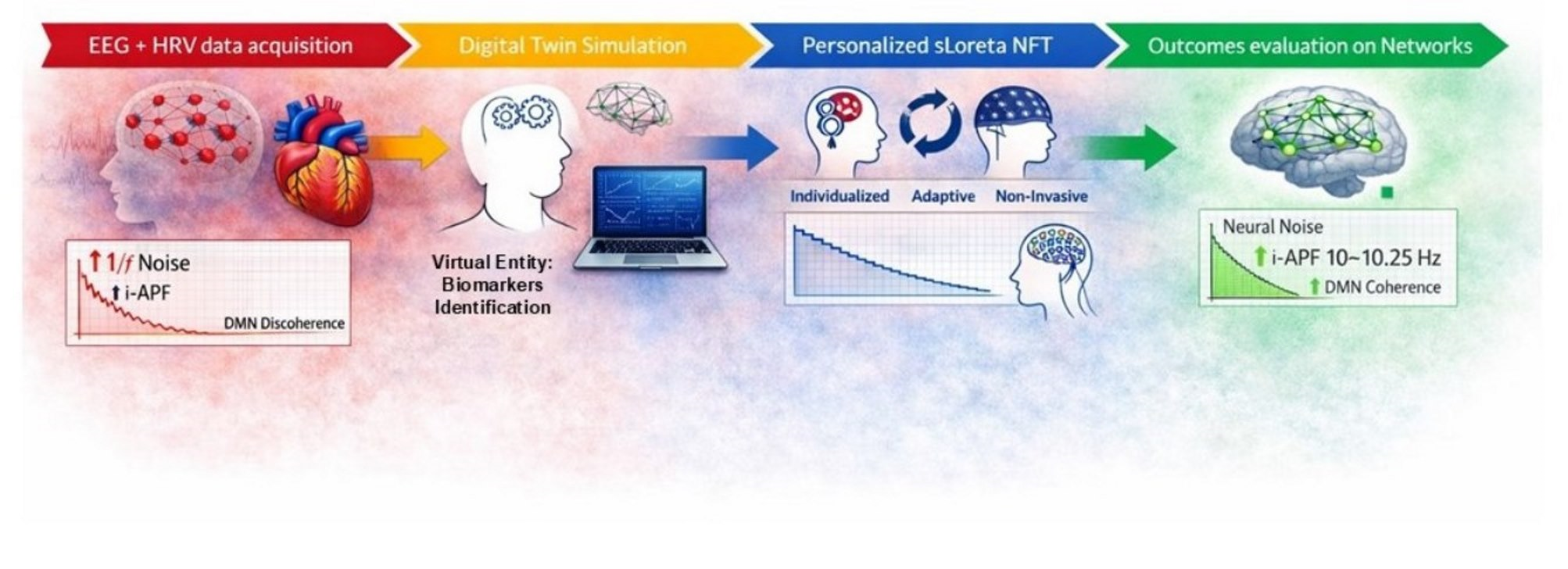
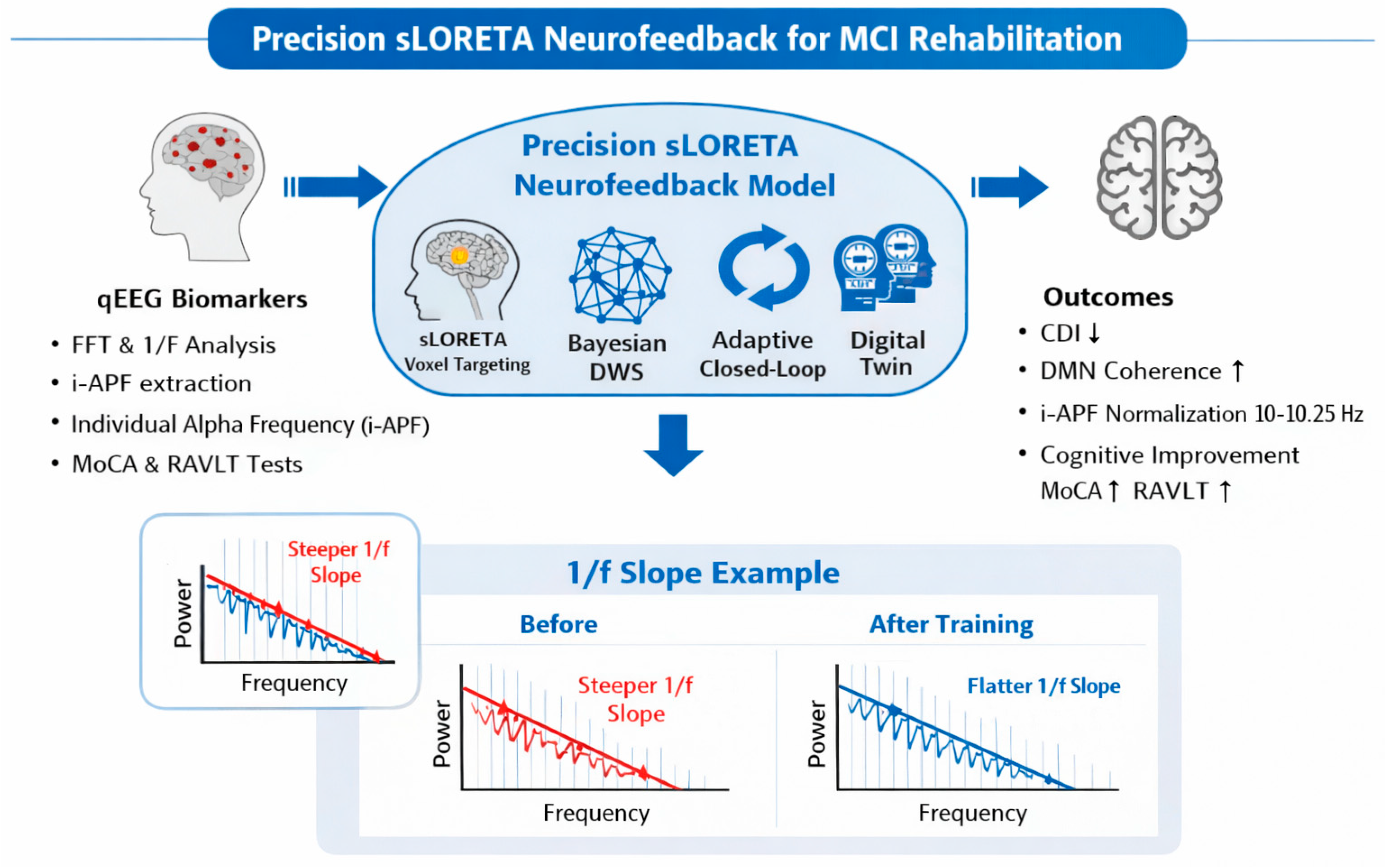
A Precision Computational Framework for sLORETA Neurofeedback in Mild Cognitive Impairment: Integration of qEEG Biomarkers and Neuropsychological Metrics




Highlights
- Mild Cognitive Impairment (MCI) represents a critical global health challenge, serving as a vital window for preventive intervention before progression toward irreversible dementia.
- This article addresses the urgent need for non-invasive Personalized Digital Therapeutics (DTx) to mitigate the socio-economic burden associated with an increasingly aging global population.
- This paper introduces a novel mathematical framework that integrates qEEG biomarkers, Individual Alpha Peak Frequency (i-APF), and the Clinical Deviation Index (CDI) with systems biology, providing superior diagnostic and rehabilitative precision compared to standard fixed-band protocols.
- The proposed approach shifts cognitive deficit treatment from symptomatic management to neurophysiological recalibration based on neural attractor stability and Long-Term Potentiation (LTP).
- For clinicians and researchers, the model establishes the necessity of accounting for aperiodic noise (1/f) and the Weber Threshold to personalize operant reinforcement and enhance sLORETA neurofeedback efficacy.
- For policy makers, this paper advocates for the adoption of Digital Twin models and Bayesian DWS (BDWS) algorithms as accessible precision medicine standards capable of inducing retroactive reversion of cognitive symptoms.
Abstract
1. Introduction
1.1. Background: From qEEG to Precision Neurofeedback
1.2. Methodological Background and Advanced Technologies for Brain Mapping in MCI Rehabilitation
1.3. Potential QEEG Biomarkers for MCI
2. Problem Statement
3. Conceptual Framework
3.1. Proposed Model and Targets for Neuroregulation
3.2. Instruments and Technical Solutions: Modality and Paradigm
3.3. Prototyping and Methodological Reproducibility
4. Theoretical and Computational Predictions
4.1. Mathematical and Computational Foundation of the Application of the Model in Mild Cognitive Impairment
4.2. Longitudinal Modulation of Mu Rhythm in the Geriatric Population
4.3. The First Model Application: Inverse Solution
- is the vector of scalp potential measurements (qEEG data).
- represents the lead field matrix (geometry of the head).
- is the unknown current density vector across the brain’s 3D voxels.
- represents the noise.
4.4. The Second Model Application: Bayesian Stochastic Modeling for the 70% Success Rule
4.5. The Third Model: Aperiodic Dynamics and 1/f Slope Calculus
- is the aperiodic exponent (the 1/f slope).
- is the offset.
- The sum represents periodic oscillations (e.g., Alpha peaks).
4.6. The Fourth Model: Hopfield Attractor Stabilization
4.7. The Fifth Model: The Default Mode Network (DMN) Connectivity Restoration
- : the post-synaptic activity (the reward in the NFT).
- : the pre-synaptic input.
- : a non-linear function that is negative (LTD) when and positive (LTP) when .
4.8. The Sixth Model: Homeostatic Plasticity and Synaptic Scaling
4.9. Seventh Model Application: i-APF Recalibration and the Temporal Resolution of Cognition
4.10. Exploration of Suggested Relation Between BCI-Assisted Rehabilitation for Cognitive Impairment and Outcome Measures
4.11. Cross-Looping Validation: Autonomic and Central Synergy on the Polyvagal System
4.12. Theoretical Synthesis and Model Outcomes
4.13. Model-Derived Predictions and Proposed Validation Endpoints
4.14. Model Metrics for Replications
5. Discussion
6. Challenges and Road Map for Future Investigation
7. Conclusions
Supplementary Materials
Author Contributions
Funding
Institutional Review Board Statement
Informed Consent Statement
Data Availability Statement
Conflicts of Interest
Abbreviations
| MCI | Mild Cognitive Impairment |
| BCI | Brain–Computer Interface |
| CDI | Clinical Deviation Index |
| CEN | Central Executive Network |
| DMN | Default Mode Network |
| BDMN | Bayesian Default Mode Network |
| ICN | Intrinsic Connectivity Network |
| FFT | Fast Fourier Transform |
| SNR | Signal-to-Noise Ratio |
| IAF | Individual Alpha Frequency |
| i-APF | Individual Alpha Peak Frequency |
| NFT | Neurofeedback Training |
| PCC | Posterior Cingulate Cortex |
| dlPFC | Dorsolateral Prefrontal Cortex |
| qEEG | Quantitative Electroencephalography |
| EEG | Electroencephalography |
| LTP | Long-Term Potentiation |
| LTD | Long-Term Depression |
| DWS | Dynamic Weight Shifting |
| BDWS | Bayesian Dynamic Weight Shifting |
| LZT | Z-score Neurofeedback |
| sLoreta | Standardized Low-Resolution Electromagnetic Tomography |
References
- Sterman, M.B.; Chartier, D.R. Origins of Electroencephalogram Rhythms and Implications of Neurofeedback. In Introduction to Quantitative EEG and Neurofeedback, 3rd ed.; Chartier, D.R., Dellinger, M.B., Evans, J.R., Budzynski, H.K., Eds.; Academic Press: London, UK, 2023; pp. 103–120. [Google Scholar] [CrossRef]
- Mehmood, F.; Rehman, S.U.; Mehmood, A.; Kim, Y.J. Advances in AI-Driven EEG Analysis for Neurological and Oculomotor Disorders: A Systematic Review. Biosensors 2025, 16, 15. [Google Scholar] [CrossRef]
- Sajno, E.; Bartolotta, S.; Tuena, C.; Cipresso, P.; Pedroli, E.; Riva, G. Machine Learning in Biosignals Processing for Mental Health: A Narrative Review. Front. Psychol. 2023, 13, 1066317. [Google Scholar] [CrossRef]
- Glomb, K.; Cabral, J.; Cattani, A.; Mazzoni, A.; Raj, A.; Franceschiello, B. Computational Models in Electroencephalography. Brain Topogr. 2022, 35, 142–161. [Google Scholar] [CrossRef] [PubMed]
- Wolpaw, J.R.; Wolpaw, E.W. Brain–Computer Interfaces: Principles and Practice; Oxford University Press: Oxford, UK, 2012. [Google Scholar]
- Filipova, S.; Galevska Jovchevski, V.; Durmishi, N.; Jankova, R. The Significance of EEG Neurofeedback Method in the Treatment of Specific Learning Disorders. Int. J. Res. Publ. Rev. 2024, 5, 8308–8316. [Google Scholar] [CrossRef]
- Peterson, T.; Rose AbouAssaly, J.; Bessler, W.; Burgin, S.; Sherwin, R.; Strale, F.J. Longitudinal Outcomes of Neurofeedback and Hyperbaric Oxygen Therapy in Treating a Traumatic Brain Injury Patient: A Case Report. Cureus 2024, 16, e64918. [Google Scholar] [CrossRef]
- Pino, O.; La Ragione, F. A Brain–Computer Interface for Audio-Visual Entrainment in Emotional Regulation: Preliminary Evidence of Its Effects. Online Int. Interdiscip. Res. J. 2016, 6, 34–46. [Google Scholar]
- Zeltser, A.; Ochneva, A.; Riabinina, D.; Zakurazhnaya, V.; Tsurina, A.; Golubeva, E.; Berdalin, A.; Andreyuk, D.; Leonteva, E.; Kostyuk, G.; et al. EEG Techniques with Brain Activity Localization, Specifically LORETA, and Its Applicability in Monitoring Schizophrenia. J. Clin. Med. 2024, 13, 5108. [Google Scholar] [CrossRef] [PubMed]
- Babiloni, C.; Visser, P.J.; Frisoni, G.; De Deyn, P.P.; Bresciani, L.; Jelic, V.; Nagels, G.; Rodriguez, G.; Rossini, P.M.; Vecchio, F. Cortical Sources of Resting EEG Rhythms in Mild Cognitive Impairment and Subjective Memory Complaint. Neurobiol. Aging 2010, 31, 1787–1798. [Google Scholar] [CrossRef]
- Pascual-Marqui, R.D. Standardized Low-Resolution Brain Electromagnetic Tomography (sLORETA): Technical Details. Methods Find. Exp. Clin. Pharmacol. 2002, 24, 5–12. [Google Scholar]
- Arns, M.; Drinkenburg, W.; Kenemans, J.L. The Effects of QEEG-Informed Neurofeedback in ADHD: An Open-Label Pilot Study. Appl. Psychophysiol. Biofeedback 2012, 37, 171–180. [Google Scholar] [CrossRef]
- Tibermacine, I.E.; Russo, S.; Scarano, G.; Tedesco, G.; Rabehi, A.; Alhussan, A.A. Conditional VAE for Personalized Neurofeedback in Cognitive Training. PLoS ONE 2025, 20, e0335364. [Google Scholar] [CrossRef]
- Charpentier, C.J.; O’Doherty, J.P. The Application of Computational Models to Social Neuroscience: Promises and Pitfalls. Soc. Neurosci. 2018, 13, 637–647. [Google Scholar] [CrossRef]
- Hammond, D.C.; Bodenhamer-Davis, G.; Gluck, G.; Stokes, D.; Harper, S.H.; Trudeau, D.; Kirk, L. Standards of Practice for Neurofeedback and Neurotherapy: A Position Paper of the International Society for Neurofeedback & Research. J. Neurother. 2011, 15, 54–64. [Google Scholar] [CrossRef]
- Li, M.; Wang, Y.; Lopez-Naranjo, C.; Hu, S.; Reyes, R.C.; Paz-Linares, D.; Areces-Gonzalez, A.; Abd Hamid, A.I.; Evans, A.C.; Savostyanov, A.N.; et al. Harmonized-Multinational qEEG Norms (HarMNqEEG). NeuroImage 2022, 256, 119190. [Google Scholar] [CrossRef]
- Amico, F.; Keane, M.; Lee, M.; McCarthy-Jones, S. A Feasibility Study of LORETA Z-Score Neurofeedback Training in Adults with Schizophrenia-Spectrum Disorder Experiencing Treatment-Resistant Auditory Verbal Hallucinations. NeuroRegulation 2022, 9, 135–146. [Google Scholar] [CrossRef]
- Pino, O.; Romano, G. Engagement and Arousal Effects in Predicting the Increase of Cognitive Functioning Following a Neuromodulation Program. Acta Biomed. 2022, 93, e2022248. [Google Scholar] [CrossRef] [PubMed]
- Pino, O. A Randomized Controlled Trial to Explore the Effect of Audio-Visual Entrainment among Psychological Disorders. Acta Biomed. 2021, 92, e2021408. [Google Scholar] [CrossRef]
- Collura, T.F.; Guan, J.; Tarrant, J.; Bailey, J.; Starr, F. EEG Biofeedback Case Studies Using Live Z-Score Training and a Normative Database. J. Neurother. 2010, 14, 22–46. [Google Scholar] [CrossRef]
- Wigton, N.; Krigbaum, G. A Review of qEEG-Guided Neurofeedback. NeuroRegulation 2015, 2, 149–155. [Google Scholar] [CrossRef][Green Version]
- Gregory, J.C.; Romero, D.; Jones, M. Predictors of Neurofeedback Outcomes Following qEEG Individualized Protocols for Anxiety. NeuroRegulation 2020, 7, 18–25. [Google Scholar] [CrossRef]
- Coward, L.A. Hierarchies of Description Enable Understanding of Cognitive Phenomena in Terms of Neuron Activity. Cogn. Process. 2024, 25, 333–347. [Google Scholar] [CrossRef]
- He, B.; Astolfi, L.; Valdes-Sosa, P.A.; Marinazzo, D.; Palva, S.; Bénar, C.-G.; Michel, C.M.; Koenig, T. Electrophysiological Brain Connectivity: Theory and Implementation. IEEE Trans. Biomed. Eng. 2019, 66, 2115–2137. [Google Scholar] [CrossRef]
- Marzola, P.; Melzer, T.; Pavesi, E.; Gil-Mohapel, J.; Brocardo, P.S. Exploring the Role of Neuroplasticity in Development, Aging, and Neurodegeneration. Brain Sci. 2023, 13, 1610. [Google Scholar] [CrossRef]
- Pérez-Elvira, R.; Carrobles, J.A.; López Bote, D.J.; Oltra-Cucarella, J. Efficacy of Live Z-Score Neurofeedback Training for Chronic Insomnia: A Single-Case Study. NeuroRegulation 2019, 6, 93–101. [Google Scholar] [CrossRef]
- Agis, D.; Hillis, A.E. The Cart before the Horse: When Cognitive Neuroscience Precedes Cognitive Neuropsychology. Cogn. Neuropsychol. 2017, 34, 420–429. [Google Scholar] [CrossRef] [PubMed]
- Hwang, G.M.; Kulwatno, J.; Cruz, T.H.; Chen, D.; Ajisafe, T.; Monaco, J.D.; Nitkin, R.; George, S.M.; Lucas, C.; Zehnder, S.M.; et al. NSF DARE, Transforming Modeling in Neurorehabilitation: Perspectives and Opportunities from US Funding Agencies. J. NeuroEng. Rehabil. 2024, 21, 17. [Google Scholar] [CrossRef]
- Marlats, F.; Bao, G.; Chevallier, S.; Boubaya, M.; Djabelkhir-Jemmi, L.; Wu, Y.-H.; Lenoir, H.; Rigaud, A.-S.; Azabou, E. SMR/Theta Neurofeedback Training Improves Cognitive Performance and EEG Activity in Elderly with Mild Cognitive Impairment: A Pilot Study. Front. Aging Neurosci. 2020, 12, 147. [Google Scholar] [CrossRef] [PubMed]
- Odano, I.; Maeyatsu, F.; Hosoya, T.; Asari, M.; Oba, K.; Taki, Y. Diagnostic Approach with Z-Score Mapping to Reduce Artifacts Caused by Cerebral Atrophy in Regional CBF Assessment of MCI and Alzheimer’s Disease by [99mTc]-ECD and SPECT. Jpn. J. Radiol. 2024, 42, 508–518. [Google Scholar] [CrossRef]
- Thatcher, R.; Lubar, J.F. History of the Scientific Standards of QEEG Normative Databases. In Introduction to Quantitative EEG and Neurofeedback; Elsevier: Amsterdam, The Netherlands, 2009. [Google Scholar] [CrossRef]
- Buzi, G.; Fornari, C.; Perinelli, A.; Mazza, V. Functional Connectivity Changes in Mild Cognitive Impairment: A Meta-Analysis of M/EEG Studies. Clin. Neurophysiol. 2023, 156, 183–195. [Google Scholar] [CrossRef]
- Watts, D.J.; Strogatz, S.H. Collective Dynamics of ‘Small-World’ Networks. Nature 1998, 393, 440–442. [Google Scholar] [CrossRef]
- Cecchetti, G.; Agosta, F.; Canu, E.; Basaia, S.; Rugarli, G.; Curti, D.G.; Coraglia, F.; Cursi, M.; Spinelli, E.G.; Santangelo, R.; et al. Analysis of Individual Alpha Frequency in a Large Cohort from a Tertiary Memory Center. Eur. J. Neurol. 2024, 31, e16424. [Google Scholar] [CrossRef]
- Klimesch, W. EEG Alpha and Theta Oscillations Reflect Cognitive and Memory Performance: A Review and Analysis. Brain Res. Rev. 1999, 29, 169–195. [Google Scholar] [CrossRef]
- Menon, V. 20 years of the default mode network: A review and synthesis. Neuron 2023, 111, 2469–2487. [Google Scholar] [CrossRef]
- Azarias, F.R.; Almeida, G.H.D.R.; de Melo, L.F.; Rici, R.E.G.; Maria, D.A. The journey of the Default Mode Network: Development, function, and impact on mental health. Biology 2025, 14, 395. [Google Scholar] [CrossRef]
- Brown, C.A.; Schmitt, F.A.; Smith, C.D.; Gold, B.T. Distinct patterns of default mode and executive control network circuitry contribute to present and future executive function in older adults. NeuroImage 2019, 195, 320–332. [Google Scholar] [CrossRef]
- Utevsky, A.V.; Smith, D.V.; Huettel, S.A. Precuneus Is a Functional Core of the Default-Mode Network. J. Neurosci. 2014, 34, 932–940. [Google Scholar] [CrossRef]
- Cavanna, A.E.; Trimble, M.R. The Precuneus: A Review of Its Functional Anatomy and Behavioural Correlates. Brain 2006, 129, 564–583. [Google Scholar] [CrossRef] [PubMed]
- Bowman, A.D.; Griffis, J.C.; Visscher, K.M.; Dobbins, A.C.; Gawne, T.J.; DiFrancesco, M.W.; Szaflarski, J.P. Relationship Between Alpha Rhythm and the Default Mode Network: An EEG-fMRI Study. J. Clin. Neurophysiol. 2017, 34, 527–533. [Google Scholar] [CrossRef] [PubMed]
- Moretti, D.V. Theta and Alpha EEG Frequency Interplay in Subjects with Mild Cognitive Impairment: Evidence from EEG, MRI, and SPECT Brain Modifications. Front. Aging Neurosci. 2015, 7, 31. [Google Scholar] [CrossRef] [PubMed]
- Tazaki, M. A review: Effects of neurofeedback on patients with mild cognitive impairment (MCI), and Alzheimer’s disease (AD). Front. Hum. Neurosci. 2024, 17, 1331436. [Google Scholar] [CrossRef]
- Su, R.; Li, X.; Xie, P.; Yuan, Y. Neurofeedback training modulates brain functional networks and improves cognition in Amnestic Mild Cognitive Impairment patients aged 60–70 years. Brain Sci. 2025, 15, 1243. [Google Scholar] [CrossRef]
- Echeverri-Ocampo, I.; Ardila, K.; Molina-Mateo, J.; Padilla-Buritica, J.I.; Carceller, H.; Barceló-Martinez, E.A.; Llamur, S.I.; Iglesia-Vaya, M.D.L. EEG-Based Functional Connectivity Analysis for Cognitive Impairment Classification. Electronics 2023, 12, 4432. [Google Scholar] [CrossRef]
- Jiang, J.; Zhang, J.; Li, C.; Yu, Z.; Yan, Z.; Jiang, J. Development of a Machine Learning Model to Discriminate Mild Cognitive Impairment Subjects from Normal Controls in Community Screening. Brain Sci. 2022, 12, 1149. [Google Scholar] [CrossRef]
- Schultz, W. Dopamine Reward Prediction Error Coding. Dialogues Clin. Neurosci. 2016, 18, 23–32. [Google Scholar] [CrossRef] [PubMed]
- Csikszentmihalyi, M. Flow: The Psychology of Optimal Experience; Harper & Row: New York, NY, USA, 1990. [Google Scholar]
- Wilson, R.C.; Shenhav, A.; Straccia, M.; Cohen, J.D. The Eighty Five Percent Rule for Optimal Learning. Nat. Commun. 2019, 10, 4646. [Google Scholar] [CrossRef] [PubMed]
- Astle, A.T.; Li, R.W.; Webb, B.S.; Levi, D.M.; McGraw, P.V. A Weber-Like Law for Perceptual Learning. Sci. Rep. 2013, 3, 1158. [Google Scholar] [CrossRef] [PubMed]
- Zanto, T.; Gazzaley, A. Cognitive Control and the Ageing Brain. In The Wiley Handbook of Cognitive Control; Egner, T., Ed.; Wiley Online Library: Hoboken, NJ, USA, 2017. [Google Scholar] [CrossRef]
- Thatcher, R.W.; North, D.M.; Biver, C.J. LORETA EEG Phase Reset of the Default Mode Network. Front. Hum. Neurosci. 2014, 8, 529. [Google Scholar] [CrossRef]
- Kinjo, M.; Honda, S.; Wada, M.; Nakajima, S.; Koike, S.; Noda, Y. A Comparative Study of the Dorsolateral Prefrontal Cortex Targeting Approaches for Transcranial Magnetic Stimulation Treatment: Insights from the Healthy Control Data. Brain Res. 2024, 1838, 148989. [Google Scholar] [CrossRef]
- Canolty, R.T.; Knight, R.T. The Functional Role of Cross-Frequency Coupling. Trends Cogn. Sci. 2010, 14, 506–515. [Google Scholar] [CrossRef]
- Palva, J.M.; Palva, S.; Kaila, K. Phase Synchrony Among Neuronal Oscillations in the Human Cortex. J. Neurosci. 2005, 25, 3962–3972. [Google Scholar] [CrossRef]
- Porges, S.W. The Polyvagal Theory: Neurophysiological Foundations of Emotions, Attachment, Communication, and Self-Regulation; W.W. Norton & Company: New York, NY, USA, 2011. [Google Scholar]
- Pashler, H. Dual-Task Interference in Simple Tasks: Data and Theory. Psychol. Bull. 1994, 116, 220–244. [Google Scholar] [CrossRef]
- Nasreddine, Z.S.; Phillips, N.A.; Bédirian, V.; Charbonneau, S.; Whitehead, V.; Collin, I.; Cummings, J.L.; Chertkow, H. The Montreal Cognitive Assessment (MoCA): A Brief Screening Tool for Mild Cognitive Impairment. J. Am. Geriatr. Soc. 2005, 53, 695–699. [Google Scholar] [CrossRef] [PubMed]
- Rey, A. L’Examen Clinique en Psychologie; Presses Universitaires de France: Paris, France, 1964. [Google Scholar]
- Bean, R. Rey Auditory Verbal Learning Test (Rey AVLT). In Encyclopedia of Clinical Neuropsychology; Kreutzer, J.S., DeLuca, J., Caplan, B., Eds.; Springer: New York, NY, USA, 2011. [Google Scholar] [CrossRef]
- Pino, O. Memory impairments and rehabilitation: Evidence-based effects of approaches and training programs. Open Rehabil. J. 2015, 8, 25–33. [Google Scholar] [CrossRef]
- Bauer, R.; Gharabaghi, A. Reinforcement learning for adaptive threshold control of restorative brain-computer interfaces: A Bayesian simulation. Front. Neurosci. 2015, 9, 36. [Google Scholar] [CrossRef]
- Keizer, A.W. Standardization and Personalized Medicine Using Quantitative EEG in Clinical Settings. Clin. EEG Neurosci. 2021, 52, 82–89. [Google Scholar] [CrossRef]
- Thatcher, R.W.; Walker, R.A.; Giudice, S. Human Cerebral Hemispheres Develop at Different Rates and Ages. Science 1987, 236, 1110–1113. [Google Scholar] [CrossRef]
- Wang, K.; Liu, Y.; Tian, F.; Yi, W.; Zhang, Y.; Jung, T.-P.; Xu, M.; Ming, D. Adaptive Neurofeedback Training Using a Virtual Reality Game Enhances Motor Imagery Performance in Brain–Computer Interfaces. IEEE Trans. Neural Syst. Rehabil. Eng. 2025, 33, 2956–2966. [Google Scholar] [CrossRef]
- Raichle, M.E. The Brain’s Default Mode Network. Annu. Rev. Neurosci. 2015, 38, 433–447. [Google Scholar] [CrossRef]
- Wang, S.; Wang, W.; Chen, J.; Yu, X. Alterations in Brain Functional Connectivity in Patients with Mild Cognitive Impairment: A Systematic Review and Meta-Analysis of fNIRS Studies. Brain Behav. 2024, 14, e3414. [Google Scholar] [CrossRef]
- Won, J.; Callow, D.D.; Pena, G.S.; Gogniat, M.A.; Kommula, Y.; Arnold-Nedimala, N.A.; Jordan, L.S.; Smith, J.C. Evidence for Exercise-Related Plasticity in Functional and Structural Neural Network Connectivity. Neurosci. Biobehav. Rev. 2021, 131, 923–940. [Google Scholar] [CrossRef] [PubMed]
- Mulders, P.C.; van Eijndhoven, P.F.; Schene, A.H.; Beckmann, C.F.; Tendolkar, I. Resting-State Functional Connectivity in Major Depressive Disorder: A Review. Neurosci. Biobehav. Rev. 2015, 56, 330–344. [Google Scholar] [CrossRef]
- Klimesch, W. EEG-Alpha Rhythms and Memory Processes. Int. J. Psychophysiol. 1997, 26, 319–340. [Google Scholar] [CrossRef]
- Tompary, A.; Duncan, K.; Davachi, L. Consolidation of Associative and Item Memory Is Related to Post-Encoding Functional Connectivity between the Ventral Tegmental Area and Different Medial Temporal Lobe Subregions during an Unrelated Task. J. Neurosci. 2015, 35, 7326–7331. [Google Scholar] [CrossRef]
- Delorme, A.; Sejnowski, T.; Makeig, S. Enhanced Detection of Artifacts in EEG Data Using Higher-order Statistics and Independent Component Analysis. NeuroImage 2007, 34, 1443–1449. [Google Scholar] [CrossRef]
- Hodgkin, A.L.; Huxley, A.F. A quantitative description of membrane current and its application to conduction and excitation in nerve. J. Physiol. 1952, 117, 500–544. [Google Scholar] [CrossRef]
- Goodwin, B.C. Oscillatory Behavior in Enzymatic Control Processes. Adv. Enzym. Regul. 1965, 3, 425–438. [Google Scholar] [CrossRef] [PubMed]
- Paszkiel, S. Using the LORETA Method for Localization of the EEG Signal Sources in BCI Technology. In Analysis and Classification of EEG Signals for Brain–Computer Interfaces; Studies in Computational Intelligence; Springer: Cham, Switzerland, 2019; Volume 852. [Google Scholar] [CrossRef]
- Radüntz, T.; Scouten, J.; Hochmuth, O.; Meffert, B. Automated EEG Artifact Elimination by Applying Machine Learning Algorithms to ICA-based Features. J. Neural Eng. 2017, 14, 046004. [Google Scholar] [CrossRef] [PubMed]
- Schölzel, C.; Blesius, V.; Ernst, G.; Dominik, A. An Understandable, Extensible, and Reusable Implementation of the Hodgkin-Huxley Equations Using Modelica. Front. Physiol. 2020, 11, 583203. [Google Scholar] [CrossRef] [PubMed]
- Izhikevich, E.M. Dynamical Systems in Neuroscience: The Geometry of Excitability and Bursting; MIT Press: Cambridge, MA, USA, 2007. [Google Scholar] [CrossRef]
- Jatoi, M.A.; Kamel, N.; Malik, A.S.; Faye, I. A Survey of Methods Used for Source Localization of EEG Signals. Biomed. Signal Process. Control 2014, 11, 42–52. [Google Scholar] [CrossRef]
- Brookes, M.J.; Woolrich, M.; Barnes, G.R. Measuring functional connectivity in MEG: A multivariate approach insensitive to linear source leakage. NeuroImage 2012, 63, 910–920. [Google Scholar] [CrossRef]
- Colclough, G.L.; Brookes, M.J.; Smith, S.M.; Woolrich, M.W. A symmetric multivariate leakage correction for MEG connectomes. NeuroImage 2015, 117, 439–448. [Google Scholar] [CrossRef]
- Liu, R. Utilizing Fast Fourier Transform in the Processing of Biomedical Signals: An Analytical Approach. Theor. Nat. Sci. 2024, 38, 154–159. [Google Scholar] [CrossRef]
- Wijaya, A.; Setiawan, N.A.; Ahmad, A.H.; Zakaria, R.; Othman, Z. Electroencephalography and Mild Cognitive Impairment Research: A Scoping Review and Bibliometric Analysis (ScoRBA). AIMS Neurosci. 2023, 10, 154–171. [Google Scholar] [CrossRef]
- Pino, O.; Bertoni, E.; Diletto, P.; Ferrari, L.; Gaspari, M.; Pelosi, A. Early detection of cognitive impairment in the general population through a digital tool targeting the prospective memory. A pilot study. Ann. Med. 2025, 57, 2525389. [Google Scholar] [CrossRef] [PubMed]
- Pineda, J.A. The Functional Significance of Mu Rhythms: Translating “Seeing” and “Hearing” into “Doing”. Brain Res. Rev. 2005, 50, 57–68. [Google Scholar] [CrossRef]
- Pascual-Marqui, R.D.; Michel, C.M.; Lehmann, D. Low Resolution Electromagnetic Tomography: A New Method for Localizing Electrical Activity in the Brain. Int. J. Psychophysiol. 1994, 18, 49–65. [Google Scholar] [CrossRef] [PubMed]
- Brett, M.; Johnsrude, I.S.; Owen, A.M. The Problem of Functional Localization in the Human Brain. Nat. Rev. Neurosci. 2002, 3, 243–249. [Google Scholar] [CrossRef]
- Mazziotta, J.; Toga, A.; Evans, A.; Fox, P.; Lancaster, J.; Zilles, K.; Woods, R.; Paus, T.; Simpson, G.; Pike, B. A Probabilistic Atlas and Reference System for the Human Brain: International Consortium for Brain Mapping (ICBM). Philos. Trans. R. Soc. B Biol. Sci. 2001, 356, 1293–1322. [Google Scholar] [CrossRef] [PubMed]
- Ko, J.; Park, U.; Kim, D.; Kang, S.W. Quantitative Electroencephalogram Standardization: A Sex- and Age-Differentiated Normative Database. Front. Neurosci. 2021, 15, 766781. [Google Scholar] [CrossRef]
- Ben-Gal, I.; Kagan, E. Information Theory: Deep Ideas, Wide Perspectives, and Various Applications. Entropy 2021, 23, 232. [Google Scholar] [CrossRef]
- Horenko, I.; Bassetti, D.; Pospíšil, L. Fast and Close Shannon Entropy Approximations of entropic measures. arxiv 2025, arXiv:2505.14234. [Google Scholar] [CrossRef]
- Pani, S.M.; Saba, L.; Fraschini, M. Clinical Applications of EEG Power Spectra Aperiodic Component Analysis: A Mini-Review. Clin. Neurophysiol. 2022, 143, 1–13. [Google Scholar] [CrossRef]
- Donoghue, T.; Hammonds, R.; Lybrand, E.; Waschke, L.; Gao, R.; Voytek, B. Evaluating and Comparing Measures of Aperiodic Neural Activity. bioRxiv 2024, 2024.09.15.613114. [Google Scholar] [CrossRef]
- Bienenstock, E.L.; Cooper, L.N.; Munro, P.W. Theory for the Development of Neuron Selectivity: Orientation Specificity and Binocular Interaction in Visual Cortex. J. Neurosci. 1982, 2, 32–48. [Google Scholar] [CrossRef] [PubMed]
- Turrigiano, G. Homeostatic Synaptic Plasticity: Local and Global Mechanisms for Stabilizing Neuronal Function. Cold Spring Harb. Perspect. Biol. 2012, 4, a005736. [Google Scholar] [CrossRef]
- Dan, Y.; Poo, M.-M. Spike-Timing-Dependent Plasticity: From Synapse to Perception. Physiol. Rev. 2006, 86, 1033–1048. [Google Scholar] [CrossRef]
- Jennings, J.R.; Sheu, L.K.; Kuan, H.; Manuck, S.B.; Gianaros, P.J. Resting State Connectivity of the Medial Prefrontal Cortex Covaries with Individual Differences in High-Frequency Heart Rate Variability. Psychophysiology 2016, 53, 444–454. [Google Scholar] [CrossRef]
- Hsiao, F.-J.; Wang, Y.-J.; Yan, S.-H.; Chen, W.-T.; Lin, Y.-Y. Altered Oscillation and Synchronization of Default-Mode Network Activity in Mild Alzheimer’s Disease Compared to Mild Cognitive Impairment: An Electrophysiological Study. PLoS ONE 2013, 8, e68792. [Google Scholar] [CrossRef]
- Chen, H.; Li, J.; Huang, Z.; Fan, X.; Wang, X.; Chen, X.; Guo, H.; Liu, H.; Li, S.; Yu, S.; et al. Dopaminergic System and Neurons: Role in Multiple Neurological Diseases. Neuropharmacology 2024, 260, 110133. [Google Scholar] [CrossRef]
- Ginex, V.; Gilardone, G.; Viganò, M.; Monti, A.; Judica, E.; Passaro, I.; Gilardone, M.; Vanacore, N.; Corbo, M. Interaction Between Recovery of Motor and Language Abilities after Stroke. Arch. Phys. Med. Rehabil. 2020, 101, 1367–1376. [Google Scholar] [CrossRef] [PubMed]
- Benso, F.; Moretti, S.; Bellazzini, V.; Benso, E.; Ardu, E.; Gazzellini, S. Principles of Integrated Cognitive Training for Executive Attention: Application to an Instrumental Skill. Front. Psychol. 2021, 12, 647749. [Google Scholar] [CrossRef]
- Maikusa, N.; Shigemoto, Y.; Chiba, E.; Kimura, Y.; Matsuda, H.; Sato, N. Harmonized Z-Scores Calculated from a Large-Scale Normal MRI Database to Evaluate Brain Atrophy in Neurodegenerative Disorders. J. Pers. Med. 2022, 12, 1555. [Google Scholar] [CrossRef]
- Schmidt, M. Rey Auditory Verbal Learning Test: A Handbook; Western Psychological Services: Los Angeles, CA, USA, 1996. [Google Scholar]
- Arakaki, X.; Arechavala, R.J.; Choy, E.H.; Bautista, J.; Bliss, B.; Molloy, C.; Wu, D.A.; Shimojo, S.; Jiang, Y.; Kleinman, M.T.; et al. The Connection Between Heart Rate Variability (HRV), Neurological Health, and Cognition: A Literature Review. Front. Neurosci. 2023, 17, 1055445. [Google Scholar] [CrossRef]
- Bahameish, M.; Stockman, T. Short-Term Effects of Heart Rate Variability Biofeedback on Working Memory. Appl. Psychophysiol. Biofeedback 2024, 49, 219–231. [Google Scholar] [CrossRef] [PubMed]
- Yao, S.; Zhu, J.; Li, S.; Zhang, R.; Zhao, J.; Yang, X.; Wang, Y. Bibliometric Analysis of Quantitative Electroencephalogram Research in Neuropsychiatric Disorders from 2000 to 2021. Front. Psychiatry 2022, 13, 830819. [Google Scholar] [CrossRef]
- Guo, S.; Zhang, G.; Zeng, X.; Xiong, Y.; Xu, Y.; Cui, Y.; Yao, D.; Guo, D. Ten Years of the Digital Twin Brain: Perspectives and Challenges. Europhys. Lett. 2025, 149, 47001. [Google Scholar] [CrossRef]
- Krotov, D. A New Frontier for Hopfield Networks. Nat. Rev. Phys. 2023, 5, 366–367. [Google Scholar] [CrossRef]
- Warren, T.S.; Shende, S.A.; Ashrafi, J.; Clements, G.M.; Mudar, R.A. Resting-State EEG Power and Aperiodic Activity in Individuals with Mild Cognitive Impairment and Cognitively Healthy Controls. Brain Sci. 2025, 15, 1305. [Google Scholar] [CrossRef]
- Delorme, A.; Makeig, S. This is no “ICA bug”: Response to the article, “ICA’s bug: How ghost ICs emerge from effective rank deficiency caused by EEG electrode interpolation and incorrect re-referencing”. Front. Neuroimaging 2023, 2, 1331404. [Google Scholar] [CrossRef]
- Kucewicz, M.T.; Worrell, G.A.; Axmacher, N. Direct electrical brain stimulation of human memory: Lessons learnt and future perspectives. Brain 2023, 146, 2214–2226. [Google Scholar] [CrossRef]
- Suhail, T.A.; Subasree, R.; Vinod, A.P.; Alladi, S. On the feasibility of an online brain-computer interface-based neurofeedback game for enhancing attention and working memory in stroke and Mild Cognitive Impairment patients. Biomed. Phys. Eng. Express 2025, 11, adb8ef. [Google Scholar]



| Electrode Site | Anatomical Region | Cognitive Function | Rationale for MCI Treatment and References |
|---|---|---|---|
| Fp1, Fp2 | Frontopolar Cortex | Attentional control Emotional regulation | Targeted to reduce hyper-arousal and Beta-peak-related anxiety [40,45,67] |
| F3, F4 | Dorsolateral Prefrontal Cortex (dlPFC) | Working Memory Executive Functions | Engagement of the Central Executive Network (CEN) to improve focus [68] |
| P3, P4 | Posterior Parietal Cortex | Information integration DMN access | Direct access to the Precuneus; critical for stabilizing the Default Mode Network [69] |
| T5, T6 | Posterior Temporal Cortex | Semantic memory Language retrieval | Support for memory consolidation and i-APF frequency stabilization [70,71] |
| Digital Twin Simulation | Parameters and Values | Purpose |
|---|---|---|
| Hill Coefficient (diffusion coefficient) | d = 0.3 | Modeling the transition from pink noise toward a state of balanced cortical excitation/inhibition, optimizing the Signal-to-Noise Ratio (SNR) |
| Coupling Strength (defines the global connectivity strength between the 76 regions of the Desikan–Killiany connectome) | G = 0.015 | Simulating the restoration of long-range synchronization within the Default Mode Network (DMN) |
| Simulation Duration | SD = 2000 ms | Allowing the algorithm to identify stable Hopfield Attractors and ensure the convergence of the biophysical oscillator models |
Disclaimer/Publisher’s Note: The statements, opinions and data contained in all publications are solely those of the individual author(s) and contributor(s) and not of MDPI and/or the editor(s). MDPI and/or the editor(s) disclaim responsibility for any injury to people or property resulting from any ideas, methods, instructions or products referred to in the content. |
© 2026 by the authors. Licensee MDPI, Basel, Switzerland. This article is an open access article distributed under the terms and conditions of the Creative Commons Attribution (CC BY) license.
Share and Cite
Dasilva, V.; Poli, D.; Pino, O. A Precision Computational Framework for sLORETA Neurofeedback in Mild Cognitive Impairment: Integration of qEEG Biomarkers and Neuropsychological Metrics. Int. J. Environ. Res. Public Health 2026, 23, 624. https://doi.org/10.3390/ijerph23050624
Dasilva V, Poli D, Pino O. A Precision Computational Framework for sLORETA Neurofeedback in Mild Cognitive Impairment: Integration of qEEG Biomarkers and Neuropsychological Metrics. International Journal of Environmental Research and Public Health. 2026; 23(5):624. https://doi.org/10.3390/ijerph23050624
Chicago/Turabian StyleDasilva, Viviane, Diana Poli, and Olimpia Pino. 2026. "A Precision Computational Framework for sLORETA Neurofeedback in Mild Cognitive Impairment: Integration of qEEG Biomarkers and Neuropsychological Metrics" International Journal of Environmental Research and Public Health 23, no. 5: 624. https://doi.org/10.3390/ijerph23050624
APA StyleDasilva, V., Poli, D., & Pino, O. (2026). A Precision Computational Framework for sLORETA Neurofeedback in Mild Cognitive Impairment: Integration of qEEG Biomarkers and Neuropsychological Metrics. International Journal of Environmental Research and Public Health, 23(5), 624. https://doi.org/10.3390/ijerph23050624