Co-Creating Organisational Health Literacy: Formative Evaluation and Feasibility Testing of OHL-Act

 , , , and
Highlights
- Organisational health literacy is critical for reducing health disparities formed and sustained in health systems.
- Although organisational health literacy is widely promoted as a public health strategy to address health literacy-related inequities, many existing tools lack evaluation; this study evaluates and refines a practical organisational health literacy approach through applications in practice.
- This study provides insights into how co-creational organisational health literacy approaches can be evaluated and refined in healthcare settings.
- The findings highlight the feasibility of a structured, bottom-up approach to support organisational reflection and prioritisation of organisational health literacy initiatives.
- This study demonstrates the feasibility of using a structured, co-creational workshop approach to support organisational reflection on health literacy in healthcare settings.
- The findings emphasise the importance of organisational context, including leadership support and participant composition, when implementing an organisational health literacy approach.
Abstract
1. Introduction
2. Method
2.1. Design and Framework
2.2. Phase 1: Formative Evaluation of OS!
2.2.1. Data Collection and Participants
2.2.2. Data Analysis
- Initial coding: Two authors (CKR and ASDR) independently read and re-read the transcripts to identify meaningful units of text, each expressing a distinct experience or reflection relevant to the study aim. Codes were generated separately through an iterative movement between raw data and emerging interpretations. This independent coding process was undertaken to enhance analytic rigour and reduce the influence of individual interpretive bias. Any discrepancies were resolved through discussion until consensus was reached.
- Thematic organisation: Codes were compared, discussed, and organised within the five RE-AIM dimensions. The framework guided the analytic structure, while openness to data-driven nuances ensured that themes captured both shared patterns and variations across participants.
- Meaning condensation: Each theme was further analysed through meaning condensation, revisiting the underlying coded units to identify their essential meaning and reformulate them into concise, analytically focused descriptions. This process involved iterative comparison between data, codes and emerging themes, reducing overlap and strengthening conceptual clarity. The resulting themes constitute the final thematic structure of the analysis. These themes are presented in Section 3 as implementation-related experiences, including perceived strengths and barriers of OS!.
2.2.3. Reflexivity
2.2.4. Refinement
2.3. Phase 2: Feasibility Study of OHL-Act
2.3.1. Setting and Participants
2.3.2. Delivery of OHL-Act
2.3.3. Feasibility Assessment
2.3.4. Final Adjustments
2.4. Ethics
3. Results
3.1. Phase 1: Formative Evaluation of OS!
3.1.1. Perceived Strengths Related to the Implementation of OS!
3.1.2. Perceived Barriers Related to the Implementation of OS!
3.1.3. Refinements Informed by the Formative Evaluation
3.2. Phase 2: Feasibility Study of OHL-Act
3.2.1. Reach
3.2.2. Effectiveness (Perceived Usefulness)
3.2.3. Adoption (Organisational Acceptability)
3.2.4. Implementation (Practical Deliverability)
3.2.5. Maintenance (Short-Term Indicators)
4. Discussion
4.1. Key Findings
4.2. Interpretations
4.3. Strengths and Limitations
4.4. Implications and Future Directions
5. Conclusions
Supplementary Materials
Author Contributions
Funding
Institutional Review Board Statement
Informed Consent Statement
Data Availability Statement
Acknowledgments
Conflicts of Interest
References
- Brach, C.; Keller, D.; Hernandez, L.M.; Baur, C.; Parker, R.; Dreyer, B.; Schyve, P.; Lemerise, A.J.; Schillinger, D. Ten Attributes of Health Literate Health Care Organizations; Discussion paper; Institute of Medicine: Washington, DC, USA, 2012. [Google Scholar]
- Rudd, R.E.; Comings, J.P.; Hyde, J.N. Leave no one behind: Improving health and risk communication through attention to literacy. J. Health Commun. 2003, 8, 104–115. [Google Scholar] [CrossRef]
- Kaper, M.S.; Sixsmith, J.; Reijneveld, S.A.; de Winter, A.F. Outcomes and critical factors for successful implementation of organizational health literacy interventions: A scoping review. Int. J. Environ. Res. Public Health 2021, 18, 11906. [Google Scholar] [CrossRef] [PubMed]
- Brach, C. The Journey to Become a Health Literate Organization: A Snapshot of Health System Improvement. Stud. Health Technol. Inform. 2017, 240, 203–237. [Google Scholar] [CrossRef] [PubMed]
- Nutbeam, D.; Lloyd, J.E. Understanding and Responding to Health Literacy as a Social Determinant of Health. Annu. Rev. Public Health 2021, 42, 159–173. [Google Scholar] [CrossRef] [PubMed]
- Brach, C.; Harris, L.M. Healthy People 2030 Health Literacy Definition Tells Organizations: Make Information and Services Easy to Find, Understand, and Use. J. Gen. Intern. Med. 2021, 36, 1084–1085. [Google Scholar] [CrossRef]
- International Union for Health Promotion and Education. IUHPE Position Statement on Health Literacy A Practical Vision for a Health Literate World, 2nd ed.; IUHPE: Paris, France, 2023. [Google Scholar]
- Sørensen, K.; Pelikan, J.M.; Röthlin, F.; Ganahl, K.; Slonska, Z.; Doyle, G.; Fullam, J.; Kondilis, B.; Agrafiotis, D.; Uiters, E.; et al. Health literacy in Europe: Comparative results of the European health literacy survey (HLS-EU). Eur. J. Public Health 2015, 25, 1053–1058. [Google Scholar] [CrossRef]
- Berkman, N.D.; Sheridan, S.L.; Donahue, K.E.; Halpern, D.J.; Crotty, K. Low Health Literacy and Health Outcomes: An Updated Systematic Review. Ann. Intern. Med. 2011, 155, 97–107. [Google Scholar] [CrossRef]
- Kickbusch, I.; Pelikan, J.M.; Apfel Franklin Tsouros, A.D. Health Literacy: The Solid Facts; World Health Organization Regional Office for Europe: Copenhagen, Denmark, 2013. [Google Scholar]
- Chauhan, A.; Linares-Jimenez, F.G.; Dash, G.C.; De Zeeuw, J.; Kumawat, A.; Mahapatra, P.; de Winter, A.F.; Mohan, S.; Akker, M.v.D.; Pati, S. Unravelling the role of health literacy among individuals with multimorbidity: A systematic review and meta-analysis. BMJ Open 2024, 14, e073181. [Google Scholar] [CrossRef]
- Svendsen, M.T.; Bak, C.K.; Sørensen, K.; Pelikan, J.; Riddersholm, S.J.; Skals, R.K.; Mortensen, R.N.; Maindal, H.T.; Bøggild, H.; Nielsen, G.; et al. Associations of health literacy with socioeconomic position, health risk behavior, and health status: A large national population-based survey among Danish adults. BMC Public Health 2020, 20, 565. [Google Scholar] [CrossRef]
- Bo, A.; Friis, K.; Osborne, R.H.; Maindal, H.T. National indicators of health literacy: Ability to understand health information and to engage actively with healthcare providers—A populationbased survey among Danish adults. BMC Public Health 2014, 14, 1095. [Google Scholar] [CrossRef]
- Zanobini, P.; Lorini, C.; Baldasseroni, A.; Dellisanti, C.; Bonaccorsi, G. A scoping review on how to make hospitals health literate healthcare organizations. Int. J. Environ. Res. Public Health 2020, 17, 1036. [Google Scholar] [CrossRef]
- Batterham, R.W.; Hawkins, M.; Collins, P.A.; Buchbinder, R.; Osborne, R.H. Health literacy: Applying current concepts to improve health services and reduce health inequalities. Public Health 2016, 132, 3–12. [Google Scholar] [CrossRef]
- Sørensen, K.; Levin-Zamir, D.; Duong, T.V.; Okan, O.; Brasil, V.V.; Nutbeam, D. Building health literacy system capacity: A framework for health literate systems. Health Promot Int. 2021, 36, I13–I23. [Google Scholar] [CrossRef]
- Lloyd, J.E.; Song, H.J.; Dennis, S.M.; Dunbar, N.; Harris, E.; Harris, M.F. A paucity of strategies for developing health literate organisations: A systematic review. PLoS ONE 2018, 13, e0195018. [Google Scholar] [CrossRef] [PubMed]
- Farmanova, E.; Bonneville, L.; Bouchard, L. Organizational health literacy: Review of theories, frameworks, guides, and implementation issues. Inquiry 2018, 55, 0046958018757848. [Google Scholar] [CrossRef] [PubMed]
- Aaby, A.; Palner, S.; Maindal, H.T. Fit for Diversity: A Staff-Driven Organizational Development Process Based on the Organizational Health Literacy Responsiveness Framework. Health Lit. Res. Pract. 2020, 4, e79–e83. [Google Scholar] [CrossRef] [PubMed]
- Aaby, A.; Maindal, H.T. Identifying Health Literacy Responsiveness Improvement Ideas in Danish Health Centers: Initial Testing of the OS! Approach. Health Lit. Res. Pract. 2022, 6, e232–e238. [Google Scholar] [CrossRef]
- Trezona, A.; Dodson, S.; Osborne, R.H. Development of the Organisational Health Literacy Responsiveness (Org-HLR) self-assessment tool and process. BMC Health Serv. Res. 2018, 18, 694. [Google Scholar] [CrossRef]
- Trezona, A.; Dodson, S.; Osborne, R.H. Development of the organisational health literacy responsiveness (Org-HLR) framework in collaboration with health and social services professionals. BMC Health Serv. Res. 2017, 17, 513. [Google Scholar] [CrossRef]
- Chu, T.C.C.; Kelly, R.K.; Hu, Y.J.; Elmer, S.; Nash, R. A systematic scoping review and content analysis of organizational health literacy responsiveness assessment tools. Health Promot Int. 2024, 39, daae064. [Google Scholar] [CrossRef]
- Agnello, D.M.; Anand-Kumar, V.; An, Q.; de Boer, J.; Delfmann, L.R.; Longworth, G.R.; Loisel, Q.; McCaffrey, L.; Steiner, A.; Chastin, S. Co-creation methods for public health research—Characteristics, benefits, and challenges: A Health CASCADE scoping review. BMC Med. Res. Methodol. 2025, 25, 60. [Google Scholar] [CrossRef]
- Holtrop, J.S.; Rabin, B.A.; Glasgow, R.E. Qualitative approaches to use of the RE-AIM framework: Rationale and methods. BMC Health Serv. Res. 2018, 18, 177. [Google Scholar] [CrossRef] [PubMed]
- Glasgow, R.E.; Vogt, T.M.; Boles, S.M.; Glasgow, E. Evaluating the Public Health Impact of Health Promotion Interventions: The RE-AIM Framework. Am. J. Public Health 1999, 89, 1322–1327. [Google Scholar] [CrossRef] [PubMed]
- Gaglio, B.; Shoup, J.A.; Glasgow, R.E. The RE-AIM Framework: A Systematic Review of Use Over Time. Am. J. Public Health 2013, 103, e38–e46. [Google Scholar] [CrossRef]
- Moore, G.; Audrey, S.; Barker, M.; Bond, L.; Bonell, C.; Hardeman, W.; Moore, L.; O’Cathain, A.; Tinati, T.; Wight, D.; et al. Process Evaluation of Complex Interventions; MRC guidance; UK Medical Research Council: London, UK, 2015. [Google Scholar]
- Vogelsang, M.; McCaffrey, L.; Ryde, G.C.; Verloigne, M.; Delfmann, L.; Dall, P.M. Using formative evaluation to adapt a co-creation process within and between workplace contexts: A Health CASCADE study. Public Health 2025, 247, 105853. [Google Scholar] [CrossRef] [PubMed]
- Eldridge, S.M.; Lancaster, G.A.; Campbell, M.J.; Thabane, L.; Hopewell, S.; Coleman, C.L.; Bond, C.M. Defining feasibility and pilot studies in preparation for randomised controlled trials: Development of a conceptual framework. PLoS ONE 2016, 11, e0150205. [Google Scholar] [CrossRef]
- Lancaster, G.A. Pilot and feasibility studies come of age! Pilot Feasibility Stud. 2015, 1, 1. [Google Scholar] [CrossRef]
- Whitehead, A.L.; Sully, B.G.O.; Campbell, M.J. Pilot and feasibility studies: Is there a difference from each other and from a randomised controlled trial? Contemp. Clin. Trials 2014, 38, 130–133. [Google Scholar] [CrossRef]
- Birk, H.O.; Vrangbæk, K.; Rudkjøbing, A.; Krasnik, A.; Eriksen, A.; Richardson, E.; Jervelund, S.S. Denmark: Health system review. Health Syst Transit. 2024, 26, 1–186. [Google Scholar]
- Palinkas, L.A.; Horwitz, S.M.; Green, C.A.; Wisdom, J.P.; Duan, N.; Hoagwood, K. Purposeful Sampling for Qualitative Data Collection and Analysis in Mixed Method Implementation Research. Adm. Policy Ment. Health Ment. Health Serv. Res. 2015, 42, 533–544. [Google Scholar] [CrossRef]
- Brinkmann, S.; Kvale, S. Doing Interviews, 2nd ed.; SAGE Publications: London, UK, 2018. [Google Scholar]
- Renneberg, C.K.; Rasmussen, A.S.D.; Maindal, H.T.; Aaby, A. OS—Et Redskab til Udvikling af Organisatorisk Sundhedskompetence [OHL-Act—A Tool for Organisational Health Literacy Development]; Sundhedsstyrelsen: København, Denmark, 2025. Available online: https://www.sst.dk/media/fouflwin/os-redskab-til-udvikling-af-organisatorisk-sundhedskompetence.pdf (accessed on 20 December 2025).
- Aaby, A.; Meldgaard, M.; Maindal, H.T. Sundhedskompetence i Det Danske Sundhedsvæsen—En vej til Mere Lighed [Health Literacy in the Danish Healthcare System—A Pathway to Equity]; Sundhedsstyrelsen: København, Denmark, 2022. Available online: https://www.sst.dk/-/media/Udgivelser/2022/Sundhedskompetence/SST-Rapport_-Sundhedskompetence_TILG.ashx (accessed on 20 December 2025).
- Trezona, A.; Dodson, S.; Fitzsimon, E.; LaMontagne, A.D.; Osborne, R.H. Field-Testing and Refinement of the Organisational Health Literacy Responsiveness Self-Assessment (Org-HLR) Tool and Process. Int. J. Environ. Res. Public Health 2020, 17, 1000. [Google Scholar] [CrossRef]
- Agnello, D.M.; Loisel, Q.E.A.; An, Q.; Balaskas, G.; Chrifou, R.; Dall, P.; de Boer, J.; Delfmann, L.R.; Giné-Garriga, M.; Goh, K.; et al. Establishing a Health CASCADE–Curated Open-Access Database to Consolidate Knowledge About Co-Creation: Novel Artificial Intelligence–Assisted Methodology Based on Systematic Reviews. J. Med. Internet Res. 2023, 25, e45059. [Google Scholar] [CrossRef] [PubMed]
- Neuhauser, L. Integrating Participatory Design and Health Literacy to Improve Research and Interventions. Stud. Health Technol. Inform. 2017, 240, 303–329. [Google Scholar] [CrossRef] [PubMed]
- Scott, T.; Mannion, R.; Davies, H.T.O.; Marshall, M.N. Implementing culture change in health care: Theory and practice. Int. J. Qual. Health Care. 2003, 15, 111–118. [Google Scholar] [CrossRef] [PubMed]
- Willis, C.D.; Saul, J.E.; Bitz, J.; Pompu, K.; Best, A.; Jackson, B. Improving organizational capacity to address health literacy in public health: A rapid realist review. Public Health 2014, 128, 515–524. [Google Scholar] [CrossRef]
- Leask, C.F.; Sandlund, M.; Skelton, D.A.; Altenburg, T.M.; Cardon, G.; Chinapaw, M.J.M.; De Bourdeaudhuij, I.; Verloigne, M.; Chastin, S.F.M.; on behalf of the GrandStand, Safe Step and Teenage Girls on the Move Research Groups. Framework, principles and recommendations for utilising participatory methodologies in the co-creation and evaluation of public health interventions. Res. Involv. Engagem. 2019, 5, 2. [Google Scholar] [CrossRef]
- Greenhalgh, T.; Jackson, C.; Shaw, S.; Janamian, T. Achieving Research Impact Through Co-creation in Community-Based Health Services: Literature Review and Case Study. Milbank Q. 2016, 94, 392–429. [Google Scholar] [CrossRef]
- Ayre, J.; Zhang, M.; Mouwad, D.; Zachariah, D.; McCaffery, K.J.; Muscat, D.M. Systematic review of health literacy champions: Who, what and how? Health Promot. Int. 2023, 38, daad074. [Google Scholar] [CrossRef]
- Greenhalgh, T.; Robert, G.; Macfarlane, F.; Bate, P.; Kyriakidou, O. Diffusion of innovations in service organizations: Systematic review and recommendations. Milbank Q. 2004, 82, 581–629. [Google Scholar] [CrossRef]
- Damschroder, L.J.; Reardon, C.M.; Widerquist, M.A.O.; Lowery, J. The updated Consolidated Framework for Implementation Research based on user feedback. Implement. Sci. 2022, 17, 75. [Google Scholar] [CrossRef]


| ID | Gender | Healthcare Setting/Organisational Setting | Role in Relation to OS! | Approximate Time Since Engagement |
|---|---|---|---|---|
| ID A | Female | Municipal health centre—Prevention unit | Facilitator | <6 months |
| ID B | Female | Regional hospital setting | Facilitator | >12 months |
| ID C | Female | Municipal health centre—Prevention unit | Participant (front line staff) | <6 months |
| ID D | Female | Regional hospital setting | Participant (front line staff) | >12 months |
| ID E | Female | Municipal health centre—Health promotion and prevention services | Participant (manager) | >24 months |
| ID F | Male | Municipal rehabilitation service | Decision maker (manager) | >12 months |
| ID G | Female | Municipal health centre—Health promotion and prevention services | Facilitator | >24 months |
| Strength | Description | Example Quote * | RE-AIM |
|---|---|---|---|
| Broad organisational reach with wide staff involvement | The OS! was perceived as adaptable across different types and sizes of healthcare organisations. The approach enabled staff from across the organisation to engage in the process, thereby fostering collective ownership and meaningful discussions. | ID F: It really must involve everyone working with differentiated approaches. It simply doesn’t work if the person sweeping outside says to someone who can barely manage to get off their tricycle and their way back while holding onto the wall, that “You can’t leave your bike there”. Or if, when they reach the counter, there is no one able to receive them, even though they had spoken on the phone beforehand and been told: “Just come up, we’ll take care of you”. | Reach |
| Shared understanding and reflective practice | The OS! contributed to a shared language about health literacy and sparked professional reflection. | ID C: What has really worked well is that we have developed a more shared language around the concept of health literacy. It has also become an integrated part of our work. We got a new Electronic Health Record, where it is actually something we are required to address… We have gained a common language for some of the things we may have talked about before. | Effectiveness |
| Numerous improvement ideas and context-specific action planning | The OS! led to the development of action plans and numerous improvement ideas anchored in local organisational practice. | ID G: I think it’s absolutely crucial. That there is a concrete action plan, because that is also what ensures proper follow-up. | Effectiveness |
| Practical workshop approach fostering comprehensive organisational reflection | The OS! was valued for its practical, workshop-based format that enabled organisations to critically reflect on their own practices. As a tangible approach, it offers a comprehensive 360-degree perspective on organisational health literacy. | ID G: Organizational health literacy can indeed be a very large and abstract concept but having a tool to talk about it is really helpful in terms of moving from this abstract level to something more concrete. It provides good opportunities to adapt and develop concrete ideas about what we can do to improve organizational health literacy in our own setting. | Adoption |
| Organisational motivation from internal curiosity and external attention | Organisations were motivated to undertake the OS! by curiosity about their own structures and the populations they serve, as well as the anticipated benefits for organisational health literacy. Growing national attention to health literacy increased its relevance. | ID C: So, it was also kind of a self-check for us, to see whether we are actually good enough to reach this target group, namely the most challenged citizens—some of those with low health literacy. They care the ones where there is the most health to gain, so to speak, and are we actually good enough to accommodate the issues they bring? (…) We also have a manager who has the perspective that it’s okay for us to do self-checks. | Adoption |
| Staff motivation driven by involvement, relevance, solutions, and leadership support | Staff motivation was strengthened by involvement and discussing two of the six domains “access” and “communication”, which were seen as directly relevant to practice. Clinicians showed a solution-focused mindset, supporting the OS!’s objective of generating improvement ideas. Strong leadership provided clear strategic support for organisational health literacy as a shared priority. | ID B: And that thing about communication. It is tangible, and of course it’s on everyone’s mind, but it’s also perhaps one of the easiest things to relate to. | Adoption |
| Adaptable approach with interactive and text-level adjustments tailored to organisational context | Implementation of the OS! involved multiple context-specific adaptations, including interactive workshop adjustments, alignment with national health literacy standards, and text refinements for clarity and usability. | ID A: We prepared some other questions based on the questions from the reflection workshop in the OS! but adjusted them so that we felt they were a bit more relevant for our context. | Implementation |
| Strong leadership and shared ownership sustain ongoing change | Clear distribution of responsibilities and strong leadership support were key to maintaining momentum and ownership after OHL-Act. | ID E: Everyone is part of some working groups. Some are part of a few more, but it is to distribute responsibility (…) So some things move faster and others slower. Otherwise, we bring it up at our staff meetings. And twice a year, we go through this entire scheme, also to talk a bit about the things we have actually implemented. | Maintenance |
| Barrier | Description | Example Quote * | RE-AIM |
|---|---|---|---|
| Lack of end-user involvement | End-user involvement was absent in most organisations. When included, participation was challenging, sometimes inhibiting clinician discussion | ID B: Well, I think this thing about the citizen, patient, and user is also somewhat absent in a way, and it’s not that easy (…) We had some citizens participate in workshop 1, and it wasn’t particularly easy for them either. Something also happens for the clinicians when citizens are present. There are some things you might be more hesitant about. Honestly, I also think it’s difficult for the citizens to relate to, so no, I don’t think it worked the way it’s structured now [OS!] (…) Of course, it then requires more resources for a process facilitator. | Reach |
| Insufficiently concrete improvement ideas | Many ideas were perceived as insufficiently concrete and required significant follow-up work by the facilitator | ID A: And when you get to the prioritization workshop and are supposed to prioritize actions, not everything has actions attached to it. I mean, a lot of issues have been generated or discussed, but no action proposals have been made. And then there’s nothing to prioritize. | Effectiveness |
| Staff resistance due to fatigue and limited influence | Repeated processes without visible results prior to undertaking the OS! led to staff fatigue and frustration. A perceived lack of influence in decision-making further lowered motivation for the approach, while inconsistent attendance and low prioritisation of workshop participation hindered engagement. | ID D: That feeling of resignation or that somewhat ’no’ attitude, because we have… We have tried this before. It doesn’t work, or it doesn’t help at all, because of management or, you know, all those different things. | Adoption |
| Challenges related to leadership support and priorities | Lack of clear leadership support and underlying conflicting priorities posed challenges for the OS! implementation. Support and engagement at the leadership level were perceived to require a “burning platform”. | ID G: They (the managers) are almost always represented in some way on the day, but many of them are also involved in so many things that many of them have to run back and forth. | Implementation |
| Facilitator role demands experience and faces multiple challenges | The OS! is highly dependent on skilled facilitation, requiring substantial experience for successful implementation. In some organisations, the approach benefited from the capacity of an external facilitator. Various challenges arose during facilitation, partly due to the facilitation guide’s high level of abstraction, which at times complicated practical application. | ID G: But I also think it requires a lot of facilitation to help them [OS! participants] be specific. Because I also experience that it’s really difficult for them be specific. What they are discussing can easily become very abstract. Just in general. | Implementation |
| Complexity and conceptual challenges in implementation | The concepts of health literacy and organisational health literacy required substantial introduction, and the comprehensive nature of the approach made it difficult for participants to stay focused and concrete during workshops. Some domains, particularly “leadership and systems,” were perceived as highly abstract, complicating engagement. | ID B: That there were some of the questions that were too difficult for them [participants], or that did not make sense for them to respond to. | Implementation |
| High resource requirements | Undertaking an OS! approach requires substantial resources, including facilitator planning and significant staff time away from daily routines to participate in and prioritise workshops. | ID B: It [OS!] is very broad. And at the same time, I would also say it’s relatively complex, because it’s so large. It [OS!] is not just like bang bang bang. It’s also quite demanding workshops. | Implementation |
| Limitations of the OHL-Act self-assessment scoring system in Workshop 2 | The self-assessment scoring system in Workshop 2 was designed for longitudinal evaluation but has not been used this way by any organisations known to the participants. Instead, it primarily served as a dialogue tool. The 0–4 scale was seen as difficult to apply consistently and somewhat irrelevant, taking up valuable time that participants already found limited. | ID F: And of course, some of us also really like those quirky numbers and thought it was a bit fun to get a score out of it, but I can see now, that because of A, B and C, we haven’t had time to repeat it (OS!) | Implementation |
| Organisational barriers to implementing improvement ideas following the OHL-Act approach | Sustaining organisational changes proved challenging due to longer-than-expected timeframes and frequent staff turnover. System-level changes were difficult to implement, while political and bureaucratic constraints often hindered progress. Moreover, insufficient leadership support complicated efforts to maintain momentum and implement improvement ideas generated during the workshops. | ID E: But that’s also because certain things happen. Then we still run into sick leaves. And then we have a temp that we hired, who is now pregnant, and these are the kinds of things that happen in our everyday work. And we need to focus on the persons we are actually here for (…) So the entire implementation, carrying out all these things, has taken significantly longer than we ever imagined, but it’s small, small steps and all in all it’s going really well. | Maintenance |
| Component/Workshop | Refinement | Rationale |
|---|---|---|
| General refinements | ||
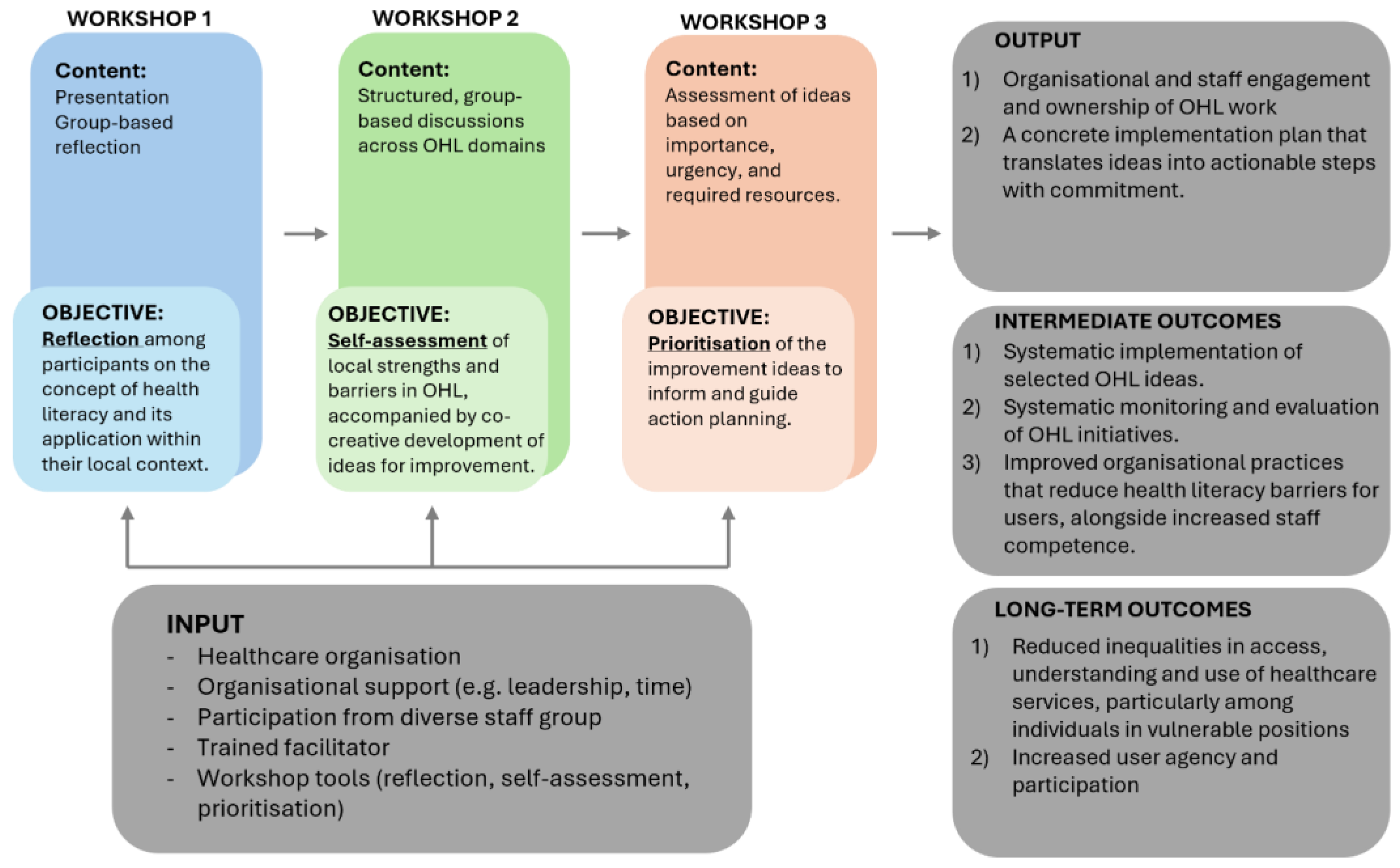
| Naming and communication | OS! renamed to OHL-Act | The refined version was renamed to more clearly reflect its focus on OHL action and improvement. |
| Facilitator guide * | Comprehensive, practice-oriented facilitator guide developed with detailed pre-, during- and post-workshop instructions | To enhance feasibility, support standardised delivery, and provide structured guidance that may assist facilitators with varying levels of experience. |
| Workshop 1—reflection | ||
| Revised reflection tool | The five discussion questions were rewritten to be concrete and practice-oriented | The formative evaluation found that the original questions were too complex |
| Workshop 2—Self-assessment | ||
| Expanding from six to eight domains ** | Added “Monitoring & Evaluation” and “Vulnerability & High Risk” domains | Overall, the eight-domain structure aligned OHL-Act with the Danish national recommendations on OHL, which prioritises system-level change to reduce health inequities with specific attention to people in high risk of health literacy challenges [37]. The recommendations are aligned with acknowledged OHL frameworks [1,18]. In the formative evaluation, equity considerations were perceived to be insufficiently captured in the self-assessment, prompting the addition of the ‘Vulnerability & High Risk’ domain to ensure that reflections regarding local risks of sustaining or worsening equity was addressed explicitly rather than implicitly. The domain focus on the identification of health literacy related challenges among users and local situations or routines requiring high level of health literacy. ‘Monitoring & Evaluation’ was separated into an independent domain to reinforce the need for data on local health literacy challenges and systematic follow-up. |
| Increase from 18 to 20 discussion questions | Expanding questions across the 8 domains | To retain the conceptual scope of OHL while stimulating reflection yet reduce the complexity and broadness of individual questions. |
| Refined wording and examples in for all discussion questions | Clearer phrasing, more concrete examples | To improve linguistic clarity and practical relevance, thereby supporting more constructive and innovative dialogue |
| Refined domain distribution | Max. four domains per group; ≥ two groups per domain | To ensure engagement and multiple perspectives per domain but reduce the burden on each participant as former participants experienced fatigue when discussing all domains |
| Removal of 0–4 scoring | Replaced with red–yellow–green dialogue tool | To promote dialogue rather than precise scoring, as participants often spent time debating small numerical differences instead of discussing improvement ideas. Although originally intended for longitudinal evaluation, the scale had not been used this way in practice and mainly functioned as a consensus tool. However, it was removed following the feasibility study. |
| Workshop 3—Prioritisation | ||
| Added two alternative workshop formats for inspiration | Format suggestions for conducting Workshop 3 were added including expanded detailed instructions. | Workshop 3 does not have a fixed format. The refinement was added to support facilitators in selecting a format that fits their organisational context and to reduce uncertainties in planning and facilitating the workshop |
| Domain in OHL-Act | Total Number of Ideas from Workshop 2 | Final Number * | Prioritised Ideas at Workshop 3 ** | Examples of OHL Improvement Ideas |
|---|---|---|---|---|
| Leadership & Culture | 9 | 4 | 3 | Develop, implement, and communicate a comprehensive management strategy for organisational health literacy at the diabetes centre. The strategy should include a clear set of values, well-defined priorities for systemic and relational approaches, and a plan for differentiating services for patients with varying needs. |
| Competencies | 9 | 6 | 3 | All staff are offered training in health literacy as part of professional development, including the aim of fostering a shared language. |
| Process & Practice | 11 | 5 | 4 | Develop a differentiated model for services—for example, in the form of a large, medium, and small package according to different user-needs. |
| Involvement | 12 | 5 | 3 | Develop a plan to increase involvement of relevant user groups, with particular focus on vulnerable or hard-to-reach populations, for example by creating a broader user panel rather than relying on a selected group. |
| Access | 11 | 7 | 4 | Introduce more flexible scheduling by offering need-based appointment times across all staff, extending physician slots for patients with special needs, and providing select walk-in consultations. |
| Communication | 13 | 4 | 2 | Develop a range of communication materials supporting different learning styles and health literacy levels. Tailor verbal and written communication to the user needs, adjusting language, readability, and visual aids. |
| Vulnerability & High Risk | 19 | 9 | 2 | Establish structured cross-sector collaborations by appointing key coordinators (e.g., social nurse) to link hospital, municipality, and primary care, clarifying responsibilities, sharing knowledge, and creating joint workflows to support patients, especially vulnerable ones, during transitions. |
| Monitoring & Evaluation | 5 | 4 | 2 | Develop a systematic approach for feedback on interventions—including feedback from patients to clinicians. |
| Total | 89 | 44 | 22 |
Disclaimer/Publisher’s Note: The statements, opinions and data contained in all publications are solely those of the individual author(s) and contributor(s) and not of MDPI and/or the editor(s). MDPI and/or the editor(s) disclaim responsibility for any injury to people or property resulting from any ideas, methods, instructions or products referred to in the content. |
© 2026 by the authors. Licensee MDPI, Basel, Switzerland. This article is an open access article distributed under the terms and conditions of the Creative Commons Attribution (CC BY) license.
Share and Cite
Renneberg, C.K.; Rasmussen, A.S.D.; Meldgaard, M.; Maindal, H.T.; Aaby, A. Co-Creating Organisational Health Literacy: Formative Evaluation and Feasibility Testing of OHL-Act. Int. J. Environ. Res. Public Health 2026, 23, 391. https://doi.org/10.3390/ijerph23030391
Renneberg CK, Rasmussen ASD, Meldgaard M, Maindal HT, Aaby A. Co-Creating Organisational Health Literacy: Formative Evaluation and Feasibility Testing of OHL-Act. International Journal of Environmental Research and Public Health. 2026; 23(3):391. https://doi.org/10.3390/ijerph23030391
Chicago/Turabian StyleRenneberg, Camilla Klinge, Anne Sofie Dydensborg Rasmussen, Maiken Meldgaard, Helle Terkildsen Maindal, and Anna Aaby. 2026. "Co-Creating Organisational Health Literacy: Formative Evaluation and Feasibility Testing of OHL-Act" International Journal of Environmental Research and Public Health 23, no. 3: 391. https://doi.org/10.3390/ijerph23030391
APA StyleRenneberg, C. K., Rasmussen, A. S. D., Meldgaard, M., Maindal, H. T., & Aaby, A. (2026). Co-Creating Organisational Health Literacy: Formative Evaluation and Feasibility Testing of OHL-Act. International Journal of Environmental Research and Public Health, 23(3), 391. https://doi.org/10.3390/ijerph23030391