Exploring Gender-Sensitive Serious Games for Nutrition Communication: A Formative Qualitative Study in Rural Indonesia
 , , , and
Highlights
- This study examines the ongoing issue of childhood stunting in rural Indonesia, where gender norms and inadequate nutritional knowledge impede effective solutions.
- It investigates culturally rooted communication tactics via serious games for moms, young women, and families residing in high-stunting areas.
- The research illustrates that gender-sensitive, game-based interventions might enhance nutritional knowledge and decision-making in high-risk populations, such as moms and brides-to-be.
- Findings emphasise the necessity of incorporating local culture, religion, and family dynamics to improve the acceptance of digital nutrition teaching tools.
- Gender-sensitive serious games can enhance national stunting-reduction initiatives by providing interactive, accessible, and engaging educational experiences.
- The findings offer practical insights for public health professionals, politicians, and Puskesmas.
Abstract
1. Introduction
Research Objectives
- (1)
- examine stakeholders’ perceptions of the cultural acceptability and usability of gender-sensitive serious games for nutrition communication;
- (2)
- analyse how serious games facilitate family-based nutrition learning and position children as co-players and learners; and
- (3)
- Identify key design principles within gender-sensitive serious games for nutrition communication, including AI-supported features where appropriate
2. Methods
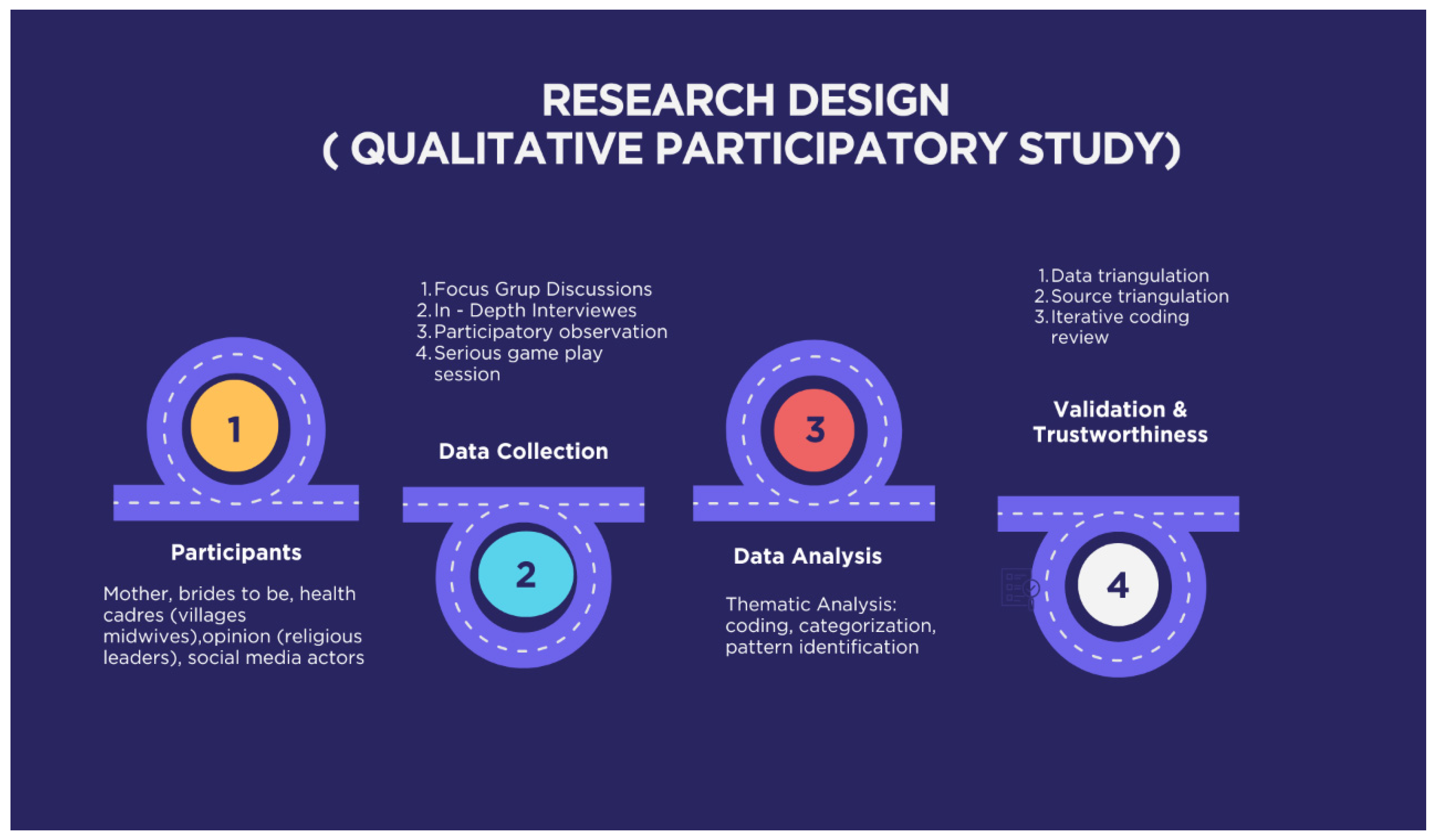
Data Validation and Trustworthiness
3. Results
3.1. Contextual Background
3.1.1. Trust-Based Nutrition Communication in Rural Madura
3.1.2. Mothers as Primary Caregivers Within Gendered Decision-Making Structures
“I usually obtain information about child nutrition from midwives, Posyandu cadres, and mothers’ WhatsApp groups.”(Mother A, 24)
“I usually get nutrition information from social media and from Posyandu.”(Mother SK, 29)
“I usually get nutrition information from the village midwife during immunisation sessions and from mothers’ WhatsApp groups. I also ask neighbours when my child has difficulty eating.”(Mother, 31, Sumenep)
“I studied in the health field, so most of my nutrition information comes from my education, workplace, and online sources.”(Mother of under-five children, 40 years, Sumenep)
“Sometimes people say eggs cause fever, but the midwife explained that this is only a myth. I feel confused when the advice from family members differs from that of health workers.”(Mother ER, 25)
“Mothers of young children described themselves as the primary actors responsible for daily feeding practices and child nutrition. However, their decisions were not made in isolation. Nutrition-related choices were often negotiated within family structures, shaped by elders’ advice and socially accepted norms. While mothers actively received information from health services, applying this knowledge consistently at home required navigating household expectations and economic constraints.”(Ummi, mother of an under-five child, 29 years, Bangkalan)
3.1.3. Male Perspectives on Authority and Support
“Information delivered by religious leaders is the most trusted.”(Religious leader, 52 years, Sumenep)
“If information comes from community leaders or religious figures, people are more likely to listen and follow it.”(Community leader, 52 years, Pamekasan)
“I do not really understand nutrition yet. Usually, I follow advice from my parents or older family members.”(Bride-to-be [young man], 25 years, Sampang)
3.1.4. Dietary Taboos and Conflicting Sources of Authority
“People say that if a child eats eggs, it will cause internal heat. The midwife said it is not true, but family members still forbid it.”(Mother, 25, Pamekasan)
“Sometimes nutrition practices clash with family beliefs, such as myths that prohibit mothers from eating certain nutritious foods after childbirth.”(Mother of under-five children, 40 years, Sumenep)
“Sometimes I feel confused because there are many nutrition myths on social media.”(Bride-to-be, 19 years, Sumenep)
“I once experienced confusion when a mother was not allowed to eat protein after giving birth because it was believed it could affect the baby’s nutrition.”(Local social media actor, 26 years old, Sumenep)
“Many nutrition messages on social media are not in line with religious values, so people here trust information delivered by religious figures more.”(Religious leader, 52 years, Sumenep)
3.1.5. Early Marriage and Limited Nutrition Preparedness Among Young Women
“I get nutrition information from pre-marital classes at the health centre and from the District Health Office’s Instagram. I want to be ready to become a mother later.”(Bride-to-be, 19 years, Sumenep)
“I do not really understand nutrition yet. Usually, I follow advice from my parents or older family members.”(Bride-to-be, 20 years)
“I usually follow my mother-in-law’s advice about nutrition during pregnancy. Sometimes I feel it is unfair, but I am hesitant to disagree”(Bride AN, 19 years).
3.1.6. Gaps Between Formal Health Education and Daily Household Practices
“During Posyandu sessions, healthy food is explained, but at home it is sometimes difficult to apply because of long-standing habits.”(Mother A, 24)
“Sometimes the information I receive is different and confusing.”(Mother SK, 29)
“Information that uses survey data is more trustworthy, but there are still many hoaxes circulating on social media.”(Public health officer, 34 years, Sumenep)
“Information that uses national data is more trusted, but many people are still confused because of hoaxes.”(Health communication officer, 30 years, Sumenep)
“Nutrition information is much better now than in the past because access is easier, but not everyone can apply it due to different social and economic conditions.”(Mother of under-five children, 40 years, Sumenep)
“Information from social media is sometimes confusing. Mothers trust information more when it has an official government label.”(Health cadre, 42 years, Sumenep)
“We explain balanced nutrition, but after the meeting, many people return to their habits. They often need reminders.”(Cadre PS, 40)
“I rarely search for nutrition information myself. Usually, information comes from health officers or pamphlets.”(Religious leader, 52 years, Sumenep)
“I have never joined a direct nutrition campaign. Most of the information I see is on social media.”(Bride-to-be, 19 years, Sumenep)
3.2. Roles of Community and Institutional Actors in Nutrition Communication
3.2.1. Health Cadres and Village Midwives as Trusted Intermediaries
“People trust information more when it comes from someone they know directly, such as midwives or Posyandu cadres.”(Female community figure, 26 years old, Sumenep)
“Midwives and health cadres are very important as the extension of the Health Office.”(Health communication officer, 30 years, Sumenep)
“The information I trust the most is from the midwife. Village leaders and the midwife really help in providing nutrition information.”(Mother, 31, Sumenep)
“Information from doctors, midwives, or the government is the most trusted and most frequently shared.”(Mother A, 24)
“Doctors are the most trusted when delivering health information.”(Mother SK, 29)
“I get information from cadre training and the Maternal and Child Health book, and then share it with mothers during Posyandu meetings.”(Health cadre, 42 years, Sumenep)
“I usually obtain child nutrition information from routine trainings held by the health centre or district health office, from pocket books or modules provided, and from WhatsApp groups among cadres where we share information.”(Health cadre, 31, Pamekasan)
“People trust us because we come regularly and speak in ways they understand. If we explain too formally, they will forget or ignore it.”(Cadre, 38)
“As a midwife, I obtain child nutrition information mainly from official trainings and seminars held by the Ministry of Health, the District Health Office, or professional organisations such as the Indonesian Midwives Association. I also regularly consult scientific journals and clinical practice guidelines.”(Midwife, 40, Pamekasan)
3.2.2. Religious and Community Leaders as Normative Influencers
“The role of community leaders, midwives, and Posyandu cadres is very important. They are the most trusted figures in the village. If information comes from them, people are more likely to listen and follow it.”(Community leader, 52, Pamekasan)
“Religious leaders who accompany young people really help us understand nutrition better.”(Bride-to-be, 19, Sumenep)
“Information delivered by religious leaders is the most trusted.”(Religious leader, 52 years, Sumenep)
“Religious leaders are the most trusted figures in the community.”(Public health officer, 34 years, Sumenep)
“Health workers are the most trusted, but their messages are stronger when supported by religious leaders.”(Mother of under-five children, 40 years, Sumenep)
“If the religious leader supports the message, families are more willing to listen.”(Cadre, 42 years, Sumenep)
3.2.3. Informal Digital Actors and Local Social Media Channels
“I get information about child nutrition through social media such as TikTok, Instagram, Facebook, and also from family and parents.”(Local social media actor, 26 years old, Sumenep)
“I have shared nutrition information both verbally and through social media.”(Local social media actor, 26 years old, Sumenep)
“I often share nutrition information with my family through WhatsApp.”(Mother, 31, Sumenep)
“Yes, I have shared nutrition information, usually through family or friends’ WhatsApp groups.”(Mother A, 24)
“Most of the information I receive comes from social media.”(Mother SK, 29)
“I usually get nutrition information from the mothers’ WhatsApp group in the village. Sometimes information is shared there, and I also pass it on to neighbours during casual conversations.”(Community leader, 52, Pamekasan)
“I follow nutrition accounts on Instagram and often share information with friends through Instagram stories.”(Bride-to-be, 19 years, Sumenep)
“The platform we use most frequently is the WhatsApp group among cadres and health workers, because information arrives quickly and we can discuss it directly.”(Health cadre, 31, Pamekasan)
“We share information through direct socialisation to health centres and printed media, but local social media also plays a role.”(Health communication officer, 30 years, Sumenep)
3.2.4. Hybrid Communication Pathways (Offline–Online)
“I distribute information through official websites and email, and it is reinforced through direct community meetings.”(Health communication officer, 30 years, Sumenep)
“The most effective way is still direct education in front of the community, but supported by digital media so the information can reach more people.”(Local social media actor, 26 years old, Sumenep)
“Usually I get nutrition information from Instagram or WhatsApp groups, and also from training sessions and monthly Posyandu meetings.”(Female community figure, 26 years old, Sumenep)
“I learned from pre-marital classes at the health centre, but I also searched on Google and Instagram.”(Bride-to-be, 19 years, Sumenep)
“I usually share nutrition information through religious gatherings and WhatsApp groups at the pesantren.”(Religious leader, 52 years, Sumenep)
“Sometimes I get information from the Posyandu WhatsApp group, but most education happens during face-to-face meetings.”(Health cadre, 42 years, Sumenep)
“We share information directly during Posyandu activities, home visits, women’s gatherings, and religious meetings, and sometimes through WhatsApp groups when information needs to be spread quickly.”(Health cadre, 31, Pamekasan)
“I share information through WhatsApp groups with health cadres, and education is delivered through mobile Posyandu activities.”(Public health officer, 34 years, Sumenep)
“I share nutrition information through direct counselling at Posyandu, home visits, and during antenatal or immunisation check-ups. I also communicate with health cadres and mothers’ groups through WhatsApp to reinforce key messages.”(Midwife, 40, Pamekasan)
“If I feel confused, I usually ask the midwife or Posyandu cadre directly. Online information helps, but a direct explanation is still important.”(Community leader, 52, Pamekasan)
3.3. Perceptions of Digital Health Technologies and AI-Supported Communication
3.3.1. AI as a Supportive Tool Rather than a Replacement for Health Workers
“I don’t think AI can fully replace health workers, because people still need direct explanations and opportunities to ask questions.”(Female community figure, 26 years old, Sumenep)
“AI can help provide information, but not replace health workers in all aspects.”(Mother of under-five children, 40 years, Sumenep)
“AI can give information quickly, but it cannot fully replace doctors.”(Bride-to-be, 19 years, Sumenep)
“AI can replace health workers in providing information, but examinations and other health services still require medical professionals.”(Local social media actor, 26 years old, Sumenep)
“AI cannot replace medical personnel, but it can help cadres provide information.”(Health cadre, 42 years, Sumenep)
“AI can be a very good supporting tool, but it cannot fully replace health workers. Machines cannot replace personal interaction, empathy, and understanding local social conditions.”(Health cadre, 31, Pamekasan)
“AI cannot fully replace health workers. It can be a powerful supporting tool by providing data and initial recommendations, but empathy, personal interaction, and understanding family contexts are things that only health workers can provide.”(Midwife, 40, Pamekasan)
“AI cannot replace doctors or midwives; it only supports their work.”(Health communication officer, 30 years, Sumenep)
“AI can be used to help children’s health, but it cannot replace religious leaders.”(Religious leader, 52 years, Sumenep)
3.3.2. Trust, Accuracy, and Cultural Fit as Conditions for Acceptance
“The main concern is excessive dependence on technology without verification by health workers.”(Health communication officer, 30 years, Sumenep)
“There is a lot of inaccurate and misleading nutrition information on social media. I always advise the community not to believe it immediately and to verify it with health professionals.”(Midwife, 40, Pamekasan)
“AI should be trustworthy, sourced from health professionals, and balanced with information from medical staff.”(Local social media actor, 26 years old, Sumenep)
“Sometimes the information on social media is confusing. If it comes from official government accounts or health organisations, then I trust it.”(Community leader, 52, Pamekasan)
“If the explanation is easy to understand, I feel comfortable, but it still needs to be checked for accuracy.”(Female community figure, 26 years old, Sumenep)
“I am interested in using AI because I could ask questions directly, but I am afraid of getting incorrect information.”(Mother, 31, Sumenep)
“At the beginning, people may find it difficult to trust AI, but with proper education, they will accept it.”(Mother of under-five children, 40 years, Sumenep)
“I worry that AI is not updated with the latest information. People will trust it if it is official.”(Bride-to-be, 19 years, Sumenep)
“There is a lot of nutrition information on the internet, but I am afraid it might be incorrect. Usually, I wait until the cadre or midwife explains it.”(Mother A, 24)
“Not everyone will trust digital applications.”(Mother SK, 29)
“I sometimes see health information on social media, but I am not sure whether it is correct.”(Bride-to-be, 20)
“People will not trust AI if there is no explanation, especially if it is not adapted to local conditions.”(Health cadre, 42 years, Sumenep)
“The main concern is the accuracy of the information—whether it matches local conditions and eating cultures in our village.”(Health cadre, 31, Pamekasan)
“I worry that AI might spread information that is not in line with religious teachings.”(Religious leader, 52 years, Sumenep)
3.3.3. Digital Literacy and Infrastructure Constraints
“The phone is shared in our household, and sometimes the signal is poor. That is why it is easier to ask directly.”(Mother, A, 24)
“People need time to understand that now everything is technology-based.”(Mother SK, 29)
“It is difficult, but it can be attempted; however, facilities and people’s readiness are still major obstacles.”(Local social media actor, 26 years old, Sumenep)
“Some people are ready to use technology, especially younger mothers, but others still need assistance because of low digital literacy.”(Midwife, 40, Pamekasan)
“I do not really understand advanced technology like AI. I only use simple applications such as WhatsApp or watching videos on YouTube.”(Community leader, 52, Pamekasan)
“Many people are still not familiar with technology, so it needs to be introduced slowly through cadres and community meetings.”(Female community figure, 26 years old, Sumenep)
“Younger generations may be more ready, but older people or those who are not familiar with smartphones need special assistance.”(Health cadre, 31, Pamekasan)
3.3.4. Expectations for Human Mediation in Digital Health Tools
“AI should use simple, youth-friendly language so it is easy to understand.”(Bride-to-be, 19 years, Sumenep)
“AI would be better if it worked together with the midwife. It should use simple language so everyone can understand.”(Mother, 31, Sumenep)
“Medical professionals should deliver AI in ways that align with the local community environment.”(Local social media actor, 26 years old, Sumenep)
“Technology should involve health cadres and community leaders so that people feel guided and confident when using it.”(Midwife, 40, Pamekasan)
“There should be a consultation feature, and intensive socialisation is needed so people can accept AI.”(Health cadre, 42 years, Sumenep)
“There should be a direct chat feature with experts so the application is more trusted.”(Mother of under-five children, 40 years, Sumenep)
“AI-based technology should be introduced gradually and through cadres or midwives who are already trusted by the community.”(Health cadre, 31, Pamekasan)
“Educational games must be designed in a way that respects religious values.”(Religious leader, 52 years, Sumenep)
3.4. Perceived Opportunities for Gender-Sensitive Serious Games in Nutrition Communication
3.4.1. Serious Games as Complementary Communication Tools
“If all approaches are combined, it would be better, but there still needs to be consultation with the midwife.”(Mother, 31, Sumenep)
“Educational games make learning fun and not boring.”(Bride-to-be, 19 years, Sumenep)
“Educational games are very good because children can learn while playing, so they don’t get bored, and the message is easier to absorb.”(Female community figure, 26 years old, Sumenep)
3.4.2. Gamification and Nudging for Sustained Engagement
“I am interested in applications with points or rewards because they help make nutrition monitoring more controlled.”(Local social media actor, 26 years old, Sumenep)
“I like applications with points. Daily challenges make me more enthusiastic.”(Bride-to-be, 19 years, Sumenep)
“If there is an application that gives points or rewards, I would be more enthusiastic.”(Mother, 31, Sumenep)
“Applications with points are good. Daily challenges and small reminders from cadres are very effective.”(Health cadre, 42 years, Sumenep)
“If there are points or rewards for recording children’s nutrition, mothers will be much more motivated. Rewards make them feel that their efforts are appreciated.”(Health cadre, 31, Pamekasan)
“If there are points or rewards, it can increase motivation among mothers and cadres.”(Female community figure, 26 years old, Sumenep)
“Small reminders, such as SMS messages, have proven to be helpful.”(Health communication officer, 30 years, Sumenep)
“Visual reminders like posters or stickers really help. If there are rewards or points, people will be even more motivated.”(Community leader, 52, Pamekasan)
“Small daily reminders from religious teachers can be very effective.”(Religious leader, 52 years, Sumenep)
“Incentives such as food packages or shopping vouchers can strongly motivate mothers to attend Posyandu and apply healthy nutrition practices.”(Midwife, 40, Pamekasan)
3.4.3. Intergenerational and Family-Based Learning Dynamics
“Young people are ready for technology, but older people may not be.”(Bride-to-be, 19 years, Sumenep)
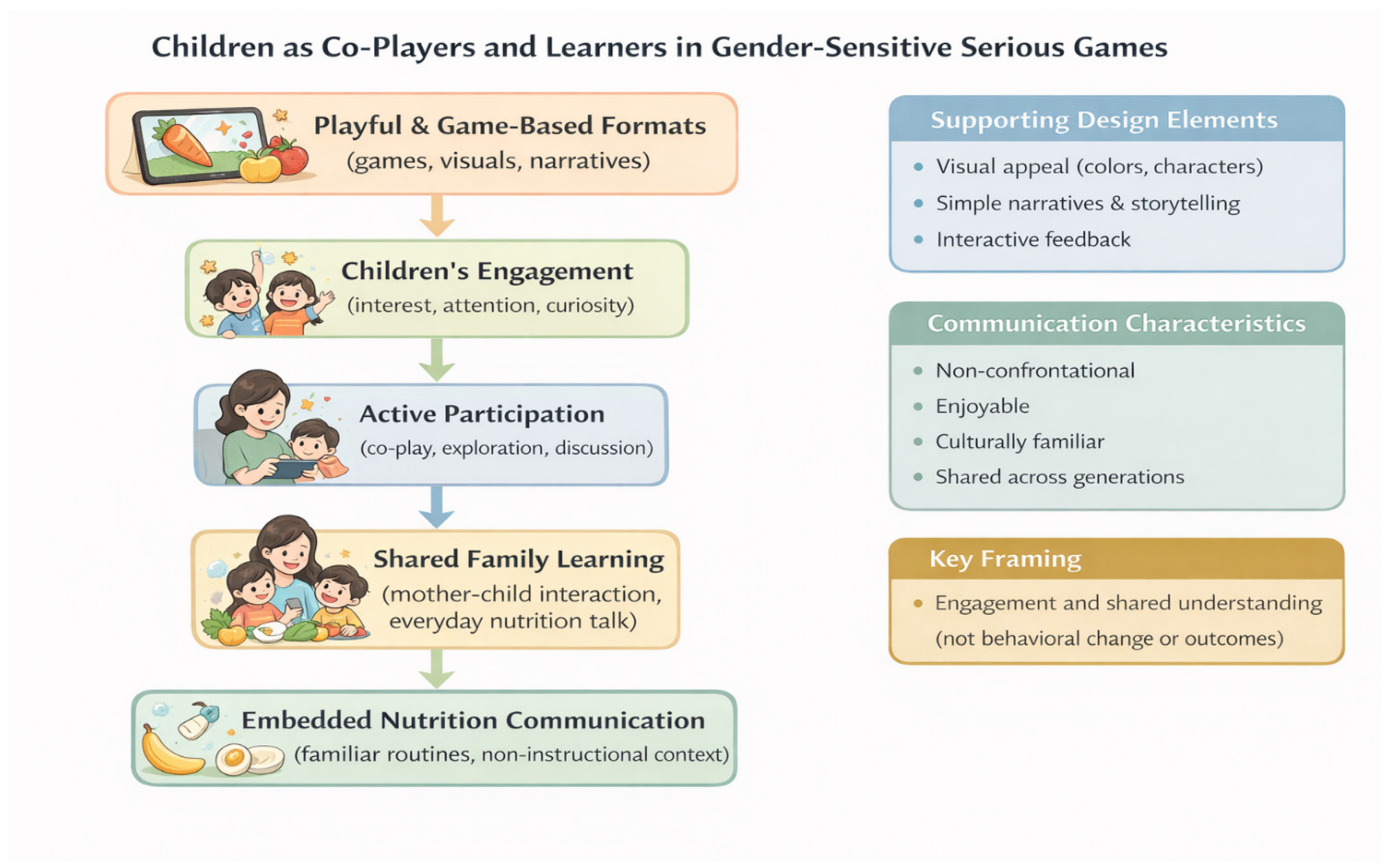
“Children can be involved in nutrition games, but the impact may remain limited to knowledge unless families support it.”(Local social media actor, 26 years old, Sumenep)
“Games for children are good, so they like vegetables and can learn nutrition while playing.”(Mother, 31, Sumenep)
“Children prefer learning through games. When learning is fun, they do not feel forced.”(Community leader, 52, Pamekasan)
“Educational games can help children learn healthy eating habits in a fun way and encourage them to adopt these habits from an early age.”(Midwife, 40, Pamekasan)
“Educational games are a brilliant idea. Children learn most effectively through play, and games can encourage them to like vegetables or fruits.”(Health cadre, 31, Pamekasan)
“Children can be involved through Islamic nutrition stories.”(Religious leader, 52 years, Sumenep)
“If the family supports it, mothers are more enthusiastic about applying healthy eating practices.”(Female community figure, 26 years old, Sumenep)
“Children also need to be involved, and small changes made consistently can have a big impact.”(Health cadre, 42 years, Sumenep)
“Children can be involved from an early age, and small changes can be very meaningful if done consistently.”(Public health officer, 34 years, Sumenep)
“The role of families and cadres is very important in assisting nutrition practices.”(Health communication officer, 30 years, Sumenep)
3.4.4. Cultural and Religious Adaptation in Game Narratives
“Messages must be simple and involve religious leaders and cadres so the community accepts them.”(Health cadre, 42 years, Sumenep)
“Educational games must be designed in a way that respects religious values.”(Religious leader, 52 years, Sumenep)
“Religious and community guidance is important so people trust the program.”(Bride-to-be, 19 years, Sumenep)
“Simple messages using the Madurese language are more attractive to the community.”(Public health officer, 34 years, Sumenep)
“Nutrition campaigns through mothers’ gatherings are effective because many women come and can discuss together.”(Mother, 31 years, Sumenep)
“Meetings such as religious gatherings and women’s groups are very effective because people feel comfortable discussing and sharing experiences there.”(Community leader, 52 years, Pamekasan)
“Community gatherings such as Posyandu, women’s groups, and religious meetings are effective because people feel comfortable and trust the information shared there.”(Midwife, 40 years, Pamekasan)
“Community forums such as arisan, religious gatherings, and PKK meetings are very effective because people trust each other there.”(Health cadre, 31 years, Pamekasan)
“Religious leaders, cadres, midwives, and village heads must be involved so programs can run smoothly.”(Health communication officer, 30 years, Sumenep)
4. Discussion
4.1. Trust-Based Nutrition Communication and Gendered Caregiving Contexts
4.2. Community and Institutional Mediation as Foundations of Credibility
4.3. AI-Supported Features Within Gender-Sensitive Serious Games
4.4. Serious Games as Family-Centred and Gender-Sensitive Communication Spaces
4.5. Brides-to-Be and Young Women as Emerging Communication Audiences
4.6. Design Implications for Gender-Sensitive Serious Games
4.7. Methodological and Practical Limitations
4.8. Implications for Future Research and Development
5. Conclusions
5.1. Summary of Findings
5.2. Theoretical Contributions
5.3. Practical Implications for Design
- Localised narratives reflecting rural life, including familiar household routines and community settings.
- Visual gamified cues that enhance accessibility, particularly for users with limited literacy.
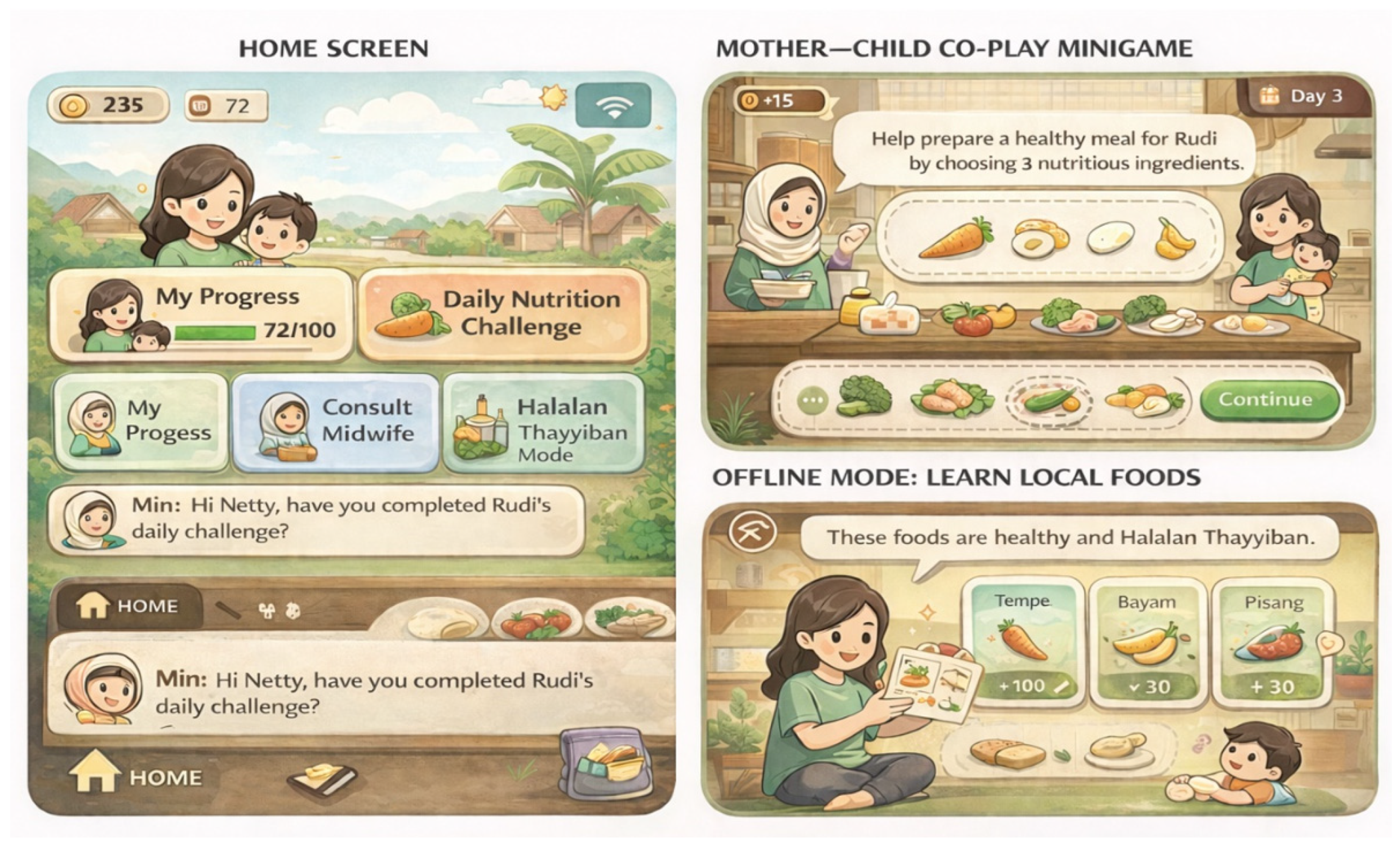
- Mother–child co-play mechanisms that support shared learning rather than hierarchical instruction.
- Modest and culturally relevant recognition systems, including digital acknowledgement and community-based appreciation.
- Integration of religious and cultural values, such as halalan thayyiban, to enhance legitimacy.
- Simplicity and offline compatibility, ensuring usability on low-end devices and in low-connectivity environments.
5.4. Policy Implications
5.5. Limitations and Future Research
5.6. Final Reflection
Author Contributions
Funding
Institutional Review Board Statement
Informed Consent Statement
Data Availability Statement
Acknowledgments
Conflicts of Interest
References
- Guo, J.; Li, B. The Application of Medical Artificial Intelligence Technology in Rural Areas of Developing Countries. Health Equity 2018, 2, 174–181. [Google Scholar] [CrossRef] [Scilit] [PubMed]
- Chavez-Cano, A.M. Artificial Intelligence Applied to Telemedicine: Opportunities for healthcare delivery in rural areas. LatIA 2023, 1, 3. [Google Scholar] [CrossRef] [Scilit]
- Murari, U.K.; Parmar, H. Leveraging Artificial Intelligence for Rural Development: Opportunities and Challenges in the Indian Context. In AI Strategies for Social Entrepreneurship and Sustainable Economic Development; IGI Global: Hershey, PA, USA, 2024; pp. 265–283. [Google Scholar] [CrossRef] [Scilit]
- Mnyaka, L.J. Bridging the gap in rural and underserved areas through AI-enabled solutions. S. Afr. Med. J. 2025, 115, 56–57. [Google Scholar] [CrossRef] [Scilit] [PubMed]
- Breen, C.F.; Fatehkia, M.; Yan, J.; Zhao, X.; Leasure, D.R.; Weber, I.; Kashyap, R. Mapping subnational gender gaps in internet and mobile adoption using social media data. Proc. Natl. Acad. Sci. USA 2025, 122, e2416624122. [Google Scholar] [CrossRef] [Scilit] [PubMed]
- Domènech, T.C. The Gender Digital Divide: Some Elements to Consider. In Palgrave Studies in Digital Inequalities; Springer: Cham, Switzerland, 2025; pp. 23–41. [Google Scholar] [CrossRef] [Scilit]
- Jamil, S. From digital divide to digital inclusion: Challenges for wide-ranging digitalization in Pakistan. Telecomm. Policy 2021, 45, 102206. [Google Scholar] [CrossRef] [Scilit]
- Khan, M.T.; Zeeshan, Z.; Gupta, N. Digital infrastructure and gender gaps in labor force participation across developing economies. Discov. Sustain. 2026, 7, 40. [Google Scholar] [CrossRef] [Scilit]
- Galindo-Manrique, A.F.; Rojas-Vargas, N.P. The Role of Digital Financial Services in Narrowing the Gender Gap in Low–Middle-Income Economies: A Bayesian Machine Learning Approach. Risks 2025, 13, 96. [Google Scholar] [CrossRef] [Scilit]
- Limone, P. Serious games and eating behaviors: A systematic review of the last years. Front. Nutr. 2022, 9, 978793. [Google Scholar] [CrossRef] [Scilit] [PubMed]
- Font, J.M.; Svensson, E.; Hedvall, A. Towards teaching maternal healthcare and nutrition in rural Ethiopia through a serious game. In Proceedings of the CHI PLAY 2017 Extended Abstracts—Extended Abstracts Publication of the Annual Symposium on Computer-Human Interaction in Play, Amsterdam, The Netherlands, 15–18 October 2017; pp. 187–193. [Google Scholar] [CrossRef] [Scilit]
- Mueller, S.; Soriano, D.; Boscor, A.; Saville, N.M.; Arjyal, A.; Baral, S.; Fordham, M.; Hearn, G.; Kayastha, R.; Kostkova, P. MANTRA: Improving Knowledge of Maternal Health, Neonatal Health, and Geohazards in Women in Rural Nepal Using a Mobile Serious Game. Front. Public Health 2020, 8, 584375. [Google Scholar] [CrossRef] [Scilit] [PubMed]
- Folkvord, F.; Haga, G.; Theben, A. The Effect of a Serious Health Game on Children’ s Eating Behavior: Cluster-Randomized Controlled Trial. JMIR Serious Games 2021, 9, e23050. [Google Scholar] [CrossRef] [Scilit] [PubMed]
- Kato-Lin, Y.C.; Kumar, U.B.; Sri Prakash, B.; Prakash, B.; Varadan, V.; Agnihotri, S.; Subramanyam, N.; Krishnatray, P.; Padman, R. Impact of pediatric mobile game play on healthy eating behavior: Randomized controlled trial. JMIR Mhealth Uhealth 2020, 8, e15717. [Google Scholar] [CrossRef] [Scilit] [PubMed]
- Kurniasari, N.D.; Susanti, E.; Surya, Y.W. Women in Health Communication The Role of Family Assistance Teams (TPK) in Accelerating Stunting Reduction in East Java. Media Gizi Indones. 2022, 17, 200–210. [Google Scholar] [CrossRef] [Scilit]
- Yunitasari, E.; Sholecha, R.P.; Armini, N.K.A.; Pradanie, R.; Lestari, W.T.; Lee, B.-O. Mother’s Eating Behavior During Pregnancy and Family Income with Malnutrition: Stunting Prevention in Madura, Indonesia (Mother’s Eating and family Income with Stunting Prevention). J. Int. Dent. Med. Res. 2022, 15, 448–453. [Google Scholar]
- Allen, C.G.; Arbelaez, D.G.; Arechiga, C.; Belliard, A.; Belliard, J.C.; Daly, M.; Diaz-Linhart, Y.; Feinberg, E.; Fernandez-Pastrana, I.; Hirsch, G.R.; et al. Cultural mediation among individuals, communities, and health and social service systems. In Promoting the Health of the Community: Community Health Workers Describing Their Roles, Competencies, and Practice; Springer: Berlin/Heidelberg, Germany, 2021; pp. 55–86. [Google Scholar] [CrossRef] [Scilit]
- Calarco, R.; Prevot-Monsacre, P.; Paternoster, M.; Vignier, N.; Trévidy, F.; Cailhol, J. Health mediation intervention at the base of a social housing complex in Seine-Saint-Denis, France: A mixed-methods, realistic evaluation protocol. Glob. Health Promot. 2025, 32, 108–116. [Google Scholar] [CrossRef] [Scilit] [PubMed]
- Liu, Z.; Cheng, H.; Guan, H.; Yang, X.; Chen, Z. Effect of paternal-maternal parenting styles on college students’ internet addiction of different genders: The mediating role of life satisfaction. PLoS ONE 2024, 19, e0303554. [Google Scholar] [CrossRef] [Scilit] [PubMed]
- Kubota, S.; Elliott, E.M.; Ounaphom, P.; Phrasisombath, K.; Xaymongkhonh, V.S.; Phimmachak, L.; Souksavanh, O.; Volaot, K.; Kounnavong, S.; Haenssgen, M.J.; et al. Community engagement and local governance for health equity through trust: Lessons from developing the CONNECT Initiative in the Lao People’s Democratic Republic. BMJ Glob. Health 2024, 9, e015409. [Google Scholar] [CrossRef] [Scilit] [PubMed]
- Aminizadeh, S.; Heidari, A.; Dehghan, M.; Toumaj, S.; Rezaei, M.; Navimipour, N.J.; Stroppa, F.; Unal, M. Opportunities and challenges of artificial intelligence and distributed systems to improve the quality of healthcare service. Artif. Intell. Med. 2024, 149, 102779. [Google Scholar] [CrossRef] [Scilit] [PubMed]
- Baranowski, T.; Ryan, C.; Lu, A.S. Nutrition Education and Dietary Behavior Change Games: A Scoping Review. Games Health J. 2019, 8, 153–176. [Google Scholar] [CrossRef] [Scilit] [PubMed]
- Venkatesh, V.; Morris, M.G.; Davis, G.B.; Davis, F.D. User Acceptance of Information Technology: Toward A Unified View1. Manag. Inf. Syst. Q. 2003, 27, 425–478. [Google Scholar] [CrossRef] [Scilit]



| Participant Group | Approx Age Range (Years) | Gender | Location | Number |
|---|---|---|---|---|
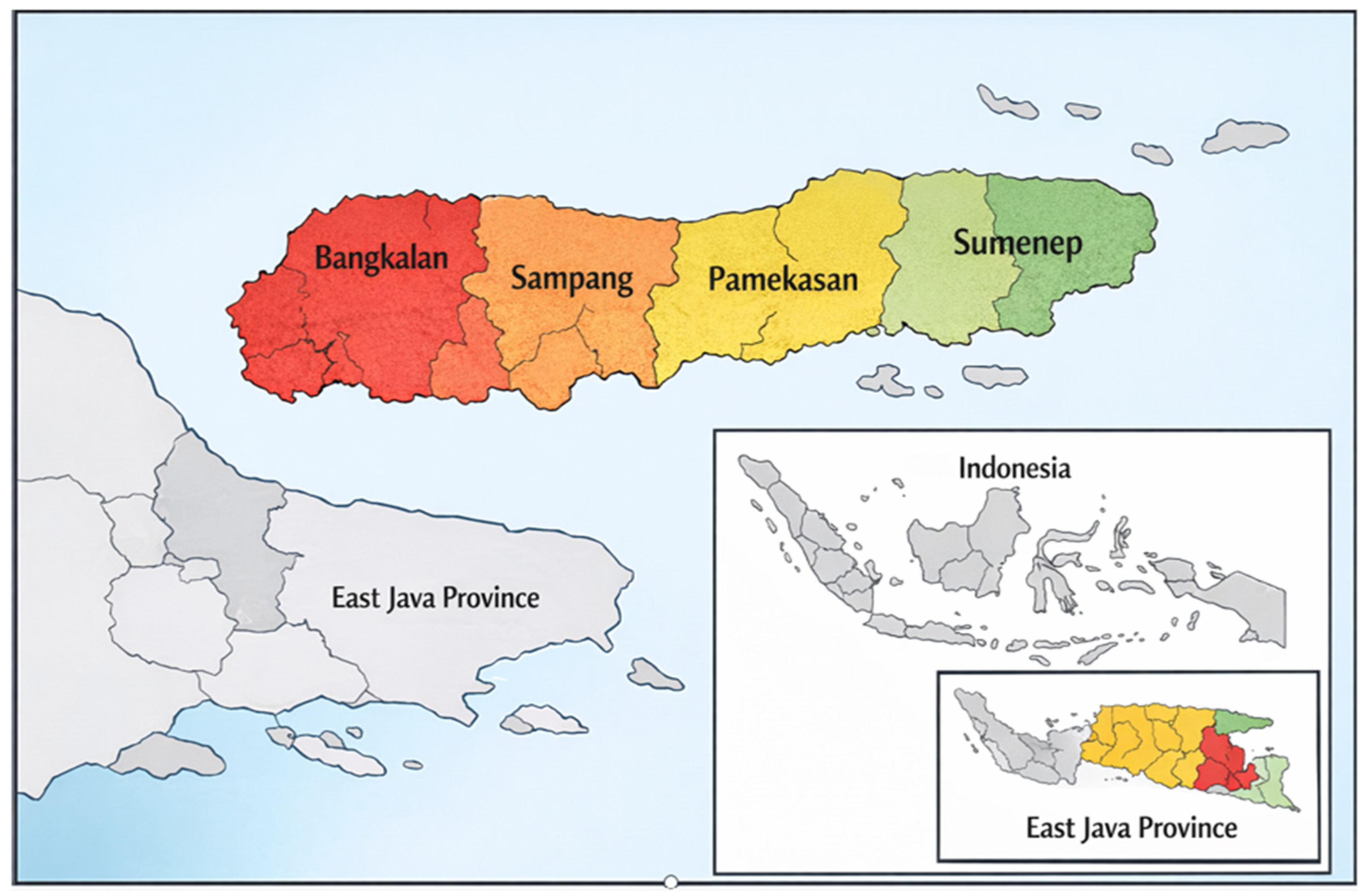
| Mother of children under five | 24–42 | female (n = 8) | Madura Island, East Java | 8 |
| Brides-to-be/young women and men | 19–25 | male (n = 4), female (n = 3) | Madura Island, East Java | 7 |
| Health cadres/Villages midwives | 26–53 | male (n = 1), female (n = 13) | Madura Island, East Java | 14 |
| Opinion (community) leaders/religious leaders | 26–52 | male (n = 3), female (n = 4) | Madura Island, East Java | 7 |
| Social media actors | 23–30 | male (n = 4) female (n = 2) | Madura Island, East Java | 6 |
| Total | 42 |
Disclaimer/Publisher’s Note: The statements, opinions and data contained in all publications are solely those of the individual author(s) and contributor(s) and not of MDPI and/or the editor(s). MDPI and/or the editor(s) disclaim responsibility for any injury to people or property resulting from any ideas, methods, instructions or products referred to in the content. |
© 2026 by the authors. Licensee MDPI, Basel, Switzerland. This article is an open access article distributed under the terms and conditions of the Creative Commons Attribution (CC BY) license.
Share and Cite
Kurniasari, N.D.; Ismail, I.; Dellia, P.; Ni`mah, A.T.; Hariastuti, I. Exploring Gender-Sensitive Serious Games for Nutrition Communication: A Formative Qualitative Study in Rural Indonesia. Int. J. Environ. Res. Public Health 2026, 23, 390. https://doi.org/10.3390/ijerph23030390
Kurniasari ND, Ismail I, Dellia P, Ni`mah AT, Hariastuti I. Exploring Gender-Sensitive Serious Games for Nutrition Communication: A Formative Qualitative Study in Rural Indonesia. International Journal of Environmental Research and Public Health. 2026; 23(3):390. https://doi.org/10.3390/ijerph23030390
Chicago/Turabian StyleKurniasari, Netty Dyah, Iriani Ismail, Prita Dellia, Ana Tsalitsatun Ni`mah, and Iswari Hariastuti. 2026. "Exploring Gender-Sensitive Serious Games for Nutrition Communication: A Formative Qualitative Study in Rural Indonesia" International Journal of Environmental Research and Public Health 23, no. 3: 390. https://doi.org/10.3390/ijerph23030390
APA StyleKurniasari, N. D., Ismail, I., Dellia, P., Ni`mah, A. T., & Hariastuti, I. (2026). Exploring Gender-Sensitive Serious Games for Nutrition Communication: A Formative Qualitative Study in Rural Indonesia. International Journal of Environmental Research and Public Health, 23(3), 390. https://doi.org/10.3390/ijerph23030390