Article

Psychometric Performance of the Stony Brook Scar Evaluation Scale and SCAR-Q Questionnaire in Dutch Children after Pediatric Surgery


by
Chantal A. Ten Kate
1,
Hilde J. H. Koese
1,
M. Jenda Hop
2,
André B. Rietman
1,3,
René M. H. Wijnen
1,
Marijn J. Vermeulen
4 and
Claudia M. G. Keyzer-Dekker
1,*
1
Department of Pediatric Surgery and Intensive Care Children, Erasmus MC Sophia Children’s Hospital, Wytemaweg 80, 3015 CD Rotterdam, The Netherlands
2
Department of Plastic and Reconstructive Surgery, Erasmus University Medical Center, 3015 CD Rotterdam, The Netherlands
3
Department of Child and Adolescent Psychiatry/Psychology, Erasmus MC Sophia Children’s Hospital, 3015 CD Rotterdam, The Netherlands
4
Department of Pediatrics, Division of Neonatology, Erasmus MC Sophia Children’s Hospital, 3015 CD Rotterdam, The Netherlands
*
Author to whom correspondence should be addressed.
Int. J. Environ. Res. Public Health 2024, 21(1), 57; https://doi.org/10.3390/ijerph21010057

Submission received: 1 November 2023 / Revised: 22 December 2023 / Accepted: 26 December 2023 / Published: 30 December 2023
Editorial Note: Due to an editorial processing error, this article was incorrectly included within the Special Issue Quality of Life of Children Born with Anomalies and Their Families upon publication. This article was removed from this Special Issue’s webpage on 14 April 2025 but remains within the regular issue in which it was originally published. The editorial office confirms that this article adhered to MDPI's standard editorial process (https://www.mdpi.com/editorial_process).

Abstract

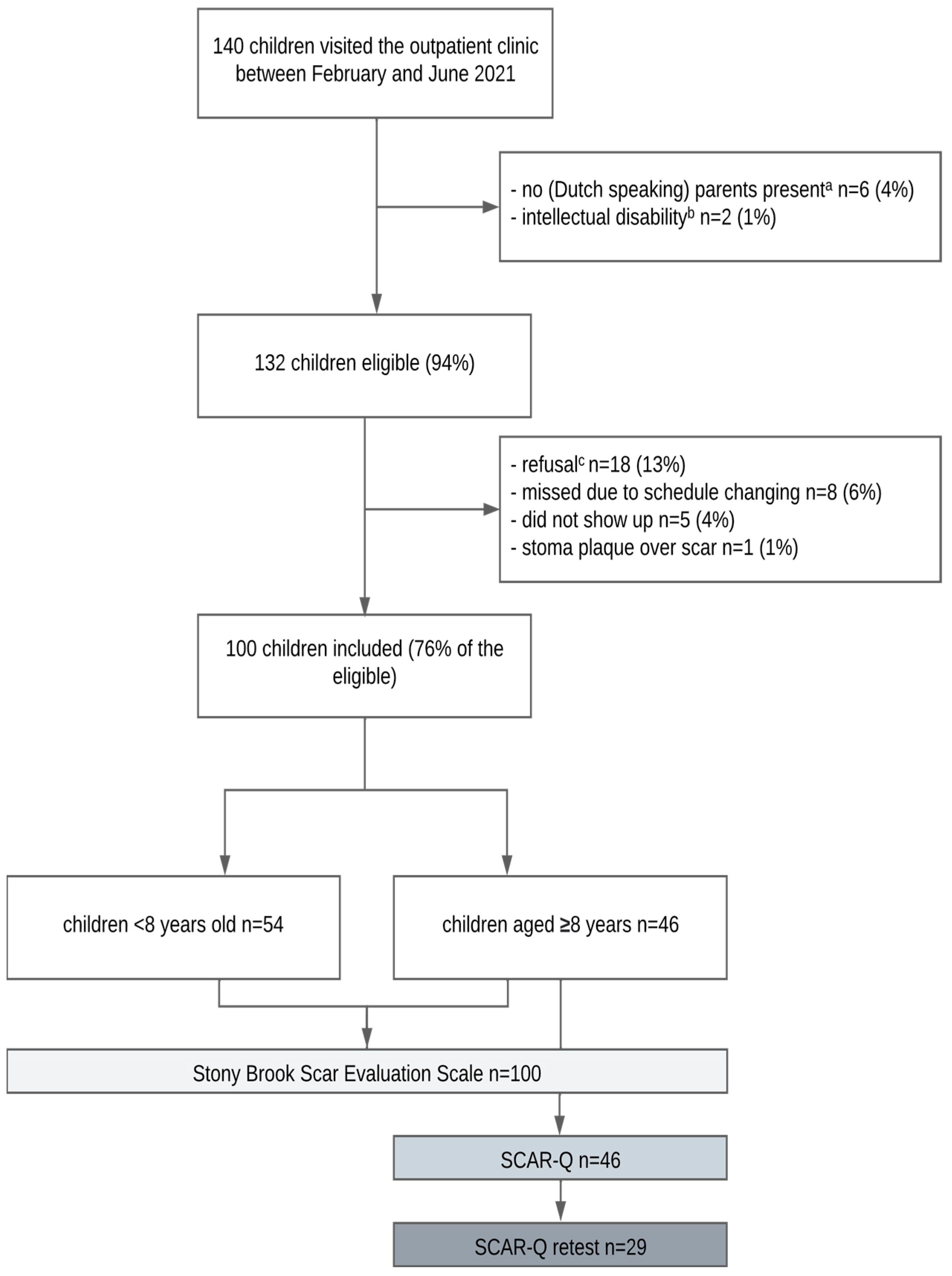
Introduction: The growing population of survivors following pediatric surgery emphasizes the importance of long-term follow-up. The impact of surgical scars on daily life can be evaluated through patient-reported outcome measurements. The Stony Brook Scar Evaluation Scale (SBSES) and SCAR-Q questionnaire are two interesting instruments for this purpose. We evaluated their psychometric performance in Dutch children after pediatric surgery. Methods: After English–Dutch translation, we evaluated—following the COSMIN guidelines—the feasibility, reliability (internal and external), and validity (construct, criterion, and convergent) of the SBSES and SCAR-Q in Dutch patients < 18 years old with surgical scars. Results: Three independent observers completed the SB for 100 children (58% boys, median age 7.3 (IQR 2.5–12.1) years) in whom surgery had been performed a median of 2.8 (0.5–7.9) years ago. Forty-six of these children (61% boys, median age 12.1 (9.3–16.2) years) completed the SCAR-Q. Feasibility and internal reliability (Cronbach’s alpha > 0.7) was good for both instruments. For the SB, external reliability was poor to moderate (interobserver variability: ICC 0.46–0.56; intraobserver variability: ICC 0.74). For the SCAR-Q, external reliability was good (test–retest agreement: ICC 0.79–0.93). Validity tests (construct, criterion, and convergent) showed poor to moderate results for both instruments. Conclusions: The Dutch-translated SBSES and SCAR-Q showed good feasibility and internal reliability. External reliability and validity were likely affected by differences in conceptual content between the questionnaires. Combining them would provide insight in the impact of scars on patients. Implementation of these instruments in longitudinal follow-up programs could provide new insights into the long-term psychological outcome after pediatric surgery.
Keywords: patient-reported outcome measures; psychometrics; postoperative; scars; surveys and questionnaires patient-reported outcome measures; psychometrics; postoperative; scars; surveys and questionnaires