Article

Maternal Factors Affecting the Macronutrient Composition of Transitional Human Milk
Department of Nursing, Research Institute for Biomedical & Health Science, Konkuk University, Chungju 27478, Chungcheongbuk-do, Korea
*
Author to whom correspondence should be addressed.
Int. J. Environ. Res. Public Health 2022, 19(6), 3308; https://doi.org/10.3390/ijerph19063308

Submission received: 21 January 2022 / Revised: 25 February 2022 / Accepted: 8 March 2022 / Published: 11 March 2022

Abstract

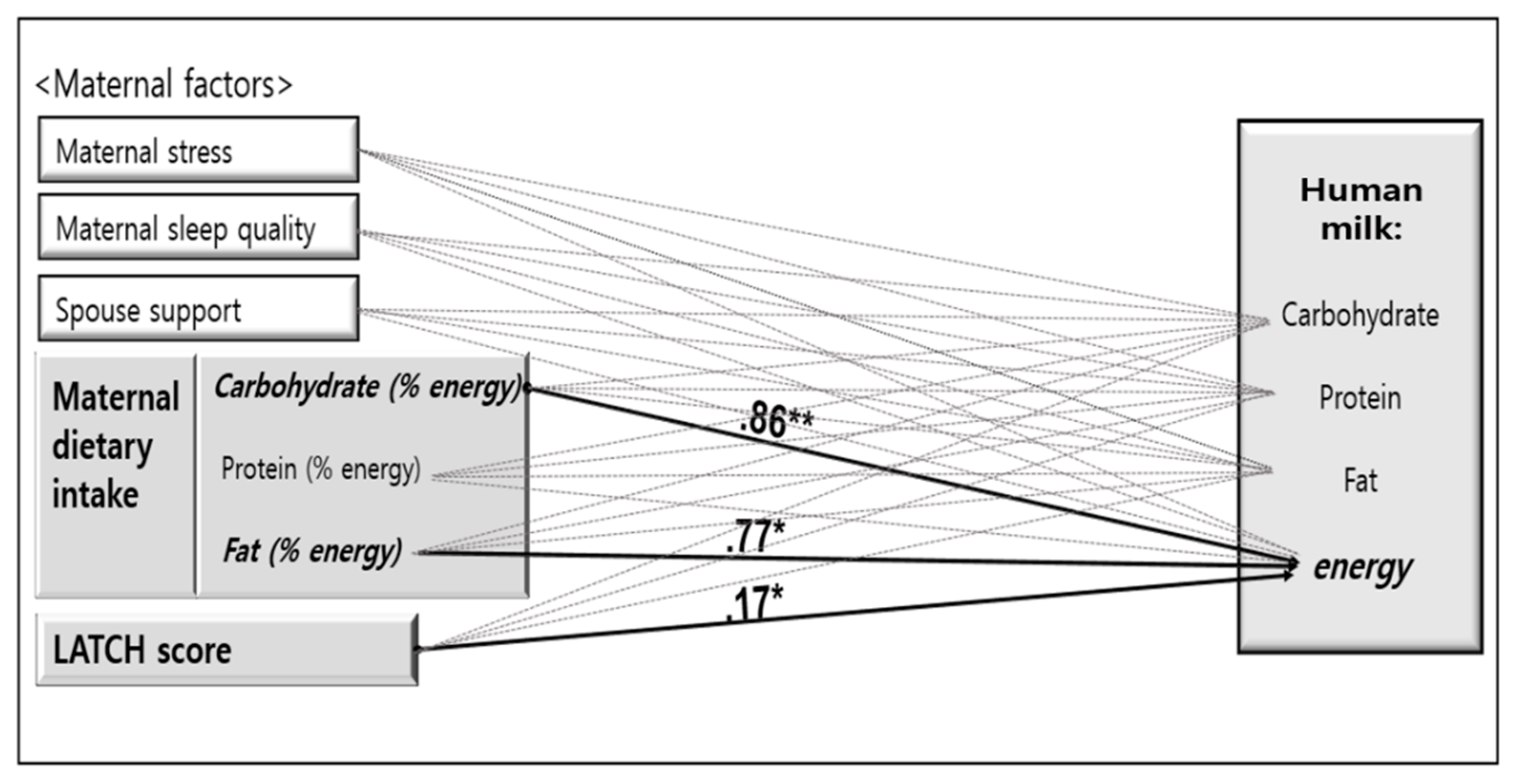
This study investigated the influence of selected maternal factors on the macronutrient composition and energy of human milk (HM). The study enrolled 159 breastfeeding mothers from five postpartum care centers in Seoul, Korea. Their gestational weeks were 37–42 weeks, they had no complications before and after childbirth, and were at 7–14 days postpartum. They provided data using structured questionnaires on general characteristics, stress, sleep quality, spousal support, and dietary intake. Breastfeeding assessment (LATCH) was investigated by qualified nurses, and each mother provided one sample of HM. The HM composition was analyzed using the Miris® HM analyzer. The relationships between variables were analyzed using Pearson’s correlation analysis, and a linear regression analysis was performed to verify the main variables. It was found that maternal dietary intake was related to HM composition as the %energy from carbohydrates (β = 0.86, p < 0.01) and %energy from fat (β = 0.77, p < 0.05) showed positive relationships with HM energy. The LATCH score was positively related to HM energy (β = 0.17, p < 0.05). In contrast, postpartum stress, sleep quality, and spousal support were not associated with HM macronutrient composition. In conclusion, HM macronutrients and energy content were associated with maternal dietary intake and LATCH scores, but not with postpartum stress, sleep quality, and spousal support.
Keywords: breastfeeding assessment; dietary intake of macronutrients; human milk macronutrients; postpartum stress; sleep quality; spousal support breastfeeding assessment; dietary intake of macronutrients; human milk macronutrients; postpartum stress; sleep quality; spousal support