Article

Stress and Distress during the COVID-19 Pandemic: The Role of Neighborhood Context
by
Michelle C. Kondo
1,*,
Erica Felker-Kantor
2,
Kimberly Wu
2,
Jeanette Gustat
3,
Christopher N. Morrison
4,5,
Lisa Richardson
6,
Charles C. Branas
4 and
Katherine P. Theall
3
1
Northern Research Station, USDA Forest Service, 100 N. 20th St, Suite 205, Philadelphia, PA 19103, USA
2
Department of Social, Behavioral, and Population Sciences, Tulane University School of Public Health and Tropical Medicine, New Orleans, LA 70112, USA
3
Department of Epidemiology, Tulane University School of Public Health and Tropical Medicine, New Orleans, LA 70112, USA
4
Department of Epidemiology, Mailman School of Public Health, Columbia University, New York, NY 10032, USA
5
Department of Epidemiology and Preventive Medicine, School of Public Health and Preventive Medicine, Monash University, Melbourne, VIC 3004, Australia
6
Institute of Women and Ethnic Studies, Research and Technology Foundation, Inc., 2021 Lakeshore Drive, Suite 220, New Orleans, LA 70112, USA
*
Author to whom correspondence should be addressed.
Int. J. Environ. Res. Public Health 2022, 19(5), 2779; https://doi.org/10.3390/ijerph19052779

Submission received: 2 February 2022 / Revised: 24 February 2022 / Accepted: 24 February 2022 / Published: 27 February 2022

Abstract

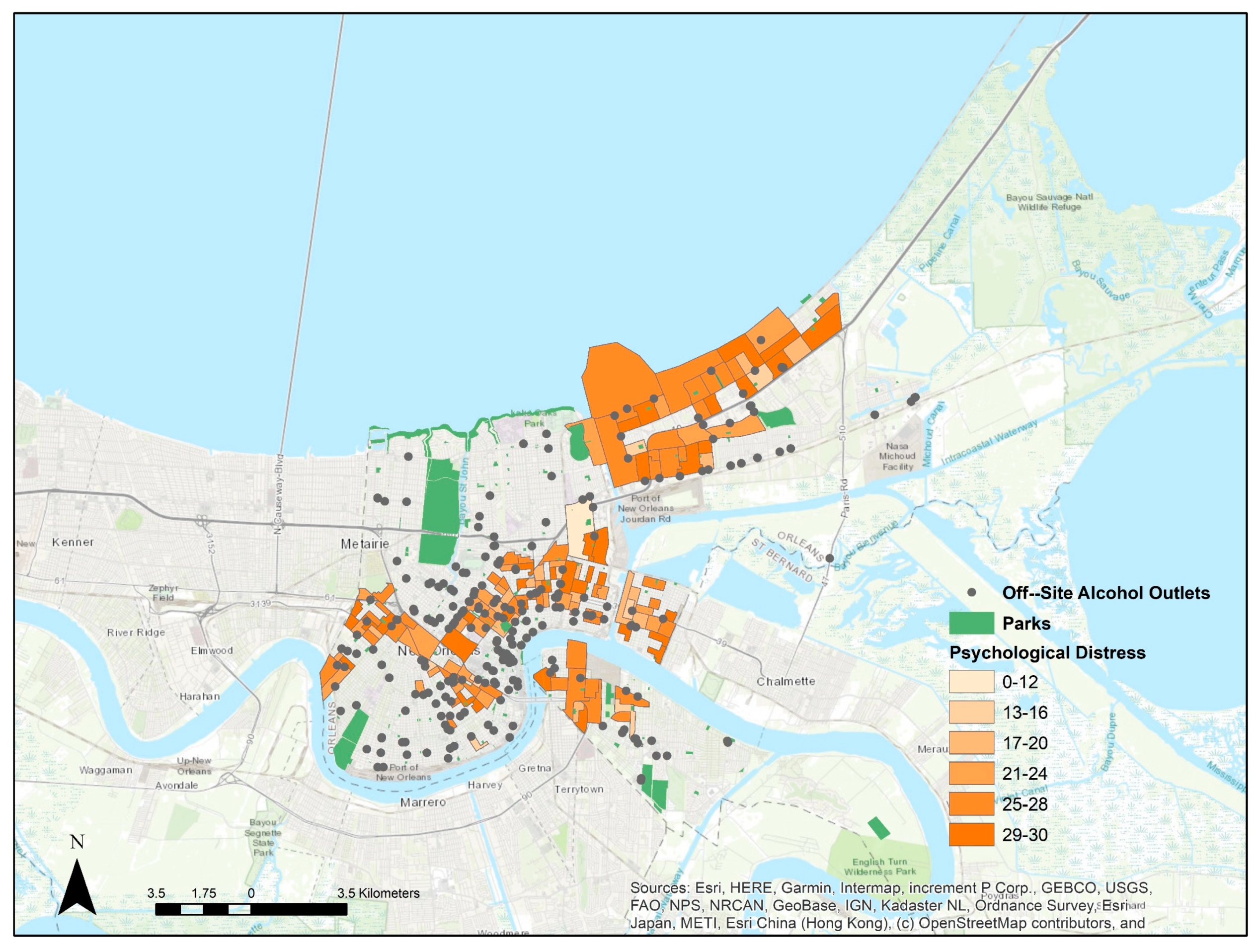
Neighborhoods play a central role in health and mental health, particularly during disasters and crises such as the COVID-19 pandemic. We examined changes in psychological distress following the pandemic, and the potential role of neighborhood conditions among 244 residents of New Orleans, Louisiana. Using modified linear regression models, we assessed associations between neighborhood characteristics and change in psychological distress from before to during the pandemic, testing effect modification by sex and social support. While higher density of offsite alcohol outlets (β = 0.89; 95% CI: 0.52, 1.23), assault rate (β = 0.14; 95% CI: 0.03, 0.24), and walkable streets (β = 0.05; 95% CI: 0.02, 0.07) in neighborhoods were associated with an increase in distress, access to neighborhood parks (β = −0.03; 95% CI: −0.05, −0.01), collective efficacy (β = −0.23; 95% CI: −0.35, −0.09), and homicide rate (β = −1.2; 95% CI: −1.8, −0.6) were associated with reduced distress related to the pandemic. These relationships were modified by sex and social support. Findings revealed the important but complicated relationship between psychological distress and neighborhood characteristics. While a deeper understanding of the neighborhoods’ role in distress is needed, interventions that target neighborhood environments to ameliorate or prevent the residents’ distress may be important not only during crisis situations.
Keywords: psychological distress; neighborhood characteristics; parks; greenspace; crime; walkability psychological distress; neighborhood characteristics; parks; greenspace; crime; walkability