Article

Hamstring Muscle Injuries and Hamstring Specific Training in Elite Athletics (Track and Field) Athletes


1
Inter-University Laboratory of Human Movement Biology (LIBM EA 7424), University of Lyon, University Jean Monnet, 42023 Saint Etienne, France
2
Department of Clinical and Exercise Physiology, Sports Medicine Unit, Faculty of Medicine, University Hospital of Saint-Etienne, 42055 Saint-Etienne, France
3
European Athletics Medical & Anti-Doping Commission, European Athletics Association (EAA), 1007 Lausanne, Switzerland
4
Institute of Sport, Exercise and Health, University College London, London W1T 7HA, UK
5
National Performance Institute, British Athletics, Loughborough LE11 3TU, UK
6
School of Health Sciences (HESAV), HES-SO University of Applied Sciences and Arts Western Switzerland, 1011 Lausanne, Switzerland
7
Department of Sprints, Hurdles and Relays, Swiss Athletics, Haus des Sports, 3063 Ittigen, Switzerland
8
Ballet Healthcare, The Royal Ballet, London WC2E 9DA, UK
9
Laboratoire Interuniversitaire de Biologie de la Motricité, Université Savoie Mont Blanc, EA 7424, 73000 Chambéry, France
10
Physiotherapy Department and Motion Analysis Lab, Swiss Olympic Medical Center, La Tour Hospital, 1217 Meyrin, Switzerland
11
Société Française des Masseurs Kinésithérapeute du Sport, SFMKS-Lab, 93380 Pierrefitte-sur-Seine, France
12
Mines Saint-Etienne, U1059 Sainbiose, INSERM, Centre CIS, University Lyon, University Jean Monnet, 42023 Saint-Etienne, France
13
CH Chalons en Champagne et Institut Mutualiste de Montsouris, 75014 Paris, France
14
Swiss Olympic Medical Center, Centre de Médecine du Sport, Division de Médecine Physique et Réadaptation, Centre Hospitalier Universitaire Vaudois, 1011 Lausanne, Switzerland
15
Institute of Sport Sciences, University of Lausanne, 1015 Lausanne, Switzerland
16
Institute of Interdisciplinary Exercise Science and Sports Medicine, MSH Medical School Hamburg, 20457 Hamburg, Germany
*
Author to whom correspondence should be addressed.
Int. J. Environ. Res. Public Health 2022, 19(17), 10992; https://doi.org/10.3390/ijerph191710992

Submission received: 9 July 2022 / Revised: 30 August 2022 / Accepted: 30 August 2022 / Published: 2 September 2022
(This article belongs to the Special Issue Injury Prevention and Musculoskeletal Rehabilitation)

Abstract

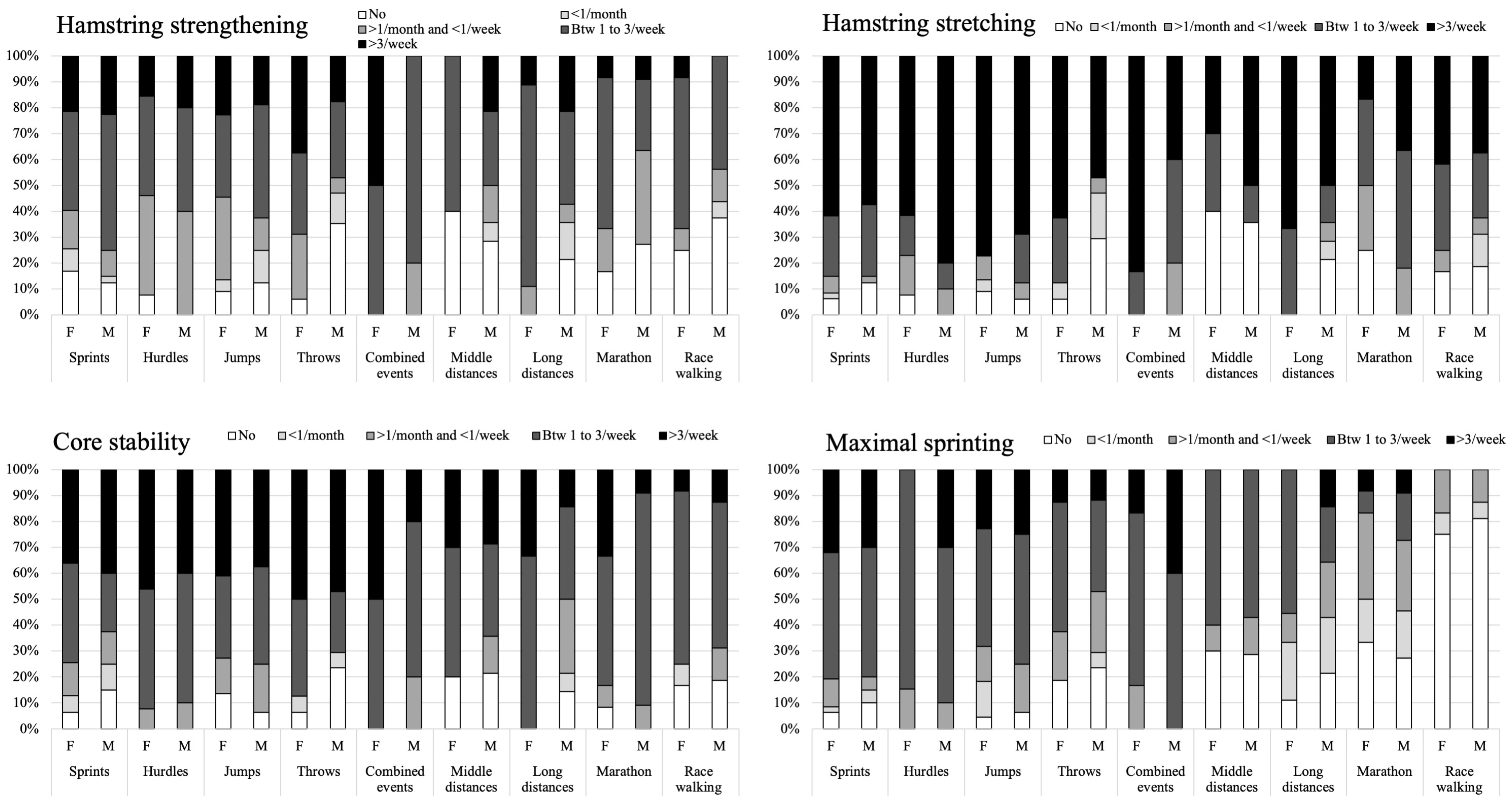
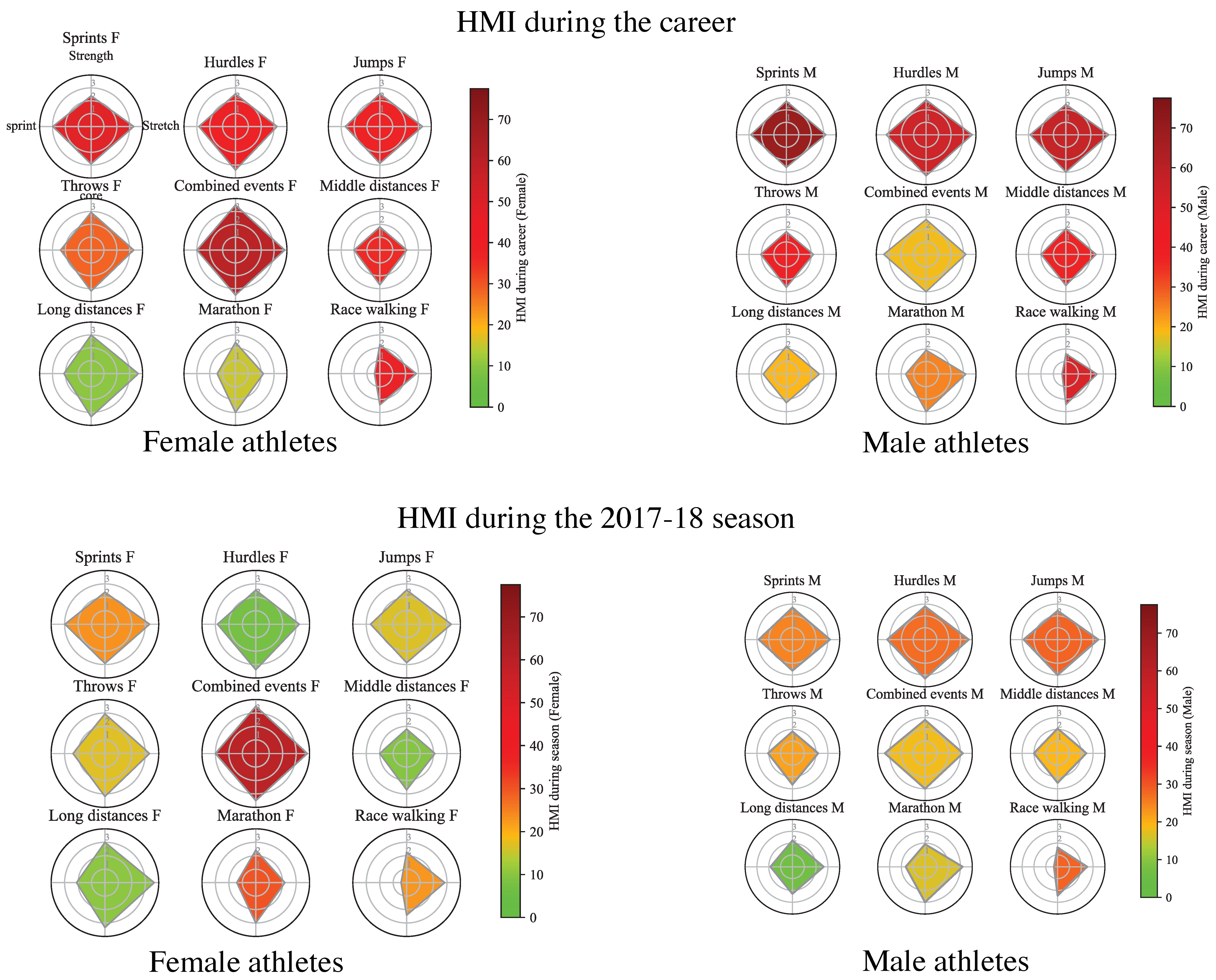
Objective: We aimed to describe hamstring muscle injury (HMI) history and hamstring specific training (HST) in elite athletes. A secondary aim was to analyse the potential factors associated with in-championships HMI. Methods: We conducted a prospective cohort study to collect data before and during the 2018 European Athletics Championships. Injury and illness complaints during the month before the championship, HMI history during the entire career and the 2017–18 season, HST (strengthening, stretching, core stability, sprinting), and in-championship HMI were recorded. We calculated proportions of athletes with HMI history, we compared HST according to sex and disciplines with Chi2 tests or ANOVA, and analysed factors associated with in-championship HMI using simple model logistic regression. Results: Among the 357 included athletes, 48% reported at least one HMI during their career and 24% during the 2017–18 season. Of this latter group, 30.6% reported reduced or no participation in athletics’ training or competition at the start of the championship due to the hamstring injury. For HST, higher volumes of hamstring stretching and sprinting were reported for disciplines requiring higher running velocities (i.e., sprints, hurdles, jumps, combined events and middle distances). Five in-championship HMIs were recorded. The simple model analysis showed a lower risk of sustaining an in-championships HMI for athletes who performed more core (lumbo-pelvic) stability training (OR = 0.49 (95% CI: 0.25 to 0.89), p = 0.021). Conclusions: Our present study reports that HMI is a characteristic of the athletics athletes’ career, especially in disciplines involving sprinting. In these disciplines, athletes were performing higher volumes of hamstring stretching and sprinting than in other disciplines. Further studies should be conducted to better understand if and how HST are protective approaches for HMI in order to improve HMI risk reduction strategies.
Keywords: track and field; injury surveillance; epidemiology; risk factors; hamstring; prevention track and field; injury surveillance; epidemiology; risk factors; hamstring; prevention