Article

Startup of Demo-Scale Anaerobic Digestion Plant Treating Food Waste Leachate: Process Instability and Recovery


1
Department of Energy Engineering, Future Convergence Technology Research Institute, Gyeongsang National University, 33 Dongjin-ro, Jinju 52828, Korea
2
Department of Energy System Engineering, Gyeongsang National University, 33 Dongjin-ro, Jinju 52828, Korea
3
Division of Environmental Science and Engineering, Pohang University of Science and Technology, 77 Cheongam-ro, Pohang 37673, Korea
4
Institute for Convergence Research and Education in Advanced Technology (I-CREATE), Yonsei University, 85 Songdogwahak-ro, Yeonsu-gu, Incheon 21983, Korea
*
Author to whom correspondence should be addressed.
Int. J. Environ. Res. Public Health 2022, 19(11), 6903; https://doi.org/10.3390/ijerph19116903

Submission received: 5 April 2022 / Revised: 1 June 2022 / Accepted: 2 June 2022 / Published: 5 June 2022
(This article belongs to the Collection Municipal Wastewater Treatment and Sludge Treatment and Disposal)

Abstract

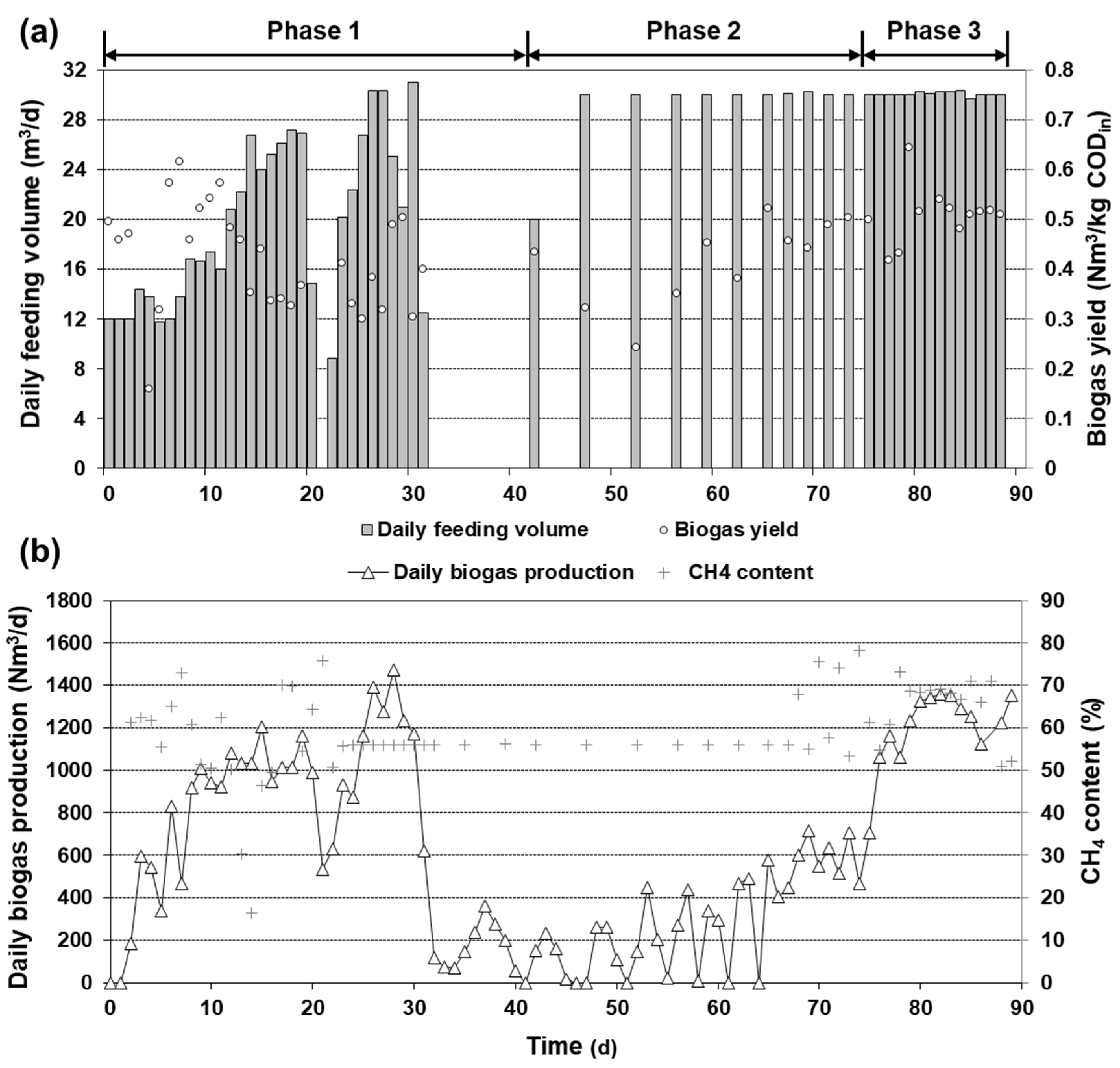
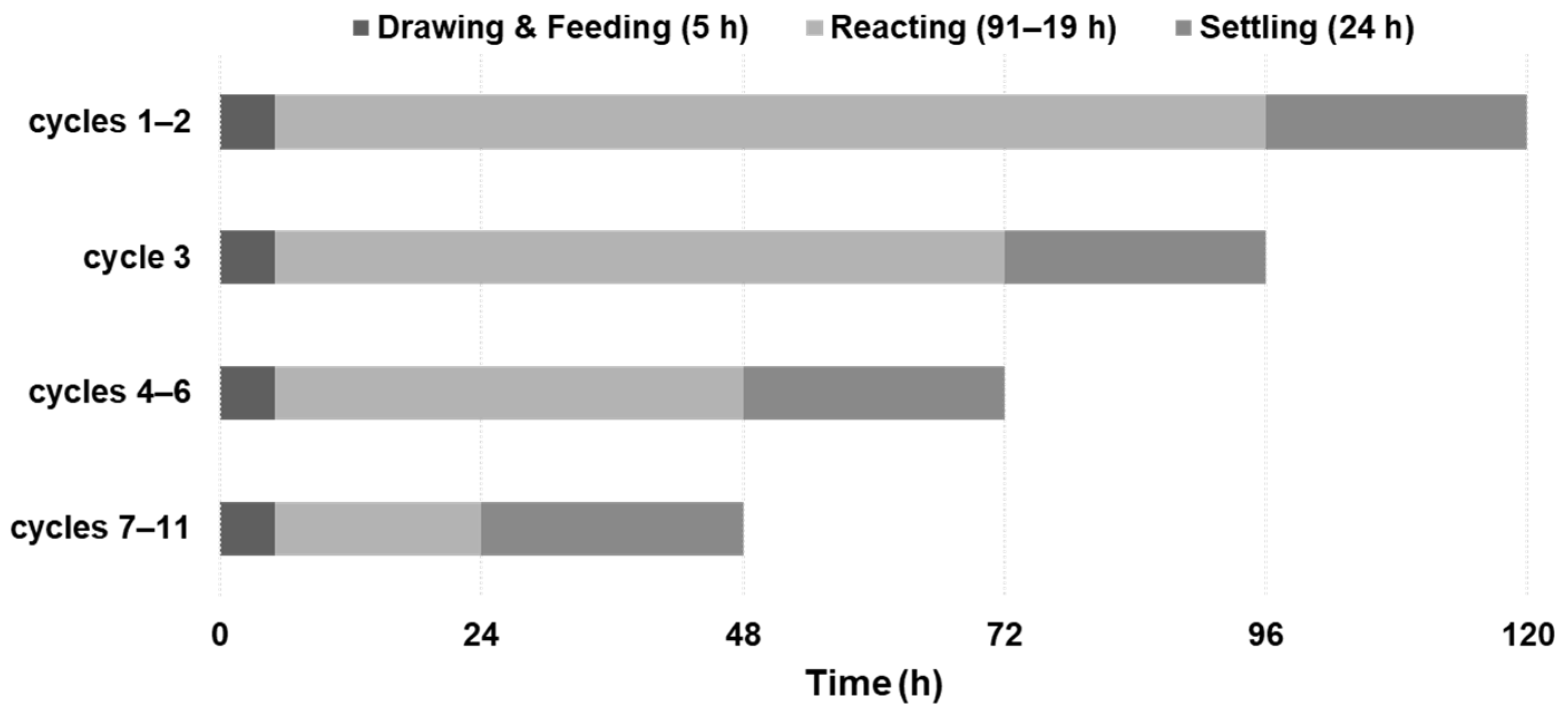
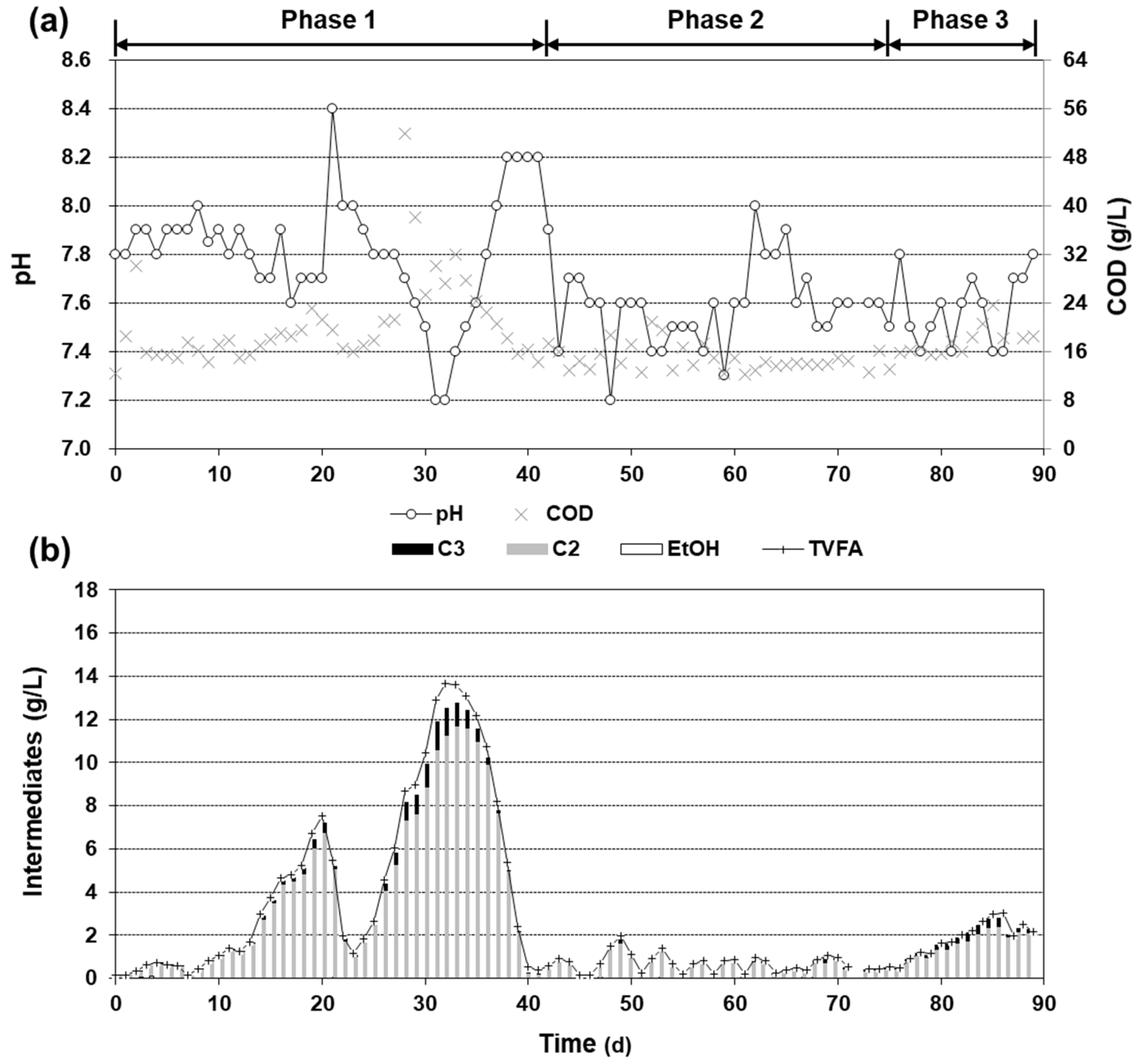
A demo-scale (600 m3 working volume) anaerobic digester treating food waste leachate was monitored during its startup period. The operation strategy was adjusted twice (i.e., three distinct phases) during the operation to recover the process from instability. During the first phase, the organic loading rate (OLR) > 2.7 kg chemical oxygen demand (COD)/m3∙day corresponded to volatile fatty acid (VFA) accumulation along with a decreasing pH, resulting in the drop in biogas yield to 0.43 ± 0.9 m3/kg CODin. During phase 2, fast recovery of this process was aimed at using a sequencing batch operation. One batch cycle (5 to 2 days) consisted of the combined drawing and feeding step (5 h), the reacting step (91 to 17 h), and the settling step (24 h). The duration of the reacting step was determined for each cycle such that (1) the biogas production ceased before the cycle end and (2) the residual VFA concentration was < 1 g/L. In total, 11 cycles were operated with a gradual increase in biogas yield to 0.55 m3/kg CODin with the absence of any sign of system disturbance. After phase 2, the digester was fed at the designed OLR of 4.1 ± 0.3 kg COD/m3∙day. The biogas yield was elevated to 0.58 ± 0.2 m3/kg CODin during phase 3 with the residual VFA concentration maintained at 2.2 ± 0.6 g/L. Methanogen populations, as determined by real-time PCR, did not change significantly throughout the period. These results imply that the adaptation of this process to the OLR of ca. 4 kg COD/m3∙day was not due to the increase in methanogen population but due to the elevation of its activity. Overall, this study suggests that the sequencing batch operation with adjustable cycle duration can be one successful recovery strategy for biogas plants under system instability.
Keywords: food waste leachate; anaerobic digestion; organic loading rate; sequencing batch reactor; recovery; real-time PCR food waste leachate; anaerobic digestion; organic loading rate; sequencing batch reactor; recovery; real-time PCR