Article

The Correlation amongst Salty Taste Preference and Overactive Bladder Symptoms in Female Individuals


1
Department of Health Administration, Dankook University, Cheonan 31116, Korea
2
Department of Urology, Soonchunhyang University Seoul Hospital, Soonchuhyang University Medical College, 59, Daesagwan-ro, Yongsan-gu, Seoul 140-743, Korea
3
Department of Humanities and Social Medicine, College of Medicine and Catholic Institute for Healthcare Management, The Catholic University of Korea, Seoul 06591, Korea
*
Author to whom correspondence should be addressed.
Int. J. Environ. Res. Public Health 2021, 18(2), 518; https://doi.org/10.3390/ijerph18020518

Submission received: 22 December 2020 / Revised: 6 January 2021 / Accepted: 8 January 2021 / Published: 10 January 2021
(This article belongs to the Section Women's Health)

Abstract

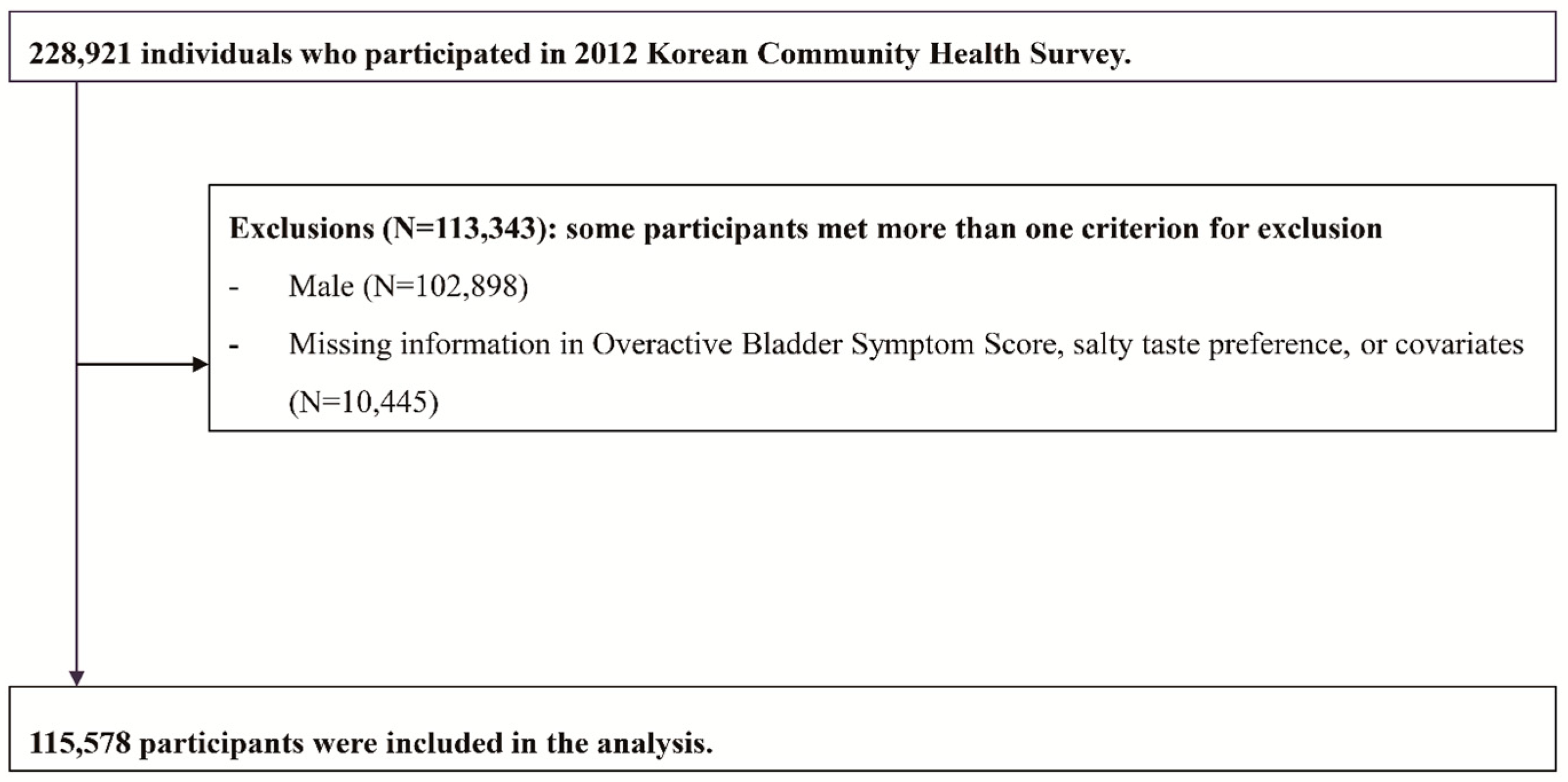
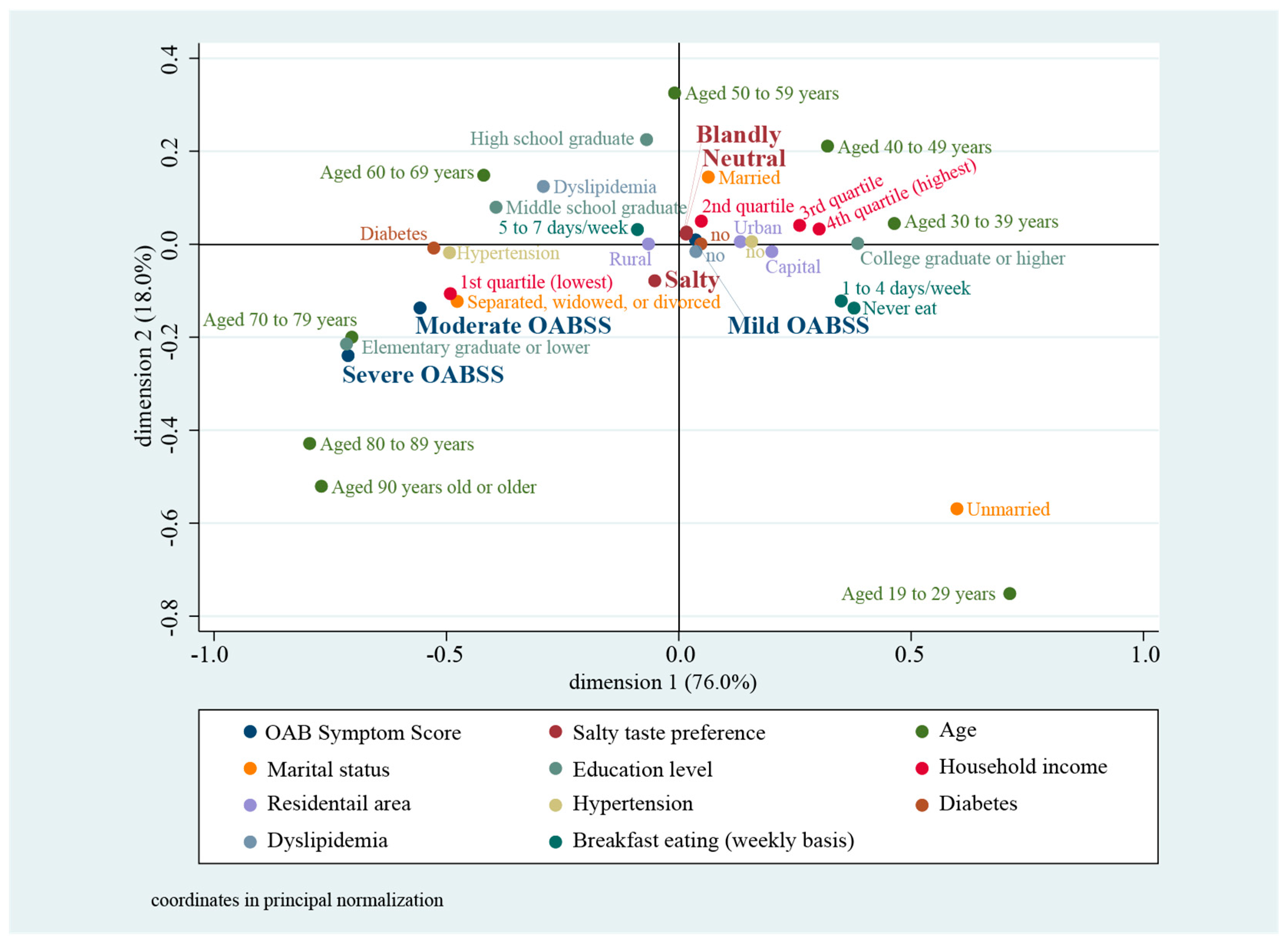
Sodium intake could have an indirect effect on storage symptoms as it is an established fact that it has a correlation to hypertension (HTN). However, clinical support for the correlation of sodium intake to STORAGE symptom remains scarce. Therefore, the present work sought to determine how sodium intake and OAB symptom seriousness were correlated in female individuals based on a cross-sectional research design. Data from 115,578 respondents chosen from 228,921 individuals enrolled in the Korean Community Health Survey (KCHS) were subjected to cross-sectional analysis. The correlation amongst sodium intake and STORAGE symptom was assessed on the basis of estimates of the incidence rate ratio (IRR) with 95% confidence interval (CI). Furthermore, joint correspondence analysis (JCA) was conducted to investigate how a predilection for salty taste was associated with several factors, including STORAGE symptom, socio-economic factors, comorbidities, and dietary habits. By comparison to respondents indicating a neutral predilection for salty taste, those who indicated a predilection for bland and salty taste were 7.1% (IRR = 1.071, p < 0.001, 95% CI = 1.045–1.097) and 20.5% (IRR = 1.205, p < 0.001, 95% CI = 1.177–1.234) more probable to experience severe STORAGE symptom, within an adjusted model with multiple variables. JCA confirmed the existence of a correlation between predilection for salty taste and STORAGE symptom. A close correlation was established to exist between predilection for salty taste and lower urinary tract symptoms (LUTS), such as voiding and storage symptoms and nocturia. Moreover, sodium intake was found to be a risk factor for LUTS seriousness in both excessive and deficient amount.
Keywords: sodium; dietary; overactive bladder; lower urinary tract symptoms sodium; dietary; overactive bladder; lower urinary tract symptoms