Review

Leptospirosis and Coinfection: Should We Be Concerned?
by
Asmalia Md-Lasim
1,2,
Farah Shafawati Mohd-Taib
1,*,
Mardani Abdul-Halim
3,
Ahmad Mohiddin Mohd-Ngesom
4,
Sheila Nathan
1 and
Shukor Md-Nor
1
1
Department of Biological Sciences and Biotechnology, Faculty of Science and Technology, Universiti Kebangsaan Malaysia, UKM, Bangi 43600, Selangor, Malaysia
2
Herbal Medicine Research Centre (HMRC), Institute for Medical Research (IMR), National Institue of Health (NIH), Ministry of Health, Shah Alam 40170, Selangor, Malaysia
3
Biotechnology Research Institute, Universiti Malaysia Sabah, Jalan UMS, Kota Kinabalu 88400, Sabah, Malaysia
4
Center for Toxicology and Health Risk, Faculty of Health Sciences, Universiti Kebangsaan Malaysia, Kuala Lumpur 50300, Federal Territory of Kuala Lumpur, Malaysia
*
Author to whom correspondence should be addressed.
Int. J. Environ. Res. Public Health 2021, 18(17), 9411; https://doi.org/10.3390/ijerph18179411

Submission received: 18 May 2021 / Revised: 5 August 2021 / Accepted: 23 August 2021 / Published: 6 September 2021
(This article belongs to the Section Infectious Disease Epidemiology)

Abstract

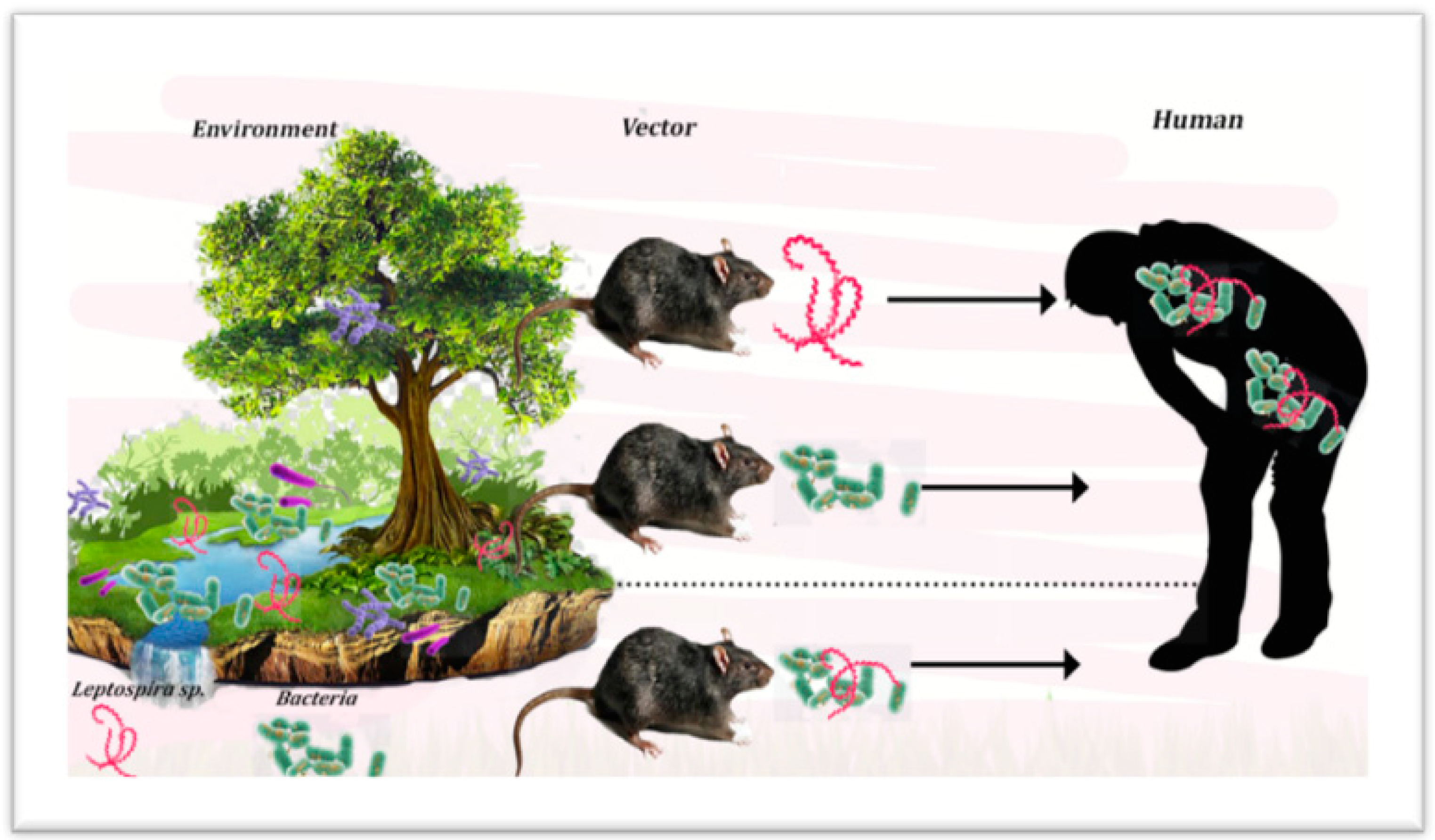
Pathogenic Leptospira is the causative agent of leptospirosis, an emerging zoonotic disease affecting animals and humans worldwide. The risk of host infection following interaction with environmental sources depends on the ability of Leptospira to persist, survive, and infect the new host to continue the transmission chain. Leptospira may coexist with other pathogens, thus providing a suitable condition for the development of other pathogens, resulting in multi-pathogen infection in humans. Therefore, it is important to better understand the dynamics of transmission by these pathogens. We conducted Boolean searches of several databases, including Google Scholar, PubMed, SciELO, and ScienceDirect, to identify relevant published data on Leptospira and coinfection with other pathogenic bacteria. We review the role of the host-microbiota in determining the synanthropic interaction of Leptospira sp. with other bacteria, thus creating a suitable condition for the leptospira to survive and persist successfully. We also discuss the biotic and abiotic factors that amplify the viability of Leptospira in the environment. The coinfection of leptospira with pathogenic bacteria has rarely been reported, potentially contributing to a lack of awareness. Therefore, the occurrence of leptospirosis coinfection may complicate diagnosis, long-lasting examination, and mistreatment that could lead to mortality. Identifying the presence of leptospirosis with other bacteria through metagenomic analysis could reveal possible coinfection. In conclusion, the occurrence of leptospirosis with other diseases should be of concern and may depend on the success of the transmission and severity of individual infections. Medical practitioners may misdiagnose the presence of multiple infections and should be made aware of and receive adequate training on appropriate treatment for leptospirosis patients. Physicians could undertake a more targeted approach for leptospirosis diagnosis by considering other symptoms caused by the coinfected bacteria; thus, more specific treatment could be given.
Keywords: coinfection; diagnostic; Leptospira; microbiome; transmission; pathogenic coinfection; diagnostic; Leptospira; microbiome; transmission; pathogenic