

A Pilot Study of the Clinical Frailty Scale to Predict Frailty Transition and Readmission in Older Patients in Vietnam



Abstract
1. Introduction
2. Methods
2.1. Participants
2.2. Sample Size Calculation
2.3. Data Collection
- -
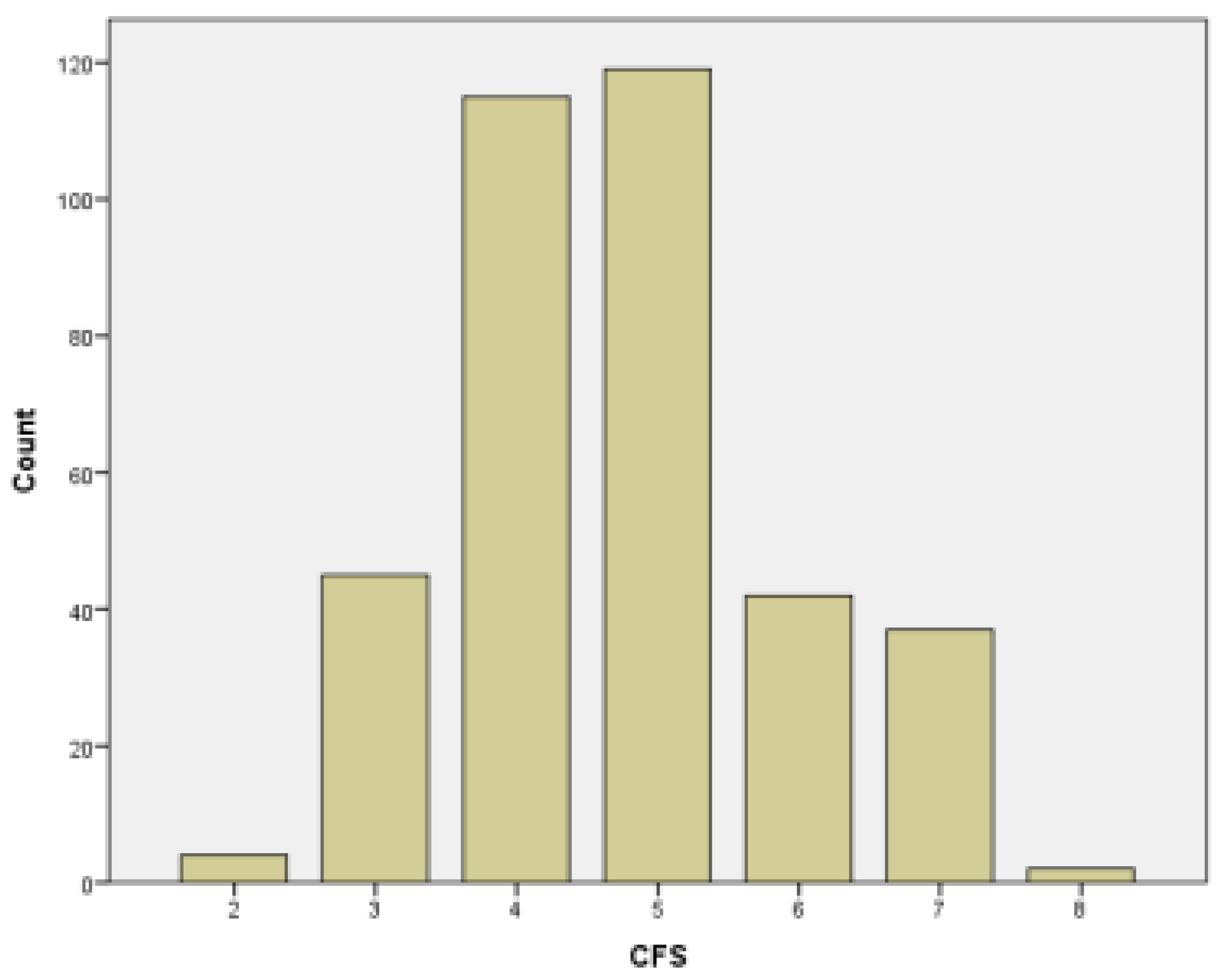
- CFS 1 (very fit): People who are robust, active, energetic, and motivated. These people commonly exercise regularly. They are among the fittest for their age.
- -
- CFS 2 (well): People who have no active disease symptoms but are less fit than category 1. Often, they exercise or are very active occasionally.
- -
- CFS 3 (managing well): People whose medical problems are well controlled, but are not regularly active beyond routine walking.
- -
- CFS 4 (vulnerable): While not dependent on others for daily help, often symptoms limit activities. They often complain of being “slowed up”, and/or being tired during the day.
- -
- CFS 5 (mildly frail): These people often have more evident slowing, with limited dependence on others for instrumental activities of daily living.
- -
- CFS 6 (moderately frail): People need help with all outside activities and with keeping house. They often have problems with climbing stairs and need help with bathing, and may need assistance with dressing.
- -
- CFS 7 (severely frail): Completely dependent for personal care. However, they seem stable and not at high risk of dying within 6 months.
- -
- CFS 8 (very severely frail): Completely dependent, approaching the end of life. Typically, they could not recover from a minor illness.
- -
- CFS 9 (terminally ill): Approaching the end of life. This category applies to people with a life expectancy less than 6 months, who are not otherwise evidently frail.
2.4. Statistical Analysis
2.5. Ethical Approval
3. Results
3.1. Frailty Transition after 3 Months
3.2. The Impact of Frailty at Discharge on Readmission
4. Discussion
Strength and Limitations
5. Conclusions
Author Contributions
Funding
Conflicts of Interest
References
- Clegg, A.; Young, J.; Iliffe, S.; Rikkert, M.O.; Rockwood, K. Frailty in elderly people. Lancet 2013, 381, 752–762. [Google Scholar] [CrossRef] [Scilit]
- Dent, E.; Lien, C.; Lim, W.S.; Wong, W.C.; Wong, C.H.; Ng, T.P.; Woo, J.; Dong, B.; de la Vega, S.; Poi, P.J.H.; et al. The Asia-Pacific Clinical Practice Guidelines for the Management of Frailty. J. Am. Med Dir. Assoc. 2017, 18, 564–575. [Google Scholar] [CrossRef] [Scilit] [PubMed]
- Fried, L.P.; Tangen, C.M.; Walston, J.; Newman, A.B.; Hirsch, C.; Gottdiener, J.; Seeman, T.; Tracy, R.; Kop, W.J.; Burke, G.; et al. Frailty in older adults: Evidence for a phenotype. J. Gerontol. Ser. A Biol. Sci. Med. Sci. 2001, 56, M146–M156. [Google Scholar] [CrossRef] [Scilit] [PubMed]
- Rockwood, K.; Andrew, M.; Mitnitski, A. A comparison of two approaches to measuring frailty in elderly people. J. Gerontol. Ser. A Biol. Sci. Med. Sci. 2007, 62, 738–743. [Google Scholar] [CrossRef] [Scilit] [PubMed]
- Rockwood, K.; Song, X.; MacKnight, C.; Bergman, H.; Hogan, D.B.; McDowell, I.; Mitnitski, A. A global clinical measure of fitness and frailty in elderly people. Cmaj Can. Med. Assoc. J. 2005, 173, 489–495. [Google Scholar] [CrossRef] [Scilit] [PubMed]
- Muessig, J.M.; Nia, A.M.; Masyuk, M.; Lauten, A.; Sacher, A.L.; Brenner, T.; Franz, M.; Bloos, F.; Ebelt, H.; Schaller, S.J.; et al. Clinical Frailty Scale (CFS) reliably stratifies octogenarians in German ICUs: A multicentre prospective cohort study. BMC Geriatr. 2018, 18, 162. [Google Scholar] [CrossRef] [Scilit] [PubMed]
- Muessig, J.M.; Nia, A.M.; Masyuk, M.; Lauten, A.; Sacher, A.L.; Brenner, T.; Franz, M.; Bloos, F.; Ebelt, H.; Schaller, S.J.; et al. The impact of frailty on prolonged hospitalization and mortality in elderly inpatients in Vietnam: A comparison between the frailty phenotype and the Reported Edmonton Frail Scale. Clin. Interv. Aging 2019, 14, 381–388. [Google Scholar]
- Nguyen, A.T.; Nguyen, L.H.; Nguyen, T.X.; Nguyen, T.T.H.; Nguyen, H.T.T.; Nguyen, T.N.; Pham, H.Q.; Tran, B.X.; Latkin, C.A.; Ho, C.S.; et al. Frailty Prevalence and Association with Health-Related Quality of Life Impairment among Rural Community-Dwelling Older Adults in Vietnam. Int. J. Env. Res. Public Health 2019, 16, 3869. [Google Scholar] [CrossRef] [Scilit] [PubMed]
- Nguyen, T.V.; Le, D.; Tran, K.D.; Bui, K.X.; Nguyen, T.N. Frailty in Older Patients with Acute Coronary Syndrome in Vietnam. Clin. Interv. Aging 2019, 14, 2213–2222. [Google Scholar] [CrossRef] [Scilit] [PubMed]
- Nguyen, T.X.; Nguyen, T.N.; Nguyen, A.T.; Nguyen, H.T.T.; Nguyen, T.T.H.; Nguyen, T.N.; Pham, T.; Vu, H.T.T. Polypharmacy at discharge in older hospitalised patients in Vietnam and its association with frailty. Australas. J. Ageing 2019. [Google Scholar] [CrossRef] [Scilit] [PubMed]
- Shimura, T.; Yamamoto, M.; Kano, S.; Kagase, A.; Kodama, A.; Koyama, Y.; Tsuchikane, E.; Suzuki, T.; Otsuka, T.; Kohsaka, S.; et al. Impact of the Clinical Frailty Scale on Outcomes After Transcatheter Aortic Valve Replacement. Circulation 2017, 135, 2013–2024. [Google Scholar] [CrossRef] [Scilit] [PubMed]
- Cheong, C.Y.; Nyunt, M.S.Z.; Gao, Q.; Gwee, X.; Choo, R.W.M.; Yap, K.B.; Wee, S.L.; Ng, T.P. Risk Factors of Progression to Frailty: Findings from the Singapore Longitudinal Ageing Study. J. Nutr. Health Aging 2020, 24, 98–106. [Google Scholar] [CrossRef] [Scilit] [PubMed]
- Setiati, S.; Laksmi, P.W.; Aryana, I.S.; Sunarti, S.; Widajanti, N.; Dwipa, L.; Seto, E.; Istanti, R.; Ardian, L.J.; Chotimah, S.C. Frailty state among Indonesian elderly: Prevalence, associated factors, and frailty state transition. BMC Geriatr. 2019, 19, 182. [Google Scholar] [CrossRef] [Scilit] [PubMed]
- Thompson, M.Q.; Theou, O.; Adams, R.J.; Tucker, G.R.; Visvanathan, R. Frailty state transitions and associated factors in South Australian older adults. Geriatr. Gerontol. Int. 2018, 18, 1549–1555. [Google Scholar] [CrossRef] [Scilit]
- Cesari, M.; Perez-Zepeda, M.U.; Marzetti, E. Frailty and Multimorbidity: Different Ways of Thinking about Geriatrics. J. Am. Med Dir. Assoc. 2017, 18, 361–364. [Google Scholar] [CrossRef] [Scilit] [PubMed]
- Gregorevic, K.J.; Hubbard, R.E.; Lim, W.K.; Katz, B. The clinical frailty scale predicts functional decline and mortality when used by junior medical staff: A prospective cohort study. BMC Geriatr. 2016, 16, 117. [Google Scholar] [CrossRef] [Scilit]
- Moreno-Arino, M.; Torrente Jimenez, I.; Cartanya Gutierrez, A.; Oliva Morera, J.C.; Comet, R. Assessing the strengths and weaknesses of the Clinical Frailty Scale through correlation with a frailty index. Aging Clin. Exp. Res. 2020. [Google Scholar] [CrossRef] [Scilit]
- Amin, K.A.; Lee, W.; Moskowitz, D.; Kobashi, K.C.; Lucioni, A.; Reed, M.J.; Nash, M.; Lee, U.J. A Rapid Method to Preoperatively Assess Frailty for Older Patients with Pelvic Floor Conditions. J. Urol. 2020. [Google Scholar] [CrossRef] [Scilit]
- Hilmer, S.N.; Perera, V.; Mitchell, S.; Murnion, B.P.; Dent, J.; Bajorek, B.; Matthews, S.; Rolfson, D.B. The assessment of frailty in older people in acute care. Australas. J. Ageing 2009, 28, 182–188. [Google Scholar] [CrossRef] [Scilit] [PubMed]

| Variables | All (n = 364) | Robust/Pre-frail (n = 164) | Frail (n = 200) | p |
|---|---|---|---|---|
| Age, years | 74.9 ± 9.4 | 69.4 ± 6.8 | 79.4 ± 8.7 | <0.001 |
| Female | 212 (58.2) | 100 (61.0) | 112 (56.0) | 0.338 |
| Education level: | ||||
| Low (illiterate or primary school) | 122 (33.5) | 41 (25.0) | 81 (40.5) | 0.007 |
| Intermediate (secondary or high school) | 171 (47.0) | 85 (51.8) | 86 (43.0) | |
| High (higher than high school) | 71 (19.5) | 38 (23.2) | 33 (16.5) | |
| Marital status: | ||||
| Married | 203 (55.8) | 104 (63.4) | 99 (49.5) | 0.018 |
| Widowed | 132 (36.3) | 45 (27.4) | 87 (43.5) | |
| Never married | 18 (4.9) | 9 (5.5) | 9 (4.5) | |
| Divorced/separated | 11 (3.0) | 6 (3.7) | 5 (2.5) | |
| Body mass index | ||||
| Underweight (<18.5) | 41 (11.4) | 8 (4.9) | 33 (16.8) | 0.001 |
| Normal (18.5 ≤ 25.0) | 236 (65.7) | 110 (67.9) | 126 (64.0) | |
| Overweight (≥25.0) | 82 (22.8) | 44 (27.2) | 38 (19.3) | |
| Number of chronic diseases | 3.65 ± 1.59 | 3.47 ± 1.65 | 3.80 ± 1.53 | 0.048 |
| Having ≥2 chronic diseases | 324 (89.0) | 142 (86.6) | 182 (91.0) | 0.180 |
| Polypharmacy at discharge | 264 (72.5) | 110 (67.1) | 154 (77.0) | 0.035 |
| Main diagnosis at discharge: | ||||
| Hypertension | 172 (47.3) | 85 (51.8) | 87 (43.5) | 0.146 |
| Infection | 78 (21.4) | 24 (14.6) | 54 (27.0) | |
| Gastrointestinal disorder | 20 (5.5) | 11 (6.7) | 9 (4.5) | |
| Musculoskeletal pain | 16 (4.4) | 8 (4.9) | 8 (4.0) | |
| Chronic lung diseases | 14 (3.8) | 5 (3.0) | 9 (4.5) | |
| Ischemic heart disease | 9 (2.5) | 5 (3.0) | 4 (2.0) | |
| Stroke | 9 (2.5) | 3 (1.8) | 6 (3.0) | |
| Other | 46 (12.6) | 23 (14.0) | 23 (11.5) | |
| Variables | Unadjusted Odds Ratios for Frailty (95% CI) | p |
|---|---|---|
| Age | 1.12 (1.06–1.18) | <0.001 |
| Female | 1.20 (0.55–2.58) | 0.649 |
| Underweight | 0.48 (0.06–4.02) | 0.496 |
| Overweight | 0.57 (0.23–1.41) | 0.223 |
| Low education | 0.67 (0.27–1.66) | 0.384 |
| Being alone (single/divorced/widow) | 1.75 (0.82–3.71) | 0.146 |
| Polypharmacy at discharge | 5.23 (1.74–15.70) | 0.003 |
| Number of chronic diseases | 1.60 (1.22–2.09) | 0.001 |
| Main reasons for admission: | ||
| Hypertension | 1.05 (0.50–2.20) | 0.902 |
| Cardiovascular disease (ischemic heart disease, stroke, heart failure) | 2.46 (0.65–9.24) | 0.183 |
| Chronic lung disease | 5.55 (0.89–34.57) | 0.067 |
| Skeletomuscular pain | 3.75 (0.89–15.82) | 0.072 |
| Variables | Adjusted Odds Ratios for Frailty (95% CI) | p |
|---|---|---|
| Age | 1.09 (1.03–1.16) | 0.003 |
| Number of chronic diseases | 1.37 (1.03–1.82) | 0.030 |
| Polypharmacy at discharge | 3.68 (1.15–11.76) | 0.028 |
| Variables | Unadjusted Odds Ratios for Readmission (95% CI) | p |
|---|---|---|
| Frailty at discharge | 2.99 (1.79–5.01) | <0.001 |
| Age | 1.02 (0.99–1.05) | 0.091 |
| Female | 0.93 (0.58–1.49) | 0.748 |
| Underweight | 1.75 (0.88–3.46) | 0.111 |
| Overweight | 1.04 (0.60–1.80) | 0.890 |
| Low education | 1.08 (0.66–1.76) | 0.769 |
| Being alone (single/divorced/widow) | 1.06 (0.66–1.69) | 0.814 |
| Polypharmacy at discharge | 1.08 (0.64–1.84) | 0.769 |
| Number of chronic diseases | 1.24 (1.07–1.45) | 0.006 |
© 2020 by the authors. Licensee MDPI, Basel, Switzerland. This article is an open access article distributed under the terms and conditions of the Creative Commons Attribution (CC BY) license (http://creativecommons.org/licenses/by/4.0/).
Share and Cite
Nguyen, T.V.; Ly, T.T.; Nguyen, T.N. A Pilot Study of the Clinical Frailty Scale to Predict Frailty Transition and Readmission in Older Patients in Vietnam. Int. J. Environ. Res. Public Health 2020, 17, 1582. https://doi.org/10.3390/ijerph17051582
Nguyen TV, Ly TT, Nguyen TN. A Pilot Study of the Clinical Frailty Scale to Predict Frailty Transition and Readmission in Older Patients in Vietnam. International Journal of Environmental Research and Public Health. 2020; 17(5):1582. https://doi.org/10.3390/ijerph17051582
Chicago/Turabian StyleNguyen, Tan Van, Thuy Thanh Ly, and Tu Ngoc Nguyen. 2020. "A Pilot Study of the Clinical Frailty Scale to Predict Frailty Transition and Readmission in Older Patients in Vietnam" International Journal of Environmental Research and Public Health 17, no. 5: 1582. https://doi.org/10.3390/ijerph17051582
APA StyleNguyen, T. V., Ly, T. T., & Nguyen, T. N. (2020). A Pilot Study of the Clinical Frailty Scale to Predict Frailty Transition and Readmission in Older Patients in Vietnam. International Journal of Environmental Research and Public Health, 17(5), 1582. https://doi.org/10.3390/ijerph17051582

