

Association of Formal and Informal Social Support With Health-Related Quality of Life Among Chinese Rural Elders

Abstract
1. Introduction
2. Materials and Methods
2.1. Design, Setting and Sample
2.2. Measurements
2.2.1. Health-Related Quality of Life
2.2.2. Social Support
2.3. Control Variables
2.4. Statistical Analysis
3. Results
3.1. Characteristics of the Participants
3.2. The Relationships Between Social Support and HRQOL
3.3. Tobit Regression Analysis of Social Support and HRQOL
4. Discussion
5. Conclusions
Author Contributions
Funding
Acknowledgments
Conflicts of Interest
References
- Hao, X.; Yang, Y.; Gao, X.; Dai, T. Evaluating the Effectiveness of the Health Management Program for the Elderly on Health-Related Quality of Life among Elderly People in China: Findings from the China Health and Retirement Longitudinal Study. Int. J. Environ. Res. Public Health 2019, 16, 113. [Google Scholar] [CrossRef]
- Vanleerberghe, P.; De Witte, N.; Claes, C.; Schalock, R.L.; Verté, D. The quality of life of older people aging in place: A literature review. Qual. Life Res. 2017, 26, 2899–2907. [Google Scholar] [CrossRef]
- Kim, J.; Lee, J.E. Social support and health-related quality of life among elderly individuals living alone in south korea: A cross-sectional study. J. Nurs. Res. 2018, 26, 316–323. [Google Scholar] [CrossRef]
- Lim, J.T.; Park, J.-H.; Lee, J.-S.; Oh, J.; Kim, Y. The relationship between the social network of community-living elders and their health-related quality of life in Korean province. J. Prev. Med. Public Health 2013, 46, 28–38. [Google Scholar] [CrossRef][Green Version]
- The World Health Organization Quality of Life assessment (WHOQOL): Position paper from the World Health Organization. Soc. Sci. Med. 1995, 41, 1403–1409. [CrossRef]
- Kumar, S.G.; Majumdar, A.; Pavithra, G. Quality of Life (QOL) and Its Associated Factors Using WHOQOL-BREF Among Elderly in Urban Puducherry, India. J. Clin. Diagn. Res. 2014, 8, 54–57. [Google Scholar] [CrossRef]
- Jensen, H.I.; Plesner, K.; Kvorning, N.; Krogh, B.L.; Kimper-Karl, A. Associations between demographics and health-related quality of life for chronic non-malignant pain patients treated at a multidisciplinary pain centre: A cohort study. Int. J. Qual. Health Care 2016, 28, 86–91. [Google Scholar] [CrossRef]
- Lai, C.K.Y.; Leung, D.D.M.; Kwong, E.W.Y.; Lee, R.L.P. Factors associated with the quality of life of nursing home residents in Hong Kong. Int. Nurs. Rev. 2015, 62, 120–129. [Google Scholar] [CrossRef] [PubMed]
- Wu, M.; Yang, Y.; Zhang, D.; Zhao, X.; Sun, Y.; Xie, H.; Jia, J.; Su, Y.; Li, Y. Association between social support and health-related quality of life among Chinese rural elders in nursing homes: The mediating role of resilience. Qual. Life Res. 2018, 27, 783–792. [Google Scholar] [CrossRef] [PubMed]
- Xiao, J.; Huang, B.; Shen, H.; Liu, X.; Zhang, J.; Zhong, Y.; Wu, C.; Hua, T.; Gao, Y.-X. Association between social support and health-related quality of life among Chinese seafarers: A cross-sectional study. PLoS ONE 2017, 12, e0187275. [Google Scholar] [CrossRef] [PubMed]
- Cassarino-Perez, L.; Dell’Aglio, D.D. Health-related quality of life and social support in adolescents with type 1 diabetes. Span. J. Psychol. 2015, 17, E108. [Google Scholar] [CrossRef] [PubMed]
- National Bureau of Statistics of the People’s Republic of China on the Statistical Yearbook. China. Available online: http://www.stats.gov.cn/tjsj/ndsj/2017/indexch.htm (accessed on 20 November 2019).
- Cheng, Y.; Gao, S.; Li, S.; Zhang, Y.; Rosenberg, M. Understanding the spatial disparities and vulnerability of population aging in China. Asia Pac. Policy Stud. 2019, 6, 73–89. [Google Scholar] [CrossRef]
- Flaherty, J.H.; Liu, M.L.; Ding, L.; Dong, B.; Ding, Q.; Li, X.; Xiao, S. China: The aging giant. J. Am. Geriatr. Soc. 2007, 55, 1295–1300. [Google Scholar] [CrossRef] [PubMed]
- Cobb, S. Social support as a moderator of life stress. Psychosom. Med. 1976, 38, 300–314. [Google Scholar] [CrossRef] [PubMed]
- Langford, C.P.H.; Bowsher, J.; Maloney, J.P.; Lillis, P.P. Social support: A conceptual analysis. J. Adv. Nurs. 1997, 25, 95–100. [Google Scholar] [CrossRef]
- Pryor, J.E.; Thompson, J.M.D.; Robinson, E.; Clark, P.M.; Becroft, D.M.O.; Pattison, N.S.; Galvish, N.; Wild, C.J.; Mitchell, E.A. Stress and lack of social support as risk factors for small-for-gestational-age birth. Acta Paediatr. 2003, 92, 62–64. [Google Scholar] [CrossRef]
- LaRocco, J.M.; House, J.S.; French, J.R., Jr. Social support, occupational stress, and health. J. Health Soc. Behav. 1980, 21, 202–218. [Google Scholar] [CrossRef]
- Cohen, S.; Wills, T.A. Stress, social support, and the buffering hypothesis. Psychol. Bull. 1985, 98, 310–357. [Google Scholar] [CrossRef]
- Tao, Y.C.; Shen, Y. The influence of social support on the physical and mental health of rural elderly. Popul. Econ. 2014, 3, 3–14. (In Chinese) [Google Scholar] [CrossRef]
- Ibrahim, N.; Din, N.C.; Ahmad, M.; Ghazali, S.E.; Said, Z.; Shahar, S.; Ghazali, A.R.; Razali, R. Relationships between social support and depression, and quality of life of the elderly in a rural community in malaysia. Asia Pac. Psychiatry 2013, 5, 59–66. [Google Scholar] [CrossRef]
- Santini, Z.I.; Koyanagi, A.; Tyrovolas, S.; Haro, J.M.; Fiori, K.L.; Uwakwa, R.; Thiyagarajan, J.A.; Webber, M.; Prince, M.; Prina, A.M. Social network typologies and mortality risk among older people in China, India, and Latin America: A 10/66 Dementia Research Group population-based cohort study. Soc. Sci. Med. 2015, 147, 134–143. [Google Scholar] [CrossRef] [PubMed]
- Zhai, S.G.; Zhuang, Q.Z.; Wang, Z.X. Study on the relationship between social support and mental health of the elderly in China: A case study of Xi’an city, Shaanxi province. J. Ment. Health 2019, 28, 119–124. [Google Scholar] [CrossRef] [PubMed]
- Vandervoort, D. Quality of social support in mental and physical health. Curr. Psychol. 1999, 18, 205–221. [Google Scholar] [CrossRef]
- Guo, Z.G.; Liu, P. Factors in Determining Ways of Meeting Demands of China’s Elderly and Their Satisfaction—Impact from the Composition of Core Family Members. J. Chin. Agric. Univ. Soc. Sci. 2007, 3, 71–80. (In Chinese) [Google Scholar]
- Knodel, J.; Friedman, J.; Anh, T.S.; Cuong, B.T. Intergenerational exchanges in Vietnam: Family size, sex composition, and the location of children. Popul. Stud. Camb. 2000, 54, 89–104. [Google Scholar] [CrossRef] [PubMed]
- Zimmer, Z.; Kwong, J. Family Size and Support of Older Adults in Urban and Rural China: Current Effects and Future Implications. Demography 2003, 40, 23–44. [Google Scholar] [CrossRef] [PubMed]
- Watson, A.J.; Kivett, V.R. Influences on the life satisfaction of older fathers. Fam. Coord. 1976, 25, 482–488. [Google Scholar] [CrossRef]
- Van Dijk, H.M.; Cramm, J.; Birnie, E.; Nieboer, A.P. Effects of an integrated neighborhood approach on older people’s (health-related) quality of life and well-being. BMC Res. Notes 2016, 9, 450. [Google Scholar] [CrossRef]
- Gao, Y.X.; Xu, C.; Liu, G.; Lin, Y. Social support and health related quality of life of the elderly: Evidence from nantong. Popul. Dev. 2013, 19, 73–81. (In Chinese) [Google Scholar]
- Fernández-Ballesteros, R. Social support and quality of life among older people in spain. J. Soc. Issues 2002, 58, 645–659. [Google Scholar] [CrossRef]
- Bernardes, S.F.; Matos, M.; Goubert, L. Older adults’ preferences for formal social support of autonomy and dependence in pain: Development and validation of a scale. Eur. J. Ageing 2017, 14, 257–268. [Google Scholar] [CrossRef] [PubMed]
- Cheng, Y.; Xi, J.; Rosenberg, M.W.; Gao, S. Intergenerational differences in social support for the community-living elderly in Beijing, China. Health Sci. Rep. 2018, 1, e96. [Google Scholar] [CrossRef] [PubMed]
- Zapata-López, B.I.; Delgado-Villamizar, N.L.; Cardona-Arango, D. Social and family support to the elderly in urban areas. Rev. Salud Publica Bogota 2015, 17, 848–860. [Google Scholar] [CrossRef] [PubMed]
- Lei, P.; Xu, L.; Nwaru, B.; Long, Q.; Wu, Z. Social networks and health-related quality of life among Chinese old adults in urban areas: Results from 4th National Household Health Survey. Public Health 2016, 131, 27–39. [Google Scholar] [CrossRef]
- Shou, J.; Du, Z.; Wang, H.; Ren, L.; Liu, Y.; Zhu, S. Quality of life and its contributing factors in an elderly community-dwelling population in Shanghai, China. Psychogeriatrics 2018, 18, 89–97. [Google Scholar] [CrossRef]
- Wang, X.; Guo, G.; Zhou, L.; Zheng, J.; Liang, X.; Li, Z.; Luo, H.; Yang, Y.; Yang, L.; Lu, L. Depression and anxiety mediate perceived social support to predict health-related quality of life in pregnant women living with HIV. AIDS Care 2018, 30, 1147–1155. [Google Scholar] [CrossRef]
- Brooker, S.; Alexander, N.; Geiger, S.; Moyeed, R.; Stander, J.; Fleming, F.; Hotez, P.J.; Correa-Oliveira, R.; Bethony, J. Contrasting patterns in the small-scale heterogeneity of human helminth infections in urban and rural environments in Brazil. Int. J. Parasitol. 2006, 36, 1143–1151. [Google Scholar] [CrossRef][Green Version]
- Liu, G.G.; Wu, H.; Li, M.; Gao, C.; Luo, N. Chinese Time Trade-Off Values for EQ-5D Health States. Value Health 2014, 11, 597–604. [Google Scholar] [CrossRef]
- Xiao, S.Y.; Yang, D.S. The effect of social support on physical and psychological health. Chin. Ment. Health J. 1987, 1, 184–187. (In Chinese) [Google Scholar]
- Ku, L.J.E.; Liu, L.F.; Wen, M.J. Trends and determinants of informal and formal caregiving in the community for disabled elderly people in Taiwan. Arch. Gerontol. Geriatr. 2013, 56, 370–376. [Google Scholar] [CrossRef]
- Tsuchiya, A.; Ikeda, S.; Ikegami, N.; Nishimura, S.; Sakai, I.; Fukuda, T.; Hamashima, C.; Hisashige, A.; Tamura, M. Estimating an EQ-5D population value set: The case of Japan. Health Econ. 2002, 11, 341–353. [Google Scholar] [CrossRef] [PubMed]
- Lam, W.W.T.; Kwok, M.K.; Chan, M.; Hung, W.K.; Ying, M.; Or, A.; Kwong, A.; Suen, D.; Yoon, S.; Fielding, R. Does the use of shared decision-making consultation behaviors increase treatment decision-making satisfaction among Chinese women facing decision for breast cancer surgery? Patient Educ. Couns. 2014, 94, 243–249. [Google Scholar] [CrossRef] [PubMed]
- Xu, R.H.; Cheung, A.; Wong, E. The relationship between shared decision-making and health-related quality of life among patients in Hong Kong SAR, China. Int. J. Qual. Health Care 2017, 29, 534–540. [Google Scholar] [CrossRef] [PubMed]

| Variables | n (%)/M ± SD | EQ-5D Index Scores | Z/H/rs1 | P Value |
|---|---|---|---|---|
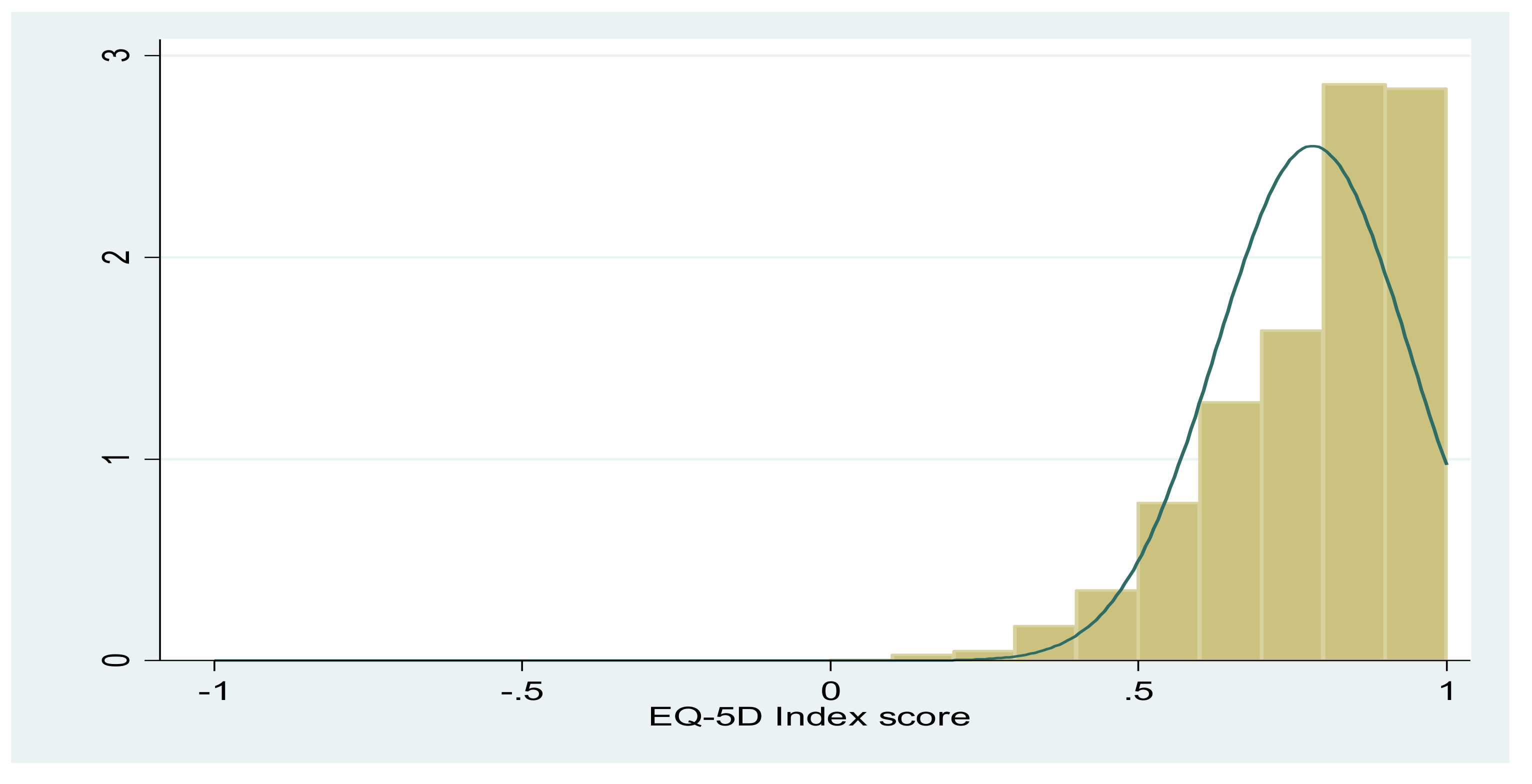
| Total Number | 4189 | 0.78 ± 0.16 | - | - |
| Age (year) | 68.40 ± 6.66 | - | - | - |
| Gender | ||||
| Male | 2450 (58.49) | 0.81 ± 0.01 | −16.78 | <0.001 |
| Female | 1739 (41.51) | 0.74 ± 0.01 | ||
| Education level | ||||
| Illiterate | 1053 (25.14) | 0.72 ± 0.17 | 0.27 | <0.001 |
| Primary school | 2211 (52.78) | 0.79 ± 0.15 | ||
| Middle school | 631 (15.06) | 0.83 ± 0.13 | ||
| High school and above | 294 (7.02) | 0.85 ± 0.12 | ||
| Marital status | ||||
| Married | 2996 (71.52) | 0.80 ± 0.15 | −10.44 | <0.001 |
| Others a | 1193 (28.48) | 0.74 ± 0.17 | ||
| Living style | ||||
| Living alone | 2718 (64.88) | 0.78 ± 0.01 | −1.17 | 0.24 |
| Living with others | 1471 (35.12) | 0.79 ± 0.01 | ||
| Number of chronic diseases | ||||
| None | 1068 (25.50) | 0.83 ± 0.13 | 84.33 | <0.001 |
| 1type | 1099 (26.24) | 0.80 ± 0.15 | ||
| 2–3 types | 1469 (35.07) | 0.76 ± 0.16 | ||
| 4 types or more | 553 (13.20) | 0.70 ± 0.18 | ||
| Disability status | ||||
| Not disabled | 2965 (70.78) | 0.80 ± 0.03 | 12.17 | <0.001 |
| Disabled | 1224 (29.22) | 0.74 ± 0.05 | ||
| Variables | n (%)/M ± SD | EQ-5D Index Scores | Z/H/rs1 | P Value |
|---|---|---|---|---|
| Number of social activities | 0.78 ± 0.87 | - | 0.12 | <0.001 |
| Number of types of medical insurance | 0.85 ± 0.48 | - | 0.07 | <0.001 |
| Urban and rural residents medical insurance | ||||
| Yes | 932 (22.25) | 0.79 ± 0.15 | −3.02 | 0.003 |
| No | 3257 (77.75) | 0.77 ± 0.16 | ||
| Government medical insurance | ||||
| Yes | 105 (2.51) | 0.85 ± 0.12 | −5.48 | <0.001 |
| No | 4084 (97.49) | 0.78 ± 0.16 | ||
| Private medical insurance | ||||
| Yes | 37 (0.88) | 0.80 ± 0.13 | −0.26 | 0.799 |
| No | 4152 (99.12) | 0.78 ± 0.16 | ||
| Medical aid | ||||
| Yes | 37 (0.88) | 0.75 ± 0.20 | 0.58 | 0.564 |
| No | 4152 (99.12) | 0.78 ± 0.16 | ||
| Other medical insurance | ||||
| Yes | 137 (3.27) | 0.80 ± 0.13 | 0.48 | 0.633 |
| No | 4052 (96.73) | 0.78 ± 0.16 | ||
| Number of types of pension insurance | 0.88±0.52 | - | 0.02 | 0.22 |
| Employee pension insurance | ||||
| Yes | 305 (7.28) | 0.86 ± 0.11 | −10.18 | <0.001 |
| No | 3882 (92.72) | 0.78 ± 0.16 | ||
| Urban and rural residents pension insurance | ||||
| Yes | 2720 (64.96) | 0.78 ± 0.16 | 5.16 | <0.001 |
| No | 1467 (35.04) | 0.80 ± 0.16 | ||
| Old age pension allowance | ||||
| Yes | 430 (10.27) | 0.76 ± 0.17 | 2.65 | 0.008 |
| No | 3757 (89.73) | 0.78 ± 0.15 | ||
| Commercial pension insurance | ||||
| Yes | 151 (3.61) | 0.83 ± 0.13 | −4.67 | <0.001 |
| No | 4036 (96.39) | 0.78 ± 0.16 | ||
| Frequency of participating in social activities | ||||
| Never | 2730 (65.17) | 0.77 ± 0.16 | 0.08 | <0.001 |
| Sometimes | 407 (9.72) | 0.80 ± 0.14 | ||
| Always | 1052 (25.11) | 0.80 ± 0.14 | ||
| Amount of pension insurance received monthly (ln) | 4.86 ± 1.24 | - | 0.21 | <0.001 |
| Variables | n (%)/M ± SD | EQ-5D Index Scores | Z/H/rs1 | P value |
|---|---|---|---|---|
| Spouses | ||||
| Yes | 2742 (65.46) | 0.80 ± 0.15 | −9.97 | <0.001 |
| No | 1447 (34.54) | 0.75 ± 0.17 | ||
| Number of children | 3.28 ± 1.56 | - | −0.15 | <0.001 |
| Number of grandchildren | 0.54 ± 0.79 | - | 0.06 | <0.001 |
| Frequency of meeting with children | ||||
| Never | 256 (6.11) | 0.79 ± 0.17 | 0.01 | 0.58 |
| Sometimes | 1366 (32.61) | 0.78 ± 0.15 | ||
| Always | 2567 (61.28) | 0.78 ± 0.16 | ||
| Frequency of contacting with children | ||||
| Never | 1054 (25.16) | 0.78 ± 0.17 | 0.04 | 0.01 |
| Sometimes | 772 (18.43) | 0.76 ± 0.16 | ||
| Always | 2363 (56.41) | 0.79 ± 0.15 | ||
| Whether to take care of grandchildren | ||||
| Yes | 1301 (31.06) | 0.80 ± 0.15 | 0.05 | <0.001 |
| No | 2888 (68.94) | 0.78 ± 0.16 | ||
| Financial support from family(ln) | 5.49 ± 1.33 | - | 0.14 | <0.001 |
| Variables | Model 1 | Model 2 | Model 3 | Model 4 | Model 5 | |||||
|---|---|---|---|---|---|---|---|---|---|---|
| β | SE | β | SE | β | SE | β | SE | β | SE | |
| Age | −0.002 *** | 0.001 | −0.002 *** | 0.001 | −0.002 *** | 0.001 | −0.002 ** | 0.001 | −0.001 * | 0.001 |
| Gender (Ref: Female) | ||||||||||
| Male | 0.045 *** | 0.005 | 0.046 *** | 0.005 | 0.045 *** | 0.006 | 0.043 *** | 0.006 | 0.046 *** | 0.006 |
| Education (Ref: Illiterate) | ||||||||||
| Primary school | 0.039 *** | 0.006 | 0.034 *** | 0.006 | 0.034 *** | 0.007 | 0.033 *** | 0.007 | 0.033 *** | 0.007 |
| Middle school | 0.063 *** | 0.008 | 0.050 *** | 0.008 | 0.052 *** | 0.009 | 0.052 *** | 0.009 | 0.053 *** | 0.01 |
| High school and above | 0.087 *** | 0.01 | 0.057 *** | 0.01 | 0.051 *** | 0.013 | 0.051 *** | 0.013 | 0.047 *** | 0.013 |
| Marital status (Ref: Unmarried/Divorced/Widowed) | ||||||||||
| Married | −0.015 ** | 0.005 | 0.013 * | 0.005 | 0.009 | 0.006 | −0.001 | 0.012 | −0.007 | 0.013 |
| Living style (Ref: Living with others) | ||||||||||
| Living alone | 0.006 | 0.005 | 0.006 | 0.005 | 0.009 | 0.005 | 0.009 | 0.006 | 0.01 | 0.006 |
| Number of chronic diseases (Ref: None) | ||||||||||
| One type | −0.021 *** | 0.006 | −0.021 ** | 0.006 | −0.016 ** | 0.007 | −0.016 * | 0.007 | −0.023 ** | 0.008 |
| Two to three types | −0.056 *** | 0.006 | −0.056 *** | 0.006 | −0.052 *** | 0.007 | −0.052 *** | 0.007 | −0.058 *** | 0.008 |
| Four types or more | −0.118 *** | 0.008 | −0.120 *** | 0.007 | −0.117 *** | 0.009 | −0.116 *** | 0.009 | −0.122 *** | 0.009 |
| Disability status (Ref: Not disabled) | ||||||||||
| Disabled | −0.037 *** | 0.005 | −0.037 *** | 0.005 | −0.036 *** | 0.006 | −0.036 *** | 0.006 | −0.030 *** | 0.006 |
| Amount of medical insurance | −0.022 * | 0.01 | −0.020 | 0.012 | −0.020 | 0.012 | −0.020 | 0.013 | ||
| Amount of pension insurance | 0.025 | 0.015 | −0.023 | 0.018 | −0.024 | 0.018 | −0.016 | 0.02 | ||
| Number of social activities | 0.016 *** | 0.002 | 0.012 *** | 0.004 | 0.012 ** | 0.004 | 0.009 * | 0.004 | ||
| Urban and rural residents’ medical insurance (Ref: Not participate in urban and rural residents medical insurance) | ||||||||||
| Yes | 0.032 ** | 0.011 | 0.026 | 0.014 | 0.027 | 0.014 | 0.026 | 0.015 | ||
| Government medical insurance (Ref: No government medical insurance) | ||||||||||
| Yes | 0.047 ** | 0.018 | 0.034 | 0.023 | 0.036 | 0.023 | 0.026 | 0.025 | ||
| Employee pension insurance (Ref: No employee pension insurance) | ||||||||||
| Yes | 0.017 | 0.018 | −0.006 | 0.019 | −0.005 | 0.019 | −0.033 | 0.021 | ||
| Urban and rural residents’ pension insurance (Ref: No urban and rural residents pension insurance) | ||||||||||
| Yes | −0.034 * | 0.016 | 0.016 | 0.018 | 0.017 | 0.018 | −0.003 | 0.02 | ||
| Old age pension allowance (Ref: No old age pension allowance) | ||||||||||
| Yes | −0.023 | 0.017 | 0.02 | 0.019 | 0.021 | 0.019 | 0.005 | 0.02 | ||
| Commercial pension insurance (Ref: No commercial pension insurance) | ||||||||||
| Yes | −0.003 | 0.019 | 0.036 | 0.022 | 0.036 | 0.022 | 0.024 | 0.024 | ||
| Frequency of participating in social activities (Ref: Never participating in social activities) | ||||||||||
| Sometimes | 0.008 | 0.01 | 0.009 | 0.01 | 0.009 | 0.01 | ||||
| Always | 0.017 * | 0.008 | 0.017 * | 0.008 | 0.016 * | 0.008 | ||||
| Amount of pension insurance received monthly (ln) | 0.023 *** | 0.004 | 0.022 *** | 0.004 | 0.024 *** | 0.004 | ||||
| Whether having spouse (Ref: No spouse) | ||||||||||
| Yes | 0.011 | 0.006 | 0.009 | 0.012 | ||||||
| Number of children | −0.005 ** | 0.002 | −0.009 *** | 0.002 | ||||||
| Number of grandchildren | −0.002 | 0.003 | −0.007 | 0.005 | ||||||
| Frequency of contacting with children (Ref: Never contacting with children) | ||||||||||
| Sometimes | 0.002 | 0.009 | ||||||||
| Always | 0.012* | 0.007 | ||||||||
| Whether to take care of grandchildren (Ref: Do not take care of grandchildren) | ||||||||||
| Yes | 0.008 | 0.008 | ||||||||
| Financial support from family (ln) | 0.011 *** | 0.002 | ||||||||
© 2020 by the authors. Licensee MDPI, Basel, Switzerland. This article is an open access article distributed under the terms and conditions of the Creative Commons Attribution (CC BY) license (http://creativecommons.org/licenses/by/4.0/).
Share and Cite
Lu, S.; Wu, Y.; Mao, Z.; Liang, X. Association of Formal and Informal Social Support With Health-Related Quality of Life Among Chinese Rural Elders. Int. J. Environ. Res. Public Health 2020, 17, 1351. https://doi.org/10.3390/ijerph17041351
Lu S, Wu Y, Mao Z, Liang X. Association of Formal and Informal Social Support With Health-Related Quality of Life Among Chinese Rural Elders. International Journal of Environmental Research and Public Health. 2020; 17(4):1351. https://doi.org/10.3390/ijerph17041351
Chicago/Turabian StyleLu, Shan, Yupan Wu, Zongfu Mao, and Xiaohui Liang. 2020. "Association of Formal and Informal Social Support With Health-Related Quality of Life Among Chinese Rural Elders" International Journal of Environmental Research and Public Health 17, no. 4: 1351. https://doi.org/10.3390/ijerph17041351
APA StyleLu, S., Wu, Y., Mao, Z., & Liang, X. (2020). Association of Formal and Informal Social Support With Health-Related Quality of Life Among Chinese Rural Elders. International Journal of Environmental Research and Public Health, 17(4), 1351. https://doi.org/10.3390/ijerph17041351

