1. Introduction
Under the dual impact of global warming and high-intensity human activities, the problem of water shortage has become increasingly severe [
1]. Trans-boundary river water resources are an important part of fresh water resources. There are 286 trans-boundary rivers globally involving 151 countries. About 42% of the global population live in trans-boundary river basins, and the annual runoff accounts for 54% of the global river flow [
2]. With the aggravation of global water shortage, many countries have gradually begun to pay attention to the development and utilization of trans-boundary water resources. At present, more than 150 trans-boundary rivers may trigger international disputes. Unfair allocation and water resources utilization disputes have become the main causes of trans-boundary water security problems.
Conflicts in trans-boundary rivers have existed for a long time, posing a serious threat to the long-term peace and sustainable development of basin countries. In recent decades, to meet the various needs of different basin countries, some programmatic treaties have been produced internationally, including the “Helsinki Rules on the Uses of the Waters of International Rivers” [
3] and “Convention on the Law of the Non-navigational Uses of International Watercourses” [
4]. These are the most important legal documents in the process of adjusting the fair and reasonable utilization of international rivers. The two documents confirmed the criterion that should be considered in the process of trans-boundary water resources allocation, but the detailed indicators and the attribute weights are not determined. To date, a unified trans-boundary water resources allocation agreement has not been formed. Basin countries have widely different views or decisions in the allocation, development, utilization, and protection of trans-boundary water resources, because they often prioritize maximizing their own interests. Therefore, to reduce the conflicts caused by competitive use between basin countries, it is urgent to formulate a fair and reasonable allocation scheme.
How to achieve a fair and reasonable allocation of trans-boundary water resources has become the main focus and a difficult issue of current studies. At present, many research methods are available and widely used, including the following: (1) The index method, which has been widely used in the allocation of trans-boundary water resources, including the single index method and the multi-index method. Generally, the indicators involve basin population [
5], water demand [
6,
7], and runoff contribution rate [
8,
9]. Fen and He [
10] proposed that the trans-boundary water resource allocation should consider the specific hydrological characteristics, the socio-economic development level, and the actual water demand. Yu and Lu [
11] analyzed the trans-boundary water resources allocation from the perspective of status quo, equity, and sustainable principles. (2) The optimization method, which focuses on describing the problem from the perspective of optimal objectives. Condon et al. [
12] coupled a physics–hydrology–water resource management model and applied it to the water resource allocation of The Washita River in the United States. Guo [
13] analyzed the multicriterion analysis and decision model for the trans-boundary water resources allocation. (3) The game method, which makes the allocation results closer to the real situation, and its application is more extensive. Based on the cooperative game model, Wang and Liu [
14] proposed that the impact of external environment should be considered when allocating public river water resources. Safari et al. [
15] discussed the interest coordination among water users by building a bargaining game model. Kucukmehmetoglu [
16] proposed a water resources allocation method by integrating game theory and Pareto frontier concepts. Wu and Whittington [
17] discussed the cooperation of water resources in the Nile basin and the coordination of interest relations among basin countries by applying the cooperative game model.
Using game theory to analyze trans-boundary water resource allocation is more practical than other methods [
18], simulating the strategic choice of each agent. Nash negotiation theory, as a branch of game theory, was proposed by Nash in the 1950s as an effective method to solve the negotiation problem, i.e., participants solve the allocation problem through negotiation [
19]. At present, some studies have applied this method for the income distribution and emission right distribution. Duan et al. [
20] introduced the fair negotiation mechanism and obtained the optimization algorithm for total pollutant allocation. Duan and Li [
21] discussed the income distribution of Public Privet Partnership (PPP) projects based on the asymmetric Nash negotiation model. As we know, in the allocation of trans-boundary water resources, there is no institution beyond national sovereignty; basin countries mainly reach relevant water allocation agreement through negotiation. Kampragou et al. [
22] pointed out that there is a great risk of conflicts in the trans-boundary water resource allocation, and only through negotiation can conflicts be alleviated and water resource sharing be realized among countries. Wang et al. [
23] believed that the initial allocation of trans-boundary water resources should be conducted by using the negotiation method.
To sum up, currently, studies have generally recognized the importance of trans-boundary water resource allocation. Although there are differences in research methods, studies all agree on the fairness and rationality of allocation schemes. From the research trend, we found the following: (1) More and more studies have changed from single index method to multi-index method. Moreover, various factors affecting the trans-boundary water resources allocation are analyzed and discussed by constructing a multicriterion decision-making (MCDM) model, improving the scientific and rationality of the allocation scheme. (2) Using game theory as a tool to analyze the trans-boundary water resources allocation is a relatively common and scientific method. Studies have been conducted on combing the optimization method and game theory method, providing scientific support for the fair and reasonable allocation of trans-boundary water resources.
However, some problems still need to be solved: firstly, the research on trans-boundary water resources allocation lags behind that in inland river basins, and specific allocation methods are still in its infancy; secondly, studies mainly focus on the formation of optimal allocation schemes, but few studies focused on whether the trans-boundary water resource allocation schemes can meet the reasonable demands of basin countries and be generally accepted by basin countries, and there is especially a lack of quantitative research.
The core issue of trans-boundary water resources allocation is what kind of standards and rules should be used to achieve the fair and reasonable allocation among basin countries. Moreover, the trans-boundary water resources allocation has the following characteristics: (1) fair and reasonable allocation of trans-boundary water resources should follow the provisions of international water laws; (2) trans-boundary water resources allocation is the optimal allocation scheme by considering the multi-factor and multi-standard comprehensively; (3) and basin countries can make joint decisions through negotiation to form the most satisfactory allocation scheme.
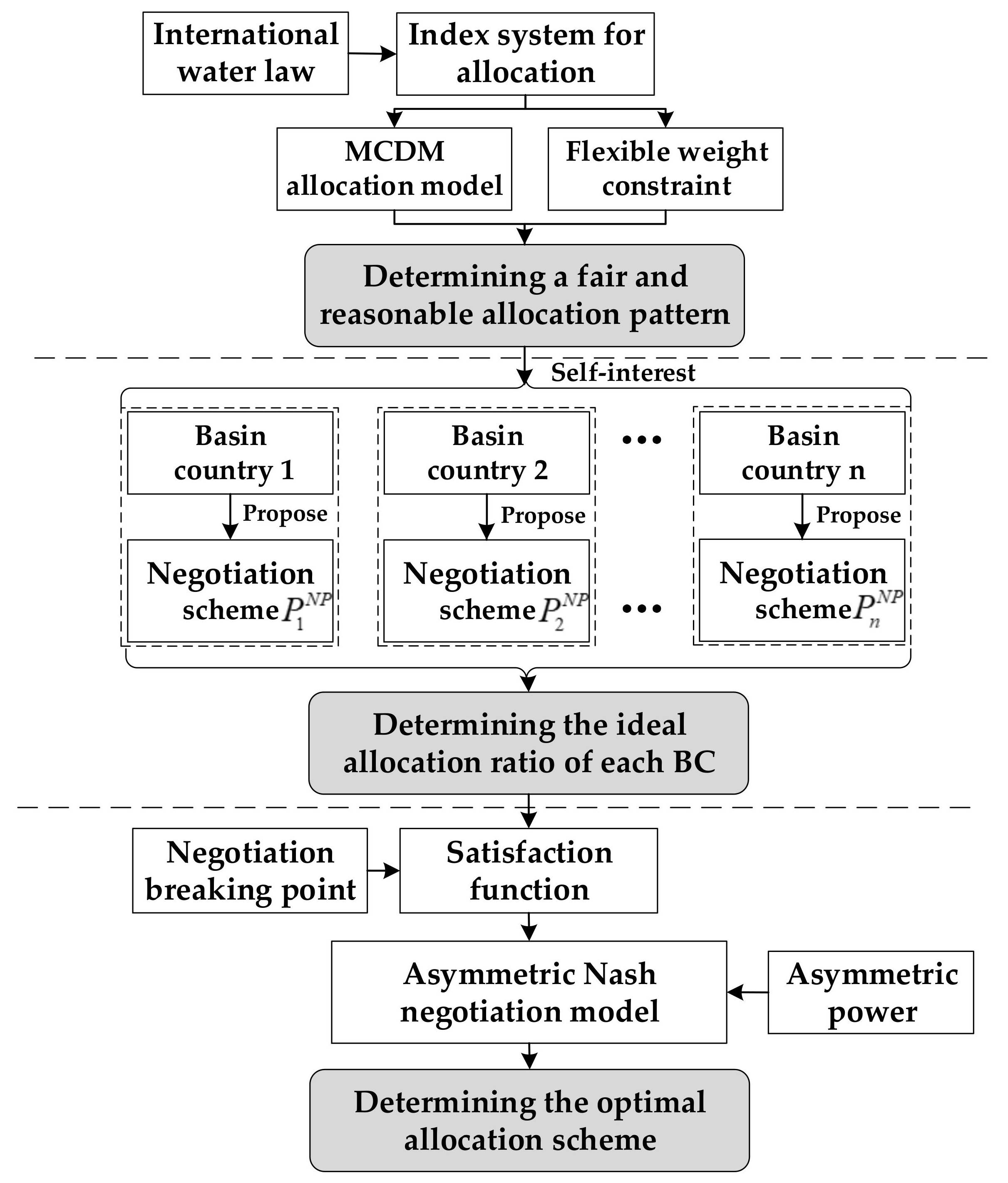
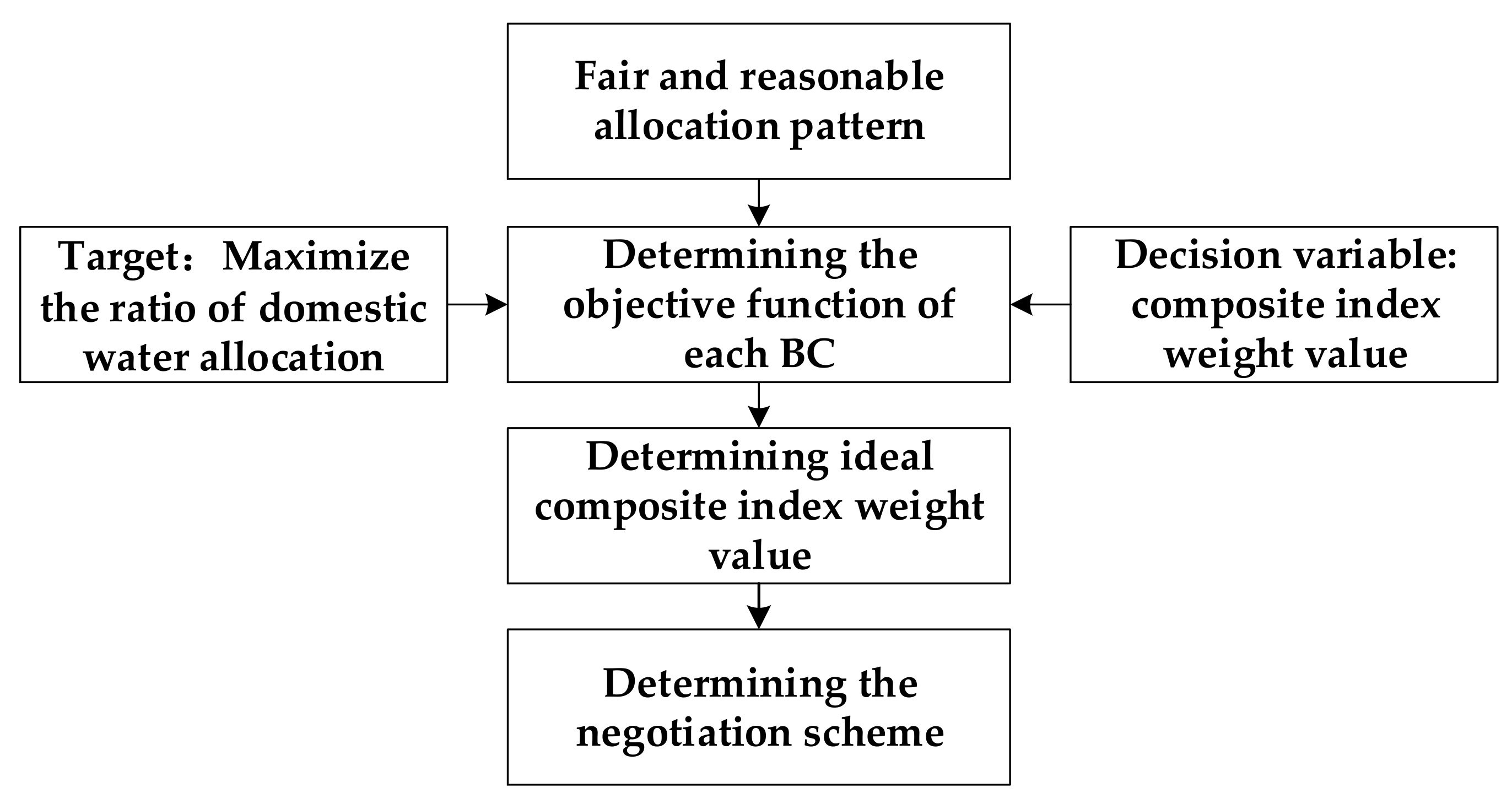
The Nash negotiation model can well simulate the negotiation process of each game subject and consider the individual reasonable interests. Based on the satisfaction perspective, this study developed an asymmetric Nash negotiation model by considering the multiple influencing factors, flexible weight constraint, and asymmetry power for the fair and reasonable allocation of trans-boundary water resources. The detailed steps are as follows: (1) Based on the two international water laws, an index system from the perspective of water demand differences, resource endowment differences, and water efficiency differences was designed. Considering the uncertainty of the weights of the indicators, a fair and reasonable allocation pattern was built by introducing the flexible weight constraints. The allocation pattern reflects the requirements of international law. This is also the basis for fair negotiation among basin countries. (2) Based on the constraints of allocation pattern, selection preferences of each basin country (BC) were considered according to their self-interest in order to determine the allocation scheme for negotiation of each BC. Since the sum of the ideal allocation ratio of each BC does not meet the constraint condition of equaling 100%, it enters into the stage of fair negotiation among the basin countries. (3) In the negotiation stage, an asymmetric Nash negotiation model is constructed using to obtain the optimal allocation scheme. This allocation scheme has a relatively high satisfaction degree through multiple rounds of negotiations.
The rest of this study is organized as follows: In
Section 2, the study area is introduced. In
Section 3, the methods are introduced. In
Section 4, the results are analyzed. In
Section 5, the study is concluded. An outline is shown in
Figure 1.
2. Case Study
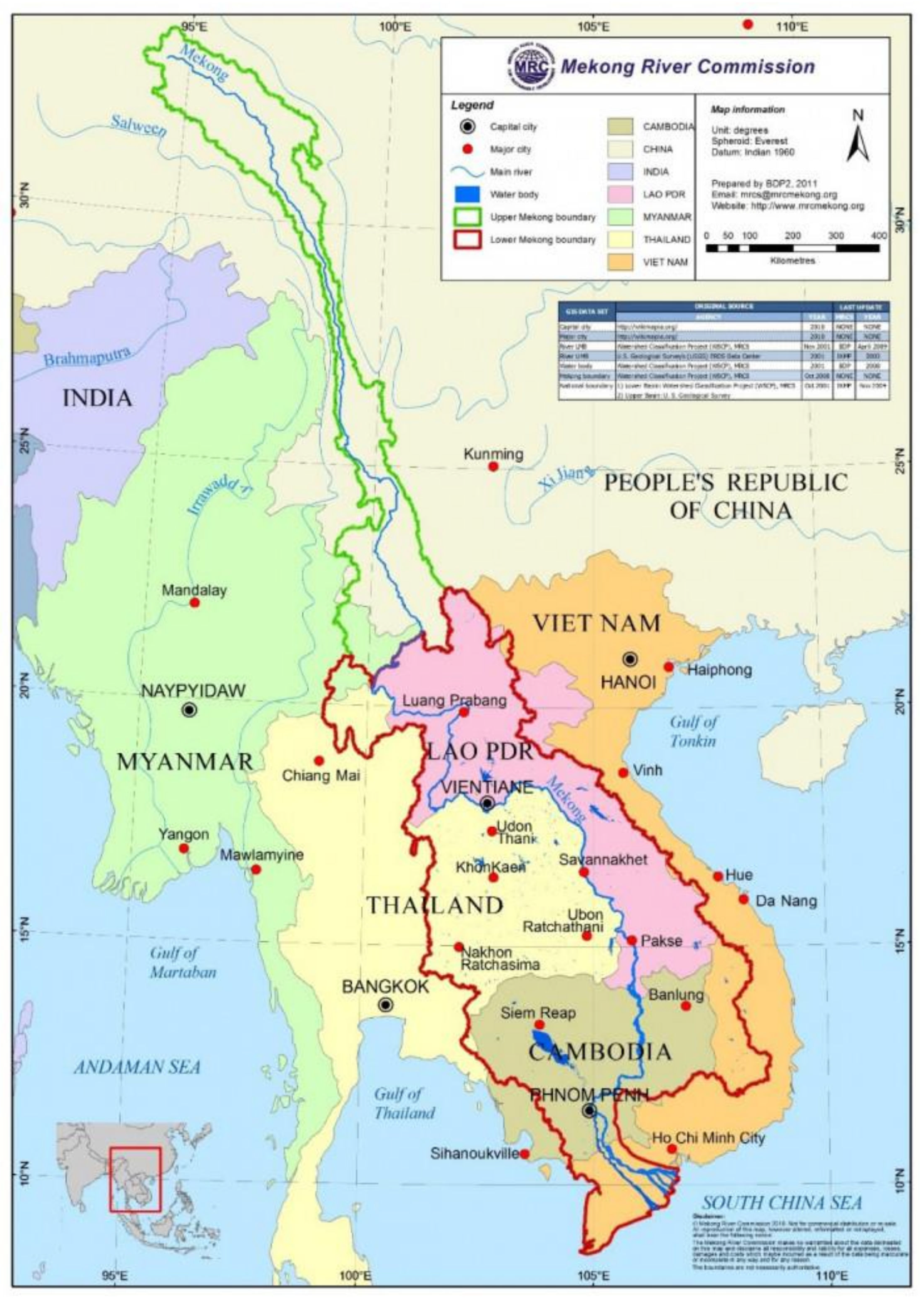
The Lancang–Mekong River basin (LMRB) is one of the world largest rivers, originating from Qinghai, China, and entering Vietnam through Laos, Myanmar, Thailand, and Cambodia. It is a typical north–south river with complex and varied characteristics in its basin shape and distribution. The geographical location of the river basin is shown in
Figure 2. The total length of LMRB is 4880
. It is the sixth longest river in the world. The basin area is 81.0 × 10
4 , ranking the 12th over the world. The average flow is 10,560
, and the total annual average runoff is 475 billion
. Most of the LMRB is in the tropical region, the annual rainfall distribution is unbalanced, and the river flow presents seasonal changes [
24]. Therefore, although the LMRB is rich in total water resources, due to the influence of seasonal rainfall and basin distribution, the water demand and water supply do not match or even contradict with each other in the basin countries.
Due to the great differences in geographical location, industrial structure, energy demand composition, social economy, and culture among countries in the trans-boundary basins, there are many different interest demands for water resources development and utilization in the LMRB. China is located in the upstream, and the utilization of water resources is mainly based on hydropower generation. China has built dams and other infrastructure for its own development, arousing the concern of downstream countries about the decrease in available water, aggravating the water contradiction in the basin. Although Myanmar is in the upstream of LMRB, it occupies a small area and has a lower degree of development. Laos is located in the middle and lower reaches, and its main demand lies in accelerating the development of hydropower resources and supporting the agricultural water needs. However, its inappropriate development mode and uncontrolled use of water resources have led to ecological and environmental problems [
25]. Thailand’s demand in the LMRB mainly includes agricultural irrigation water. Its farming schemes could lead to salinization of large areas and damage its ecological balance, causing dissatisfaction from downstream countries. Cambodia’s supporting industries are agriculture and fishing. To safeguard its own fishing development, Cambodia opposed upstream basin countries’ hydropower cascade development and diversion irrigation projects [
26]. As the most downstream basin country, Vietnam has a large agricultural water demand and has a high consumption of water resources in the basin.
Based on their own development needs and the maximization of their own interests, basin countries are expected to obtain more water resources to support their own development. In addition, population increase, sustainable economic, and social development lead to the increasing demand for water resources in the LMRB, which also aggravate the water contradictions and conflicts among the basin countries. Therefore, it is urgent to make scientific and rational allocation of water resources in LMRB. This is the key problem to solve the water contradiction among basin countries and realize the sustainable utilization of water resources in the basin.
5. Conclusions
To reduce water conflict and realize the sustainable development of trans-boundary water resources, based on the asymmetric Nash negotiation game model, we simulated the consultative decision-making process among basin countries, and under the constraints of the international water laws, we introduced a negotiation mechanism to discuss the fair and reasonable allocation of trans-boundary water resources: (1) The differences of each BC including the water demand, resources endowment and water use efficiency were considered, and based on the flexible constraint weights, a fair and reasonable allocation pattern was built, improving the practicability of international water laws in trans-boundary water resources allocation. (2) With the BC as the negotiation agent, under the constraint of the fair and reasonable allocation pattern, each BC proposed its own NS based on the maximization of its own interests. By fully considering the reasonable requirements of each BC, the participation and initiative of each BC were enhanced. (3) From the perspective of geography, economics, and politics, the AP of each BC was determined, and the asymmetric Nash negotiation model was constructed to obtain an optimal allocation scheme, improving the acceptability of the trans-boundary water resources allocation scheme and effectively reducing trans-boundary water conflict.
We took LMRB as an example in this study. The results are as follows:
- (1)
The NS proposed by each BC based on the constraint of the fair and reasonable allocation pattern reflects the interest demands of each BC, but the sum of the ideal allocation ratios of each BC does not meet the constraint condition that equals 100%, so it is necessary for them to negotiate and undertake certain water resources losses. Moreover, the reduction range of allocation ratio undertaken by each BC in LMRB is between 0.00% and −4.95%.
- (2)
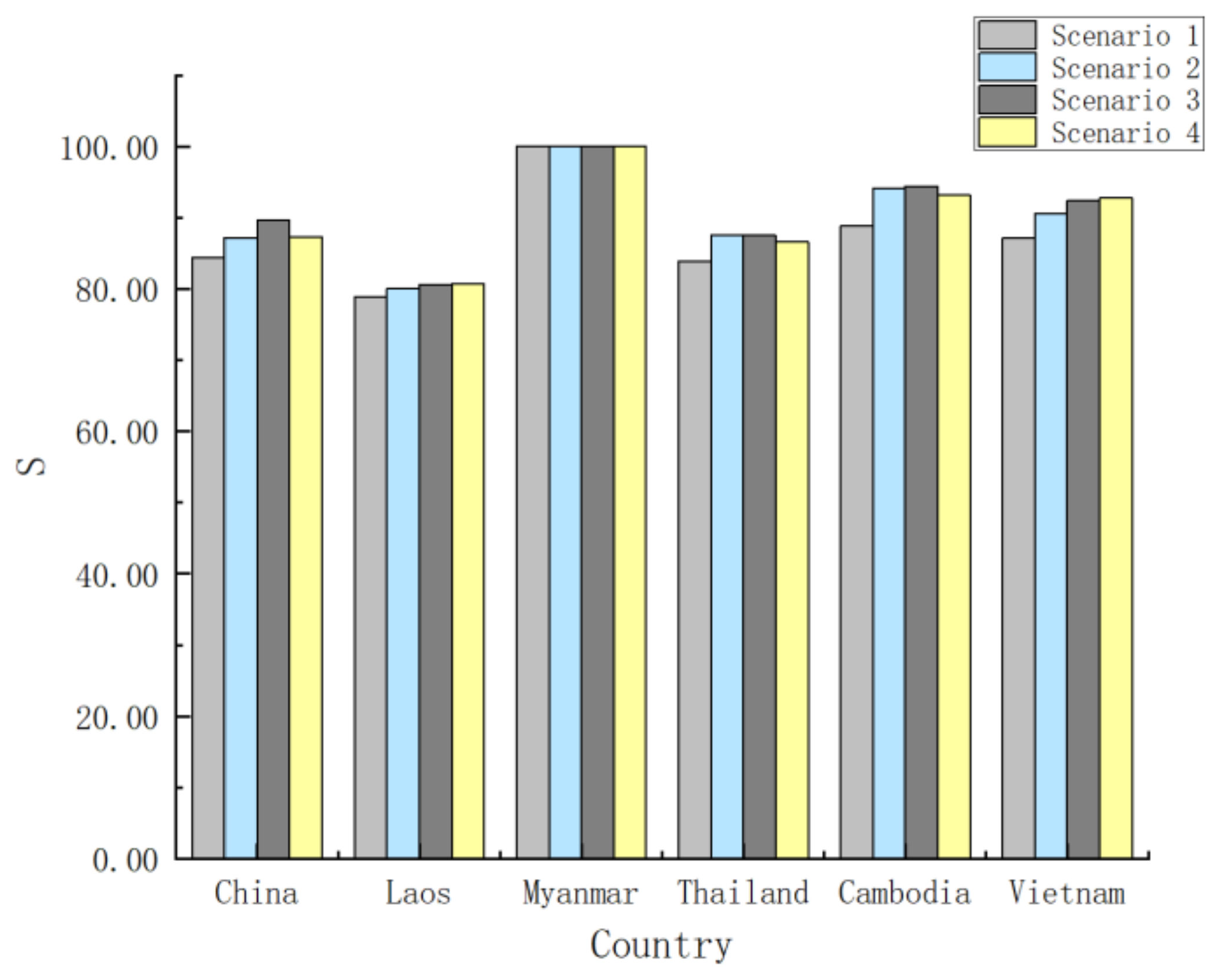
The average satisfaction degree of allocation schemes after negotiation optimization under different preference scenarios is more than 87.19%, which has a higher satisfaction and stability than the negotiation schemes proposed by each BC in LMRB. It shows that the optimal solution of trans-boundary water resources allocation based on negotiation can improve the feasibility and acceptability. From the perspective of the change rate before and after the negotiation, and the average satisfaction of the basin countries, the allocation scheme under the resource endowment preference scenario is better.
- (3)
The allocation scheme of LMRB is based on the utility function of each BC and considers the interest of each of them, subsequently enhancing the fairness and rationality of the allocation scheme, which provides a new idea for solving water conflicts.
Trans-boundary water resources allocation is complex work, and this study has some limitations: notably, the lack of an information sharing mechanism among the basin countries and the fact that basic data are difficult to obtain. In the future, effective cooperation among basin countries and sharing of information will be the key to carry out trans-boundary water resources allocation.