


Abstract
This review examines the current literature focused on nomophobia (objectives, methodological design, main variables, sample details, and measurement methods) in the Scopus and Web of Science databases. To this end, we conducted a systematic literature review in accordance with the Preferred Reporting Items for Systematic Reviews (PRISMA) guidelines. The initial sample consisted of 142 articles, of which 42 met the inclusion criteria and were analyzed in detail. The findings show that the current research is in an exploratory phase, with a greater predominance of descriptive, nonexperimental, and cross-sectional studies that explore the prevalence of nomophobia mainly in adolescents and university students. The most widely used measurement instrument is the Nomophobia Questionnaire (NMP-Q) proposed by Yildrim and Correia. In addition, the research suggests that nomophobia negatively affects personality, self-esteem, anxiety, stress, academic performance, and other physical and mental health problems. We are therefore faced with a health problem, which negatively affects a person, causing psychological problems and physical and behavioral changes.
1. Introduction
Today’s smartphones present great opportunities and comforts for people; at the same time, they facilitate the accomplishment of tasks and have achieved generalized popularity in the present society [1] thanks to their communicative power and people’s engagement with them [2]. The users of this technology even state that it has become an extension of their body, determining both their identity and their way of being [3].
It is indisputable that these devices have become an integral part of modern life [4] and have come to produce behavioral modifications in everyday habits and actions [5]. The advance of mobile technology, given its ubiquitous nature, has meant that the smartphone has become an indispensable resource in people’s lives [6].
However, in recent years, the number of problems arising from the use of smartphones has increased considerably [7]. As a result, the number of investigations into the state of the matter has increased, characterizing this phenomenon as addictive, antisocial, and dangerous [8]. Smartphone addiction is so prevalent that it is already considered to be like any other addiction to harmful substances. Therefore, it is a public health problem [9], which is why, because of the excessive use of this device [10] and the dependence that this technology generates [11], a new pathology known as nomophobia is emerging [12] and being cataloged as a clinical disorder [13].
Nomophobia is seen as a type of contemporary phobia that emerged in the digital age [14,15,16], which is expanding after the integration of the smartphone into society [17]. This term has its origin in England and is the result of the conjunction “non-mobile” combined with “phobia”, that is, fear, anxiety, and discomfort of not having a mobile device at a certain moment or not having access to a device when required [18,19,20,21]. In other words, nomophobia is the fear of feeling disconnected from the digital world [22].
According to [23] or [24], nomophobia is structured in four main dimensions and/or causes: (1) fear or nervousness for not being able to communicate with other people; (2) fear of not being able to connect; (3) fear of not being able to have immediate access to information; and (4) fear of the renunciation of the comfort provided by mobile devices.
Nomophobia promotes the development of mental disorders, personality disorders [25], as well as problems in people’s self-esteem, loneliness, and happiness [26], especially in the younger population [27,28]. All of this has a great impact on health, which has negative repercussions on other aspects of life such as study and work [29], by creating a strong dependence on mobile technology [30], affecting professional practice by provoking constant distractions [31]. In addition, it is influencing the relationships and interactions between individuals, producing a distance and isolation from the physical world [21].
This modern disorder increases, in turn, the fear of losing immediate access to any information and communication with others [32], which raises the indicators concerning depression, anxiety, anger, aggressiveness [33], stress, nervousness [34], emotional stability [35], and sleep disorders [36].
Likewise, nomophobia presents a direct and significant link with internet use, social network dependence, and anxiety [37]. Due to these factors, it is considered a digital disease, whose risk factor of suffering is increased in the youth population, between 12 and 18 years old [38], and those subjects whose personality tends to be emotionally dependent [39].
In this technological spectrum, the Internet cannot be forgotten as a technology whose access has been enhanced with the expansion of mobile devices. This has caused addictions to both mobile telephony and Internet access. These new addictions, typical of the digital era, tend to proliferate in economically developed regions, where citizens have the resources and means to have the necessary technology [40].
The characteristics of today’s society have caused adolescence to be the most critical age range for suffering from nomophobia, as well as other symptoms such as Internet and video game addiction and the corresponding psychological and emotional implications [41]. Currently, young people are familiar with developing, communicating, interacting, playing, and having fun with other people through digital media. Some young people state that they prefer digital contact to physical contact [42], causing cognitive, behavioral, and physiological alterations [43]. This continuous and abusive action results in the appearance of problems such as a sedentary lifestyle, eating disorders, sleep problems, depression, irritation, aggressiveness, and low self-esteem, among others [44].
As a novelty in the matter, recent studies have focused on measuring the influence of culture on the prevalence of nomophobia. The results show that culture has a relevant role in human behaviors linked to technology [45,46]. However, little has been studied on how culture influences the appearance of nomophobia in people [47].
This study explores the state of the art regarding a very frequent pathology among the youngest population, which has been derived as a consequence of the technological development experienced in contemporary society. It reveals that people in contemporary society are not only addicted to the Internet, videogames, and technology in general, but are also afraid of not having the means and technological resources to perform the basic functions such as relating, communicating, having fun, and accessing information.
We are faced with a very recent problem that is typical of the digital age and caused by the rise of mobile technology in people’s daily lives. For this reason, this research explores the state of the nomophobia issue in scientific research with the greatest impact.
2. Method
This review examines existing literature focused on nomophobia in the Scopus and Web of Science databases. In addition, this work shows the main objectives, methodological design, main variables, sample details, and measurement tools of the included investigations. In order to do this, we carry out a systematic review in accordance with the Preferred Reporting Items for Systematic Reviews (PRISMA) guidelines [48] to test the following questions:
- RQ1
- To what extent is nomophobia a growing public health problem?
- RQ2
- To what extent are adolescents more vulnerable to nomophobia than other populations?
- RQ3
- What are the physical and mental health problems and behavioral changes associated with nomophobia?
2.1. Search Strategy
During October 2019 we carried out an inquiry that began with the introduction of the keyword “nomophobia” in all possible search fields (title, abstract, keywords, main text, and so on) in both Scopus and the main collection of the Web of Science (WOS, BCI, BIOSIS, CCC, DIIDW, KJD, MEDLINE, RSCI, SCIELO), and contemplating all possible outcomes in the present day. These databases contain most of the current research references and are, in turn, the most consulted by researchers and experts from different areas of knowledge [49]. No limits were given for geographic area, language, year of publication, or method used. We found 149 results (article, meeting, abstract, others). However, the final sample consisted of 42 references.
2.2. Inclusion Criteria
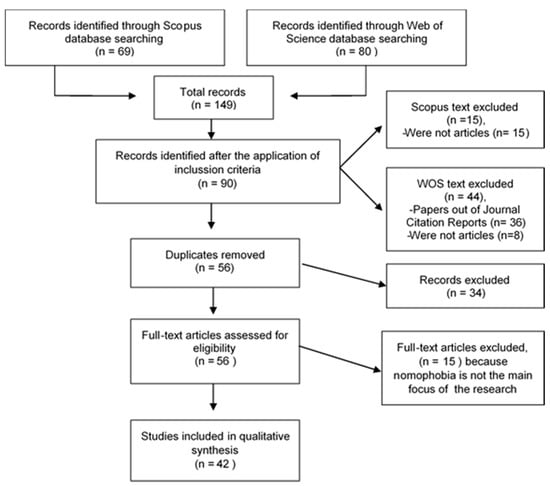
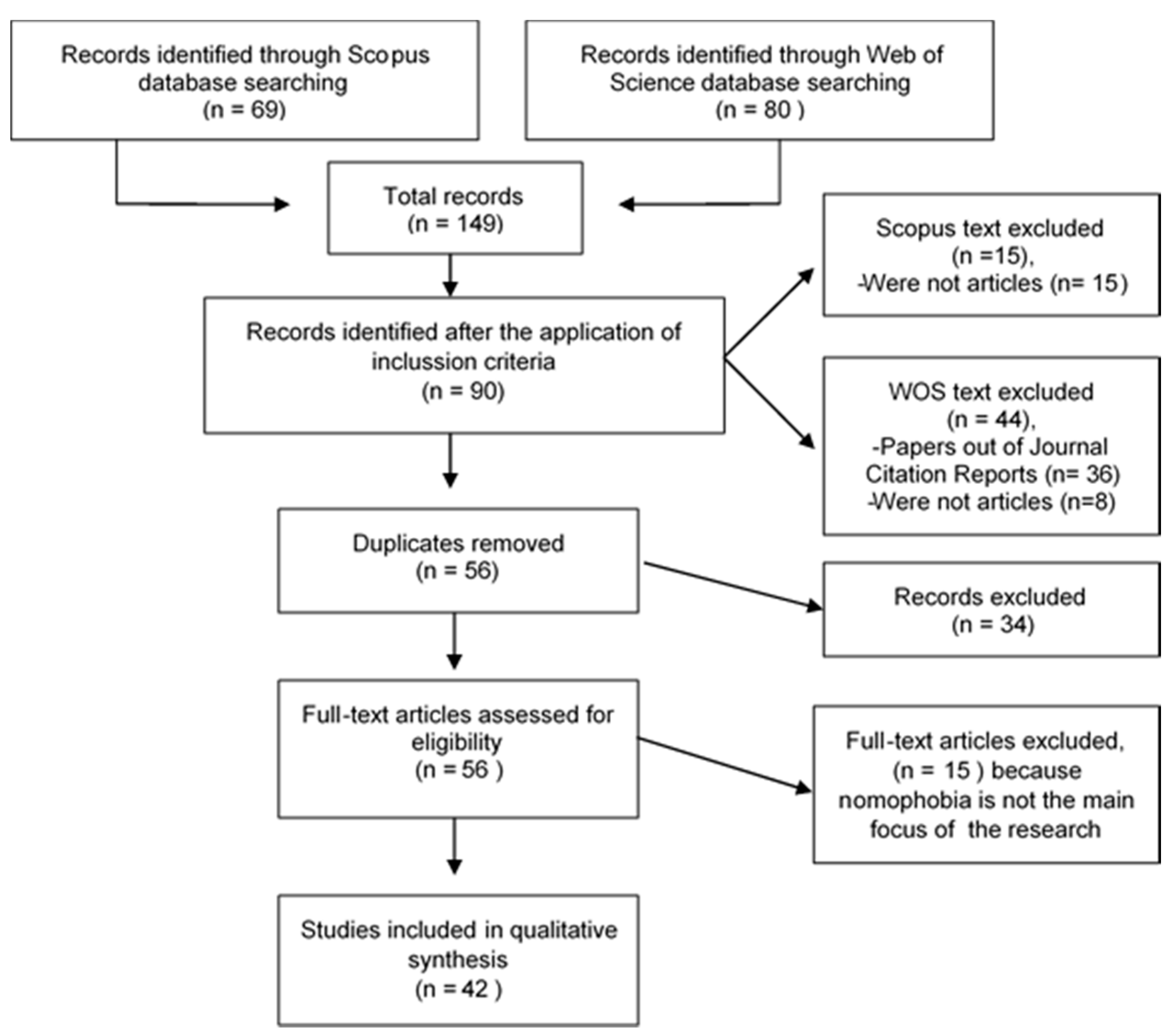
The 107 suppressed results were analyzed following a PRISMA protocol for systematic reviews [40]. The main objective was to analyze the articles with the greatest impact that had “nomophobia” as the central focus of their research. In the case of the sample retrieved from the Web of Science (n = 80), we deleted references that were not in the Journal Citation Reports indices (n = 36) and those that were not articles (n = 8) until we reached the final sample. Similarly, we performed this procedure in Scopus, excluding a total of 15 references that did not meet the inclusion criteria with respect to the type of publication. Thus, 91 references were analyzed, 34 of which were deleted as they were articles found in both databases. The 56 remaining records were assessed for eligibility on the basis of the abstract, and in case of doubt, the full text was read. Finally, this figure was reduced to 42 (Figure 1) due to the fact that the main object of study was not nomophobia (n = 14) [3,6,8,9,10,21,50,51,52,53,54,55,56,57].
Figure 1.
Flow diagram.
3. Results
The articles included in this review were mostly written in English and published between 2010 and 2019. The majority presented results from Turkey (n = 8), followed by Spain (n = 7) and India (n = 6). The most used methods were only quantitative (n = 35), nonexperimental (n = 26), and cross-sectional studies (n = 32). Only n = 3 used mixed methods and n = 5 were developed with experimental design (Table A1). At the same time, it should be noted that seven of the articles analyzed attempts to create and/or validate a scale to measure nomophobia in different populations (Table A2). Finally, there are three literature review studies (Table A3).
3.1. Aims
Most research aims to analyze the prevalence of nomophobia in different groups, whether students, clinic patients, or random people [1,18,19,23,29,30,32,33,36,37]. At the same time, some of them ask if there is any correlation between presenting nomophobia and other alterations of a psychic [5,13,25,26,35,58,59,60] or physical [61] nature, as well as alterations in learning and attention [31,54], in academic performance [2], coping styles [4], or other psychosocial problems arising in the digital and smartphone era [11,15]. Similarly, there are studies that focus on determining risk factors in relation to certain personality traits [16].
3.2. Methodological Design
The research analyzed is eminently exploratory, descriptive, nonexperimental, correlational, and cross-sectional, using the questionnaire as a single research collection instrument [1,2,4,13,16,18,19,20,23,25,26,29,30,31,32,33,35,37,39,58,61,62,63,64], presenting a quantitative methodological design. Others, however, extend this information with mixed methodological design, including qualitative techniques, such as interviews or discussion groups [5,20,24,65]. To a lesser extent, some research applies an experimental design, either through the application of cognitive behavioral therapies [5,20] or the use of control and experimental groups [11,13,15,59,62]. Finally, the articles aimed at validating an instrument for measuring nomophobia stand out. They have adapted the tool proposed by Yildrim and Correia [24] to different country contexts, such as Iran [7], Spain [17,27,28], and Israel [14], reaffirming its factors of validity and reliability [12]. Some review articles were also included [17,38,65].
3.3. Main Variables
Most research has nomophobia as the main and only study variable [1,4,7,14,17,18,19,22,23,24,27,28,30,31,34,65]. However, other researchers have been interested in examining the relationship between nomophobia and physical factors, such as age [29,33,60], context [29], presence of Carpal tunnel syndrome or median nerve in the wrist [61], and gender [32,33,35,39,58]. Others have studied the relationship between nomophobia and psychic and psychological variables such as anxiety [20,33,37,39], panic disorder [5,20,59], stress [11], depression, avoidance or hostility [12,39], obsessiveness [12,25], FOMO (fear of missing out) [15], personality (extraversion, awareness, emotional stability and regulation, sympathy, and openness to experience) [12,13,16,26,33,35], mindfulness [58], and loneliness and self-happiness [26]. Moreover, others have studied the relationship between nomophobia and sociological, educational, and other factors, including Internet usage and social media [29,37], academic performance [2], learning and attention [13,62], socio-educational variables and collectivism [63], and social threat [11].
3.4. Sample Details
The samples used in the various studies vary considerably, both in number, where there is a range from one person to 3216, and in the population on which it is focused. First, in relation to the size of the sample, there are studies that have used a sample between one and 150 people [19,21,27,33,59,61], between 151 and 400 people [11,13,18,23,24,25,30,31,34,35,60,62,64], between 401 and 1000 people [1,2,4,12,14,15,16,22,26,29,32,36,37,39,58,63,65], or more than 1000 [7]. Second, with regard to population, studies have focused on volunteers of various classes and types [5,16,20,22,59,60], adolescents or youth [4,7,28,34,35,36], university students where the specialty is not specified [2,12,14,15,23,24,25,26,32,35,39,58,61,62,64,65], university nursing students [18,27,30,31,37], medical students [1,19,29,33], engineering students [29], and professional researchers [11]. In other cases, the population is not indicated, given that the study focuses on a systematic review of papers and journals [17].
3.5. Measurement
Most studies have conducted their research exclusively using the Nomophobia Questionnaire (NMP-Q) [1,2,4,7,13,14,18,19,22,24,27,28,29,30,31,32,34,62,64] proposed by [24], which has been adequate and adapted to Persian [7], Indian [2], Spanish [27,28,34], Israeli [14], Italian [12], and Arabic [22] contexts. Other researchers have also added another measuring instrument, such as the Brief Symptom Inventory (BSI) [12,14], Obsessiveness Content Scale (OBS) [25], ultrasonography of the median nerve, Phalen’s test, and reverse Phalen’s test [61], FOMO Scale [15], UCLA Loneliness Scale (ULS-8), Self-Happiness Scale and Rosenberg’ Self-Esteem Scale [26], Stress Scale Social Threat Scale [11], Brief Symptom Inventory [12], Mobile Phone Involvement Questionnaire (MPIQ) [35], Scale of Experiences in Close Relationships (ECR) and Scale of Attention Awareness Mindful-Warning (MAAS) [39], Mindful-Awareness Scale (MAAS) [58], Individualism-Collectivism (INDCOL) [63], Problematic Internet Use Scale (PIUS), Social Appearance Anxiety Scale (SAAS) and Social media use integration scale [37], Emotional Intelligence Questionnaire and Academic iCheating Questionnaire [36], in other scales such as Interviews Scales Inventories Questionnaires [20], Questionnaire to Assess Nomophobia (QANIP), and Temperament and Character Inventory Revised (TCI-R) [16], and in other cases, ad hoc questionnaires of their own elaboration [5,23,33,59,60,65] or ad hoc questionnaires based on NMP-Q [64].
4. Discussion
Internet, video games, and now the proliferation of smartphones are causing problems in people’s health [40,41,42,43,44]. The rise of mobile technology as a means of interacting and communicating with people [4,6] has led to the emergence of nomophobia [12], cataloged as a typical pathology of the new millennium [15,16], arising from the constant and abusive use of technology [25], which leads to fear, stress, panic, and anxiety when that technology is not available [11,37,65] for communication or accessing information [32].
The analysis of the 42 articles retrieved from Scopus and Web of Science, which have satisfied the inclusion criteria delimited in the PRISMA review process, leads us to the following inferences. The included literature was mostly recent and in the exploratory phase of research, with a primacy of quantitative and cross-sectional studies with a young population (teenagers and university). The general objective of this current line of research is analyzing the prevalence of nomophobia, as well as the relationship of this disorder with the emergence of problems that affect the psychic, physical, and psychosocial development of the subject, as well as their academic performance.
In relation to the instruments reported from the literature analyzed, it has been ascertained that both the analysis tool initially designed by Yildrim and Correia [24] and its derivatives adapted to other study populations [7,14,22,27,28,34] have proven to be valid and reliable. The initial instrument proposed [24] is therefore consolidated as the most-endorsed tool to analyze nomophobia.
However, other instruments have also been created based on measurement scales and ad hoc questionnaires that have been used to obtain information on the prevalence of nomophobia and another linked to it, such as those provided by the research of [5,11,12,15,16,23,25,26,33,35,37,39,58,60,64,65], among others.
The results of the analyzed research highlight aspects of gender [26] and young age [33,60] as predictors of nomophobia. As for the students analyzed in the reported studies, especially those in health studies (nursing and medicine) have high levels of nomophobia [1,19,30,31]. In spite of this, engineering students revealed a higher index of this pathology over those of medicine [29]. In the field of education, nomophobia has a negative impact on learning outcomes and academic performance, as has been seen in several studies [2,13,18,62]. This phobia has led to medical and psychosocial disorders such as physical injuries [53] and mental disorders [20,59]. The latter generate a set of fears arising from the non-use of mobile devices [23]. It has also been found that extroverted people and people with deficits in consciousness, attention, emotional stability, and self-esteem are more likely to suffer this pathology [35,39,58].
5. Conclusions
Based on the results found in this work, it is concluded that nomophobia is a field of study that is currently in the early stages of research, so that most of the research is in the exploratory phase. Young people exposed to intensive and irrational use of technology are only aware of the advantages it offers and are unaware of the risks they may suffer as a consequence [51]. Therefore, a greater volume of research is needed to explore, investigate, and note which are the most determining variables that influence this contemporary pathology; evidence has shown that nomophobia is closely associated with individual mental health, internet addiction, and behavior modification. In addition, it is necessary to promote efficient and healthy use of mobile technology in learning spaces, in order to avoid the emergence of nomophobia and its consequences.
We, therefore, confirm our three initial hypotheses and can state that nomophobia is a public health problem typical of the digital age and that it is caused by an excessive fear of being without access to a smartphone. The great dependence that the current population has generated towards these devices, due to the different possibilities that they offer, makes them more and more vulnerable, with the adolescent population presenting a greater risk factor. Furthermore, due to the nature of the study and the various scientific contributions published so far, nomophobia is related to the development of personality disorders and mental, physical, educational, and social problems.
As for the limitations of the present study, there are those of systematic review studies, for which information may have been lost due to not using the correct descriptors or due to the lack of viability of covering all the databases existing at present. However, due to the novelty and specificity of the term, it was decided to introduce only the concept “nomophobia” as a search engine element. As a future line of research, it is proposed to analyze the influence of nomophobia on aspects related to people’s day-to-day life, such as sleeping hours or food.
Author Contributions
Conceptualization, J.L.B. and A.-M.R.-G.; methodology, A.-J.M.-G.; software, A.-J.M.-G.; formal analysis, A.-M.R.-G.; investigation, A.-M.R.-G.; resources, J.L.B.; data curation, A.-J.M.-G.; writing—original draft preparation, A.-J.M.-G., J.L.B., and A.-M.R.-G.; writing—review and editing, J.L.B. and A.-J.M.-G.; visualization, J.L.B.; supervision, A.-M.R.-G. All authors have read and agreed to the published version of the manuscript.
Funding
This research has received public funding from the Ministry of Education of the Government of Spain (FPU14/04626).
Acknowledgments
We acknowledge the researchers of the research group AREA (HUM-672), which belongs to the Ministry of Education and Science of the Junta de Andalucía and is registered in the Department of Didactics and School Organization of the Faculty of Education Sciences of the University of Granada.
Conflicts of Interest
The authors declare no conflict of interest.
Appendix A
Table A1.
Experimental or nonexperimental studies.
Table A2.
Adaptation and validation of questionnaires to measure nomophobia.
Table A3.
Literature review.
References
- Bartwal, J.; Nath, B. Evaluation of nomophobia among medical students using smartphone in north India. Med. J. Armed Forces India 2019. [Google Scholar] [CrossRef] [Scilit]
- Prasad, M.; Patthi, B.; Singla, A.; Gupta, R.; Saha, S.; Kumar, J.K.; Malhi, R.; Pandita, V. Nomophobia: A cross-sectional study to assess mobile phone usage among dental students. J. Clin. Diagn. Res. 2017, 11, 34–39. [Google Scholar] [CrossRef] [Scilit]
- Park, C.S.; Kaye, B.K. Smartphone and self-extension: Functionally, anthropomorphically, and ontologically extending self via the smartphone. Mob. Media Commun. 2019, 7, 215–231. [Google Scholar] [CrossRef] [Scilit]
- Bragazzi, N.L.; Simona, T.; Zerbetto, R. The relationship between nomophobia and maladaptive coping styles in a sample of Italian young adults: Insights and implications from a cross-sectional study. JMIR Ment. Health 2019, 6, e123154. [Google Scholar] [CrossRef] [Scilit] [PubMed]
- King, A.L.S.; Valença, A.M.; Nardi, A.E. Nomophobia: The mobile phone in panic disorder with agoraphobia: Reducing phobias or worsening of dependence? Cogn. Behav. Neurol. 2010, 23, 52–54. [Google Scholar] [CrossRef] [Scilit] [PubMed]
- Kneidinger-Mueller, B. When the smartphone goes offline: A factorial survey of smartphone users’ experiences of mobile unavailability. Comput. Hum. Behav. 2019, 98, 1–10. [Google Scholar] [CrossRef] [Scilit]
- Lin, C.Y.; Griffiths, M.D.; Pakpour, A.H. Psychometric evaluation of Persian Nomophobia Questionnaire: Differential item functioning and measurement invariance across gender. J. Behav. Addict. 2018, 7, 100–108. [Google Scholar] [CrossRef] [Scilit]
- Pivetta, E.; Harkin, L.; Billieux, J.M.; Kanjo, E.; Kuss, D.J. Problematic smartphone use: An empirically validated model. Comput. Hum. Behav. 2019, 100, 105–117. [Google Scholar] [CrossRef] [Scilit]
- Basu, S.; Garg, S.; Singh, M.; Kohli, C. Addiction-like behavior associated with mobile phone usage among medical students in Delhi. Indian J. Psychol. Med. 2018, 40, 446–451. [Google Scholar] [CrossRef] [Scilit]
- Aboujaoude, E. Problematic Internet use two decades later: Apps to wean us off apps. CNS Spectr. 2019, 24, 371–373. [Google Scholar] [CrossRef] [Scilit]
- Tams, S.; Legoux, R.; Léger, P.M. Smartphone withdrawal creates stress: A moderated mediation model of nomophobia, social threat, and phone withdrawal context. Comput. Hum. Behav. 2018, 81, 1–9. [Google Scholar] [CrossRef] [Scilit]
- Adawi, M.; Zerbetto, R.; Re, T.S.; Bisharat, B.; Mahamid, M.; Amital, H.; Del Puente, G.; Bragazzi, N.L. Psychometric properties of the brief symptom inventory in nomophobic subjects: Insights from preliminary confirmatory factor, exploratory factor, and clustering analyses in a sample of healthy italian volunteers. Psychol. Res. Behav. Manag. 2019, 12, 145–154. [Google Scholar] [CrossRef] [Scilit] [PubMed]
- Lee, S.; Kim, M.W.; McDonough, I.M.; Mendoza, J.S.; Kim, M.S. The Effects of Cell Phone Use and Emotion-regulation Style on College Students’ Learning. Appl. Cogn. Psychol. 2017, 31, 360–366. [Google Scholar] [CrossRef] [Scilit]
- Adawi, M.; Bragazzi, N.L.; Argumosa-Villar, L.; Boada-Grau, J.; Vigil-Colet, A.; Yildirim, C.; Del Puente, F.; Watad, A. Translation and validation of the nomophobia questionnaire in the Italian language: Exploratory factor analysis. JMIR Mhealth Uhealth 2018, 6, 1–9. [Google Scholar] [CrossRef] [Scilit] [PubMed]
- Mertkan, D.; Burcin, N.; Sezen-Gultekin, G.; Gemikonakli, O. Relationship between nomophobia and fear of missing out among Turkish university students. Cypriot J. Educ. Sci. 2018, 13, 549–561. [Google Scholar] [CrossRef] [Scilit]
- Olivencia-Carrión, M.A.; Ferri-García, R.; Rueda, M.D.M.; Jiménez-Torres, M.G.; López-Torrecillas, F. Temperament and characteristics related to nomophobia. Psychiatry Res. 2018, 266, 5–10. [Google Scholar] [CrossRef] [Scilit]
- Sandeep, T.K. A study on the effects of ICT enabled gadgets and screen addiction among mechanical engineering students. Int. J. Mech. Eng. Technol. 2018, 9, 1223–1227. [Google Scholar]
- Ahmed, S.; Pokhrel, N.; Roy, S.; Samuel, A.J. Impact of nomophobia: A nondrug addiction among students of physiotherapy course using an online cross-sectional survey. Indian J. Psychiatry 2019, 61, 77–80. [Google Scholar]
- Farooqui, I.A.; Pore, P.; Gothankar, J. Nomophobia: An emerging issue in medical institutions? J. Ment. Health 2018, 27, 438–441. [Google Scholar] [CrossRef] [Scilit]
- King, A.L.S.; Valença, A.M.; Silva, A.C.O.; Baczynski, T.; Carvalho, M.R.; Nardi, A.E. Nomophobia: Dependency on virtual environments or social phobia? Comput. Hum. Behav. 2013, 29, 140–144. [Google Scholar] [CrossRef] [Scilit]
- Santos, T.; Da Silva, L.K.; Abbas, W.; De Souza, L.A.; De Sá, L.V. Cade meu celular? Uma análise da nomofobia no ambiente organizacional. RAE Rev. Adm. Empresas 2017, 57, 634–635. [Google Scholar]
- Al-Balhan, E.M.; Khabbache, H.; Watfa, A.; Re, T.S.; Zerbetto, R.; Bragazzi, N.L. Psychometric evaluation of the Arabic version of the nomophobia questionnaire: Confirmatory and exploratory factor analysis—Implications from a pilot study in Kuwait among university students. Psychol. Res. Behav. Manag. 2018, 11, 471–482. [Google Scholar] [CrossRef] [Scilit] [PubMed]
- Ali, A.; Muda, M.; Ridzuan, A.R.; Nuji, M.N.N.; Izzamuddin, M.H.M.; Latiff, D.I.A. The relationship between phone usage factors and nomophobia. Adv. Sci. Lett. 2017, 23, 7610–7613. [Google Scholar] [CrossRef] [Scilit]
- Yildirim, C.; Correia, A.P. Exploring the dimensions of nomophobia: Development and validation of a self-reported questionnaire. Comput. Hum. Behav. 2015, 49, 130–137. [Google Scholar] [CrossRef] [Scilit]
- Lee, S.; Kim, M.; Mendoza, J.S.; McDonough, I.M. Addicted to cellphones: Exploring the psychometric properties between the nomophobia questionnaire and obsessiveness in college students. Heliyon 2018, 4, 1–20. [Google Scholar] [CrossRef] [Scilit]
- Ozdemir, B.; Cakir, O.; Hussain, I. Prevalence of Nomophobia among university students: A comparative study of Pakistani and Turkish undergraduate students. Eurasia J. Math. Sci. Technol. Ed. 2018, 14, 1519–1532. [Google Scholar] [CrossRef] [Scilit]
- Gutiérrez-Puertas, L.; Márquez-Hernández, V.V.; Aguilera-Manrique, G. Adaptation and validation of the Spanish version of the nomophobia questionnaire in nursing studies. CIN Comput. Inform. Nurs. 2016, 34, 470–475. [Google Scholar] [CrossRef] [Scilit]
- Ramos-Soler, I.; López-Sánchez, C.; Quiles-Soler, M.C. Adaptation and validation of the Yildirim & Correia nomophobia scale in Spanish students of «compulsory secondary education». Health Addict. 2017, 17, 201–213. [Google Scholar]
- Dasgupta, P.; Bhattacherjee, S.; Dasgupta, S.; Roy, J.K.; Mukherjee, A.; Biswas, R. Nomophobic behaviors among smartphone using medical and engineering students in two colleges of West Bengal. Indian J. Public Health 2017, 61, 199–204. [Google Scholar] [CrossRef] [Scilit]
- Gutiérrez-Puertas, L.; Márquez-Hernández, V.V.; São-Romão-Preto, L.; Granados-Gámez, G.; Gutiérrez-Puertas, V.; Aguilera-Manrique, G. Comparative study of nomophobia among Spanish and Portuguese nursing students. Nurse Educ. Pract. 2019, 34, 79–84. [Google Scholar] [CrossRef] [Scilit]
- Aguilera-Manrique, G.; Márquez-Hernández, V.V.; Alcaraz-Córdoba, T.; Granados-Gámez, G.; Gutiérrez-Puertas, V.; Gutiérrez-Puertas, L. The relationship between nomophobia and the distraction associated with smartphone use among nursing students in their clinical practicum. PLoS ONE 2018, 13, e0202953. [Google Scholar] [CrossRef] [Scilit] [PubMed]
- Yildirim, C.; Sumuer, E.; Adnan, M.; Yildirim, S. A growing fear: Prevalence of nomophobia among Turkish college students. Inf. Dev. 2016, 32, 1322–1331. [Google Scholar] [CrossRef] [Scilit]
- Darvishi, M.; Noori, M.; Nazer, M.R.; Sheikholeslami, S.; Karimi, E. Investigating different dimensions of nomophobia among medical students: A cross-sectional study. Open Access Maced. J. Med. Sci. 2019, 7, 573–578. [Google Scholar] [CrossRef] [Scilit] [PubMed]
- González-Cabrera, J.; León-Mejía, A.; Pérez-Sancho, C.; Calvete, E. Adaptation of the Nomophobia Questionnaire (NMP-Q) to Spanish in a sample of adolescents. Actas Españolas Psiquiatr. 2017, 45, 137–144. [Google Scholar]
- Argumosa-Villar, L.; Boada-Grau, J.; Vigil-Colet, A. Exploratory investigation of theoretical predictors of nomophobia using the Mobile Phone Involvement Questionnaire (MPIQ). J. Adolesc. 2017, 56, 127–135. [Google Scholar] [CrossRef] [Scilit]
- Gentina, E.; Li-Ping, T.; Dancoine, P.F. Does Gen Z’s emotional intelligence promote iCheating (cheating with iPhone) yet curb iCheating through reduced nomophobia? Comput. Educ. 2018, 126, 231–247. [Google Scholar] [CrossRef] [Scilit]
- Ayar, D.; Özalp, G.; Özdemir, E.Z.; Bektaş, M. The Effect of Problematic Internet Use, Social Appearance Anxiety, and Social Media Use on Nursing Students’ Nomophobia Levels. CIN Comput. Inform. Nurs. 2018, 36, 589–595. [Google Scholar] [CrossRef] [Scilit]
- Betoncu, O.; Ozdamli, F. The disease of 21st century: Digital disease. TEM J. 2019, 8, 598–603. [Google Scholar] [CrossRef] [Scilit]
- Arpaci, I.; Baloğlu, M.; Özteke, H.I.; Kesici, S. Individual differences in the relationship between attachment and nomophobia among college students: The mediating role of mindfulness. J. Med. Internet. Res. 2017, 19, e404. [Google Scholar] [CrossRef] [Scilit]
- Rojas-Jara, C.; Henríquez, F.; Sanhueza, F.; Núñez, P.; Inostroza, E.; Solís, A.; Contreras, D. Adicción a Internet y uso de redes sociales en adolescentes: Una revisión. Rev. Española Drogodepend. 2018, 43, 39–54. [Google Scholar]
- Rojas-Jara, C.; Ramos-Vera, J.; Pardo-González, E.; Henríquez-Caroca, F. Adicción a internet en adolescentes: Una breve revisión. Drugs Addict. Behav. 2018, 3, 267–281. [Google Scholar] [CrossRef] [Scilit]
- Ruiz-Palmero, J.; Sánchez-Rodríguez, J.; Trujillo-Torres, J.M. Utilización de Internet y dependencia a teléfonos móviles en adolescentes. Rev. Latinoam. Cienc. Soc. Niñez Y Juv. 2016, 14, 1357–1369. [Google Scholar] [CrossRef] [Scilit]
- De la Villa Moral, M.; Suárez, C. Factores de riesgo en el uso problemático de Internet y del teléfono móvil en adolescentes españoles. Rev. Iberoam. Psicol. Salud 2016, 7, 69–78. [Google Scholar] [CrossRef] [Scilit]
- Buiza-Aguado, C.; García-Calero, A.; Alonso-Cánovas, A.; Ortiz-Soto, P.; Guerrero-Díaz, M.; González-Molinier, M.; Hernández-Medrano, I. Los videojuegos: Una afición con implicaciones neuropsiquiátricas. Psicol. Educ. 2017, 23, 129–136. [Google Scholar] [CrossRef] [Scilit]
- Guedes, E.; Sancassiani, F.; Carta, M.G.; Campos, C.; Machado, S.; Spear, A.L.; Nardi, A.E. Internet addiction and excessive social networks use: What about Facebook? Clin. Pract. Epidemiol. Ment. Health 2016, 12, 43–48. [Google Scholar] [CrossRef] [Scilit] [PubMed]
- Okoye, C.A.; Obi-Nwosu, H.; Obikwelu, V.C. Nomophobia among undergraduate. Pract. Psychol. 2017, 7, 64–74. [Google Scholar]
- Arpaci, I. Culture and nomophobia: The role of vertical versus horizontal collectivism in predicting nomophobia. Inf. Dev. 2019, 35, 96–106. [Google Scholar] [CrossRef] [Scilit]
- Moher, D.; Liberati, A.; Tetzlaff, J.; Altman, D.G. Preferred reporting items for systematic reviews and meta-analyses: The PRISMA statement. Ann. Intern. Med. 2009, 151, 264–269. [Google Scholar] [CrossRef]
- Aksnes, D.W.; Sivertsen, G. A Criteria-based Assessment of the Coverage of Scopus and Web of Science. J. Data Inf. Sci. 2019, 4, 1–21. [Google Scholar] [CrossRef] [Scilit]
- Anshari, M.; Alas, Y.; Hardaker, G.; Jaidin, J.H.; Smith, M.; Ahad, A.D. Smartphone habit and behavior in Brunei: Personalization, gender, and generation gap. Comput. Hum. Behav. 2016, 64, 719–727. [Google Scholar] [CrossRef] [Scilit]
- Correr, R.; Bijos, M.T. The use of cell phones by adolescents: Impacts on relationships. Adolesc. Saude 2017, 14, 24–39. [Google Scholar]
- Csibi, S.; Griffiths, M.D.; Cook, B.; Demetrovics, Z.; Szabo, A. The Psychometric Properties of the Smartphone Application-Based Addiction Scale (SABAS). Int. J. Ment. Health Addict. 2018, 16, 393–403. [Google Scholar] [CrossRef] [Scilit] [PubMed]
- Liu, T.; Sun, Y.; Li, Z.; Xin, T. The Impact of Aberrant Response on Reliability and Validity. Measurement 2019, 17, 133–142. [Google Scholar] [CrossRef] [Scilit]
- Quicios, D.P.; Sevillano, M.L.; Ortega, I. Educational uses of mobile phones by university students in Spain. New Educ. Rev. 2013, 34, 151–163. [Google Scholar]
- Siddiqi, N.; Jahan, F.; Moin, F.; Shehhi, F.A.L.; Balushi, F.A.L. Excessive use of mobile phones by medical students: Should precautions be taken? Biomed. Pharmacol. J. 2017, 10, 1631–1638. [Google Scholar] [CrossRef] [Scilit]
- Tangmunkongvorakul, A.; Musumari, P.M.; Thongpibul, K.; Srithanaviboonchai, K.; Techasrivichien, T.; Suguimoto, S.P.; Non-Kihara, M.; Kihara, M. Association of excessive smartphone use with psychological well-being among university students in Chiang Mai, Thailand. PLoS ONE 2019, 14, e0210294. [Google Scholar] [CrossRef] [Scilit]
- Throuvala, M.A.; Griffiths, M.D.; Rennoldson, M.; Kuss, D.J. Motivational processes and dysfunctional mechanisms of social media use among adolescents: A qualitative focus group study. Comput. Hum. Behav. 2019, 93, 164–175. [Google Scholar] [CrossRef] [Scilit]
- Arpaci, I.; Baloğlu, M.; Kesici, Ş. A multi-group analysis of the effects of individual differences in mindfulness on nomophobia. Inf. Dev. 2019, 35, 333–341. [Google Scholar] [CrossRef] [Scilit]
- King, A.L.S.; Martins, A.; Valença, A.M.; Cardoso, A.; Sancassiani, F.; Machado, S.; Egidio, A. «Nomophobia»: Impact of cell phone use interfering with symptoms and emotions of individuals with panic disorder compared with a control group. Clin. Pract. Epidemiol. Ment. Health 2014, 10, 28–35. [Google Scholar] [CrossRef] [Scilit]
- Musa, R.; Saidon, J.; Rahman, S.A. Who’s at risk for smartphone nomophobia and pathology; the young or matured urban millennials? Adv. Sci. Lett. 2017, 23, 7486–7489. [Google Scholar] [CrossRef] [Scilit]
- Lee, Y.S.; Yang, H.S.; Jeong, C.J.; Yoo, Y.D.; Jeong, G.Y.; Moon, J.S.; Hong, S.W. Changes in the thickness of median nerves due to excessive use of smartphones. J. Phys. Ther. Sci. 2012, 24, 1259–1262. [Google Scholar] [CrossRef] [Scilit]
- Mendoza, J.S.; Pody, B.C.; Lee, S.; Kim, M.; McDonough, I.M. The effect of cellphones on attention and learning: The influences of time, distraction, and nomophobia. Comput. Hum. Behav. 2018, 86, 52–60. [Google Scholar] [CrossRef] [Scilit]
- Han, S.; Kim, K.J.; Kim, J.H. Understanding Nomophobia: Structural Equation Modeling and Semantic Network Analysis of Smartphone Separation Anxiety. Cyberpsychol. Behav. Soc. Netw. 2017, 20, 419–427. [Google Scholar] [CrossRef] [Scilit] [PubMed]
- Rosales-Huamani, J.A.; Guzman-Lopez, R.R.; Aroni-Vilca, E.E.; Matos-Avalos, C.R.; Castillo-Sequera, J.L. Determining symptomatic factors of nomophobia in peruvian students from the national university of engineering. Appl. Sci. 2019, 9, 1814. [Google Scholar] [CrossRef] [Scilit]
- Bragazzi, N.L.; Del Puente, G. A proposal for including nomophobia in the new DSM-V. Psychol. Res. Behav. Manag. 2014, 7, 155–160. [Google Scholar] [CrossRef] [Scilit]
© 2020 by the authors. Licensee MDPI, Basel, Switzerland. This article is an open access article distributed under the terms and conditions of the Creative Commons Attribution (CC BY) license (http://creativecommons.org/licenses/by/4.0/).