


Abstract
Meat consumption is a major contributor to global warming. Given the worldwide growing demand of meat, and the severe impact of meat production on the planet, reducing animal protein consumption is a matter of food security and public health. Changing consumer food behavior is a challenge. Taste preferences, culinary traditions and social norms factor into food choices. Since behavioral change cannot occur without the subject’s positive attitude based on reasons and motivations, a total of 34 papers on consumer attitudes and behavior towards meat consumption in relation to environmental concerns were examined. The results show that consumers aware of the meat impact on the planet, willing to stop or significantly reduce meat consumption for environmental reasons, and who have already changed their meat intake for ecological concerns are a small minority. However, environmental motives are already appealing significant proportions of Westerners to adopt certain meat curtailment strategies. Those who limit meat intake for environmental reasons are typically female, young, simply meat-reducer (not vegan/vegetarian), ecology-oriented, and would more likely live in Europe and Asia than in the U.S.
1. Introduction
Worldwide demand for meat and other animal products is increasing due to rising incomes, growing populations and other sociocultural factors [1,2]. This trend is a global problem because meat production is a major responsible for global warming and environmental degradation [1,3,4,5,6]. The livestock industry pollutes freshwater with antibiotics, hormones and chemical substances among others, depletes freshwater availability, contributes to the loss of biodiversity, and is a major source of anthropogenic greenhouse gas emissions [1]. Consequently, finding ways to make diets more sustainable by reducing animal protein consumption has become a matter of food security and thus, a public health issue [7].
Changing consumer food behaviors is a challenge. They are the result of strongly held factors like taste preferences, culinary traditions and social norms [8]. Health behavior theorists have described the stages a person undergoes when trying to adopt healthy behaviors. They cite that behavioral change can only occur with the adoption of a positive attitude based on reasons and motivations [9]. It is therefore relevant to know if environmental reasons can prompt individuals to reduce or avoid meat consumption.
In Western societies, meat-based diets are the norm. Meat avoiders like vegans and vegetarians represent a small minority. For instance, in the United States and the United Kingdom, vegetarians account for significantly less than 5% of the population [10]. The motivations of converted vegans and vegetarians—those raised on a meat-based diet—have been described as non-static and related to health, economy, environment, society and culture, ethics and religion [11]. Vegetarians can be categorized in two large groups: health oriented and ethically motivated [12]. This is because the most prevalent motivations among vegetarians are health and animal welfare [13,14,15,16,17]. Environmental reasons, on the contrary, are important to a small fraction of vegetarians [11].
Another group of consumers to consider are those not ready to give up meat, but who have, or are willing to consider reducing meat consumption. These are known as meat-reducers or flexitarians. Contrary to vegans and vegetarians who have been studied for decades, meat-reducers have received scant attention [18].
The goal of this systematic review is to enhance our understanding of consumer attitudes on meat consumption in relation to environmental sustainability in order to support potential public health interventions oriented towards meat intake reduction. We looked into the three main stages of behavioral change process as proposed by Glanz et al.’s [9]: awareness (precontemplation), willingness (contemplation and preparation) and change (action, maintenance and termination). Having a general overview of the three stages should give public health professionals a general understanding of the role environmental reasons may play in the food eating behavior change process. Thus, this systematic review aims to answer the three following research questions: (1) Are people aware of the environmental impact of meat production and consumption? (2) Are people willing to stop or reduce meat consumption based on environmental concerns? and (3) Have ecological/environmental concerns been the motivation for people who have altered their meat consumption?
2. Materials and Methods
This systematic review was reported following the PRISMA (Preferred Reporting Items for Systematic Reviews and Meta-Analyses) guidelines [19] We performed a preliminary search in Google Scholar for articles that reported data on at least one of the following three topics: people’s awareness of the environmental impact of meat production and consumption; people’s willingness to stop or reduce meat consumption because of environmental concerns; and people who have already stopped or reduced meat consumption because of environmental reasons or motivations (diet change).
This initial search allowed us to identify a series of keywords that we later used to conduct a literature search of the Web of Science (WOS) Core Collection in March 2018. A separate query was conducted for each topic (awareness, willingness and diet change). Each query consisted of a series of search strings that combined no more than three terms each from one of the following categories: consumer related, meat related, and planet related. For example, one query looked like this: consumer attitudes AND meat AND climate change.
Thus, for “awareness” we used a series of search strings that combined the following terms: “consumer/people attitudes/perceptions” AND “meat”/“livestock” AND “climate change”/“GHG emissions”/“global near/2 warming”/“environment”/“water near/3 use”/“land near/3 use”. Similar search strings were used for “willingness” and “change”.
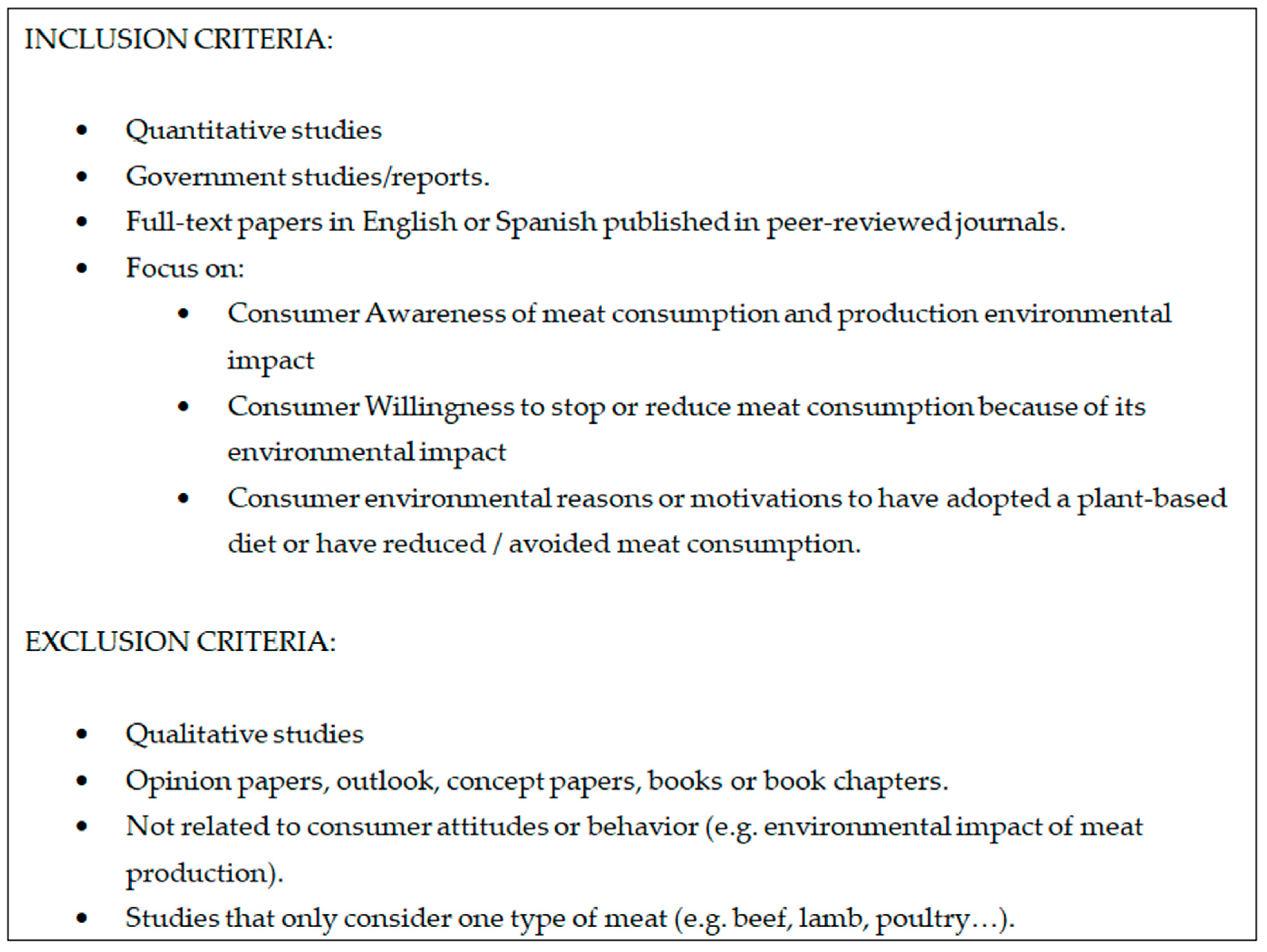
The screening process was completed by both authors independently to reduce bias. It comprised three stages for each one of the three topics considered. First, articles and abstracts were screened. Citations that met the eligibility criteria (Figure 1) were imported to the reference manager Zotero. Second, selected citations were read in full to make a final decision on their relevance for any of the three topics considered, and to locate new relevant articles that had not been found by the WOS search. Third, these first two steps were conducted for the new bibliography until no new eligible references were detected. The few articles considered pertinent by only one reviewer were included or discarded after a discussion between the two coauthors. The search for “awareness” yielded a total of 14 articles that met the eligibility criteria. The search for “willingness” yielded a total of 16 articles that met the eligibility criteria. And the search for “diet change” yielded a total of 17 articles that met the eligibility criteria. This systematic review rendered a total of 34 articles since some publications were relevant for more than one topic. Pertinent data from these articles was abstracted in tables with categories including: study design, sample characteristics, question or dependent variable and covariates effects, among other relevant information.
Figure 1.
Eligibility criteria.
3. Results
3.1. People Awareness of the Environmental Impact of Meat Production and Consumption
The results from 14 articles that examined awareness of the negative impact meat production and consumption have on the environment are summarized in Table A1, presented in the Appendix A at the end of this dcocument. In short, the main findings are: (1) aware consumers are a minority; (2) consumers either underestimate or ignore the potential of either stopping or reducing meat production and consumption to reduce the anthropogenic impact on the environment; and (3) it is not clear for the consumer that a vegetarian diet is more environmental friendly than a diet including meat.
Consumer awareness of the meat environmental toll has been studied in Belgium, Finland, Germany, the Netherlands, Portugal and the United States using different methods. The percentages of aware participants ranged from 23% to 35% across studies [20,21,22]. One study in which subjects received prior information, the percentage jumped to 58% [23]. Another study required respondents to list concrete impacts of meat production on the planet: only 24% named “pollution” and 20% “erosion of natural resources” [24]. Another study showed a tendency toward a neutral opinion on the negative environmental impact of meat [25]. And regarding behaviors that damage the earth, one study showed that consumers rarely (less than 10%) thought of “meat eating” [26].
Consumer estimation of meat production and consumption toll on the environment was studied in Australia, Belgium, the Netherlands, Switzerland, the United Kingdom, and the U.S. Only two studies specifically queried participants on meat production. Less than half (38%) agreed that changing animal husbandry can counter climate change [20], but still its toll was underestimated relative to other activities like transport, even when prior information on meat and the environment was given [23]. All other studies focused on meat consumption reduction. Percentages of participants agreeing with it as a way to help the environment varied between 18% to 29% across studies [27,28,29]. Percentages of subjects that considered it an effective way to alleviate climate change varied from 5% to 64%. This big range can be explained by different methodological and geographical factors across studies. Still, reducing meat consumption was usually considered the least or second least effective when compared to other options [26,30,31]. Still consistent with this finding, the only longitudinal study found by the reviewers showed that participants gave slightly higher effectiveness to meat reduction in the follow-up survey four years later [32]. Finally, it is not clear to consumers that a vegetarian diet is more environmentally friendly than a diet with meat [25].
Not all studies report on covariate effects. From those which do, the gender variable is the most frequent one. Women are more conscious about the negative impact meat has on the environment [22,25], and thus, they perceive a higher effectiveness in reducing meat consumption to alleviate climate change than men [26,30,31,32,33]. One study found that the only important covariates were the frequency of meat intake and already established concerns about the environment. As meat intake went up, the perceived effectiveness of meat reduction went down. But the subjects who held a strong belief in human causation of climate change assigned a positive association between eating less meat and helping the planet. Other covariates like age and level of education presented no correlations [30]. Another study also showed no correlations of awareness with age, but surprisingly, neither with gender nor with meat consumption frequency [28].
3.2. People Willingness to Stop or Reduce Meat Consumption Because of Environmental Reasons or Motivations
The results from 15 papers plus a European Union Report (EUR) that examined people willingness to stop or reduce meat consumption for environmental reasons are summarized in Table A2 (see Appendix B). The main findings are: (1) those motivated by ecological concerns to reduce meat intake are a minority, and (2) meat curtailment is among the least preferred personal options to counter climate change.
When no prior information on the meat environmental toll was given, participants from Finland, Germany, The Netherlands, Switzerland and the U.S. willing to stop or reduce meat consumption because of environmental reasons ranged from 12.8% to 25.5% [22,25,33]. Reducing meat intake was usually the least chosen option to curb climate change [26,30]. Belief in the negative impact of meat on the planet associated positively with willingness to change meat consumption in three studies [26,30,33]. One study also revealed a positive association between consciousness, understood as cognitive and affective awareness of the environmental toll of meat, with willingness to reduce meat consumption [22]. Another study that specifically distinguished between belief and actual knowledge on the effectiveness of meat reduction for climate change mitigation, showed that while belief was positively associated with willingness, knowledge was not [26]. Only one study explicitly reported that education and age were not related to willingness [33].
Eight studies conducted throughout Belgium, Germany, The Netherlands, Portugal, Sweden and the U.S., and the EUR did provide information to the participants connecting meat production and consumption with the environment before the data collection. The results show disparate percentages of people willing or maybe willing to reduce meat consumption for environmental reasons. If simply asked for their willingness to make such a dietary change, participants “certainly willing” were a small minority (5–18%), while those “maybe willing” were 41% [20,25]. Regarding agreement with certain direct meat curtailment strategies, percentages varied widely (15–60%) depending on the strategy considered. Meat substitution for vegetables was significantly less popular than meat reduction, but the latter was still among the least preferred options unless compared with eating insects or meat substitutes [21,23,24]. In one study, participants did not find altering meat consumption easy to do [34].
The EUR [35] reported that about 50% of Europeans would be willing to replace most of the meat they eat with vegetables, and 80% of them would be willing to eat less meat but of certified origin. Considering some countries separately, the UK, the Netherlands, Denmark, Finland and Belgium present lower percentages of people willing to replace meat with vegetables (29–49%) and of people willing to consume less meat but of certified origin (62–73%) than countries like Portugal, Spain, Italy and Romania in which percentages range from 53% to 69% and 83% to 89% respectively.
Covariate effects are similar to those presented in the awareness section. Being female is usually a strong predictor of willingness to decrease meat consumption or choose meat-free menus [21,29,31,35,36]. Meat consumption frequency and positive attitudes to meat are negatively associated with willingness to eat it less [21,24,31,37]. Ethnicity and culture can strongly influence willingness. Turks living in the Netherlands were less willing to alter meat consumption than Chinese and Native Dutch [36]. Mediterranean Europeans responded more positively to replacing most of the meat with vegetables (56% average) and to reduce meat consumption (86%) than Northern Europeans (46% and 80%, respectively) [38]. Regarding income, one study presented a negative association between affluence and willingness [38]. Age and education, on the contrary, had in general no influence [31].
Finally, the effect of information on meat and the environment on willingness is less clear. In one study, it could be seen that prior information increased the percentage of people willing to eat less meat from 12% to 18% [25]. In two other studies, information did not alter the number of participants willing to choose meals with less or no meat [21,29]. However, one study reported that participants concerned for the environment and/or already aware before the experiment about the negative impact of meat, were more likely to support meat curtailment strategies [21]. Still, another study found that pro-environmental beliefs had no significant predictive value [29]. In any case, it should be kept in mind that each study provided participants with different types, degrees, and formats of information on the meat environmental toll and thus, generalizing results is not recommendable.
3.3. Meat Consumption Changes for Environmental Reasons
The results from 17 articles that examined motivations for limiting meat consumption are summarized in Table A3 (Appendix C). The main findings show that those who have already adopted a meatless diet or have already reduced its consumption are: (1) a small minority among samples from the general population, and a significantly bigger one among certain population groups; and (2) female, most likely young, partial meat limiters and reside in Europe.
The studies reviewed referred to people who follow a low or no-animal product diet in two different ways: (1) vegans and vegetarians; and (2) “meat avoiders”, “animal product limiters”, and similar expressions. This fact directly affected the wording of questions and sentences that participants had to answer or rate. Thus, some studies looked for reasons for being “vegan”, “vegetarian” or something similar like “semi-vegetarian”, while other studies searched for reasons for “avoiding meat”, “reducing meat consumption” or any other wording that means the curtailment of animal products consumption. It is necessary to bring attention to this point because veganism and vegetarianism are not only a diet choice but an identity [39]. Deciding to become a vegetarian is a much more complex process than simply opting for reducing or avoiding meat consumption, or even adopting a plant-based diet.
Studies that specifically asked for reasons or motives for being vegan/vegetarian were all conducted in the U.S. Those who indicated environmental concerns were few (>3.2%) [39,40] in recent surveys with a general population of vegans/vegetarians. However, among specific population groups environmental vegan/vegetarians were significant minorities: 14% in the case of marathon runners [41], and 32.1% in the case of women physicians surveyed two decades ago [42]. Other research conducted in the U.S. and Finland showed that vegans, vegetarians and semi-vegetarians tend to agree with and give a moderate importance to the protective benefits of a vegetarian diet towards the environment [43,44].
Only a few consumers (4–19%) indicated environmental concerns for having reduced or avoided meat intake in studies conducted in Belgium, The Netherlands and the U.S. [23,45,46]. However, when specific population groups and certain meat curtailment strategies are considered the percentage of environmental meat reducers or avoiders increases. More than a 50% of a general population sample from The Netherlands reported to have “one meat-free day a week” and “smaller meat portions” at least once a month [47]. Other studies showed that meat avoiders/reducers gave a moderate importance to environmental concerns in their meat purchasing and consumption habits [48]. Those who considered ecology important were the 38.2% of a Dutch sample [45,49,50]. And 38.1% of university students from eleven Eurasian countries pointed to the environment as their major reason for meat avoidance [51].
Reported covariate effects across studies, and research on specific groups like vegans, portray those who limit meat consumption because of the environment as female, young, semi-vegetarian/meat reducer, ecology-oriented, and more likely living in Europe and Asia than in the U.S. Four studies that specifically asked participants to indicate their main reason for meat reduction or avoidance further reflect this profile [39,40,49,51]. Once more, women proved more likely to reduce meat intake because of the environment than men. This was true for Euromerican women [48,49], and for a multiethnic sample from The Netherlands [47,52]. Studies rarely reported age as a significant covariate. However, considering the one study that did [43], and the fact that this review found the highest percentage of meat avoiders because of the environment, in a survey of 3433 students attending different universities based in eleven Eurasian countries [51], it appears that young people may be the most motivated by ecology for already having reduced or stopped meat intake. The degree of involvement with food and sustainability, regardless of age, is another covariate that also correlated positively with environmental reasons for meat curtailment [46,47]. Ethnicity, as well, had a significant impact in one study conducted in The Netherlands [36].
Considering only studies published after 2010, vegans and meat limiters may be more likely to be influenced by environmental reasons than vegetarians. Samples from the U.S., Europe and Asia presented much lower percentages (9–21%) of vegetarians that consider sustainability an important factor that shapes their diet than semi-vegetarians (30–49%), light semi-vegetarians (34–44%) or meat limiters in general (41%) [48,49,51,52]. Two studies carried out in the U.S. before the year 2000, add to this pattern: 60.7% of all types of meat limiters including vegetarians [45] and 32.1% of self-described vegetarians indicated ecological concerns as current reason for their dietary choices [42]. An older study in the UK also showed that vegans and meat reducers are more likely to be influenced by environmental reasons than vegetarians [53]. Opposite results to this pattern, meaning that vegetarians reported to be more influenced by ecological concerns than vegans and meat reducers, appeared to a certain extent, in a study conducted in Finland [44]. In any case, more evidence is needed in order to draw conclusions on differences between vegans, vegetarians and meat reducers. Finally, two recent surveys of vegans living in the U.S. yielded very low percentages (2–3.2%) of consumers motivated by the environment [39,40], adding country location as another significant variable to consider.
4. Discussion
The reduction of meat production and consumption would alleviate the anthropogenic impact on the environment [1]. Individual choices for diets low in meat and high in vegetables are urgently needed according to the latest scientific evidence [7]. Previous studies have identified two main motivations that prompt people in the West to become vegan or vegetarian: animal welfare and health [14,16,45,54]. Ecological concerns, however, are only relevant to a minority of them [11]. In addition to vegans and vegetarians, there are a significant number of consumers who limit meat consumption. Known as meat-reducers or flexitarians, few studies have explored their motivations for reducing meat intake [18].
Review of the main findings shows that, in the so-called developed countries, those aware of the meat impact on the planet, and those willing to alter their meat consumption for environmental reasons, are a small minority. This result is in line with a previous review of awareness and willingness only [55]. Regarding change, the present review shows that people who altered their meat consumption patterns because of the environment represent also a small minority of the studied samples. Within this minority of people aware, willing, or who have already changed, women are a clear majority. Considering in addition that the reduction of meat consumption tends to be among the least preferred strategies to alleviate climate change when compared to other non-food activities like driving less, it looks like environmental reasons are not a major motive for reducing meat intake for the general Western population.
Giving information on the environmental toll of meat production could be a promising strategy to increase awareness and willingness. Studies that provided participants with such information before the test showed significantly higher percentages of people aware and willing. However, there are two other factors that could very well explain such increases. First, social desirability, i.e., survey respondents’ tendency to give answers they believe will be viewed favorably by researchers or other participants. The second factor, which applies only to the studies reviewed on willingness, has to do with their different designs. Percentages of people willing to alter meat consumption when prior information is given vary from 5% to 80% in the papers reviewed. Such significant disparity could be explained by studies variations in: (1) methodology; (2) the assessed behavioral action state: some studies measured “belief” while others “intention” or “willingness”; (3) the definition of target behavior (it is not the same to aim for a plant-based diet than for eating meat-free meals regularly) and (4) the time frame to adopt the favorable behavior: for instance, having a meat-free meal x times per month or per week. Therefore, it remains unclear how beneficial the strategy of informing the consumer on the meat environmental toll will actually be for the reduction of its intake.
It is also necessary to pay attention to how the information on the meat impact on the environment is usually introduced. The papers reviewed present the environmental problem in a very rational and detached way. By this we mean that prior information given or questions addressed to participants are based on the common-sense supposition that the environment is separate from, and around, humans. As Lakoff [56] has argued, this is a false supposition because humans are an inseparable part of nature. Yet, this mode of thinking and understanding (“frame” in communication sciences parlance) is common in mass media and public policy communications [56], as well as how scientists word the questions they use and how study participants interpret them. Thus, it is necessary to explore how subjects would react to meat curtailment strategies when ecological concerns are presented to them in an emotional fashion. Research on this regard is promising as environmental messages that appealed to emotions and/or values reduced the intentions of participants to eat meat and affected their attitudes towards meat consumption [34,57,58]. However, research on the effects of emotional messages on people’s attitudes and behaviors towards climate change in general has shown that fear-based appeals can backfire and lead to a decrease in participants’ willingness to reduce their carbon footprints [59]. In addition, a longitudinal study conducted in the UK showed that levels of concern and motivation to behaviorally address climate change decrease as time passes from participants’ exposure to climate change communications [60]. Therefore, more research on communication strategies to increase awareness and willingness to alter meat consumption among Westerners is needed.
Surprisingly, despite increased media attention in recent years to the environmental concerns linked to meat consumption, percentages of vegan, vegetarian and meat reducer participants who claim to follow such dietary patterns on environmental concerns have remained largely unchanged in studies conducted after 2010 compared to the few published before 2002 included in this review. This could be explained by the fact that scientific knowledge and even dietary recommendations for reducing meat consumption based on environmental reasons precede the time span (1987–2016) of the studies included in this systematic review [61]. Such knowledge evidently permeated to vegans and vegetarians long before the more recent mass media attention, probably because they have belief systems and/or sources of information outside the mainstream.
The studies reviewed have limitations that should be addressed in future research. The geographical limitation (the fact that the majority of studies were conducted in only a small number of countries of northern Europe and North America) is the most noticeable. The large survey carried out by the European Commission showed big differences in willingness between northern and southern European countries [35,38]. This gives reason to believe that research on awareness, willingness, and change regarding meat consumption in relation to planetary health can yield significantly different results when Mediterranean, Latin American, and the so-called developing countries are considered. Were this the case, such differences could be explained due to cultural and economic determinants.
There are also methodological limitations worth considering when designing future studies. The majority of the studies reviewed used convenience samples. Random samples are better in order to generalize results to the general populations. Another limitation is that we have found only one longitudinal study. Longitudinal studies could be of interest to identify the evolution of the influence environmental reasons may have on subjects throughout their lives. Cultural aspects may not have been sufficiently taken into account. One study noted large differences in willingness and diet change across ethnicities living in the same country [36]. Further research exploring willingness and change could benefit from an understanding of the cultural significance meat has in the culture/society to be studied. For this and the geographical limitation mentioned before, we consider the results of this systematic review hard to generalize cross-nationally.
Future research could incorporate covariates such as gastronomic and hedonistic dimensions of meat intake and people’s cooking skills when examining willingness and change. Previous studies have already shown that people rarely want to give up meat for the pleasure it gives them [27,62,63]. Thus, it is probable that those who do not have the skills to cook palatable meat-free meals, may not reduce its consumption not because they do not want to, but because they do not know how to have an enjoyable food experience without meat. Another covariate to consider in future research is the participant’s social networks. Since eating is a socially regulated behavior [64], such an important dietary change as altering meat consumption may be favored or impeded by, for instance, family and/or significant communities such as churches, vegetarian associations.
5. Conclusions
This systematic review reveals a lack of disposition by the general population in Western countries to stop eating meat on environmental reasons. Even for vegans/vegetarians, ecological concerns are more of another motive to further justify their dietary pattern than an original motivation to give up animal products altogether. However, the reviewed evidence also shows that environmental motives are already appealing to significant proportions of Western meat-eaters to adopt certain meat curtailment strategies like meat-free days. This appeal is more prevalent among women and people from certain cultures. Given that dietary habits are not static, and the fact that mass media attention to sustainable food systems and diets is increasing, it is feasible that ecological concerns become a trigger to at least minor reductions in meat consumption for a majority of the Western population, especially for those not motivated by health or animal welfare. Since a small reduction in meat intake among a large proportion of Westerners could mean a significant contribution to reducing the anthropogenic impact on the environment, mass media outlets, public health educators, nutritionists, policy makers, and the food industry may also consider environmental reasons to promote healthy and sustainable diets.
Author Contributions
Both authors contributed to the conceptualization of this systematic review. R.S.-S. wrote the original draft. Both authors reviewed and edited the original draft. Both authors have read and approved the final manuscript.
Funding
No funding received.
Conflicts of Interest
The authors declare no conflict of interest.
Appendix A
Table A1.
People’s awareness of the environmental impact of meat production and consumption.
Appendix B
Table A2.
People willingness to stop or reduce meat consumption because of its environmental impact.
Appendix C
Table A3.
Vegans, vegetarians, and meat consumption curtailers for environmental reasons.
References
- Steinfeld, H.; Gerber, P.; Wassenaar, T.D.; Castel, V.; Rosales, M.; Rosales, M.; de Haan, C. Livestock’s Long Shadow: Environmental Issues and Options; Food & Agriculture Org.: Rome, Italy, 2006; ISBN 92-5-105571-8. [Google Scholar]
- Slingo, J.M.; Challinor, A.J.; Hoskins, B.J.; Wheeler, T.R. Introduction: Food crops in a changing climate. Philos. Trans. R. Soc. B Biol. Sci. 2005, 360, 1983–1989. [Google Scholar] [CrossRef] [Scilit] [PubMed]
- Bouwman, L.; Goldewijk, K.K.; Van Der Hoek, K.W.; Beusen, A.H.; Van Vuuren, D.P.; Willems, J.; Rufino, M.C.; Stehfest, E. Exploring global changes in nitrogen and phosphorus cycles in agriculture induced by livestock production over the 1900–2050 period. Proc. Natl. Acad. Sci. USA 2013, 110, 20882–20887. [Google Scholar] [PubMed]
- Godfray, H.C.J.; Beddington, J.R.; Crute, I.R.; Haddad, L.; Lawrence, D.; Muir, J.F.; Pretty, J.; Robinson, S.; Thomas, S.M.; Toulmin, C. Food security: The challenge of feeding 9 billion people. Science 2010, 327, 812–818. [Google Scholar] [CrossRef] [Scilit] [PubMed]
- Thornton, P.K. Livestock production: Recent trends, future prospects. Philos. Trans. R. Soc. B Biol. Sci. 2010, 365, 2853–2867. [Google Scholar] [CrossRef] [Scilit] [PubMed]
- Dauvergne, P. The Shadows of Consumption: Consequences for the Global Environment; MIT Press: Cambridge, MA, USA, 2010; ISBN 0-262-26057-3. [Google Scholar]
- Willett, W.; Rockström, J.; Loken, B.; Springmann, M.; Lang, T.; Vermeulen, S.; Garnett, T.; Tilman, D.; DeClerck, F.; Wood, A.; et al. Food in the Anthropocene: The EAT–Lancet Commission on healthy diets from sustainable food systems. Lancet 2019, 393, 447–492. [Google Scholar] [CrossRef] [Scilit]
- Sabate, J.; Soret, S. Sustainability of plant-based diets: Back to the future. Am. J. Clin. Nutr. 2014, 100, 476S–482S. [Google Scholar] [CrossRef] [Scilit]
- Glanz, K.; Rimer, B.K.; Viswanath, K. Health Behavior and Health Education: Theory, Research, and Practice; John Wiley & Sons: Hoboken, NJ, USA, 2008; ISBN 0-470-43248-9. [Google Scholar]
- Segovia-Siapco, G.; Sabaté, J. Health and sustainability outcomes of vegetarian dietary patterns: A revisit of the EPIC-Oxford and the Adventist Health Study-2 cohorts. Eur. J. Clin. Nutr. 2018. [Google Scholar] [CrossRef] [Scilit]
- Ruby, M.B. Vegetarianism. A blossoming field of study. Appetite 2012, 58, 141–150. [Google Scholar] [CrossRef] [Scilit]
- Kessler, C.S.; Holler, S.; Joy, S.; Dhruva, A.; Michalsen, A.; Dobos, G.; Cramer, H. Personality Profiles, Values and Empathy: Differences between Lacto-Ovo-Vegetarians and Vegans. Complement. Med. Res. 2016, 23, 95–102. [Google Scholar] [CrossRef] [Scilit]
- Beardsworth, A.D.; Keil, E.T. Vegetarianism, Veganism, and Meat Avoidance: Recent Trends and Findings. Br. Food J. 1991, 93, 19–24. [Google Scholar] [CrossRef] [Scilit]
- Fox, N.; Ward, K. Health, ethics and environment: A qualitative study of vegetarian motivations. Appetite 2008, 50, 422–429. [Google Scholar] [CrossRef] [Scilit] [PubMed]
- Hussar, K.M.; Harris, P.L. Children who choose not to eat meat: A study of early moral decision-making. Soc. Dev. 2010, 19, 627–641. [Google Scholar] [CrossRef] [Scilit]
- Jabs, J.; Devine, C.M.; Sobal, J. Model of the process of adopting vegetarian diets: Health vegetarians and ethical vegetarians. J. Nutr. Educ. 1998, 30, 196–202. [Google Scholar] [CrossRef] [Scilit]
- Neale, R.J.; Tilston, C.H.; Gregson, K.; Stagg, T. Women vegetarians: Lifestyle considerations and attitudes to vegetarianism. Nutr. Food Sci. 1993, 93, 24–27. [Google Scholar] [CrossRef] [Scilit]
- Dagevos, H.; Voordouw, J. Sustainability and meat consumption: Is reduction realistic? Sustain. Sci. Pract. Policy 2013, 9, 60–69. [Google Scholar] [CrossRef] [Scilit]
- Moher, D.; Liberati, A.; Tetzlaff, J.; Altman, D.G.; The PRISMA Group. Preferred Reporting Items for Systematic Reviews and Meta-Analyses: The PRISMA Statement. PLoS Med. 2009, 6, e1000097. [Google Scholar] [CrossRef] [Scilit] [PubMed]
- de Boer, J.; Schosler, H.; Boersema, J.J. Climate change and meat eating: An inconvenient couple? J. Environ. Psychol. 2013, 33, 1–8. [Google Scholar] [CrossRef] [Scilit]
- De Groeve, B.; Bleys, B. Less Meat Initiatives at Ghent University: Assessing the Support among Students and How to Increase It. Sustainability 2017, 9, 1550. [Google Scholar] [CrossRef] [Scilit]
- Pohjolainen, P.; Tapio, P.; Vinnari, M.; Jokinen, P.; Räsänen, P. Consumer consciousness on meat and the environment—Exploring differences. Appetite 2016, 101, 37–45. [Google Scholar] [CrossRef] [Scilit] [PubMed]
- Vanhonacker, F.; Van Loo, E.J.; Gellynck, X.; Verbeke, W. Flemish consumer attitudes towards more sustainable food choices. Appetite 2013, 62, 7–16. [Google Scholar] [CrossRef] [Scilit]
- Graca, J.; Oliveira, A.; Calheiros, M.M. Meat, beyond the plate. Data-driven hypotheses for understanding consumer willingness to adopt a more plant-based diet. Appetite 2015, 90, 80–90. [Google Scholar] [CrossRef] [Scilit] [PubMed]
- Cordts, A.; Nitzko, S.; Spiller, A. Consumer Response to Negative Information on Meat Consumption in Germany. Int. Food Agribus. Manag. Rev. 2014, 17, 83–106. [Google Scholar]
- Truelove, H.B.; Parks, C. Perceptions of behaviors that cause and mitigate global warming and intentions to perform these behaviors. J. Environ. Psychol. 2012, 32, 246–259. [Google Scholar] [CrossRef] [Scilit]
- Lea, E.; Worsley, A. Australian consumers’ food-related environmental beliefs and behaviours. Appetite 2008, 50, 207–214. [Google Scholar] [CrossRef] [Scilit] [PubMed]
- Clonan, A.; Wilson, P.; Swift, J.A.; Leibovici, D.G.; Holdsworth, M. Red and processed meat consumption and purchasing behaviours and attitudes: Impacts for human health, animal welfare and environmental sustainability. Public Health Nutr. 2015, 18, 2446–2456. [Google Scholar] [CrossRef] [Scilit] [PubMed]
- Campbell-Arvai, V. Food-related environmental beliefs and behaviours among university undergraduates a mixed-methods study. Int. J. Sustain. High. Educ. 2015, 16, 279–295. [Google Scholar] [CrossRef] [Scilit]
- de Boer, J.; de Witt, A.; Aiking, H. Help the climate, change your diet: A cross-sectional study on how to involve consumers in a transition to a low-carbon society. Appetite 2016, 98, 19–27. [Google Scholar] [CrossRef] [Scilit] [PubMed]
- de Boer, J.; Schosler, H.; Aiking, H. “Meatless days” or “less but better”? Exploring strategies to adapt Western meat consumption to health and sustainability challenges. Appetite 2014, 76, 120–128. [Google Scholar] [CrossRef] [Scilit]
- Siegrist, M.; Visschers, V.H.M.; Hartmann, C. Factors influencing changes in sustainability perception of various food behaviors: Results of a longitudinal study. Food Qual. Prefer. 2015, 46, 33–39. [Google Scholar] [CrossRef] [Scilit]
- Tobler, C.; Visschers, V.H.M.; Siegrist, M. Eating green. Consumers’ willingness to adopt ecological food consumption behaviors. Appetite 2011, 57, 674–682. [Google Scholar] [CrossRef] [Scilit]
- Hunter, E.; Roos, E. Fear of climate change consequences and predictors of intentions to alter meat consumption. Food Policy 2016, 62, 151–160. [Google Scholar] [CrossRef] [Scilit]
- European Commission. Brussels DG Communication COMM A1 ‘Research and Speechwriting’ Flash Eurobarometer 367 (Attitudes of Europeans towards Building the Single Market for Green Products); European Commission: Brussels, Belgium, 2013.
- Schösler, H.; de Boer, J.; Boersema, J.J.; Aiking, H. Meat and masculinity among young Chinese, Turkish and Dutch adults in the Netherlands. Appetite 2015, 89, 152–159. [Google Scholar] [CrossRef] [Scilit]
- Graca, J.; Calheiros, M.M.; Oliveira, A. Attached to meat? (Un)Willingness and intentions to adopt a more plant-based diet. Appetite 2015, 95, 113–125. [Google Scholar] [CrossRef] [Scilit] [PubMed]
- de Boer, J.; Aiking, H. Prospects for pro-environmental protein consumption in Europe: Cultural, culinary, economic and psychological factors. Appetite 2018, 121, 29–40. [Google Scholar] [CrossRef] [Scilit] [PubMed]
- Hoffman, S.R.; Stallings, S.F.; Bessinger, R.C.; Brooks, G.T. Differences between health and ethical vegetarians. Strength of conviction, nutrition knowledge, dietary restriction, and duration of adherence. Appetite 2013, 65, 139–144. [Google Scholar] [CrossRef] [Scilit] [PubMed]
- Dyett, P.A.; Sabate, J.; Haddad, E.; Rajaram, S.; Shavlik, D. Vegan lifestyle behaviors. An exploration of congruence with health-related beliefs and assessed health indices. Appetite 2013, 67, 119–124. [Google Scholar] [CrossRef] [Scilit] [PubMed]
- Turner-McGrievy, G.M.; Moore, W.J.; Barr-Anderson, D. The Interconnectedness of Diet Choice and Distance Running: Results of the Research Understanding the Nutrition of Endurance Runners (RUNNER) Study. Int. J. Sport Nutr. Exerc. Metab. 2016, 26, 205–211. [Google Scholar] [CrossRef] [Scilit] [PubMed]
- White, R.F.; Seymour, J.; Frank, E. Vegetarianism among us Women Physicians. J. Am. Diet. Assoc. 1999, 99, 595–598. [Google Scholar] [CrossRef] [Scilit]
- Pribis, P.; Pencak, R.C.; Grajales, T. Beliefs and Attitudes toward Vegetarian Lifestyle across Generations. Nutrients 2010, 2, 523–531. [Google Scholar] [CrossRef] [Scilit] [PubMed]
- Lindeman, M.; Sirelius, M. Food choice ideologies: The modern manifestations of normative and humanist views of the world. Appetite 2001, 37, 175–184. [Google Scholar] [CrossRef] [Scilit]
- Rozin, P.; Markwith, M.; Stoess, C. Moralization and becoming a vegetarian: The transformation of preferences into values and the recruitment of disgust. Psychol. Sci. 1997, 8, 67–73. [Google Scholar] [CrossRef] [Scilit]
- Schoesler, H.; de Boer, J.; Boersema, J.J. Fostering more sustainable food choices: Can Self-Determination Theory help? Food Qual. Prefer. 2014, 35, 59–69. [Google Scholar] [CrossRef] [Scilit]
- Verain, M.C.; Dagevos, H.; Antonides, G. Sustainable food consumption. Product choice or curtailment? Appetite 2015, 91, 375–384. [Google Scholar] [CrossRef] [Scilit] [PubMed]
- Haverstock, K.; Forgays, D.K. To eat or not to eat. A comparison of current and former animal product limiters. Appetite 2012, 58, 1030–1036. [Google Scholar] [CrossRef] [Scilit] [PubMed]
- De Backer, C.J.S.; Hudders, L. From Meatless Mondays to Meatless Sundays: Motivations for Meat Reduction among Vegetarians and Semi-vegetarians Who Mildly or Significantly Reduce Their Meat Intake. Ecol. Food Nutr. 2014, 53, 639–657. [Google Scholar] [CrossRef] [Scilit] [PubMed]
- Peneau, S.; Fassier, P.; Alles, B.; Kesse-Guyot, E.; Hercberg, S.; Mejean, C. Dilemma between health and environmental motives when purchasing animal food products: Sociodemographic and nutritional characteristics of consumers. BMC Public Health 2017, 17, 876. [Google Scholar] [CrossRef] [Scilit] [PubMed]
- Izmirli, S.; Phillips, C.J.C. The relationship between student consumption of animal products and attitudes to animals in Europe and Asia. Br. Food J. 2011, 113, 436–450. [Google Scholar] [CrossRef] [Scilit]
- de Boer, J.; Schoesler, H.; Aiking, H. Towards a reduced meat diet: Mindset and motivation of young vegetarians, low, medium and high meat-eaters. Appetite 2017, 113, 387–397. [Google Scholar] [CrossRef] [Scilit]
- Povey, R.; Wellens, B.; Conner, M. Attitudes towards following meat, vegetarian and vegan diets: An examination of the role of ambivalence. Appetite 2001, 37, 15–26. [Google Scholar] [CrossRef] [Scilit]
- Beardsworth, A.; Keil, T. Health-related beliefs and dietary practices among vegetarians and vegans: A qualitative study. Health Educ. J. 1991, 50, 38–42. [Google Scholar] [CrossRef] [Scilit]
- Hartmann, C.; Siegrist, M. Consumer perception and behaviour regarding sustainable protein consumption: A systematic review. Trends Food Sci. Technol. 2017, 61, 11–25. [Google Scholar] [CrossRef] [Scilit]
- Lakoff, G. Why it matters how we frame the environment. Environ. Commun. 2010, 4, 70–81. [Google Scholar] [CrossRef] [Scilit]
- Graham, T.; Abrahamse, W. Communicating the climate impacts of meat consumption: The effect of values and message framing. Glob. Environ. Chang.-Hum. Policy Dimens. 2017, 44, 98–108. [Google Scholar] [CrossRef] [Scilit]
- Evans, L.; Milfont, T.L.; Lawrence, J. Considering local adaptation increases willingness to mitigate. Glob. Environ. Chang.-Hum. Policy Dimens. 2014, 25, 69–75. [Google Scholar] [CrossRef] [Scilit]
- Feinberg, M.; Willer, R. Apocalypse soon? Dire messages reduce belief in global warming by contradicting just-world beliefs. Psychol. Sci. 2011, 22, 34–38. [Google Scholar] [CrossRef] [Scilit] [PubMed]
- Howell, R.A. Investigating the long-term impacts of climate change communications on individuals’ attitudes and behavior. Environ. Behav. 2014, 46, 70–101. [Google Scholar] [CrossRef] [Scilit]
- Gussow, J.D.; Clancy, K.L. Dietary guidelines for sustainability. J. Nutr. Educ. 1986, 18, 1–5. [Google Scholar] [CrossRef] [Scilit]
- Campbell, J.; Macdiarmid, J.I.; Douglas, F. Young people’s perception of the environmental impact of food and their willingness to eat less meat for the sake of the environment: A qualitative study. Proc. Nutr. Soc. 2016, 75, E224. [Google Scholar] [CrossRef] [Scilit]
- Macdiarmid, J.I.; Douglas, F.; Campbell, J. Eating like there’s no tomorrow: Public awareness of the environmental impact of food and reluctance to eat less meat as part of a sustainable diet. Appetite 2016, 96, 487–493. [Google Scholar] [CrossRef] [Scilit]
- Poulain, J.-P. The Sociology of Food: Eating and the Place of Food in Society; Bloomsbury Academic: London, UK; New York, NY, USA, 2017; ISBN 978-1-4725-8620-9. [Google Scholar]
© 2019 by the authors. Licensee MDPI, Basel, Switzerland. This article is an open access article distributed under the terms and conditions of the Creative Commons Attribution (CC BY) license (http://creativecommons.org/licenses/by/4.0/).