

Concurrent Types of Intracranial Hemorrhage are Associated with a Higher Mortality Rate in Adult Patients with Traumatic Subarachnoid Hemorrhage: A Cross-Sectional Retrospective Study


 ,
, 
Abstract
1. Introduction
2. Materials and Methods
2.1. Ethics Statement
2.2. Study Population
2.3. Statistical Analysis
3. Results
3.1. Characteristics of the Patients
3.2. Patient Outcome
4. Discussion
5. Conclusions
Author Contributions
Funding
Acknowledgments
Conflicts of Interest
References
- Holmes, J.F.; Hendey, G.W.; Oman, J.A.; Norton, V.C.; Lazarenko, G.; Ross, S.E.; Hoffman, J.R.; Mower, W.R. Epidemiology of blunt head injury victims undergoing ED cranial computed tomographic scanning. Am. J. Emerg. Med. 2006, 24, 167–173. [Google Scholar] [CrossRef] [PubMed]
- Ditty, B.J.; Omar, N.B.; Foreman, P.M.; Patel, D.M.; Pritchard, P.R.; Okor, M.O. The nonsurgical nature of patients with subarachnoid or intraparenchymal hemorrhage associated with mild traumatic brain injury. J. Neurosurg. 2015, 123, 649–653. [Google Scholar] [CrossRef] [PubMed]
- Servadei, F.; Murray, G.D.; Teasdale, G.M.; Dearden, M.; Iannotti, F.; Lapierre, F.; Maas, A.J.; Karimi, A.; Ohman, J.; Persson, L.; et al. Traumatic subarachnoid hemorrhage: Demographic and clinical study of 750 patients from the European brain injury consortium survey of head injuries. Neurosurgery 2002, 50, 261–267. [Google Scholar] [PubMed]
- Choi, J.H.; Jakob, M.; Stapf, C.; Marshall, R.S.; Hartmann, A.; Mast, H. Multimodal early rehabilitation and predictors of outcome in survivors of severe traumatic brain injury. J. Trauma 2008, 65, 1028–1035. [Google Scholar] [CrossRef]
- Compagnone, C.; d’Avella, D.; Servadei, F.; Angileri, F.F.; Brambilla, G.; Conti, C.; Cristofori, L.; Delfini, R.; Denaro, L.; Ducati, A.; et al. Patients with moderate head injury: A prospective multicenter study of 315 patients. Neurosurgery 2009, 64, 690–696. [Google Scholar] [CrossRef]
- Armin, S.S.; Colohan, A.R.; Zhang, J.H. Traumatic subarachnoid hemorrhage: Our current understanding and its evolution over the past half century. Neurol. Res. 2006, 28, 445–452. [Google Scholar] [CrossRef]
- Boesiger, B.M.; Shiber, J.R. Subarachnoid hemorrhage diagnosis by computed tomography and lumbar puncture: Are fifth generation CT scanners better at identifying subarachnoid hemorrhage? J. Emerg. Med. 2005, 29, 23–27. [Google Scholar] [CrossRef]
- Diaz, B.; Elkbuli, A.; Wobig, R.; McKenney, K.; Jaguan, D.; Boneva, D.; Hai, S.; McKenney, M. Subarachnoid versus Nonsubarachnoid Traumatic Brain Injuries: The Impact of Decision-Making on Patient Safety. J. Emerg. Trauma Shock 2019, 12, 173–175. [Google Scholar] [CrossRef]
- Quigley, M.R.; Chew, B.G.; Swartz, C.E.; Wilberger, J.E. The clinical significance of isolated traumatic subarachnoid hemorrhage. J. Trauma Acute Care Surg. 2013, 74, 581–584. [Google Scholar] [CrossRef]
- Phelan, H.A.; Richter, A.A.; Scott, W.W.; Pruitt, J.H.; Madden, C.J.; Rickert, K.L.; Wolf, S.E. Does isolated traumatic subarachnoid hemorrhage merit a lower intensity level of observation than other traumatic brain injury? J. Neurotrauma 2014, 31, 1733–1736. [Google Scholar] [CrossRef]
- Lee, J.J.; Segar, D.J.; Asaad, W.F. Comprehensive assessment of isolated traumatic subarachnoid hemorrhage. J. Neurotrauma 2014, 31, 595–609. [Google Scholar] [CrossRef] [PubMed]
- Borczuk, P.; Penn, J.; Peak, D.; Chang, Y. Patients with traumatic subarachnoid hemorrhage are at low risk for deterioration or neurosurgical intervention. J. Trauma Acute Care Surg. 2013, 74, 1504–1509. [Google Scholar] [CrossRef] [PubMed]
- Nassiri, F.; Badhiwala, J.H.; Witiw, C.D.; Mansouri, A.; Davidson, B.; Almenawer, S.A.; Lipsman, N.; Da Costa, L.; Pirouzmand, F.; Nathens, A.B. The clinical significance of isolated traumatic subarachnoid hemorrhage in mild traumatic brain injury: A meta-analysis. J. Trauma Acute Care Surg. 2017, 83, 725–731. [Google Scholar] [CrossRef] [PubMed]
- Washington, C.W.; Grubb, R.L., Jr. Are routine repeat imaging and intensive care unit admission necessary in mild traumatic brain injury? J. Neurosurg. 2012, 116, 549–557. [Google Scholar] [CrossRef] [PubMed]
- Gates, M.; Mallory, G.; Planchard, R.; Nothdurft, G.; Graffeo, C.; Atkinson, J. Triage Patterns of Traumatic Subarachnoid Hemorrhage: Is Referral to a Tertiary Care Center Necessary? World Neurosurg. 2017, 100, 417–423. [Google Scholar] [CrossRef]
- Bee, T.K.; Magnotti, L.J.; Croce, M.A.; Maish, G.O.; Minard, G.; Schroeppel, T.J.; Zarzaur, B.L.; Fabian, T.C. Necessity of repeat head CT and ICU monitoring in patients with minimal brain injury. J. Trauma 2009, 66, 1015–1018. [Google Scholar] [CrossRef]
- Wong, G.K.; Yeung, J.H.; Graham, C.A.; Zhu, X.L.; Rainer, T.H.; Poon, W.S. Neurological outcome in patients with traumatic brain injury and its relationship with computed tomography patterns of traumatic subarachnoid hemorrhage. J. Neurosurg. 2011, 114, 1510–1515. [Google Scholar] [CrossRef]
- Parchani, A.; El-Menyar, A.; Al-Thani, H.; El-Faramawy, A.; Zarour, A.; Asim, M.; Latifi, R. Traumatic subarachnoid hemorrhage due to motor vehicle crash versus fall from height: A 4-year epidemiologic study. World Neurosurg. 2014, 82, e639–e644. [Google Scholar] [CrossRef]
- Chang, E.F.; Meeker, M.; Holland, M.C. Acute traumatic intraparenchymal hemorrhage: Risk factors for progression in the early post-injury period. Neurosurgery 2006, 58, 647–656. [Google Scholar] [CrossRef]
- Chang, E.F.; Meeker, M.; Holland, M.C. Acute traumatic intraparenchymal hemorrhage: Risk factors for progression in the early post-injury period. Neurosurgery 2007, 61, 222–230. [Google Scholar] [CrossRef]
- Chieregato, A.; Fainardi, E.; Morselli-Labate, A.M.; Antonelli, V.; Compagnone, C.; Targa, L.; Kraus, J.; Servadei, F. Factors associated with neurological outcome and lesion progression in traumatic subarachnoid hemorrhage patients. Neurosurgery 2005, 56, 671–680. [Google Scholar] [CrossRef] [PubMed]
- Lee, J.H.; Martin, N.A.; Alsina, G.; McArthur, D.L.; Zaucha, K.; Hovda, D.A.; Becker, D.P. Hemodynamically significant cerebral vasospasm and outcome after head injury: A prospective study. J. Neurosurg. 1997, 87, 221–233. [Google Scholar] [CrossRef] [PubMed]
- Lin, T.K.; Tsai, H.C.; Hsieh, T.C. The impact of traumatic subarachnoid hemorrhage on outcome: A study with grouping of traumatic subarachnoid hemorrhage and transcranial Doppler sonography. J. Trauma Acute Care Surg. 2012, 73, 131–136. [Google Scholar] [CrossRef] [PubMed]
- Hsieh, C.H.; Chen, Y.C.; Hsu, S.Y.; Hsieh, H.Y.; Chien, P.C. Defining polytrauma by abbreviated injury scale ≥ 3 for a least two body regions is insufficient in terms of short-term outcome: A cross-sectional study at a level I trauma center. Biomed. J. 2018, 41, 321–327. [Google Scholar] [CrossRef] [PubMed]
- Hsieh, C.H.; Hsu, S.Y.; Hsieh, H.Y.; Chen, Y.C. Differences between the sexes in motorcycle-related injuries and fatalities at a Taiwanese level I trauma center. Biomed. J. 2017, 40, 113–120. [Google Scholar] [CrossRef]
- Hsieh, C.H.; Liu, H.T.; Hsu, S.Y.; Hsieh, H.Y.; Chen, Y.C. Motorcycle-related hospitalizations of the elderly. Biomed. J. 2017, 40, 121–128. [Google Scholar] [CrossRef]
- Butcher, N.; Balogh, Z.J. AIS>2 in at least two body regions: A potential new anatomical definition of polytrauma. Injury 2012, 43, 196–199. [Google Scholar] [CrossRef]
- Lee, V.H.; Ouyang, B.; John, S.; Conners, J.J.; Garg, R.; Bleck, T.P.; Temes, R.E.; Cutting, S.; Prabhakaran, S. Risk stratification for the in-hospital mortality in subarachnoid hemorrhage: The HAIR score. Neurocrit. Care 2014, 21, 14–19. [Google Scholar] [CrossRef]
- Yadav, Y.R.; Basoor, A.; Jain, G.; Nelson, A. Expanding traumatic intracerebral contusion/hematoma. Neurol. India 2006, 54, 377–381. [Google Scholar] [CrossRef]
- Modi, N.J.; Agrawal, M.; Sinha, V.D. Post-traumatic subarachnoid hemorrhage: A review. Neurol. India 2016, 64, S8–S13. [Google Scholar] [CrossRef]
- Witiw, C.D.; Byrne, J.P.; Nassiri, F.; Badhiwala, J.H.; Nathens, A.B.; da Costa, L.B. Isolated Traumatic Subarachnoid Hemorrhage: An Evaluation of Critical Care Unit Admission Practices and Outcomes From a North American Perspective. Crit. Care Med. 2018, 46, 430–436. [Google Scholar] [CrossRef] [PubMed]
- Wunsch, H.; Angus, D.C.; Harrison, D.A.; Collange, O.; Fowler, R.; Hoste, E.A.; de Keizer, N.F.; Kersten, A.; Linde-Zwirble, W.T.; Sandiumenge, A.; et al. Variation in critical care services across North America and Western Europe. Crit. Care Med. 2008, 36, 2787–2793. [Google Scholar] [CrossRef] [PubMed]
- Nishijima, D.K.; Sena, M.J.; Holmes, J.F. Identification of low-risk patients with traumatic brain injury and intracranial hemorrhage who do not need intensive care unit admission. J. Trauma 2011, 70, E101–E107. [Google Scholar] [CrossRef] [PubMed]
- Chartrain, A.G.; Awad, A.J.; Sarkiss, C.A.; Feng, R.; Liu, Y.; Mocco, J.; Bederson, J.B.; Mayer, S.A.; Dangayach, N.S.; Gordon, E. A step-down unit transfer protocol for low-risk aneurysmal subarachnoid hemorrhage. Neurosurg. Focus 2017, 43, E15. [Google Scholar] [CrossRef]
- Farion, K.; Michalowski, W.; Wilk, S.; O’Sullivan, D.; Matwin, S. A tree-based decision model to support prediction of the severity of asthma exacerbations in children. J. Med. Syst. 2010, 34, 551–562. [Google Scholar] [CrossRef]
- Subic, A.; Cermakova, P.; Norrving, B.; Winblad, B.; von Euler, M.; Kramberger, M.G.; Eriksdotter, M.; Garcia-Ptacek, S. Management of acute ischaemic stroke in patients with dementia. J. Intern. Med. 2017, 281, 348–364. [Google Scholar] [CrossRef]
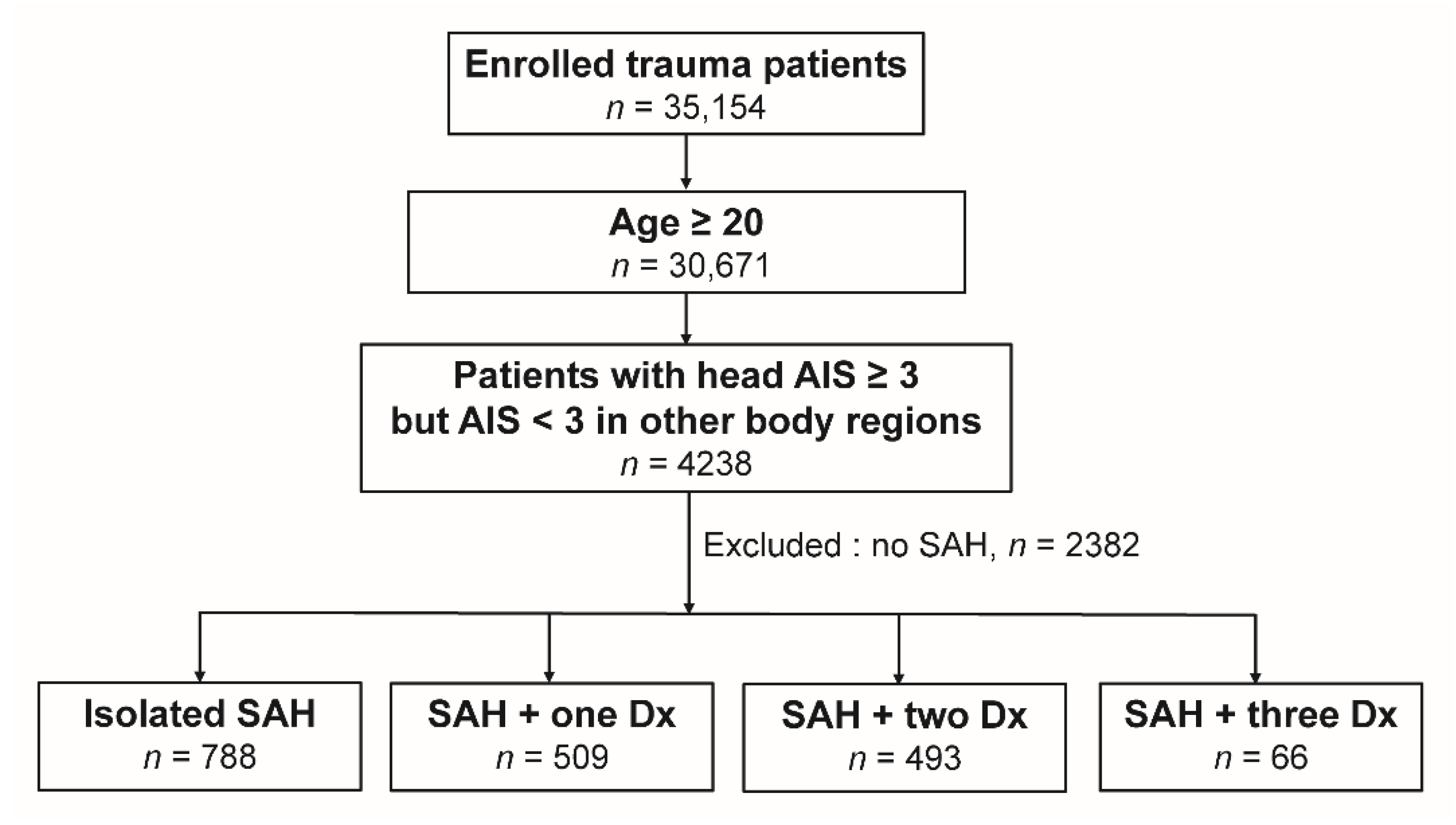
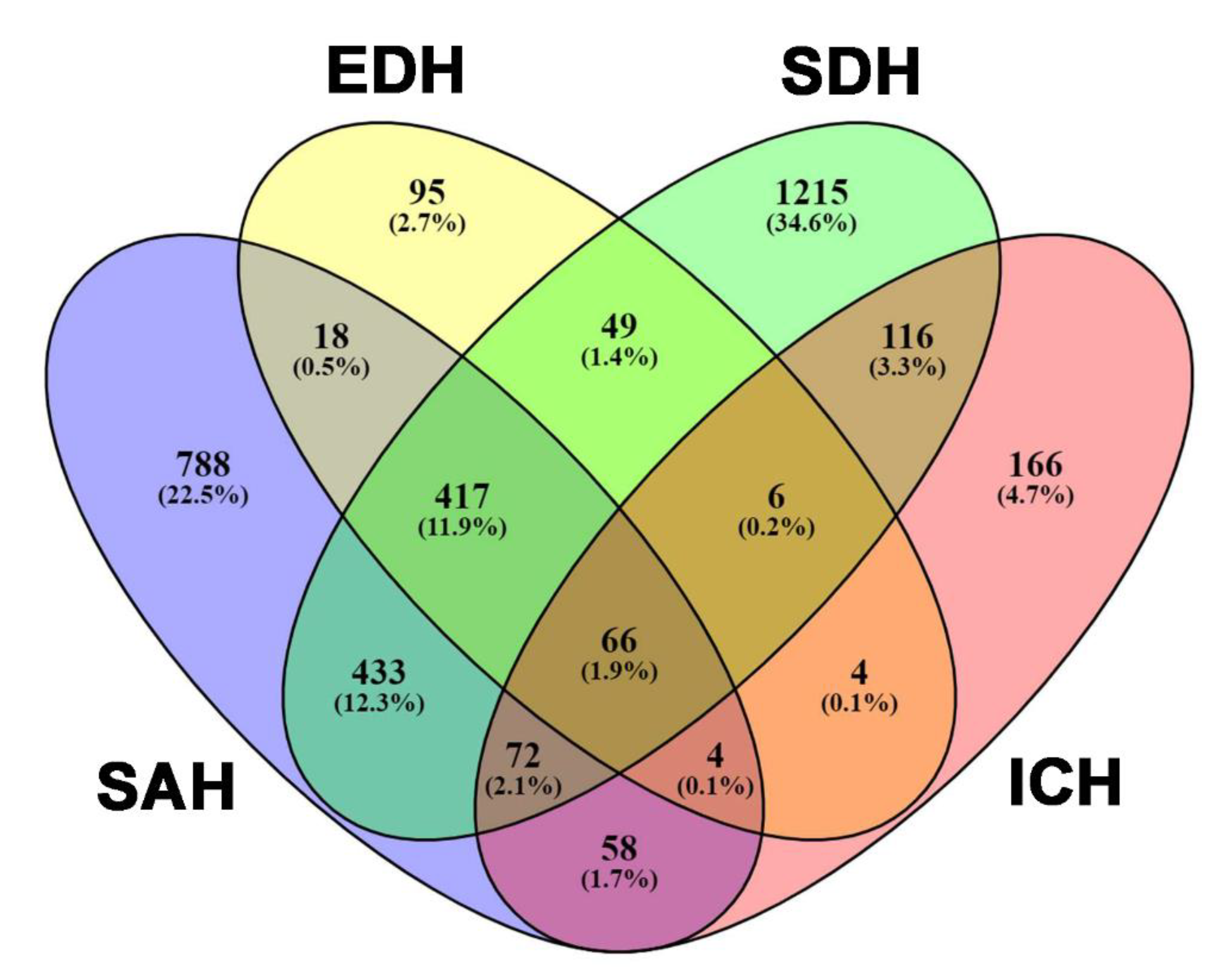

| Variables | Group I (Isolated SAH) n = 788 | Group II (SAH + one Dx) N = 509 | Group III (SAH + two Dx) n = 493 | Group IV (SAH + three Dx) n = 66 | p | ||||
|---|---|---|---|---|---|---|---|---|---|
| Sex, n (%) | <0.001 | ||||||||
| Male | 401 | (50.9) | 318 | (62.5) * | 359 | (72.8) * | 53 | (80.3) * | |
| Female | 387 | (49.1) | 191 | (37.5) * | 134 | (27.2) * | 13 | (19.7) * | |
| Age (years) | 55.4 | ±18.5 | 59.6 | ±18.4 * | 49.0 | ±19.4 * | 52.6 | ±18.9 | <0.001 |
| Comorbidities, n (%) | |||||||||
| HTN | 236 | (29.9) | 182 | (35.8) | 114 | (23.1) * | 12 | (18.2) | <0.001 |
| DM | 130 | (16.5) | 102 | (20.0) | 48 | (9.7) * | 6 | (9.1) | <0.001 |
| CAD | 28 | (3.6) | 30 | (5.9) | 21 | (4.3) | 3 | (4.5) | 0.256 |
| CHF | 10 | (1.3) | 6 | (1.2) | 2 | (0.4) | 0 | (0.0) | 0.356 |
| CVA | 39 | (4.9) | 34 | (6.4) | 16 | (3.2) | 1 | (1.5) | 0.045 |
| ESRD | 8 | (1.0) | 14 | (2.8) | 9 | (1.8) | 0 | (0.0) | 0.076 |
| GCS, median (IQR) | 15 | (14–15) | 14 | (10–15) * | 13 | (7–15) * | 8 | (4–14) * | <0.001 |
| 1–8, n (%) | 77 | (9.9) | 110 | (21.6) * | 149 | (30.2) * | 37 | (56.1) * | <0.001 |
| 9–12 | 74 | (9.4) | 71 | (13.9) | 73 | (14.8) * | 8 | (12.1) | 0.015 |
| ≥13, n (%) | 637 | (80.8) | 328 | (64.4) * | 271 | (55.0) * | 21 | (31.8) * | <0.001 |
| ISS, median (IQR) | 11 | (9–14) | 16 | (16–20) * | 17 | (16–24) * | 21 | (16–25) * | <0.001 |
| <16, n (%) | 595 | (75.5) | 90 | (17.7) * | 66 | (13.4) * | 5 | (7.6) * | <0.001 |
| 16–24, n (%) | 173 | (22.0) | 363 | (71.3) * | 331 | (67.1) * | 37 | (56.1) * | <0.001 |
| ≥25, n (%) | 20 | (2.5) | 56 | (11.0) * | 96 | (19.5) * | 24 | (36.4) * | <0.001 |
| Craniotomy, n (%) | 35 | (4.4) | 88 | (17.3) * | 164 | (33.3) * | 24 | (36.4) * | <0.001 |
| Hospital LOS (days) | 8.6 | ±9.3 | 12.7 | ±13.1 * | 13.7 | ±13.2 * | 15.9 | ±14.3 * | <0.001 |
| Mortality, n (%) | 14 | (1.8) | 40 | (7.9) * | 61 | (12.4) * | 18 | (27.3) * | <0.001 |
| Mortality OR | - | 4.7 | (2.5–8.8) | 7.8 | (4.3–14.1) | 20.7 | (9.7–44.2) | <0.001 | |
| Mortality AOR | - | 4.0 | (2.4–6.5) | 8.9 | (4.8–16.5) | 21.1 | (9.4–47.7) | <0.001 | |
© 2019 by the authors. Licensee MDPI, Basel, Switzerland. This article is an open access article distributed under the terms and conditions of the Creative Commons Attribution (CC BY) license (http://creativecommons.org/licenses/by/4.0/).
Share and Cite
Rau, C.-S.; Wu, S.-C.; Hsu, S.-Y.; Liu, H.-T.; Huang, C.-Y.; Hsieh, T.-M.; Chou, S.-E.; Su, W.-T.; Liu, Y.-W.; Hsieh, C.-H. Concurrent Types of Intracranial Hemorrhage are Associated with a Higher Mortality Rate in Adult Patients with Traumatic Subarachnoid Hemorrhage: A Cross-Sectional Retrospective Study. Int. J. Environ. Res. Public Health 2019, 16, 4787. https://doi.org/10.3390/ijerph16234787
Rau C-S, Wu S-C, Hsu S-Y, Liu H-T, Huang C-Y, Hsieh T-M, Chou S-E, Su W-T, Liu Y-W, Hsieh C-H. Concurrent Types of Intracranial Hemorrhage are Associated with a Higher Mortality Rate in Adult Patients with Traumatic Subarachnoid Hemorrhage: A Cross-Sectional Retrospective Study. International Journal of Environmental Research and Public Health. 2019; 16(23):4787. https://doi.org/10.3390/ijerph16234787
Chicago/Turabian StyleRau, Cheng-Shyuan, Shao-Chun Wu, Shiun-Yuan Hsu, Hang-Tsung Liu, Chun-Ying Huang, Ting-Min Hsieh, Sheng-En Chou, Wei-Ti Su, Yueh-Wei Liu, and Ching-Hua Hsieh. 2019. "Concurrent Types of Intracranial Hemorrhage are Associated with a Higher Mortality Rate in Adult Patients with Traumatic Subarachnoid Hemorrhage: A Cross-Sectional Retrospective Study" International Journal of Environmental Research and Public Health 16, no. 23: 4787. https://doi.org/10.3390/ijerph16234787
APA StyleRau, C.-S., Wu, S.-C., Hsu, S.-Y., Liu, H.-T., Huang, C.-Y., Hsieh, T.-M., Chou, S.-E., Su, W.-T., Liu, Y.-W., & Hsieh, C.-H. (2019). Concurrent Types of Intracranial Hemorrhage are Associated with a Higher Mortality Rate in Adult Patients with Traumatic Subarachnoid Hemorrhage: A Cross-Sectional Retrospective Study. International Journal of Environmental Research and Public Health, 16(23), 4787. https://doi.org/10.3390/ijerph16234787

