Heavy Metals of Santiago Island (Cape Verde) Alluvial Deposits: Baseline Value Maps and Human Health Risk Assessment



Abstract
1. Introduction
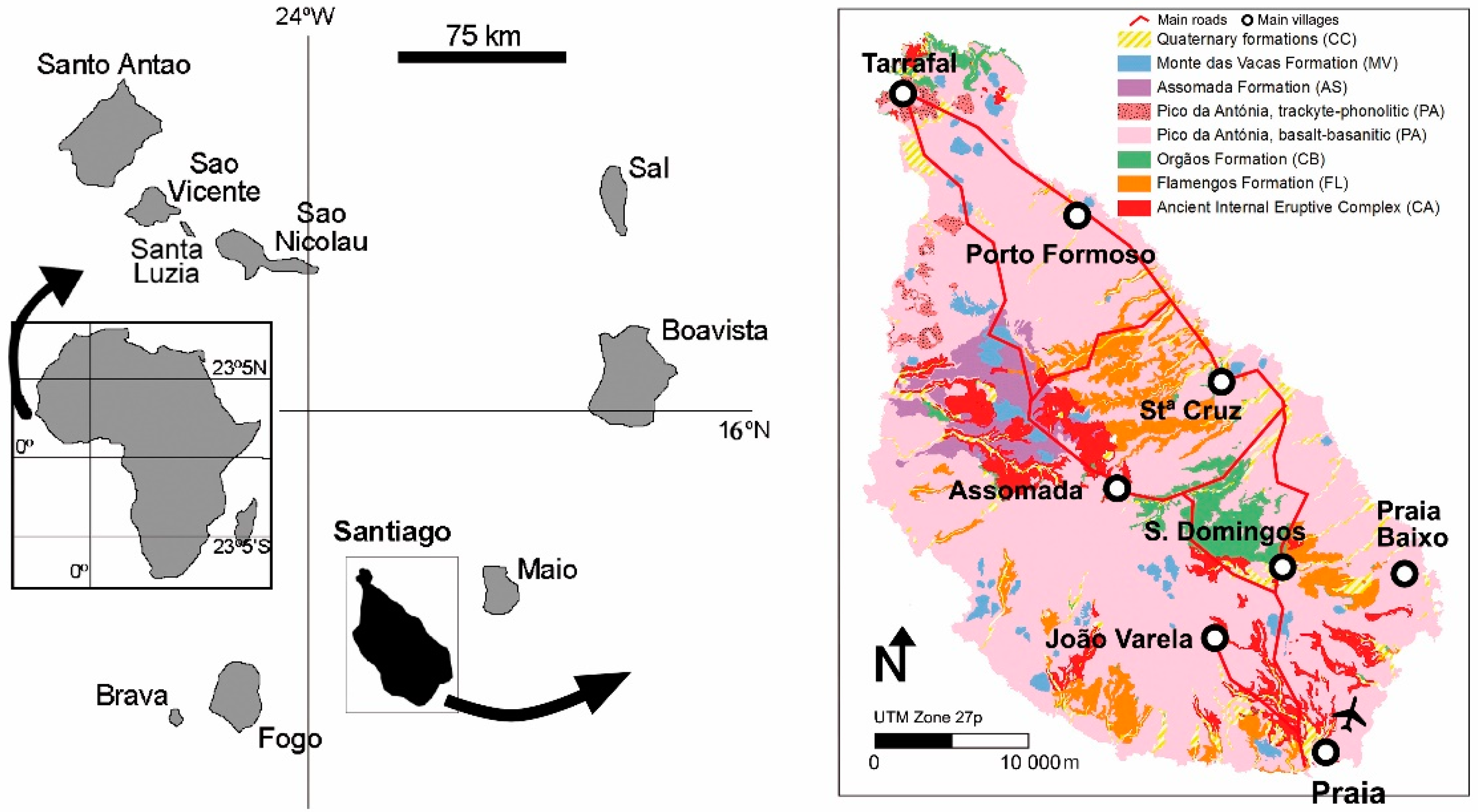
2. Settings of the Archipelago of Cape Verde and Santiago Island
3. Materials and Methods
3.1. Sample Collection, Chemical Analysis
3.2. Analytical Quality Control, Statistical Analysis and Baseline Value
3.3. Risk Assessment
4. Results and Discussion
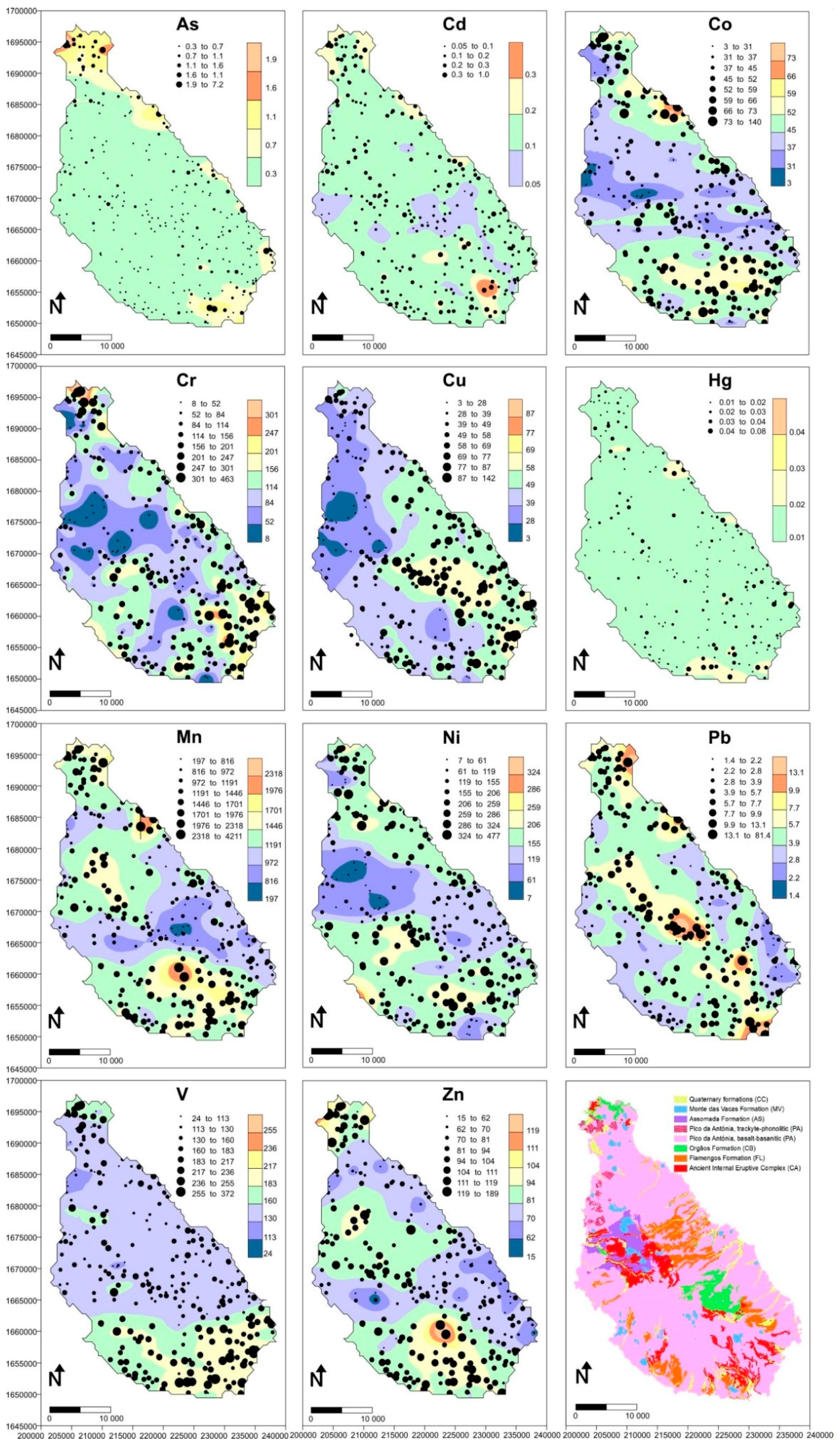
4.1. Baseline Value Maps
4.2. Risk Assessment
5. Conclusions
Supplementary Materials
Author Contributions
Funding
Acknowledgments
Conflicts of Interest
References
- Darnley, A.G.; Björklund, A.; Bølviken, B.; Gustavsson, N.; Koval, P.V.; Plant, J.A.; Steenfelt, A.; Tauchid, M.; Xie, X. A Global Geochemical Database For Environmental and Resource Management. Recommendations for International Geochemical Mapping; Final Report of IGCP Project 259; UNESCO Publishing: Paris, France, 1995. [Google Scholar]
- Plant, J.A.; Smith, D.; Smith, B.; Williams, L. Environmental geochemistry at the global scale. Appl. Geochem. 2001, 16, 1291–1308. [Google Scholar] [CrossRef]
- Araújo, P.R.M.; Biondi, C.M.; da Silva, F.B.V.; Nascimento, C.W.A.; Souza-Júnior, V.S. Geochemical soil anomalies: Assessment of risk to human health and implications for environmental monitoring. J. Geochem. Explor. 2018, 190, 325–335. [Google Scholar] [CrossRef]
- Garret, R.G.; Reimann, C.; Smith, D.B.; Xie, X. From geochemical prospecting to international geochemical mapping: A historical overview. Geochem. Explor. Environ. Anal. 2008, 8, 205–217. [Google Scholar] [CrossRef]
- Albanese, S.; De Vivo, B.; Lima, A.; Cicchella, D. Geochemical background and baseline values of toxic elements in stream sediments of Campania region (Italy). J. Geochem. Explor. 2007, 93, 21–34. [Google Scholar] [CrossRef]
- Smith, D.B.; Reimann, C. Low-density geochemical mapping and the robustness of geochemical patterns. Geochem. Explor. Environ. Anal. 2008, 8, 219–227. [Google Scholar] [CrossRef]
- Cabral Pinto, M.M.S.; Ferreira da Silva, E.A.; Silva, M.M.V.G.; Melo-Gonçalves, P. Heavy metals of Santiago Island (Cape Verde) top soils: Estimated background value maps and environmental risk assessment. J. Afr. Earth Sci. 2015, 101, 162–176. [Google Scholar] [CrossRef]
- Cabral Pinto, M.M.S.; Dinis, P.A.; Silva, M.M.; da Silva, E.A.F. Sediment generation on a volcanic island with arid tropical climate: A perspective based on geochemical maps of topsoils and stream sediments from Santiago Island, Cape Verde. Appl. Geochem. 2016, 75, 114–124. [Google Scholar] [CrossRef]
- Webb, J.S.; Thornton, I.; Thompson, M.; Howarth, R.J.; Lowenstein, P.L. The Wolfson Geochemical Atlas of England and Wales; Clarendon Press: Oxford, UK, 1978. [Google Scholar]
- Bini, C.; Sartori, G.; Wahsha, M.; Fontana, S. Background levels of trace elements and soil geochemistry at regional level in NE Italy. J. Geochem. Explor. 2011, 109, 125–133. [Google Scholar] [CrossRef]
- Redon, P.O.; Bur, T.; Guiresse, M.; Probst, J.L.; Toiser, A.; Revel, J.C.; Jolivet, C.; Probst, A. Modelling trace metal background to evaluate anthropogenic contamination in arable soils of south-western France. Geoderma 2013, 206, 112–122. [Google Scholar] [CrossRef]
- Silva, Y.J.A.B.; Nascimento, C.W.A.; Cantalice, J.R.B.; Silva, Y.J.A.B.; Cruz, C.M.C.A. Watershed-scale assessment of background concentrations and guidance values for heavy metals in soils from a semiarid and coastal zone of Brazil. Environ. Monit. Assess. 2015, 187, 558–568. [Google Scholar] [CrossRef]
- Inácio, M.; Pereira, V.; Pinto, M. The soil geochemical Atlas of Portugal: Overview and applications. J. Geochem. Explor. 2008, 98, 22–33. [Google Scholar] [CrossRef]
- Rékási, M.; Filep, T. Fractions and background concentrations of potentially toxic elements in Hungarian surface soils. Environ. Monit. Assess. 2012, 184, 7461–7471. [Google Scholar] [CrossRef] [PubMed]
- Cohen, D.R.; Rutherford, N.F.; Morisseau, E.; Zissimos, A.M. Geochemical patterns in the soils of Cyprus. Sci. Total Environ. 2012, 420, 250–262. [Google Scholar] [CrossRef] [PubMed]
- Cappuyns, V.; Mallaerts, T. Background values of cobalt in Flemish and European soils. Geol. Belg. 2014, 17, 107–114. [Google Scholar]
- Alfaro, M.R.; Montero, A.; Ugarte, O.M.; Nascimento, C.W.A.; Accioly, A.M.A.; Biondi, C.M.; Silva, Y.J.A.B. Background concentrations and reference values for heavy metals in soils of Cuba. Environ. Monit. Assess. 2015. [Google Scholar] [CrossRef] [PubMed]
- Reimann, C.; Siewers, U.; Tarvainen, T.; Bityukova, L.; Eriksson, J.; Gilucis, A.; Gregorauskiene, V.; Lukashev, V.; Matinian, N.; Pasieczna, A. Baltic soil survey: Total concentrations of major and selected trace elements in arable soils from 10 countries around the Baltic Sea. Sci. Total Environ. 2000, 257, 155–170. [Google Scholar] [CrossRef]
- Smith, D.B.; Cannon, W.F.; Woodruff, L.G.; Moreira Rivera, F.; Rencz, A.N.; Garrett, R.G. History and progress of the North American Soil Geochemical Landscapes Project, 2001–2010. Earth Sci. Front. 2012, 19, 19–32. [Google Scholar]
- Lado, L.R.; Hengl, T.; Reuter, H.I. Heavy metals in European soils: A geostatistical analysis of the FOREGS Geochemical database. Geoderma 2008, 148, 189–199. [Google Scholar] [CrossRef]
- Caritat, P.; Cooper, M. A continental-scale geochemical atlas for resource exploration and environmental management: The National Geochemical Survey of Australia. Geochem. Explor. Environ. Anal. 2016, 16, 3–13. [Google Scholar] [CrossRef]
- Thornton, I. Environmental geochemistry: 40 years research at Imperial College, London, UK. Appl. Geochem. 2012, 27, 939–953. [Google Scholar] [CrossRef]
- Cabral Pinto, M.M.S.; Silva, M.M.; da Silva, E.A.F.; Dinis, P.A.; Rocha, F. Transfer processes of potentially toxic elements (PTE) from rocks to soils and the origin of PTE in soils: A case study on the island of Santiago (Cape Verde). J. Geochem. Explor. 2017, 183, 140–151. [Google Scholar] [CrossRef]
- Cabral Pinto, M.M.S.; Marinho-Reis, A.P.; Almeida, A.; Ordens, C.M.; Silva, M.M.; Freitas, S.; Ferreira da Silva, E.A.F. Human predisposition to cognitive impairment and its relation with environmental exposure to potentially toxic elements. Environ. Geochem. Health 2017, 1–18. [Google Scholar] [CrossRef] [PubMed]
- Reuben, A.; Caspi, A.; Belsky, D.W.; Broadbent, J.; Harrington, H.; Sugden, K.; Houts, R.M.; Ramrakha, S.; Poulton, R.; Moffitt, T.E. Association of childhood blood lead levels with cognitive function and socioeconomic status at age 38 years and with IQ change and socioeconomic mobility between childhood and adulthood. JAMA 2017, 317, 1244–1251. [Google Scholar] [CrossRef] [PubMed]
- Yao, Y.; Pei, F.; Kang, P. Selenium, iodine, and the relation with Kashin-Beck disease. Nutrition 2011, 27, 1095–1100. [Google Scholar] [CrossRef]
- Selinus, O.; Alloway, B.J. Essentials of Medical Geology; Centeno, J.A., Finkelman, R.B., Fuge, R., Lindh, U., Smedley, P., Eds.; Springer: New York, NY, USA, 2013; p. 820. [Google Scholar]
- Cabral Pinto, M.M.S.; Marinho-Reis, A.P.; Almeida, A.; Freitas, S.; Simões, M.R.; Diniz, M.L.; Moreira, P.I.; da Silva, F. Fingernail Trace Element Content in Environmentally Exposed Individuals and Its Influence on Their Cognitive Status in Ageing. Expor. Health 2018, 1–14. [Google Scholar] [CrossRef]
- Obeng-Gyasi, E. Lead Exposure and Oxidative Stress—A Life Course Approach in US Adults. Toxics 2018, 6, 42. [Google Scholar] [CrossRef]
- Phan, K.; Sthiannopkao, S.; Kim, K.W.; Wong, M.H.; Sao, V.; Hashim, J.H.; Aljunid, S.M. Health risk assessment of inorganic arsenic intake of Cambodia residents through groundwater drinking pathway. Water Res. 2010, 44, 5777–5788. [Google Scholar] [CrossRef]
- Wongsasuluk, P.; Chotpantarat, S.; Siriwong, W.; Robson, M. Heavy metal contamination and human health risk assessment in drinking water from shallow groundwater wells in an agricultural area in Ubon Ratchathani province, Thailand. Environ. Geochem. Health 2014, 36, 169–182. [Google Scholar] [CrossRef]
- Kavcar, P.; Sofuoglu, A.; Sofuoglu, S.C. A health risk assessment for exposure to trace metals via drinking water ingestion pathway. Int. J. Hyg. Environ. Health 2009, 212, 216–227. [Google Scholar] [CrossRef]
- Nieuwenhuijsen, M.J. (Ed.) Exposure Assessment in Environmental Epidemiology; Oxford University Press: Evans Road Cary, NC, USA, 2015. [Google Scholar]
- Kozlowski, H.; JanickaKlosb, A.; Brasunb, J.; Gaggelli, E.; Valensinc, D.; Valensinc, J. Copper, iron, and zinc ions homeostasis and their role in neurodegenerative disorders (metal uptake, transport, distribution and regulation). Coord. Chem. Rev. 2009, 253, 2665–2685. [Google Scholar] [CrossRef]
- Needleman, H.L.; Schell, A.; Bellinger, D.; Leviton, A.; Allred, E.N. The long-term effects of exposure to low doses of lead in childhood: An 11-year follow-up report. N. Engl. J. Med. 1990, 322, 83–88. [Google Scholar] [CrossRef] [PubMed]
- Liu, Q.R.; Walther, D.; Drgon, T.; Polesskaya, O.; Lesnick, T.G.; Strain, K.J.; de Andrade, M.; Bower, J.H.; Maraganore, D.M.; Uhl, G.R. Human brain derived neurotrophic factor (BDNF) genes, splicing patterns, and assessments of associations with substance abuse and Parkinson’s Disease. Am. J. Med. Genet. Part B Neuropsychiatr. Genet. 2005, 134, 93–103. [Google Scholar] [CrossRef] [PubMed]
- Gorell, J.M.; Johnson, C.C.; Rybicki, B.A.; Peterson, E.L.; Kortsha, G.X.; Kortsha, G.G.; Richardson, R.J. Occupational exposure to manganese, copper, lead, iron, mercury and zinc and the risk of Parkinson’s disease. Neurotoxicology 1999, 20, 239–248. [Google Scholar] [PubMed]
- Heindel, J.J.; Newbold, R.R.; Bucher, J.R.; Camacho, L.; Delclos, K.B.; Lewis, S.M.; Vanlandingham, M.; Churchwell, M.I.; Twaddle, N.C.; McLellen, M.; et al. NIEHS/FDA CLARITY-BPA research program update. Reprod. Toxicol. 2015, 58, 33–44. [Google Scholar] [CrossRef]
- Tartaglione, A.M.; Venerosi, A.; Calamandrei, G. Early-life toxic insults and onset of sporadic neurodegenerative diseases—An overview of experimental studies. Available online: https://link.springer.com/bookseries/7854 (accessed on 15 November 2018).
- Komatina, M.M. Medical Geology—Effects of Geological Environments on Human Health; Elsevier: New York, NY, USA, 2004. [Google Scholar]
- Rasheed, T.; Bilal, M.; Nabeel, F.; Iqbal, H.M.; Li, C.; Zhou, Y. Fluorescent sensor based models for the detection of environmentally-related toxic heavy metals. Sci. Total Environ. 2018, 615, 476–485. [Google Scholar] [CrossRef] [PubMed]
- Bilal, M.; Rasheed, T.; Sosa-Hernández, J.; Raza, A.; Nabeel, F.; Iqbal, H. Biosorption: An interplay between marine algae and potentially toxic elements—A review. Mar. Drugs 2018, 16, 65. [Google Scholar] [CrossRef] [PubMed]
- Hernandez-Vargas, G.; Sosa-Hernández, J.; Saldarriaga-Hernandez, S.; Villalba-Rodríguez, A.; Parra-Saldivar, R.; Iqbal, H. Electrochemical biosensors: A solution to pollution detection with reference to environmental contaminants. Biosensor 2018, 8, 29. [Google Scholar] [CrossRef]
- Rasheed, T.; Li, C.; Bilal, M.; Yu, C.; Iqbal, H.M. Potentially toxic elements and environmentally-related pollutants recognition using colorimetric and ratiometric fluorescent probes. Sci. Total Environ. 2018, 640, 174–193. [Google Scholar] [CrossRef] [PubMed]
- Rasheed, T.; Li, C.; Zhang, Y.; Nabeel, F.; Peng, J.; Qi, J.; Gong, L.; Yu, C. Rhodamine-based multianalyte colorimetric probe with potentialities as on-site assay kit and in biological systems. Sens. Actuators B Chem. 2018, 258, 115–124. [Google Scholar] [CrossRef]
- Pérez, J.A.C.; Sosa-Hernández, J.E.; Hussain, S.M.; Bilal, M.; Parra-Saldivar, R.; Iqbal, H.M. Bioinspired Biomaterials and Enzyme-Based Biosensors for Point-of-Care Applications with Reference to Cancer and Bio-Imaging. Biocatal. Agric. Biotechnol. 2018. [Google Scholar] [CrossRef]
- Rasheed, T.; Li, C.; Fu, L.; Nabeel, F.; Yu, C.; Gong, L.; Zhou, Y. Development and characterization of newly engineered chemosensor with intracellular monitoring potentialities and lowest detection of toxic elements. J. Mol. Liq. 2018, 272, 440–449. [Google Scholar] [CrossRef]
- Koller, M.; Saleh, H.M. Introductory Chapter: Introducing Heavy Metals. In Heavy Metals; IntechOpen: Rijeka, Croatia, 2018. [Google Scholar]
- Matos Alves, C.A.; Macedo, J.R.; Celestino Silva, L.; Serralheiro, A.; Peixoto Faria, A.F. Estudo geológico, petrológico e vulcanológico da ilha de Santiago (Cabo Verde). Garcia De Orta Serviços Geológicos 1979, 3, 47–74. (In Portuguese) [Google Scholar]
- Instituto Nacional de Meteorologia e Geofisica (INMG). Climatologic Data of Some Stations in Santiago Island, Praia, Cabo Verde; Internal Report; INMG: Praia, Santiago Island, Cabo Verde, 2005. [Google Scholar]
- United Nations Development Program for Cape Verde; PNUD: New York, NY, USA, 1993.
- Martins, S.; Mata, J.; Munhá, J.; Madeira, J.; Moreira, M. Evidências geológicas e geoquímicas para a existência de duas unidades estratigráficas distintas na Formação do Pico da Antónia (Ilha de Santiago, República de Cabo Verde). Memórias E Notícias Universidade De Coimbra 2008, 3, 123–128. (In Portuguese) [Google Scholar]
- Holm, P.; Grandvuinet, T.; Friis, J.; Wilson, J.R.; Barker, A.K.; Plesner, S. Na 40Ar–39Ar study of the Cape Verde hot spot: Temporal evolution in a semistationary plate environment. J. Geophys. Res. Solid Earth 2008, 113, B08201. [Google Scholar] [CrossRef]
- Ramalho, R.; Helffrich, G.; Cosca, M.; Vance, D.; Hoffmann, D.; Schmidt, D.N. Vertical movements of ocean island volcanoes: Insights from a stationary plate. Mar. Geol. 2010, 275, 84–95. [Google Scholar] [CrossRef]
- Ramalho, R.; Helffrich, G.; Schmidt, D.; Vance, D. Tracers of uplift and subsidence in the Cape Verde Archipelago. J. Geol. Soc. 2010, 167, 519–538. [Google Scholar] [CrossRef]
- Tukey, J.W. Exploratory Data Analysis; Addison-Wesley: Reading, UK, 1977. [Google Scholar]
- Minister of the Environment (Canada). Soil, Ground Water and Sediment Standards for Use under Part XV.1 of the Environmental Protection Act. Available online: http://www.mah.gov.on.ca/ AssetFactory.aspx?did=8993 (accessed on 15 October 2018).
- Ministry of Housing, Spatial Planning and the Environment (VROM). Circular on Target Values and Intervention Values for Soil Remediation. The Netherlands Government Gazette, No. 39, Ministry of Housing, Spatial Planning and Environment, Directorate General for Environmental Protection, Department of Soil Protection. Available online: http://www.esdat.net/Environmental%20Standards/ Dutch/annexS_I2000Dutch%20Environmental%20Standards.pdf (accessed on 16 October 2018).
- USEPA (United States Environmental Protection Agency). Guidelines for Exposure Assessment, Risk Assessment Forum; [EPA/600/Z-92/001]; United States Environmental Protection Agency: Washington, DC, USA, 1992.
- USEPA (United States Environmental Protection Agency). Exposure Factors Handbook 2011 Edition (Final); United States Environmental Protection Agency: Washington, DC, USA, 2011. Available online: http://cfpub.epa.gov/ncea/risk/recordisplay.cfm?deid=236252 (accessed on 18 September 2018).
- USEPA (United States Environmental Protection Agency). Calculating Upper Confidence Limits for Exposure Point Concentrations at Hazardous Waste Sites; Publication 9285.6-10; Office of Emergency and Remedial Response: Washington, DC, USA, December 2002.
- USEPA (United States Environmental Protection Agency). Risk Assessment Guidance for Superfund: Volume III—Part A, Process for Conducting Probabilistic Risk Assessment; EPA 540-R-02-002; United States Environmental Protection Agency: Washington, DC, USA, 2001. Available online: https://www.epa.gov/sites/production/files/2015-09/documents/rags3adt_complete.pdf (accessed on 4 September 2018).
- USDE (U.S. Department of Energy). The Risk Assessment Information System (RAIS); U.S. Department of Energy’s Oak Ridge Operations Office: Oak Ridge, TN, USA, 2013. Available online: https://rais.ornl.gov/ (accessed on 4 September 2018).
- Cabral Pinto, M.M.S.; Ferreira da Silva, E.A.; Silva, M.M.V.G.; Melo-Gonçalves, P.; Candeias, C. Environmental risk assessment based on high-resolution spatial maps of potential toxic elements sampled on stream sediments of Santiago, Cape Verde. Geosciences 2014, 4, 297–315. [Google Scholar] [CrossRef]
- Rudnick, R.L.; Gao, S. Composition of the Continental Crust. Treatise Geochem. 2003, 3, 659. [Google Scholar]
- Chin-Chan, M.; Navarro-Yepes, J.; Quintanilla-Vega, B. Environmental pollutants as risk factors for neurodegenerative disorders: Alzheimer and Parkinson diseases. Front. Cell. Neurosci. 2015, 9, 124. [Google Scholar] [CrossRef] [PubMed]
- IARC (International Agency for Research on Cancer). Chromium, Nickel and Welding. In Monographs on the Evaluation of Carcinogenic Risks to Humans; IARC: Lyon, France, 1990; Volume 49. [Google Scholar]
- Sun, Y.; Zhou, Q.; Xie, X.; Liu, R. Spatial, sources and risk assessment of heavy metal contamination of urban soils in typical regions of Shenyang, China. J. Hazard. Mater. 2010, 174, 455–462. [Google Scholar] [CrossRef]
- Xie, Y.; Chen, T.B.; Lei, M.; Yang, J.; Guo, Q.J.; Song, B. Spatial distribution of soil heavy metal pollution estimated by different interpolation methods: Accuracy and uncertainty analysis. Chemosphere 2011, 82, 468–476. [Google Scholar] [CrossRef] [PubMed]
- Türkdoğan, M.K.; Kilicel, F.; Kara, K.; Tuncer, I.; Uygan, I. Heavy metals in soil, vegetables and fruits in the endemic upper gastrointestinal cancer region of Turkey. Environ. Toxicol. Pharmacol. 2003, 13, 175–179. [Google Scholar] [CrossRef]
- Pellegriti, G.; De Vathaire, F.; Scollo, C.; Attard, M.; Giordano, C.; Arena, S.; Dardanoni, G.; Frasca, F.; Malandrino, P.; Vermiglio, F.; et al. Papillary thyroid cancer incidence in the volcanic area of Sicily. J. Natl. Cancer Inst. 2009, 101, 1575–1583. [Google Scholar] [CrossRef] [PubMed]
- Duntas, L.H.; Doumas, C. The ‘rings of fire’and thyroid cancer. Hormones 2009, 8, 249–253. [Google Scholar] [CrossRef] [PubMed]
- Malandrino, P.; Scollo, C.; Marturano, I.; Russo, M.; Tavarelli, M.; Attard, M.; Richiusa, P.; Violi, M.A.; Dardanoni, G.; Vigneri, R.; et al. Descriptive epidemiology of human thyroid cancer: Experience from a regional registry and the “volcanic factor”. Front. Endocrinol. 2013, 4, 65. [Google Scholar] [CrossRef] [PubMed]
- Simonart, T. Role of environmental factors in the pathogenesis of classic and African-endemic Kaposi sarcoma. Cancer Lett. 2006, 244, 1–7. [Google Scholar] [CrossRef] [PubMed]
- Hueper, W.C.; Payne, W.W. Experimental cancers in rats produced by chromium compounds and their significance to industry and public health. Am. Ind. Hyg. Assoc. J. 1959, 20, 274–280. [Google Scholar] [CrossRef] [PubMed]
- Keane, W.M.; Atkins, J.P., Jr.; Wetmore, R.; Vidas, M. Epidemiology of head and neck cancer. Laryngoscope 1981, 91, 2037–2045. [Google Scholar] [CrossRef] [PubMed]
- Hassanin, K.M.; El-Kawi, S.H.A.; Hashem, K.S. The prospective protective effect of selenium nanoparticles against chromium-induced oxidative and cellular damage in rat thyroid. Int. J. Nanomed. 2013, 8, 1713. [Google Scholar]
- Khlifi, R.; Olmedo, P.; Gil, F.; Hammami, B.; Chakroun, A.; Rebai, A.; Hamza-Chaffai, A. Arsenic, cadmium, chromium and nickel in cancerous and healthy tissues from patients with head and neck cancer. Sci. Total Environ. 2013, 452, 58–67. [Google Scholar] [CrossRef]
- Kasim Baltaci, A.; Belviranli, M. Serum levels of calcium, selenium, magnesium, phosphorus, chromium, copper and iron—Their relation to zinc in rats with induced hypothyroidism. Acta Clin. Croat. 2013, 52, 151–156. [Google Scholar]


| Geological Formation | Outcrop | Rock Type | Composition | Primary Minerals |
|---|---|---|---|---|
| CA—Ancient internal eruptive complex | Centre, centre-W and in stream valleys | Subaerial and submarine lava flows and pyroclastic deposits; dykes and intrusive rocks | Basalts-basanites, phonolites-trachytes and carbonatites | Feldspar pyroxene carbonates, olivine, phyllosilicates |
| FL—Flamengos formation | NE-flank of the island | Submarine lava flows with subordinated breccias and tuffs | Basanites | Pyroxene, Fe-Ti oxides, olivine, feldspar |
| CB—Orgãos formation | Centre-E | Volcano-sedimentary deposits; rare lava flowss | Diverse | Pyroxene, Fe-Ti oxides, carbonates, feldspar |
| PA—Pico da Antónia eruptive complex | Widespread in the island | Subaerial and submarine lava flows, dykes and pyroclastic material; intercalated sedimentary deposits | Basalts-basanites, phonolites-trachytes and conglomerates | Pyroxene, Fe-Ti oxides, feldspar olivine |
| AS—Assomada formation | Centre-W | Subaerial lava flows and some pyroclasts | Basanites | Pyroxene, Fe-Ti oxides, feldspar, olivine |
| MV—Monte das Vacas formation | 50 cinder cones throughout the island | Subaerial pyroclasts and small subordinated lava flows | Basanites | Pyroxene, Fe-Ti oxides, feldspar, olivine |
| CC—recent sedimentary formations | Mostly in stream valleys | Alluvial, aeolian and marine deposits | Diverse | Pyroxene, Fe-Ti oxides, carbonates, feldspar |
| Variable | Median | Mean | SD | CV | Range | P5–P95 | Tukey Range | BV-S |
|---|---|---|---|---|---|---|---|---|
| As | 0.3 | 0.6 | 0.6 | 1.07 | 0.3–7.2 | 0.3–1.6 | 0.3–1.4 | 0.25 |
| Cd | 0.10 | 0.14 | 0.09 | 0.64 | 0.05–1.00 | 0.05–0.30 | 0.05–0.35 | 0.10 |
| Co | 44.7 | 45.1 | 13.9 | 0.31 | 3.1–140 | 26.4–66.1 | 15.8–73.4 | 44.65 |
| Cr | 114.0 | 124 | 68 | 0.55 | 8.0–463 | 20.0–251.5 | 8.0–264.0 | 114 |
| Cu | 48.8 | 48.6 | 18 | 0.37 | 3.2–142 | 17.6–77.8 | 9.4–87.6 | 48.7 |
| Hg | 0.01 | 0.01 | 0.01 | 0.74 | 0.01–0.08 | 0.01–0.03 | 0.01–0.04 | 0.01 |
| Mn | 1191 | 1260 | 442 | 0.35 | 197–4210 | 737–1976 | 255–2162 | 1182 |
| Ni | 155 | 161 | 76 | 0.47 | 6.8–477 | 21.3–286 | 6.8–338 | 154 |
| Pb | 3.9 | 5.2 | 6.6 | 1.26 | 1.4–81.4 | 2.0–10.1 | 1.4–10.1 | 3.80 |
| V | 160 | 161 | 45.7 | 0.28 | 24.0–372 | 92.4–236 | 50.5–263 | 159 |
| Zn | 81.0 | 82.7 | 19.1 | 0.23 | 15.0–199 | 57.0–189 | 34.0–130 | 81 |
| Element | BV-S | Canadian Guidelines | Dutch Guidelines | ||
|---|---|---|---|---|---|
| Soil Agricultural Property Uses | Soil Residential Property Uses | Sediments (All Types of Property Uses | Target Values | ||
| As | 0.25 | 11 | 18 | 6 | 29 |
| Cd | 0.1 | 1 | 1.2 | 0.6 | 0.8 |
| Co | 44.7 | 19 | 21 | 50 | 9 |
| Cr | 114 | 67 | 70 | 26 | 100 |
| Cu | 48.7 | 62 | 92 | 16 | 36 |
| Hg | 0.01 | 0.3 | 0.2 | 0.2 | 0.3 |
| Mn | 1182 | - | - | - | - |
| Ni | 154 | 37 | 82 | 16 | 36 |
| Pb | 3.8 | 45 | 129 | 31 | 85 |
| V | 159 | 86 | 86 | 90 | - |
| Zn | 81 | 290 | 290 | 120 | 140 |
| Element | HQ Ingestion | HQ Dermal | HQ Inhalation | HI | ||||
|---|---|---|---|---|---|---|---|---|
| Children | Adult | Children | Adult | Children | Adult | Children | Adult | |
| Co | 2.9 × 100 | 3.1 × 10⁻¹ | 8.2 × 10⁻³ | 1.2 × 10⁻³ | 4.1 × 10⁻³ | 2.3 × 10⁻³ | 2.9 | 0.3 |
| Cr | 1.1 × 100 | 1.2 × 10⁻¹ | 3.1 × 10⁻³ | 4.7 × 10⁻⁴ | 9.2 × 10⁻⁴ | 5.2 × 10⁻⁴ | 1.1 | 0.1 |
| V | 1.9 × 10⁻¹ | 2.0 × 10⁻² | 5.3 × 10⁻⁴ | 8.1 × 10⁻⁵ | 1.2 × 10⁻³ | 6.7 × 10⁻⁴ | 0.2 | 0.0 |
| Ni | 2.6 × 10⁻² | 2.7 × 10⁻³ | 7.2 × 10⁻⁵ | 1.1 × 10⁻⁵ | 7.2 × 10⁻⁷ | 4.0 × 10⁻⁷ | 0.0 | 0.0 |
| Cu | 6.2 × 10⁻¹ | 6.7 × 10⁻² | 1.7 × 10⁻³ | 2.7 × 10⁻⁴ | 8.8 × 10⁻⁴ | 5.0 × 10⁻⁴ | 0.6 | 0.1 |
| Zn | 8.4 × 10⁻³ | 9.0 × 10⁻⁴ | 2.3 × 10⁻⁵ | 3.6 × 10⁻⁶ | 2.3 × 10⁻⁷ | 1.3 × 10⁻⁷ | 0.0 | 0.0 |
| Cd | 4.0 × 10⁻³ | 4.3 × 10⁻⁴ | 4.5 × 10⁻⁴ | 6.8 × 10⁻⁵ | 1.1 × 10⁻⁵ | 6.3 × 10⁻⁶ | 0.0 | 0.0 |
| Mn | 1.1 × 100 | 1.2 × 10⁻¹ | 3.1 × 10⁻³ | 4.7 × 10⁻⁴ | 1.5 × 10⁻² | 8.3 × 10⁻³ | 1.1 | 0.1 |
| Element | Cancer risk | |
|---|---|---|
| Children | Adult | |
| Cr | 3.2 × 10⁻⁷ | 1.1 × 10⁻⁶ |
| Ni | 7.7 × 10⁻⁹ | 2.5 × 10⁻⁸ |
| Cd | 5.8 × 10⁻¹¹ | 1.9 × 10⁻¹⁰ |
© 2018 by the authors. Licensee MDPI, Basel, Switzerland. This article is an open access article distributed under the terms and conditions of the Creative Commons Attribution (CC BY) license (http://creativecommons.org/licenses/by/4.0/).
Share and Cite
Cabral Pinto, M.M.S.; Ferreira da Silva, E.A. Heavy Metals of Santiago Island (Cape Verde) Alluvial Deposits: Baseline Value Maps and Human Health Risk Assessment. Int. J. Environ. Res. Public Health 2019, 16, 2. https://doi.org/10.3390/ijerph16010002
Cabral Pinto MMS, Ferreira da Silva EA. Heavy Metals of Santiago Island (Cape Verde) Alluvial Deposits: Baseline Value Maps and Human Health Risk Assessment. International Journal of Environmental Research and Public Health. 2019; 16(1):2. https://doi.org/10.3390/ijerph16010002
Chicago/Turabian StyleCabral Pinto, Marina M. S., and Eduardo A. Ferreira da Silva. 2019. "Heavy Metals of Santiago Island (Cape Verde) Alluvial Deposits: Baseline Value Maps and Human Health Risk Assessment" International Journal of Environmental Research and Public Health 16, no. 1: 2. https://doi.org/10.3390/ijerph16010002
APA StyleCabral Pinto, M. M. S., & Ferreira da Silva, E. A. (2019). Heavy Metals of Santiago Island (Cape Verde) Alluvial Deposits: Baseline Value Maps and Human Health Risk Assessment. International Journal of Environmental Research and Public Health, 16(1), 2. https://doi.org/10.3390/ijerph16010002