Bacterioneuston in Lake Baikal: Abundance, Spatial and Temporal Distribution

 , , ,
, , ,
Abstract
1. Introduction
2. Materials and Methods
3. Results
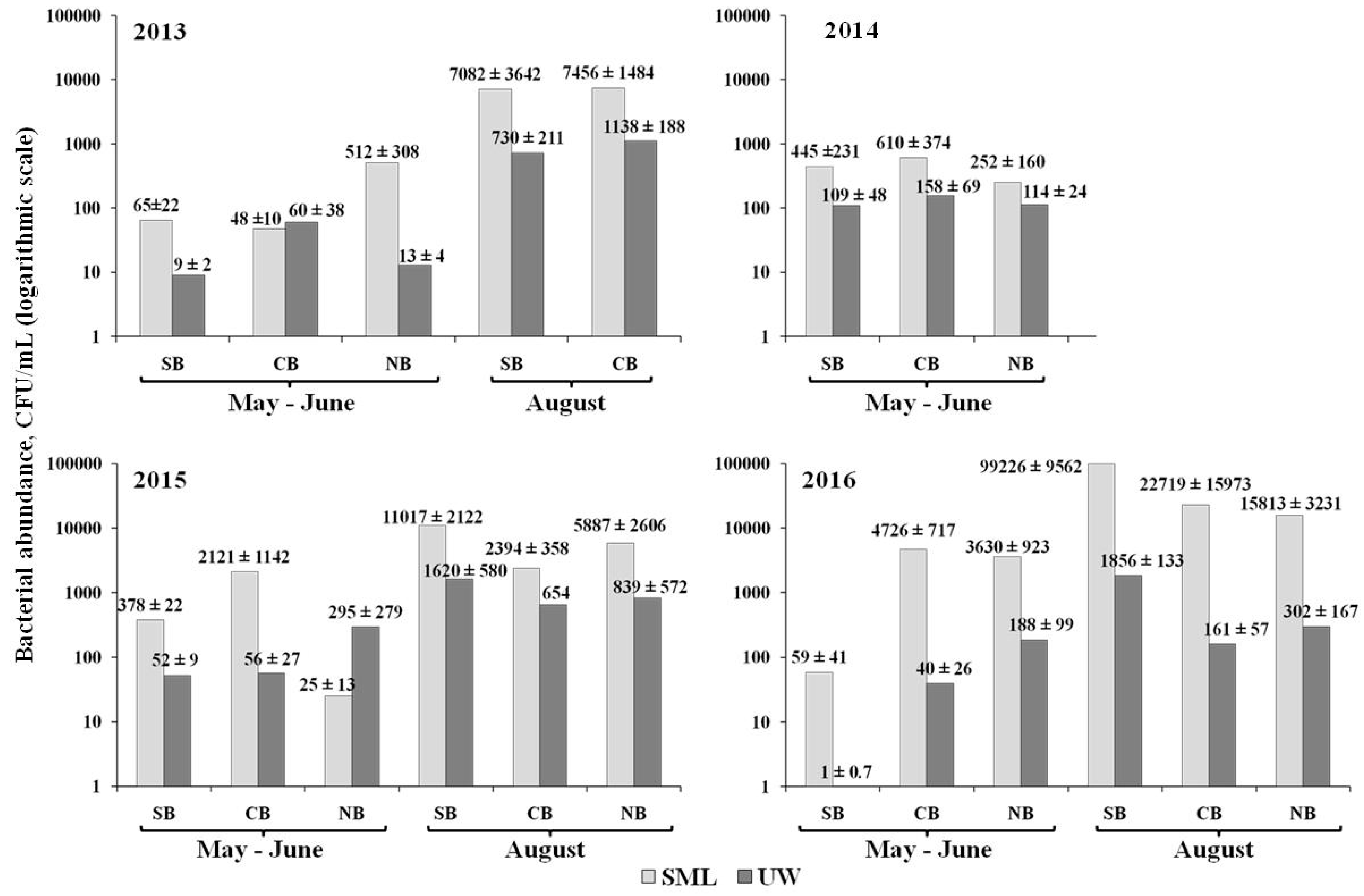
3.1. Abundance and Spatial Distribution of Bacteria in SML and UW of Lake Baikal
3.2. Influence of Physical Factors on the Number of Bacteria in SML of Lake Baikal
3.2.1. Wind
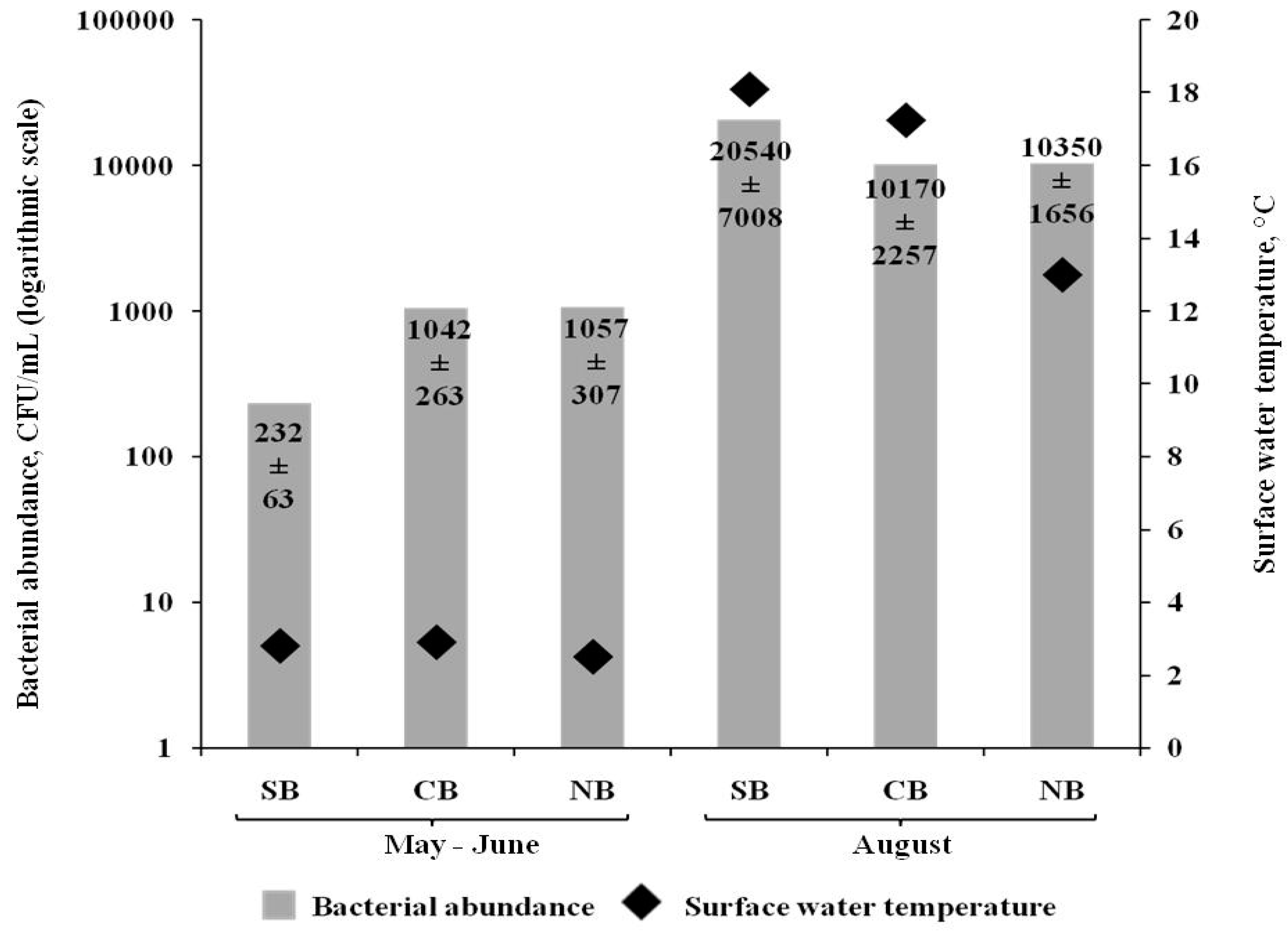
3.2.2. Temperature
3.3. Chemical Composition of the SML in Lake Baikal
4. Discussion
5. Conclusions
Supplementary Materials
Author Contributions
Funding
Conflicts of Interest
References
- Zhang, Z.; Liu, C.; Liu, L. Physicochemical Studies of the Sea-Surface Microlayer. Front. Chem. China 2006, 1, 1–14. [Google Scholar] [CrossRef] [Scilit]
- Cunliffe, M.; Upstill-Goddard, R.; Murrell, C. Microbiology of aquatic surface microlayers. FEMS Microbiol. Rev. 2011, 35, 233–246. [Google Scholar] [CrossRef] [Scilit] [PubMed]
- Coelho, C.; Heim, B.; Foerster, S.; Brosinsky, A.; De Araújo, J.C. In situ and satellite observation of CDOM and Chlorophyll-a dynamics in small water surface reservoirs in the Brazilian semiarid region. Water 2017, 9, 913. [Google Scholar] [CrossRef] [Scilit]
- Kuznetsova, M.; Lee, C. Enhanced extracellular enzymatic peptide hydrolysis in the seasurface microlayer. Mar. Chem. 2001, 73, 319–332. [Google Scholar] [CrossRef] [Scilit]
- Cunliffe, M.; Whiteley, A.S.; Newbold, L.; Oliver, A.; Schäfer, H.; Murrell, J.C. Comparison of bacterioneuston and bacterioplankton dynamics during a phytoplankton bloom in a fjord mesocosm. Appl. Environ. Microbiol. 2009, 75, 7173–7181. [Google Scholar] [CrossRef] [Scilit] [PubMed]
- Porter, K.G.; Feig, Y.S. The use of DAPI for identifying and counting aquatic microflora. Limnol. Oceanogr. 1980, 25, 943–948. [Google Scholar] [CrossRef] [Scilit]
- Kuznetsova, M.; Lee, C.; Aller, J.; Frew, N.M. Enrichment of amino acids in the sea-surface microlayers at coastal and open ocean sites in the North Atlantic Ocean. Limnol. Oceanogr. 2004, 49, 1605–1619. [Google Scholar] [CrossRef] [Scilit]
- Aller, J.Y.; Kuznetsova, M.R.; Jahns, C.J.; Kemp, P.F. The sea surface microlayer as a source of viral and bacterial enrichment in marine aerosols. J Aerosol Sci. 2005, 36, 801–812. [Google Scholar] [CrossRef] [Scilit]
- Santos, L.; Santos, A.L.; Coelho, F.J.R.C.; Gomes, N.C.M.; Dias, J.M.; Cunha, A.; Almeida, A. Relation between bacterial activity in the surface microlayer and estuarine hydrodynamics. FEMS Microbiol. Ecol. 2011, 77, 636–646. [Google Scholar] [CrossRef] [Scilit] [PubMed]
- Santos, A.L.; Baptista, I.; Gomes, N.C.M.; Henriques, I.; Almeida, A.; Correia, A.; Cunha, A. Contribution of chemical water properties to the differential responses of bacterioneuston and bacterioplankton to ultraviolet-B radiation. FEMS Microbiol. Ecol. 2014, 87, 517–535. [Google Scholar] [CrossRef] [Scilit] [PubMed]
- Auguet, J.-C.; Casamayor, E.O. A hotspot for cold crenarchaeota in the neuston of high mountain lakes. Environ. Microbiol. 2008, 10, 1080–1086. [Google Scholar] [CrossRef] [Scilit] [PubMed]
- Hörtnagl, P.; Perez, M.T.; Zeder, M.; Sommaruga, R. The bacterial community composition of the surface microlayer in a high mountain lake. FEMS Microbiol. Ecol. 2010, 73, 458–467. [Google Scholar] [CrossRef] [Scilit] [PubMed]
- Sarmento, H.; Casamayor, E.O.; Auguet, J.-C.; Vila-Costa, M.; Felip, M.; Camarero, L.; Gasol, J.M. Microbial food web components, bulk metabolism, and single-cell physiology of piconeuston in surface microlayers of high-altitude lakes. Front. Microbiol. 2015, 6, 1–12. [Google Scholar] [CrossRef] [Scilit] [PubMed]
- Dietz, A.S.; Albright, L.J.; Tuominen, T. Heterotrophic activities of bacterioneuston and bacterioplankton. Can. J. Microbiol. 1976, 22, 1699–1709. [Google Scholar] [CrossRef] [Scilit] [PubMed]
- Fehon, W.C.; Oliver, J.D. Taxonomy and distribution of surface microlayer bacteria from two estuarine sites. Estuaries 1979, 2, 194–197. [Google Scholar] [CrossRef] [Scilit]
- Joux, F.; Agogué, H.; Obernosterer, I.; Dupuy, C.; Reinthaler, T.; Herndl, G.J.; Lebaron, P. Microbial community structure in the sea surface microlayer at two contrasting coastal sites in the Northwestern Mediterranean Sea. Aquat. Microb. Ecol. 2006, 42, 91–104. [Google Scholar] [CrossRef] [Scilit]
- White, P.A.; Kalff, J.; Rasmussen, J.B.; Gasol, J.M. The effect of temperature and algal biomass on bacterial production and specific growth rate in freshwater and marine habitats. Microb. Ecol. 1991, 21, 99–118. [Google Scholar] [CrossRef] [Scilit] [PubMed]
- Shiah, F.-K.; Ducklow, H.W. Temperature and substrate regulation of bacterial abundance, production and specific growth rate in Chesapeake Bay, USA. Mar. Ecol. Prog. Sér. 1994, 103, 297–308. [Google Scholar] [CrossRef] [Scilit]
- Kuriqi, A. Simulink application on dynamic modeling of biological waste water treatment for aerator tank case. IJSTR 2014, 3, 69–72. [Google Scholar]
- Kuriqi, A.; Kuriqi, I.; Poci, E. Simulink programing for dynamic modelling of activated sludge process: Aerator and settler tank case. Fresen. Environ. Bull. 2016, 25, 2891–2899. [Google Scholar]
- Galazi, G.I. Lake Baikal: Atlas; Roskartografiya: Omsk, Russia, 1993; p. 7. [Google Scholar]
- Verbolov, V.I.; Granin, N.G.; Sherstyankin, P.P. Physical Limnology of Lake Baikal: A Review, 2nd ed.; Baikal International Center for Ecological Research: Irkutsk, Russia, 1994; pp. 31–44. [Google Scholar]
- Khodzher, T.V.; Domysheva, V.M.; Sorokovikova, L.M.; Sakirko, M.V.; Tomberg, I.V. Current chemical composition of Lake Baikal water. Inland Waters 2017, 7, 250–258. [Google Scholar] [CrossRef] [Scilit]
- Yasnitsky, V.A.; Blankov, B.N.; Gortikov, V.I. Report on the work of the Baikal Limnological Station. Izvestiya Biologo-geographicheskogo Instituta pri IGU [Bull. Biol. Geogr. Inst. ISU] 1927, 3, 47–54. (In Russian) [Google Scholar]
- Maksimov, V.V.; Shchetinina, E.V.; Kraikivskaya, O.V.; Maksimov, V.N.; Maksimova, E.A. The classification and the monitoring of the state of mouth riverine and lacustrine ecosystems in Lake Baikal based on the composition of local microbiocenoses and their activity. Microbiology 2002, 71, 595–600. [Google Scholar] [CrossRef] [Scilit]
- Maksimov, V.V.; Shchetinina, E.V. Microbiological characteristics of the open waters of Lake Baikal according to the total number of microorganisms. J. Sib. Fed. Univ. 2009, 2, 263–270. [Google Scholar]
- Parfenova, V.V.; Belkova, N.L.; Pestunova, O.S.; Suslova, M.Y.; Pavlova, O.N. Microbiological monitoring of Lake Baikal. In Novel Methods for Monitoring and Managing Land and Water Resources in Siberia; Mueller, L., Sheudshen, A.K., Eulenstein, F., Eds.; Springer: Cham, Switzerland, 2016; pp. 133–155. [Google Scholar]
- Parfenova, V.V.; Gladkikh, A.S.; Belykh, O.I. Comparative analysis of biodiversity in the planktonic and biofilm bacterial communities in Lake Baikal. Microbiology 2013, 82, 91–101. [Google Scholar] [CrossRef] [Scilit]
- Kurilkina, M.I.; Zakharova, Y.R.; Galachyants, Y.P.; Petrova, D.P.; Bukin, Y.S.; Domysheva, V.M.; Blinov, V.V.; Likhoshway, Y.V. Bacterial community composition in the water column of the deepest freshwater Lake Baikal as determined by next-generation sequencing. FEMS Microbiol. Ecol. 2016, 92, 1–13. [Google Scholar] [CrossRef] [Scilit] [PubMed]
- Nikitin, V.M. Bacterioneuston. In Ekologiya Yuzhnogo Baikala (Ecology of Southern Baikal); Galazi, G.I., Ed.; Sib. otd. AN SSSR Publishing House: Irkutsk, Russia, 1983; pp. 68–77. [Google Scholar]
- Galachyants, A.D.; Bel’kova, N.L.; Sukhanova, E.V.; Romanovskaya, V.A.; Gladka, G.V.; Bedoshvili, E.D.; Parfenova, V.V. Diversity and physiological and biochemical properties of heterotrophic bacteria isolated from Lake Baikal neuston. Microbiology 2016, 85, 604–613. [Google Scholar] [CrossRef] [Scilit]
- Galach’yants, A.D.; Bel’kova, N.L.; Sukhanova, E.V.; Galach’yants, Y.P.; Morozov, A.A.; Parfenova, V.V. Taxonomic omposition of Lake Baikal bacterioneuston communities. Microbiology 2017, 86, 241–249. [Google Scholar] [CrossRef] [Scilit]
- Garrett, W.D. Collection of slick-forming materials from the sea surface. Limnol. Oceanogr. 1965, 10, 602–605. [Google Scholar] [CrossRef] [Scilit]
- Agogue, H.; Casamayor, E.O.; Joux, F.; Obernosterer, I.; Dupuy, C.; Lantoine, F.; Catala, P.; Weinbauer, M.G.; Reinthaler, T.; Herndl, G.J.; Lebaron, P. Comparison of samplers for the biological characterization of the sea surface microlayer. Limnol. Oceanogr. Methods 2004, 2, 213–225. [Google Scholar] [CrossRef] [Scilit]
- Wetzel, R.G.; Likens, G.E. Limnological Analyses; Springer: New York, NY, USA, 2000; pp. 85–111. [Google Scholar]
- Bolleter, W.T.; Bushman, C.J.; Tidwell, P.W. Spectrophotometric determination of ammonia as indophenols. Anal. Chem. 1961, 33, 592–594. [Google Scholar] [CrossRef] [Scilit]
- Khodzher, T.V.; Domysheva, V.M.; Sorokovikova, L.M.; Golobokova, L.P. Methods for monitoring the chemical composition of Lake Baikal water. In Novel Methods for Monitoring and Managing Land and Water Resources in Siberia; Mueller, L., Sheudshen, A.K., Eulenstein, F., Eds.; Springer: Cham, Switzerland, 2016; pp. 113–132. [Google Scholar]
- Romanenko, V.I.; Kuznetsov, S.I. Ecology of freshwater microorganisms. In Laboratory Manual; Nauka: Leningrad, Russia, 1974; pp. 112–113. [Google Scholar]
- Parfenova, V.V.; Shimaraev, M.N.; Kostornova, T.Y.; Domysheva, V.M.; Levin, L.A.; Dryukker, V.V.; Zhdanov, A.A.; Gnatovskii, R.Y.; Tsekhanovskii, V.V.; Logacheva, N.F. On the vertical distribution of microorganisms in Lake Baikal during spring deep-water renewal. Microbiology 2000, 69, 357–363. [Google Scholar] [CrossRef] [Scilit]
- Mikhailov, I.S.; Zakharova, Y.R.; Galachyants, Y.P.; Usoltseva, M.V.; Petrova, D.P.; Sakirko, M.V.; Likhoshway, Y.V.; Grachev, M.A. Similarity of structure of taxonomic bacterial communities in the photic layer of Lake Baikal’s three basins differing in spring phytoplankton composition and abundance. Dokl. Biochem. Biophys. 2015, 465, 413–419. [Google Scholar] [CrossRef] [Scilit] [PubMed]
- Reinthaler, T.; Sintes, E.; Herndl, G.J. Dissolved organic matter and bacterial production and respiration in the sea–surface microlayer of the open Atlantic and the western Mediterranean Sea. Limnol. Oceanogr. 2008, 53, 122–136. [Google Scholar] [CrossRef] [Scilit]
- Stolle, C.; Nagel, K.; Labrenz, M.; Jürgens, K. Bacterial activity in the sea-surface microlayer: In situ investigations in the Baltic Sea and the influence of sampling devices. Aquat. Microb. Ecol. 2009, 58, 67–78. [Google Scholar] [CrossRef] [Scilit]
- Shimaraev, M.N.; Granin, N.G. On the Stratification and the Mechanisms of Convection in Lake Baikal. Available online: http://lin.irk.ru/pdf/1803.pdf (accessed on 16 November 2018).
- Carlson, D.J. Dissolved organic materials in surface microlayers: Temporal and spatial variability and relation to sea state. Limnol. Oceanogr. 1983, 28, 415–431. [Google Scholar] [CrossRef] [Scilit]
- Wurl, O.; Wurl, E.; Miller, L.; Johnson, K.; Vagle, S. Formation and global distribution of sea-surface microlayers. Biogeosciences 2011, 8, 121–135. [Google Scholar] [CrossRef] [Scilit]
- Zaitsev, Y.P.; Aleksandrov, B.G.; Minicheva, G.G. North-Western Part of the Black Sea: Biology and Ecology; Nauka Dumka: Kiev, Ukraine, 2006. [Google Scholar]


| Water Layer | August of 2013 | May–June of 2015 | August of 2015 | May–June of 2016 | |||||
|---|---|---|---|---|---|---|---|---|---|
| PM, mg/L | РО43−, mg/L | NO2−, mg/L | РО43−, mg/L | NH4+, mg/L | РО43−, mg/L | TOC, mg C/L | РО43−, mg/L | NO3−, mg/L | |
| SML | 13.5 ± 4.5 | 0.026 ± 0.006 | 0.010 ± 0.003 | 0.024 ± 0.004 | 0.021 ± 0.003 | 0.020 ± 0.005 | 3.5 ± 2.2 | 0.009 ± 0.004 | 0.38 ± 0.04 |
| UW | 3.6 ± 1.5 | 0.012 ± 0.006 | 0.005 ± 0.001 | 0.010 ± 0.002 | 0.007 ± 0.001 | 0.014 ± 0.003 | 1.4 ± 0.3 | 0.006 ± 0.004 | 0.36 ± 0.04 |
© 2018 by the authors. Licensee MDPI, Basel, Switzerland. This article is an open access article distributed under the terms and conditions of the Creative Commons Attribution (CC BY) license (http://creativecommons.org/licenses/by/4.0/).
Share and Cite
Galachyants, A.D.; Tomberg, I.V.; Sukhanova, E.V.; Shtykova, Y.R.; Suslova, M.Y.; Zimens, E.A.; Blinov, V.V.; Sakirko, M.V.; Domysheva, V.M.; Belykh, O.I. Bacterioneuston in Lake Baikal: Abundance, Spatial and Temporal Distribution. Int. J. Environ. Res. Public Health 2018, 15, 2587. https://doi.org/10.3390/ijerph15112587
Galachyants AD, Tomberg IV, Sukhanova EV, Shtykova YR, Suslova MY, Zimens EA, Blinov VV, Sakirko MV, Domysheva VM, Belykh OI. Bacterioneuston in Lake Baikal: Abundance, Spatial and Temporal Distribution. International Journal of Environmental Research and Public Health. 2018; 15(11):2587. https://doi.org/10.3390/ijerph15112587
Chicago/Turabian StyleGalachyants, Agnia D., Irina V. Tomberg, Elena V. Sukhanova, Yulia R. Shtykova, Maria Yu. Suslova, Ekaterina A. Zimens, Vadim V. Blinov, Maria V. Sakirko, Valentina M. Domysheva, and Olga I. Belykh. 2018. "Bacterioneuston in Lake Baikal: Abundance, Spatial and Temporal Distribution" International Journal of Environmental Research and Public Health 15, no. 11: 2587. https://doi.org/10.3390/ijerph15112587
APA StyleGalachyants, A. D., Tomberg, I. V., Sukhanova, E. V., Shtykova, Y. R., Suslova, M. Y., Zimens, E. A., Blinov, V. V., Sakirko, M. V., Domysheva, V. M., & Belykh, O. I. (2018). Bacterioneuston in Lake Baikal: Abundance, Spatial and Temporal Distribution. International Journal of Environmental Research and Public Health, 15(11), 2587. https://doi.org/10.3390/ijerph15112587