Combining AHP-Entropy Approach with GIS for Construction Waste Landfill Selection—A Case Study of Shenzhen



Abstract
1. Introduction
2. Materials and Method
2.1. The Study Area
2.2. Influencing Factors for Locating Construction Waste Landfills
2.3. Research Methodology
2.3.1. AHP-Entropy Approach
2.3.2. GIS Technology
- (1)
- Data extraction. Data extraction is an important function of GIS technology. It can be used to crop, segment, and screen given data, so as to extract required data for further analysis. Thus, it is the prerequisite for utilizing other GIS modeling functions.
- (2)
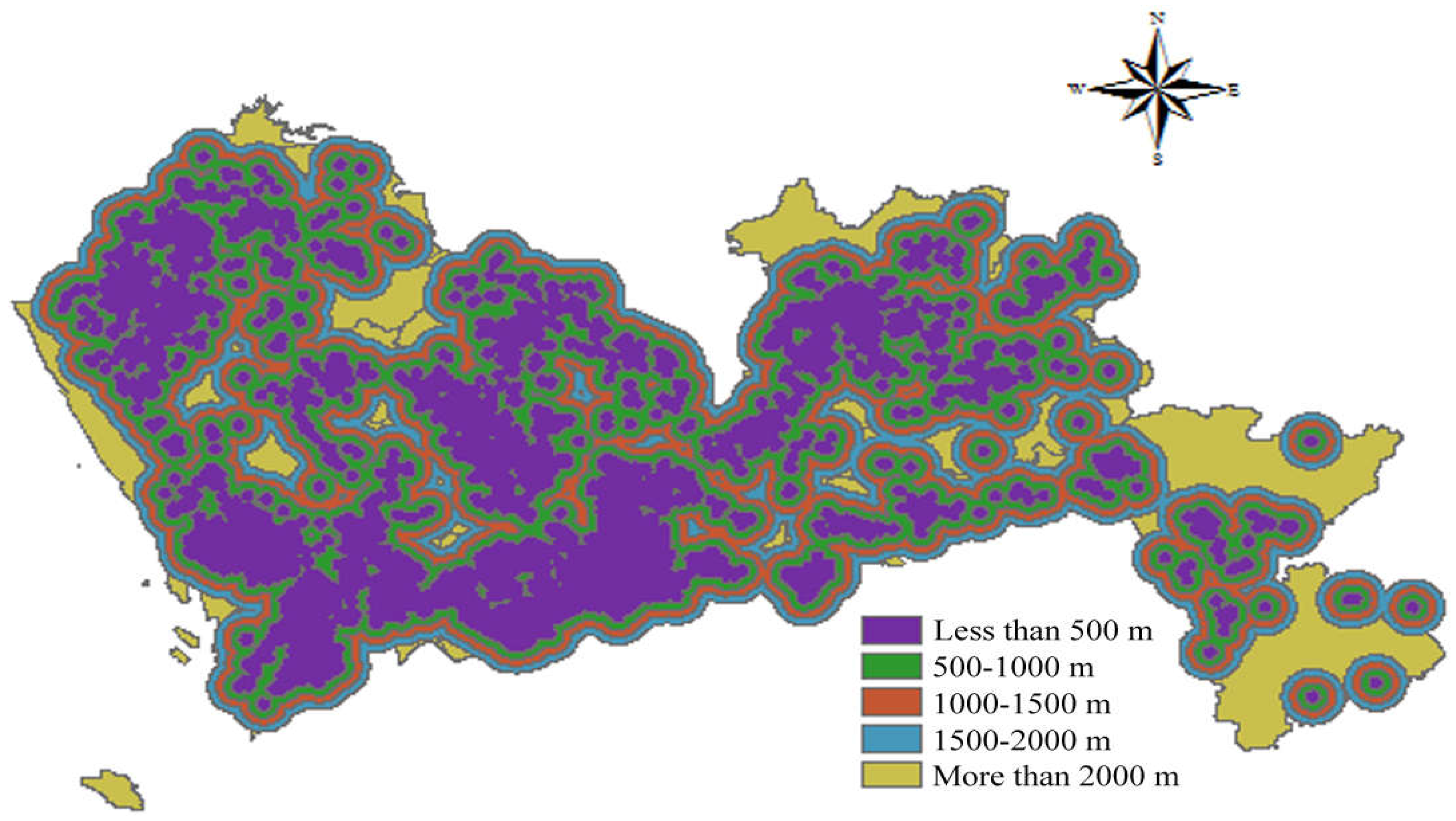
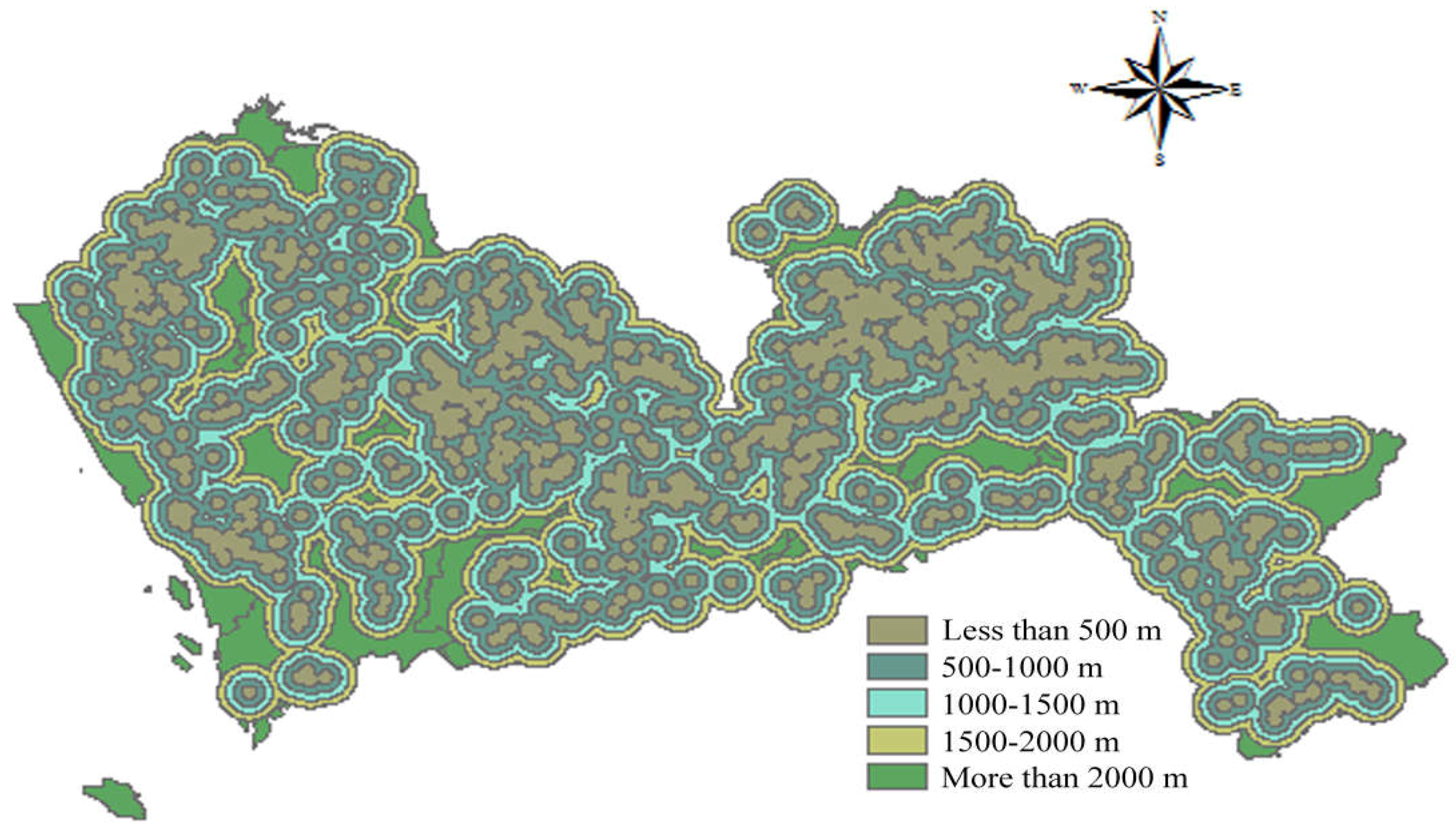
- Buffer analysis. A buffer is an area whose boundary area consists of a set of defined points at a specified maximum distance, and the size of the area is determined by the radius of the neighborhood or the condition of the buffer set [60]. In the selection of landfill sites, it is necessary to implement buffer analysis to meet local environmental, city planning, and other requirements.
- (3)
- Surface analysis. Surface analysis is obtaining the spatial characteristic information data implied in the existing data, such as slope direction, contour, fill excavation, mountain shadow, slope, curvature, and visibility analysis, etc. Surface analysis is mainly based on raster tools to analyze geological information data.
- (4)
- Overlay analysis. Overlay analysis is an important analysis tool for the establishment of the site selection model and for extracting the implicit space information. Based on the same reference coordinate system, overlay analysis can aggregate and deal with two or more groups of different data to generate new data and new attribute features.
3. Results
3.1. Determination of Weights
3.2. Model Establishment
3.2.1. Environmental Criteria
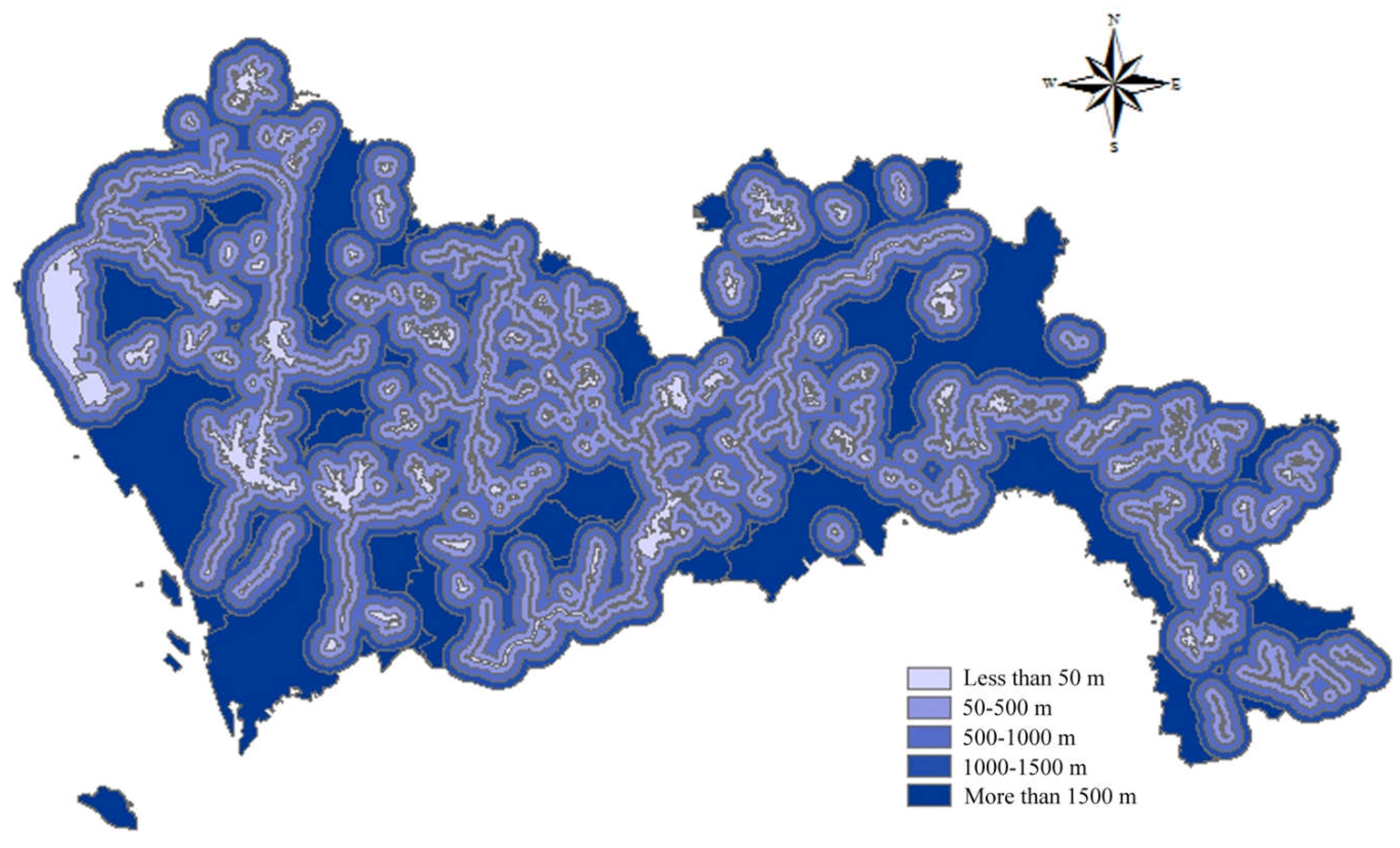
Distance to Surface Water
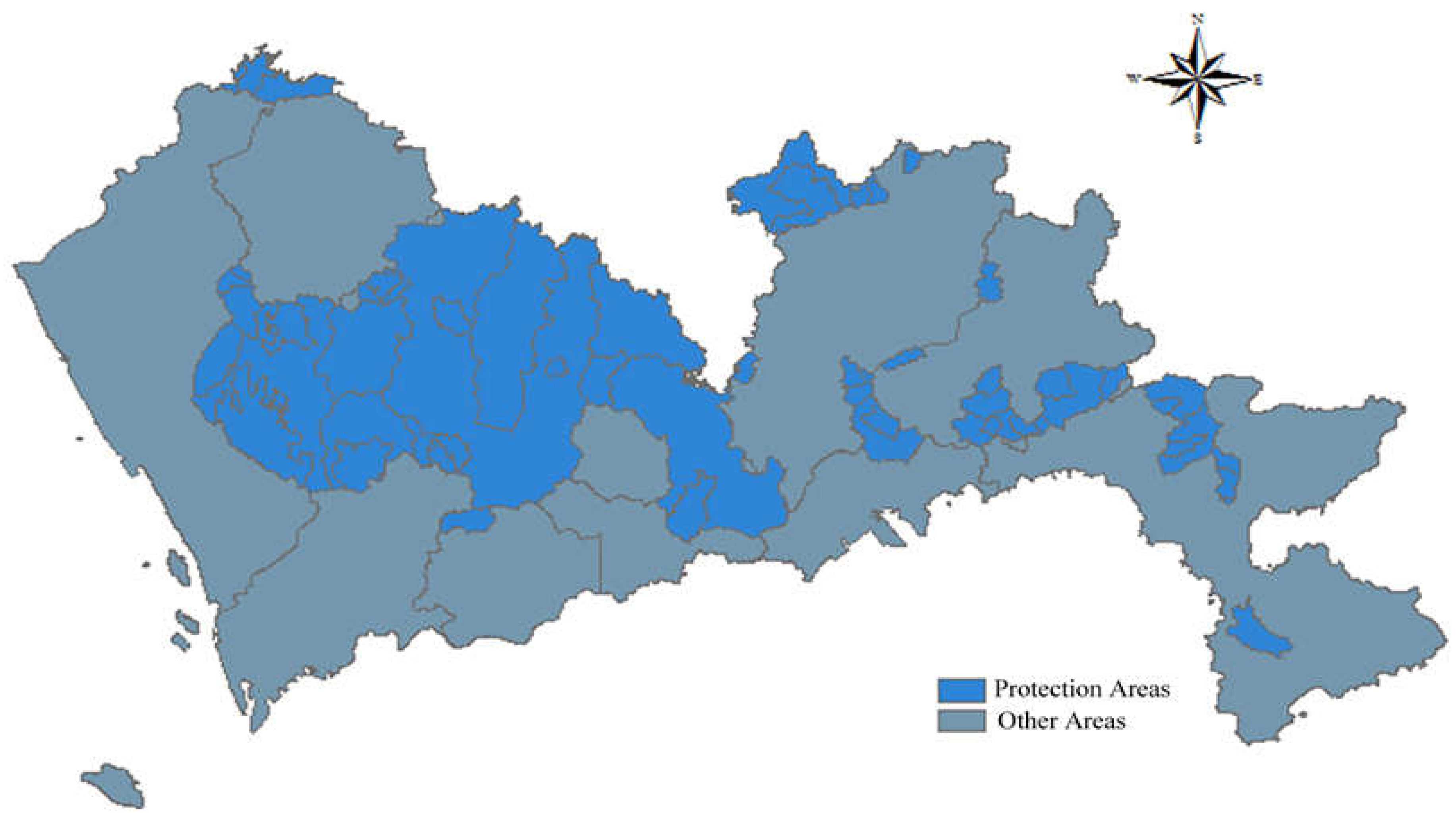
Distance to Water Source Protection Areas
Distance to Nature Reserve
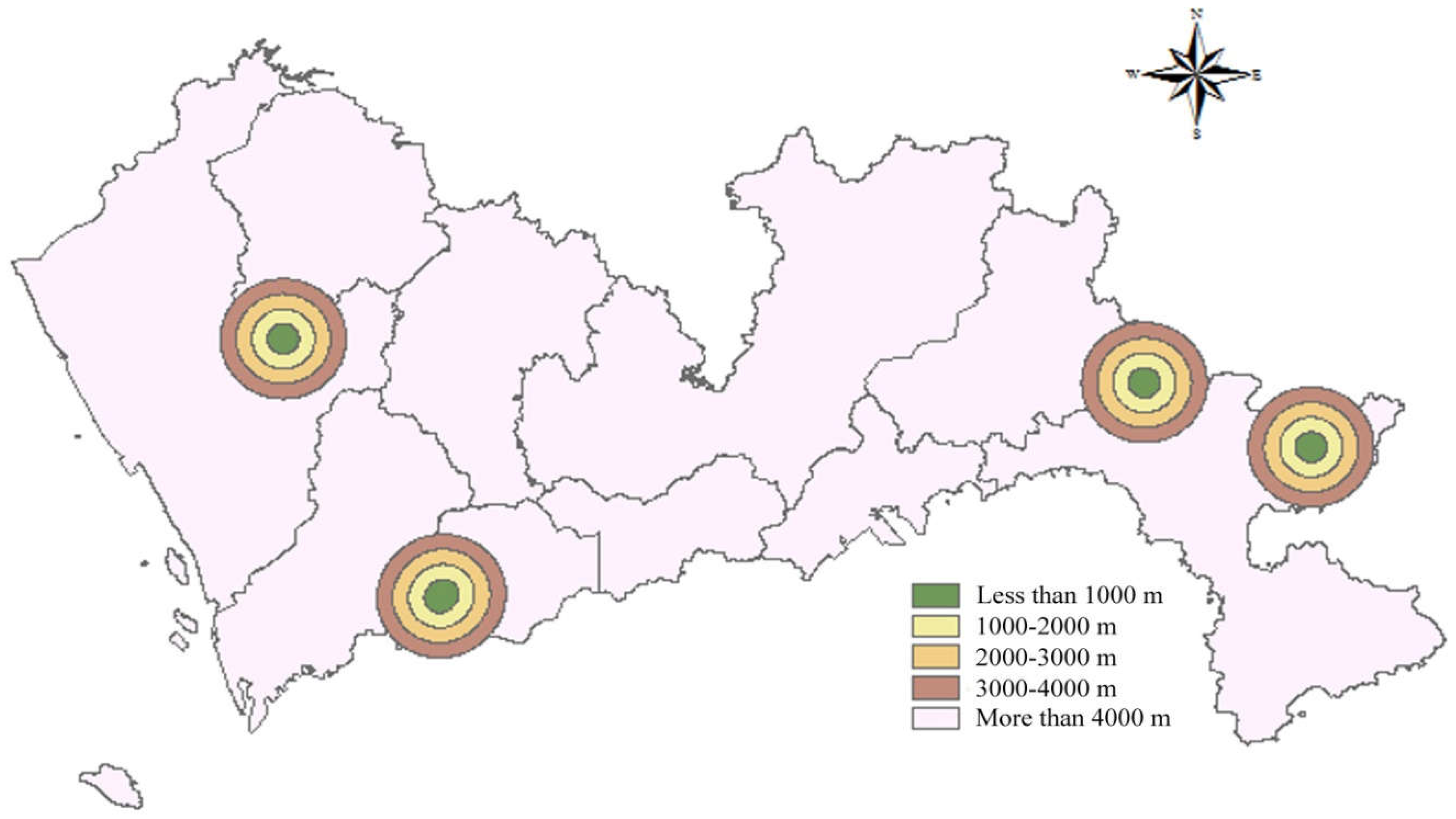
Distance to Airport
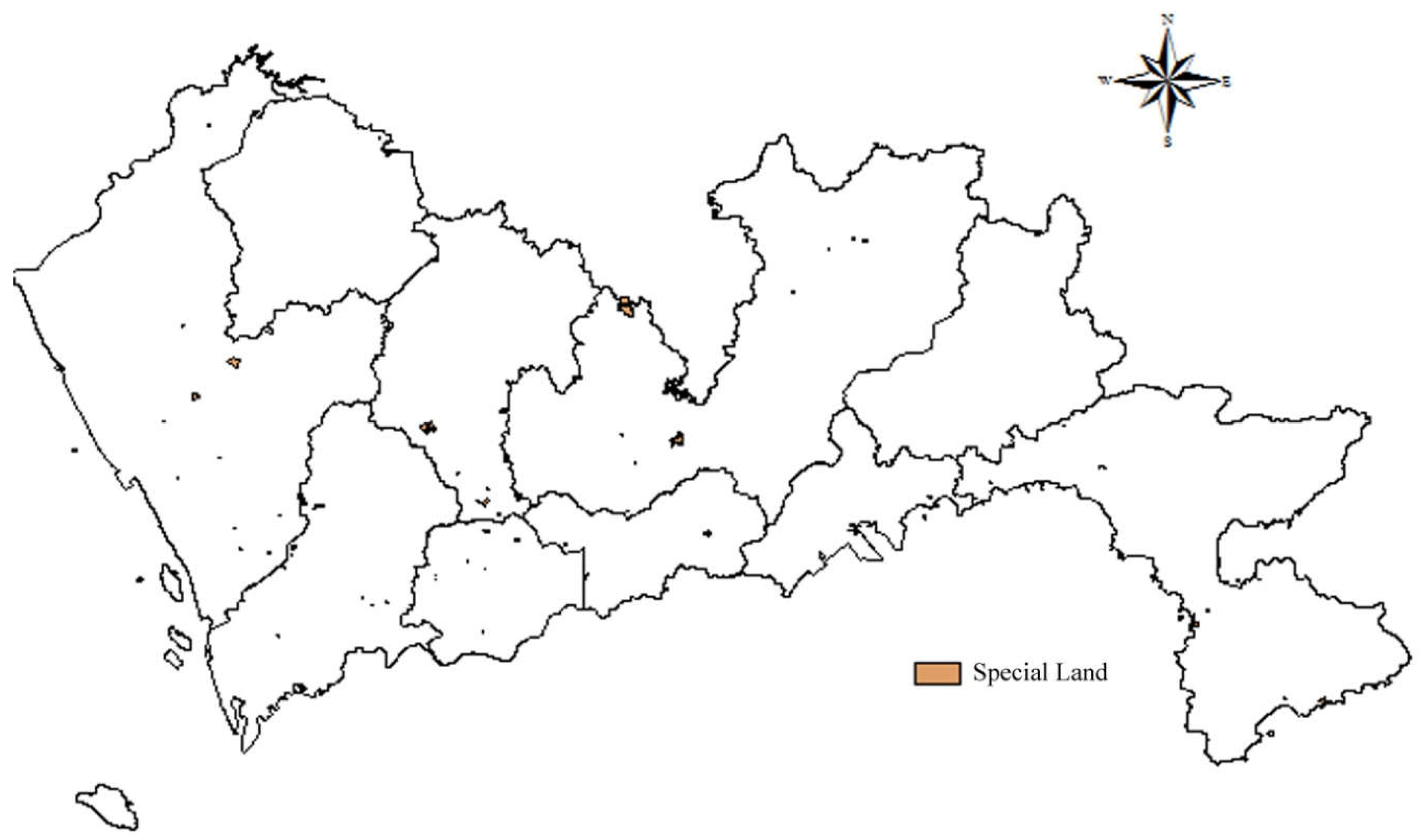
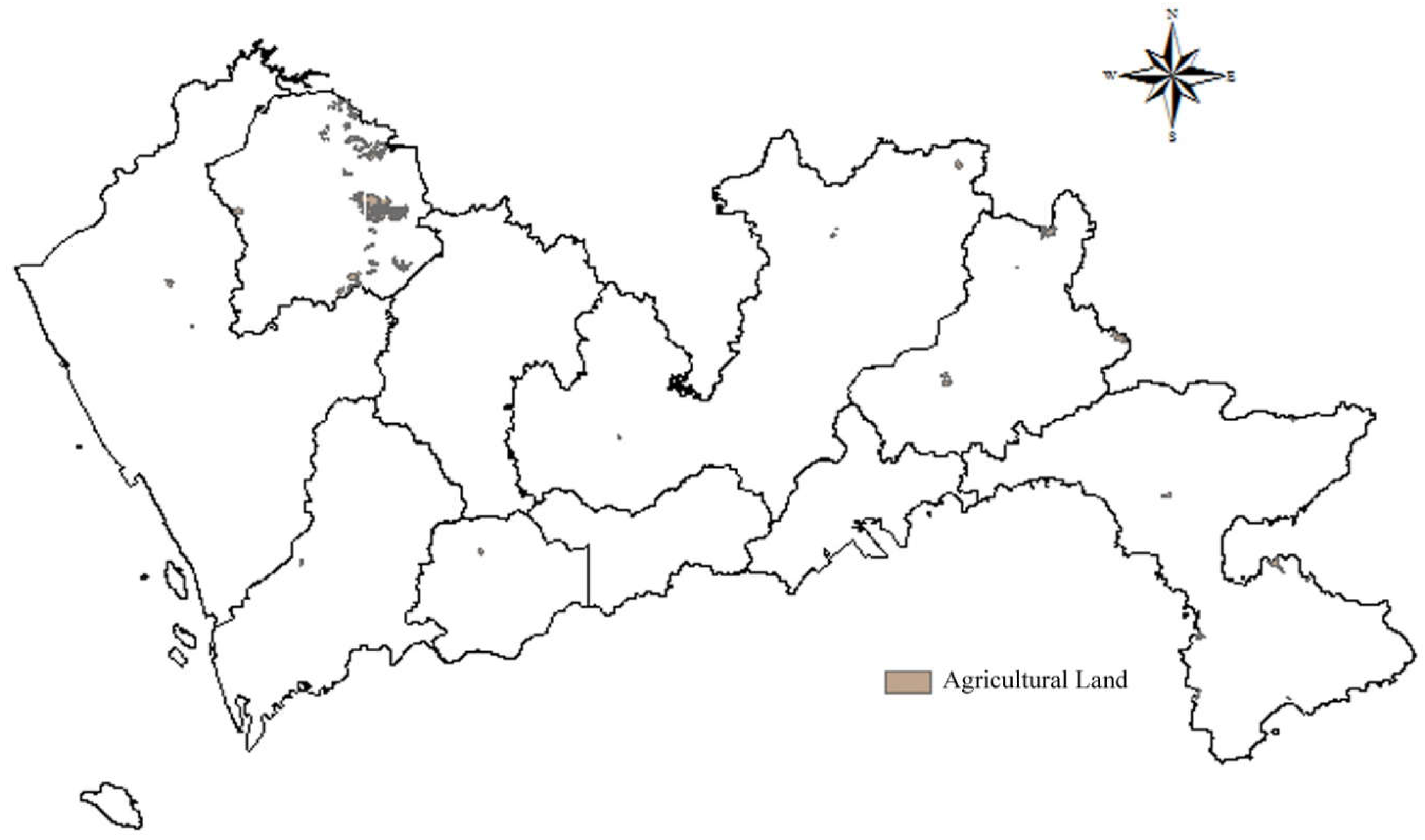
Special Land and Agricultural Land
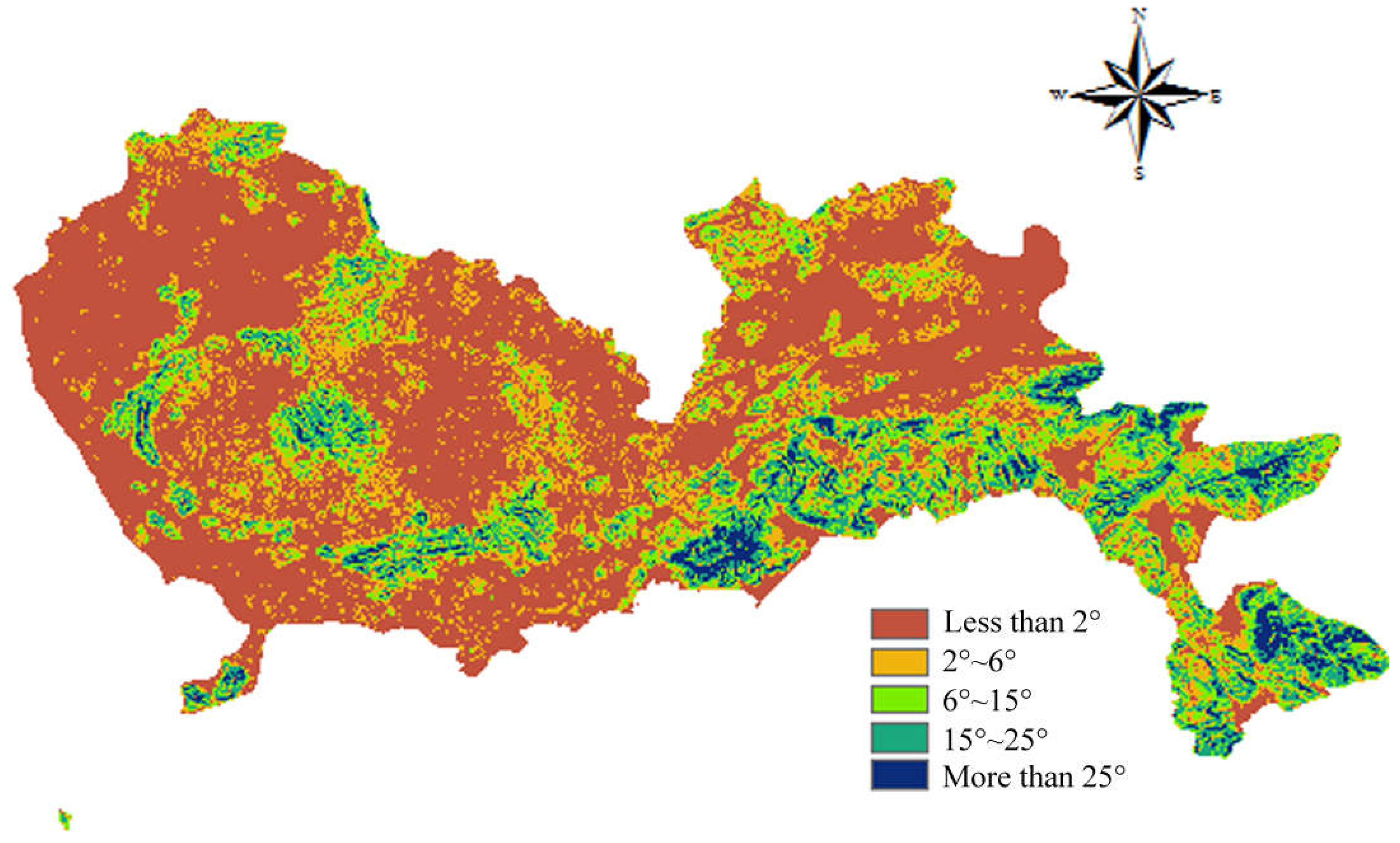
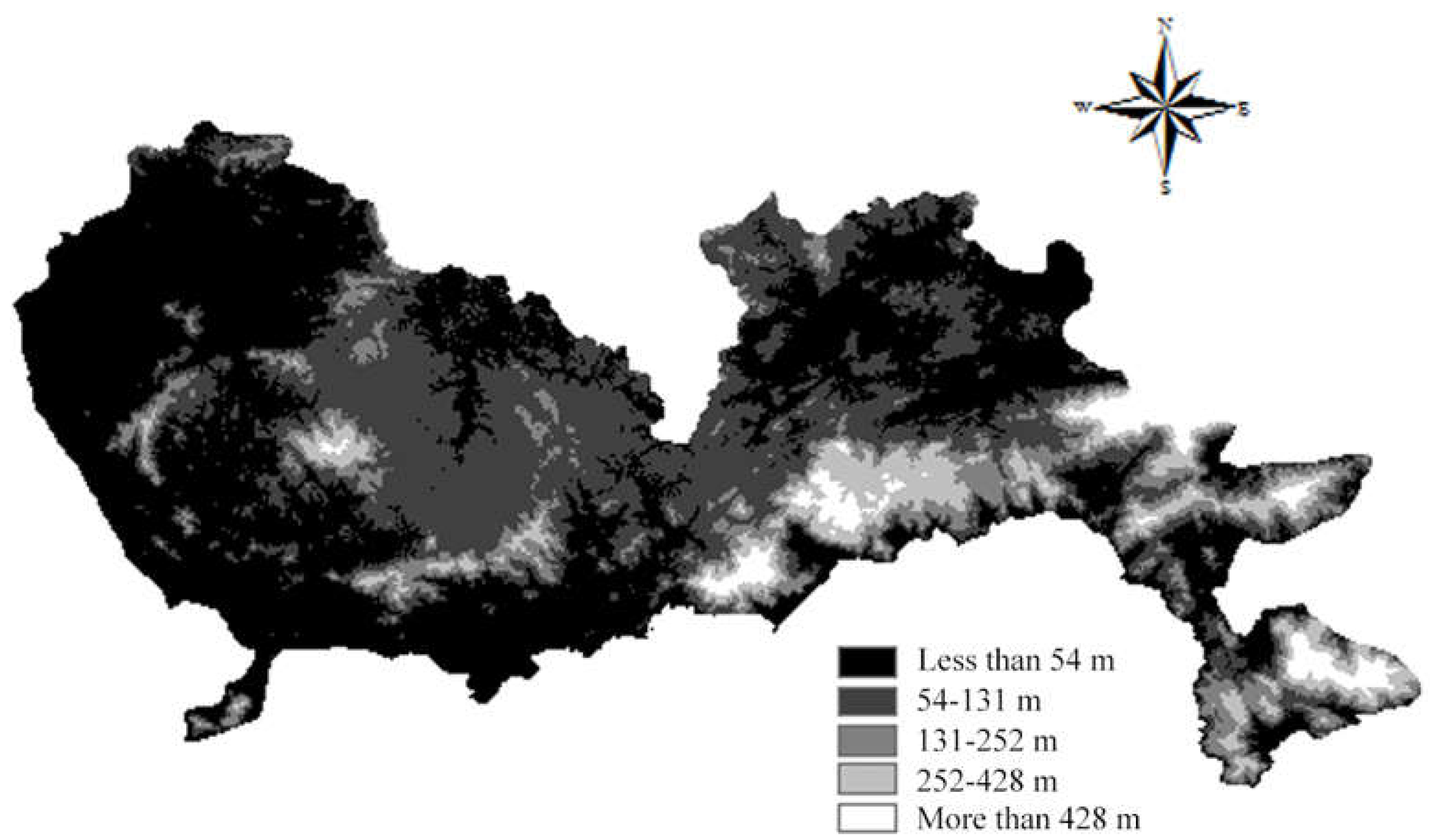
Slope and Altitude
3.2.2. Social Criteria
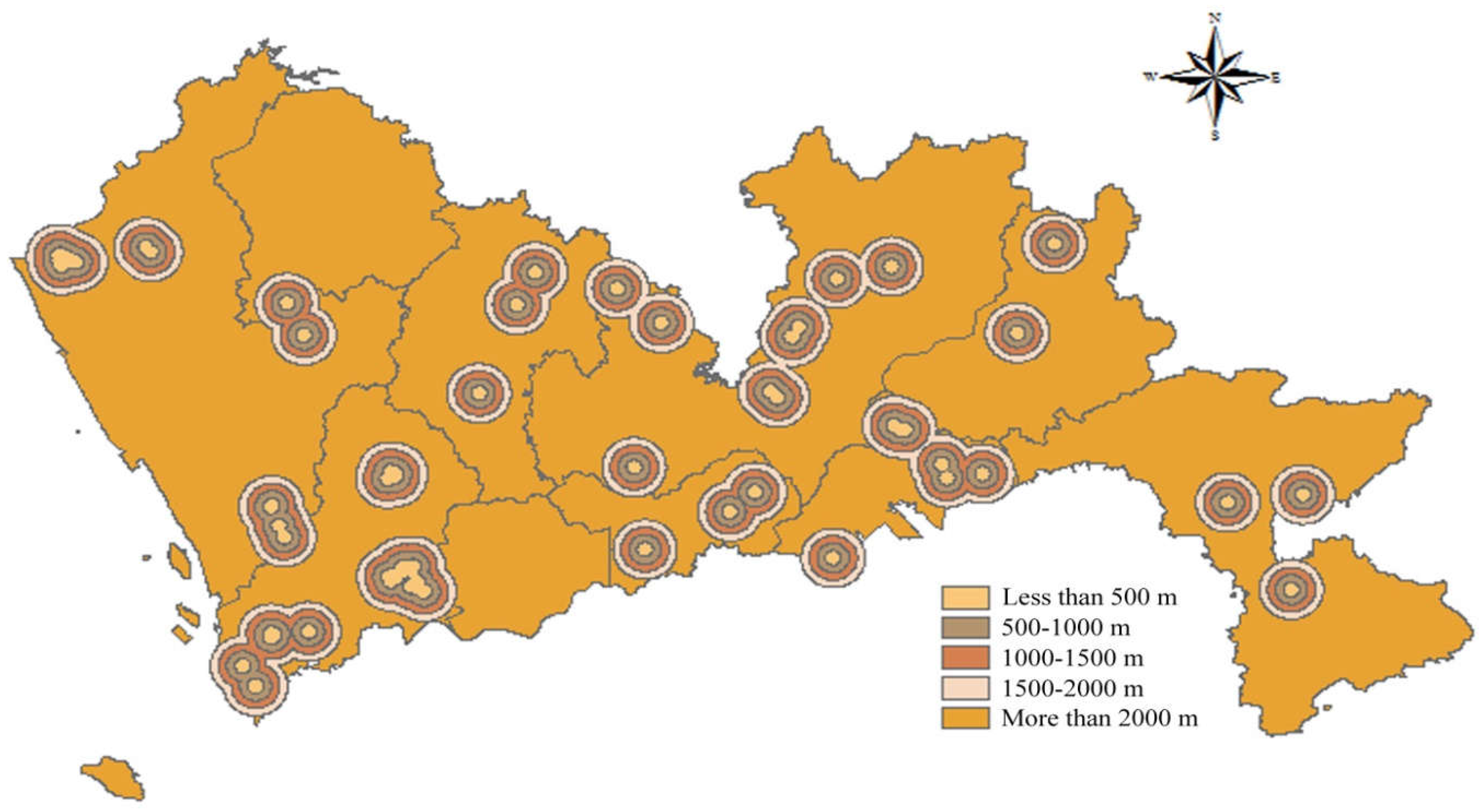
Distance to Tourist Attractions
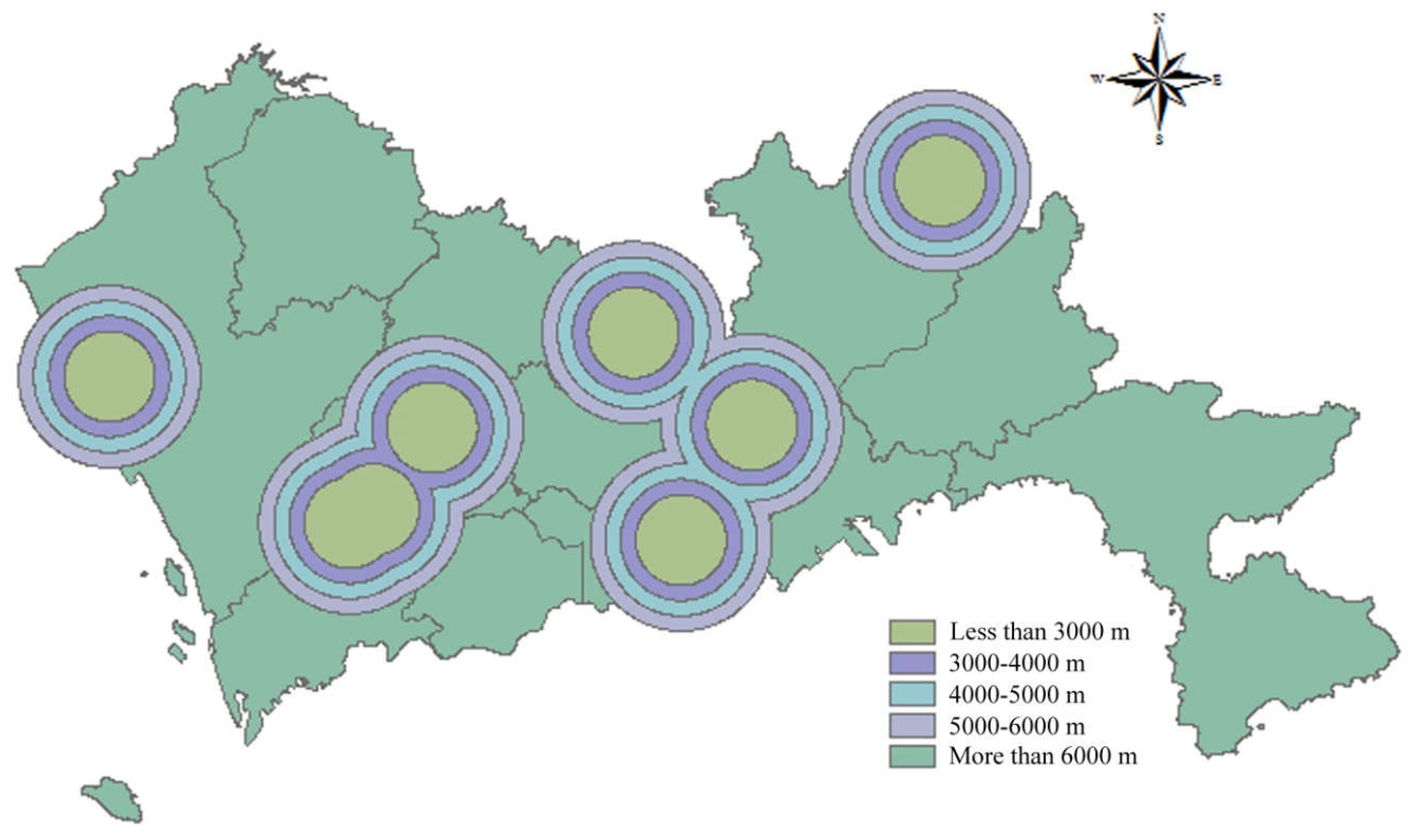
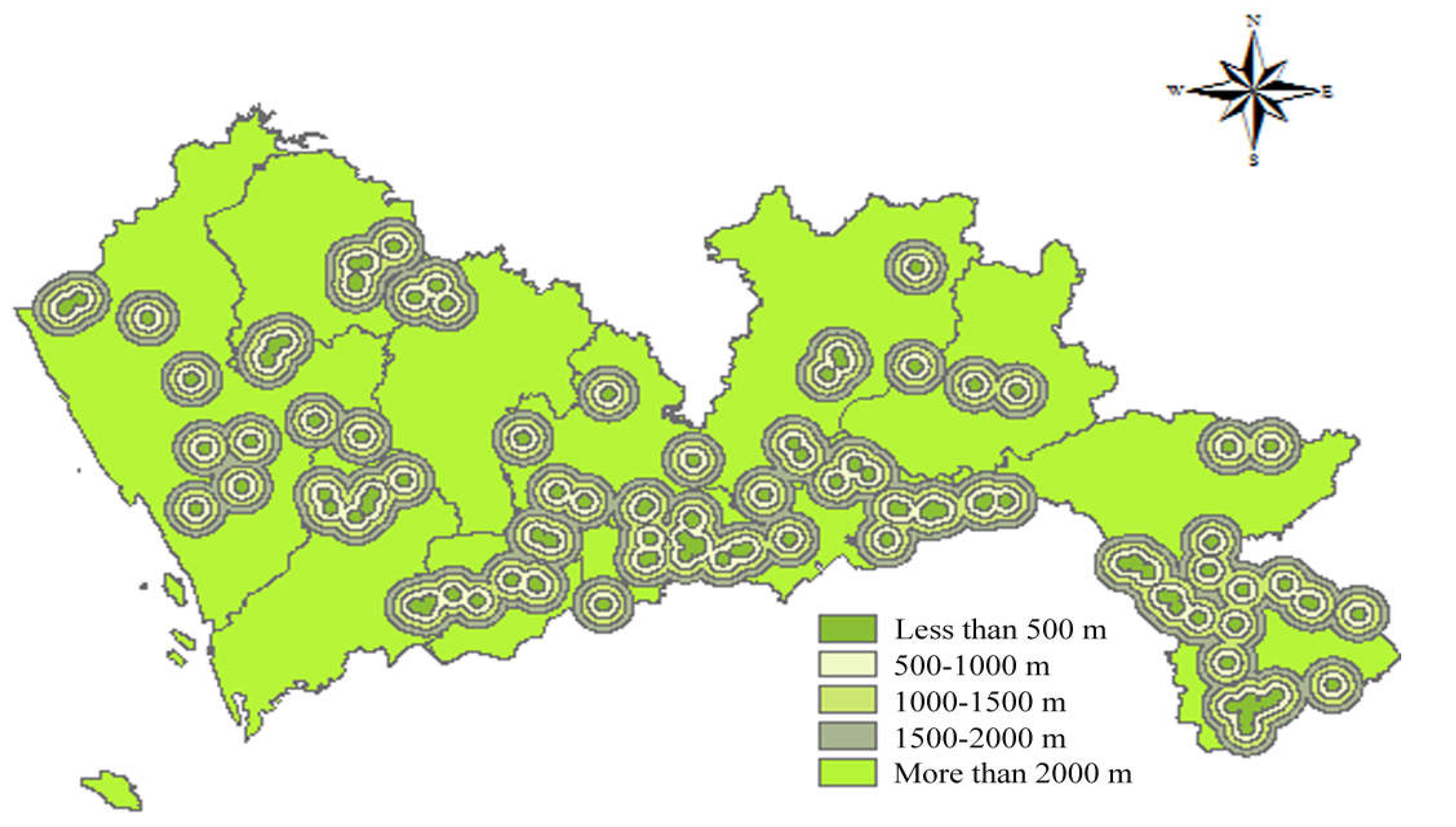
Distance to Residents
3.2.3. Economic Criteria
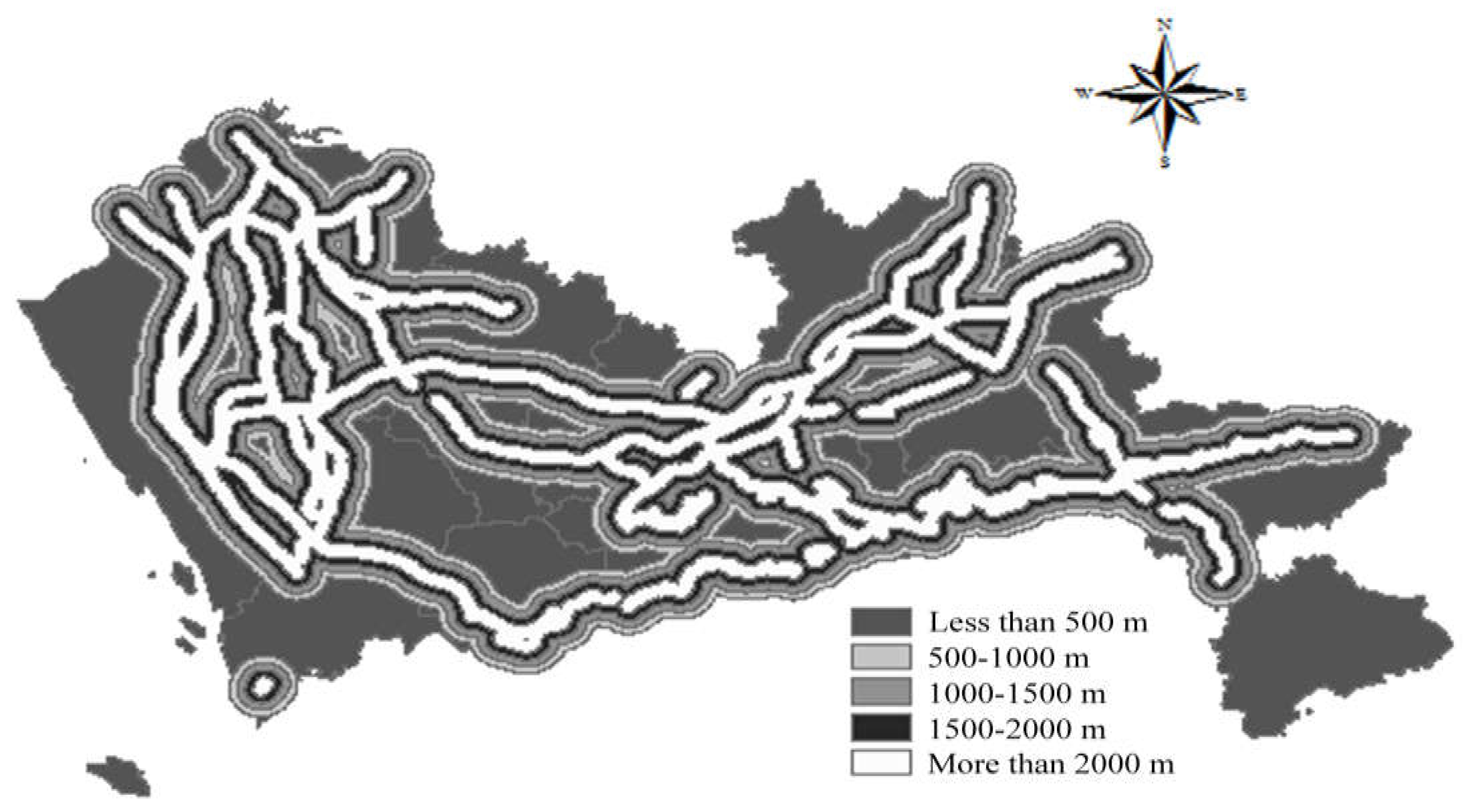
Distance to Main Road
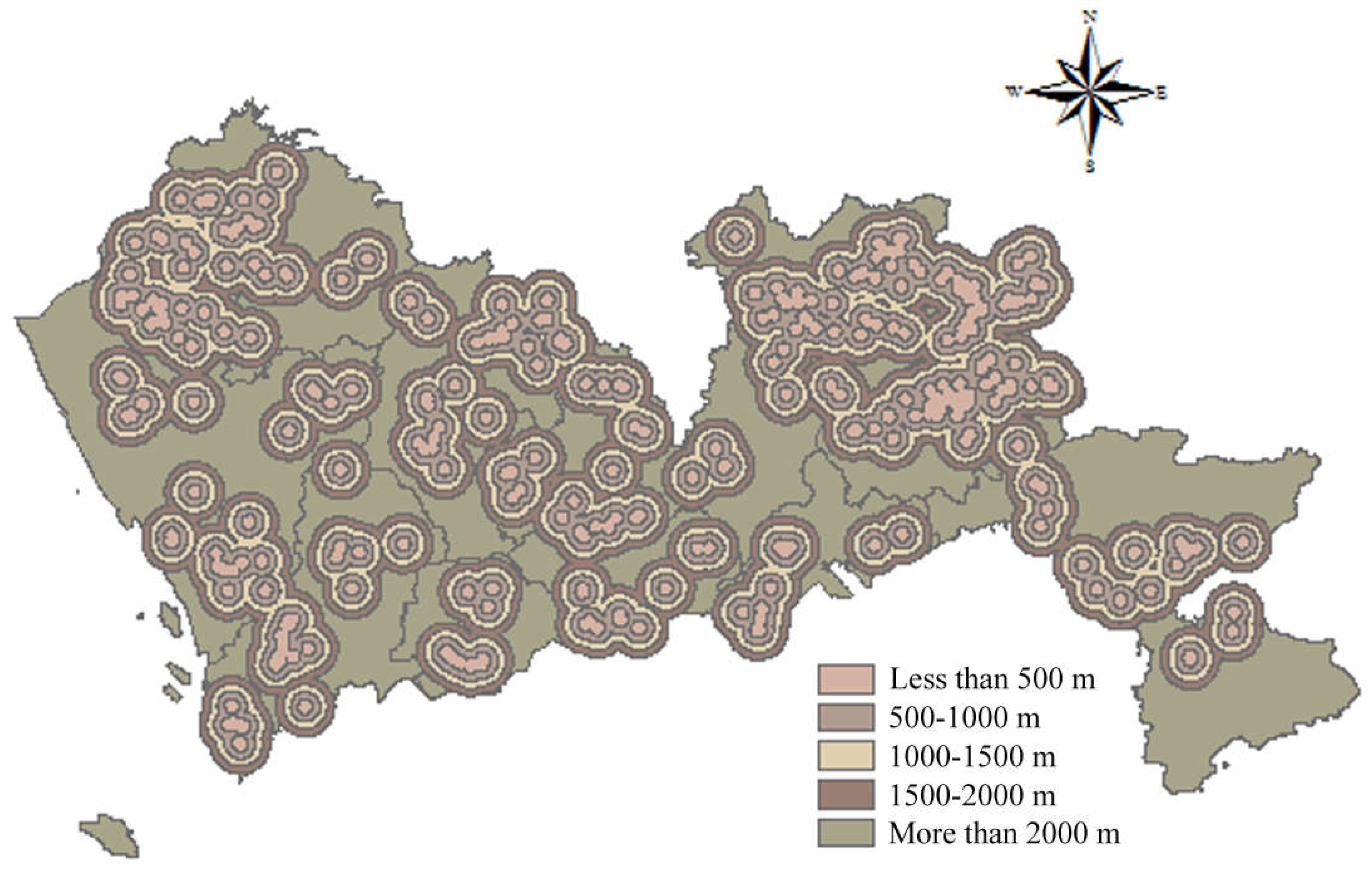
Distance to Potential Demolished Buildings in the Next 20 Years
Land Price
3.3. Suitability Analysis
4. Discussion
5. Conclusions
Author Contributions
Funding
Conflicts of Interest
References
- Statista. China: Urbanization from 2007 to 2017. Available online: https://www.statista.com/statistics/455793/urbanization-in-china/ (accessed on 1 August 2018).
- Lu, W.; Webster, C.; Peng, Y.; Chen, X.; Zhang, X. Estimating and calibrating the amount of building-related construction and demolition waste in urban China. Int. J. Constr. Manag. 2017, 17, 13–24. [Google Scholar] [CrossRef]
- Song, Y.; Wang, Y.; Liu, F.; Zhang, Y. Development of a hybrid model to predict construction and demolition waste: China as a case study. Waste Manag. 2017, 59, 350–361. [Google Scholar] [CrossRef] [PubMed]
- Wu, H.; Duan, H.; Zheng, L.; Wang, J.; Niu, Y.; Zhang, G. Demolition waste generation and recycling potentials in a rapidly developing flagship megacity of South China: Prospective scenarios and implications. Constr. Build. Mater. 2016, 113, 1007–1016. [Google Scholar] [CrossRef]
- Duan, H.; Li, J. Construction and demolition waste management: China’s lessons. Waste Manag. Res. 2016, 34, 397–398. [Google Scholar] [CrossRef] [PubMed]
- Peng, Y.; Zhu, X.; Zhang, F.; Huang, L.; Xue, J.; Xu, Y. Farmers’ risk perception of concentrated rural settlement development after the 5.12 Sichuan Earthquake. Habitat Int. 2018, 71, 169–176. [Google Scholar] [CrossRef]
- Wu, Z.; Yu, A.T.W.; Shen, L. Investigating the determinants of contractor’s construction and demolition waste management behavior in Mainland China. Waste Manag. 2017, 60, 290–300. [Google Scholar] [CrossRef] [PubMed]
- Ding, Z.; Zhu, M.; Tam, V.W.Y.; Yi, G.; Tran, C.N.N. A system dynamics-based environmental benefit assessment model of construction waste reduction management at the design and construction stages. J. Clean. Prod. 2018, 176, 676–692. [Google Scholar] [CrossRef]
- Ajayi, S.O.; Oyedele, L.O.; Akinade, O.O.; Bilal, M.; Owolabi, H.A.; Alaka, H.A.; Kadiri, K.O. Reducing waste to landfill: A need for cultural change in the UK construction industry. J. Build. Eng. 2016, 5, 185–193. [Google Scholar] [CrossRef]
- Colomer Mendoza, F.J.; Esteban Altabella, J.; Gallardo Izquierdo, A. Application of inert wastes in the construction, operation and closure of landfills: Calculation tool. Waste Manag. 2017, 59, 276–285. [Google Scholar] [CrossRef] [PubMed]
- López, A.; Lobo, A. Emissions of C&D refuse in landfills: A European case. Waste Manag. 2014, 34, 1446–1454. [Google Scholar] [PubMed]
- Václavík, V.; Ondrašiková, I.; Dvorský, T.; Černochová, K. Leachate from Municipal Waste Landfill and Its Natural Degradation—A Case Study of Zubří, Zlín Region. Int. J. Environ. Res. Public Health 2016, 13, 873. [Google Scholar] [CrossRef] [PubMed]
- Zhao, Y.; Xue, Q.; Liu, L. A Coupling Kinetics Model for Pollutant Release and Transport in the Process of Landfill Settlement. Int. J. Environ. Res. Public Health 2012, 9, 3437–3453. [Google Scholar] [CrossRef] [PubMed]
- Giannikos, I. A multiobjective programming model for locating treatment sites and routing hazardous wastes. Eur. J. Oper. Res. 1998, 104, 333–342. [Google Scholar] [CrossRef]
- Rakas, J.; Teodorović, D.; Kim, T. Multi-objective modeling for determining location of undesirable facilities. Transport. Res. Part D Transp. Environ. 2004, 9, 125–138. [Google Scholar] [CrossRef]
- Şener, B.; Süzen, M.L.; Doyuran, V. Landfill site selection by using geographic information systems. Environ. Geol. 2006, 49, 376–388. [Google Scholar] [CrossRef]
- Cheng, S.; Chan, C.W.; Huang, G.H. An integrated multi-criteria decision analysis and inexact mixed integer linear programming approach for solid waste management. Eng. Appl. Artif. Intell. 2003, 16, 543–554. [Google Scholar] [CrossRef]
- Calvo, F.; Moreno, B.; Zamorano, M.; Szanto, M. Environmental diagnosis methodology for municipal waste landfills. Waste Manag. 2005, 25, 768–779. [Google Scholar] [CrossRef] [PubMed]
- Al-Jarrah, O.; Abu-Qdais, H. Municipal solid waste landfill siting using intelligent system. Waste Manag. 2006, 26, 299–306. [Google Scholar] [CrossRef] [PubMed]
- Eiselt, H.A. Locating landfills and transfer stations in Alberta. INFOR Inf. Syst. Oper. Res. 2006, 44, 284–298. [Google Scholar] [CrossRef]
- Alumur, S.; Kara, B.Y. A new model for the hazardous waste location-routing problem. Comput. Oper. Res. 2007, 34, 1406–1423. [Google Scholar] [CrossRef]
- Sumathi, V.; Natesan, U.; Sarkar, C. GIS-based approach for optimized siting of municipal solid waste landfill. Waste Manag. 2008, 28, 2146–2160. [Google Scholar] [CrossRef] [PubMed]
- Wang, G.; Qin, L.; Li, G.; Chen, L. Landfill site selection using spatial information technologies and AHP: A case study in Beijing, China. J. Environ. Manag. 2009, 90, 2414–2421. [Google Scholar] [CrossRef] [PubMed]
- Şener, Ş.; Şener, E.; Nas, B.; Karagüzel, R. Combining AHP with GIS for landfill site selection: A case study in the Lake Beyşehir catchment area (Konya, Turkey). Waste Manag. 2010, 30, 2037–2046. [Google Scholar] [CrossRef] [PubMed]
- Şener, Ş.; Sener, E.; Karagüzel, R. Solid waste disposal site selection with GIS and AHP methodology: A case study in Senirkent-Uluborlu (Isparta) Basin, Turkey. Environ. Monit. Assess. 2011, 173, 533–554. [Google Scholar] [CrossRef] [PubMed]
- Eskandari, M.; Homaee, M.; Mahmodi, S. An integrated multi criteria approach for landfill siting in a conflicting environmental, economical and socio-cultural area. Waste Manag. 2012, 32, 1528–1538. [Google Scholar] [CrossRef] [PubMed]
- Gorsevski, P.V.; Donevska, K.R.; Mitrovski, C.D.; Frizado, J.P. Integrating multi-criteria evaluation techniques with geographic information systems for landfill site selection: A case study using ordered weighted average. Waste Manag. 2012, 32, 287–296. [Google Scholar] [CrossRef] [PubMed]
- Vasiljević, T.Z.; Srdjević, Z.; Bajčetić, R.; Miloradov, M.V. GIS and the analytic hierarchy process for regional landfill site selection in transitional countries: A case study from Serbia. Environ. Manag. 2012, 49, 445–458. [Google Scholar] [CrossRef] [PubMed]
- Abd-El Monsef, H. Optimization of municipal landfill siting in the Red Sea coastal desert using geographic information system, remote sensing and an analytical hierarchy process. Environ. Earth Sci. 2015, 74, 2283–2296. [Google Scholar] [CrossRef]
- El Baba, M.; Kayastha, P.; De Smedt, F. Landfill site selection using multi-criteria evaluation in the GIS interface: A case study from the Gaza Strip, Palestine. Arab. J. Geosci. 2015, 8, 7499–7513. [Google Scholar] [CrossRef]
- Kharat, M.G.; Kamble, S.J.; Raut, R.D.; Kamble, S.S.; Dhume, S.M. Modeling landfill site selection using an integrated fuzzy MCDM approach. Model. Earth Syst. Environ. 2016, 2, 53. [Google Scholar] [CrossRef]
- Torabi-Kaveh, M.; Babazadeh, R.; Mohammadi, S.; Zaresefat, M. Landfill site selection using combination of GIS and fuzzy AHP, a case study: Iranshahr, Iran. Waste Manag. Res. 2016, 34, 438–448. [Google Scholar] [CrossRef] [PubMed]
- Rahmat, Z.G.; Niri, M.V.; Alavi, N.; Goudarzi, G.; Babaei, A.A.; Baboli, Z.; Hosseinzadeh, M. Landfill site selection using GIS and AHP: A case study: Behbahan, Iran. KSCE J. Civ. Eng. 2017, 21, 111–118. [Google Scholar] [CrossRef]
- Guler, D.; Yomralioglu, T. Alternative suitable landfill site selection using analytic hierarchy process and geographic information systems: A case study in Istanbul. Environ. Earth Sci. 2017, 76, 678. [Google Scholar] [CrossRef]
- Habibi, F.; Asadi, E.; Sadjadi, S.J.; Barzinpour, F. A multi-objective robust optimization model for site-selection and capacity allocation of municipal solid waste facilities: A case study in Tehran. J. Clean. Prod. 2017, 166, 816–834. [Google Scholar] [CrossRef]
- Hanine, M.; Boutkhoum, O.; Tikniouine, A.; Agouti, T. An Application of OLAP/GIS-Fuzzy AHP-TOPSIS Methodology for Decision Making: Location Selection for Landfill of Industrial Wastes as a Case Study. KSCE J. Civ. Eng. 2017, 21, 2074–2084. [Google Scholar] [CrossRef]
- Krishna, V.V.S.; Pandey, K.; Karnatak, H. Geospatial multicriteria approach for solid waste disposal site selection in Dehradun city, India. Curr. Sci. 2017, 112, 549–559. [Google Scholar] [CrossRef]
- Islam, A.; Ali, S.M.; Afzaal, M.; Iqbal, S.; Zaidi, S.N.F. Landfill sites selection through analytical hierarchy process for twin cities of Islamabad and Rawalpindi, Pakistan. Environ. Earth Sci. 2018, 77, 72. [Google Scholar] [CrossRef]
- Khodaparast, M.; Rajabi, A.M.; Edalat, A. Municipal solid waste landfill siting by using GIS and analytical hierarchy process (AHP): A case study in Qom city, Iran. Environ. Earth Sci. 2018, 77, 52. [Google Scholar] [CrossRef]
- Liu, K.M.; Lin, S.H.; Hsieh, J.C.; Tzeng, G.H. Improving the food waste composting facilities site selection for sustainable development using a hybrid modified MADM model. Waste Manag. 2018, 75, 44–59. [Google Scholar] [CrossRef] [PubMed]
- Santhosh, L.G.; Babu, G.L.S. Landfill site selection based on reliability concepts using the DRASTIC method and AHP integrated with GIS—A case study of Bengaluru city, India. Georisk 2018, 12, 234–252. [Google Scholar] [CrossRef]
- Spigolon, L.M.G.; Giannotti, M.; Larocca, A.P.; Russo, M.A.T.; Souza, N.D. Landfill siting based on optimisation, multiple decision analysis, and geographic information system analyses. Waste Manag. Res. 2018, 36, 606–615. [Google Scholar] [CrossRef] [PubMed]
- Wang, Y.; Li, J.; An, D.; Xi, B.D.; Tang, J.; Wang, Y.; Yang, Y. Site selection for municipal solid waste landfill considering environmental health risks. Resour. Conserv. Recycl. 2018, 138, 40–46. [Google Scholar] [CrossRef]
- Ding, Z.; Zhu, M.; Wang, Y.; Zhu, J. An AHP-GIS Based Model of C&D Waste Landfill Site Selection: A Triangulation of Critical Factors. In Proceedings of the 21st International Symposium on Advancement of Construction Management and Real Estate, Hong Kong, China, 19 December 2017; pp. 163–174. [Google Scholar]
- He, H. Shenzhen Surpasses US$338 Billion GDP Mark in 2017, Beats Hong Kong and Singapore’s Growth. Available online: https://www.scmp.com/news/china/economy/article/2128310/shenzhen-88-cent-hi-tech-growth-roll-hit-y2tr-2017 (accessed on 17 August 2018).
- Τsolaki-Fiaka, S.; Bathrellos, G.D.; Skilodimou, H.D. Multi-Criteria Decision Analysis for an Abandoned Quarry in the Evros Region (NE Greece). Land 2018, 7, 43. [Google Scholar] [CrossRef]
- Lu, P.; Yang, X.; Wang, Z.-J. Fuzzy Group Consensus Decision Making and Its Use in Selecting Energy-Saving and Low-carbon Technology Schemes in Star Hotels. Int. J. Environ. Res. Public Health 2018, 15, 2057. [Google Scholar] [CrossRef] [PubMed]
- Chen, Y.; Li, B.; Bai, Q.; Liu, Z. Decision-Making and Environmental Implications under Cap-and-Trade and Take-Back Regulations. Int. J. Environ. Res. Public Health 2018, 15, 678. [Google Scholar] [CrossRef] [PubMed]
- Chen, X.; Xu, Z.; Yao, L.; Ma, N. Processing Technology Selection for Municipal Sewage Treatment Based on a Multi-Objective Decision Model under Uncertainty. Int. J. Environ. Res. Public Health 2018, 15, 448. [Google Scholar] [CrossRef] [PubMed]
- Sun, H.; Dang, Y.; Mao, W. A Decision-Making Method with Grey Multi-Source Heterogeneous Data and Its Application in Green Supplier Selection. Int. J. Environ. Res. Public Health 2018, 15, 446. [Google Scholar] [CrossRef] [PubMed]
- Tam, M.C.; Tummala, V.R. An application of the AHP in vendor selection of a telecommunications system. Omega 2001, 29, 171–182. [Google Scholar] [CrossRef]
- Bathrellos, G.D.; Skilodimou, H.D.; Chousianitis, K.; Youssef, A.M.; Pradhan, B. Suitability estimation for urban development using multi-hazard assessment map. Sci. Total Environ. 2017, 575, 119–134. [Google Scholar] [CrossRef] [PubMed]
- Bathrellos, G.D.; Gaki-Papanastassiou, K.; Skilodimou, H.D.; Papanastassiou, D.; Chousianitis, K.G. Potential suitability for urban planning and industry development using natural hazard maps and geological-geomorphological parameters. Environ. Earth Sci. 2012, 66, 537–548. [Google Scholar] [CrossRef]
- Saaty, T.L. How to make a decision: The analytic hierarchy process. Eur. J. Oper. Res. 1990, 48, 9–26. [Google Scholar] [CrossRef]
- Mahdi, I.M.; Alreshaid, K. Decision support system for selecting the proper project delivery method using analytical hierarchy process (AHP). Int. J. Proj. Manag. 2005, 23, 564–572. [Google Scholar] [CrossRef]
- Bai, L.; Wang, H.; Huang, N.; Du, Q.; Huang, Y. An Environmental Management Maturity Model of Construction Programs Using the AHP-Entropy Approach. Int. J. Environ. Res. Public Health 2018, 15, 1317. [Google Scholar] [CrossRef] [PubMed]
- Zheng, H.W.; Shen, G.Q.; Wang, H.; Hong, J. Simulating land use change in urban renewal areas: A case study in Hong Kong. Habitat Int. 2015, 46, 23–34. [Google Scholar] [CrossRef]
- Maliene, V.; Grigonis, V.; Palevičius, V.; Griffiths, S. Geographic information system: Old principles with new capabilities. Urban Des. Int. 2011, 16, 1–6. [Google Scholar] [CrossRef]
- Wang, H.; Shen, Q.; Tang, B.-S. GIS-based framework for supporting land use planning in urban renewal: Case study in Hong Kong. J. Urban Plan. Dev. 2014, 141, 05014015. [Google Scholar] [CrossRef]
- Wade, T.; Sommer, S. A to Z GIS: An Illustrated Dictionary of Geographic Information Systems; Esri Press: Redlands, CA, USA, 2006. [Google Scholar]
- Wu, H.; Wang, J.; Duan, H.; Ouyang, L.; Huang, W.; Zuo, J. An innovative approach to managing demolition waste via GIS (geographic information system): A case study in Shenzhen city, China. J. Clean. Prod. 2016, 112, 494–503. [Google Scholar] [CrossRef]
- Wu, Z.; Yu, A.T.W.; Shen, L.; Liu, G. Quantifying construction and demolition waste: An analytical review. Waste Manag. 2014, 34, 1683–1692. [Google Scholar] [CrossRef] [PubMed]
- Ding, Z.; Wang, Y.; Zou, P.X.W. An agent based environmental impact assessment of building demolition waste management: Conventional versus green management. J. Clean. Prod. 2016, 133, 1136–1153. [Google Scholar] [CrossRef]
- Wu, Z.; Shen, L.; Yu, A.T.W.; Zhang, X. A comparative analysis of waste management requirements between five green building rating systems for new residential buildings. J. Clean. Prod. 2016, 112, 895–902. [Google Scholar] [CrossRef]




| Reference | Waste Type | Method Used |
|---|---|---|
| Giannikos [14] | Hazardous waste | Multi-objective modeling. |
| Cheng, et al. [17] | Solid waste | Integration of Multi-Criteria Decision Analysis (MCDA) and Inexact Mixed Integer Linear Programming (IMILP) methods. |
| Rakas, Teodorović and Kim [15] | General waste | Multi-objective modeling. |
| Calvo, et al. [18] | Municipal waste | Environmental diagnosis methodology. |
| Al-Jarrah and Abu-Qdais [19] | Municipal solid waste | Intelligent system based on fuzzy inference. |
| Eiselt [20] | Municipal solid waste | Mixed-integer linear programming. |
| Şener, Süzen and Doyuran [16] | General waste | Integration of Geographic Information Systems (GIS) and Multi-Criteria Decision Analysis (MCDA). |
| Alumur and Kara [21] | Hazardous waste | Multi-objective location-routing model. |
| Sumathi, et al. [22] Wang, et al. [23] | Solid waste | Multi-Criteria Decision Analysis (MCDA) and overlay analysis using Geographic Information System (GIS). |
| Şener, et al. [24] | Solid waste | Analytical Hierarchy Process (AHP) and Geographic Information System (GIS). |
| Şener, et al. [25] | Municipal solid waste | Analytical Hierarchy Process (AHP) and Geographic Information System (GIS). |
| Eskandari, et al. [26] | Solid waste | Analytical Hierarchy Process (AHP), Geographic Information System (GIS), and remote sensing methods. |
| Gorsevski, et al. [27] | Municipal solid waste | Analytical Hierarchy Process (AHP) and Geographic Information System (GIS). |
| Vasiljević, et al. [28] | General waste | GIS-based multi-criteria decision analysis approach. |
| Abd-El Monsef [29] El Baba, et al. [30] | General waste | Analytical Hierarchy Process (AHP) and Geographic Information System (GIS). |
| Kharat, et al. [31] | General waste | Analytical Hierarchy Process (AHP), Geographic Information System (GIS), and remote sensing methods. |
| Torabi-Kaveh, et al. [32] | Solid waste | Multi-Criteria Decision Analysis (MCDA) and Analytical Hierarchy Process (AHP) method. |
| Rahmat, et al. [33] | Municipal solid waste | Fuzzy-Analytical Hierarchy Process (FAHP) and Technique for Order Preference by Similarity to Ideal Solution (TOPSIS)-based methodology. |
| Giannikos [14] | Solid waste | Multi-Criteria Decision Analysis (MCDA), Geographic Information System (GIS), and Fuzzy Analytical Hierarchy Process (FAHP). |
| Cheng, Chan and Huang [17] | Solid waste | A combination of Geographic Information System (GIS) and Analytic Hierarchy Process (AHP). |
| Guler and Yomralioglu [34] | Solid waste | Analytical Hierarchy Process (AHP) and Geographic Information System (GIS). |
| Habibi, et al. [35] | Municipal solid waste | A multi-objective robust optimization model. |
| Hanine, et al. [36] | Industrial waste | An OLAP/GIS-Fuzzy AHP–TOPSIS based methodology. |
| Krishna, et al. [37] | Solid waste | A geospatial multicriteria approach. |
| Islam, et al. [38] | Solid waste | Analytic Hierarchy Process (AHP). |
| Khodaparast, et al. [39] | Municipal solid waste | A combination of Geographic Information System (GIS) and Analytic Hierarchy Process (AHP). |
| Liu, et al. [40] | Food waste | A hybrid modified MADM model. |
| Santhosh and Babu [41] | Municipal solid waste | DRASTIC method and Analytical Hierarchy Process (AHP) and Geographic Information System (GIS). |
| Spigolon, et al. [42] | Municipal solid waste | Multiple decision analysis and geographic information system (GIS) analysis. |
| Wang, et al. [43] | Municipal solid waste | A fuzzy age-sectioned groundwater environmental health risk assessment model. |
| Criteria | Factor | Sub-Factor |
|---|---|---|
| Environmental Criteria (B1) | Distance to surface water (C1) | |
| Distance to water source protection area (C2) | ||
| Distance to nature reserve (C3) | ||
| Distance to airport (C4) | ||
| Special land (C5) | ||
| Agricultural land (C6) | ||
| Geomorphic topography (C7) | Slope (D1) | |
| Altitude (D2) | ||
| Social Criteria (B2) | Distance to tourist attractions (C8) | Distance to cultural attractions (D3) |
| Distance to natural attractions (D4) | ||
| Distance to historical relics (D5) | ||
| Impact on residents (C9) | Distance to urban residents (D6) | |
| Distance to rural residents (D7) | ||
| Economic Criteria (B3) | Transportation cost (C10) | Distance to main road (D8) |
| Distance to potential demolished buildings in the next 20 years (D9) | ||
| Land price (C11) |
| AHP Weights | Entropy | Difference Coefficient | Entropy Method Weight | Comprehensive Weight | ||
|---|---|---|---|---|---|---|
| Criteria | B1 | 0.5373 | 0.9741 | 0.0259 | 0.303 | 0.4947 |
| B2 | 0.3776 | 0.9687 | 0.0313 | 0.3659 | 0.4198 | |
| B3 | 0.085 | 0.9716 | 0.0284 | 0.3311 | 0.0855 | |
| Sum | 0.9999 | 2.9144 | 0.0856 | 1 | 1 | |
| Environmental Criteria | C1 | 0.1303 | 0.9862 | 0.0138 | 0.1571 | 0.1671 |
| C2 | 0.3564 | 0.9932 | 0.0068 | 0.0777 | 0.2262 | |
| C3 | 0.2044 | 0.9902 | 0.0098 | 0.1114 | 0.1859 | |
| C4 | 0.0574 | 0.9859 | 0.0141 | 0.1615 | 0.0757 | |
| C5 | 0.0839 | 0.9852 | 0.0148 | 0.1688 | 0.1157 | |
| C6 | 0.1269 | 0.9848 | 0.0152 | 0.1731 | 0.1794 | |
| C7 | 0.0407 | 0.9868 | 0.0132 | 0.1504 | 0.05 | |
| Sum | 1 | 6.9123 | 0.0877 | 1 | 1 | |
| Social Criteria | C8 | 0.1476 | 0.9524 | 0.0476 | 0.4809 | 0.1383 |
| C9 | 0.8524 | 0.9486 | 0.0514 | 0.5191 | 0.8617 | |
| Sum | 1 | 1.901 | 0.099 | 1 | 1 | |
| Economic Criteria | C10 | 0.4901 | 0.9999 | 0.0001 | 0.4996 | 0.4897 |
| C11 | 0.5099 | 0.9999 | 0.0001 | 0.5004 | 0.5103 | |
| Sum | 1 | 1.9998 | 0.0002 | 1 | 1 | |
| Geomorphic topography (C7) | D1 | 0.4785 | 0.9809 | 0.0191 | 0.4311 | 0.4101 |
| D2 | 0.5215 | 0.9747 | 0.0253 | 0.5689 | 0.5899 | |
| Sum | 1 | 1.9556 | 0.0444 | 1 | 1 | |
| Distance from the tourist attractions (C8) | D3 | 0.2391 | 0.9928 | 0.0072 | 0.2381 | 0.1359 |
| D4 | 0.1891 | 0.9942 | 0.0058 | 0.1924 | 0.0869 | |
| D5 | 0.5718 | 0.9829 | 0.0171 | 0.5694 | 0.7772 | |
| Sum | 1 | 2.9699 | 0.0301 | 0.9999 | 1 | |
| Impact on Residents (C9) | D6 | 0.5597 | 0.9957 | 0.0043 | 0.8329 | 0.8637 |
| D7 | 0.4403 | 0.9991 | 0.0009 | 0.1671 | 0.1363 | |
| Sum | 1 | 1.9948 | 0.0052 | 1 | 1 | |
| Transportation cost (C10) | D8 | 0.2018 | 0.9636 | 0.0364 | 0.4747 | 0.186 |
| D9 | 0.7982 | 0.9597 | 0.0403 | 0.5253 | 0.814 | |
| Sum | 1 | 1.9233 | 0.0767 | 1 | 1 |
| Code | Influencing Factors | Weights |
|---|---|---|
| C1 | Distance to surface water | 0.0827 |
| C2 | Distance to water source protection area | 0.1119 |
| C3 | Distance to nature reserve | 0.092 |
| C4 | Distance to airport | 0.0374 |
| C5 | Special land | 0.0572 |
| C6 | Agricultural land | 0.0887 |
| D1 | Slope | 0.0101 |
| D2 | Altitude | 0.0146 |
| D3 | Distance to cultural attractions | 0.0079 |
| D4 | Distance to natural attractions | 0.005 |
| D5 | Distance to historical relics | 0.0451 |
| D6 | Distance to urban residents | 0.3124 |
| D7 | Distance to rural residents | 0.0493 |
| D8 | Distance to main road | 0.0078 |
| D9 | Distance to demolished buildings in the next 20 years | 0.0341 |
| C11 | Land price | 0.0436 |
© 2018 by the authors. Licensee MDPI, Basel, Switzerland. This article is an open access article distributed under the terms and conditions of the Creative Commons Attribution (CC BY) license (http://creativecommons.org/licenses/by/4.0/).
Share and Cite
Ding, Z.; Zhu, M.; Wu, Z.; Fu, Y.; Liu, X. Combining AHP-Entropy Approach with GIS for Construction Waste Landfill Selection—A Case Study of Shenzhen. Int. J. Environ. Res. Public Health 2018, 15, 2254. https://doi.org/10.3390/ijerph15102254
Ding Z, Zhu M, Wu Z, Fu Y, Liu X. Combining AHP-Entropy Approach with GIS for Construction Waste Landfill Selection—A Case Study of Shenzhen. International Journal of Environmental Research and Public Health. 2018; 15(10):2254. https://doi.org/10.3390/ijerph15102254
Chicago/Turabian StyleDing, Zhikun, Menglian Zhu, Zezhou Wu, Yanbin Fu, and Xia Liu. 2018. "Combining AHP-Entropy Approach with GIS for Construction Waste Landfill Selection—A Case Study of Shenzhen" International Journal of Environmental Research and Public Health 15, no. 10: 2254. https://doi.org/10.3390/ijerph15102254
APA StyleDing, Z., Zhu, M., Wu, Z., Fu, Y., & Liu, X. (2018). Combining AHP-Entropy Approach with GIS for Construction Waste Landfill Selection—A Case Study of Shenzhen. International Journal of Environmental Research and Public Health, 15(10), 2254. https://doi.org/10.3390/ijerph15102254